What is the job analysis questionnaire form template?
Job descriptions drift. A role advertised three years ago picks up new duties, loses others, and ends up looking nothing like the paperwork. Before rewriting job descriptions, grading roles or redesigning a team, it helps to ask the people in those jobs what they actually do.
This questionnaire gives every employee the same structure for that. It starts with the purpose of the job in a sentence or two, then up to three main duties with the share of time each takes, the decisions they can make alone, the people and budget they're responsible for, how often the job brings tight deadlines, travel or difficult conversations, and the skills it really needs.
Each completed questionnaire is saved as a PDF in your FileIt vault, with the current job description attached if the employee has one, ready for HR or the manager to review side by side.
- Best for
- HR teams writing job descriptions, grading roles or planning a restructure
- Filled in by
- The employee doing the job, often checked by their manager afterwards
- Time to complete
- About 20–30 minutes
- Includes
- Duties with time shares, people and budget follow-ups, a demands grid and a job description upload
Who uses a job analysis questionnaire form?
- Refreshing out-of-date job descriptions across a department
- Gathering consistent information before a job evaluation or grading exercise
- Understanding how a role has grown before deciding whether it needs regrading
- Mapping who does what before merging or restructuring teams
- Writing a job advert for a replacement based on what the leaver actually did
Questions on this job analysis questionnaire form
31 questions over 4 pages · includes file upload, conditional questions, multiple pages, consent checkbox, ratings.
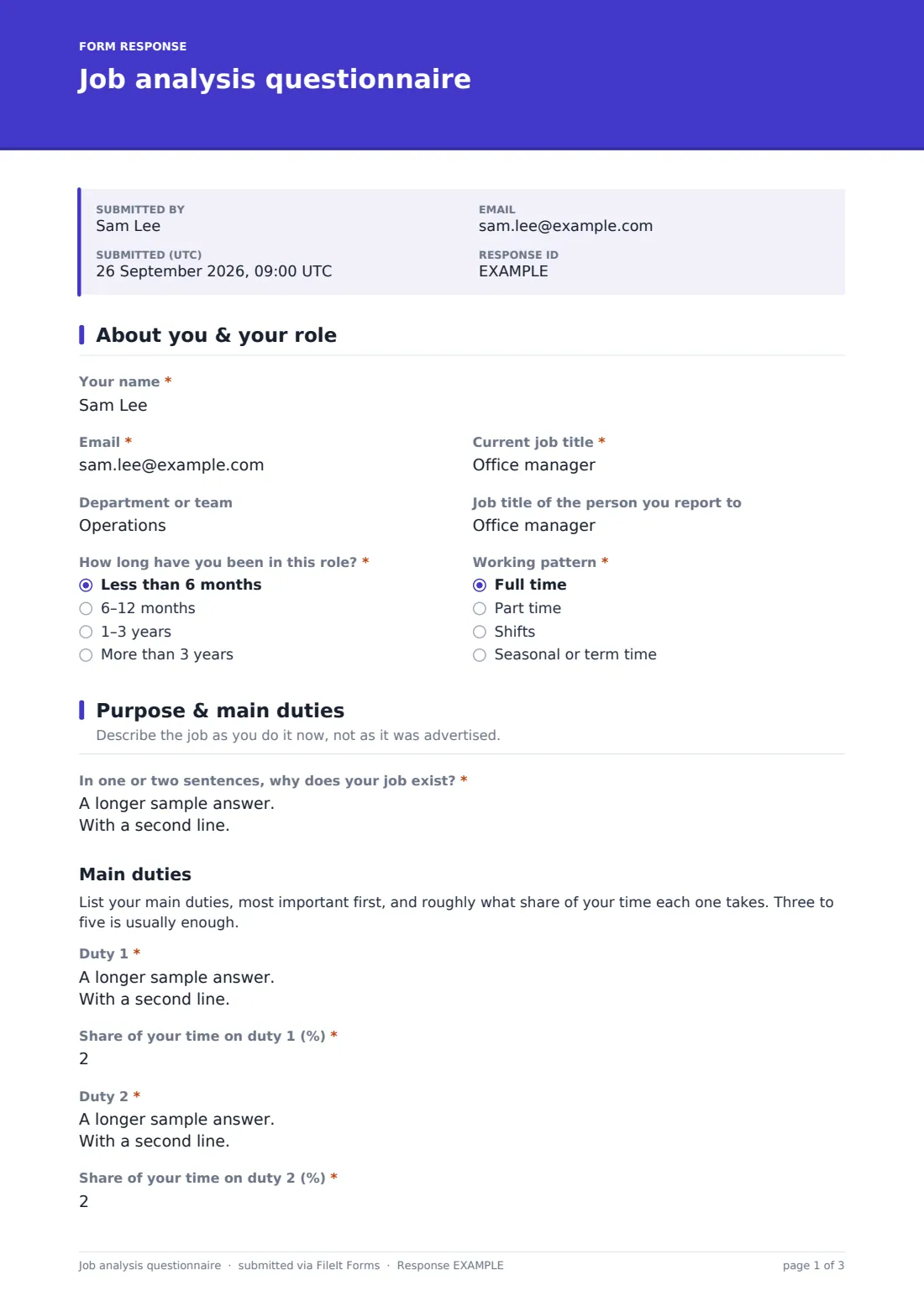
1 About you & your role
- Your name*
- Email*
- Current job title*
- Department or team
- Job title of the person you report to
- How long have you been in this role?* Less than 6 months · 6–12 months · 1–3 years · More than 3 years
- Working pattern* Full time · Part time · Shifts · Seasonal or term time
2 Purpose & main duties
- In one or two sentences, why does your job exist?*
- Duty 1*
- Share of your time on duty 1 (%)*
- Duty 2*
- Share of your time on duty 2 (%)*
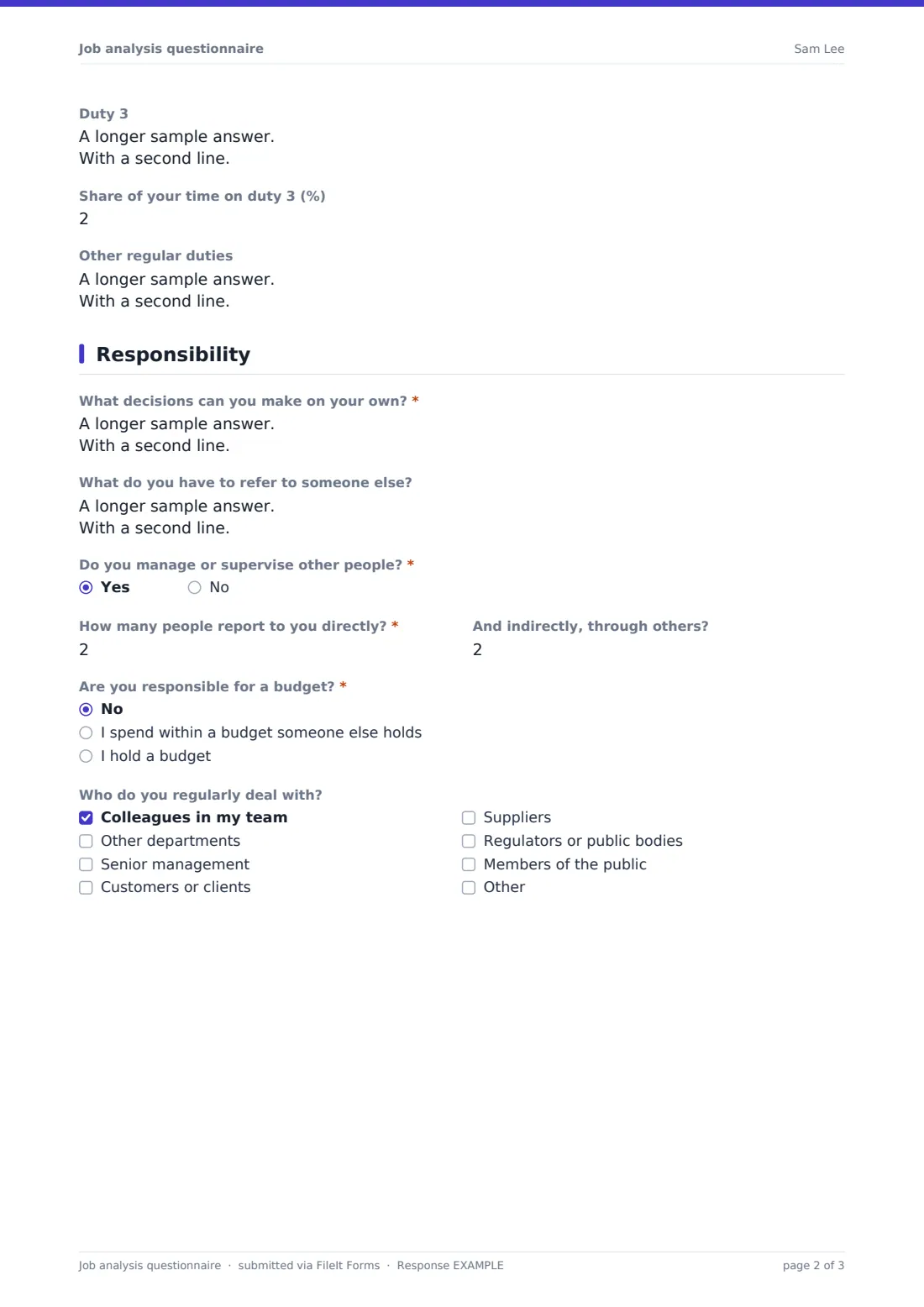
- Duty 3
- Share of your time on duty 3 (%) asked only when it applies
- Other regular duties
3 Responsibility
- What decisions can you make on your own?*
- What do you have to refer to someone else?
- Do you manage or supervise other people?*
- How many people report to you directly?* asked only when it applies
- And indirectly, through others? asked only when it applies
- Are you responsible for a budget?* No · I spend within a budget someone else holds · I hold a budget
- Approximate yearly budget you hold asked only when it applies
- Who do you regularly deal with? Colleagues in my team · Other departments · Senior management · Customers or clients · Suppliers · Regulators or public bodies · Members of the public
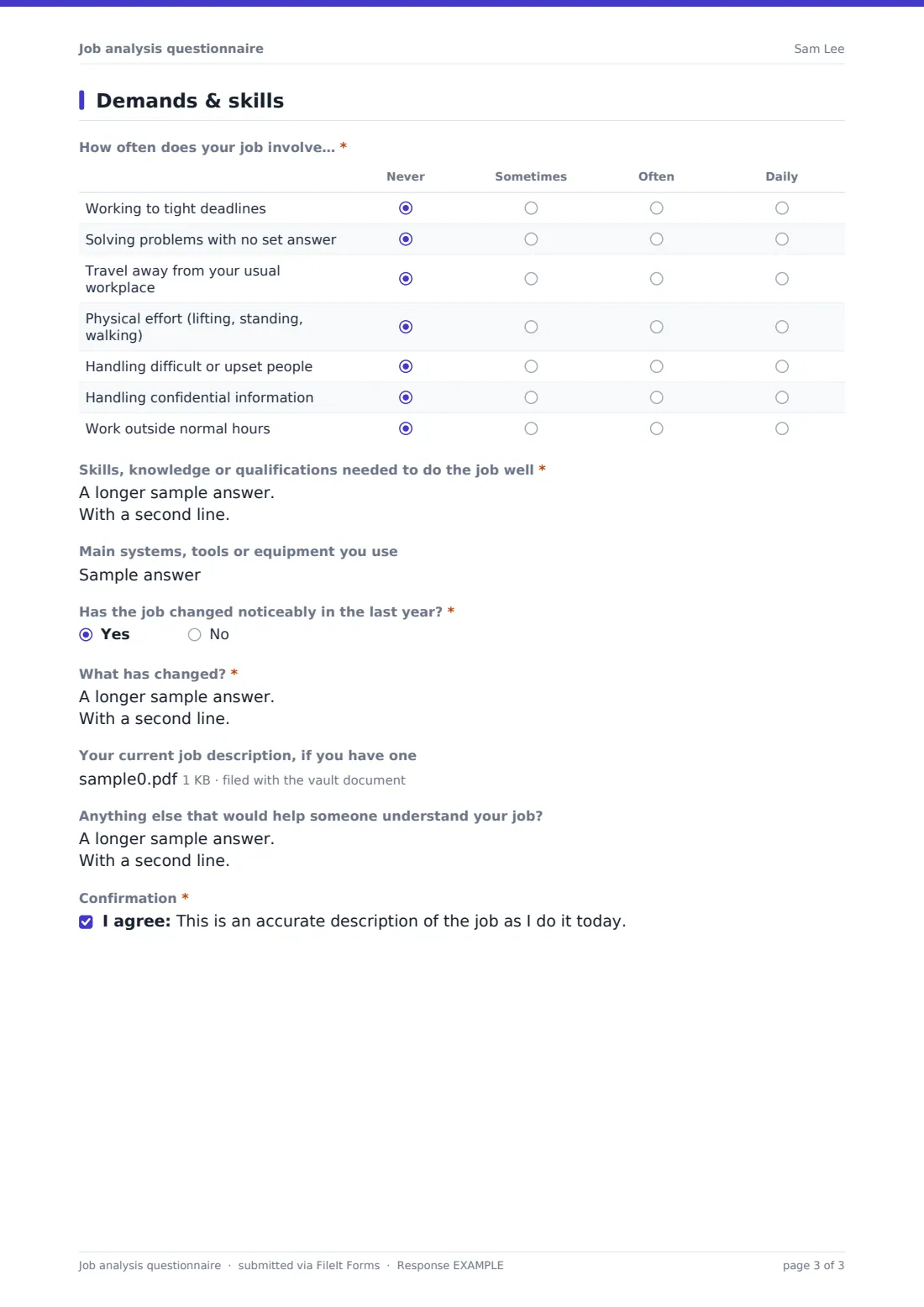
4 Demands & skills
- How often does your job involve…* Never · Sometimes · Often · Daily
- Skills, knowledge or qualifications needed to do the job well*
- Main systems, tools or equipment you use
- Has the job changed noticeably in the last year?*
- What has changed?* asked only when it applies
- Your current job description, if you have one
- Anything else that would help someone understand your job?
- Confirmation*
The job analysis questionnaire form, page by page
1 About you & your role
The employee gives their name, email, current job title, department or team, and the job title of the person they report to. Two short questions add context: how long they've been in the role and their working pattern, whether full time, part time, shifts, or seasonal or term time.
2 Purpose & main duties
The page opens with In one or two sentences, why does your job exist? Help text nudges people towards what would not get done without the role.
Under Main duties they list up to three duties, most important first, each with a Share of your time figure in percent. Duty 1 and Duty 2 are required. The time share for Duty 3 only appears once something is written in it, and an Other regular duties box catches the rest.
3 Responsibility
What decisions can you make on your own? is required, with examples such as approving spend or setting priorities. A follow-up asks what they have to refer to someone else. Answering Yes to Do you manage or supervise other people? opens two numbers: direct reports, and people managed indirectly through others.
A budget question offers three answers: no, spending within someone else's budget, or holding a budget. Only the last asks for the approximate yearly budget. A checklist records who they regularly deal with, from colleagues and other departments to customers, suppliers, regulators and the public.
4 Demands & skills
A grid asks how often the job involves tight deadlines, problems with no set answer, travel, physical effort, difficult or upset people, confidential information and work outside normal hours, from Never to Daily. The employee then describes the skills, knowledge or qualifications needed to do the job well, and the main systems or tools they use.
If the job has changed noticeably in the last year, a required box asks what changed. They can attach their current job description, add anything else that would help, and confirm the answers describe the job as they do it today.
Make the template yours
- Add rows to the demands grid that matter in your sector, such as night work or exposure to weather
- Change the budget currency to match where you operate
- Add a fourth or fifth duty if your roles tend to be broad
- Add a short manager's comments page so the line manager can confirm or add to the answers
- File responses into a folder per department or per project
Tips for a better job analysis questionnaire form
- Explain up front that this describes the job, not the person's performance
- Ask for the job as it is today, and capture planned changes separately
- Check that the time shares add up to roughly 100 percent before you rely on them
- Send the same form to everyone in similar roles so the answers can be compared
- Give people a few days, since good answers take some thought
Every response becomes a PDF in your vault
Each submission is filed as a PDF in the vault folder you picked, titled with the employee's name and the date, with any job description they uploaded attached to the document. The owner gets an email notification, and you can add HR colleagues to the notification list.
In the Responses table you can open each PDF, search for a job title or team, and export everything to CSV to compare duties, time shares and demands across similar roles.
- Start from this template. It opens in the FileIt Forms designer — change any question, add pages, set the rules for when questions appear.
- Share it. Turn on a public link, or send it to people by email, each with their own link. They don’t need a FileIt account.
- Get the answers as PDFs. Each response is saved as a PDF in the vault folder you choose, with uploaded files attached — and listed in a Responses table you can export to CSV.
Job analysis questionnaire form: frequently asked questions
What is a job analysis questionnaire?
It's a structured set of questions that asks someone what their job involves: its purpose, main duties, responsibilities, demands and the skills needed. The answers feed job descriptions, job evaluation and team planning.
Is this template free?
Yes. It's a starter template in the FileIt Forms app, and you can edit any question.
Should the employee or the manager fill it in?
It's written for the employee. Many organisations then share the PDF with the manager to review, or you can add a page for the manager's comments.
Can I send it to a whole department at once?
Yes. Send it by email to a list of people, each with their own link, and FileIt shows who has opened and submitted it. You can send reminders and set the requests to expire.
Will this grade the job for us?
No. The form collects information; how you evaluate or grade roles is up to your own process.
What if the job has changed a lot recently?
The form asks whether the job has changed noticeably in the last year and, if so, what changed, so recent growth is captured.