
What is the confined space entry permit form template?
A confined space entry permit authorises people to enter a tank, pit, manhole, silo, vault or similar space where the atmosphere or layout could trap or overcome them. This template identifies the space and purpose, lists the hazards, confirms isolation and ventilation, records the gas detector and pre-entry readings for oxygen, flammables, H2S and CO, names the entrants, attendant and supervisor, and sets out the rescue arrangements before the issuer signs.
Confined space permits are only useful if every section is completed before entry. A paper permit can be signed with blanks in it. This form requires the readings, the attendant, the equipment and the rescue plan, and shows a clear stop message if the readings aren't acceptable.
It runs on FileIt's Forms app, included on every FileIt account. The entry supervisor fills it in at the entry point from a phone or tablet, and each permit becomes a PDF in your vault under the site.
- Best for
- Water and wastewater, utilities, manufacturing, agriculture and maintenance contractors
- Filled in by
- The entry supervisor or permit issuer
- Time to complete
- About 10–15 minutes before entry, plus close-out
- Includes
- Hazard checklist, isolation matrix, gas readings, rescue plan, signature, close-out
Who uses a confined space entry permit form?
- Entering a wet well or pump station sump for maintenance
- Cleaning or inspecting the inside of a tank or vessel
- Working in a sewer, manhole or utility vault
- Clearing a blockage in a silo or hopper
- Inspection work in ducts, tunnels or crawl spaces
- Keeping a register of every confined space entry at a site
Questions on this confined space entry permit form
36 questions over 5 pages · includes signature, conditional questions, multiple pages, consent checkbox, ratings.
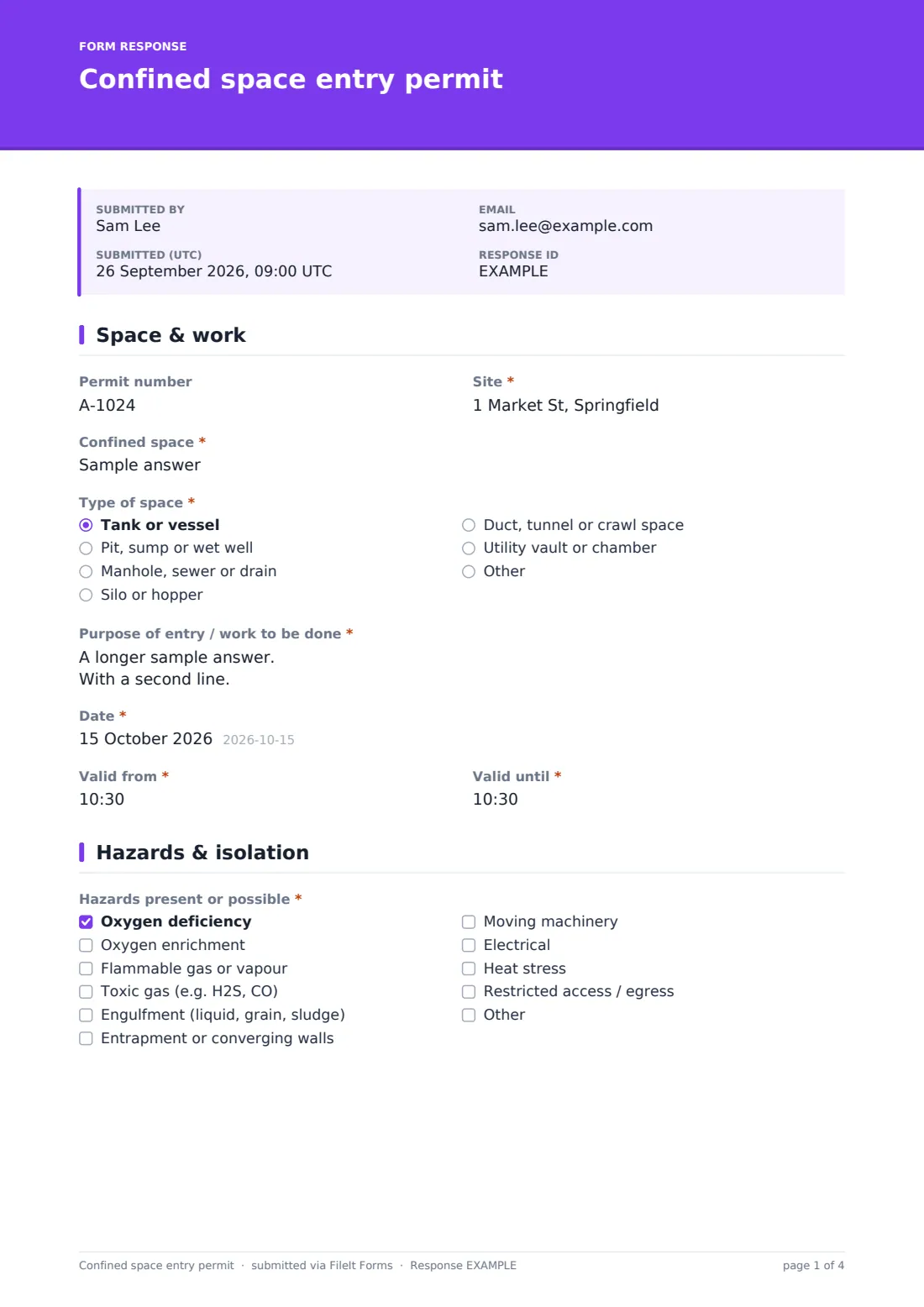
1 Space & work
- Permit number
- Site*
- Confined space*
- Type of space* Tank or vessel · Pit, sump or wet well · Manhole, sewer or drain · Silo or hopper · Duct, tunnel or crawl space · Utility vault or chamber · Other
- Purpose of entry / work to be done*
- Date*
- Valid from*
- Valid until*
2 Hazards & isolation
- Hazards present or possible* Oxygen deficiency · Oxygen enrichment · Flammable gas or vapour · Toxic gas (e.g. H2S, CO) · Engulfment (liquid, grain, sludge) · Entrapment or converging walls · Moving machinery · Electrical · Heat stress · Restricted access / egress
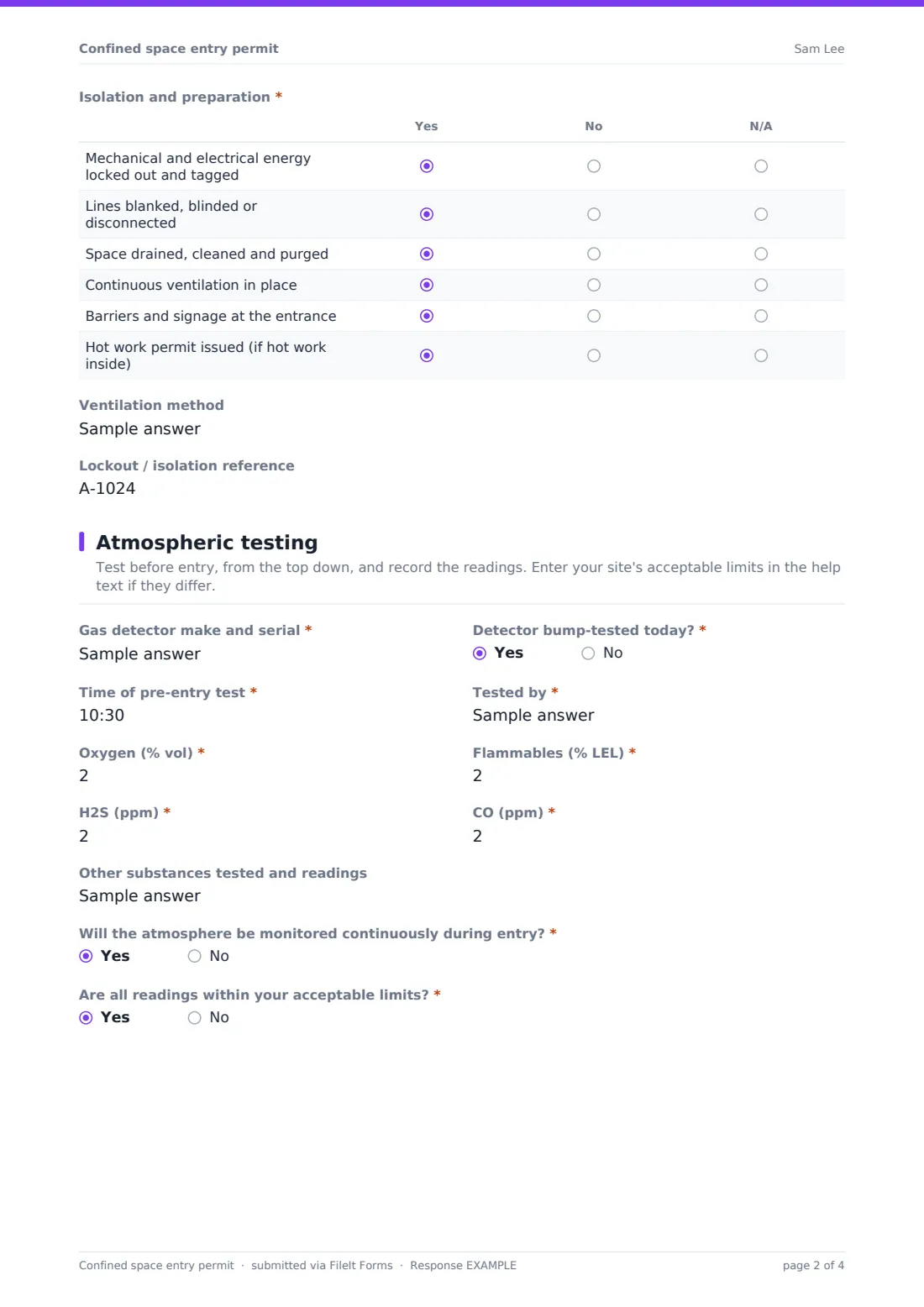
- Isolation and preparation* Yes · No · N/A
- Ventilation method
- Lockout / isolation reference
3 Atmospheric testing
- Gas detector make and serial*
- Detector bump-tested today?*
- Time of pre-entry test*
- Tested by*
- Oxygen (% vol)*
- Flammables (% LEL)*
- H2S (ppm)*
- CO (ppm)*
- Other substances tested and readings
- Will the atmosphere be monitored continuously during entry?*
- Are all readings within your acceptable limits?*
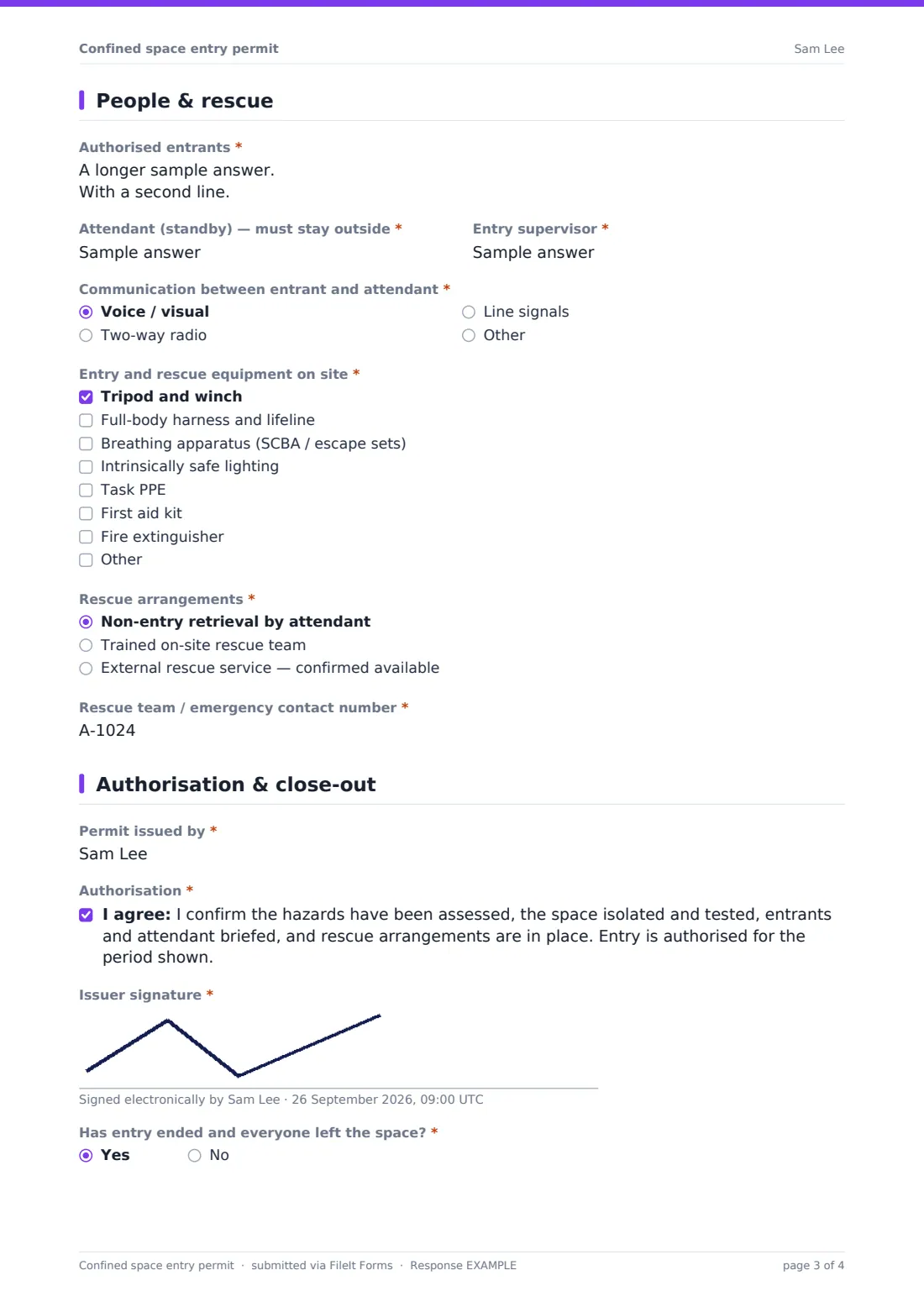
4 People & rescue
- Authorised entrants*
- Attendant (standby) — must stay outside*
- Entry supervisor*
- Communication between entrant and attendant* Voice / visual · Two-way radio · Line signals
- Entry and rescue equipment on site* Tripod and winch · Full-body harness and lifeline · Breathing apparatus (SCBA / escape sets) · Intrinsically safe lighting · Task PPE · First aid kit · Fire extinguisher
- Rescue arrangements* Non-entry retrieval by attendant · Trained on-site rescue team · External rescue service — confirmed available
- Rescue team / emergency contact number*
5 Authorisation & close-out
- Permit issued by*
- Authorisation*
- Issuer signature*
- Has entry ended and everyone left the space?*
- Permit closed at* asked only when it applies
- Close-out notes
The confined space entry permit form, page by page
1 Space & work
Permit number, site, the space itself and its type, the purpose of entry, and the date and valid-from and valid-until times define the permit.
2 Hazards & isolation
A checklist covers oxygen deficiency and enrichment, flammable and toxic gases, engulfment, entrapment, machinery, electrical, heat and restricted access. A matrix confirms energy is locked out, lines blanked, the space drained and purged, ventilation running, the entrance barriered, and a hot work permit issued if needed. Ventilation method and a lockout reference are recorded.
3 Atmospheric testing
The detector make and serial, a bump-test confirmation, test time and tester come first. Readings for oxygen, flammables as % LEL, H2S and CO are required, with space for other substances. The supervisor confirms whether monitoring will be continuous and whether readings are within acceptable limits — answering no shows a do-not-enter message.
4 People & rescue
Authorised entrants are listed, and the attendant and entry supervisor named. The communication method, entry and rescue equipment on site, the rescue arrangement — non-entry retrieval, an on-site team or a confirmed external service — and a rescue contact number complete the page.
5 Authorisation & close-out
The issuer names themselves, confirms the authorisation statement and signs. When entry ends, a yes asks for the time the permit closed, with notes on isolations handed back or anything that happened during entry.
Make the template yours
- Put your own acceptable atmospheric limits in the help text for each reading
- Add fields for periodic re-test readings during long entries
- Add a list of your permit-required spaces as a dropdown
- Add signatures for each entrant and the attendant
- Send every permit to your safety manager's address
- File permits into a folder per site
Tips for a better confined space entry permit form
- Test the atmosphere at the top, middle and bottom of the space — gases layer
- Bump-test the detector every day it's used
- The attendant never enters to attempt a rescue
- Confirm external rescue services are actually available before relying on them
- Keep ventilation running for the whole entry
- Close the permit as soon as everyone is out and the space is secured
Every response becomes a PDF in your vault
The permit is saved as a PDF titled with the date and filed in the vault folder you chose. You're notified and the issuer gets a copy for the entry point.
Every permit appears in the Responses table, where you can review readings across entries and export to CSV for audits.
- Start from this template. It opens in the FileIt Forms designer — change any question, add pages, set the rules for when questions appear.
- Share it. Turn on a public link, or send it to people by email, each with their own link. They don’t need a FileIt account.
- Get the answers as PDFs. Each response is saved as a PDF in the vault folder you choose, with uploaded files attached — and listed in a Responses table you can export to CSV.
Confined space entry permit form: frequently asked questions
Is this confined space entry permit template free?
Yes. It's included with the Forms app on every FileIt account, including the free plan.
Does it meet OSHA 1910.146 or other confined space regulations?
FileIt doesn't give legal or compliance advice. The permit covers common elements of confined space entry, but you must check it against the regulations that apply to you and adjust it.
Are the atmospheric limits built in?
The help text shows commonly used values for oxygen and flammables. The form doesn't block entry by itself — the supervisor confirms whether readings meet your own limits.
Can I record repeat gas tests during entry?
The template records the pre-entry test and whether monitoring is continuous. Add more reading fields in the designer for timed re-tests.
Does the supervisor need a FileIt account?
No. They fill it in from the link you share.
Can entrants sign the permit?
The template has an issuer signature. Add signature fields for entrants and the attendant in the designer if you need them.
Can I keep a register of entries?
Yes. Every permit is listed in the Responses table and can be exported to CSV.