What is the stay interview form template?
Exit interviews tell you why someone left, after it's too late to change anything. A stay interview asks similar questions of the people who are still with you — what they enjoy, what frustrates them, what would tempt them elsewhere — while there's still time to act on the answers.
This stay interview template gives managers a consistent structure for that conversation. It opens with the basics, moves through what keeps the employee here (including a satisfaction grid across eight areas of their job), then the harder questions about leaving, and closes with growth goals, the one thing they'd change, and the actions you both agreed.
Every completed interview is saved as a PDF in your FileIt vault, so managers and HR can look back at what was said and check that agreed actions actually happened before the next conversation.
- Best for
- Managers and HR teams working on retention and engagement
- Filled in by
- The manager, during or straight after a one-to-one with the employee
- Time to complete
- About 10 minutes of form-filling for a 30-45 minute conversation
- Includes
- A satisfaction grid, a likelihood-to-stay scale, follow-ups on leaving, and a manager-only risk rating
Who uses a stay interview form?
- A manager holding stay interviews with each team member once a year
- HR running a round of stay interviews after an engagement survey showed low scores
- A small business owner checking in with key staff before a busy season
- A new manager getting to know an inherited team and what matters to each person
- A people team comparing themes across departments to decide where to invest
- A manager following up on an employee who has seemed less engaged lately
Questions on this stay interview form
23 questions over 4 pages · includes conditional questions, multiple pages, ratings.
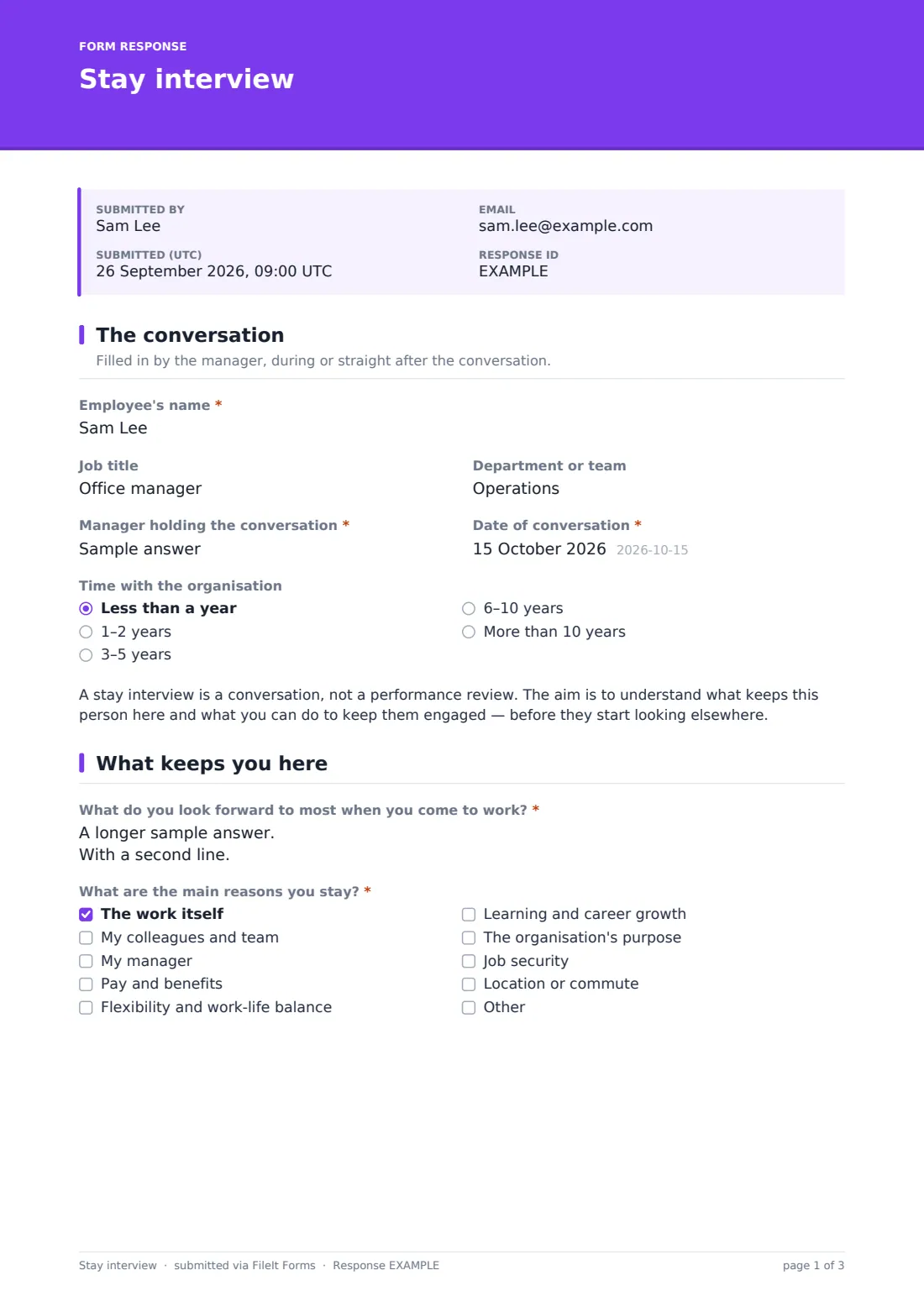
1 The conversation
- Employee's name*
- Job title
- Department or team
- Manager holding the conversation*
- Date of conversation*
- Time with the organisation Less than a year · 1–2 years · 3–5 years · 6–10 years · More than 10 years
2 What keeps you here
- What do you look forward to most when you come to work?*
- What are the main reasons you stay?* The work itself · My colleagues and team · My manager · Pay and benefits · Flexibility and work-life balance · Learning and career growth · The organisation's purpose · Job security · Location or commute
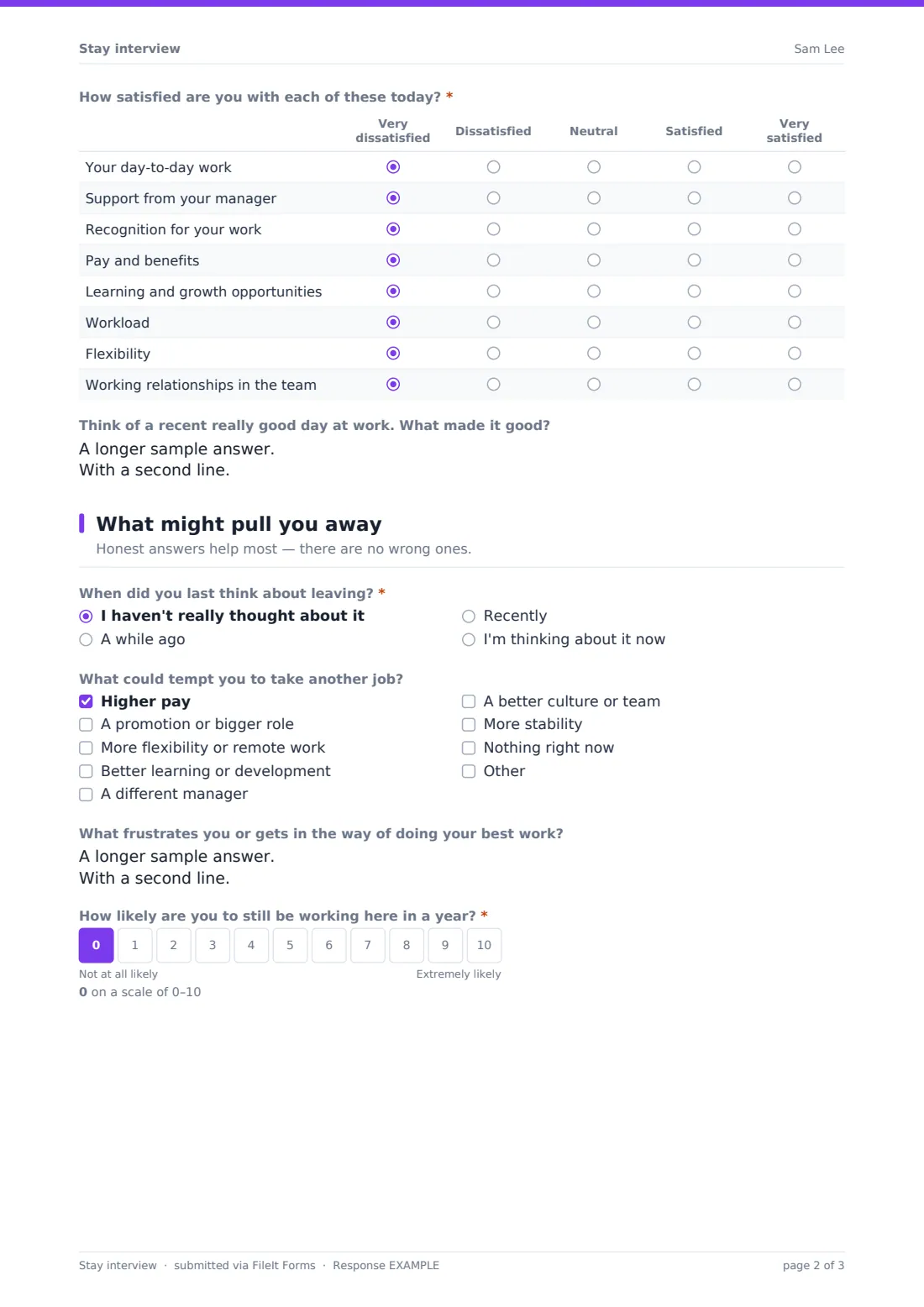
- How satisfied are you with each of these today?* Very dissatisfied · Dissatisfied · Neutral · Satisfied · Very satisfied
- Think of a recent really good day at work. What made it good?
3 What might pull you away
- When did you last think about leaving?* I haven't really thought about it · A while ago · Recently · I'm thinking about it now
- What prompted that?* asked only when it applies
- What could tempt you to take another job? Higher pay · A promotion or bigger role · More flexibility or remote work · Better learning or development · A different manager · A better culture or team · More stability · Nothing right now
- What frustrates you or gets in the way of doing your best work?
- How likely are you to still be working here in a year?*
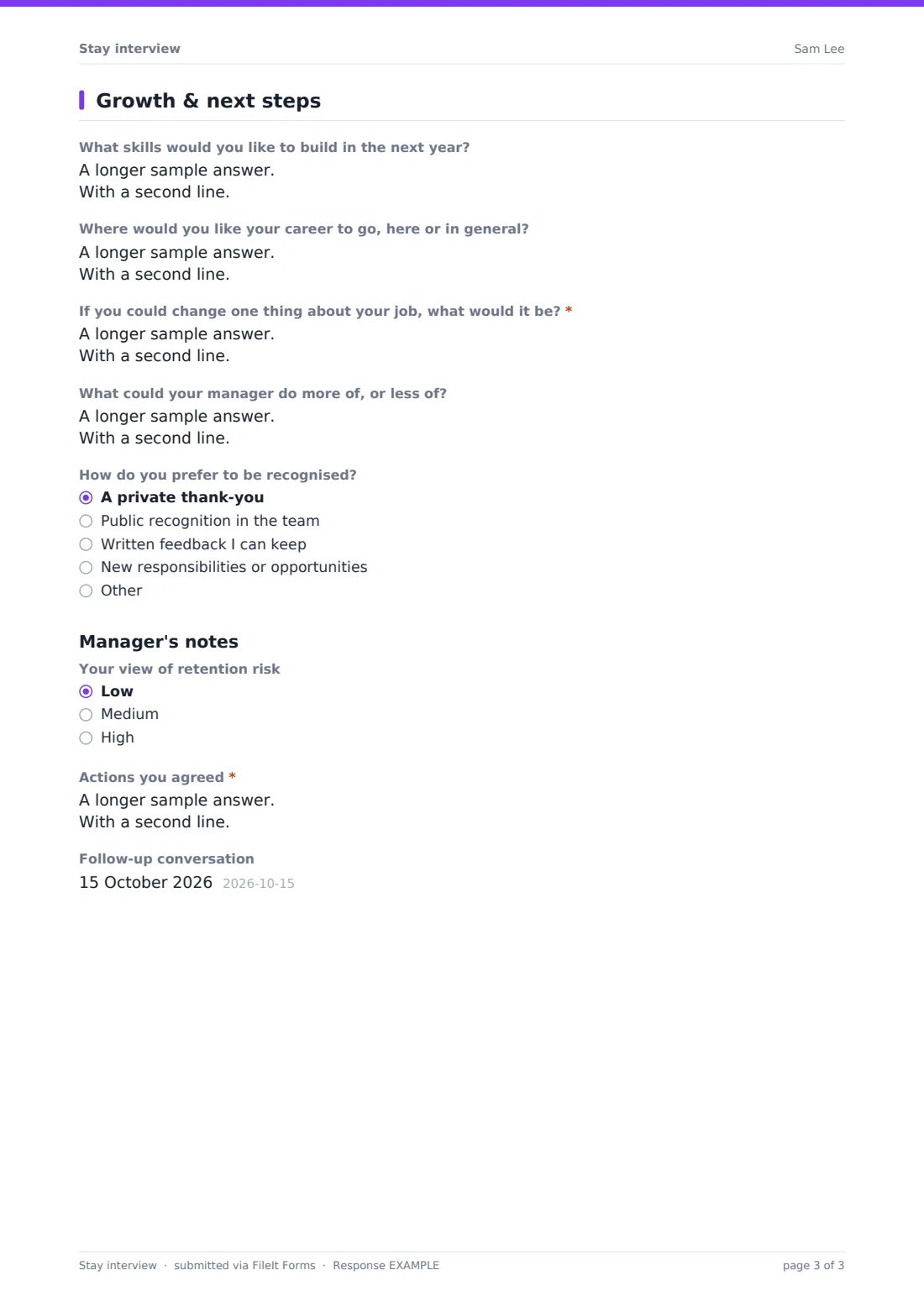
4 Growth & next steps
- What skills would you like to build in the next year?
- Where would you like your career to go, here or in general?
- If you could change one thing about your job, what would it be?*
- What could your manager do more of, or less of?
- How do you prefer to be recognised? A private thank-you · Public recognition in the team · Written feedback I can keep · New responsibilities or opportunities
- Your view of retention risk Low · Medium · High
- Actions you agreed*
- Follow-up conversation
The stay interview form, page by page
1 The conversation
The manager records the Employee's name, job title, department or team, their own name, the date and the employee's time with the organisation. A short note reminds them that a stay interview is a conversation rather than a performance review — its purpose is to understand what keeps this person engaged.
2 What keeps you here
The first question — what the employee looks forward to most when they come to work — is deliberately positive. A required checklist of the main reasons they stay follows, from the work itself and colleagues to pay, flexibility, growth, purpose, job security and location, with space for anything else.
A satisfaction grid rates eight areas on a five-point scale: day-to-day work, manager support, recognition, pay and benefits, learning and growth, workload, flexibility and team relationships. A final question asks about a recent really good day at work, which often surfaces what actually motivates someone better than a rating does.
3 What might pull you away
When did you last think about leaving? offers four honest answers, from not really to right now; anything other than the first reveals a required box asking what prompted it. A checklist covers what could tempt them to another job, including higher pay, promotion, flexibility, development, a different manager or culture, stability, or nothing right now.
The page also asks what gets in the way of their best work, and ends with a 0-10 scale: how likely they are to still be working here in a year.
4 Growth & next steps
The employee shares skills they'd like to build, where they'd like their career to go, the one thing they'd change about their job, what their manager could do more or less of, and how they prefer to be recognised.
The Manager's notes section has a Retention risk rating (low, medium or high), marked as manager only, plus a required Actions you agreed box and a follow-up date so the conversation leads somewhere.
Make the template yours
- Trim the questions if you plan short, frequent check-ins rather than a longer annual conversation
- Replace the satisfaction rows with the areas your last engagement survey flagged
- Remove the retention risk rating if you'd rather the whole record be shareable with the employee
- Route completed interviews to a private HR folder rather than a shared team folder
- Add a question about specific benefits or programmes you're considering introducing
- Send the form to managers with personal links so each one records their own team's interviews
Tips for a better stay interview form
- Tell the employee in advance what the conversation is for, so it doesn't feel like a warning sign
- Listen more than you talk — the form is a guide, not a script to read out
- Don't promise things you can't deliver; agree on actions you actually control
- Follow up on the agreed actions before the next conversation, or trust drops quickly
- Think carefully about who can see the manager's retention risk rating before you use it
- Look for patterns across several interviews rather than reacting to one answer
Every response becomes a PDF in your vault
Once the manager submits the form, FileIt saves the interview as a PDF in your vault, dated and named after the employee. With notifications on, HR can be told each time an interview is recorded.
The Responses table lets HR see every stay interview in one place and export the answers — including the satisfaction grid and likelihood-to-stay score — to a CSV to spot themes across teams. The agreed actions and follow-up date on each PDF make it easy to prepare for the next conversation.
- Start from this template. It opens in the FileIt Forms designer — change any question, add pages, set the rules for when questions appear.
- Share it. Turn on a public link, or send it to people by email, each with their own link. They don’t need a FileIt account.
- Get the answers as PDFs. Each response is saved as a PDF in the vault folder you choose, with uploaded files attached — and listed in a Responses table you can export to CSV.
Stay interview form: frequently asked questions
What is a stay interview?
It's a structured conversation with a current employee about what keeps them in their job, what might make them leave and what would make their work better — the opposite of an exit interview, held while you can still act.
Who fills in this form, the manager or the employee?
It's designed for the manager to complete during or straight after the conversation. If you'd rather employees answer some questions beforehand, duplicate the form and remove the manager's notes section for their copy.
Is the employee's answer about leaving shared with anyone?
The form only records what's said. Who can open the PDFs depends on which vault folder you route them to and who has access to it, so choose a folder with appropriate privacy.
How often should we hold stay interviews?
Many teams hold them once or twice a year, separate from performance reviews. The form works the same whichever rhythm you choose.
Is this stay interview template free?
Yes. It's included as a starter template in the FileIt Forms app, and every question can be edited.
Can we compare answers across the whole company?
Yes. Export the responses to a CSV from the Responses table to compare satisfaction ratings, reasons for staying and likelihood-to-stay scores across teams.