What is the career development plan form template?
Career conversations often go well in the moment and then disappear: the employee said they'd like to lead a team one day, the manager suggested a course, and six months later neither can remember exactly what was agreed. Without a written plan, development depends on who has the better memory.
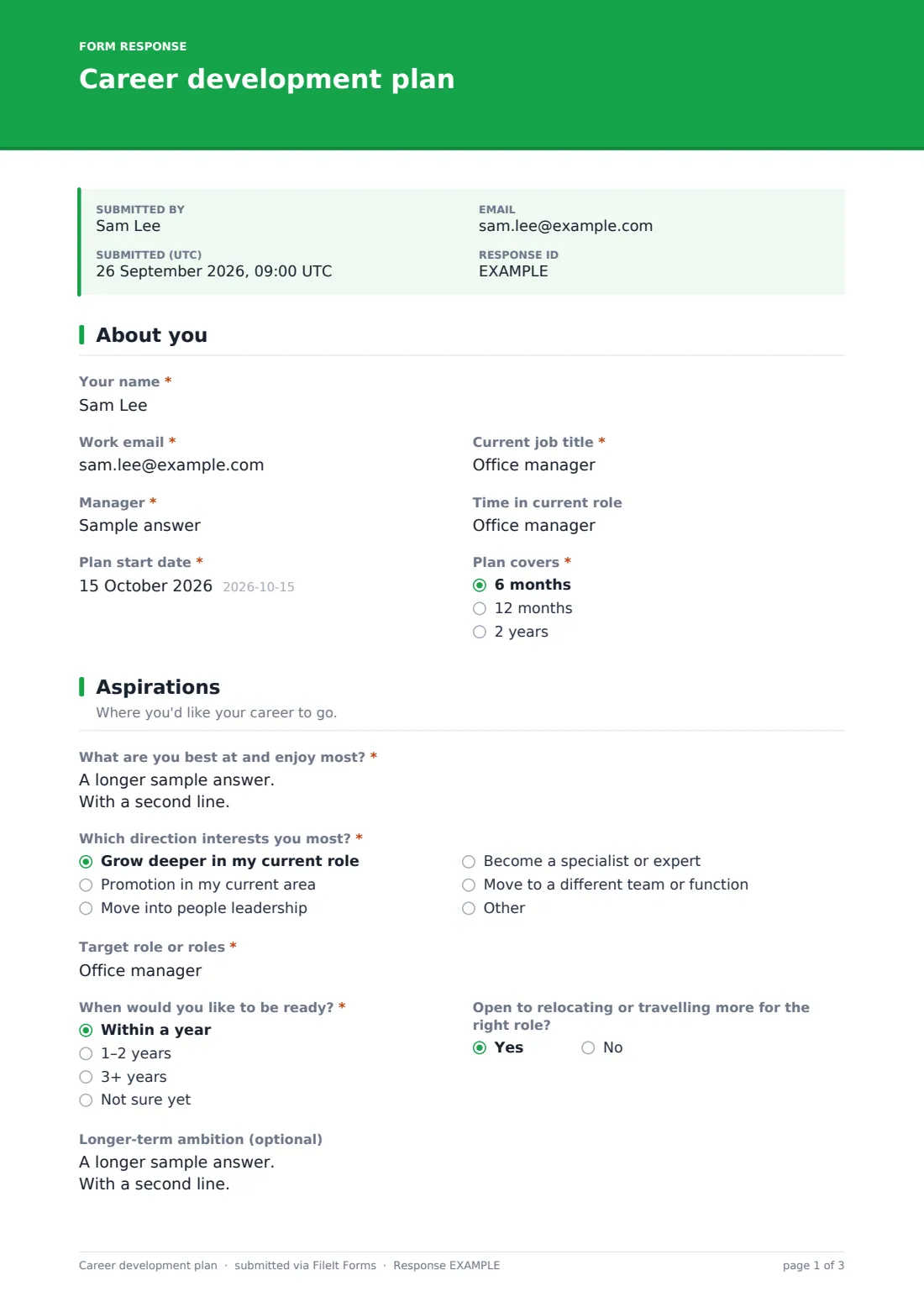
This template guides an employee and manager through a complete plan. It starts with the employee's role, manager and the period the plan covers, then captures strengths, preferred direction — deeper in the current role, promotion, people leadership, specialist or a move — target roles and timeframe. A six-row grid rates current skills from developing to expert, and the employee names the top three to build.
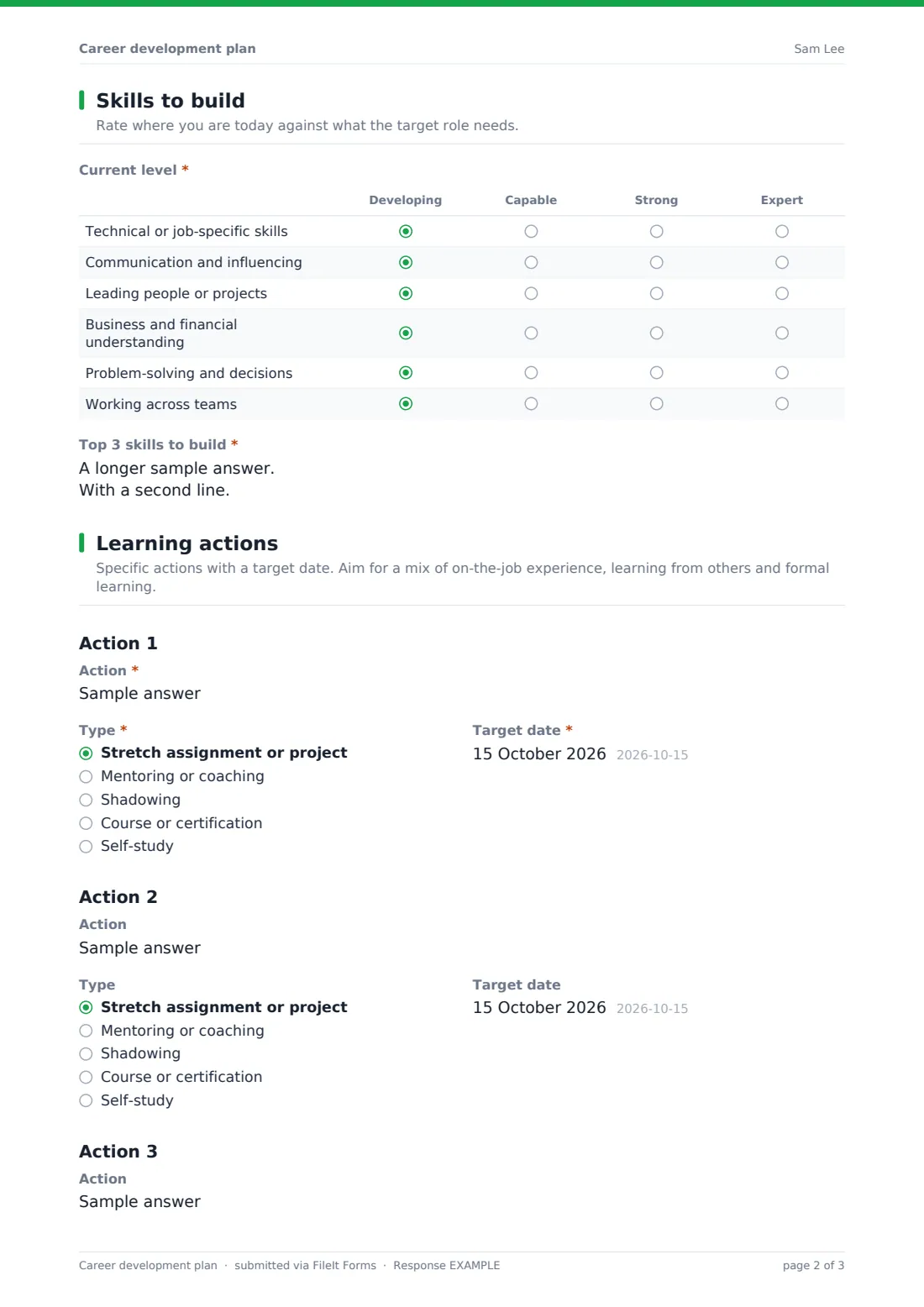
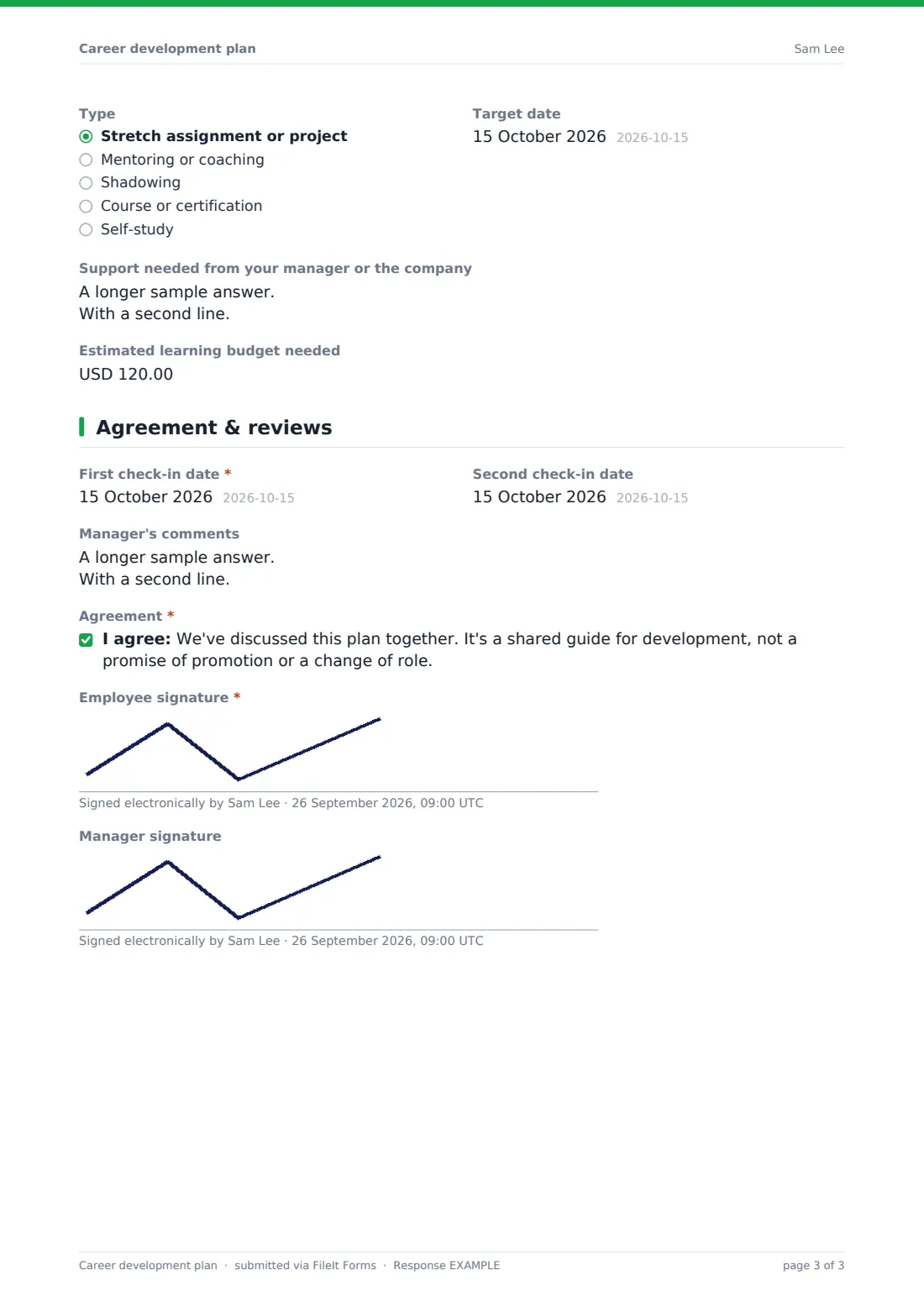
Up to three learning actions each have a type and target date, followed by the support and budget needed. The plan ends with check-in dates, manager comments, an agreement that it isn't a promise of promotion, and signatures from both. Every plan is saved as a PDF in your FileIt vault.
- Best for
- Employees, line managers and learning teams
- Filled in by
- The employee, with their manager
- Time to complete
- About 15 minutes after a career conversation
- Includes
- Direction and target role, skills grid, three dated actions, budget, check-ins and two signatures
Who uses a career development plan form?
- Following up an annual review with a written development plan
- Supporting a high-potential employee preparing for a first leadership role
- Planning a lateral move into a different function
- Recording a graduate's growth plan during a rotation program
- Giving a specialist a path to grow without managing people
- Learning teams collecting plans to forecast training budgets
Questions on this career development plan form
32 questions over 5 pages · includes signature, multiple pages, consent checkbox, ratings.
1 About you
- Your name*
- Work email*
- Current job title*
- Manager*
- Time in current role
- Plan start date*
- Plan covers* 6 months · 12 months · 2 years
2 Aspirations
- What are you best at and enjoy most?*
- Which direction interests you most?* Grow deeper in my current role · Promotion in my current area · Move into people leadership · Become a specialist or expert · Move to a different team or function
- Target role or roles*
- When would you like to be ready?* Within a year · 1–2 years · 3+ years · Not sure yet
- Open to relocating or travelling more for the right role?
- Longer-term ambition (optional)
3 Skills to build
- Current level* Developing · Capable · Strong · Expert
- Top 3 skills to build*
4 Learning actions
- Action*
- Type* Stretch assignment or project · Mentoring or coaching · Shadowing · Course or certification · Self-study
- Target date*
- Action
- Type Stretch assignment or project · Mentoring or coaching · Shadowing · Course or certification · Self-study
- Target date
- Action
- Type Stretch assignment or project · Mentoring or coaching · Shadowing · Course or certification · Self-study
- Target date
- Support needed from your manager or the company
- Estimated learning budget needed
5 Agreement & reviews
- First check-in date*
- Second check-in date
- Manager's comments
- Agreement*
- Employee signature*
- Manager signature
The career development plan form, page by page
1 About you
The employee gives Your name, Work email, Current job title, Manager, Time in current role, Plan start date and whether the plan covers six months, a year or two years.
2 Aspirations
They describe what they're best at and enjoy most, then choose a direction: grow deeper in the current role, promotion, people leadership, specialist or expert, a move to a different team, or something else. Target role or roles, When would you like to be ready?, openness to relocating or travelling and an optional longer-term ambition complete the page.
3 Skills to build
A grid rates six areas — technical skills, communication and influencing, leading people or projects, business understanding, problem-solving and working across teams — from developing to expert. The employee then lists their top three skills to build.
4 Learning actions
Three action blocks each ask for the Action, its Type (stretch assignment, mentoring, shadowing, course or self-study) and a Target date; only the first is required. The page closes with the support needed from the manager or company and an estimated learning budget.
5 Agreement & reviews
The plan sets a first check-in date and an optional second, has room for the manager's comments, and ends with an agreement that the plan is a shared guide rather than a promise of promotion, plus the employee's signature and the manager's.
Make the template yours
- Replace the skills grid rows with your organisation's competency framework
- Change the budget currency or remove the budget question if learning is centrally funded
- Add more action blocks for longer plans
- Link to your internal learning catalogue in the Learning actions page description
- Route plans into a vault folder per department so managers can find their team's plans
- Send personal links pre-filled with each employee's name and email during review season
Tips for a better career development plan form
- Have the conversation first and fill in the form together, rather than sending it cold
- Favour on-the-job experience; courses work best when paired with a chance to use the skill
- Keep each action small enough to finish before the next check-in
- Put the check-in dates in both calendars as soon as the plan is signed
- Revisit the target role if the business or the employee's interests change
- Be clear that a plan improves readiness, not that it guarantees the next role
Every response becomes a PDF in your vault
The signed plan is saved as a PDF in your vault and, with copies on, emailed to the employee. Notifications can alert HR or the learning team when a new plan arrives.
From the Responses table HR can export plans to a CSV to total requested learning budget, see common skills gaps across teams and follow up on check-in dates.
- Start from this template. It opens in the FileIt Forms designer — change any question, add pages, set the rules for when questions appear.
- Share it. Turn on a public link, or send it to people by email, each with their own link. They don’t need a FileIt account.
- Get the answers as PDFs. Each response is saved as a PDF in the vault folder you choose, with uploaded files attached — and listed in a Responses table you can export to CSV.
Career development plan form: frequently asked questions
Is this career development plan template free?
Yes. It's part of the FileIt Forms app on every plan, including the free plan.
Who fills it in — the employee or the manager?
Both. The employee completes most of it, the manager adds comments, and each can sign.
Does the manager have to sign?
The employee's signature is required and the manager's is optional, so a plan can be saved even if the manager signs later on paper.
Can we use our own competency framework?
Yes. Edit the skills grid rows to match your framework's competencies.
Is the plan a promise of promotion?
No. The agreement both people confirm says it's a shared guide for development, not a promise of promotion or a change of role.
How do we track progress?
Use the check-in dates and the dated actions. Many teams fill in a new plan at each check-in, keeping earlier versions in the vault.