What is the succession planning profile form template?
Most organisations know which roles they couldn't do without, but very few have written down who would step in, how ready they are, and what they still need to learn. When a key person leaves at short notice, that knowledge lives only in one leader's head — if it exists at all.
This template gives managers a consistent profile for each key role. They describe the role, the current holder and their time in role, how critical it is and how likely it is to become vacant in the next two years, then list the skills and relationships that would be hardest to replace. For up to three successors they record current role, readiness (now, one to two years, or three plus), development gaps, flight risk and whether a career conversation has happened.
The last page names short-notice emergency cover, whether key processes are documented, overall bench strength, agreed development actions and the next review date. Profiles are saved as PDFs in your FileIt vault, ready for a talent review.
- Best for
- Leadership teams and HR running talent reviews
- Filled in by
- The manager responsible for the key role
- Time to complete
- About 10 minutes per role
- Includes
- Criticality and vacancy risk, three successor blocks, emergency cover, bench strength and confidentiality
Who uses a succession planning profile form?
- A leadership team preparing for an annual talent review
- A family business planning for an owner's or director's retirement
- A hospital department covering specialist roles with long training times
- A board asking for evidence of succession cover for senior roles
- A growing company spotting roles held by one person with no backup
- An HR team building development plans for high-potential staff
Questions on this succession planning profile form
36 questions over 3 pages · includes conditional questions, multiple pages, consent checkbox.
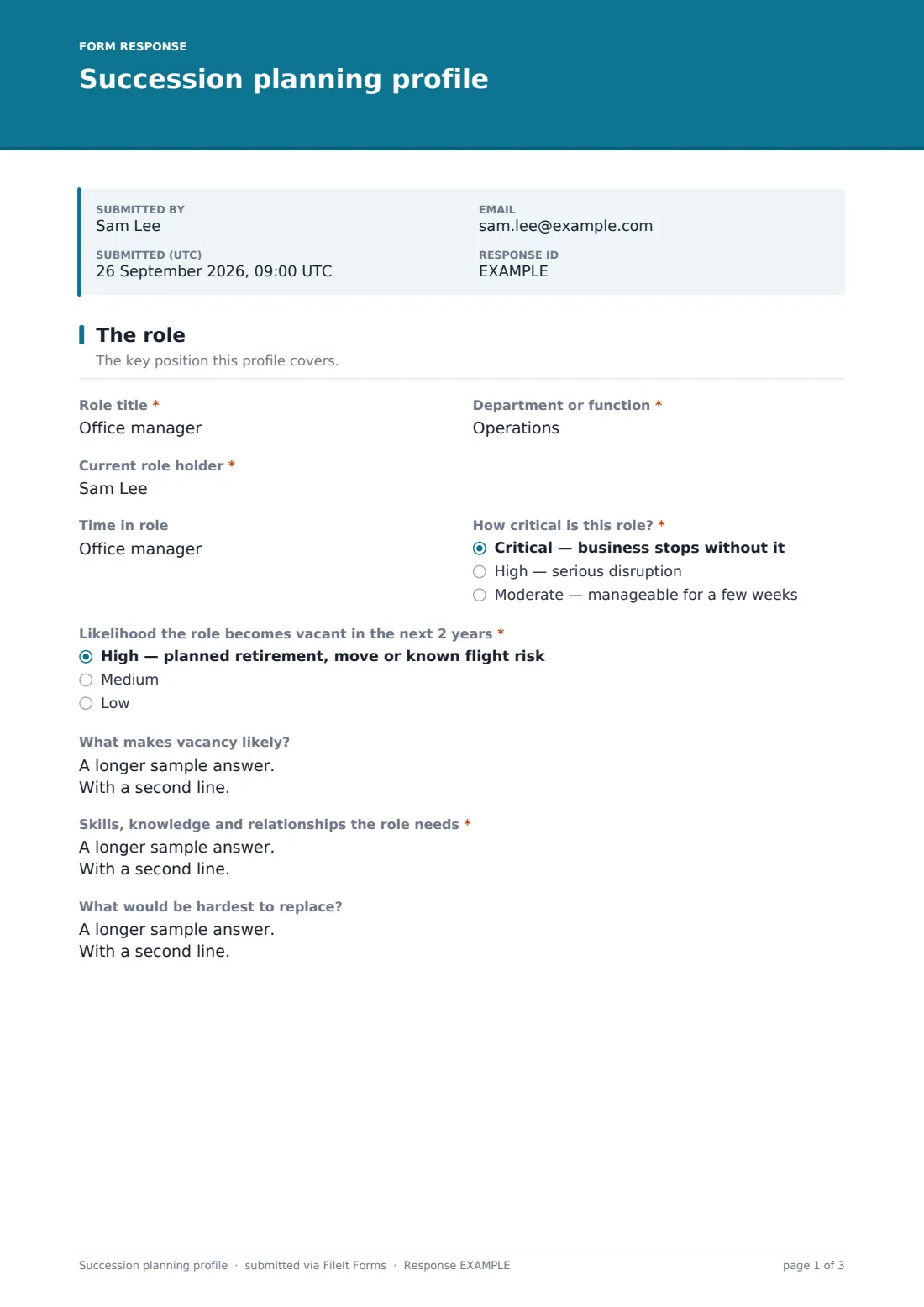
1 The role
- Role title*
- Department or function*
- Current role holder*
- Time in role
- How critical is this role?* Critical — business stops without it · High — serious disruption · Moderate — manageable for a few weeks
- Likelihood the role becomes vacant in the next 2 years* High — planned retirement, move or known flight risk · Medium · Low
- What makes vacancy likely? asked only when it applies
- Skills, knowledge and relationships the role needs*
- What would be hardest to replace?
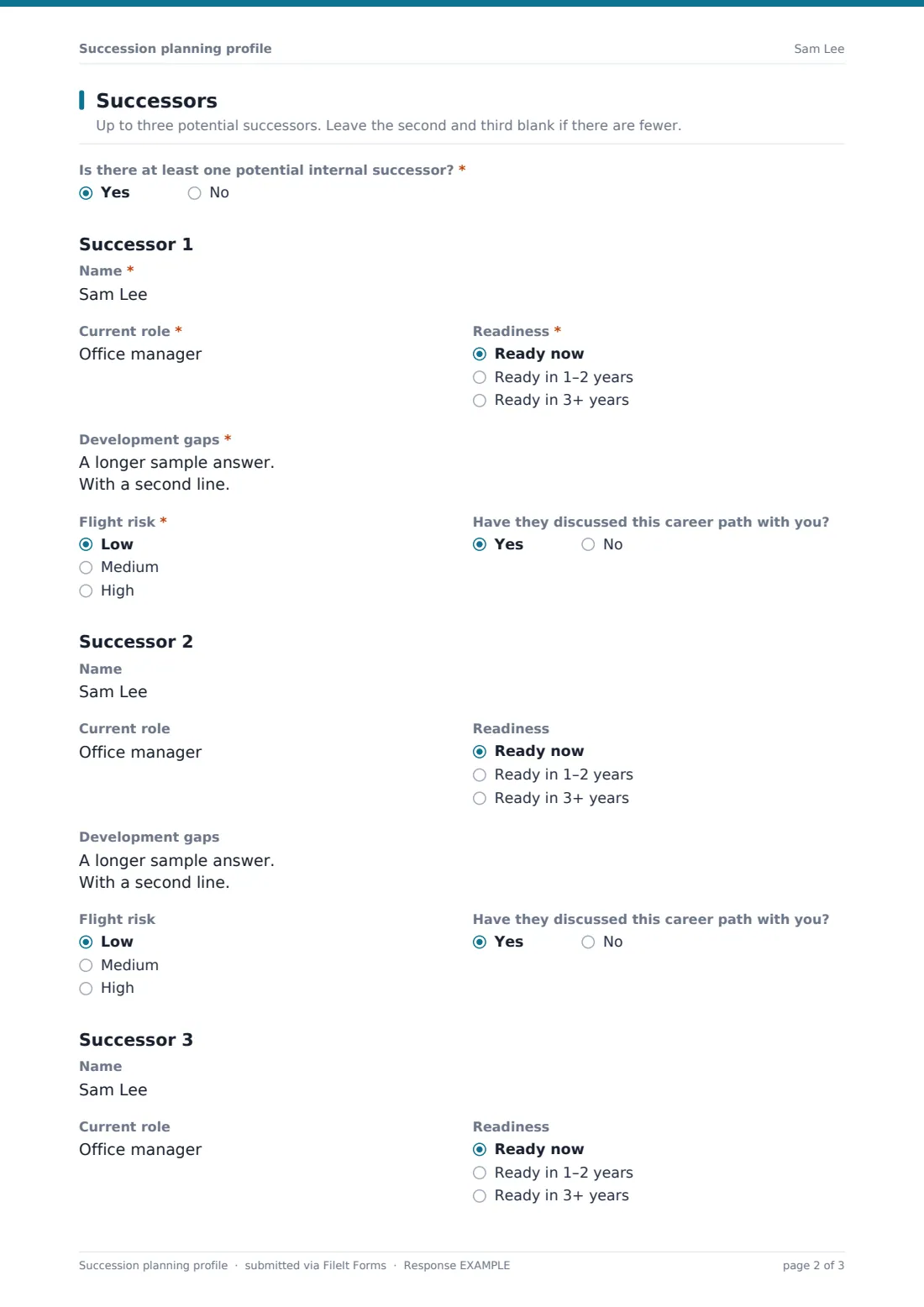
2 Successors
- Is there at least one potential internal successor?*
- Name* asked only when it applies
- Current role* asked only when it applies
- Readiness* asked only when it applies Ready now · Ready in 1–2 years · Ready in 3+ years
- Development gaps* asked only when it applies
- Flight risk* asked only when it applies Low · Medium · High
- Have they discussed this career path with you? asked only when it applies
- Name asked only when it applies
- Current role asked only when it applies
- Readiness asked only when it applies Ready now · Ready in 1–2 years · Ready in 3+ years
- Development gaps asked only when it applies
- Flight risk asked only when it applies Low · Medium · High
- Have they discussed this career path with you? asked only when it applies
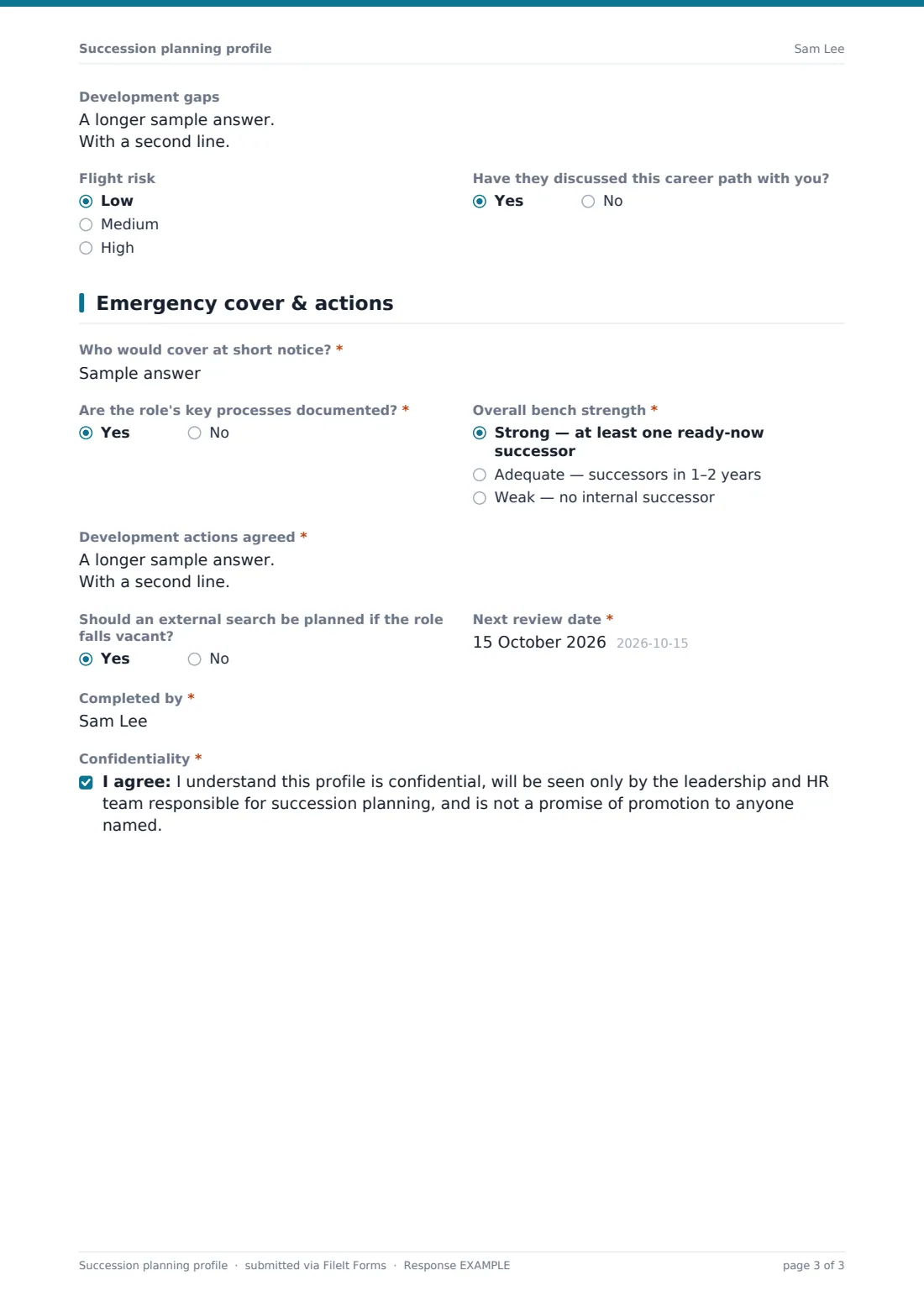
3 Emergency cover & actions
- Who would cover at short notice?*
- Are the role's key processes documented?*
- Overall bench strength* Strong — at least one ready-now successor · Adequate — successors in 1–2 years · Weak — no internal successor
- Development actions agreed*
- Should an external search be planned if the role falls vacant?
- Next review date*
- Completed by*
- Confidentiality*
The succession planning profile form, page by page
1 The role
The manager enters the Role title, Department or function, Current role holder and their Time in role, then rates How critical is this role? and the Likelihood the role becomes vacant in the next 2 years. A high likelihood asks what makes vacancy likely, with guidance to keep to business facts. Two text boxes capture the skills, knowledge and relationships the role needs and what would be hardest to replace.
2 Successors
The page first asks whether there's at least one potential internal successor. If there is, three identical blocks capture each one: Name, Current role, Readiness (ready now, one to two years, or three plus years), Development gaps, Flight risk and whether they've discussed this career path. Only the first block is required; a role with no internal successor skips them.
3 Emergency cover & actions
The manager names who would cover at short notice, says whether key processes are documented and rates overall bench strength from strong to weak. They list the development actions agreed, say whether an external search should be planned, set the next review date, give their name and confirm the confidentiality statement.
Make the template yours
- Change the readiness bands to match your talent review framework
- Add a nine-box performance and potential rating for each successor
- Remove the third successor block for smaller teams
- Restrict the vault folder to senior leaders and HR
- Pre-fill the role title and incumbent by sending personal links to each manager
- Set a closing date ahead of your talent review meeting
Tips for a better succession planning profile form
- Start with a short list of genuinely critical roles rather than profiling every position
- Name an emergency cover for every role, even when there's no long-term successor
- Keep flight-risk notes factual and avoid assumptions about age, family or health
- Turn development gaps into specific actions with owners and dates
- Review profiles at least yearly and after any major reorganisation
- Have honest career conversations with named successors rather than keeping plans secret
Every response becomes a PDF in your vault
Each profile is saved as a PDF in your chosen vault folder. Managers give their name and email before starting, so HR knows who completed it, and notifications let HR see new profiles as they arrive.
Before the talent review, HR can export all profiles to a CSV to see bench strength across roles, spot people named as successor for several roles, and track agreed development actions.
- Start from this template. It opens in the FileIt Forms designer — change any question, add pages, set the rules for when questions appear.
- Share it. Turn on a public link, or send it to people by email, each with their own link. They don’t need a FileIt account.
- Get the answers as PDFs. Each response is saved as a PDF in the vault folder you choose, with uploaded files attached — and listed in a Responses table you can export to CSV.
Succession planning profile form: frequently asked questions
Is this succession planning template free?
Yes. It's part of the FileIt Forms app on every plan, including the free plan.
Who fills it in?
The manager responsible for the key role, usually with HR. Respondents give their name and email before starting, so the profile shows who completed it.
How many successors can we list?
Up to three per role. Answering no to the first question skips the successor blocks, and when there are successors only the first block is required.
Are successors told they've been named?
Not by the form. Each successor block asks whether they've discussed the career path, and the confidentiality statement makes clear the profile isn't a promise of promotion.
Can we use it for every role in the company?
You can, but it works best for roles where a vacancy would cause serious disruption.
Can we compare roles side by side?
Yes. Export responses to a CSV to compare criticality, vacancy risk and bench strength across roles.