What is the lost deal review form template?
Most CRMs have a "closed lost" reason field that ends up full of "price" and "other". A proper loss review asks a few more questions while the deal is still fresh: where in the process it was lost, what the prospect did instead, how you compared with the alternative, and what the prospect actually said.
This template takes a sales rep about five minutes. They record the deal value, segment and dates, the stage it was lost at, and whether the prospect chose a competitor, built it in-house, did nothing or delayed. Each answer brings up its own follow-up: the competitor's name and price, or when the project might be revisited. Reps pick up to three main reasons, rate how you compared on six areas, and say whether the loss was within your control.
Each review is filed as a PDF in your FileIt vault, and the CSV export makes it easy to see patterns across a quarter's losses.
- Best for
- Sales teams, founders and revenue leaders running win/loss analysis
- Filled in by
- The sales rep who owned the deal
- Time to complete
- About 5 minutes
- Includes
- Outcome follow-ups, up to three loss reasons, a comparison grid and a re-engage date
Who uses a lost deal review form?
- Reviewing every lost deal above a certain value
- Feeding missing-feature feedback to the product team
- Spotting a competitor that keeps winning on price
- Coaching reps on deals lost at the same stage
- Building a list of prospects to re-engage next quarter
Questions on this lost deal review form
24 questions over 3 pages · includes conditional questions, multiple pages, ratings.
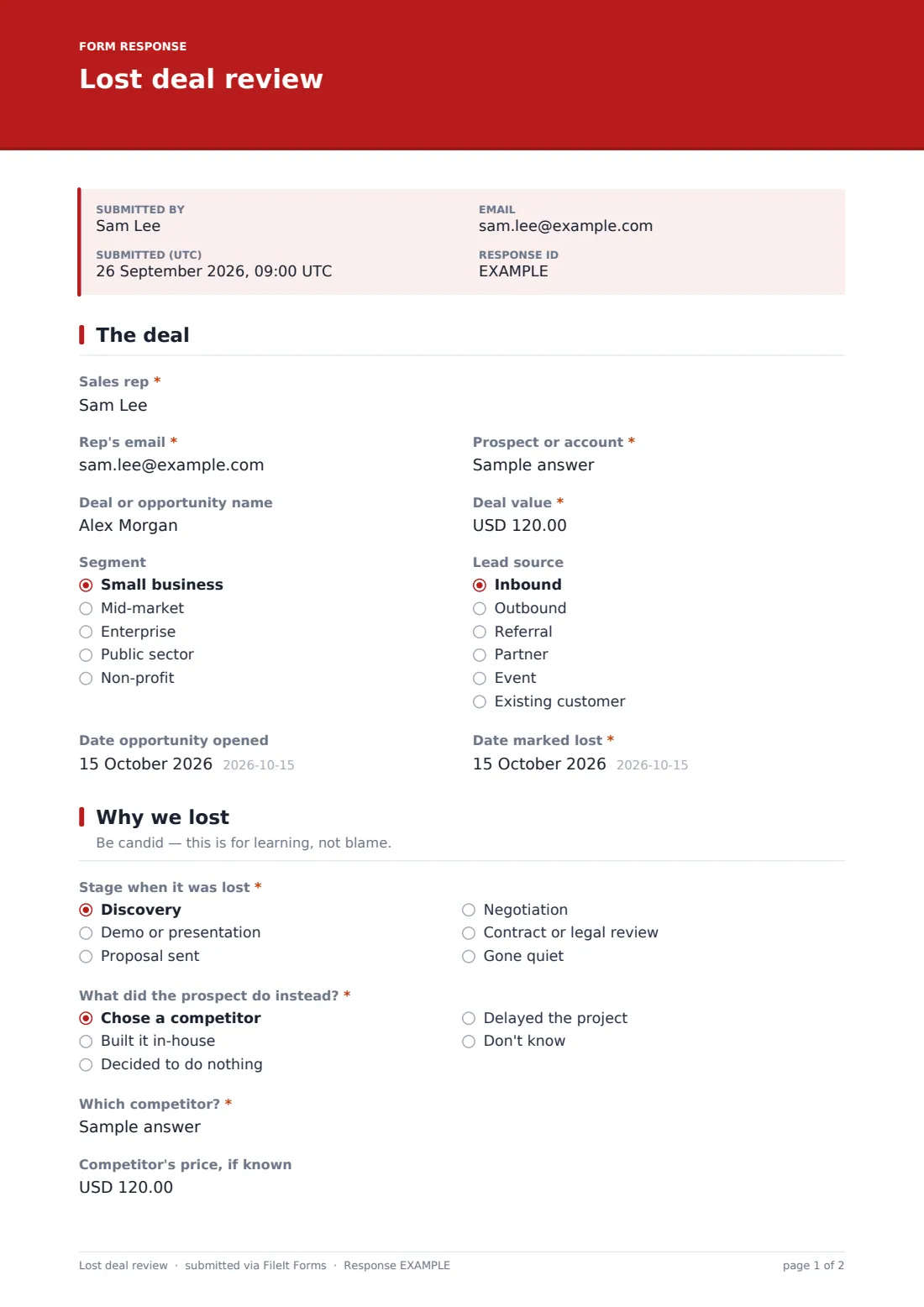
1 The deal
- Sales rep*
- Rep's email*
- Prospect or account*
- Deal or opportunity name
- Deal value*
- Segment Small business · Mid-market · Enterprise · Public sector · Non-profit
- Lead source Inbound · Outbound · Referral · Partner · Event · Existing customer
- Date opportunity opened
- Date marked lost*
2 Why we lost
- Stage when it was lost* Discovery · Demo or presentation · Proposal sent · Negotiation · Contract or legal review · Gone quiet
- What did the prospect do instead?* Chose a competitor · Built it in-house · Decided to do nothing · Delayed the project · Don't know
- Which competitor?* asked only when it applies
- Competitor's price, if known asked only when it applies
- When might the project be revisited? asked only when it applies
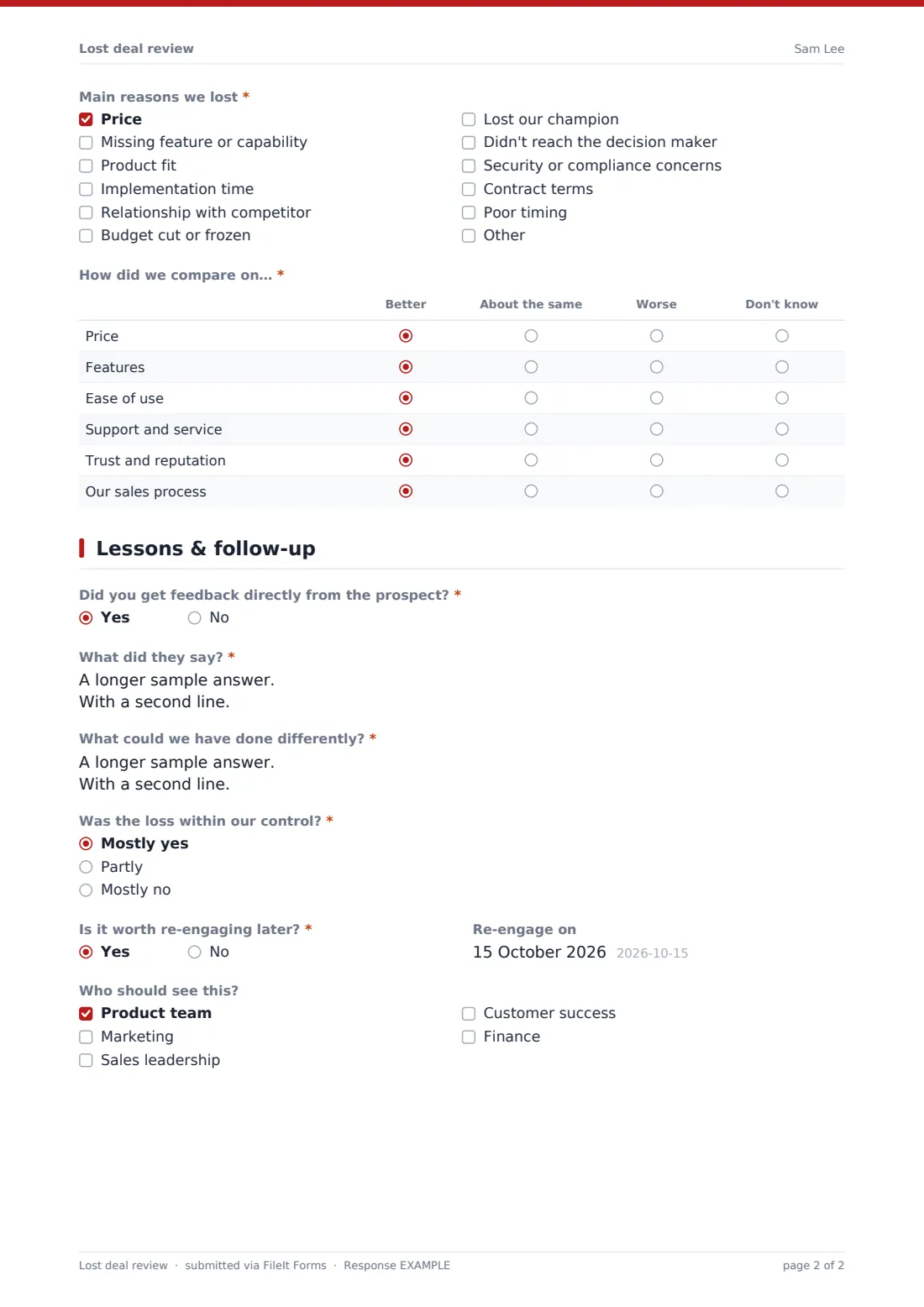
- Main reasons we lost* Price · Missing feature or capability · Product fit · Implementation time · Relationship with competitor · Budget cut or frozen · Lost our champion · Didn't reach the decision maker · Security or compliance concerns · Contract terms · Poor timing
- How did we compare on…* Better · About the same · Worse · Don't know
- Which feature or capability was missing? asked only when it applies
3 Lessons & follow-up
- Did you get feedback directly from the prospect?*
- What did they say?* asked only when it applies
- What could we have done differently?*
- Was the loss within our control?* Mostly yes · Partly · Mostly no
- Is it worth re-engaging later?*
- Re-engage on asked only when it applies
- Who should see this? Product team · Marketing · Sales leadership · Customer success · Finance
The lost deal review form, page by page
1 The deal
The rep enters their name and email, the prospect or account, the deal or opportunity name, the Deal value, the segment and the lead source, plus the date the opportunity opened and the date it was marked lost.
2 Why we lost
Stage when it was lost runs from discovery to contract review, plus Gone quiet. What did the prospect do instead? offers five answers. Chose a competitor asks which competitor and their price if known. Delayed the project asks when it might be revisited.
Main reasons we lost allows up to three choices, including price, a missing feature, product fit, implementation time, budget, a lost champion, not reaching the decision maker, security concerns, contract terms and timing. Picking a missing feature opens a box to describe it. A grid then rates how you compared on price, features, ease of use, support, trust and your sales process: better, about the same, worse or don't know.
3 Lessons & follow-up
Did you get feedback directly from the prospect? A Yes asks what they said, in their own words where possible. What could we have done differently? is required, and a short question asks whether the loss was mostly within your control. If it's worth re-engaging later, the rep sets a date. A final checklist says who should see the review, from product and marketing to sales leadership.
Make the template yours
- Replace the reasons list with the loss reasons your CRM already uses
- Add your main competitors as a dropdown instead of free text
- Change the currency and segments to match your market
- Add product or marketing leads to the notification emails
- Duplicate it as a won deal review with the same comparison grid
Tips for a better lost deal review form
- Fill it in within a few days of the loss, while details are fresh
- Ask the prospect for a short debrief call; most will say yes
- Look at trends across many reviews rather than reacting to one
- Keep the tone blame-free so reps answer honestly
- Follow up on re-engage dates, since timing losses often come back
Every response becomes a PDF in your vault
Each review is saved as a PDF in your chosen vault folder, dated, and you're notified by email. The rep can be sent a copy for their own records.
Export the Responses table to CSV each month or quarter. Every reason, rating row and outcome becomes a column, so you can count losses by competitor, stage or reason and share the patterns with product and marketing.
- Start from this template. It opens in the FileIt Forms designer — change any question, add pages, set the rules for when questions appear.
- Share it. Turn on a public link, or send it to people by email, each with their own link. They don’t need a FileIt account.
- Get the answers as PDFs. Each response is saved as a PDF in the vault folder you choose, with uploaded files attached — and listed in a Responses table you can export to CSV.
Lost deal review form: frequently asked questions
What is a lost deal review?
It's a short structured debrief after a sales opportunity is lost, recording why it was lost and what the team can learn, often called win/loss analysis.
Is this template free?
Yes. It's a starter template in FileIt's Forms app, and you can edit every question.
Does it connect to our CRM?
No. Responses are filed as PDFs in your vault and can be exported to CSV, which most CRMs and spreadsheets can import.
Why limit the loss reasons to three?
Forcing a choice keeps the data useful. When every reason is ticked, no pattern shows up.
Can sales managers fill it in instead of reps?
Yes. Whoever knows the deal best can complete it, and the first page records their name.
Can I use it for won deals too?
Duplicate the form and rename it, then adjust the reasons to why you won. The comparison grid works for both.