What is the symptom diary form template?
"When did it start, how long did it last, and what were you doing?" are hard questions to answer weeks later in a ten-minute appointment. A symptom diary turns those memories into a dated record. This template gives patients one short form per episode, so every entry asks the same things in the same order and a pattern is easier to spot.
The form starts with the person's name, email and optional date of birth, then the date and time the episode started and "How long did it last?" — with a follow-up if the answer is "Still going on". The symptoms page has a checklist of common symptoms, a 0–10 question "How bad was it at its worst?" and space to describe the episode in the patient's own words. Possible triggers, medicine taken and whether it helped come next, followed by how much it affected the day.
Clinics can send it to a patient as a link to fill in between appointments, and individuals can use it for themselves. Every entry is saved as a PDF in a FileIt vault folder, so the diary builds up as a set of dated documents rather than scattered notes on a phone.
- Best for
- Patients tracking recurring symptoms, and clinics who ask them to
- Filled in by
- The patient, or a parent or carer on their behalf
- Time to complete
- About 3 minutes per episode
- Includes
- Symptom checklist, 0–10 severity, triggers, medicine taken, photo upload
Who uses a symptom diary form?
- A patient with recurring headaches logs each one before a neurology appointment
- A GP practice sends a diary link to a patient investigating palpitations
- A parent records their child's stomach-ache episodes for the paediatrician
- Someone with a skin flare-up uploads a photo of the rash on each entry
- A physiotherapist asks a client to log pain flare-ups between sessions
- A carer keeps a record of dizzy spells for an older relative
Questions on this symptom diary form
25 questions over 4 pages · includes file upload, conditional questions, multiple pages, consent checkbox, ratings.
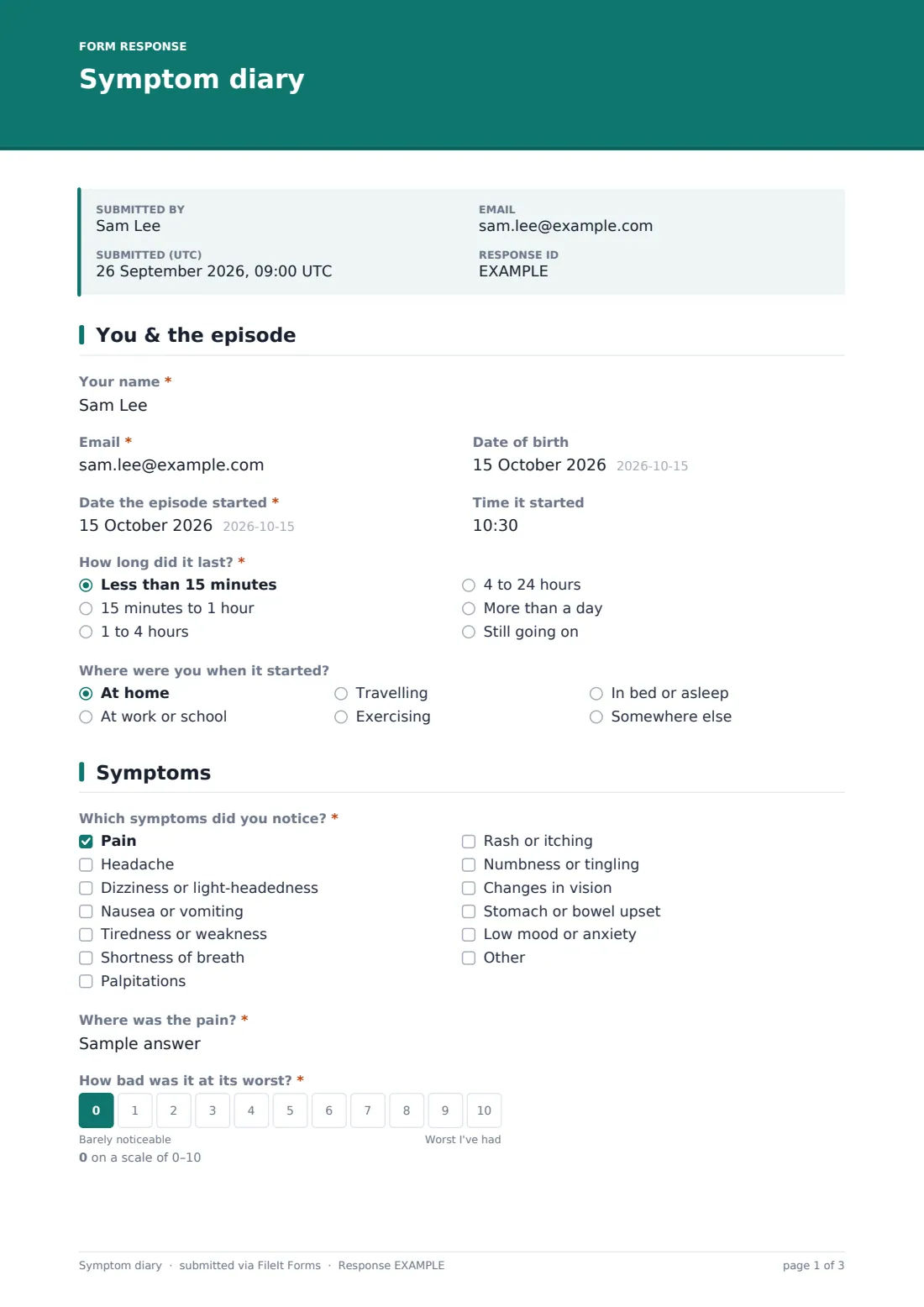
1 You & the episode
- Your name*
- Email*
- Date of birth
- Date the episode started*
- Time it started
- How long did it last?* Less than 15 minutes · 15 minutes to 1 hour · 1 to 4 hours · 4 to 24 hours · More than a day · Still going on
- Roughly how long has it been going on so far? asked only when it applies
- Where were you when it started? At home · At work or school · Travelling · Exercising · In bed or asleep · Somewhere else
2 Symptoms
- Which symptoms did you notice?* Pain · Headache · Dizziness or light-headedness · Nausea or vomiting · Tiredness or weakness · Shortness of breath · Palpitations · Rash or itching · Numbness or tingling · Changes in vision · Stomach or bowel upset · Low mood or anxiety
- Where was the pain?* asked only when it applies
- How bad was it at its worst?*
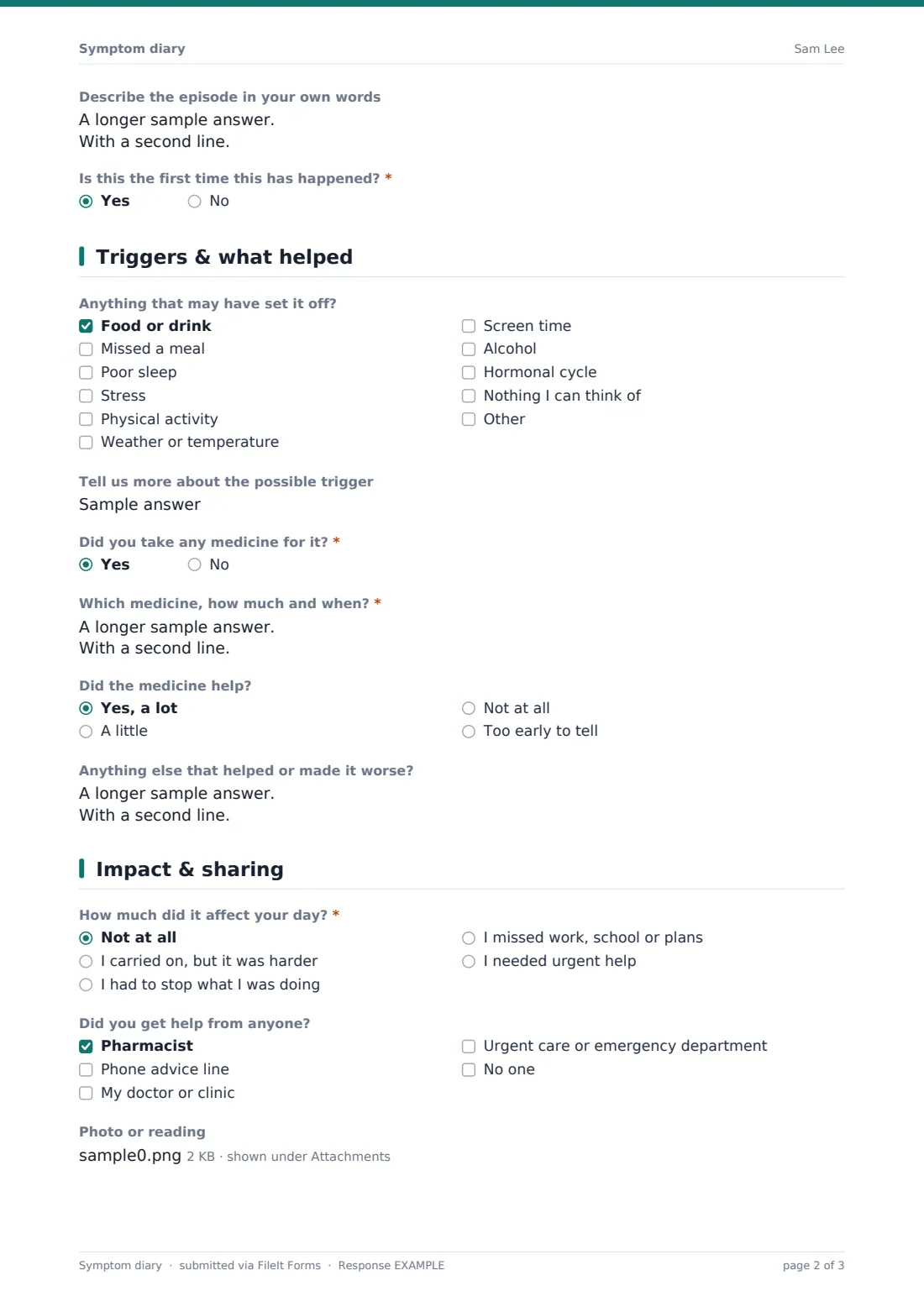
- Describe the episode in your own words
- Is this the first time this has happened?*
- How often does it happen now? asked only when it applies Every day · Several times a week · About once a week · A few times a month · Less often
3 Triggers & what helped
- Anything that may have set it off? Food or drink · Missed a meal · Poor sleep · Stress · Physical activity · Weather or temperature · Screen time · Alcohol · Hormonal cycle · Nothing I can think of
- Tell us more about the possible trigger asked only when it applies
- Did you take any medicine for it?*
- Which medicine, how much and when?* asked only when it applies
- Did the medicine help? asked only when it applies Yes, a lot · A little · Not at all · Too early to tell
- Anything else that helped or made it worse?
4 Impact & sharing
- How much did it affect your day?* Not at all · I carried on, but it was harder · I had to stop what I was doing · I missed work, school or plans · I needed urgent help
- Did you get help from anyone? Pharmacist · Phone advice line · My doctor or clinic · Urgent care or emergency department · No one
- Photo or reading
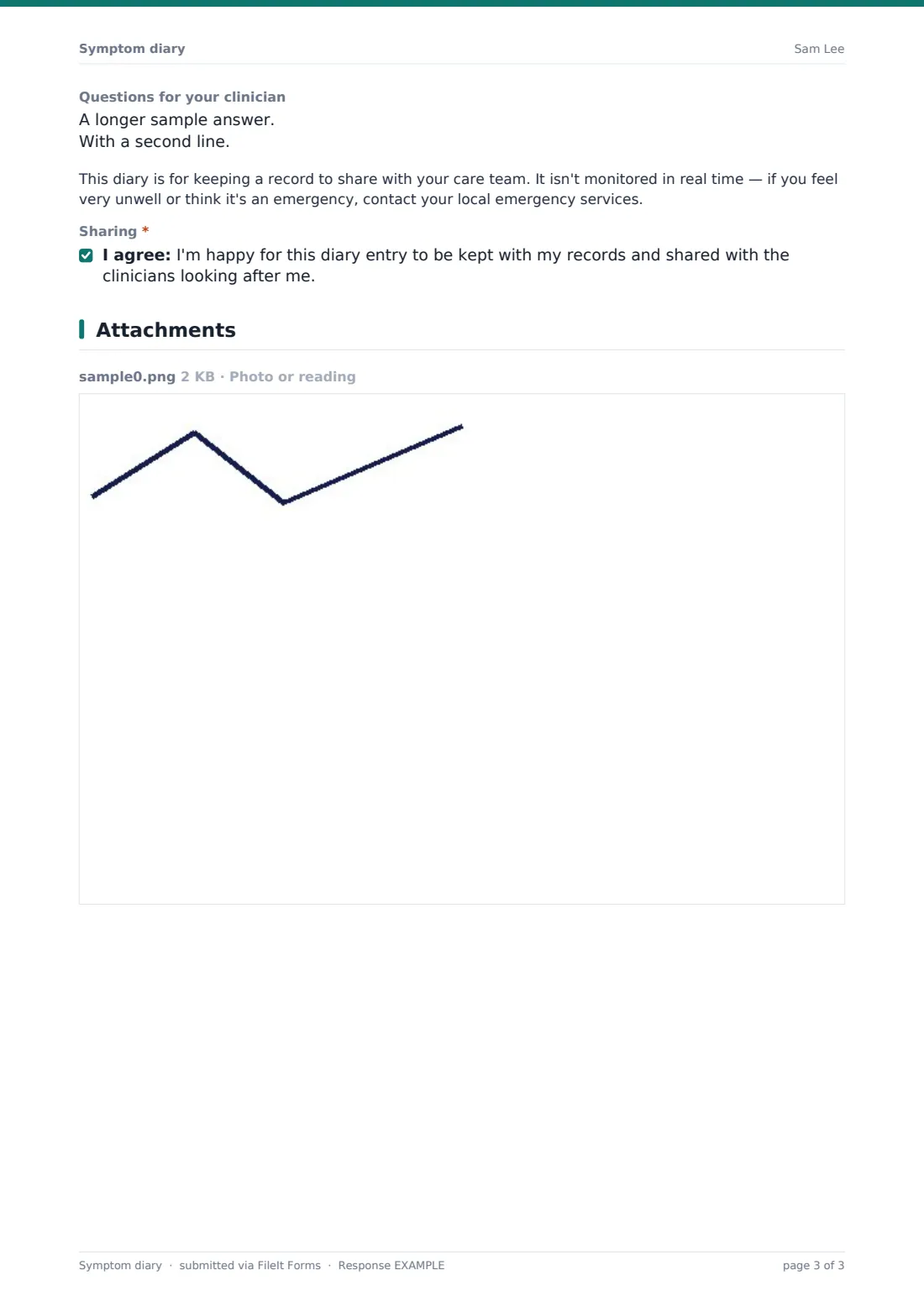
- Questions for your clinician
- Sharing*
The symptom diary form, page by page
1 You & the episode
"Your name" and "Email" are required, with an optional date of birth to help the clinic match the entry. Then the required "Date the episode started", an optional start time, and "How long did it last?" from less than 15 minutes to more than a day. Choosing "Still going on" asks roughly how long so far. "Where were you when it started?" is optional.
2 Symptoms
A required checklist — "Which symptoms did you notice?" — with twelve common symptoms and an Other option. Ticking Pain asks "Where was the pain?". Then the required 0–10 scale "How bad was it at its worst?", a free-text description, and "Is this the first time this has happened?" — a no asks how often it happens now.
3 Triggers & what helped
"Anything that may have set it off?" lists food, missed meals, poor sleep, stress, activity, weather, screens, alcohol and the hormonal cycle; any answer opens a box for more detail. "Did you take any medicine for it?" is required — a yes asks which medicine, how much and when, and whether it helped. A final box covers anything else that helped or made it worse.
4 Impact & sharing
"How much did it affect your day?" is required, from "Not at all" to "I needed urgent help". Then who the patient got help from, an optional upload of up to three photos or readings, "Questions for your clinician", a short note that the diary isn't monitored in real time, and a required sharing consent.
Make the template yours
- Swap the symptom checklist for the ones relevant to your clinic, such as migraine aura or joint stiffness
- Change the 0–10 severity scale labels to match the pain scale your team already uses
- Add a question for a specific reading you track, such as blood glucose or peak flow
- Rewrite the urgent-care paragraph with your own out-of-hours number
- Set the vault folder to one per patient so each diary stays together
- Turn off the emailed copy if patients prefer not to receive one
Tips for a better symptom diary form
- Ask patients to fill in one form per episode rather than a weekly summary — the dates are what reveal a pattern
- Send the link by email request so each patient's entries arrive with their name already attached
- Encourage a photo for anything visible, like a rash or swelling, as it may have faded by the appointment
- Export the Responses table as CSV before a review to see dates, severity and triggers side by side
- Remind patients that the diary is a record, not a way to ask for urgent help
Every response becomes a PDF in your vault
Each entry becomes a PDF in your FileIt vault, titled with the person's name and the date, with any photos filed as attachments of that document. The owner is emailed about the new entry and the patient can get a copy of their own PDF.
In the Responses table every episode is one row. Search by name to pull up one patient's diary, or export to CSV to sort entries by date or severity before an appointment.
- Start from this template. It opens in the FileIt Forms designer — change any question, add pages, set the rules for when questions appear.
- Share it. Turn on a public link, or send it to people by email, each with their own link. They don’t need a FileIt account.
- Get the answers as PDFs. Each response is saved as a PDF in the vault folder you choose, with uploaded files attached — and listed in a Responses table you can export to CSV.
Symptom diary form: frequently asked questions
Is this symptom diary template free?
Yes. It's one of the starter templates in the FileIt Forms app, available on every account including the free plan, and you can edit every question.
Should I fill in one form per episode or one per week?
One per episode. Each entry is saved as its own dated PDF, which makes it easier to see how often something happens and what came before it.
Can I attach photos?
Yes. The last page has an optional upload for up to three photos or screenshots, such as a rash or a reading from a monitor. They're filed as attachments of the entry's PDF.
Does anyone watch the diary in real time?
No. The form says so on its last page. It's a record to share at appointments, not a way to get urgent help.
Can a parent or carer fill it in?
Yes. Change the first question's label to the patient's name and add one for the person completing it if you'd like both recorded.
Does the patient need a FileIt account?
No. They fill it in from a link you share or an emailed request.