What is the sleep assessment questionnaire form template?
Most of a first sleep appointment can go on simply establishing the basics: when someone goes to bed, how long they lie awake, how often they wake, and whether anyone has noticed snoring or pauses in breathing. This questionnaire collects those answers in advance, so the consultation can start from the details rather than from scratch.
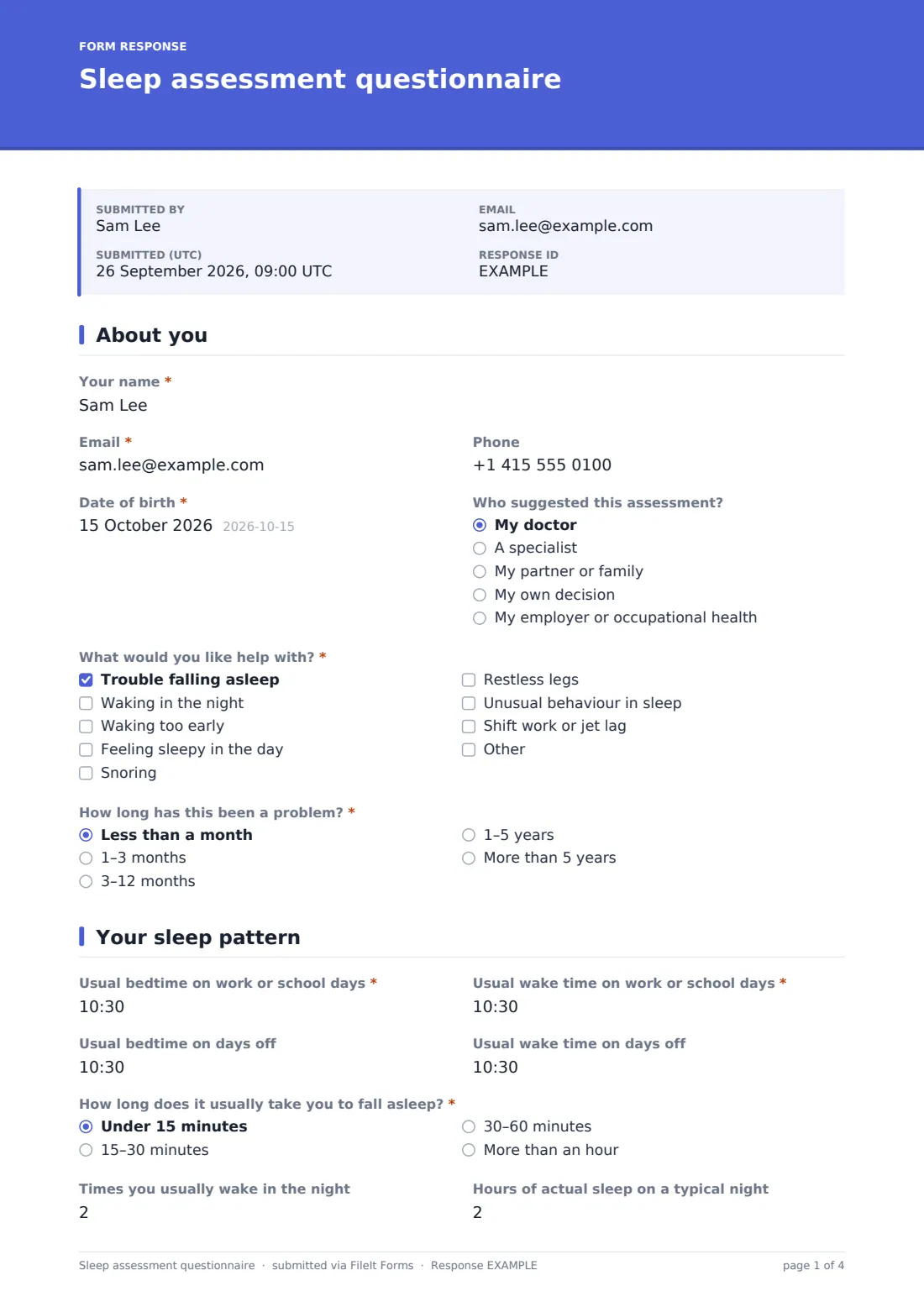
It opens with "What would you like help with?" — trouble falling asleep, waking in the night or too early, daytime sleepiness, snoring, restless legs, unusual behaviour in sleep or shift work — and how long it's been a problem. The pattern page asks for bed and wake times on work days and days off, how long it takes to fall asleep, wakings, hours of sleep and an overall star rating. Shift workers describe their pattern.
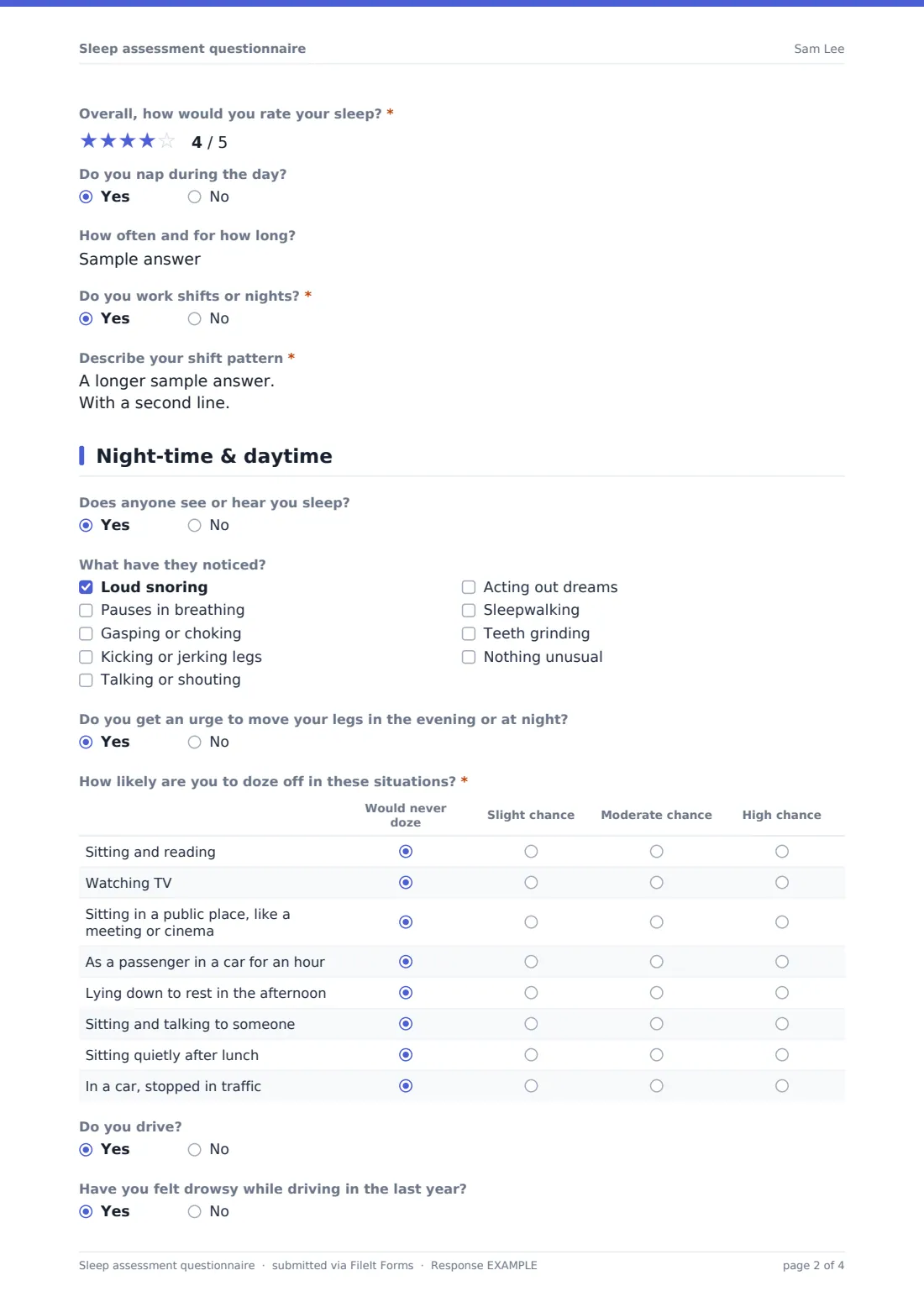
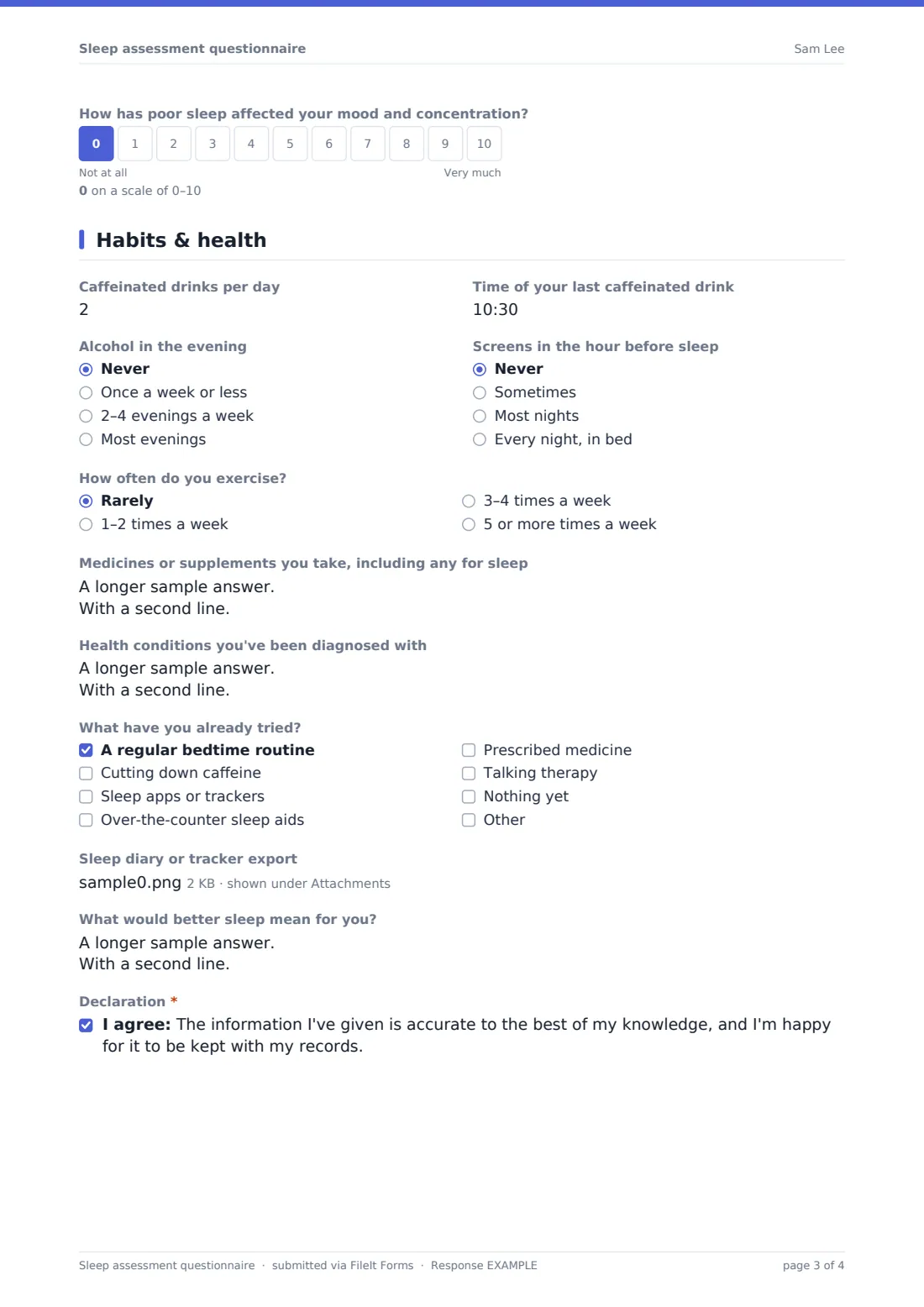
A night-time and daytime page asks what a bed partner has noticed and how likely the person is to doze off in eight everyday situations, laid out as one grid. The last page covers caffeine, alcohol, screens, exercise, medicines, what they've tried and their goals, with an optional upload for a sleep diary or tracker export. Each completed questionnaire is saved as a PDF in your FileIt vault.
- Best for
- Sleep clinics, GPs, sleep coaches and occupational health
- Filled in by
- The client, ideally with input from a bed partner
- Time to complete
- About 8 minutes
- Includes
- Sleep schedule, partner observations, daytime dozing grid, habits, tracker upload
Who uses a sleep assessment questionnaire form?
- A sleep clinic sends the questionnaire to new referrals before their first appointment
- A sleep coach collects a baseline from a client who struggles to fall asleep
- Occupational health asks shift workers about their sleep pattern and daytime drowsiness
- A GP practice gathers background ahead of a snoring consultation
- A wellbeing programme compares answers before and after a sleep course
- A client uploads a month of smartwatch sleep data alongside their answers
Questions on this sleep assessment questionnaire form
37 questions over 4 pages · includes file upload, conditional questions, multiple pages, consent checkbox, ratings.
1 About you
- Your name*
- Email*
- Phone
- Date of birth*
- Who suggested this assessment? My doctor · A specialist · My partner or family · My own decision · My employer or occupational health
- What would you like help with?* Trouble falling asleep · Waking in the night · Waking too early · Feeling sleepy in the day · Snoring · Restless legs · Unusual behaviour in sleep · Shift work or jet lag
- How long has this been a problem?* Less than a month · 1–3 months · 3–12 months · 1–5 years · More than 5 years
2 Your sleep pattern
- Usual bedtime on work or school days*
- Usual wake time on work or school days*
- Usual bedtime on days off
- Usual wake time on days off
- How long does it usually take you to fall asleep?* Under 15 minutes · 15–30 minutes · 30–60 minutes · More than an hour
- Times you usually wake in the night
- Hours of actual sleep on a typical night
- Overall, how would you rate your sleep?*
- Do you nap during the day?
- How often and for how long? asked only when it applies
- Do you work shifts or nights?*
- Describe your shift pattern* asked only when it applies
3 Night-time & daytime
- Does anyone see or hear you sleep?
- What have they noticed? asked only when it applies Loud snoring · Pauses in breathing · Gasping or choking · Kicking or jerking legs · Talking or shouting · Acting out dreams · Sleepwalking · Teeth grinding · Nothing unusual
- Do you get an urge to move your legs in the evening or at night?
- How likely are you to doze off in these situations?* Would never doze · Slight chance · Moderate chance · High chance
- Do you drive?
- Have you felt drowsy while driving in the last year? asked only when it applies
- How has poor sleep affected your mood and concentration?
4 Habits & health
- Caffeinated drinks per day
- Time of your last caffeinated drink
- Alcohol in the evening Never · Once a week or less · 2–4 evenings a week · Most evenings
- Screens in the hour before sleep Never · Sometimes · Most nights · Every night, in bed
- How often do you exercise? Rarely · 1–2 times a week · 3–4 times a week · 5 or more times a week
- Medicines or supplements you take, including any for sleep
- Health conditions you've been diagnosed with
- What have you already tried? A regular bedtime routine · Cutting down caffeine · Sleep apps or trackers · Over-the-counter sleep aids · Prescribed medicine · Talking therapy · Nothing yet
- Sleep diary or tracker export
- What would better sleep mean for you?
- Declaration*
The sleep assessment questionnaire form, page by page
1 About you
"Your name", "Email" and "Date of birth" are required, with optional phone and "Who suggested this assessment?". Then the required checklist "What would you like help with?" (with an Other option) and "How long has this been a problem?".
2 Your sleep pattern
Required bed and wake times on work or school days, optional times for days off, the required "How long does it usually take you to fall asleep?", the number of wakings and hours of actual sleep, and a required five-star rating of overall sleep. A yes to naps asks how often and how long; a yes to "Do you work shifts or nights?" asks the client to describe the pattern.
3 Night-time & daytime
If someone sees or hears the client sleep, a checklist asks what they've noticed — loud snoring, pauses in breathing, gasping, leg movements, talking, acting out dreams, sleepwalking or grinding. Then restless legs, the required grid "How likely are you to doze off in these situations?" with eight rows from reading to sitting in traffic, drowsy driving for drivers, and a 0–10 scale for the effect on mood and concentration.
4 Habits & health
Caffeinated drinks per day and the time of the last one, evening alcohol, screens before bed and exercise. Free-text boxes for medicines and supplements and for diagnosed conditions, a checklist of what's already been tried, an optional upload for a sleep diary or tracker export, "What would better sleep mean for you?" and a required declaration.
Make the template yours
- Replace the dozing grid with the questionnaire your service already uses, keeping it as one matrix
- Add a page for a bed partner to fill in their own observations
- Add neck size, height and weight questions if your clinicians ask for them
- Remove the shift-work questions for a general consumer coaching service
- Set a close date on the link for each clinic list
- File each questionnaire in the vault folder for that clinic or clinician
Tips for a better sleep assessment questionnaire form
- Ask clients to fill it in after a typical week, not after one unusually bad night
- Suggest they answer the night-time questions together with their partner
- Send it a week before the appointment so there's time to read the answers
- Use the CSV export to compare a group's answers before and after a programme
- Pair it with the symptom diary for clients who want to log individual bad nights
Every response becomes a PDF in your vault
Each questionnaire is saved as a PDF in your vault with the dozing grid printed as a table, and any uploaded diary or tracker files are filed as attachments. You're emailed when one arrives, and the client can be sent a copy.
The Responses table lists every client with their submission date. Open a response to read every answer before the consultation, or export them to CSV.
- Start from this template. It opens in the FileIt Forms designer — change any question, add pages, set the rules for when questions appear.
- Share it. Turn on a public link, or send it to people by email, each with their own link. They don’t need a FileIt account.
- Get the answers as PDFs. Each response is saved as a PDF in the vault folder you choose, with uploaded files attached — and listed in a Responses table you can export to CSV.
Sleep assessment questionnaire form: frequently asked questions
Is this sleep questionnaire template free?
Yes. It's included in the FileIt Forms app on every account, and every question can be edited or removed.
Does the form calculate a sleepiness score?
No. FileIt Forms doesn't score answers. The dozing grid prints as a table in the PDF, and your team reviews it.
Can the client upload data from a sleep tracker?
Yes. There's an optional upload for up to three files — a sleep diary, screenshots or a CSV export — filed as attachments of the vault document.
Why are the partner questions optional?
Not everyone sleeps near someone else. The follow-up checklist only appears when the client says someone sees or hears them sleep.
Can I send it to each patient individually?
Yes. Send it by email request to track who has opened and completed it, and remind anyone who hasn't.
Do clients need a FileIt account?
No. They fill it in from a link.