What is the speech therapy intake form template?
A good speech and language assessment starts with context: what the family or client has noticed, how long it has been going on, what the hearing test showed, and what the school or workplace sees. This intake form collects that history in advance, so the first appointment can focus on the person rather than the questionnaire.
It works for children and adults. One early question asks whether the client is under 18, and the form adapts: parents are asked about first words, other milestones, birth and early feeding, and the school or nursery; adults are asked how the difficulties affect work, study and social life. Whoever fills it in — the client, a parent, a carer or a partner — says so, and gives their own name and relationship.
The completed intake, with any earlier reports attached, is saved as a signed PDF in your FileIt vault.
- Best for
- Speech and language therapists in private practice, clinics and school services
- Filled in by
- The client, or a parent, carer or family member
- Time to complete
- About 10 minutes
- Includes
- Child and adult paths, hearing history, school input, report uploads, consent and signature
Who uses a speech therapy intake form?
- A parent referring a toddler who is late to start talking
- Pre-assessment history for a school-age child with speech sound or literacy difficulties
- An adult seeking help with a stammer or a voice problem
- A family member arranging therapy after a relative's stroke
- Collecting earlier therapy and hearing reports before a new episode of care
- Standardising intake across a multi-therapist practice
Questions on this speech therapy intake form
39 questions over 5 pages · includes signature, file upload, conditional questions, multiple pages, consent checkbox, ratings.
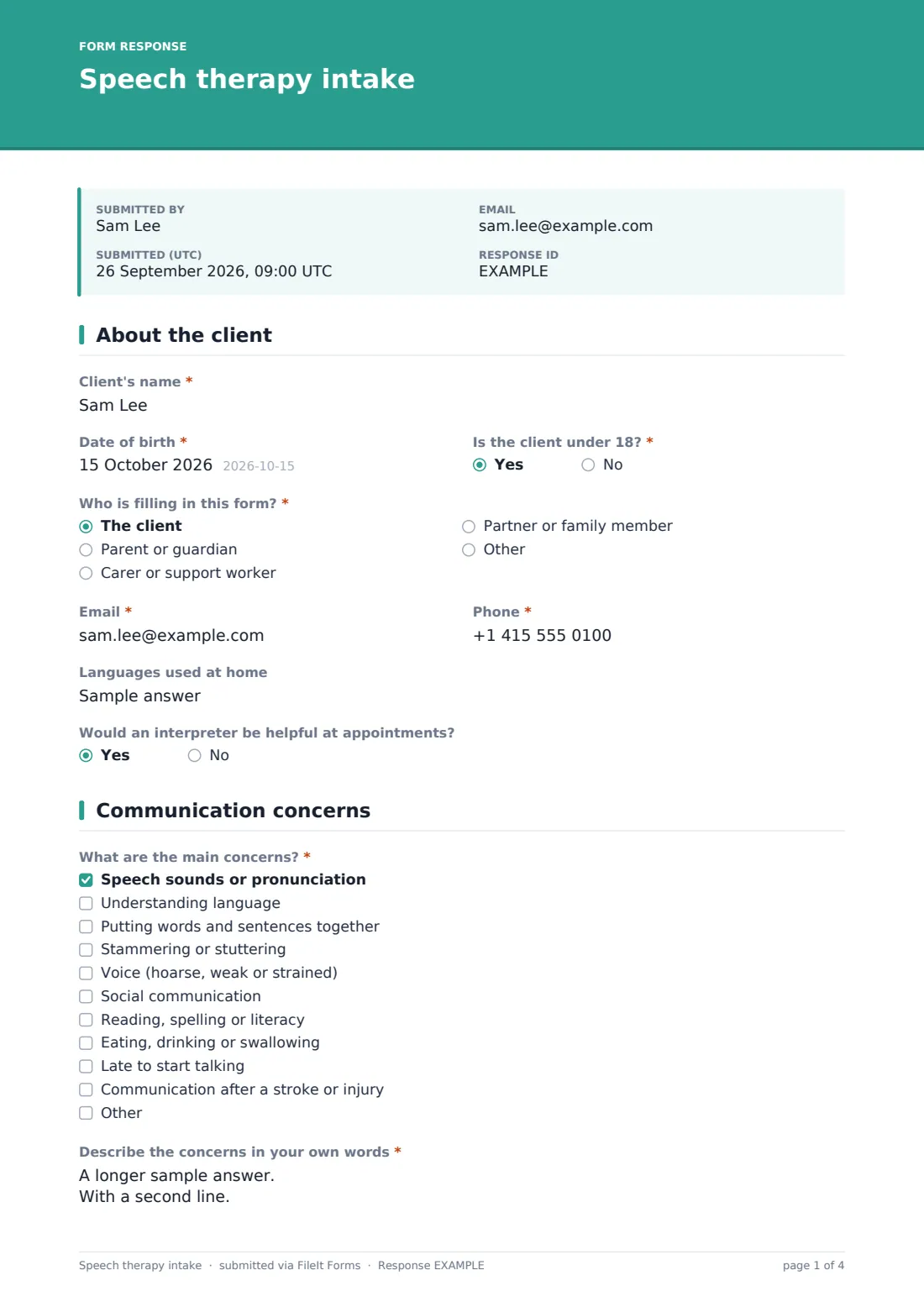
1 About the client
- Client's name*
- Date of birth*
- Is the client under 18?*
- Who is filling in this form?* The client · Parent or guardian · Carer or support worker · Partner or family member
- Your name* asked only when it applies
- Your relationship to the client asked only when it applies
- Email*
- Phone*
- Languages used at home
- Would an interpreter be helpful at appointments?
2 Communication concerns
- What are the main concerns?* Speech sounds or pronunciation · Understanding language · Putting words and sentences together · Stammering or stuttering · Voice (hoarse, weak or strained) · Social communication · Reading, spelling or literacy · Eating, drinking or swallowing · Late to start talking · Communication after a stroke or injury
- Describe the concerns in your own words*
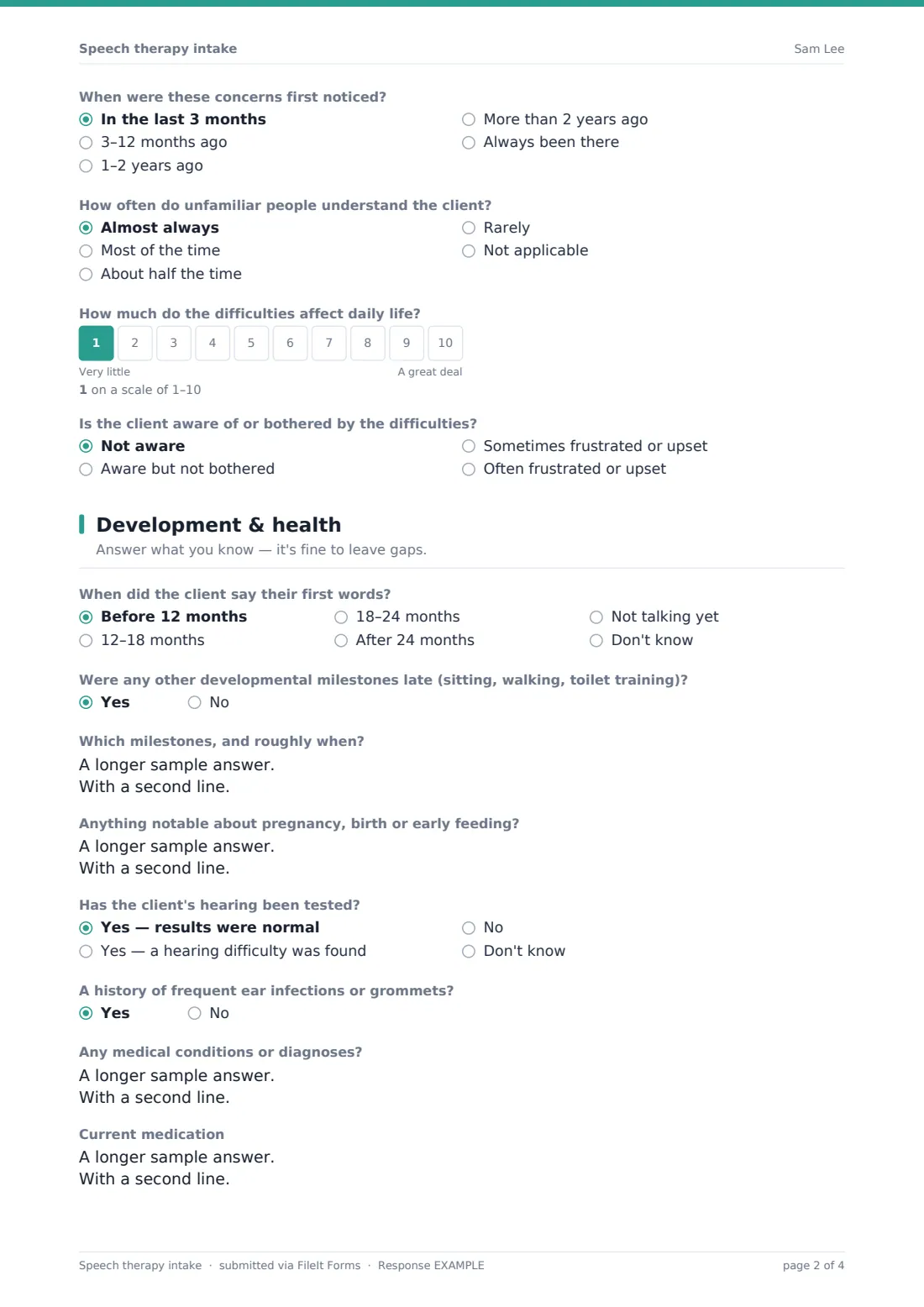
- When were these concerns first noticed? In the last 3 months · 3–12 months ago · 1–2 years ago · More than 2 years ago · Always been there
- How often do unfamiliar people understand the client? Almost always · Most of the time · About half the time · Rarely · Not applicable
- How much do the difficulties affect daily life?
- Is the client aware of or bothered by the difficulties? Not aware · Aware but not bothered · Sometimes frustrated or upset · Often frustrated or upset
3 Development & health
- When did the client say their first words? asked only when it applies Before 12 months · 12–18 months · 18–24 months · After 24 months · Not talking yet · Don't know
- Were any other developmental milestones late (sitting, walking, toilet training)? asked only when it applies
- Which milestones, and roughly when? asked only when it applies
- Anything notable about pregnancy, birth or early feeding? asked only when it applies
- Has the client's hearing been tested? Yes — results were normal · Yes — a hearing difficulty was found · No · Don't know
- A history of frequent ear infections or grommets?
- Any medical conditions or diagnoses?
- Current medication
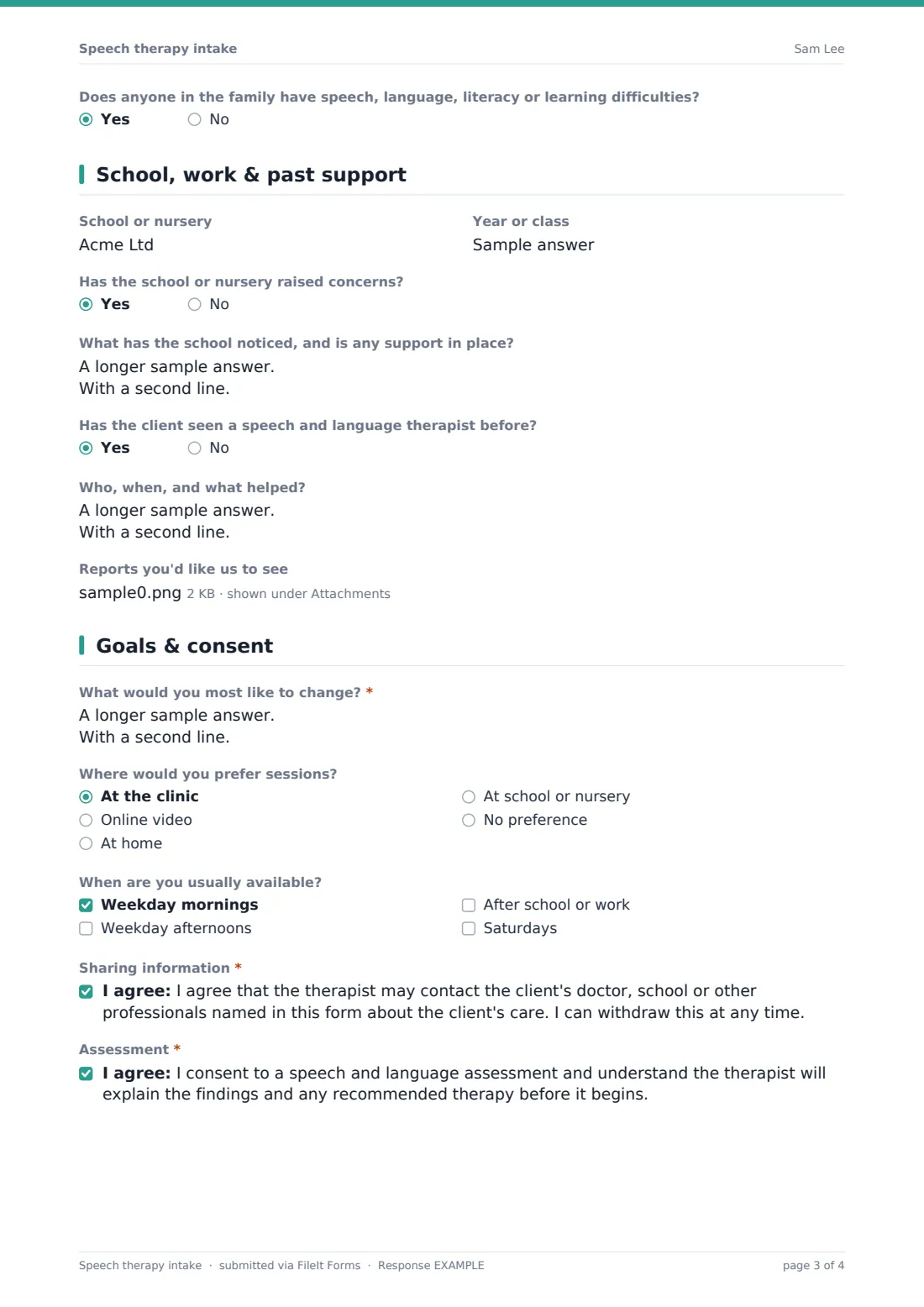
- Does anyone in the family have speech, language, literacy or learning difficulties?
4 School, work & past support
- School or nursery asked only when it applies
- Year or class asked only when it applies
- Has the school or nursery raised concerns? asked only when it applies
- What has the school noticed, and is any support in place? asked only when it applies
- How do the difficulties affect work, study or social life? asked only when it applies
- Has the client seen a speech and language therapist before?
- Who, when, and what helped? asked only when it applies
- Reports you'd like us to see
5 Goals & consent
- What would you most like to change?*
- Where would you prefer sessions? At the clinic · Online video · At home · At school or nursery · No preference
- When are you usually available? Weekday mornings · Weekday afternoons · After school or work · Saturdays
- Sharing information*
- Assessment*
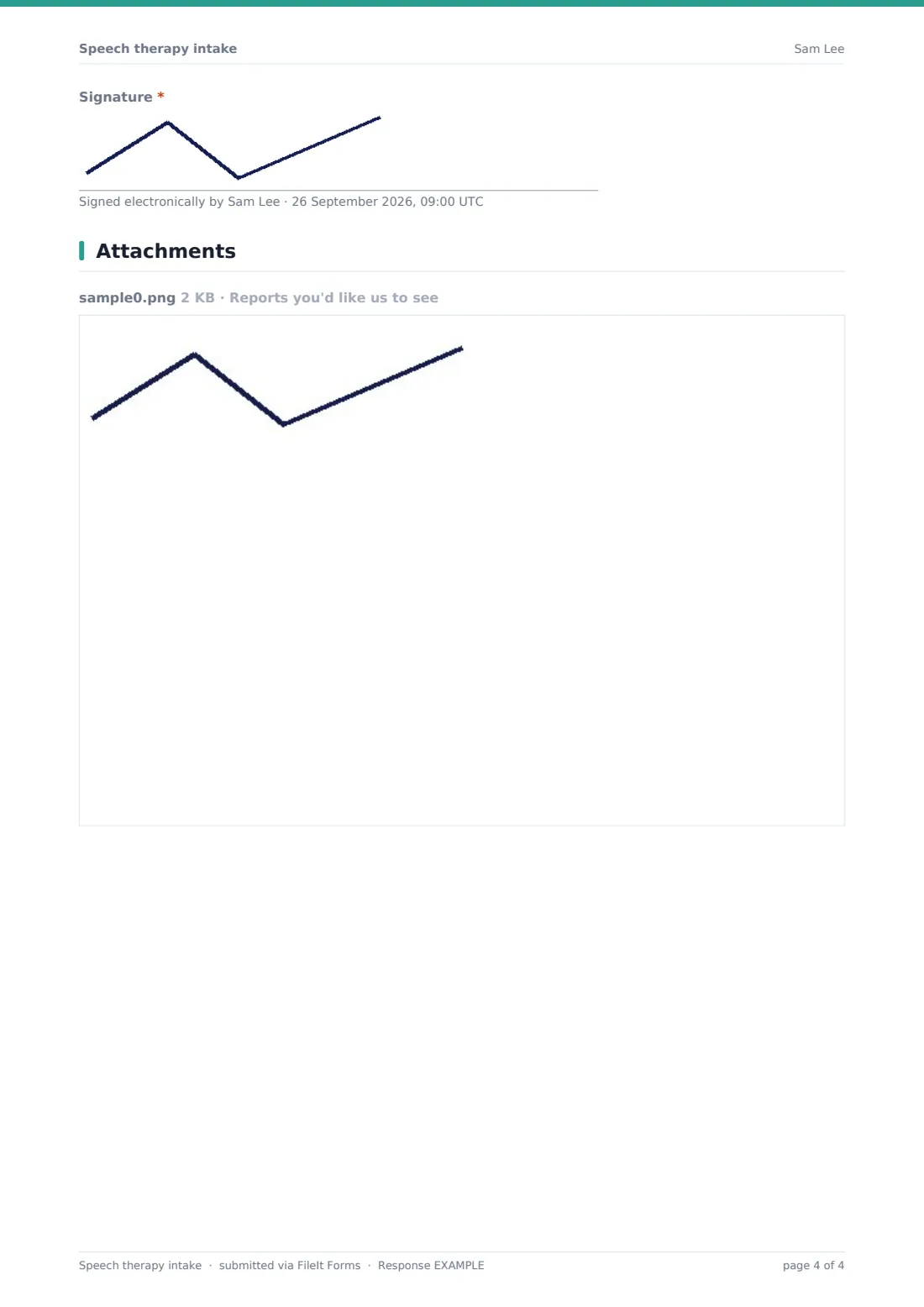
- Signature*
The speech therapy intake form, page by page
1 About the client
The client's name and date of birth, whether they are under 18, and who is filling in the form. If it isn't the client, the form asks for the completer's name and relationship. Contact details follow, with the languages used at home and whether an interpreter would help.
2 Communication concerns
Ten common areas to tick — from speech sounds and stammering to voice, social communication, literacy and swallowing — plus a description in the respondent's own words. Short questions cover when the concerns started, how often unfamiliar people understand the client, a 1–10 rating of the effect on daily life, and whether the client is aware of or frustrated by the difficulties.
3 Development & health
For children only: when first words came, whether other milestones were late (with a follow-up asking which), and anything notable about pregnancy, birth or early feeding. For everyone: hearing test results, ear infections or grommets, diagnoses, medication and family history of speech, language or learning difficulties.
4 School, work & past support
Children's school or nursery and year, and whether the school has raised concerns — with a follow-up for what they've noticed and any support in place. Adults are asked how the difficulties affect work, study or social life instead. Everyone is asked about previous speech therapy, and can upload up to five earlier reports.
5 Goals & consent
What the client or family most wants to change, where sessions would work best and usual availability. Two consents follow — permission to contact the named doctor, school or professionals, and consent to the assessment — then a signature.
Make the template yours
- Add the age ranges or conditions your practice specialises in to the concerns list
- Include your fees, funding routes or insurance questions on a separate page
- Change the session locations to match what you actually offer
- Add a standardised parent questionnaire as an extra page for younger children
- Set the vault folder so intakes file under each client
- Have the consent wording reviewed against your professional body's guidance
Tips for a better speech therapy intake form
- Read the parent's own description first — it often tells you more than the tick boxes
- If hearing has never been tested, consider arranging that before or alongside the assessment
- Ask for school reports in advance so you can plan classroom observations
- Use the goals answer to agree priorities at the end of the first session
- Keep the form's language plain — many respondents are anxious parents, not clinicians
Every response becomes a PDF in your vault
The intake is saved in your FileIt vault as a signed PDF, with any uploaded reports attached, and you get an email when it arrives. The respondent can receive their own copy.
Use the Responses table to see which new referrals are waiting for an assessment slot, and export to CSV if you track waiting lists in a spreadsheet.
- Start from this template. It opens in the FileIt Forms designer — change any question, add pages, set the rules for when questions appear.
- Share it. Turn on a public link, or send it to people by email, each with their own link. They don’t need a FileIt account.
- Get the answers as PDFs. Each response is saved as a PDF in the vault folder you choose, with uploaded files attached — and listed in a Responses table you can export to CSV.
Speech therapy intake form: frequently asked questions
Is this speech therapy intake form free?
Yes. It's included in FileIt's Forms app on every account, including the free plan, and every question can be edited.
Can parents fill it in for a child?
Yes. The form asks who is completing it, and parents or carers give their own name and relationship. Child-specific questions about first words, milestones and school only appear when the client is under 18.
Does it work for adult clients too?
Yes. Adults skip the developmental and school questions and are asked how the difficulties affect work, study and social life instead.
Can families upload earlier reports?
Yes — up to five files such as previous therapy, hearing, school or medical reports. They are attached to the saved PDF.
Do respondents need a FileIt account?
No. They open the link you share and submit without an account.
Is this a diagnostic tool?
No. It collects background information to prepare for an assessment by a qualified speech and language therapist.