What is the hearing assessment intake form template?
Audiologists and hearing care clinics ask the same history questions before almost every test: what the patient notices, which ear, how it started, noise exposure, ear surgery, medication and current hearing aids. This intake form gathers all of it before the appointment, in a format that is easy for people who find phone calls hard.
A situations grid shows at a glance where the patient struggles — one-to-one, groups, restaurants, TV, the phone or alarms. Follow-up questions appear only when relevant: a tinnitus rating for those who tick tinnitus, noise details for those with regular exposure, and a full hearing aid section for current wearers. If someone reports that their hearing changed suddenly, the form shows a clear note to seek urgent medical advice rather than wait.
Every submission is saved as a signed PDF in your FileIt vault, ready for the audiologist before the test.
- Best for
- Audiology clinics, hearing aid dispensers and ENT practices
- Filled in by
- The patient, before their hearing assessment
- Time to complete
- About 7 minutes
- Includes
- Situations grid, tinnitus scale, noise history, hearing aid questions, consent and signature
Who uses a hearing assessment intake form?
- A first hearing test for someone whose family has noticed they miss things
- Hearing aid review or replacement appointments
- Tinnitus assessment clinics
- Occupational hearing checks for noise-exposed workers
- ENT referrals that need a history before audiometry
- Mobile or community hearing screening sessions
Questions on this hearing assessment intake form
32 questions over 4 pages · includes signature, conditional questions, multiple pages, consent checkbox, ratings.
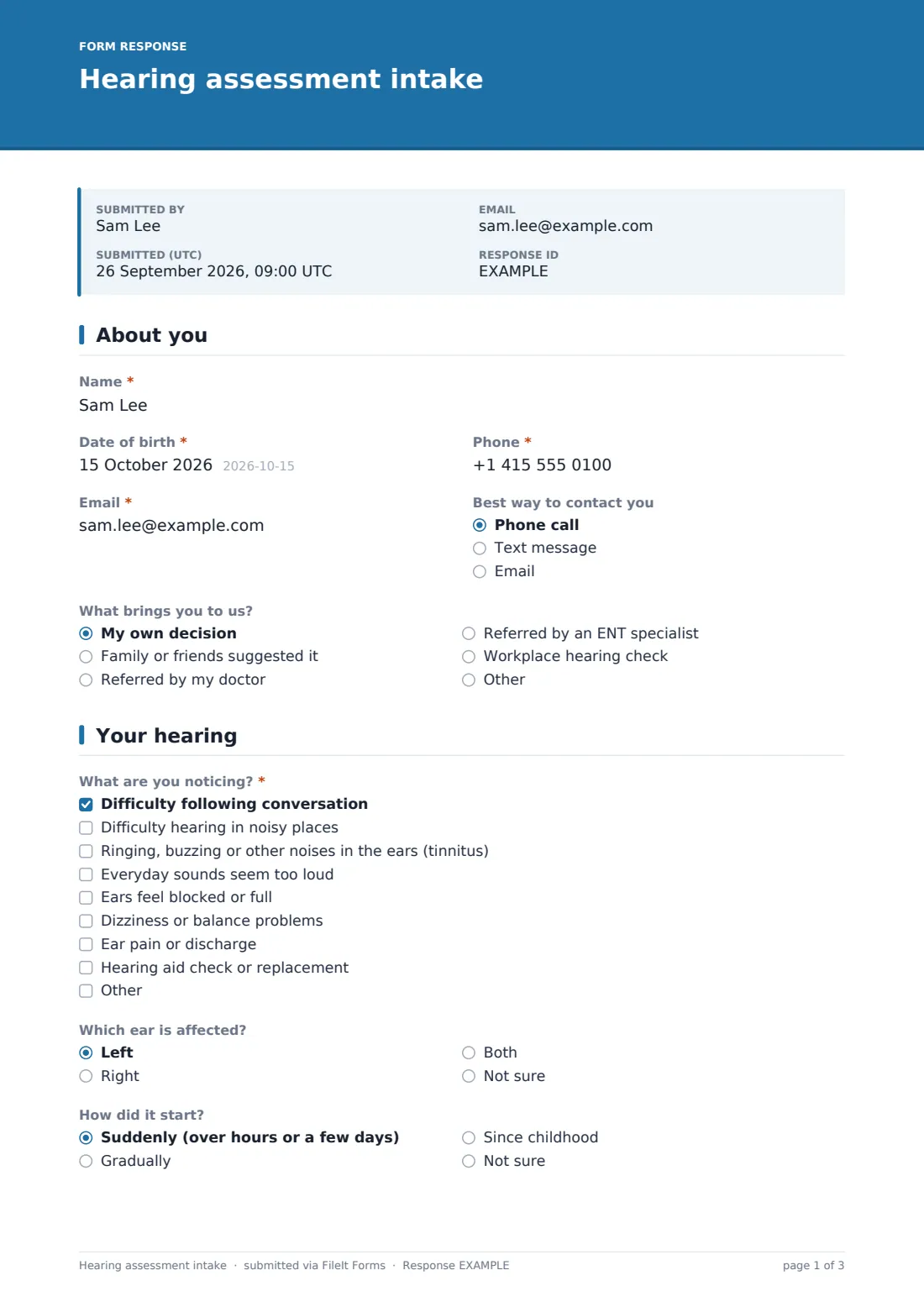
1 About you
- Name*
- Date of birth*
- Phone*
- Email*
- Best way to contact you Phone call · Text message · Email
- What brings you to us? My own decision · Family or friends suggested it · Referred by my doctor · Referred by an ENT specialist · Workplace hearing check
2 Your hearing
- What are you noticing?* Difficulty following conversation · Difficulty hearing in noisy places · Ringing, buzzing or other noises in the ears (tinnitus) · Everyday sounds seem too loud · Ears feel blocked or full · Dizziness or balance problems · Ear pain or discharge · Hearing aid check or replacement
- Which ear is affected? Left · Right · Both · Not sure
- How did it start? Suddenly (over hours or a few days) · Gradually · Since childhood · Not sure
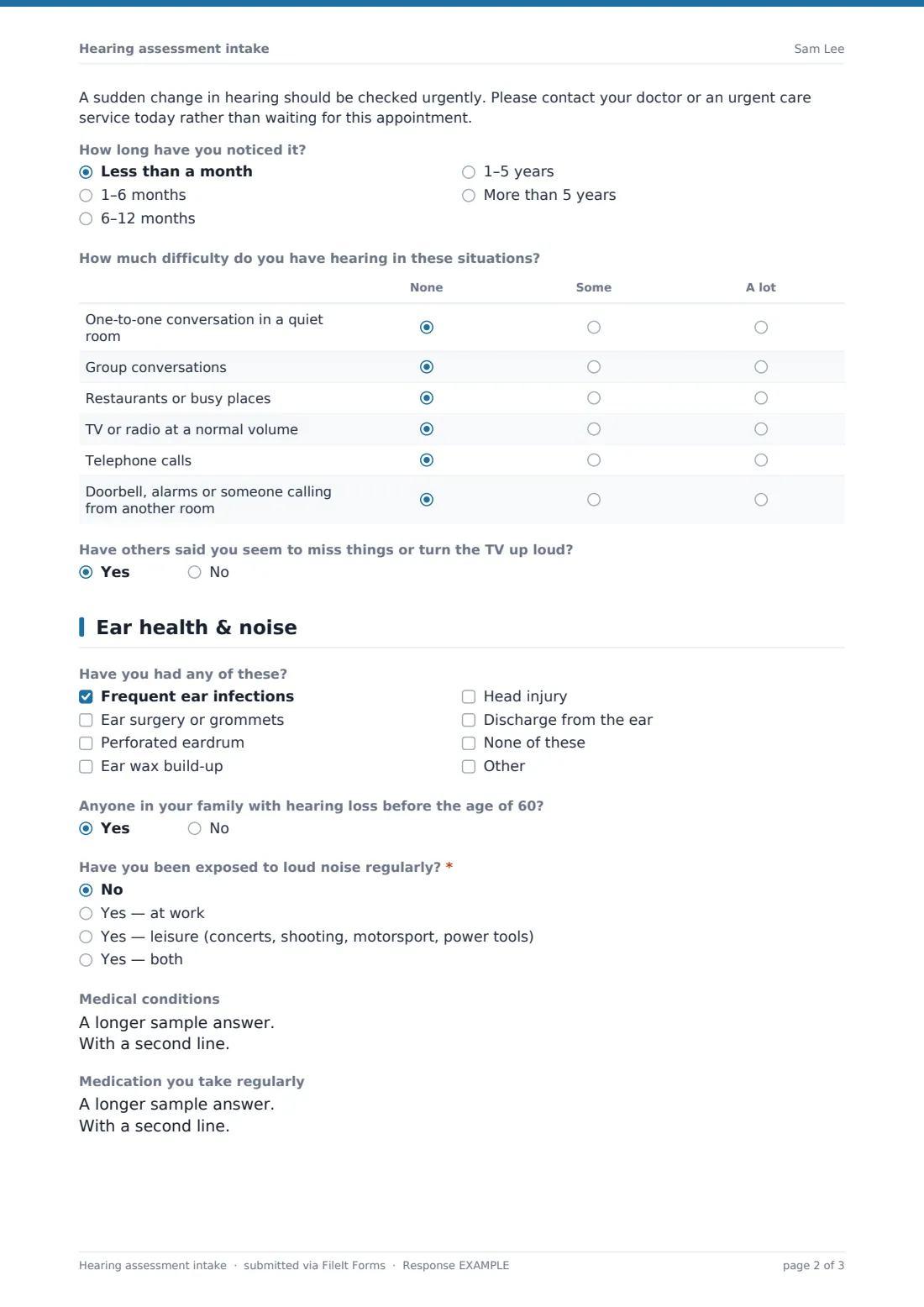
- How long have you noticed it? Less than a month · 1–6 months · 6–12 months · 1–5 years · More than 5 years
- How much difficulty do you have hearing in these situations? None · Some · A lot
- How much does the tinnitus bother you? asked only when it applies
- Have others said you seem to miss things or turn the TV up loud?
3 Ear health & noise
- Have you had any of these? Frequent ear infections · Ear surgery or grommets · Perforated eardrum · Ear wax build-up · Head injury · Discharge from the ear · None of these
- Anyone in your family with hearing loss before the age of 60?
- Have you been exposed to loud noise regularly?* No · Yes — at work · Yes — leisure (concerts, shooting, motorsport, power tools) · Yes — both
- What kind of noise, and for how long? asked only when it applies
- Did you usually wear hearing protection? asked only when it applies Always · Sometimes · Rarely or never
- Medical conditions
- Medication you take regularly
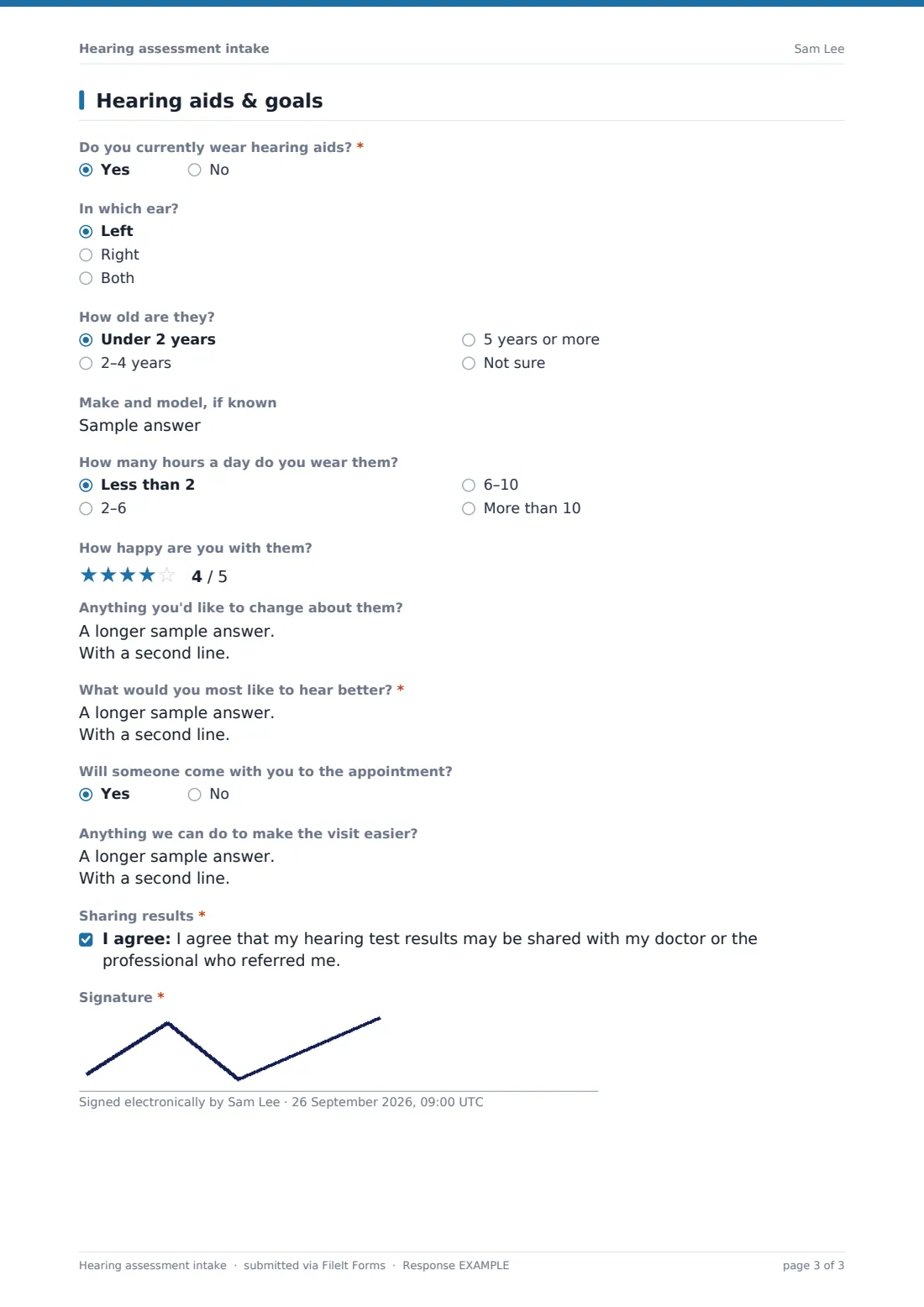
4 Hearing aids & goals
- Do you currently wear hearing aids?*
- In which ear? asked only when it applies Left · Right · Both
- How old are they? asked only when it applies Under 2 years · 2–4 years · 5 years or more · Not sure
- Make and model, if known asked only when it applies
- How many hours a day do you wear them? asked only when it applies Less than 2 · 2–6 · 6–10 · More than 10
- How happy are you with them? asked only when it applies
- Anything you'd like to change about them? asked only when it applies
- What would you most like to hear better?*
- Will someone come with you to the appointment?
- Anything we can do to make the visit easier?
- Sharing results*
- Signature*
The hearing assessment intake form, page by page
1 About you
Name, date of birth, phone, email and the best way to reach the patient — text and email are offered for people who find calls difficult — plus what brought them in, from their own decision to a doctor's or ENT referral.
2 Your hearing
Eight common concerns to tick, the ear affected, how it started and how long it's been noticeable. Choosing a sudden onset shows a note advising urgent medical contact. A grid rates difficulty in six everyday situations, a 0–10 scale appears for anyone reporting tinnitus, and a last question asks whether others have noticed.
3 Ear health & noise
Past ear infections, surgery, perforations, wax, head injury and discharge; family history of early hearing loss; and regular noise exposure at work or leisure. Anyone exposed is asked what kind of noise and whether they wore protection. Medical conditions and a full medication list close the page.
4 Hearing aids & goals
Current hearing aid wearers are asked which ear, how old the aids are, make and model, daily wearing time, a star rating and what they'd change. Everyone says what they most want to hear better, whether someone will come with them, and any access needs, then consents to results being shared with their doctor and signs.
Make the template yours
- Add your clinic's services, such as wax removal or custom ear protection, to the concerns list
- Include a funding or insurance question if appointments are covered by a health plan
- Add questions from a validated hearing handicap questionnaire if you use one
- Remove the hearing aid page for a screening-only service
- Route notifications to the audiologist who will see the patient
- File intakes into a per-patient folder in your vault
Tips for a better hearing assessment intake form
- Check the sudden-onset answer as soon as intakes arrive, and call the patient if it's ticked
- Use the situations grid to open the conversation about goals and hearing aid expectations
- Ask patients to bring a family member — the form already asks whether they will
- Offer text or email follow-up to patients who say calls are hard
- This form gathers history only; it is not a hearing test or a medical diagnosis
Every response becomes a PDF in your vault
The intake is saved as a signed PDF in your FileIt vault and you get an email notification. The patient can receive a copy of their answers.
Use the Responses table to prepare the day's appointment list, and export to CSV if you want to review referral sources or common concerns.
- Start from this template. It opens in the FileIt Forms designer — change any question, add pages, set the rules for when questions appear.
- Share it. Turn on a public link, or send it to people by email, each with their own link. They don’t need a FileIt account.
- Get the answers as PDFs. Each response is saved as a PDF in the vault folder you choose, with uploaded files attached — and listed in a Responses table you can export to CSV.
Hearing assessment intake form: frequently asked questions
Is this audiology intake form free?
Yes. It's part of FileIt's Forms app on every account, including the free plan.
What happens if a patient reports sudden hearing loss?
The form shows a note advising them to contact their doctor or urgent care the same day. It doesn't alert anyone automatically, so check new intakes promptly.
Do non-wearers see the hearing aid questions?
No. The questions about make, age, wearing time and satisfaction only appear when the patient says they currently wear hearing aids.
Can I add a standard hearing questionnaire?
Yes. Add a page with a grid or scale questions in the designer — the form is fully editable.
Does the patient need an account?
No. They open the link and submit without signing up.
Where are completed intakes stored?
Each submission is saved as a PDF in your FileIt vault and listed in the form's Responses table.