What is the notice to end tenancy form template?
Giving notice to end a tenancy usually means writing an email that tries to cover the move-out date, what happens to the keys, a forwarding address, and how the deposit should come back — and it's easy to leave something out. This template asks for all of it in order: the property and lease details, the notice and move-out date, where to send post and the deposit, and a signed confirmation.
Because the form adapts to the situation, a fixed-term tenant is asked for their lease end date while a month-to-month tenant isn't, and someone leaving because of a property issue gets a box to describe it while everyone else skips straight past. A question about being present at the move-out inspection, and how the tenant plans to return the keys, means the landlord has the practical details in hand as well as the formal notice itself.
Once signed, FileIt saves the whole notice as a PDF in the landlord's or agent's vault, giving both sides the same dated record of exactly what was agreed for moving out.
- Best for
- Tenants giving notice to end a residential tenancy
- Filled in by
- The tenant (or the lead tenant on a shared lease)
- Time to complete
- About 8-10 minutes
- Includes
- Conditional questions for fixed-term leases, property issues and bank details, plus a signature
Who uses a notice to end tenancy form?
- A tenant on a month-to-month or rolling tenancy giving standard notice to move out
- Someone on a fixed-term lease confirming they won't be renewing when the term ends
- A tenant who wants to flag a property issue, such as ongoing damp, as part of their reason for leaving
- Co-tenants on a shared lease coordinating one notice that names everyone who is leaving
- A tenant with a deposit split between several people, who wants to specify how it should be divided
- A landlord or agent who wants every departing tenant's notice, key return plan and forwarding address captured the same way
Questions on this notice to end tenancy form
27 questions over 4 pages · includes signature, conditional questions, multiple pages, consent checkbox.
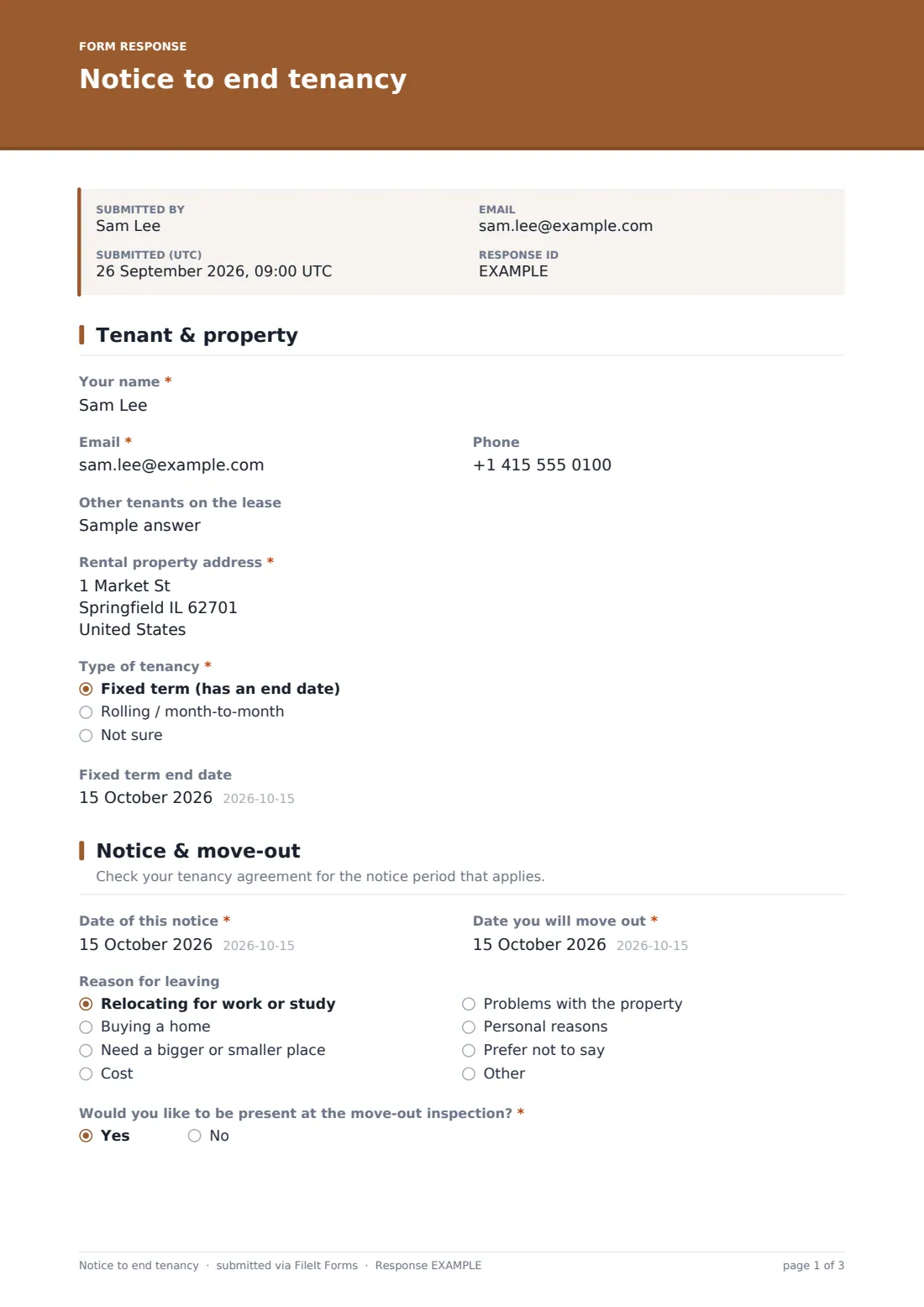
1 Tenant & property
- Your name*
- Email*
- Phone
- Other tenants on the lease
- Rental property address*
- Type of tenancy* Fixed term (has an end date) · Rolling / month-to-month · Not sure
- Fixed term end date asked only when it applies
2 Notice & move-out
- Date of this notice*
- Date you will move out*
- Reason for leaving Relocating for work or study · Buying a home · Need a bigger or smaller place · Cost · Problems with the property · Personal reasons · Prefer not to say
- Tell us about the problems asked only when it applies
- Would you like to be present at the move-out inspection?*
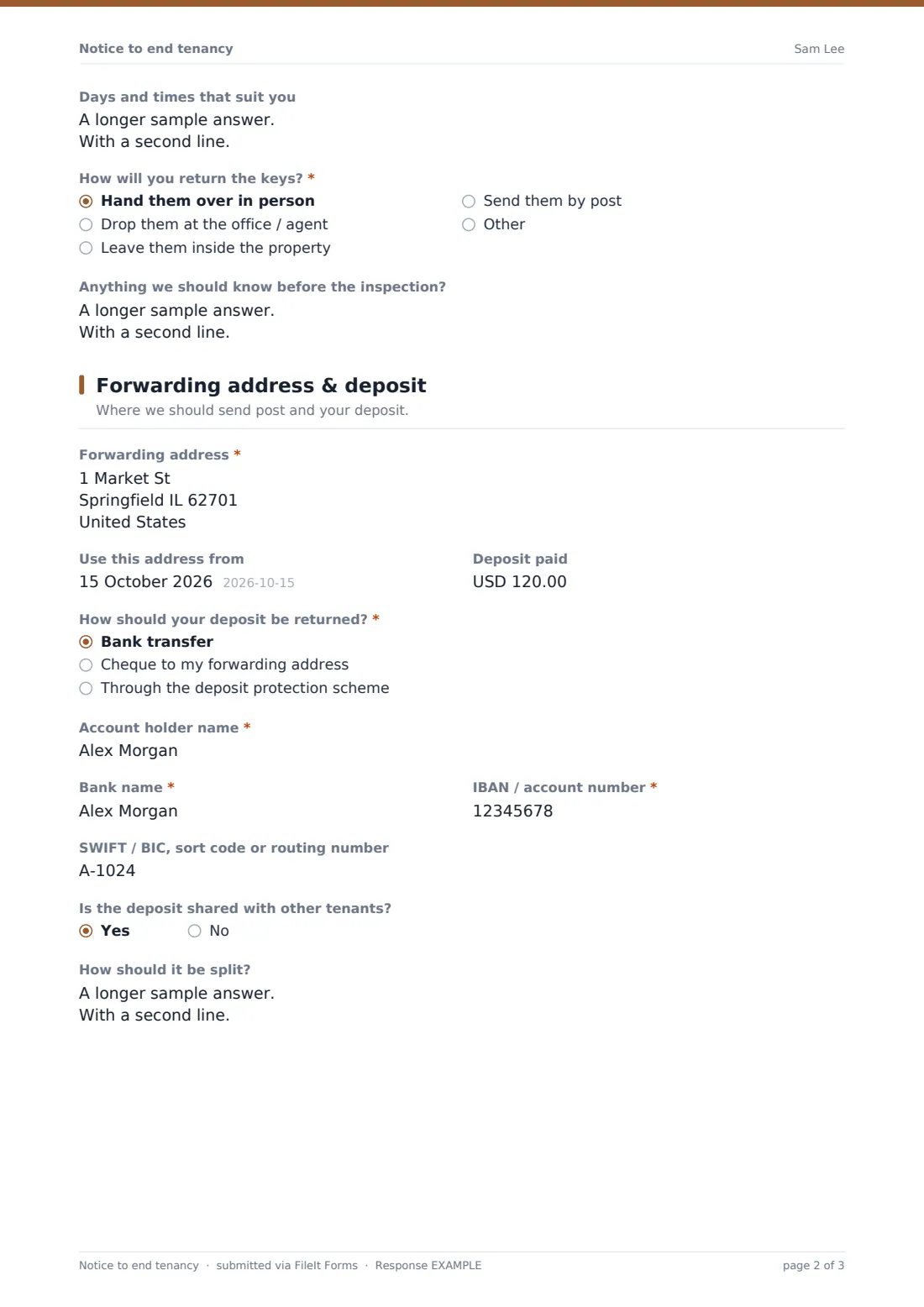
- Days and times that suit you asked only when it applies
- How will you return the keys?* Hand them over in person · Drop them at the office / agent · Leave them inside the property · Send them by post
- Anything we should know before the inspection?
3 Forwarding address & deposit
- Forwarding address*
- Use this address from
- Deposit paid
- How should your deposit be returned?* Bank transfer · Cheque to my forwarding address · Through the deposit protection scheme
- Account holder name* asked only when it applies
- Bank name* asked only when it applies
- IBAN / account number* asked only when it applies
- SWIFT / BIC, sort code or routing number asked only when it applies
- Is the deposit shared with other tenants?
- How should it be split? asked only when it applies
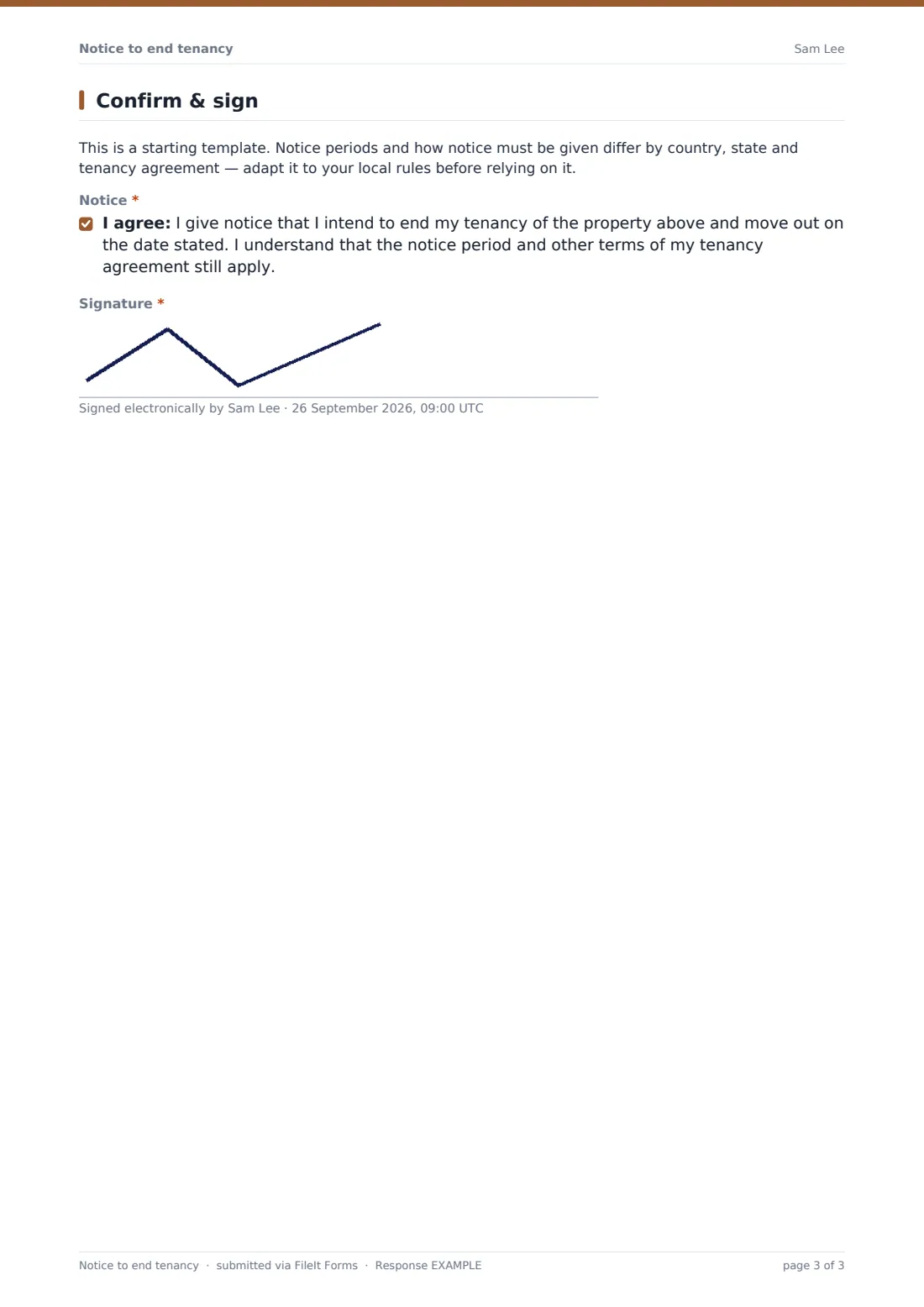
4 Confirm & sign
- Notice*
- Signature*
The notice to end tenancy form, page by page
1 Tenant & property
The tenant gives their name, email, phone, and any other tenants named on the lease who are also leaving, along with the rental property address. A tenancy-type question distinguishes a fixed-term lease from a rolling or month-to-month one, and choosing fixed-term opens a field for the lease's end date as written in the tenancy agreement.
2 Notice & move-out
The page reminds tenants to check their tenancy agreement for the notice period that applies, then records the date of the notice and the date they'll move out. An optional reason for leaving — relocating, buying a home, needing a different size property, cost, property issues, personal reasons, or preferring not to say — opens a details box specifically when property issues is chosen, giving the landlord useful context without making it compulsory.
A yes/no question asks whether the tenant wants to be present at the move-out inspection, opening a field for suitable days and times if so, and a further question asks how the keys will be returned — in person, dropped at the office, left inside the property, or sent by post. A final box lets the tenant flag anything the landlord should know before the inspection, such as needed repairs or items being left behind.
3 Forwarding address & deposit
The tenant provides a forwarding address for post and deposit correspondence, and when to start using it, along with the deposit amount paid if known. A deposit-return method — bank transfer, cheque to the forwarding address, or through a deposit protection scheme — opens bank account fields when transfer is chosen. If the deposit is shared with other tenants, a follow-up box lets the tenant describe how it should be split.
4 Confirm & sign
A clear note explains that notice periods and how notice must be given differ by country, state and tenancy agreement, and that the template should be adapted to local rules before relying on it. The tenant then gives formal notice to end the tenancy and move out on the stated date, confirming the rest of their tenancy agreement's terms still apply, and signs on screen.
Make the template yours
- Adjust the notice-period reminder and any deposit-scheme wording to match the rules that apply where the property is located
- Add a field for a specific move-out checklist or cleaning requirement your tenancy agreement includes
- Route notifications to the property manager or accounts team responsible for returning deposits
- File notices into a vault folder per property so the paperwork is easy to find alongside the original tenancy agreement
- Turn on an emailed PDF copy to the tenant so they have their own signed record of the notice they gave
- Set a closing date if you only want to accept notices submitted through this form during a specific period
- Add a co-signature requirement if all named tenants on a shared lease need to confirm the notice individually
Tips for a better notice to end tenancy form
- Check the tenancy agreement's required notice period before submitting, since it varies by lease and by location
- Give an accurate move-out date rather than an aspirational one — it affects when the inspection and deposit return can happen
- Flag any known repairs or damage ahead of the inspection rather than leaving it to be discovered on the day
- Provide a forwarding address that will actually be valid for as long as post or deposit correspondence might take
- If splitting a deposit among co-tenants, agree on the split in advance so the landlord isn't caught in the middle of a dispute
- Always check local landlord-tenant law or your written tenancy agreement — this template is a starting point, not legal advice
Every response becomes a PDF in your vault
As soon as the tenant signs, FileIt saves the notice as a PDF in the landlord's or agent's vault, and the account owner is notified by email. If an emailed copy to the respondent is switched on, the tenant also receives their own signed PDF for their records.
From there, most landlords and agents use the Responses table to track upcoming move-outs, schedule inspections around the dates and times tenants have proposed, and arrange the deposit return using the method and details given. Because everything is in one signed document, there's a clear record to refer back to if a question comes up later.
- Start from this template. It opens in the FileIt Forms designer — change any question, add pages, set the rules for when questions appear.
- Share it. Turn on a public link, or send it to people by email, each with their own link. They don’t need a FileIt account.
- Get the answers as PDFs. Each response is saved as a PDF in the vault folder you choose, with uploaded files attached — and listed in a Responses table you can export to CSV.
Notice to end tenancy form: frequently asked questions
Is this notice to end tenancy template free?
Yes. It's included in FileIt's Forms app on every plan, including free, and every question can be edited to match your own process.
Does the tenant need a FileIt account to give notice?
No. Share the form by public link or send it by email — tenants don't need a FileIt account to submit their notice.
Is this notice legally valid wherever I live?
No — notice periods and the way notice must be given differ by country, state and tenancy agreement. Check your own lease and local landlord-tenant rules and adapt the wording before relying on it.
How do I get a copy of a submitted notice?
Every submission is saved automatically as a signed PDF in the vault, and you can turn on an emailed PDF copy sent to the tenant too.
What if my tenancy doesn't have a fixed end date?
Choose "rolling / month-to-month" as the tenancy type and the fixed-term end date question is skipped automatically.
Can more than one tenant on the same lease use this form?
One tenant can name the others leaving with them in the co-tenants field, or each tenant can submit their own notice if your landlord requires that.
How is the deposit actually returned?
The form records the tenant's preferred method — bank transfer, cheque, or through a deposit protection scheme — but the landlord or agent still needs to action the return separately.