What is Form P1 pension sharing annex?
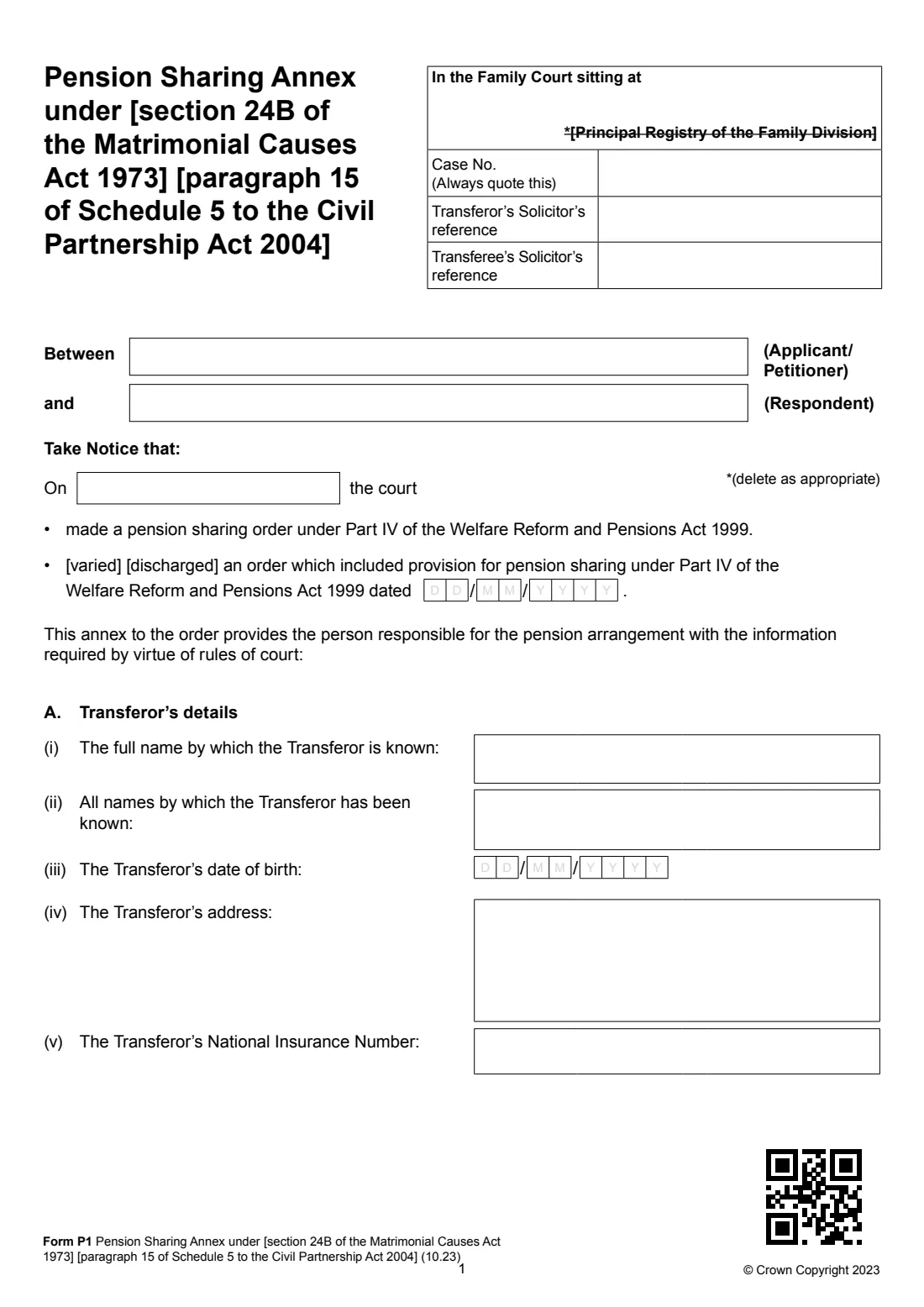
Form P1 is the Pension Sharing Annex used in the Family Court in England and Wales. When a court makes, varies or discharges a pension sharing order on divorce, dissolution or nullity, this annex goes with the order. It gives the person responsible for the pension arrangement (usually the scheme's trustees, administrator or provider) the information the rules of court require: who the transferor and transferee are, which pension is being shared, and the percentage of its cash equivalent value (CEV) to be transferred.
The transferor is the scheme member whose pension is being shared; the transferee is the former spouse or civil partner who receives the pension credit. The annex also records who pays the pension sharing charges, whether Form D81 has been filed, whether the transferee prefers an internal or external transfer, and the direction to the scheme about the implementation period. If the State Pension is being shared, it records the shared weekly amount instead.
The printed form is full of 'delete as appropriate' wording. FileIt asks plain questions and strikes through the wording that doesn't apply — the marriage or civil partnership Act, made / varied / discharged, the charges option, the parties' certificate and paragraph 1 or 2 — then prints your answers into the official HMCTS PDF. You file it yourself with the order; FileIt never submits anything to the court or the pension scheme.
- Who fills it
- Usually the solicitor or party drafting the pension sharing order (a litigant in person can complete it)
- Used in
- The Family Court in England and Wales, with a financial order on divorce, dissolution or nullity
- Goes with
- The pension sharing order (often a consent order with Form D81); a separate annex for each pension shared
- Signatures
- None on the annex itself
- Edition
- P1 (10.23)
- Pages
- 5
Who needs to fill out Form P1 pension sharing annex?
- Separating spouses or civil partners whose financial settlement shares one or more pensions.
- Solicitors and mediators drafting a consent order that includes a pension sharing order.
- People representing themselves who need to send the court a complete draft order with its annex.
- Parties to an order that varies or discharges an earlier order that included pension sharing.
- Couples sharing the new State Pension (shared weekly amount), where the rules on the form apply.
When to use Form P1 pension sharing annex
- When the court is asked to make a pension sharing order as part of a financial remedy on divorce, dissolution or nullity — usually lodged with the draft order.
- When an existing order that included provision for pension sharing is varied or discharged.
- Once for each pension arrangement being shared: each scheme needs its own annex.
What you need before you start
- The court's name, the case number and both solicitors' references.
- The full names, all previous names, dates of birth, addresses and National Insurance numbers of both parties.
- The pension's name, the name and address of the person responsible for it, and the reference number, from the scheme's cash equivalent (CEV) statement.
- The agreed or ordered percentage of the CEV to transfer (or, for the State Pension, the shared weekly amount).
- Who pays the scheme's pension sharing charges, and in what shares if they're split.
- Whether Form D81 (Statement of Information for a Consent Order) has been filed.
- For an external transfer: the receiving arrangement's name, address, the transferee's policy number and an adviser or contact, plus the arrangement's letter agreeing to accept the credit.
What’s on Form P1 pension sharing annex
The 2023 edition has 5 pages. FileIt asks for it in 8 parts:
- The court and the orderParty or solicitor preparing the annex
- A. Transferor's detailsParty or solicitor preparing the annex
- B. Transferee's detailsParty or solicitor preparing the annex
- C. The transferor's pension arrangementParty or solicitor preparing the annex
- D to F. Charges, Form D81 and the type of transferParty or solicitor preparing the annex
- G. External transfer detailsParty or solicitor preparing the annex
- H to J. Further information for the schemeParty or solicitor preparing the annex
- Implementation periodParty or solicitor preparing the annex
How to fill out Form P1 pension sharing annex, step by step
1 The court and the order
Enter the Family Court hearing centre, the case number, both solicitors' references and the parties as named in the case (applicant and respondent). Say whether the proceedings concern a marriage or a civil partnership: FileIt strikes through the Act that doesn't apply in the title, in the box E certificate and in paragraph 1.
Then give the date of the order and whether the court made a pension sharing order, or varied or discharged an earlier order that included pension sharing — with the earlier order's date. The options not chosen are struck through.
2 A and B — the transferor and the transferee
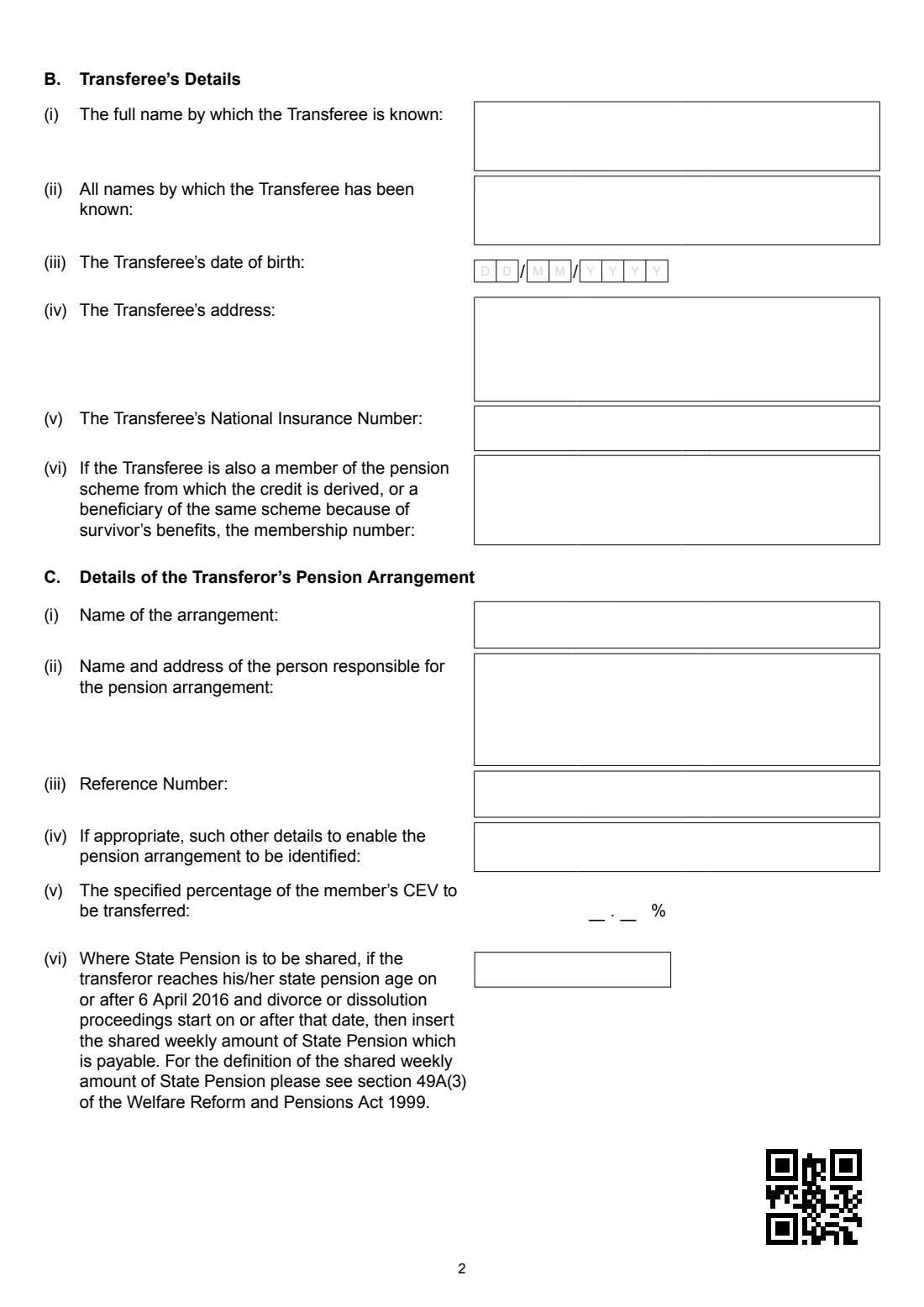
For each party: the full name they're known by, every name they've been known by, date of birth, address and National Insurance number. If the transferee is also a member of the same scheme (or a beneficiary because of survivor's benefits), add their membership number.
3 C — the pension arrangement
The name of the arrangement, the name and address of the person responsible for it, the reference number and any other details that identify it. Then the specified percentage of the member's CEV to be transferred, up to two decimal places. Where the State Pension is shared (the transferor reaches State Pension age on or after 6 April 2016 and the proceedings started on or after that date), give the shared weekly amount instead.
4 D to F — charges, Form D81 and the type of transfer
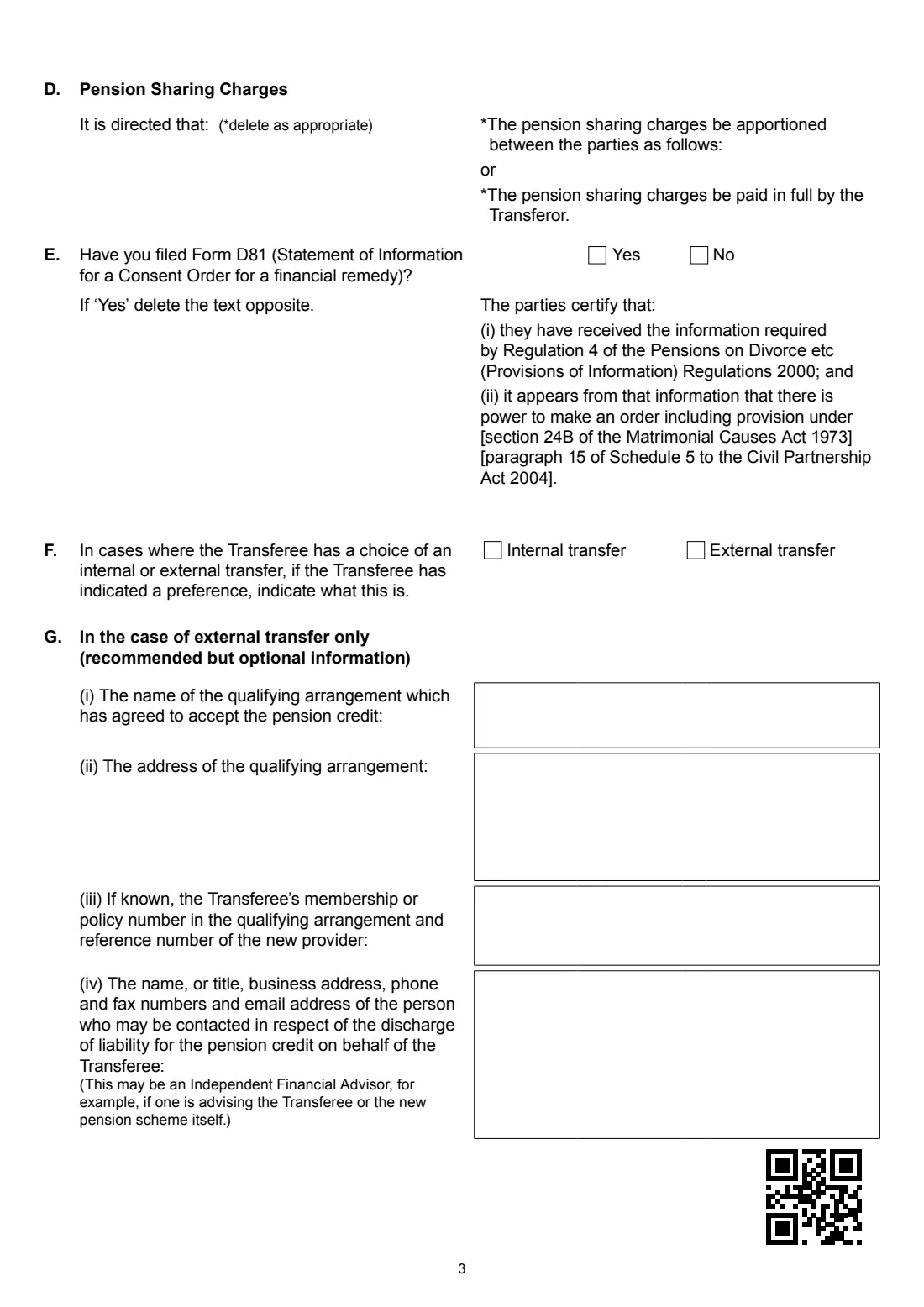
Choose whether the pension sharing charges are apportioned between the parties (and give each share) or paid in full by the transferor. Say whether you have filed Form D81: if you have, the parties' certificate in box E is struck through, as the form asks. Finally, if the transferee has a choice and has said which they prefer, tick internal or external transfer.
5 G — external transfer details
Recommended but optional, and only for an external transfer: the qualifying arrangement that has agreed to accept the pension credit, its address, the transferee's policy or membership number and the new provider's reference, and who can be contacted about discharging the liability — often an independent financial adviser. Tick (v) if the arrangement's letter agreeing to accept the credit is attached.
6 H to J — further information
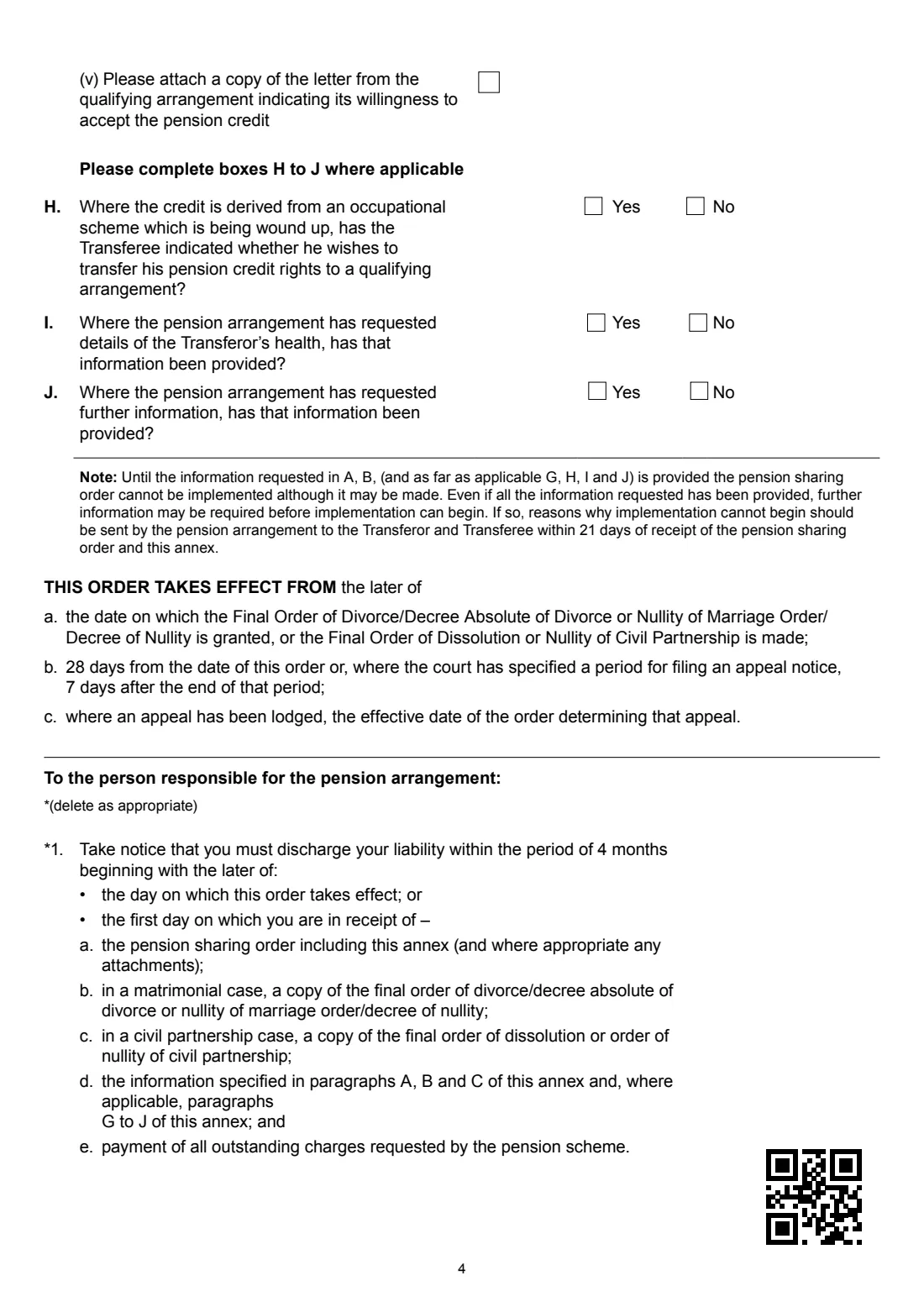
Answer where they apply: whether the transferee has said if they want to transfer credit rights from an occupational scheme that's being wound up, and whether health details or other information the scheme asked for have been provided. The note on the form explains that the order can be made but not implemented until the information in A, B and (where applicable) G to J is provided.
7 The direction to the pension scheme
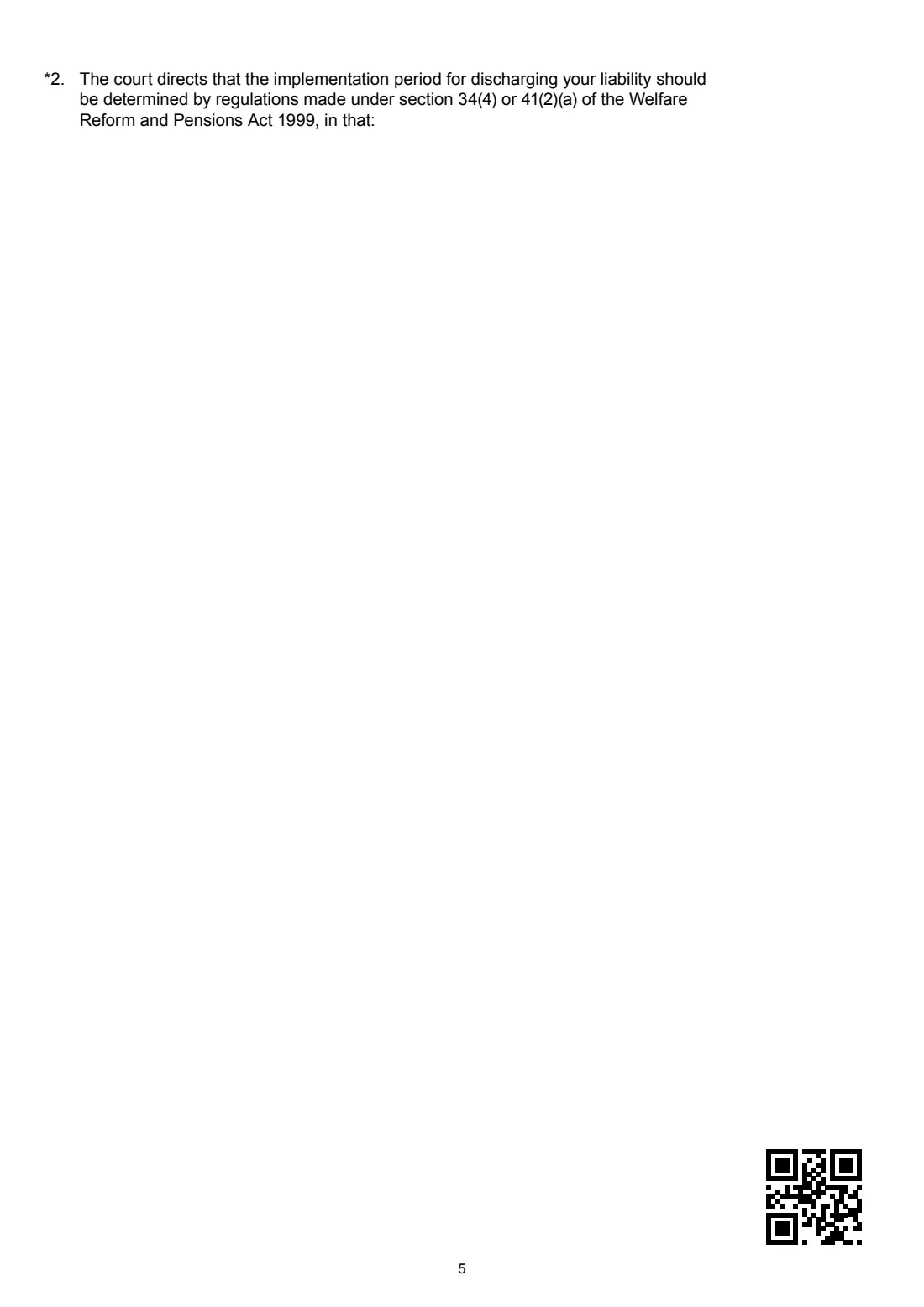
Paragraph 1 is the usual direction: the scheme must discharge its liability within 4 months of the later of the day the order takes effect and the day it receives the order and annex, the final order of divorce, dissolution or nullity, the information in A to C (and G to J where they apply) and payment of its charges. Paragraph 2 is used where the implementation period is to be set by regulations under the Welfare Reform and Pensions Act 1999; FileIt prints your explanation under it. The paragraph not used is struck through.
Common mistakes to avoid
- Using one annex for two pensions. Each pension arrangement needs its own Form P1.
- Copying the scheme name or reference loosely — use the exact details from the scheme's CEV statement so it can identify the member.
- Giving a percentage that doesn't match the order, or more than two decimal places.
- Leaving the 'delete as appropriate' wording in place. The Act, made / varied / discharged, the charges option and paragraph 1 or 2 should each show only what applies.
- Forgetting to delete the parties' certificate in box E when Form D81 has been filed (FileIt does this when you answer Yes).
- Leaving out the information in parts A and B. The note on the form says the order cannot be implemented until it is provided.
After you fill it out
Check every page of the PDF, especially the percentage, the names and the struck-through wording, and agree it with the other party or their solicitor.
Lodge it with the draft order (and Form D81 where it applies) as your court or solicitor directs. After the order is made, the pension scheme needs the sealed order, this annex and the final order of divorce, dissolution or nullity to start implementing the share. FileIt doesn't file or send anything.
Keep the completed annex, the CEV statement and the sealed order together in each party's FileIt folder, and note the implementation period so you can chase the scheme if it runs over.
Fill out Form P1 pension sharing annex online with FileIt
- Pick the person. Choose someone from People and FileIt fills in their name, date of birth, address and other details it already knows.
- Answer plain-language questions. One part of the form at a time, with the official help text beside each question — 56 fields in all. Your answers save as you go.
- Check the live preview. Watch your answers land on the real HM Courts & Tribunals Service (Family Court) form, and let FileIt do any worksheet arithmetic.
- Generate the official PDF. FileIt prints your answers into the agency’s own PDF and files it in that person’s folder in your vault.
FileIt fills the form — it never files or submits anything for you. Deliver the finished form to whoever asked for it, the way the form’s instructions say.
Start Form P1 pension sharing annex now — it’s freeForm P1 pension sharing annex: frequently asked questions
What is Form P1 used for?
It is the Pension Sharing Annex that goes with a pension sharing order made by the Family Court on divorce, dissolution or nullity in England and Wales. It gives the pension scheme the information it needs to share the pension.
Who is the transferor and who is the transferee?
The transferor is the scheme member whose pension is being shared. The transferee is the former spouse or civil partner who receives the pension credit.
Do I need a separate Form P1 for each pension?
Yes. Each pension arrangement being shared needs its own annex.
What does 'delete as appropriate' mean on Form P1?
The form prints alternatives in brackets or with asterisks — for example the marriage or civil partnership Act, made / varied / discharged, and who pays the charges. The wording that doesn't apply should be crossed out. FileIt strikes it through for you based on your answers.
What if Form D81 has been filed?
Box E says that if you answer Yes, the parties' certificate opposite should be deleted. FileIt strikes it through when you say D81 has been filed.
Can Form P1 be used to share the State Pension?
Section C(vi) covers the State Pension: where the transferor reaches State Pension age on or after 6 April 2016 and the proceedings started on or after that date, you insert the shared weekly amount of State Pension. A valuation is available from DWP on form BR20.
Does FileIt send the annex to the court or the pension scheme?
No. FileIt prepares the official PDF with your answers. You or your solicitor lodge it with the court and send it to the scheme.
Official sources
- Blank form (PDF), published by HM Courts & Tribunals Service (Family Court): https://assets.publishing.service.gov.uk/media/653247d1e839fd0014867239/Form_P1_1023.pdf
- Official instructions and guidance: https://www.gov.uk/government/publications/make-or-change-a-pension-sharing-order-form-p1
- Edition shown on this page: P1 (10.23) (checked 2026-09-28).
FileIt is not affiliated with or endorsed by HM Courts & Tribunals Service (Family Court) or any government. This page explains the form in general terms and is not legal, tax or immigration advice. Always read the official instructions, and check that you are using the edition the recipient accepts. Page last reviewed 2026-09-28.