
What is BR20NSP State Pension valuation on divorce?
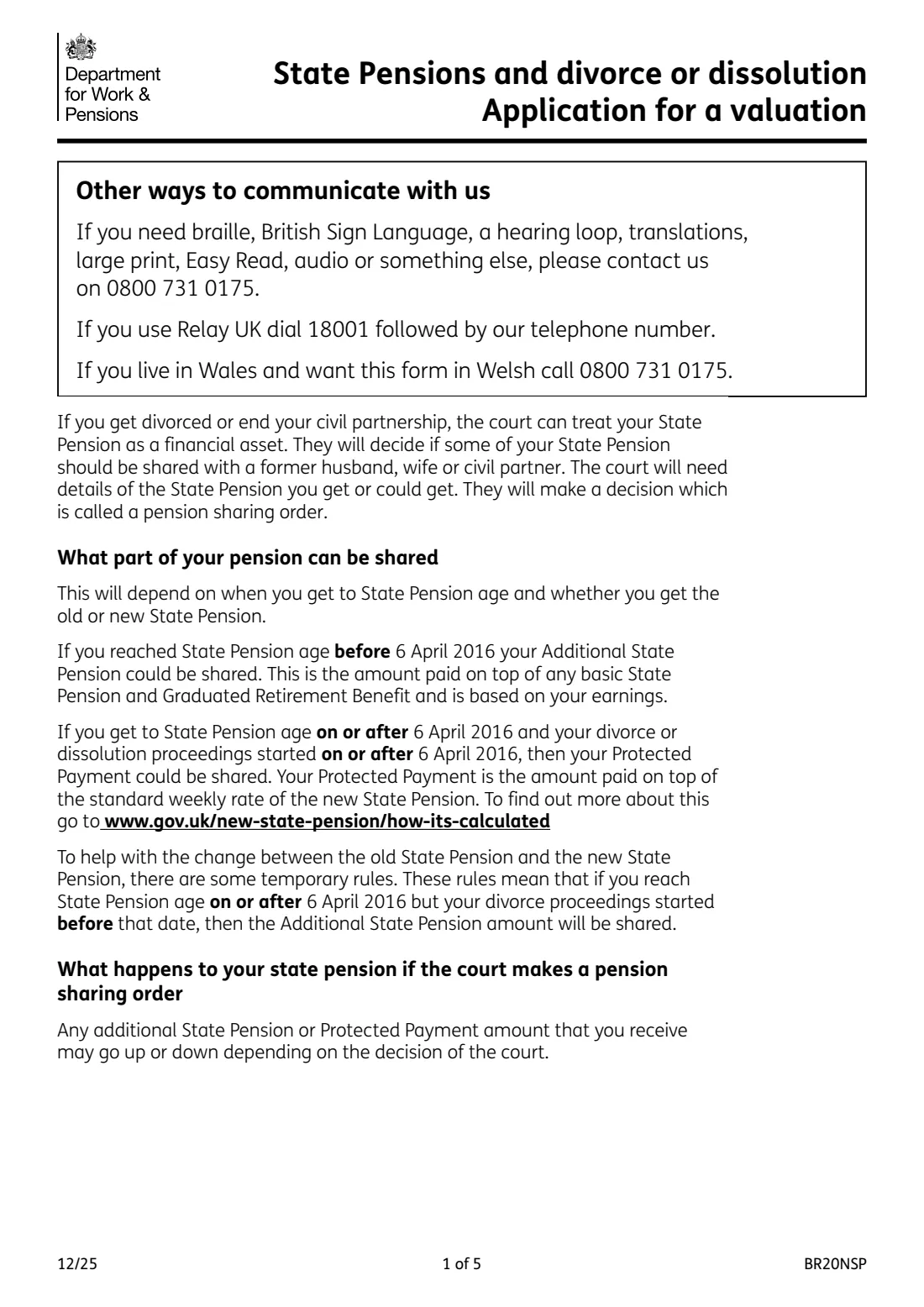
When you divorce or end a civil partnership, the court can treat your State Pension as a financial asset and decide whether some of it should be shared with your former husband, wife or civil partner through a pension sharing order. To do that, the court needs a valuation. Form BR20NSP (the form GOV.UK lists as BR20) asks the Department for Work and Pensions to work out that valuation, which it calls a Cash Equivalent Value, and send it to you in a valuation letter.
Not all of the State Pension can be shared. If you reached State Pension age before 6 April 2016, the shareable part is your Additional State Pension. If you reach State Pension age on or after 6 April 2016 and the proceedings started on or after that date, it is your Protected Payment — the amount above the standard weekly rate of the new State Pension. Temporary rules mean the Additional State Pension is shared if you reach State Pension age on or after 6 April 2016 but the divorce started before that date. That is why DWP says the date proceedings started (question 8) is so important.
Both people in the divorce or dissolution need to fill in their own copy. FileIt guides you through the 21 questions, works out Scotland's 'relevant date' for you, and prints your answers into DWP's own BR20NSP PDF. Details can be pre-filled from the People records in your FileIt vault, and the completed form is saved in your folder. You print it, sign it and post it yourself; FileIt never submits it.
- Who fills it
- Each person in the divorce or dissolution, on their own copy
- Sent to
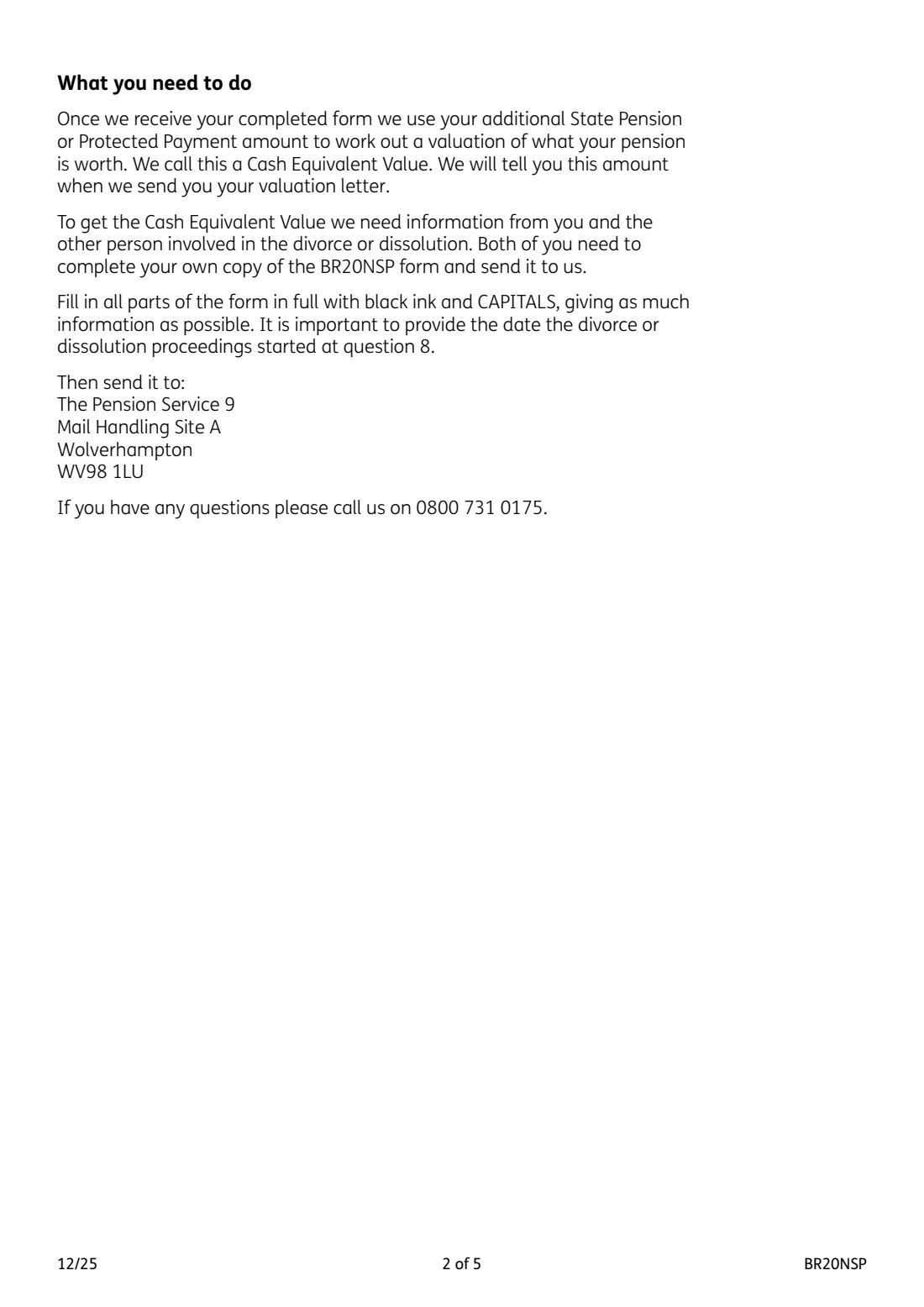
- The Pension Service 9, Mail Handling Site A, Wolverhampton, WV98 1LU
- What you get
- A valuation letter with the Cash Equivalent Value of the shareable part of your State Pension
- Questions
- Call the Pension Service on 0800 731 0175 (free from mobiles and landlines)
- Signatures
- The applicant signs and dates the declaration by hand
- Edition
- BR20NSP 12/25 (Version 2)
Who needs to fill out BR20NSP State Pension valuation on divorce?
- People going through a divorce, or the dissolution of a civil partnership, whose financial settlement may include sharing a State Pension.
- Both spouses or civil partners — DWP needs information from each of you, on separate copies of the form.
- Solicitors and legal advisers helping a client get the State Pension valuation a court needs (they can be named to receive it).
- People divorcing under Scottish law, who also give the 'relevant date' at question 9.
When to use BR20NSP State Pension valuation on divorce
- Once divorce or dissolution proceedings have started, when the court or your solicitor needs a value for the State Pension as part of the financial settlement.
- Early in the financial side of the case, so the Cash Equivalent Value is ready when the court considers a pension sharing order.
- Each of you sends your own form — the valuation needs details from both people.
What you need before you start
- Your name, National Insurance number, date of birth, address and a phone number.
- Whether you have ever worked or paid National Insurance in the Isle of Man.
- The date the divorce or dissolution proceedings started — DWP says this is important.
- Under Scottish law: the date you stopped living together and the date the summons was served (the earlier one is the relevant date).
- Your spouse's or civil partner's name, National Insurance number (if you know it), date of birth and address, and the date of your marriage or civil partnership.
- If you want the valuation sent to someone else: your solicitor's or adviser's name, organisation, address, phone number and reference.
What’s on BR20NSP State Pension valuation on divorce
The 2025 edition has 5 pages. FileIt asks for it in 5 parts, and it is signed by Applicant:
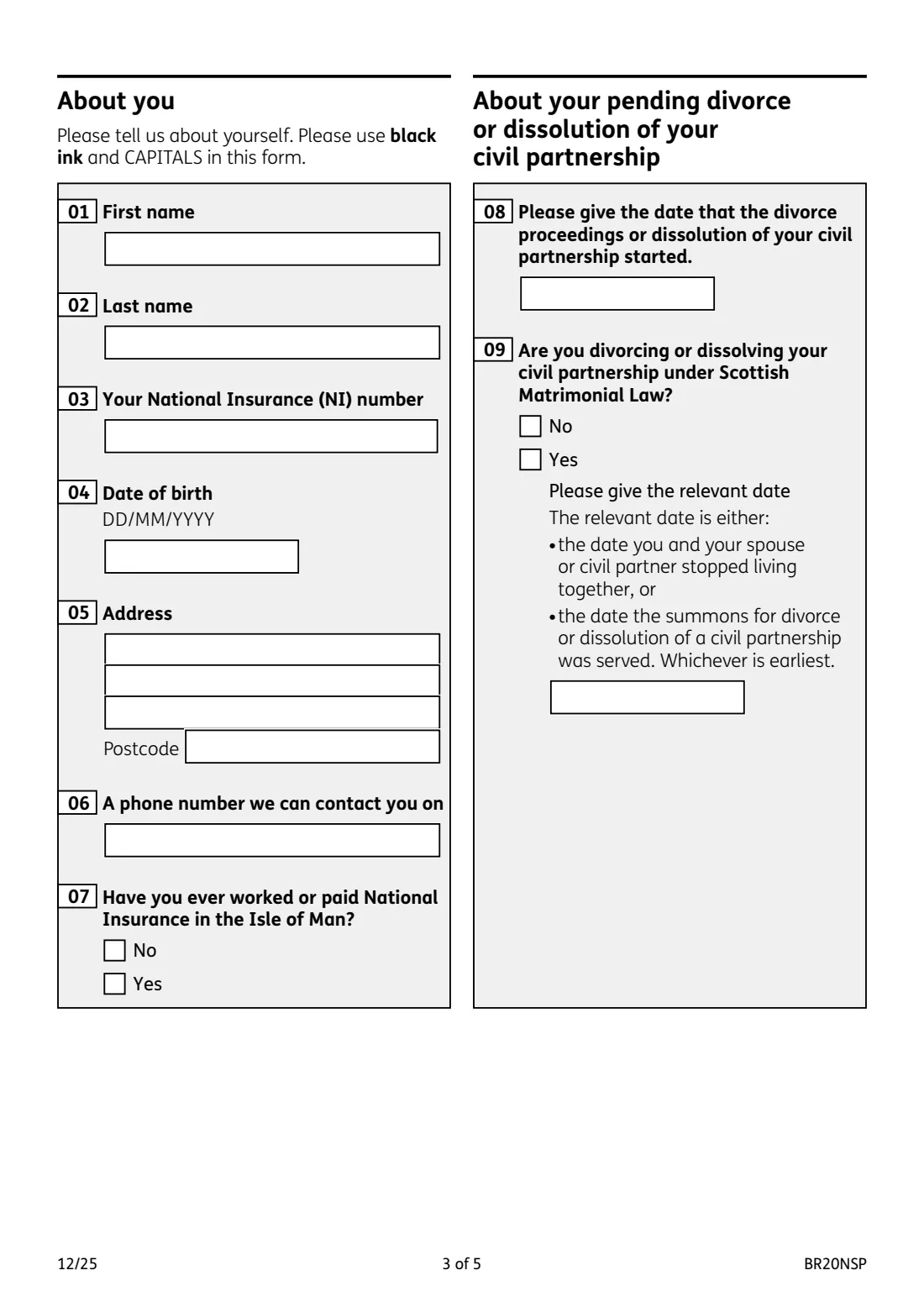
- About you (01–07)Applicant
- About your pending divorce or dissolution (08–09)Applicant
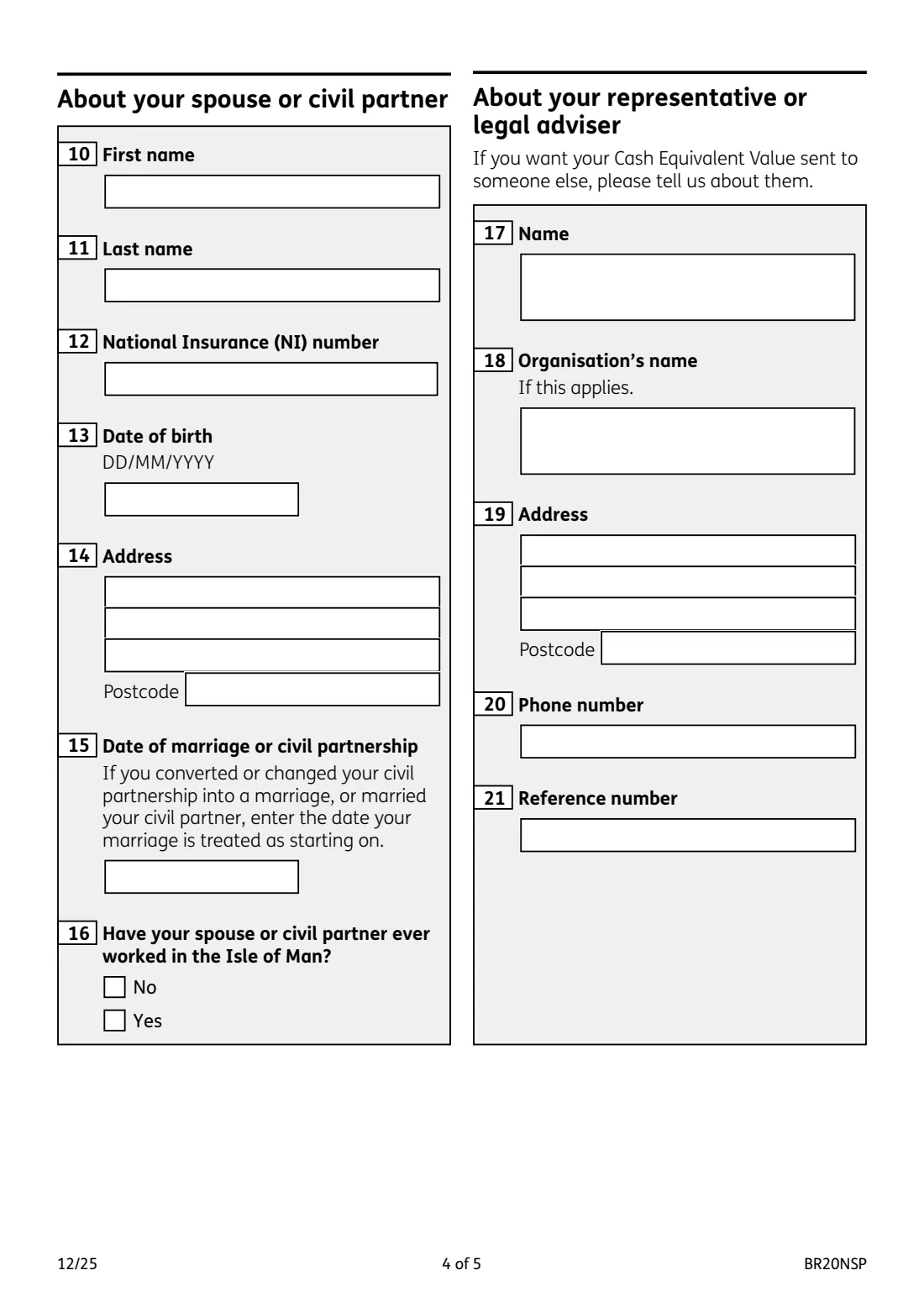
- About your spouse or civil partner (10–16)Applicant
- Your representative or legal adviser (17–21)Applicant
- DeclarationApplicant
How to fill out BR20NSP State Pension valuation on divorce, step by step
1 About you (questions 01 to 07)
Your first and last name, National Insurance number, date of birth, address and a phone number DWP can reach you on. Question 07 asks whether you have ever worked or paid National Insurance in the Isle of Man.
2 About your pending divorce or dissolution (questions 08 and 09)
Question 08 is the date the divorce or dissolution proceedings started. It decides whether your Additional State Pension or your Protected Payment is valued, so give the exact date from your court papers.
Question 09 asks whether you are divorcing or dissolving your civil partnership under Scottish law. If so, give the relevant date: whichever is earlier of the date you and your spouse or civil partner stopped living together and the date the summons was served. FileIt asks for both and prints the earlier one.
3 About your spouse or civil partner (questions 10 to 16)
Their first and last name, National Insurance number, date of birth and address, and the date of your marriage or civil partnership. If you converted a civil partnership into a marriage, or married your civil partner, use the date your marriage is treated as starting on. Question 16 asks whether they have ever worked in the Isle of Man.
4 About your representative or legal adviser (questions 17 to 21)
Only if you want your Cash Equivalent Value sent to someone else, such as your solicitor: their name, organisation (if any), address, phone number and reference number.
5 Declaration
You declare that the information is correct and complete as far as you know and believe, then sign and date the form by hand. DWP also reminds you that if you include another adult's personal information you should let them know.
Common mistakes to avoid
- Only one of you sending a form. Both people need to complete and send their own copy.
- Leaving out, or guessing, the date proceedings started. DWP specifically asks for it because it decides which part of the pension is valued.
- Under Scottish law, giving the later of the two dates. The relevant date is whichever is earlier.
- Using the date of a civil partnership when it was later converted into a marriage — give the date the marriage is treated as starting on.
- Filling in the representative section when you want the valuation sent to you. Leave it blank unless someone else should receive it.
- Forgetting to sign and date the declaration.
After you fill it out
Print the BR20NSP from FileIt, check every page, and sign and date the declaration on page 5.
Post it to The Pension Service 9, Mail Handling Site A, Wolverhampton, WV98 1LU. FileIt doesn't send it for you. Make sure your spouse or civil partner sends theirs too.
DWP works out the Cash Equivalent Value and sends it in a valuation letter, to you or to the representative you named. Keep the letter and a copy of the form in your FileIt folder for your solicitor and the court. If the court makes a pension sharing order, any Additional State Pension or Protected Payment you receive may go up or down.
Fill out BR20NSP State Pension valuation on divorce online with FileIt
- Pick the person. Choose someone from People and FileIt fills in their name, date of birth, address and other details it already knows.
- Answer plain-language questions. One part of the form at a time, with the official help text beside each question — 36 fields in all. Your answers save as you go.
- Check the live preview. Watch your answers land on the real Department for Work and Pensions (DWP) — The Pension Service form, and let FileIt do any worksheet arithmetic.
- Generate the official PDF. FileIt prints your answers into the agency’s own PDF and files it in that person’s folder in your vault. Sign it, or send it for e-signature.
FileIt fills the form — it never files or submits anything for you. Deliver the finished form to whoever asked for it, the way the form’s instructions say.
Start BR20NSP State Pension valuation on divorce now — it’s freeBR20NSP State Pension valuation on divorce: frequently asked questions
Is BR20NSP the same as form BR20?
Yes. GOV.UK's page for 'State Pension: valuation on divorce or dissolution' links this form, which is printed as BR20NSP.
What is a Cash Equivalent Value?
It is DWP's valuation of what the shareable part of your State Pension is worth — your Additional State Pension or your Protected Payment. The court uses it when deciding whether to make a pension sharing order.
Can the whole State Pension be shared on divorce?
No. Depending on when you reach State Pension age and when proceedings started, only the Additional State Pension or the Protected Payment (the amount above the standard new State Pension rate) can be shared.
Do both of us need to fill in the form?
Yes. DWP needs information from both people, and each of you completes your own copy of the BR20NSP.
What is the relevant date in Scotland?
For a divorce or dissolution under Scottish law, it's whichever is earlier: the date you stopped living together, or the date the summons was served.
Can the valuation go to my solicitor?
Yes. Fill in the representative or legal adviser section (questions 17 to 21) and DWP will send the Cash Equivalent Value to them.
Where do I send the BR20NSP?
The Pension Service 9, Mail Handling Site A, Wolverhampton, WV98 1LU. For questions, call 0800 731 0175.
Official sources
- Blank form (PDF), published by Department for Work and Pensions (DWP) — The Pension Service: https://assets.publishing.service.gov.uk/media/6960e32fd71fc48238c11791/BR20NSP.pdf
- Official instructions and guidance: https://www.gov.uk/government/publications/application-for-a-state-pension-forecast-on-divorce-or-dissolution-br20
- Edition shown on this page: BR20NSP 12/25 (Version 2) (checked 2026-09-28).
FileIt is not affiliated with or endorsed by Department for Work and Pensions (DWP) — The Pension Service or any government. This page explains the form in general terms and is not legal, tax or immigration advice. Always read the official instructions, and check that you are using the edition the recipient accepts. Page last reviewed 2026-09-28.