What is BR1 State Pension claim?
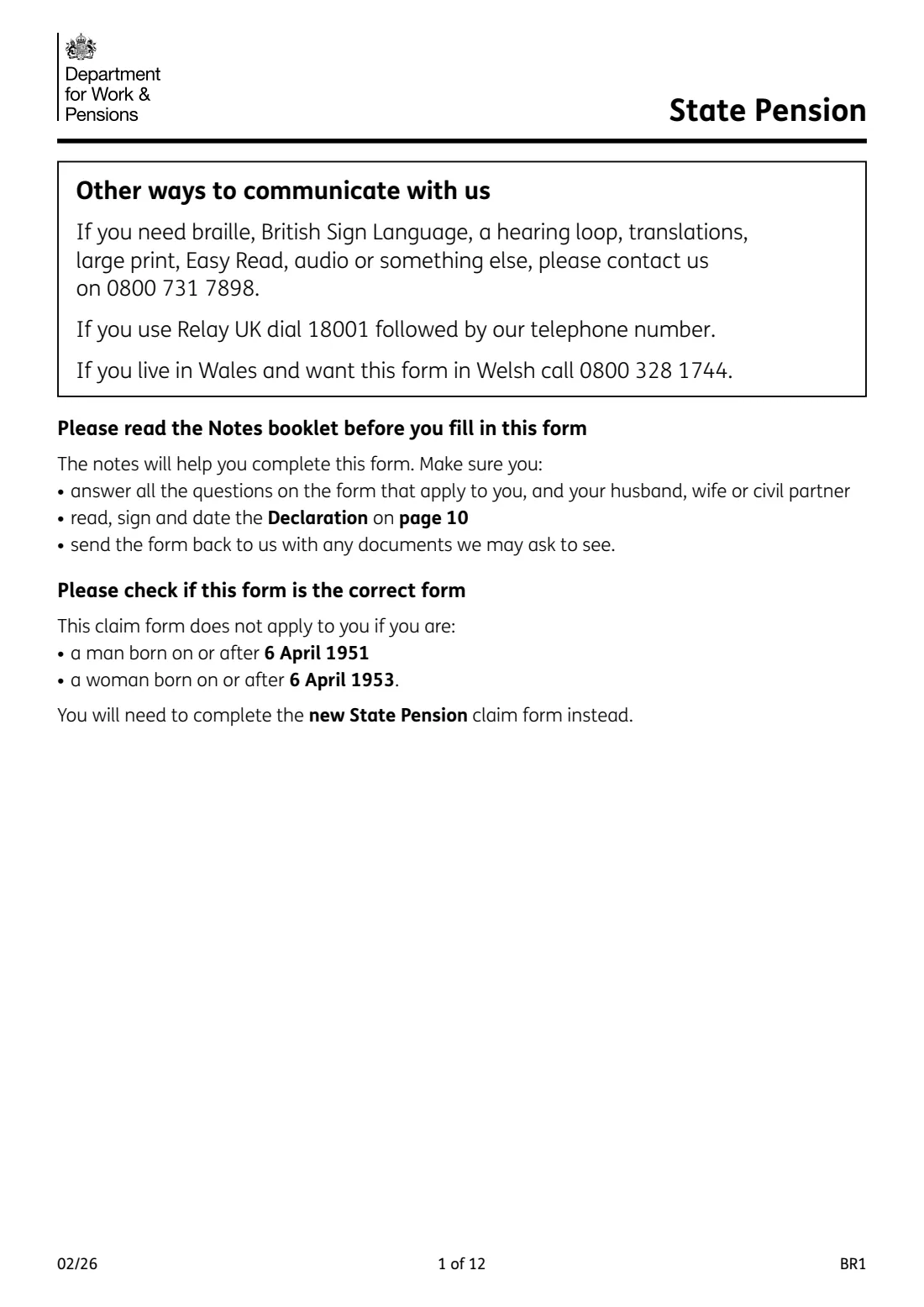
Form BR1 is the Department for Work and Pensions (DWP) claim form for the State Pension under the older, pre-2016 rules — often called the basic State Pension. It is handled by the Pension Service. The form is only for a man born before 6 April 1951 or a woman born before 6 April 1953; anyone born on or after those dates needs the new State Pension claim form instead.
Everyone the BR1 covers has already reached State Pension age, so today it is mostly used by people who put off (deferred) claiming, or never got round to claiming. The form collects your personal details, your marriage or civil partnership history, when you want your pension to start, where it should be paid, any time spent living or working abroad, your recent work and National Insurance position, and other benefits in the household.
FileIt guides you through all 60 questions in plain English, skips the ones your answers make unnecessary, checks the form is the right one for your date of birth, and prints your answers in capitals into the DWP's own official BR1 PDF. Names, dates and addresses can be pre-filled from the People records in your FileIt vault — handy when a family member is helping an older relative — and the completed PDF is saved in their folder. You print it, sign it by hand and send it yourself; FileIt never submits it.
- Who fills it
- The person claiming the State Pension (a family member can help fill it in)
- Given to
- The Pension Service (DWP), by post to the address in the BR1 notes
- Who can use it
- Men born before 6 April 1951 and women born before 6 April 1953
- Signatures
- The claimant signs and dates the declaration by hand
- Edition
- BR1 02/26
- Read first
- The BR1 notes booklet
Who needs to fill out BR1 State Pension claim?
- A man born before 6 April 1951, or a woman born before 6 April 1953, who has not yet claimed their State Pension.
- Someone in that age group who chose to put off claiming their State Pension and now wants it to start.
- Widows, widowers, surviving civil partners and divorced people in that age group whose marriage or partnership history the Pension Service needs to know about.
- People who have lived or worked abroad and need to tell the Pension Service about their time and social security contributions in other countries.
- Adult children or carers helping an older relative complete a paper claim — though the claimant still signs it.
- Not for anyone born on or after those dates: they claim through the new State Pension instead.
When to use BR1 State Pension claim
- When you decide you want your State Pension to start, if you haven't claimed it yet.
- When you have put off claiming and are ready to begin payments — question 22 asks about this, and the BR1 notes explain your options.
- It's a one-off claim. Once it's in payment, report changes of circumstances to the Pension Service rather than filling in a new BR1.
What you need before you start
- Your National Insurance number (from an NI card, benefit letters, payslips or a P60) — or whether you have ever had one.
- Your full name and every other surname you have used, including maiden and former married names.
- Your address, a contact phone number and your date of birth.
- Your husband's, wife's or civil partner's name, NI number, address and date of birth, and key dates: marriage or partnership, death, divorce or dissolution.
- The date you want your State Pension to start from.
- Bank or building society details: account holder name as on the statement, sort code, account number and roll number if needed.
- Countries you have lived or worked in outside the UK, with dates and any foreign social security numbers.
- Names, addresses, payroll references and dates for any employers in the two years before you reached State Pension age.
- Names and reference numbers of any benefits you or your partner receive or are waiting to hear about.
What’s on BR1 State Pension claim
The 2026 edition has 12 pages. FileIt asks for it in 12 parts:
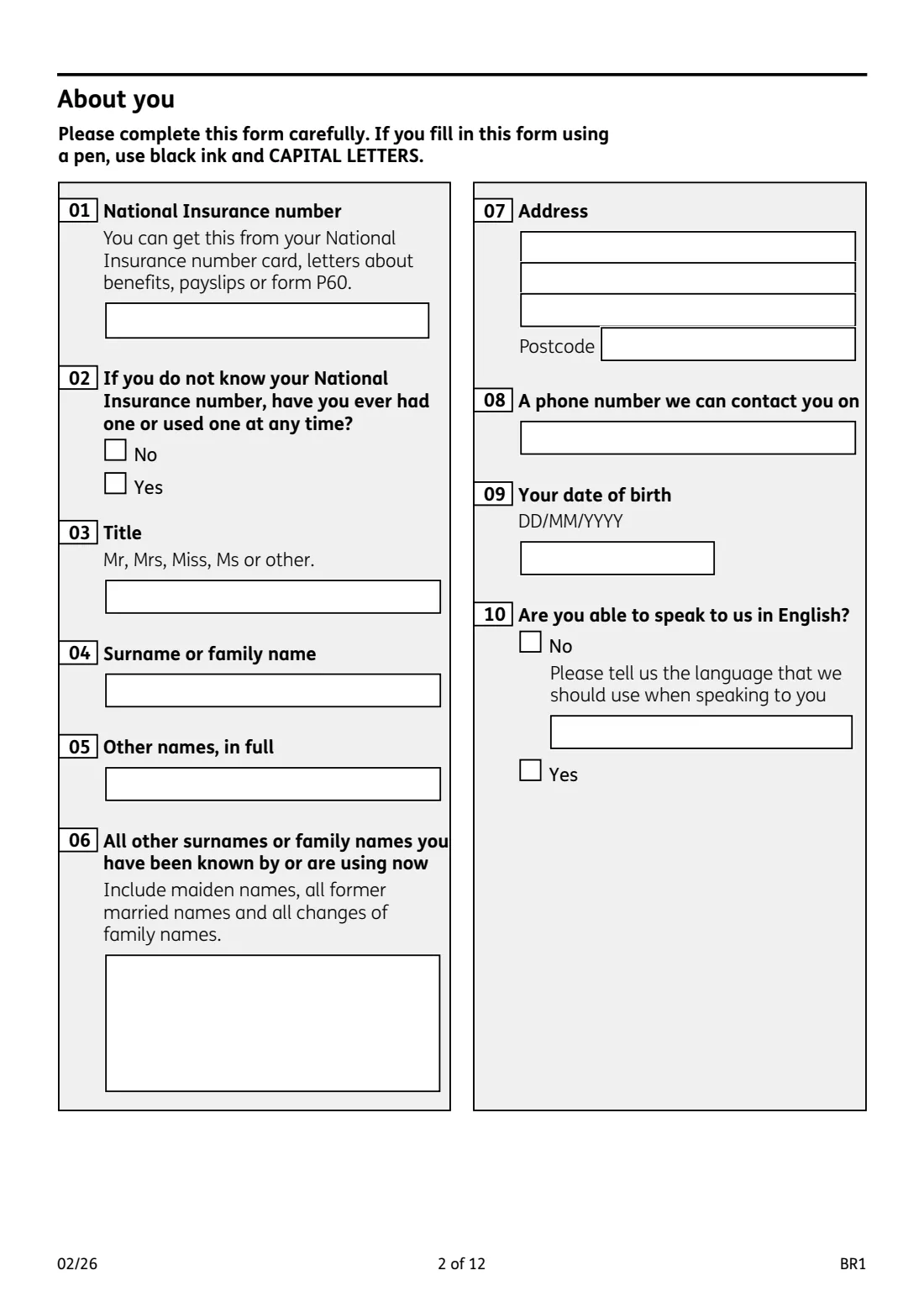
- About you (01-10)Claimant
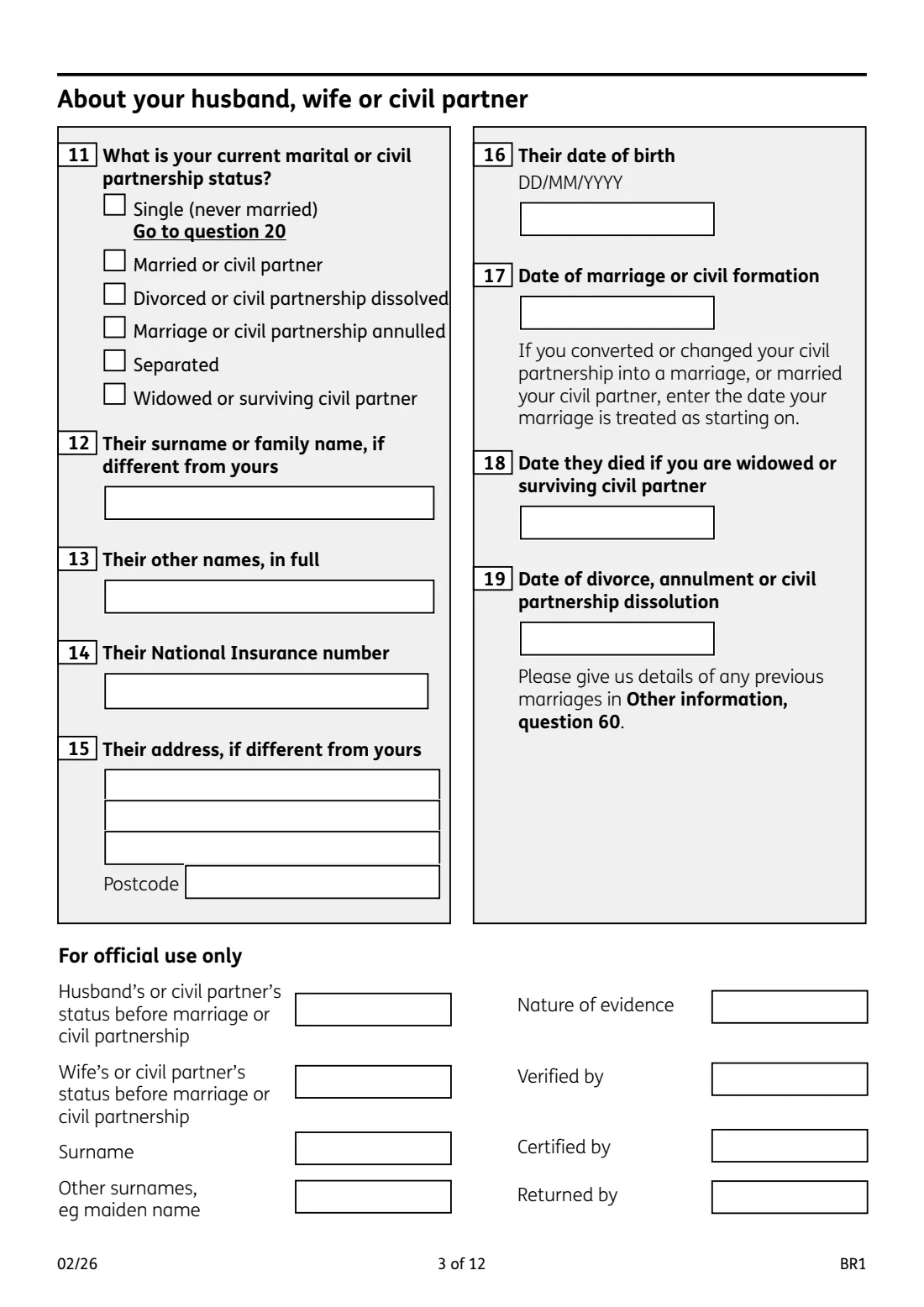
- About your husband, wife or civil partner (11-19)Claimant
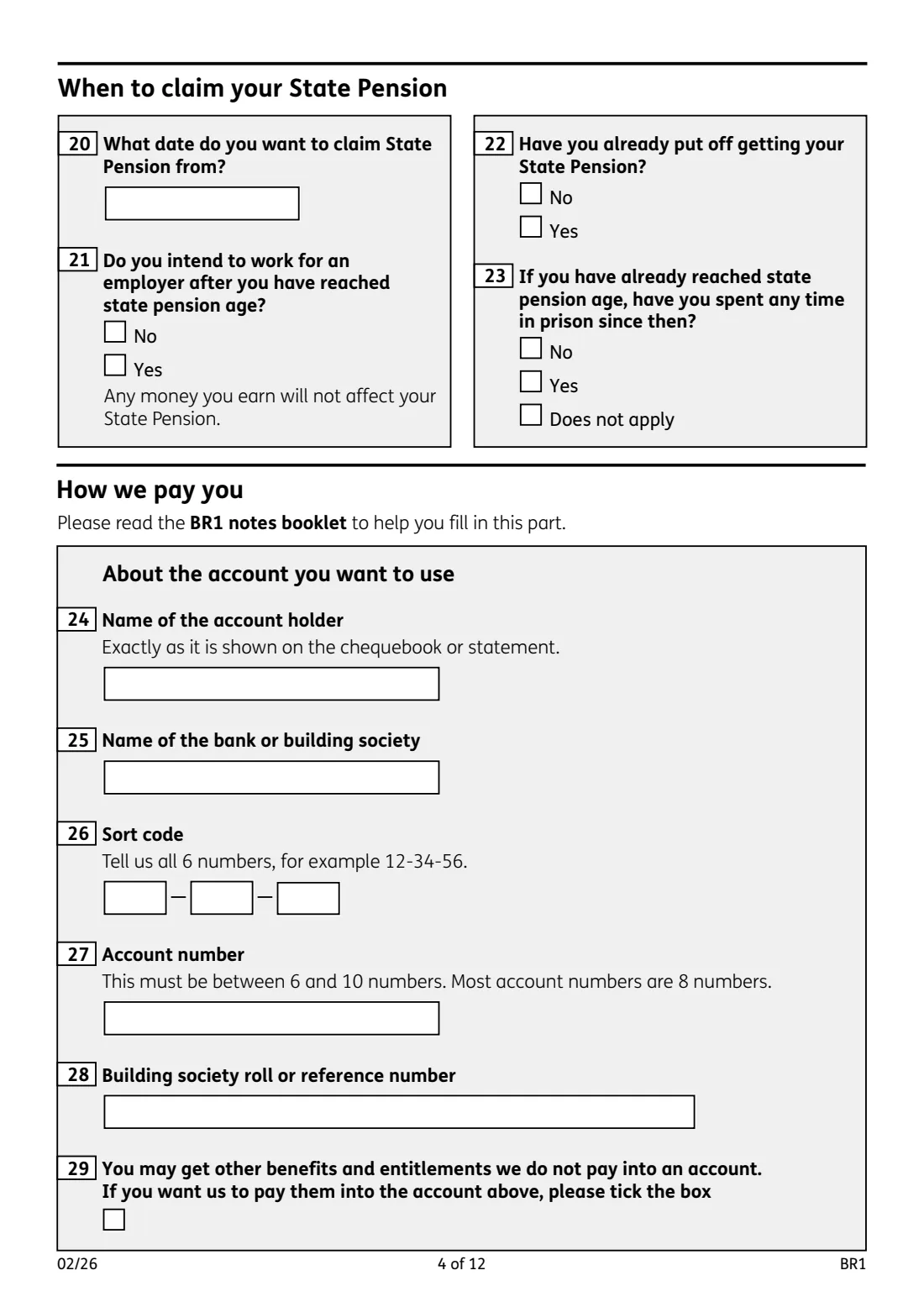
- When to claim your State Pension (20-23)Claimant
- How we pay you (24-29)Claimant
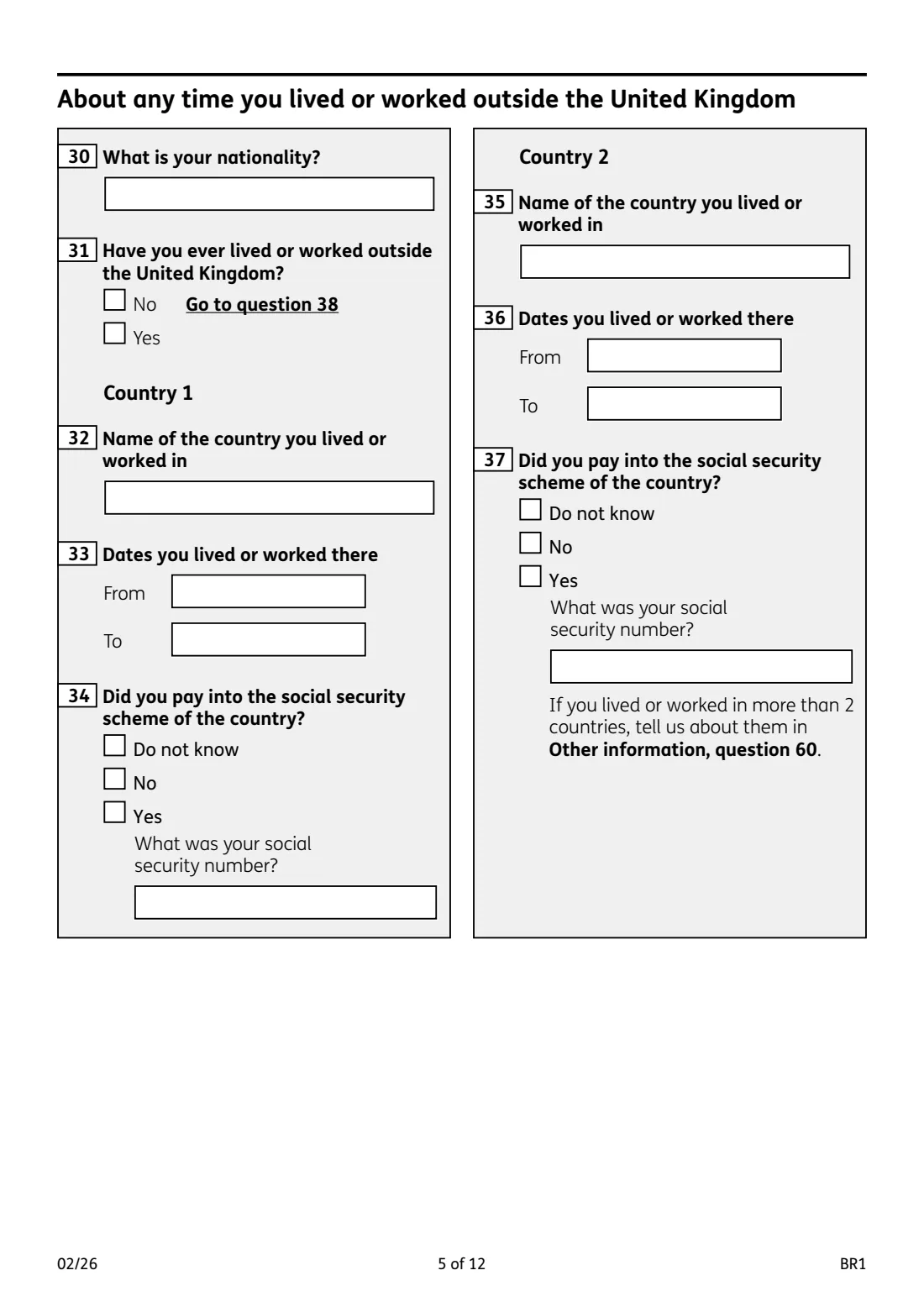
- Any time you lived or worked outside the UK (30-34)Claimant
- A second country you lived or worked in (35-37)Claimant
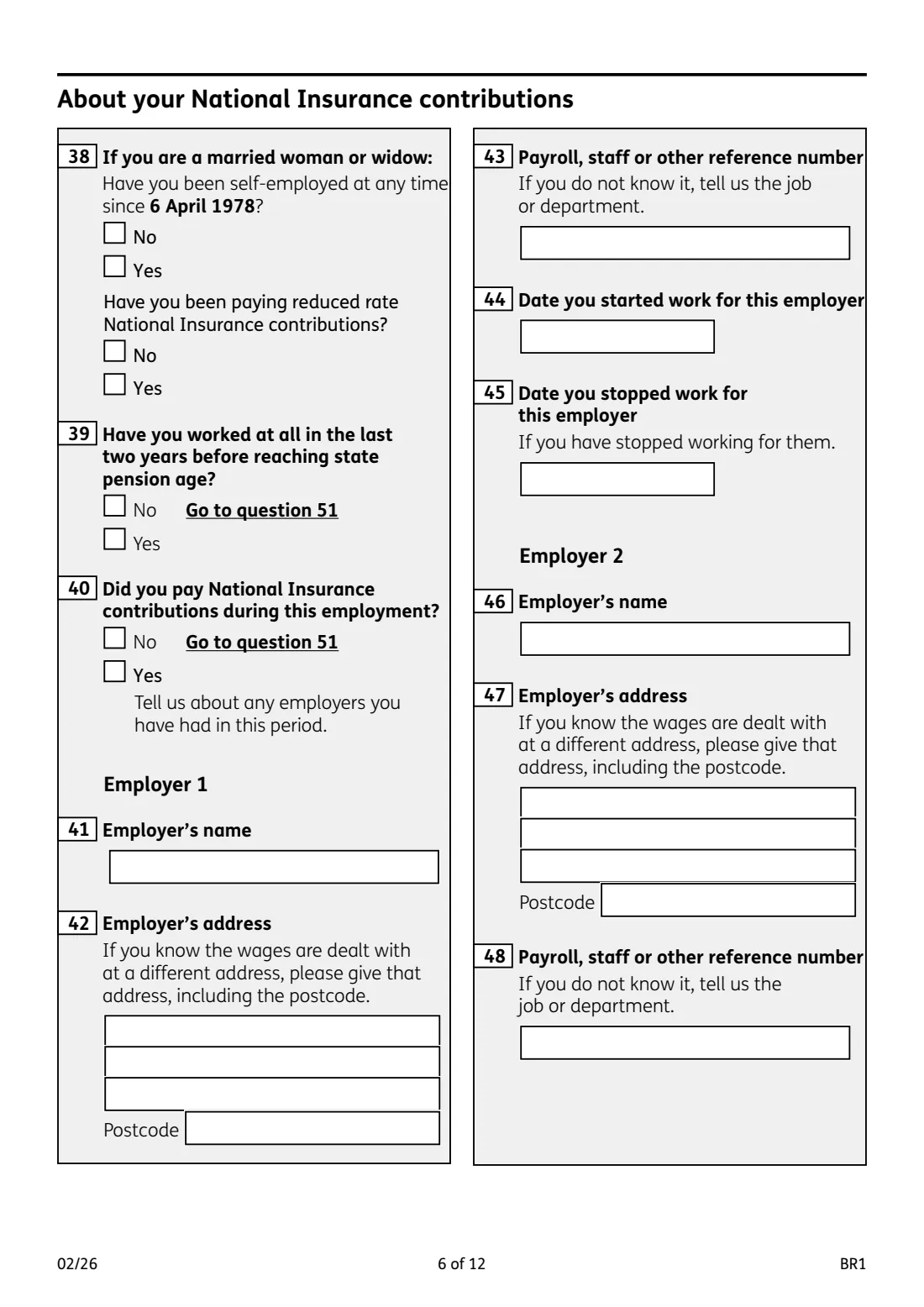
- About your National Insurance contributions (38-45)Claimant
- A second employer (46-50)Claimant
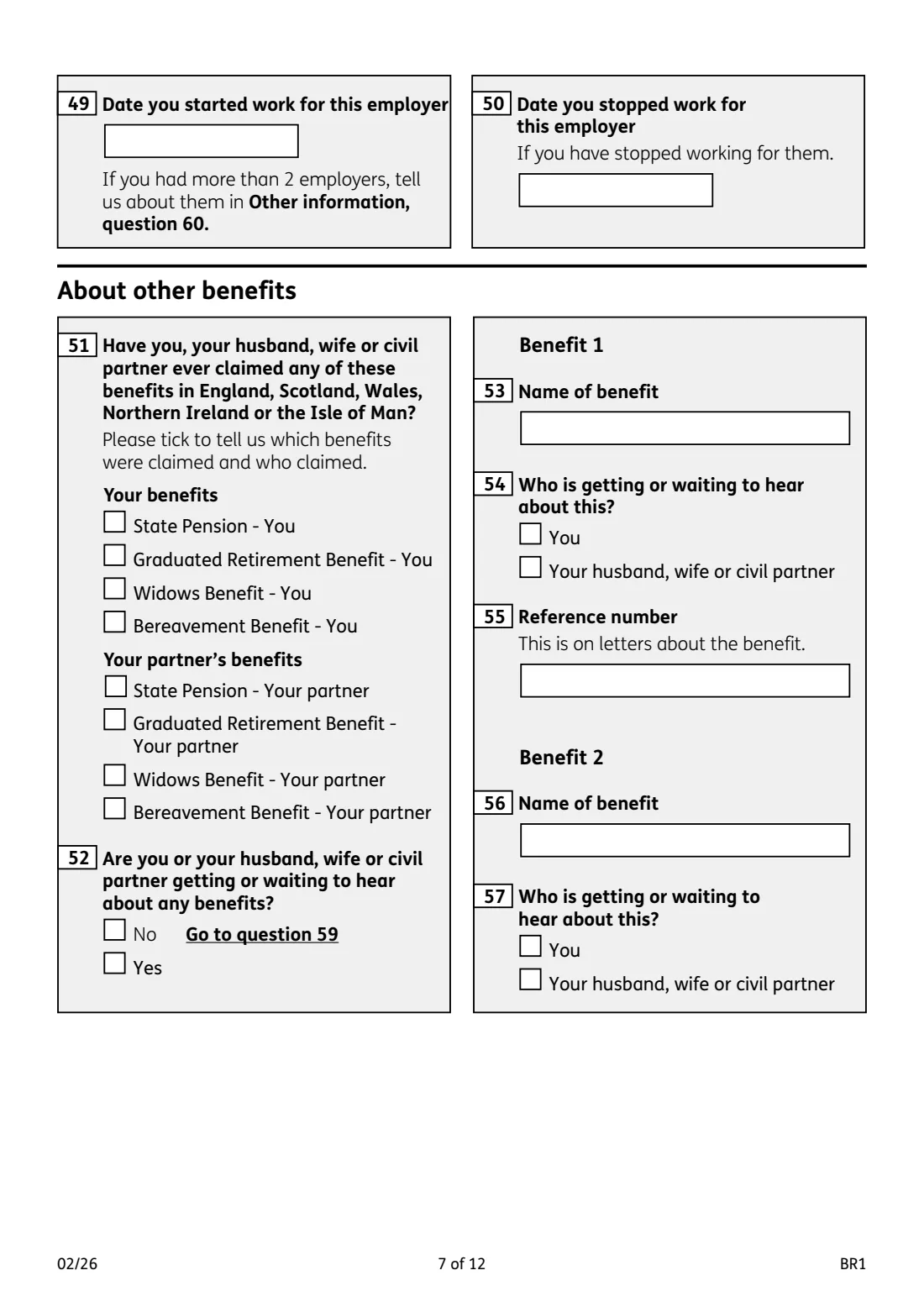
- About other benefits (51-55)Claimant
- A second benefit (56-58)Claimant
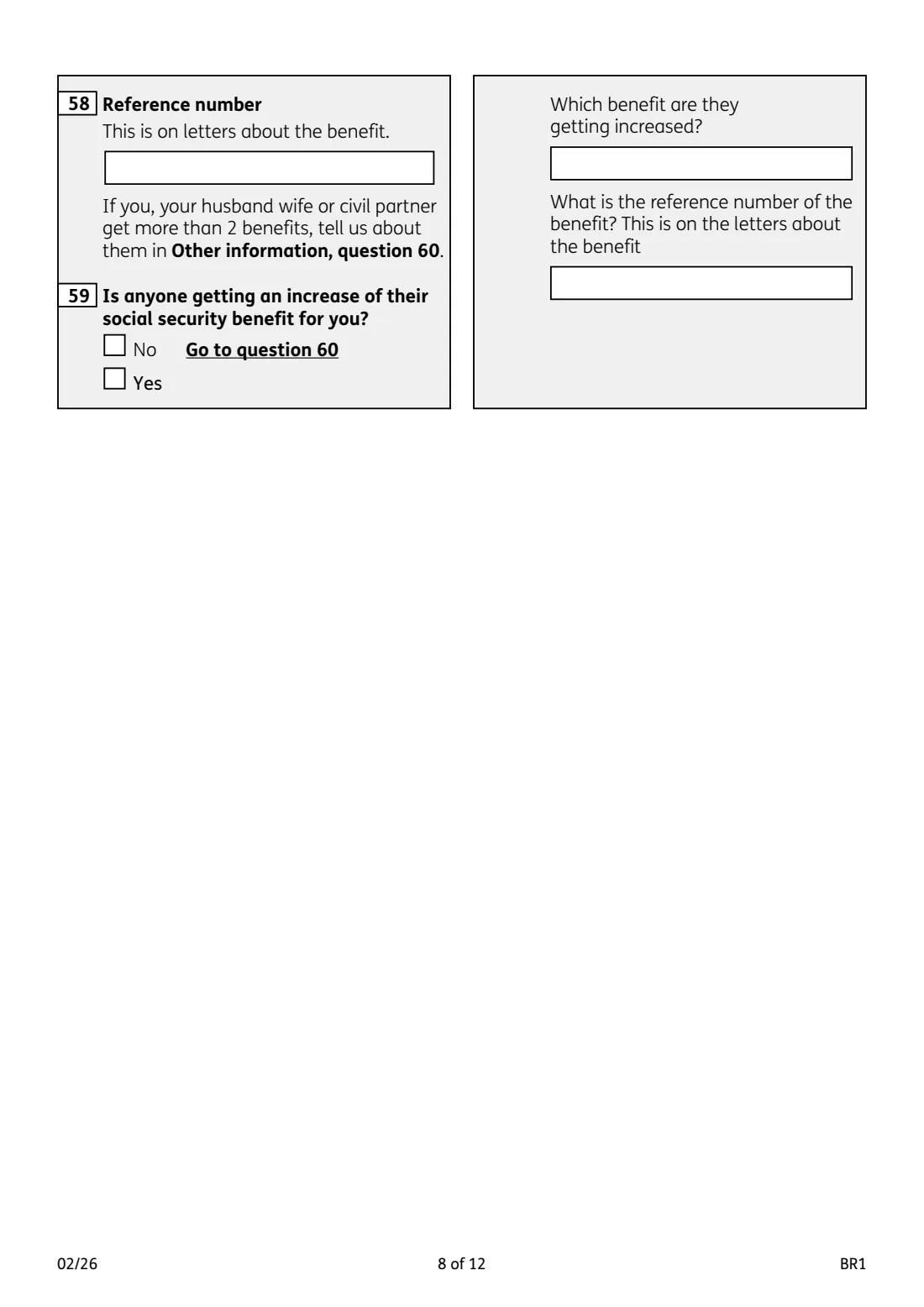
- Other information and Pension Credit (59-60)Claimant
- DeclarationClaimant
How to fill out BR1 State Pension claim, step by step
1 About you (questions 01 to 10)
Your National Insurance number, title, surname, other names in full, and every other surname you have ever been known by — include maiden names, all former married names and any changes. Then your address, a phone number and date of birth.
Question 10 asks whether you can speak to the Pension Service in English; if not, tell them the language to use. The form asks for black ink and capital letters, which is how FileIt prints it.
2 About your husband, wife or civil partner (questions 11 to 19)
Choose your current status: single (never married), married or civil partner, divorced or dissolved, annulled, separated, or widowed or surviving civil partner. If you're single, skip to question 20.
Otherwise give your spouse's or partner's name, National Insurance number, address if different, date of birth, and the dates of your marriage or civil partnership and, where relevant, their death or your divorce or dissolution. If you converted a civil partnership into a marriage, use the date your marriage is treated as starting. Previous marriages go in question 60. These details matter because a spouse's or former spouse's National Insurance record can sometimes affect what you receive under the older rules.
3 When to claim your State Pension (questions 20 to 23)
Question 20 is the date you want your pension to start. It can start from the date you reached State Pension age, or later if you put off claiming — the BR1 notes explain what applies to you. Question 21 asks whether you intend to work for an employer after State Pension age; the form reassures you that any money you earn won't affect your State Pension.
Question 22 asks whether you have already put off getting your State Pension, and question 23 whether you have spent any time in prison since reaching State Pension age.
4 How we pay you (questions 24 to 29)
The account for your pension: the holder's name exactly as it appears on the chequebook or statement, the bank or building society, the 6-digit sort code and the account number (between 6 and 10 numbers; most are 8). Add a building society roll or reference number only if the account needs one.
Question 29 lets you ask for other benefits and entitlements that are not normally paid into an account to be paid into this one too.
5 About any time you lived or worked outside the United Kingdom (questions 30 to 37)
Your nationality, then whether you have ever lived or worked outside the UK. If so, give up to two countries with the dates you were there, whether you paid into that country's social security scheme and your social security number if you did. More than two countries go in question 60.
6 About your National Insurance contributions (questions 38 to 50)
Question 38 is only for married women and widows: whether you have been self-employed at any time since 6 April 1978, and whether you have been paying reduced rate National Insurance contributions.
Questions 39 and 40 ask whether you worked, and paid National Insurance, in the last two years before reaching State Pension age. If so, give up to two employers with their address (or the address where wages were handled), your payroll or staff reference (or your job or department if you don't know it), and your start and stop dates.
7 About other benefits (questions 51 to 58)
Question 51 asks which of State Pension, Graduated Retirement Benefit, Widow's Benefit or Bereavement Benefit you or your spouse or civil partner have ever claimed in England, Scotland, Wales, Northern Ireland or the Isle of Man. Then say whether either of you is getting, or waiting to hear about, any benefits, with the name, who it's for and the reference number from the benefit letters.
8 Other information (questions 59 and 60)
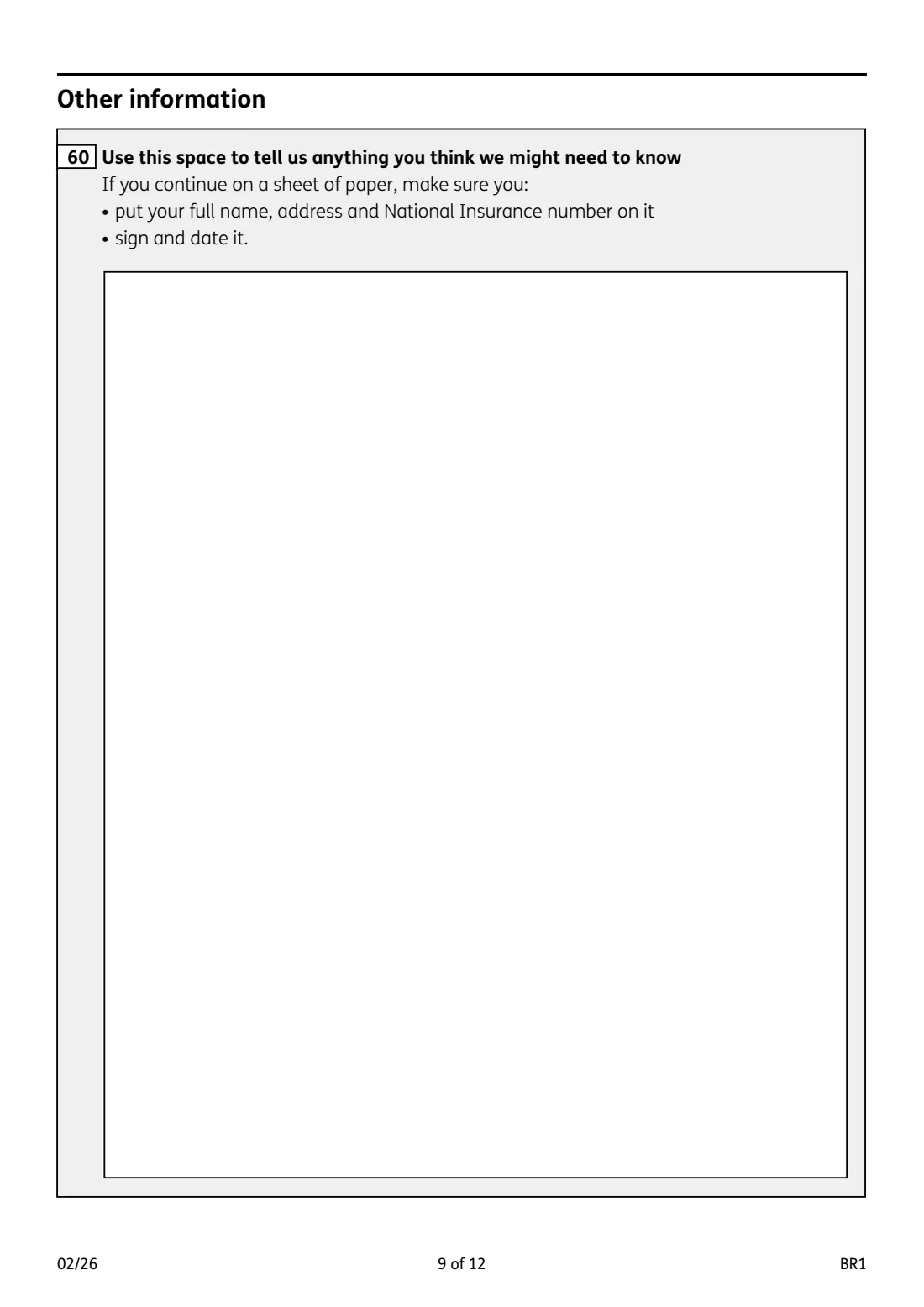
Question 59 asks whether anyone is getting an increase in their social security benefit for you. Question 60 is free space for anything else — previous marriages, a third country, more employers or more benefits. If you continue on a separate sheet, put your full name, address and National Insurance number on it, and sign and date it.
9 Pension Credit
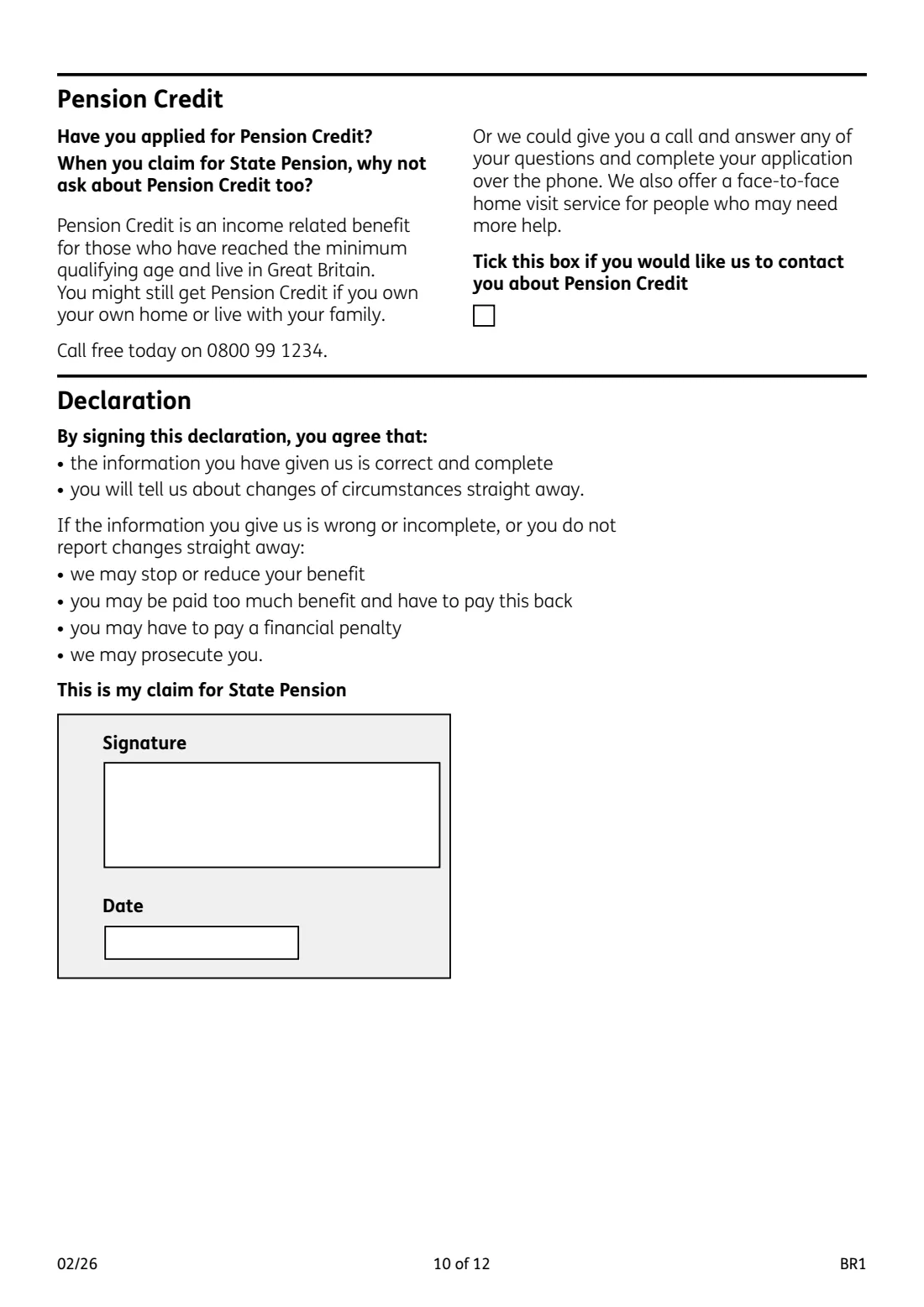
Before the declaration, the form reminds you about Pension Credit — an income-related benefit for people who have reached the qualifying age and live in Great Britain, which you might still get if you own your home or live with family. Tick the box if you'd like the Pension Service to contact you about it.
10 Declaration
By signing you agree that your information is correct and complete and that you'll report changes of circumstances straight away. The form warns that wrong or incomplete information, or not reporting changes, can lead to benefit being stopped or reduced, overpayments having to be repaid, a financial penalty or prosecution. Sign and date it by hand.
Common mistakes to avoid
- Using the BR1 when you were born on or after 6 April 1951 (men) or 6 April 1953 (women). You need the new State Pension claim form instead.
- Leaving out former surnames. List every maiden and married name so your National Insurance record can be matched.
- Missing previous marriages or civil partnerships — give details in question 60.
- Giving the account holder's name differently from how it appears on the bank statement or chequebook.
- Forgetting time abroad. Periods living or working in another country can matter, so list them with dates.
- Not reading the BR1 notes before choosing a start date in question 20, particularly if you have put off claiming.
- Forgetting to sign and date the declaration, or any continuation sheet you added.
After you fill it out
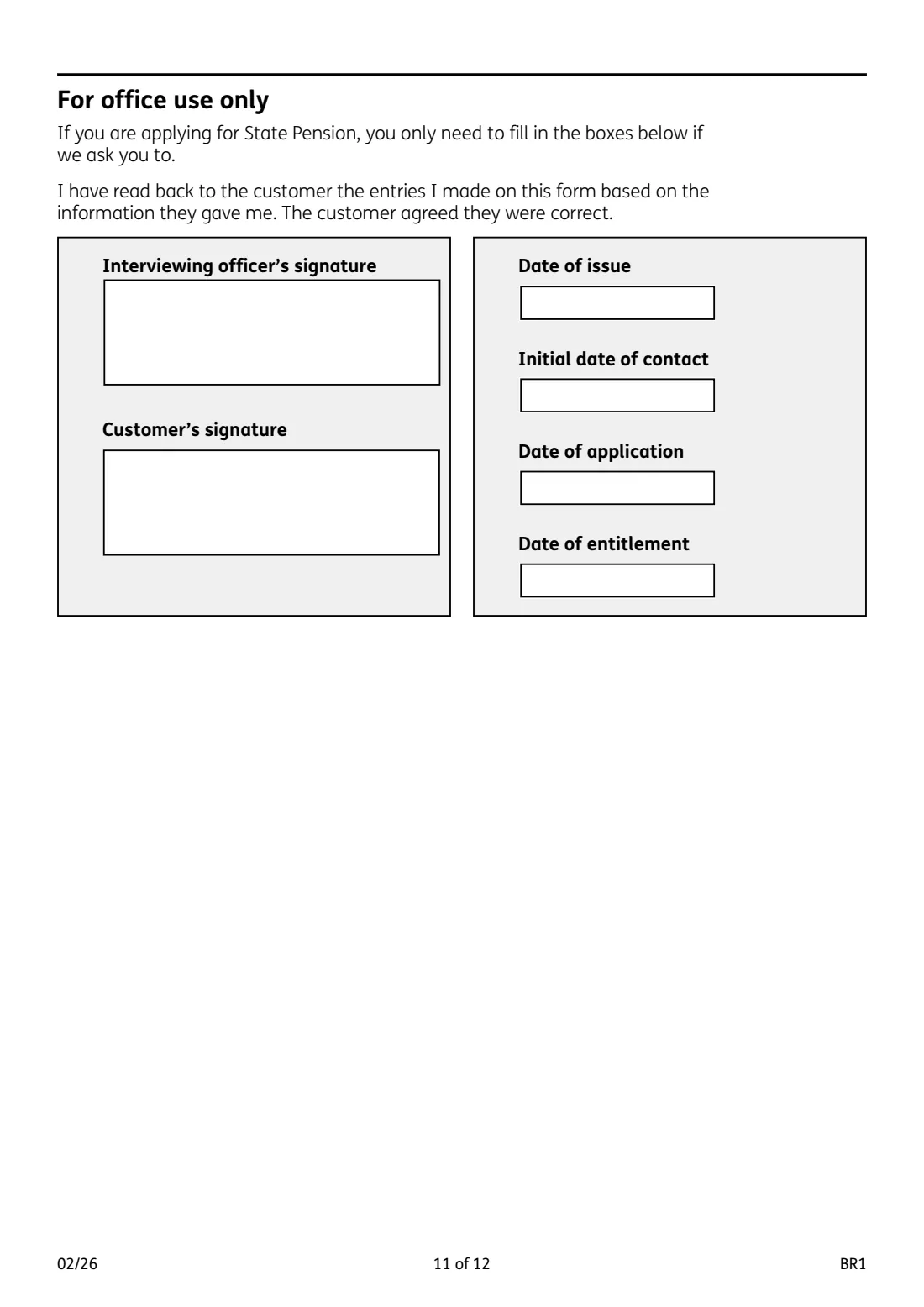
Print the completed BR1 from FileIt, check every page, then sign and date the declaration on page 10 by hand. If you used an extra sheet for question 60, add your full name, address and National Insurance number to it and sign and date that too. The office-use page is only filled in if the Pension Service asks you to.
Send the form, with any documents the Pension Service asks to see, to the address given in the BR1 notes booklet. FileIt doesn't post or submit it for you. The Pension Service may contact you on the phone number you gave if they need more information.
Keep a copy of the completed claim in the claimant's FileIt folder, together with the award letter when it arrives. Tell the Pension Service straight away about any change of circumstances, such as a new address, marriage or bereavement.
Fill out BR1 State Pension claim online with FileIt
- Pick the person. Choose someone from People and FileIt fills in their name, date of birth, address and other details it already knows.
- Answer plain-language questions. One part of the form at a time, with the official help text beside each question — 91 fields in all. Your answers save as you go.
- Check the live preview. Watch your answers land on the real Department for Work and Pensions (DWP) — The Pension Service form, and let FileIt do any worksheet arithmetic.
- Generate the official PDF. FileIt prints your answers into the agency’s own PDF and files it in that person’s folder in your vault.
FileIt fills the form — it never files or submits anything for you. Deliver the finished form to whoever asked for it, the way the form’s instructions say.
Start BR1 State Pension claim now — it’s freeBR1 State Pension claim: frequently asked questions
Who should use form BR1?
Only a man born before 6 April 1951 or a woman born before 6 April 1953. The form says that if you were born on or after those dates, you need the new State Pension claim form instead.
Is BR1 for the basic State Pension or the new State Pension?
BR1 is for the State Pension under the older rules, usually called the basic State Pension. The new State Pension has its own claim form.
Can I fill in the BR1 online?
Yes. FileIt lets you complete the BR1 online for free and prints your answers into the DWP's official PDF, ready to print and sign by hand. It also checks you're using the right form for your date of birth.
Where do I send the BR1 State Pension claim form?
Send it to the Pension Service at the address given in the BR1 notes booklet, along with any documents they ask for. FileIt prepares the form, but you post it yourself.
I put off claiming my State Pension — can I still use the BR1?
Yes, if you meet the date-of-birth rule. Question 22 asks whether you have already put off getting your State Pension, and question 20 asks when you want it to start. Read the BR1 notes to understand the choices open to you.
Will working affect my State Pension?
The form says any money you earn will not affect your State Pension. Question 21 simply asks whether you intend to work for an employer after reaching State Pension age.
Can someone else fill in a BR1 for my parent?
A family member can help complete it, and FileIt can pre-fill details from the People in your vault. But the claimant must read the declaration and sign it themselves.
What is Pension Credit and should I ask about it?
Pension Credit is an income-related benefit for people who have reached the qualifying age and live in Great Britain. The BR1 has a box to tick if you want the Pension Service to contact you about it, and notes you might still qualify if you own your home or live with family.
Official sources
- Blank form (PDF), published by Department for Work and Pensions (DWP) — The Pension Service: https://assets.publishing.service.gov.uk/media/69835177afabc06c35d343e8/br1.pdf
- Official instructions and guidance: https://assets.publishing.service.gov.uk/media/698351845a7e802e96d343ea/br1-notes.pdf
- Edition shown on this page: BR1 02/26 (checked 2026-09-25).
FileIt is not affiliated with or endorsed by Department for Work and Pensions (DWP) — The Pension Service or any government. This page explains the form in general terms and is not legal, tax or immigration advice. Always read the official instructions, and check that you are using the edition the recipient accepts. Page last reviewed 2026-09-25.