
What is LP1H?
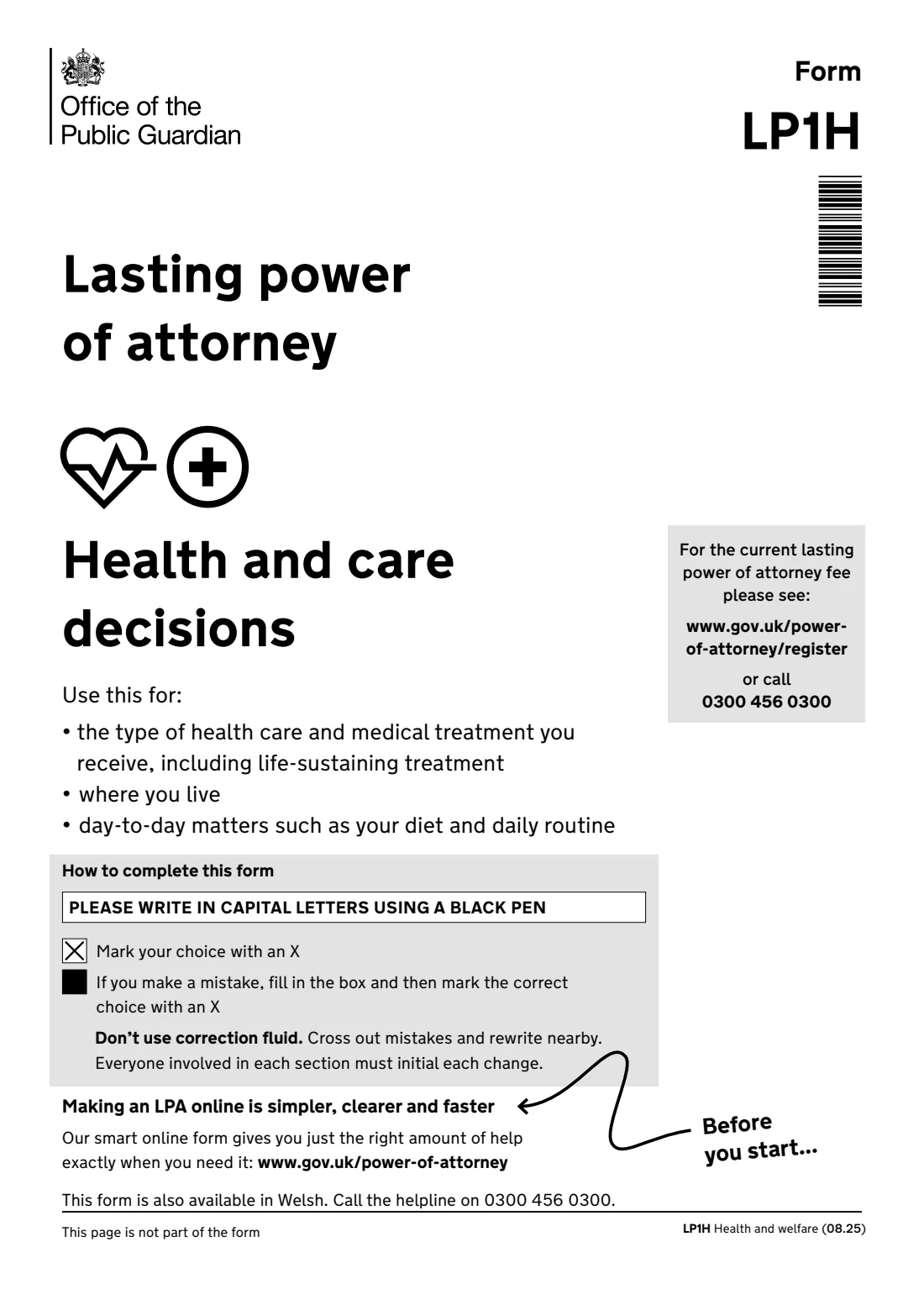
Form LP1H is the paper lasting power of attorney (LPA) for health and welfare from the Office of the Public Guardian (OPG). It lets you, the 'donor', appoint trusted 'attorneys' to decide about the medical care and treatment you receive, whether you move into a care home, and everyday matters like your diet and daily routine. It also asks you to decide, in a section of its own, whether your attorneys can give or refuse consent to life-sustaining treatment.
Unlike the financial LPA (form LP1F), a health and welfare LPA can only ever be used when you don't have the mental capacity to make the particular decision yourself. While you can decide, you decide. Without one, the people closest to you have no automatic legal right to make these decisions for you — which is why many families make an LP1H alongside an LP1F.
FileIt guides you through the LP1H section by section in plain English and prints your answers, in capitals, into the OPG's own official PDF. It can pre-fill names, dates of birth and addresses from the People in your FileIt vault, places the date under the life-sustaining treatment option you choose, and saves the finished PDF in the donor's folder. You then print it, sign it in ink in the right order and post it to the OPG yourself — FileIt never submits it for you.
- Who fills it
- The donor, aged 18 or over and able to make their own decisions; the registration part can be completed by the donor or the attorneys
- Given to
- The Office of the Public Guardian (OPG), by post, for registration
- When
- While the donor has mental capacity; it can only be used once registered and only when the donor lacks capacity for a decision
- Signatures
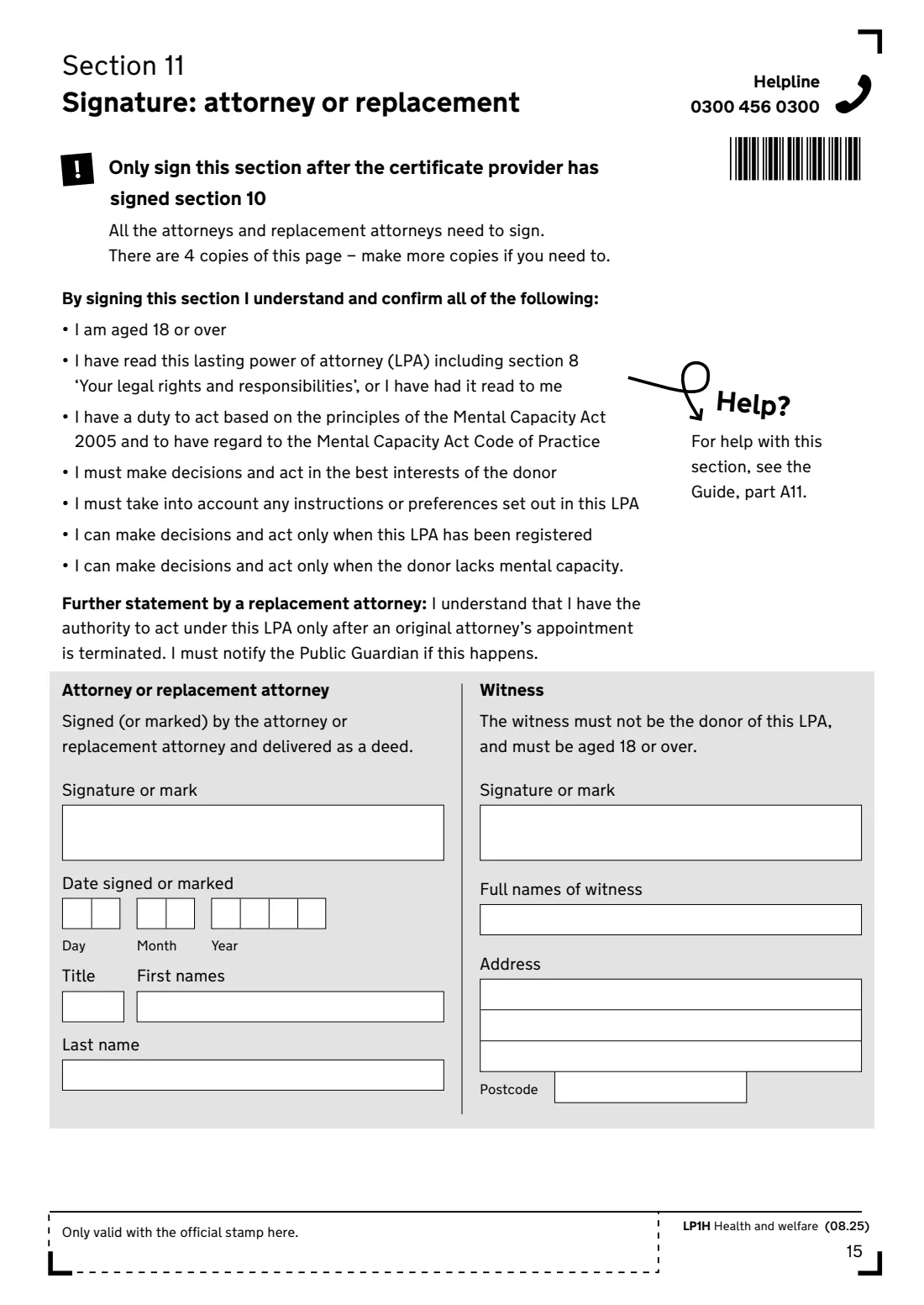
- In ink, in order: donor signs sections 5 and 9 (witnessed), certificate provider, each attorney and replacement (witnessed), then the applicant
- Edition
- LP1H Health and welfare (08.25)
- Covers
- England and Wales
Who needs to fill out LP1H?
- Adults in England or Wales who want to decide now who should speak for them about health and care if illness, injury or dementia leaves them unable to decide.
- People with firm views about life-sustaining treatment who want those views, and the people trusted to apply them, recorded in a legal document.
- Unmarried partners, stepfamilies and close friends who want a clear legal role in each other's care decisions.
- Older people planning for a possible move into residential care, and who want a say in who makes that choice.
- Anyone with a progressive condition who still has capacity today — the LPA must be made while they can understand it.
- It can't be made for someone who has already lost capacity; in that case other legal routes apply.
When to use LP1H
- Make it while you are well and able to understand what you are signing — the certificate provider has to confirm this.
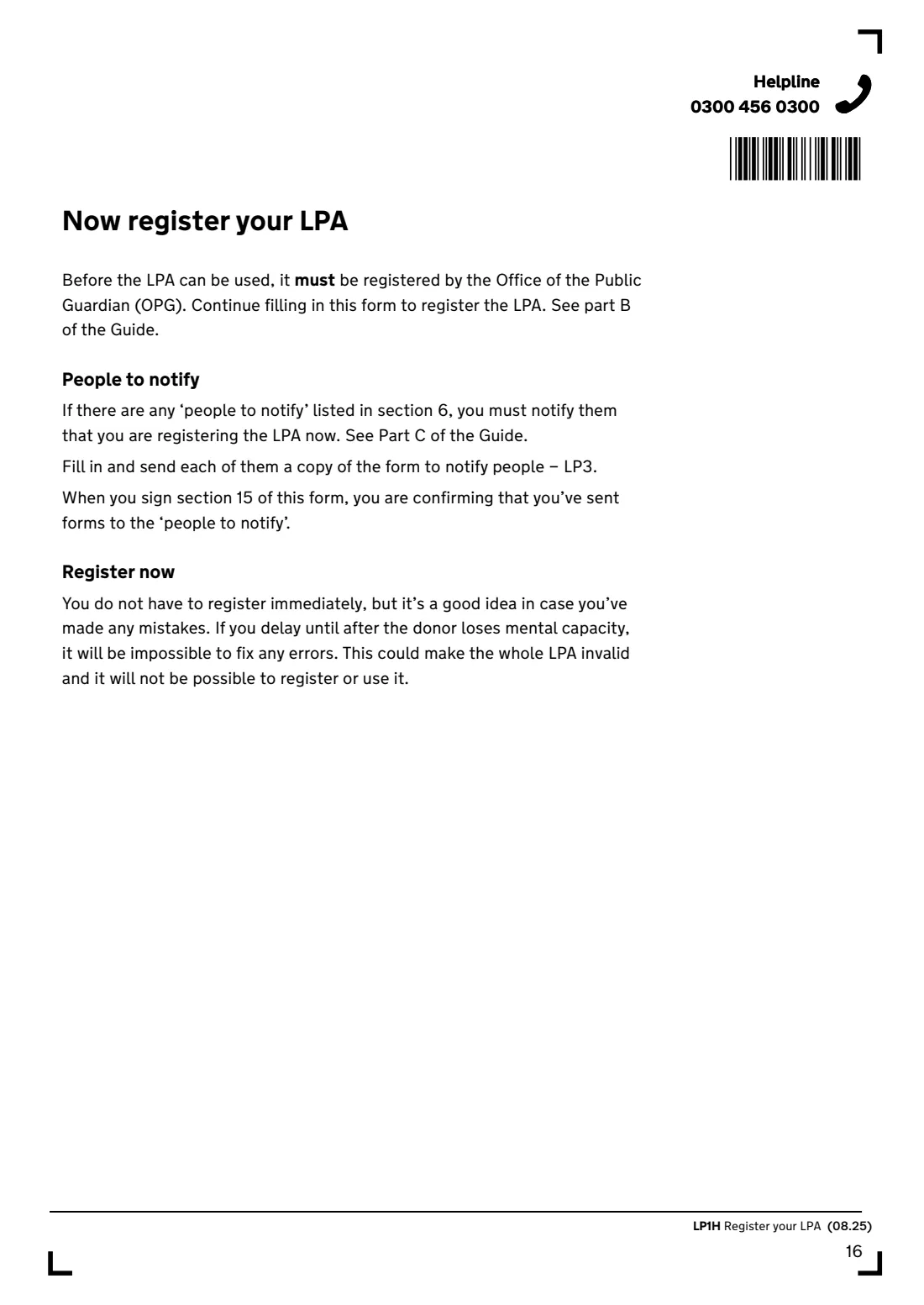
- Register it once everyone has signed. The OPG advises registering straight away so that any mistakes can be corrected while you can still sign a new form.
- It becomes usable only after registration and only for decisions you can't make at the time — for example after a stroke, during a period of unconsciousness, or with advanced dementia.
- Review it if an attorney dies, you separate or divorce, or your wishes about treatment change. You can cancel it at any time while you have capacity.
- If you also want help with money and property, make a separate property and financial affairs LPA on form LP1F.
What you need before you start
- Your full name (every first name, as on your passport or ID), any other names you use, date of birth, address and optional email.
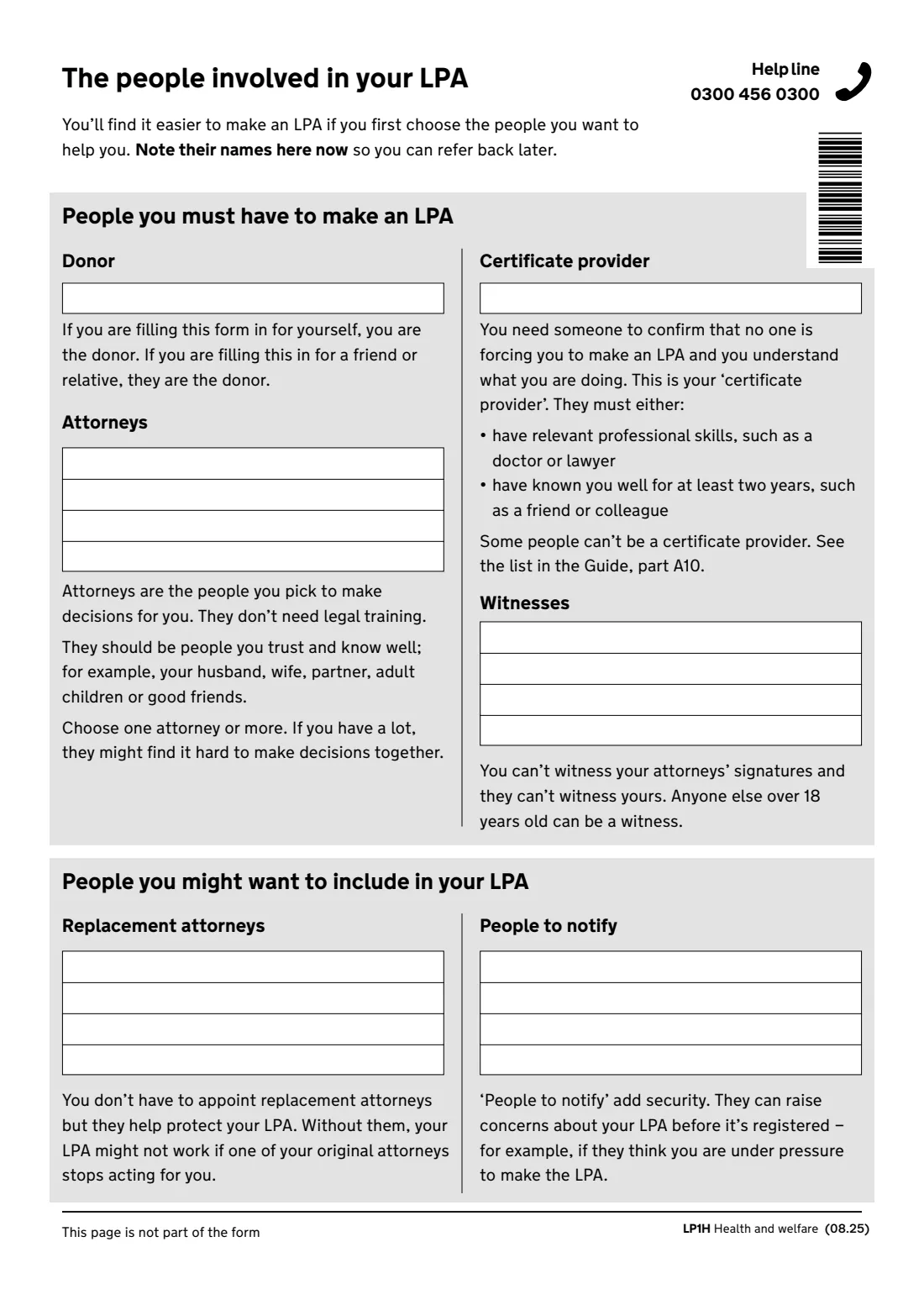
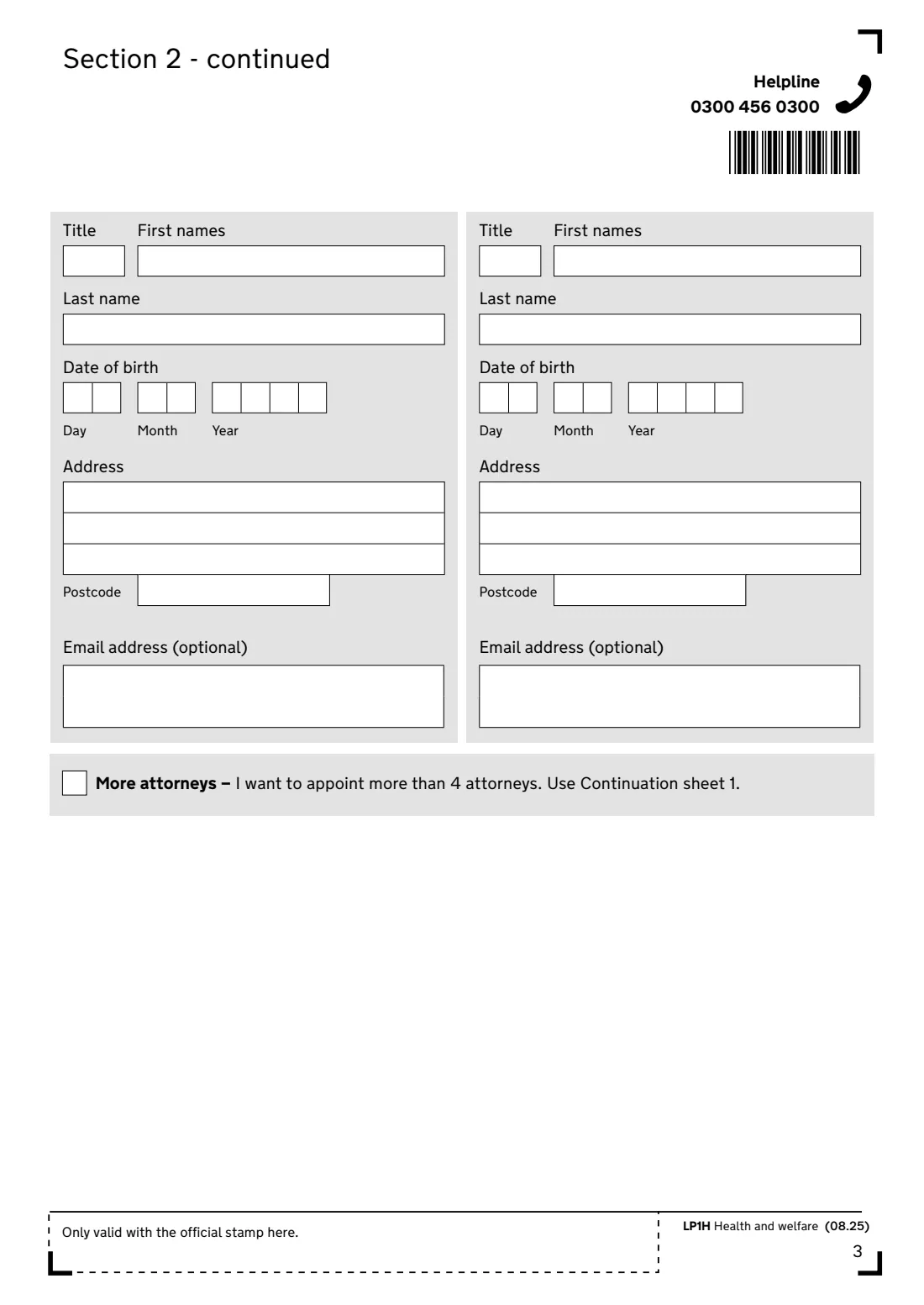
- Full names, dates of birth and addresses for each attorney (room for four; more on Continuation sheet 1).
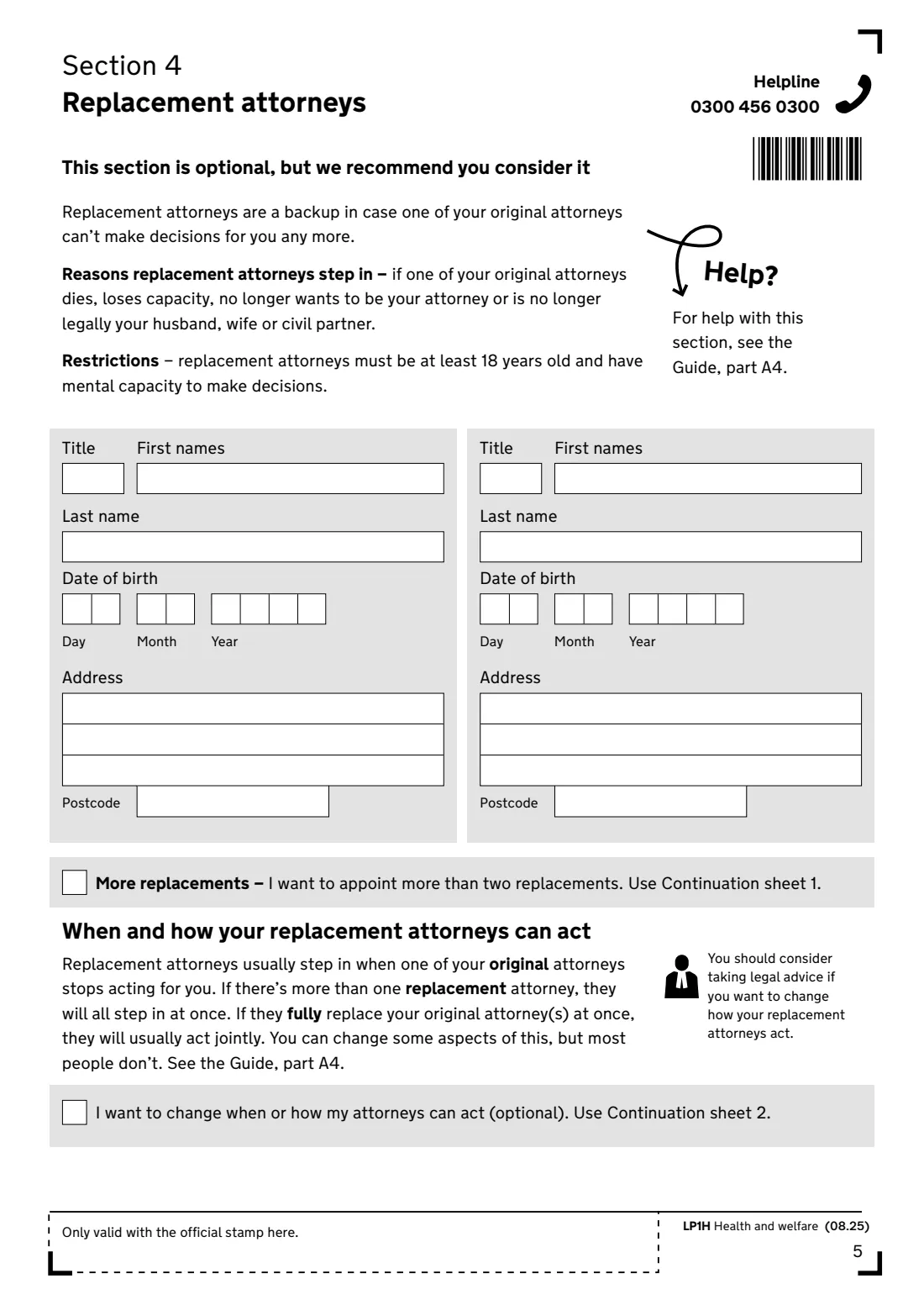
- Details of up to two replacement attorneys, if you want a backup.
- Your decision on life-sustaining treatment — Option A or Option B — and any wishes you want to add in section 7.
- A certificate provider who has known you personally for at least 2 years, or a professional such as your GP, a healthcare professional or a solicitor.
- Names and addresses of up to five people to notify (optional), plus copies of form LP3 to send them.
- An adult witness who is not an attorney or replacement, present when you sign sections 5 and 9 together.
- Payment for the registration fee (card or cheque), or form LPA120 and proof of low income for a reduced fee.
- Any advance decision you have already made, so your LPA and your advance decision don't contradict each other.
What’s on LP1H
The 2025 edition has 24 pages. FileIt asks for it in 13 parts:
- Section 1: The donorDonor
- Section 2: The attorneysAttorney
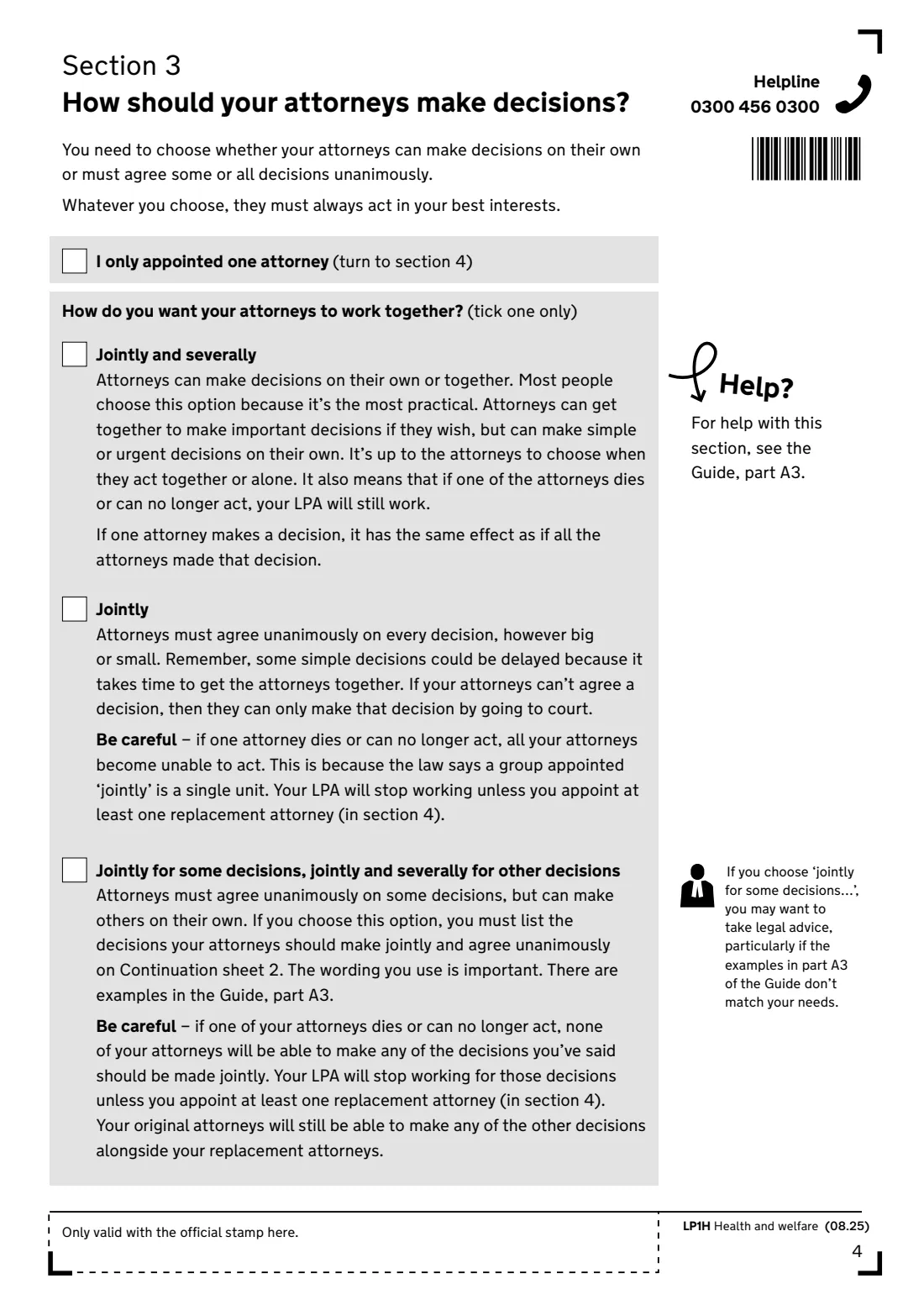
- Section 3: How should your attorneys make decisions?Donor
- Section 4: Replacement attorneysReplacement attorney
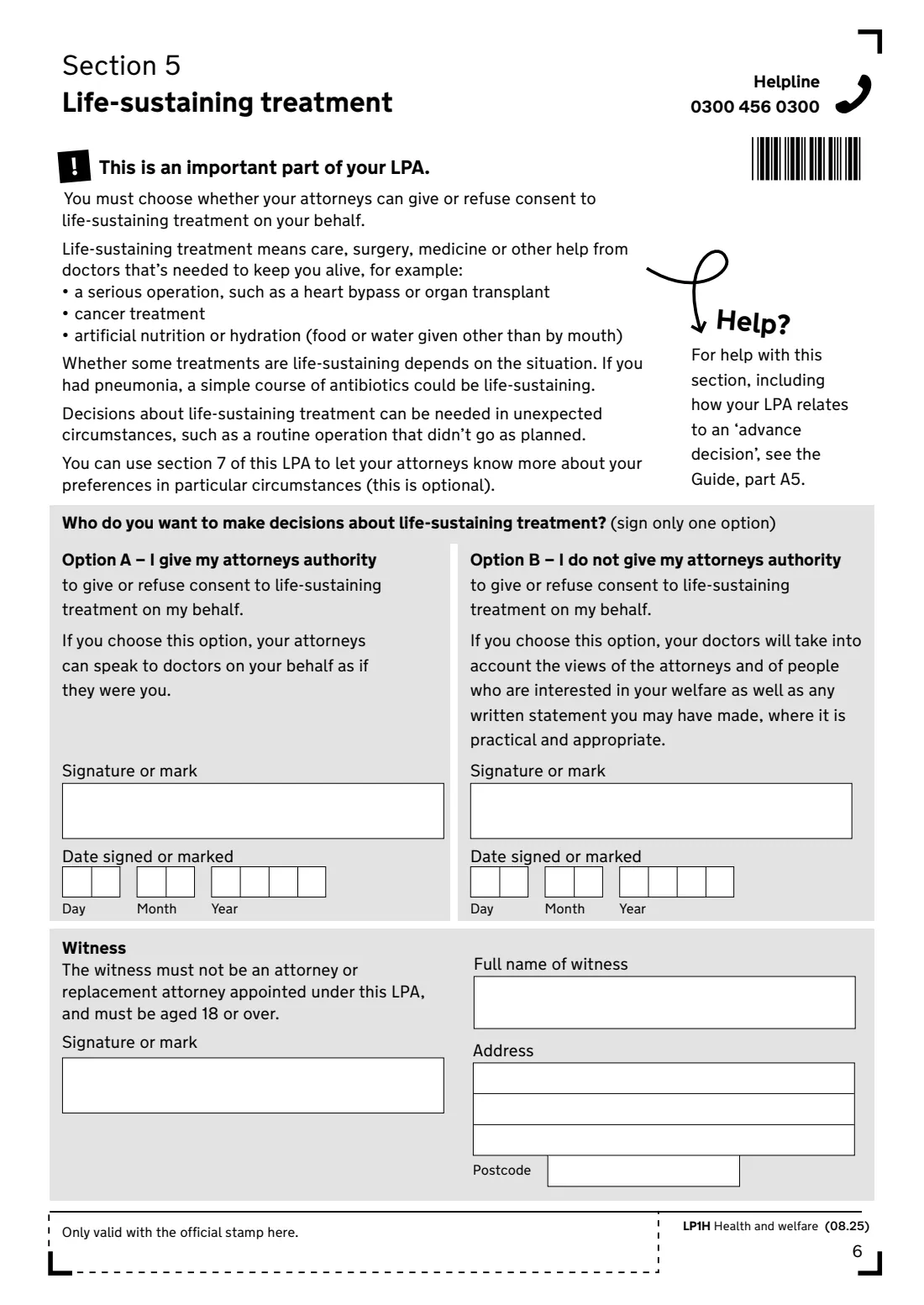
- Section 5: Life-sustaining treatmentDonor
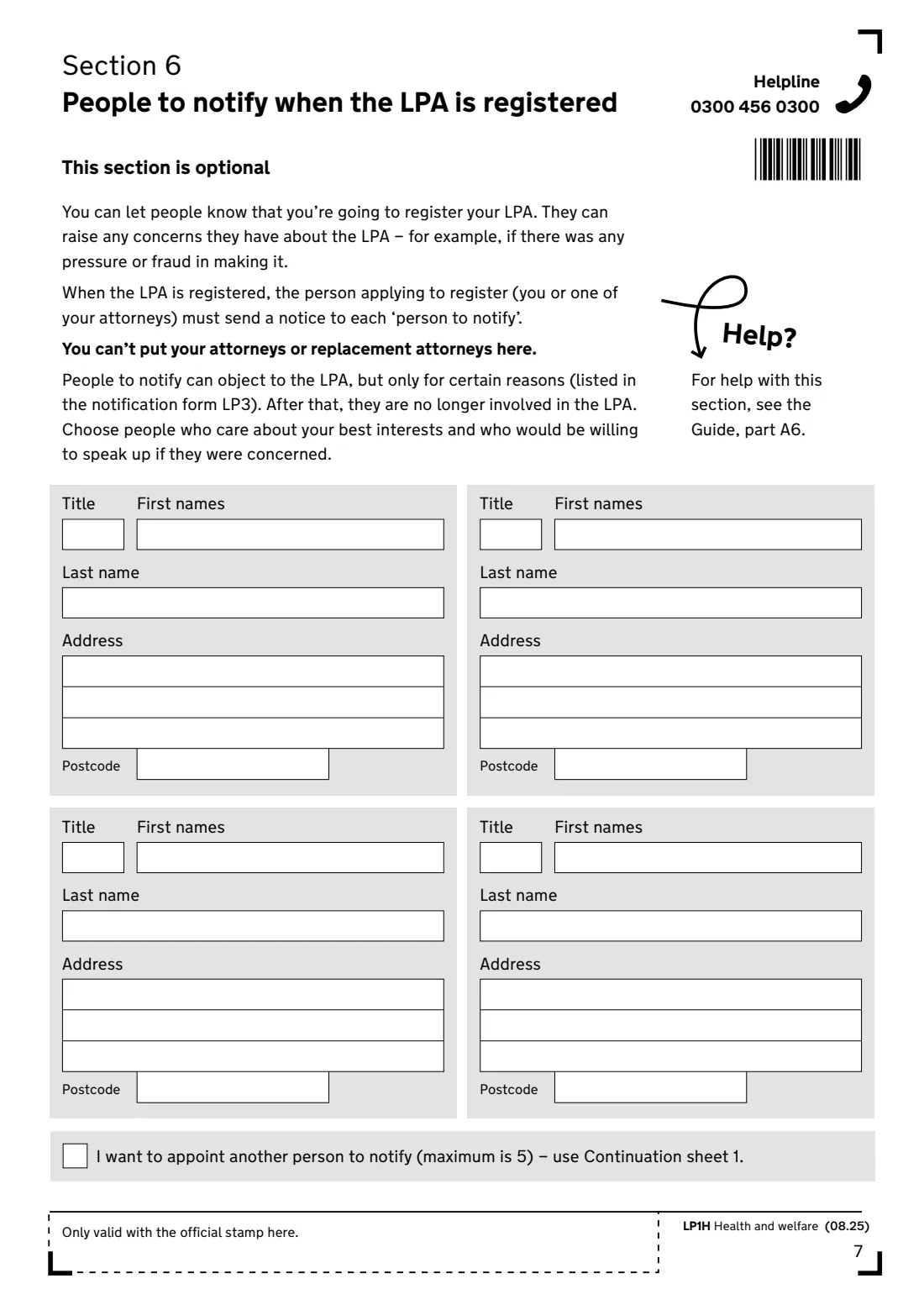
- Section 6: People to notify when the LPA is registeredPerson to notify
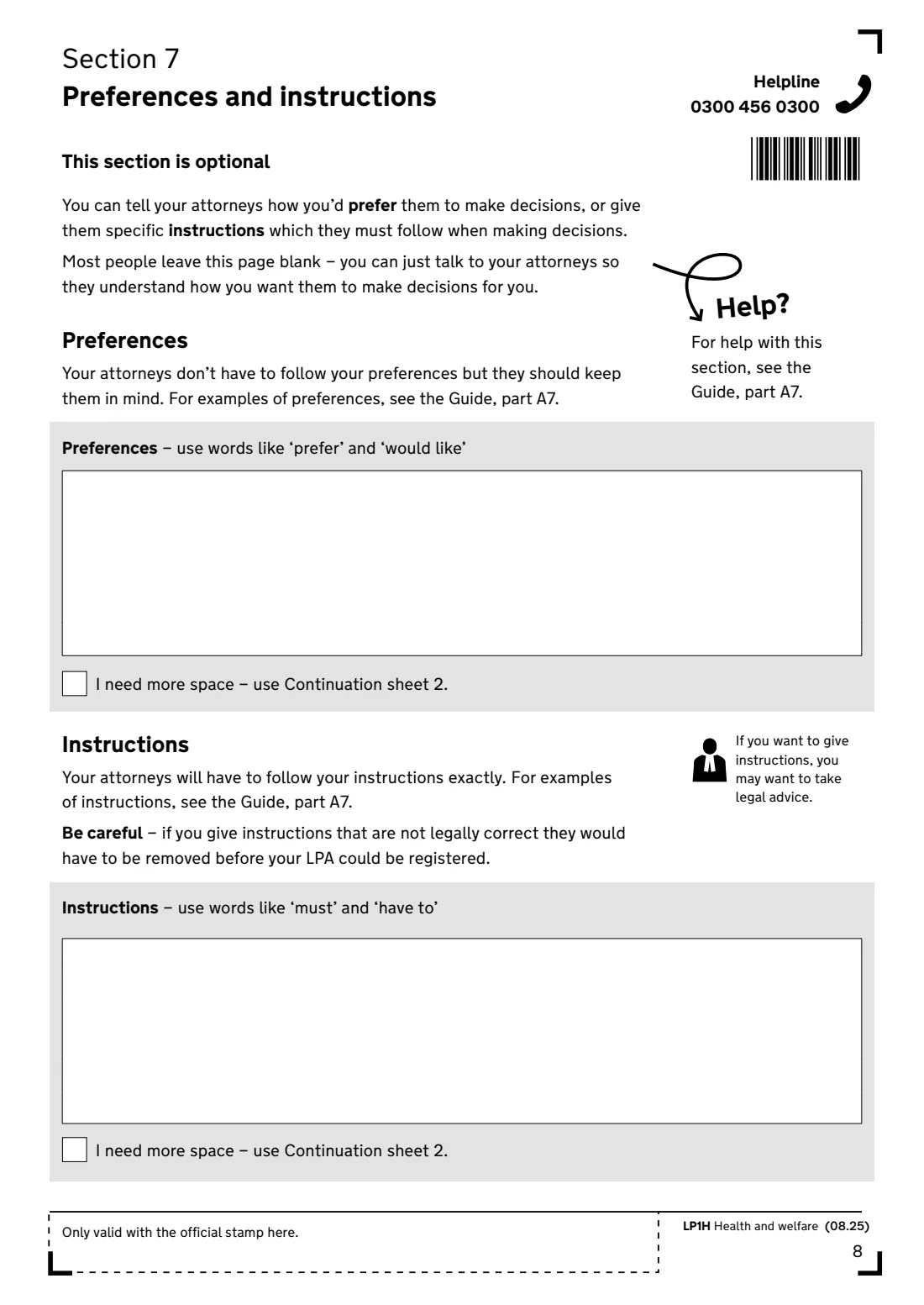
- Section 7: Preferences and instructionsDonor
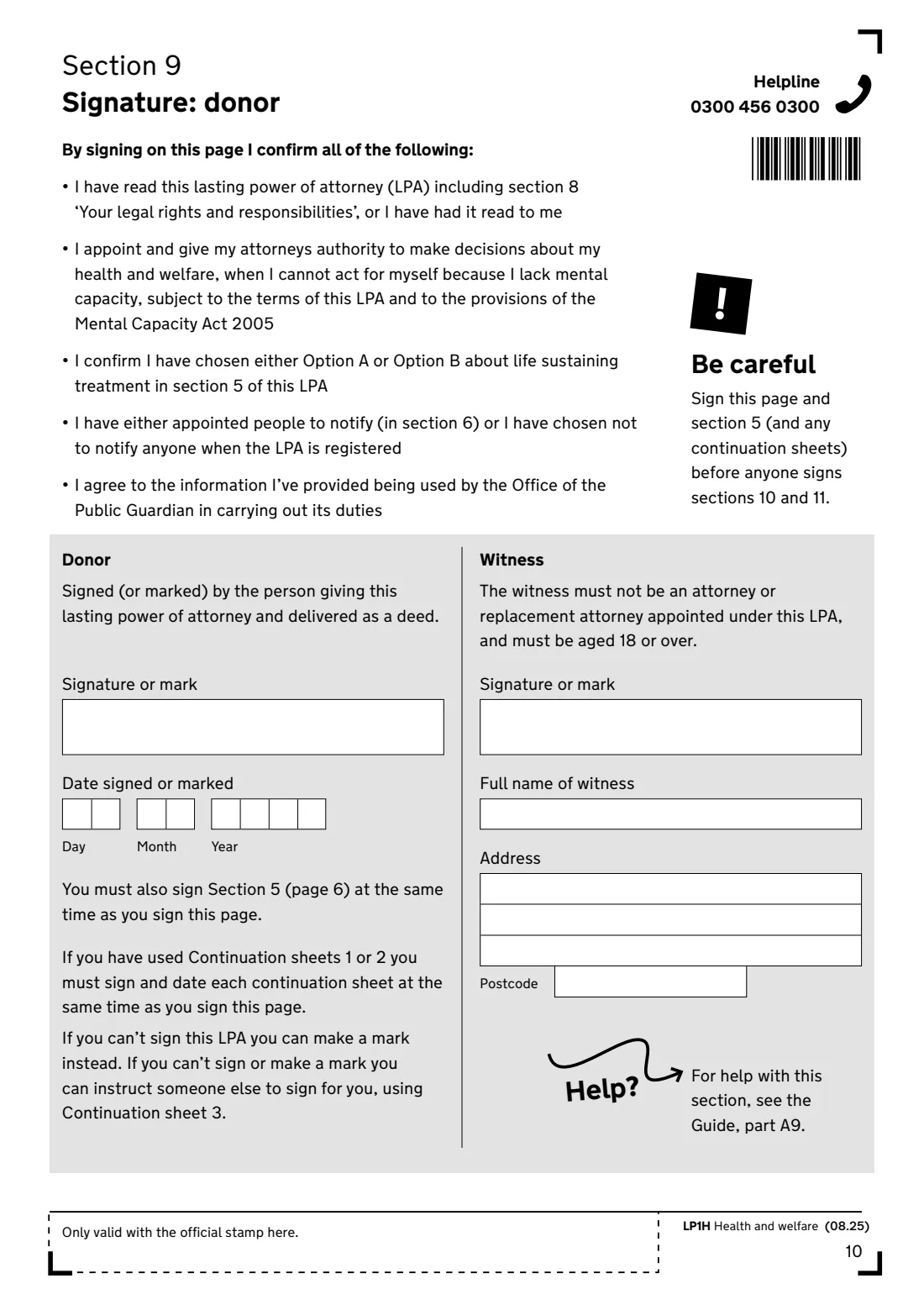
- Section 9: Signature — donorDonor
- Section 9: Witness to the donor's signatureWitness
- Section 10: Signature — certificate providerCertificate provider
- Section 11: Signature — attorneys and replacement attorneysAttorney
- Sections 12–15: Register the LPAApplicant (registration)
- Checklist: Check your lasting power of attorneyApplicant (registration)
How to fill out LP1H, step by step
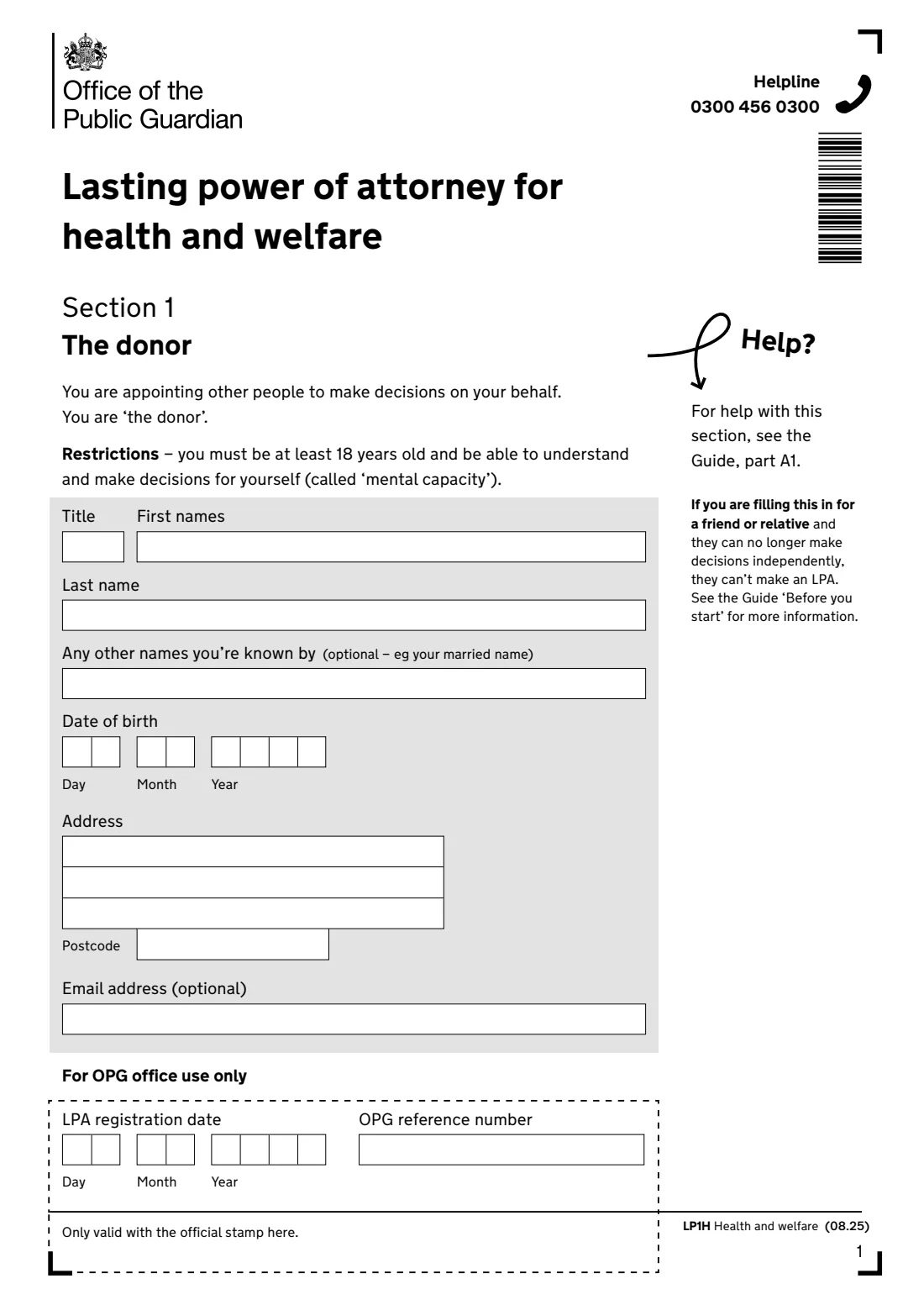
1 Section 1: The donor
Your own details as the person making the LPA. Use all your first names as they appear on your ID and add any other names you're known by. The form must be in capital letters and black ink; FileIt prints it that way.
The form reminds you that if you're completing it for a relative who can no longer make decisions independently, they can't make an LPA.
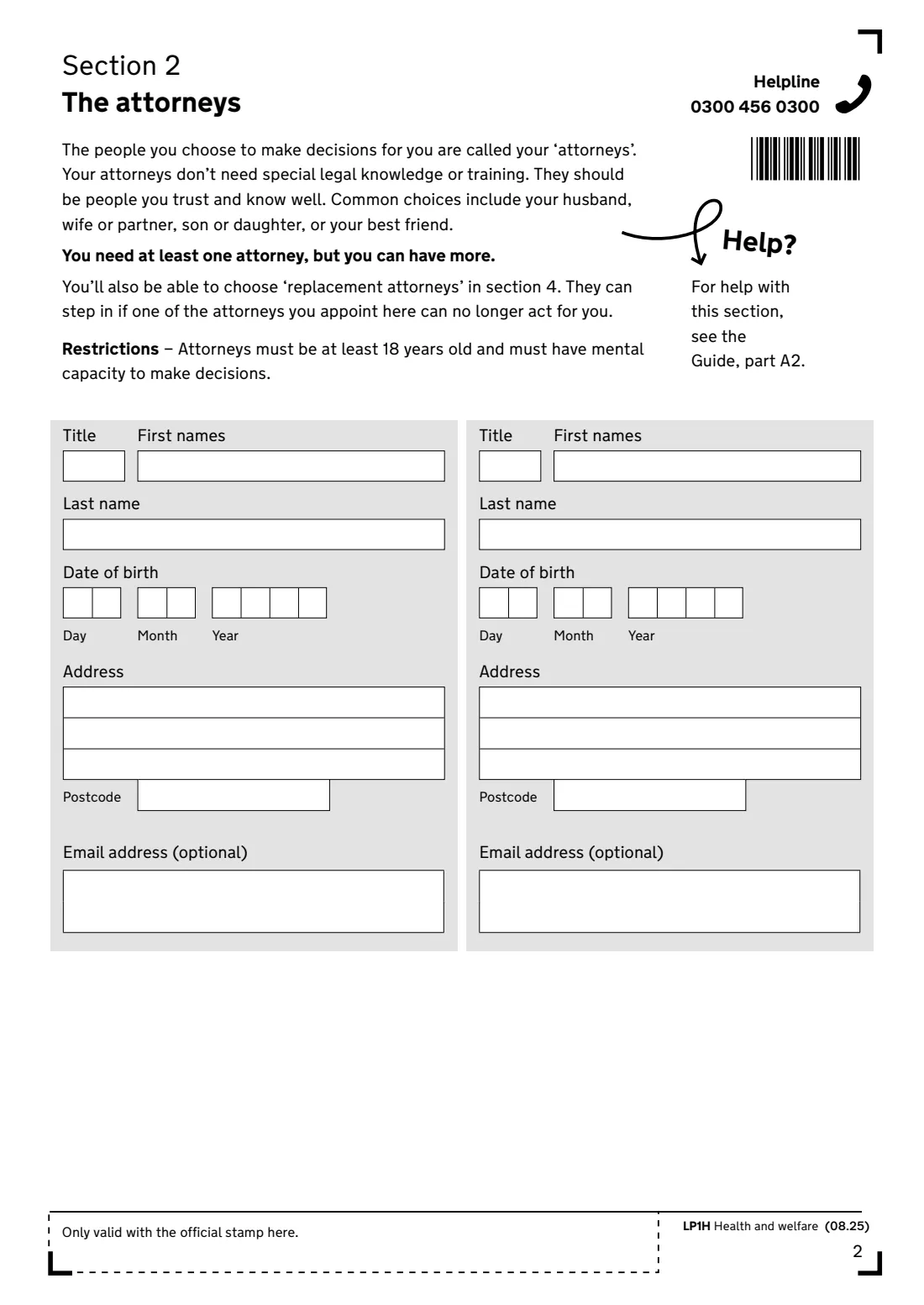
2 Section 2: The attorneys
The people who will make health and care decisions for you. They must be 18 or over and have mental capacity; they don't need medical or legal knowledge, but they should know you well enough to understand what you would want. A spouse, partner, adult child or close friend is typical.
Two practical differences from the financial form: there is no trust corporation option on the LP1H, and the bankruptcy and debt relief order restriction that applies to financial attorneys isn't part of this section.
3 Section 3: How should your attorneys make decisions?
With more than one attorney, choose whether they can act 'jointly and severally' (together or on their own), 'jointly' (every decision unanimous), or jointly for some decisions and jointly and severally for others. For care decisions that can be urgent — a hospital needing an answer quickly — the ability for one attorney to act alone matters.
If you choose 'jointly' and one attorney can no longer act, the LPA stops working unless a replacement steps in. The mixed option needs a list of the joint decisions on Continuation sheet 2, and the OPG suggests legal advice if the guide's examples don't fit.
4 Section 4: Replacement attorneys
Optional but worth considering. Replacements step in if an original attorney dies, loses capacity, no longer wants to act, or is no longer legally your husband, wife or civil partner. Normally they all step in at once; you can change when or how they act on Continuation sheet 2, though most people don't.
5 Section 5: Life-sustaining treatment
This is the section that makes the LP1H different. Life-sustaining treatment means care, surgery, medicine or other help needed to keep you alive — the form gives examples such as a heart bypass or organ transplant, cancer treatment, and artificial nutrition or hydration. It also points out that whether something is life-sustaining depends on the situation: for someone with pneumonia, a simple course of antibiotics could be.
You choose by signing only one option. Option A gives your attorneys authority to give or refuse consent to life-sustaining treatment for you, so they can speak to doctors as if they were you. Option B withholds that authority; your doctors will then take into account your attorneys' views, the views of others interested in your welfare, and any written statement you have made.
You sign your chosen option in front of a witness at the same time as you sign section 9, before the certificate provider signs. Nothing is ticked — your signature is the choice — so FileIt simply puts the date under the option you pick.
6 Section 6: People to notify when the LPA is registered
Optional. Up to five people (four on the form, one more on Continuation sheet 1) who will be told about the registration and can raise concerns, for example about pressure or fraud. Attorneys and replacements can't be named here. The applicant must send each of them form LP3 before signing section 15.
7 Section 7: Preferences and instructions
Optional. For a health and welfare LPA this is often where people add wishes about care — for instance where they'd like to live, or religious or dietary needs. Preferences are wishes to bear in mind; instructions must be followed. Instructions that aren't legally valid will be removed before registration, so word them carefully. FileIt splits your text into the roughly nine lines that fit each box and flags when you are continuing on Continuation sheet 2.
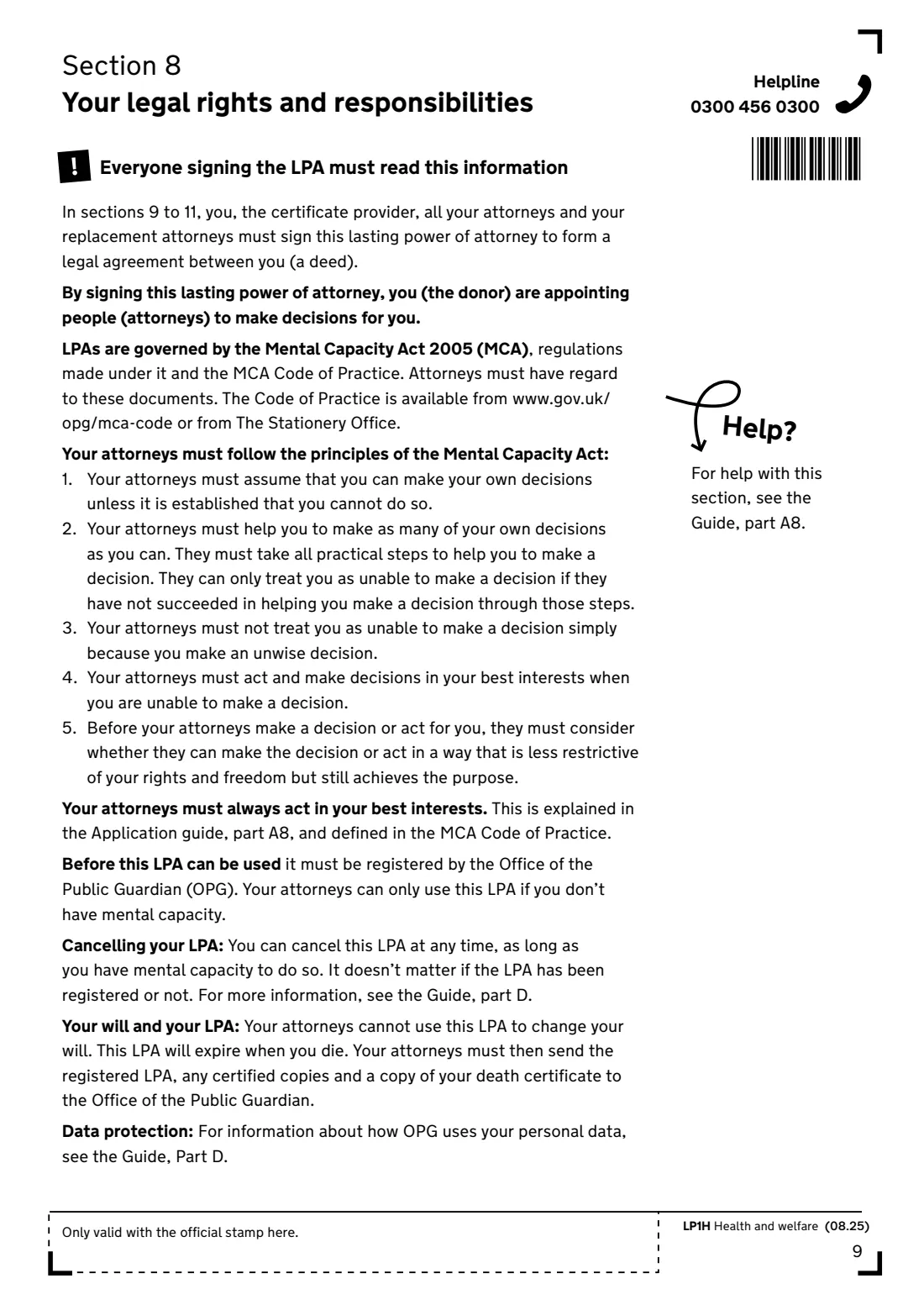
8 Section 8: Your legal rights and responsibilities
No boxes to fill, but everyone who signs must read it. It explains that attorneys must follow the Mental Capacity Act 2005 principles and act in your best interests, and that the LPA can only be used once registered and only when you lack capacity to make the decision in question.
9 Section 9: Signature — donor
Sign and date this page in front of your witness — ideally the same person, at the same sitting, who witnesses your section 5 signature (FileIt can copy their details across). The witness must be 18 or over and not an attorney or replacement. Your certificate provider can act as witness.
Sign any continuation sheets 1 or 2 at the same time. All of this must be done before sections 10 and 11 are signed.
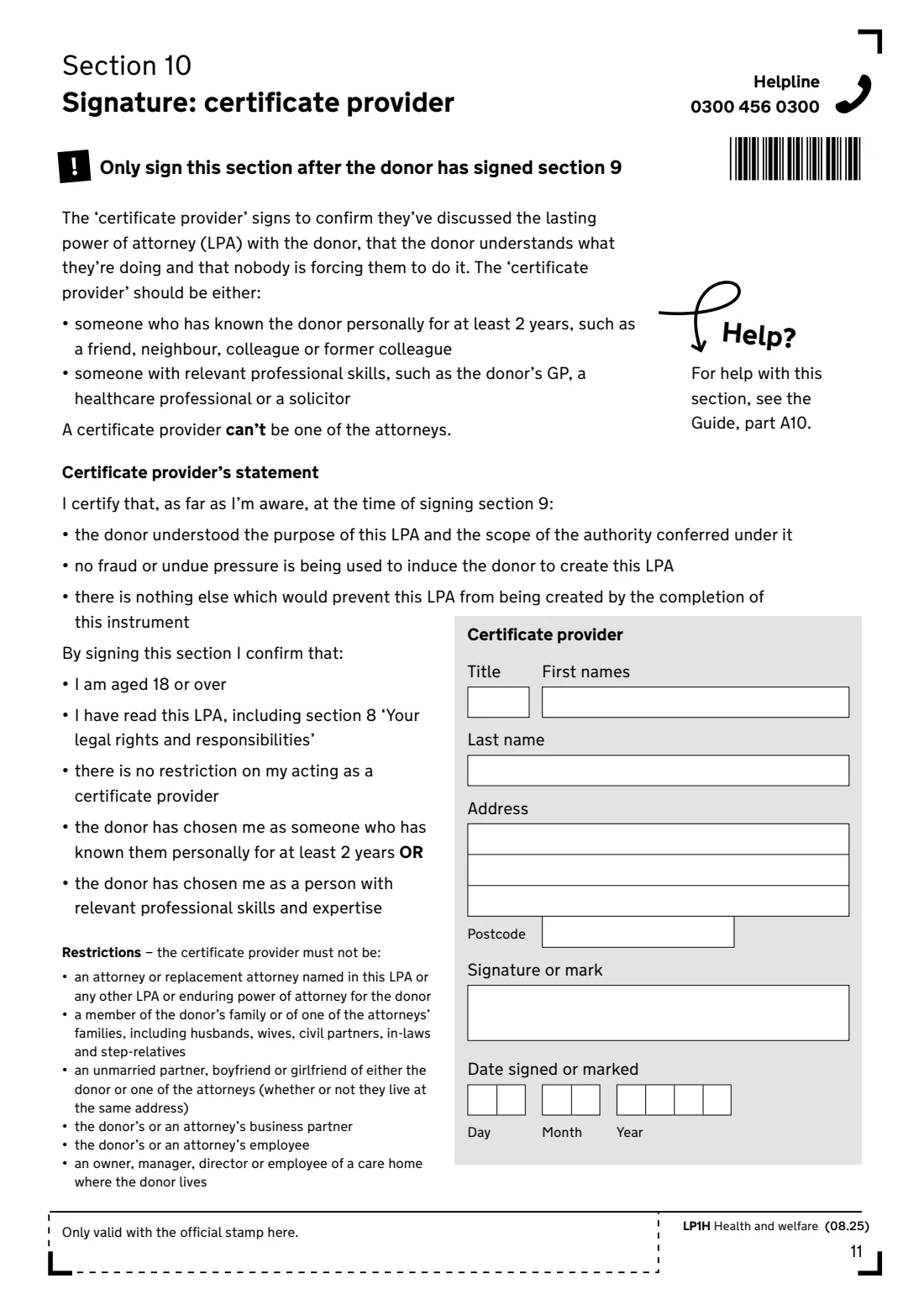
10 Section 10: Signature — certificate provider
After the donor has signed sections 5 and 9, the certificate provider confirms that you understand the LPA and that no fraud or undue pressure is involved. They must have known you personally for at least 2 years or have relevant professional skills, and must not be an attorney, a family member of yours or an attorney, a partner, a business partner or employee, or connected with a care home where you live.
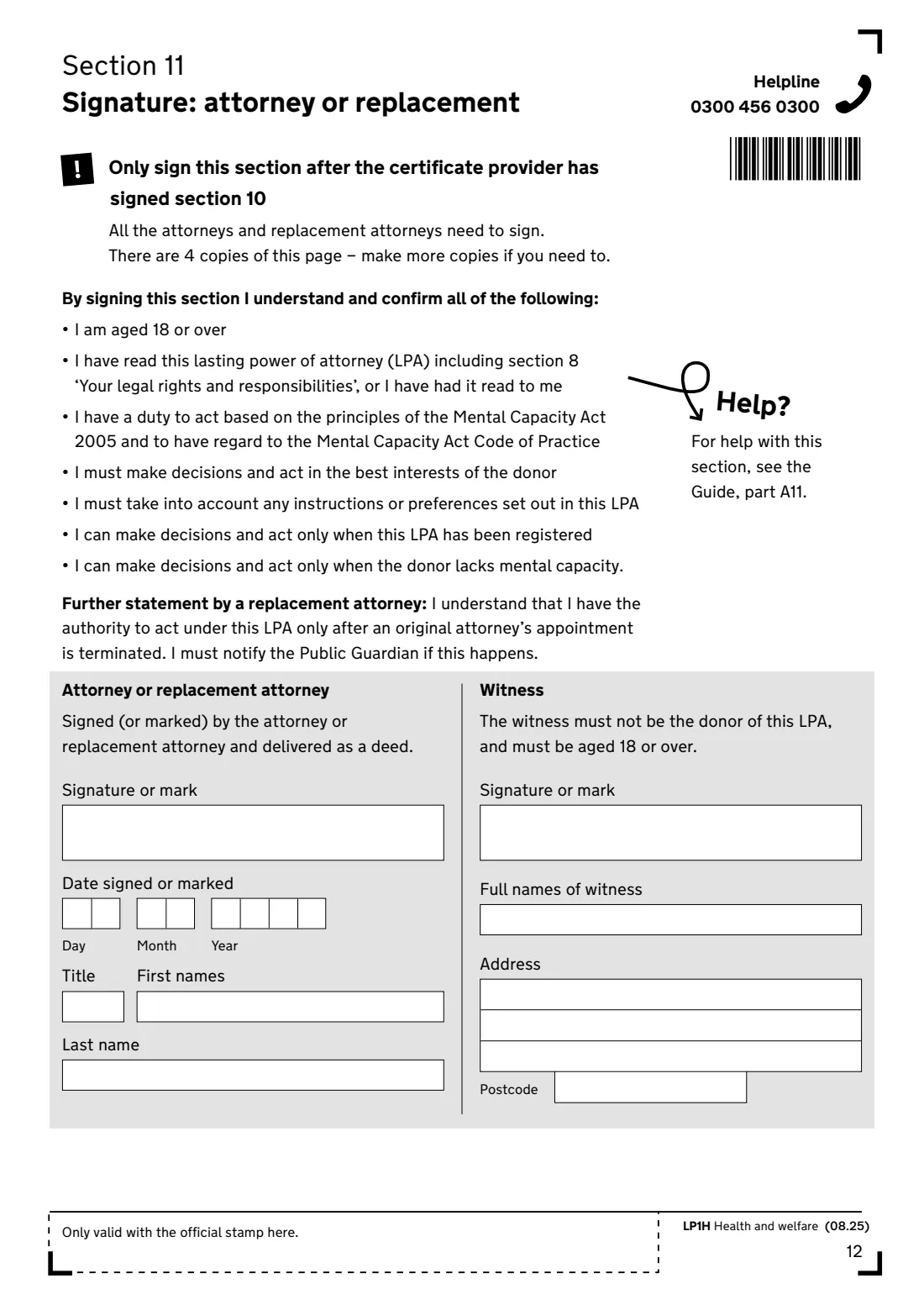
11 Section 11: Signature — attorneys and replacement attorneys
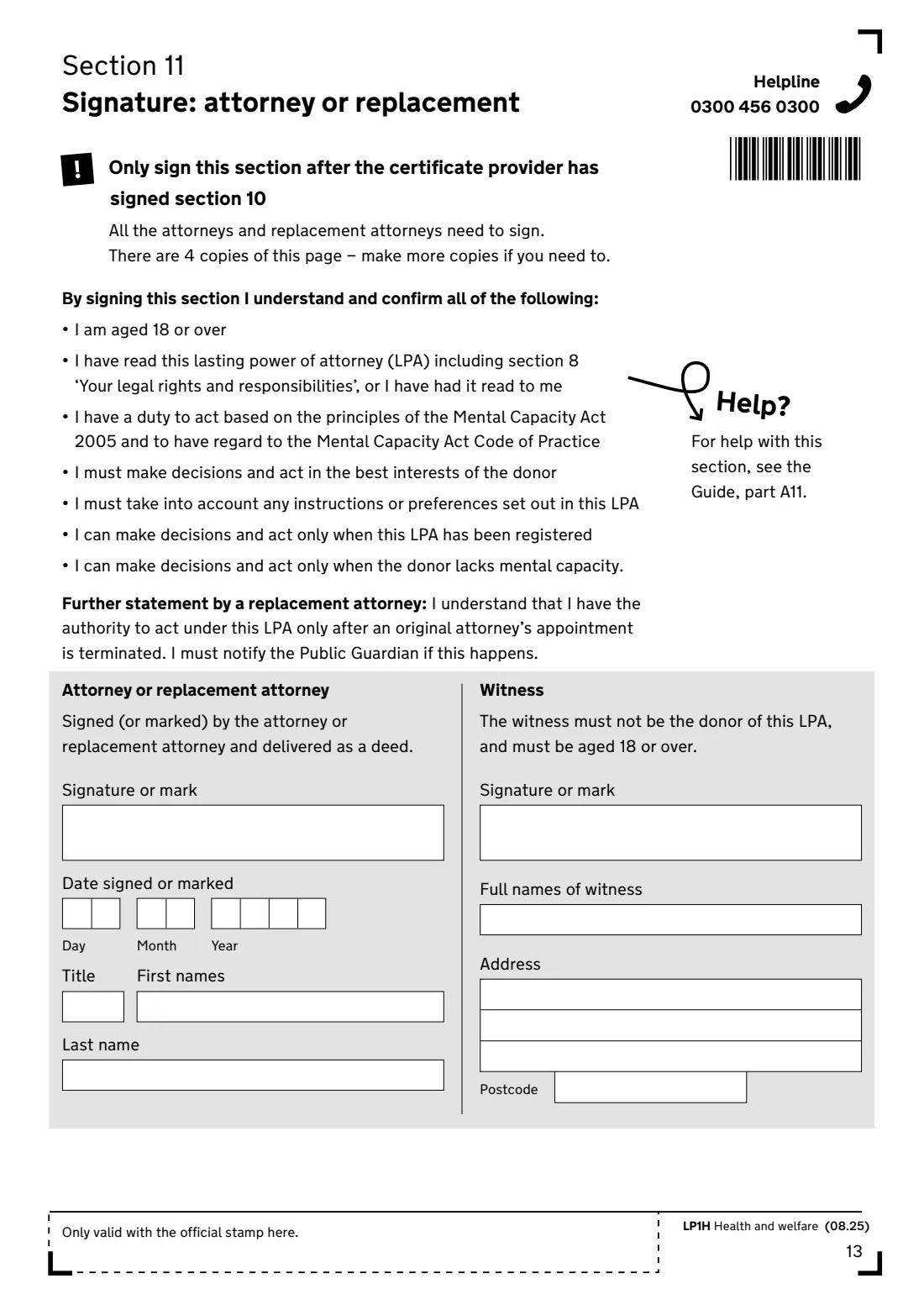
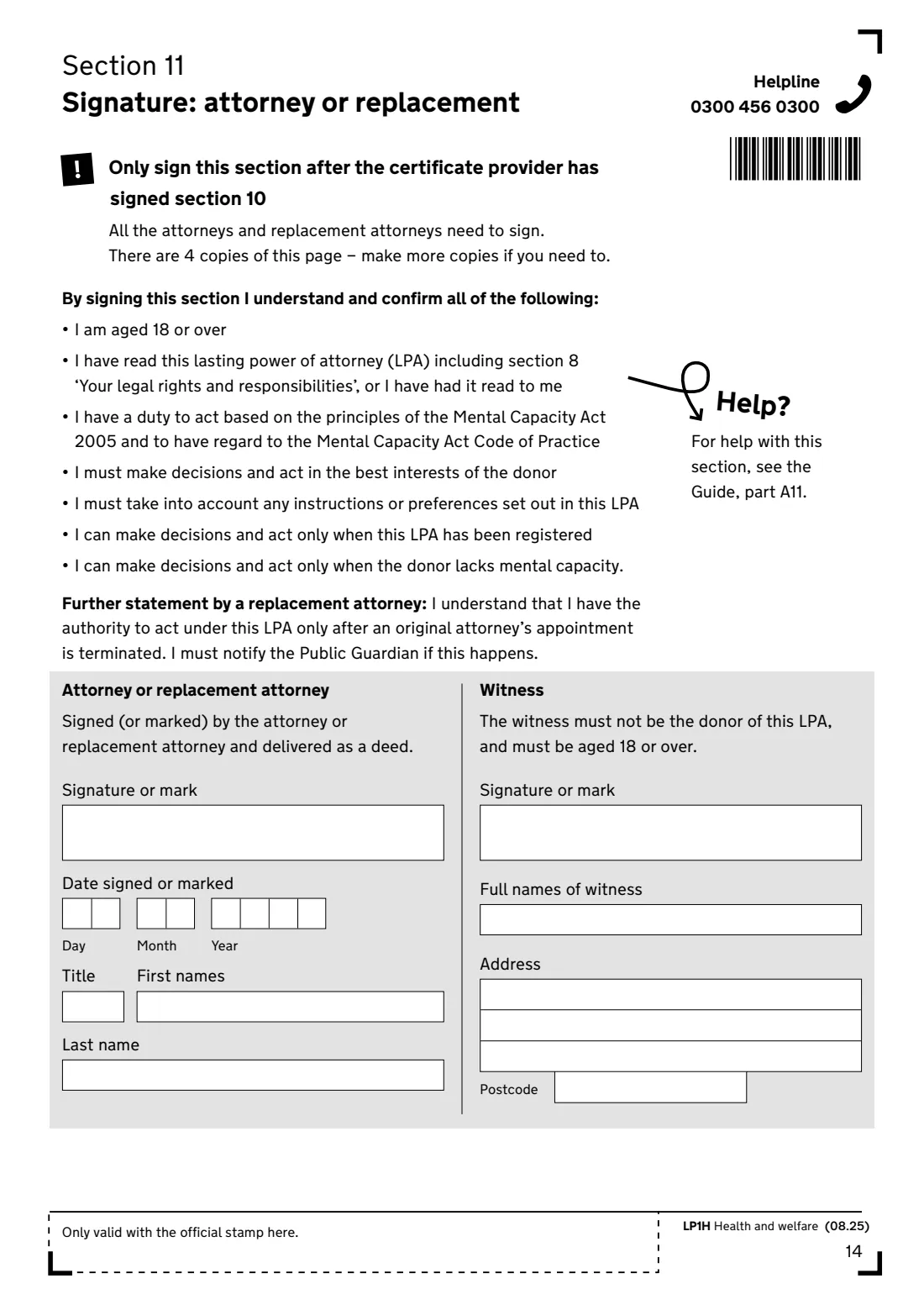
Each attorney and replacement then signs their own copy of this page in front of an adult witness who is not the donor; attorneys may witness for each other. There are four copies in the form — photocopy a blank one if more people need to sign.
12 Sections 12 to 15: Register the LPA
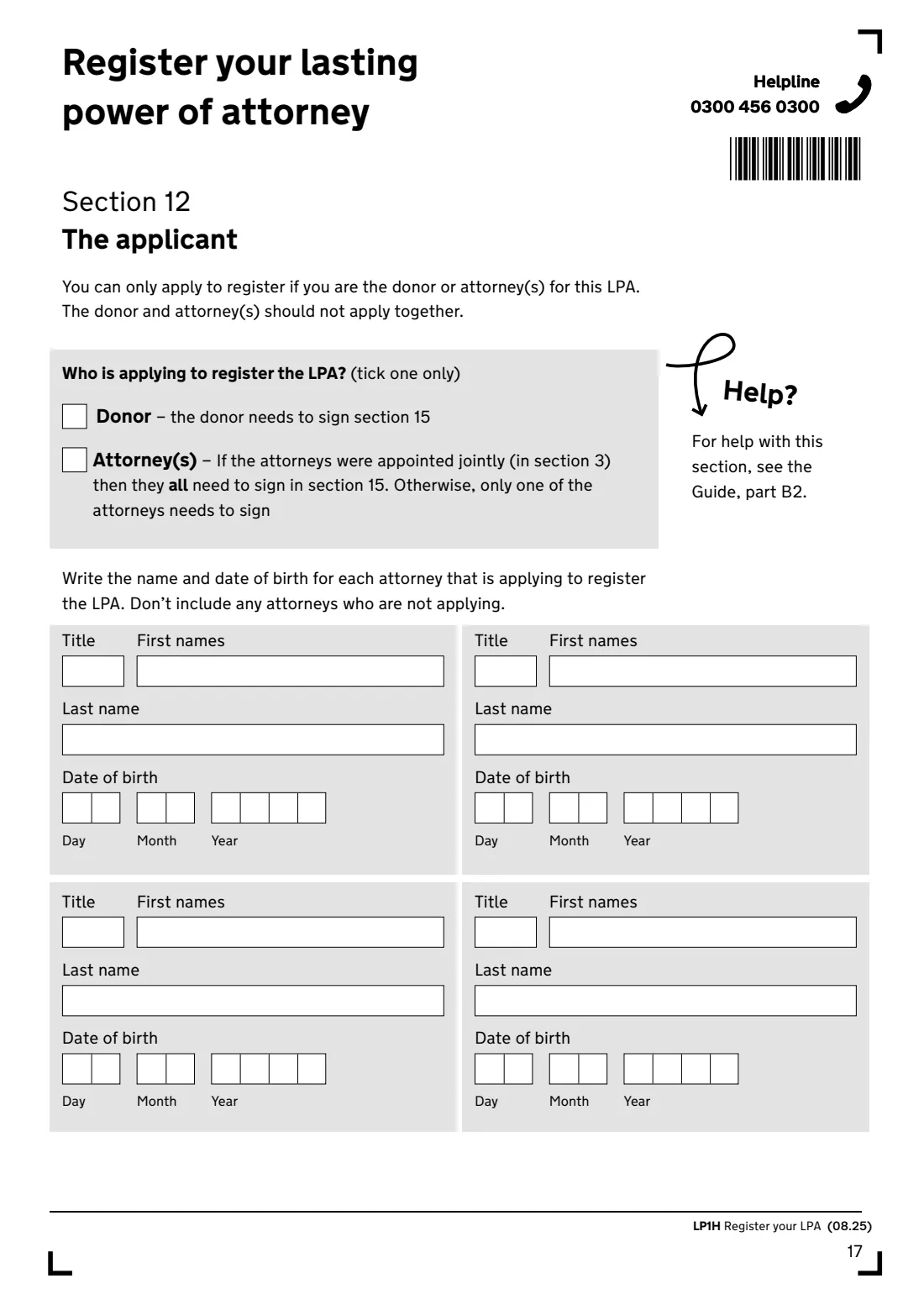
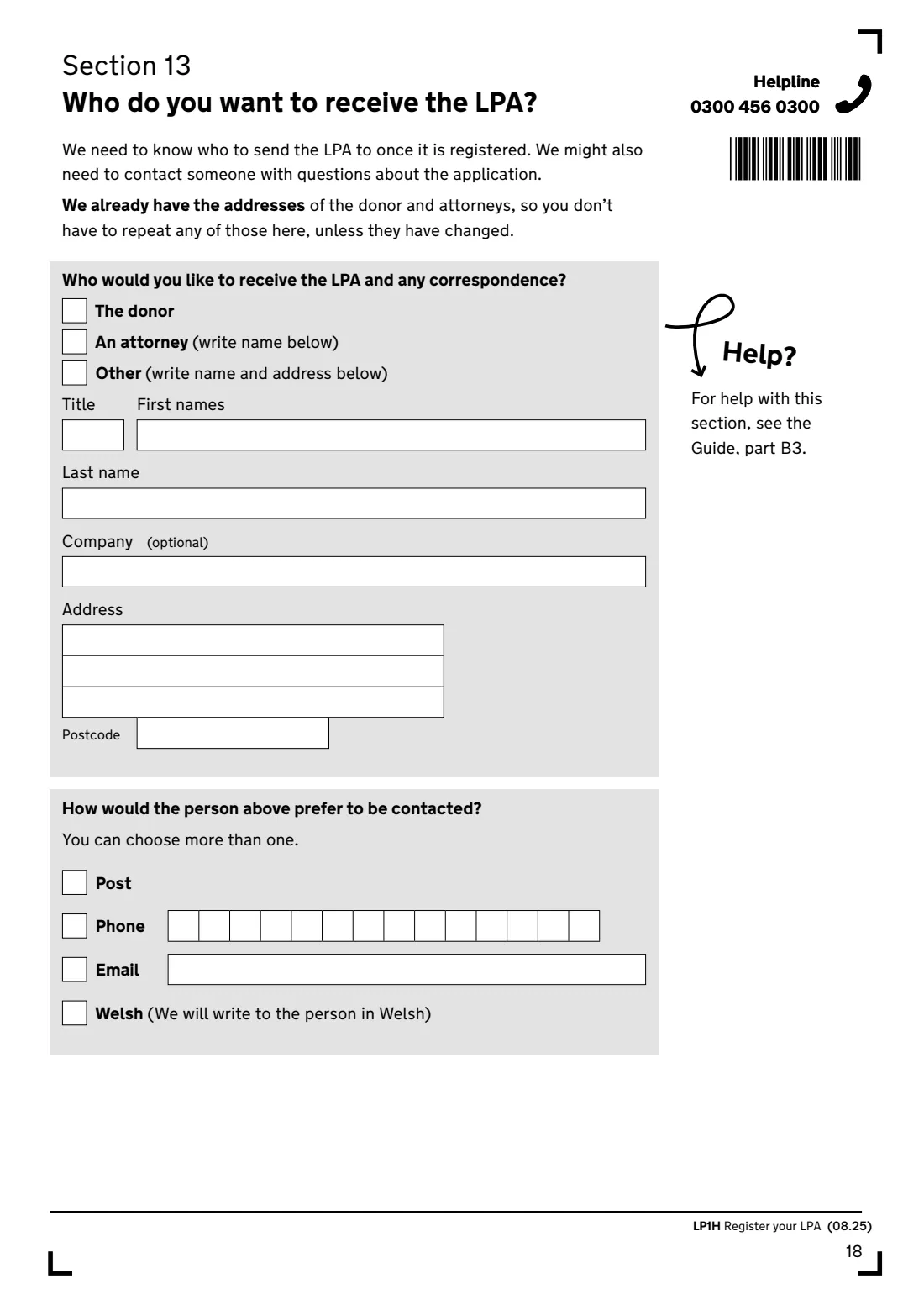
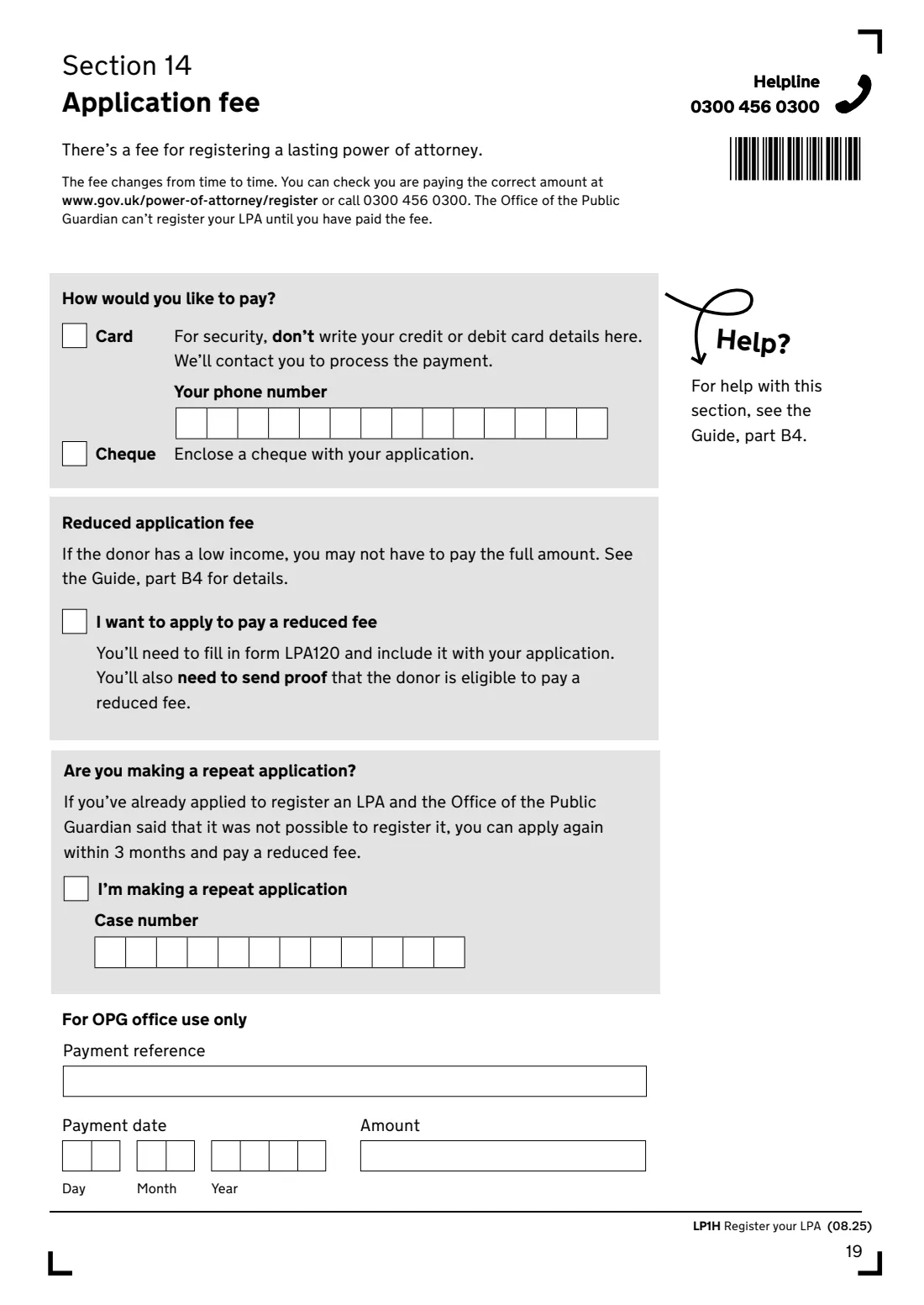
The donor or the attorney(s) — never both together — apply to register. Say who should receive the registered LPA, how the OPG should contact them (post, phone, email, and whether in Welsh), and how you'll pay: the OPG phones for card payment, or you enclose a cheque. Check the current fee on GOV.UK, as it isn't printed on the form.
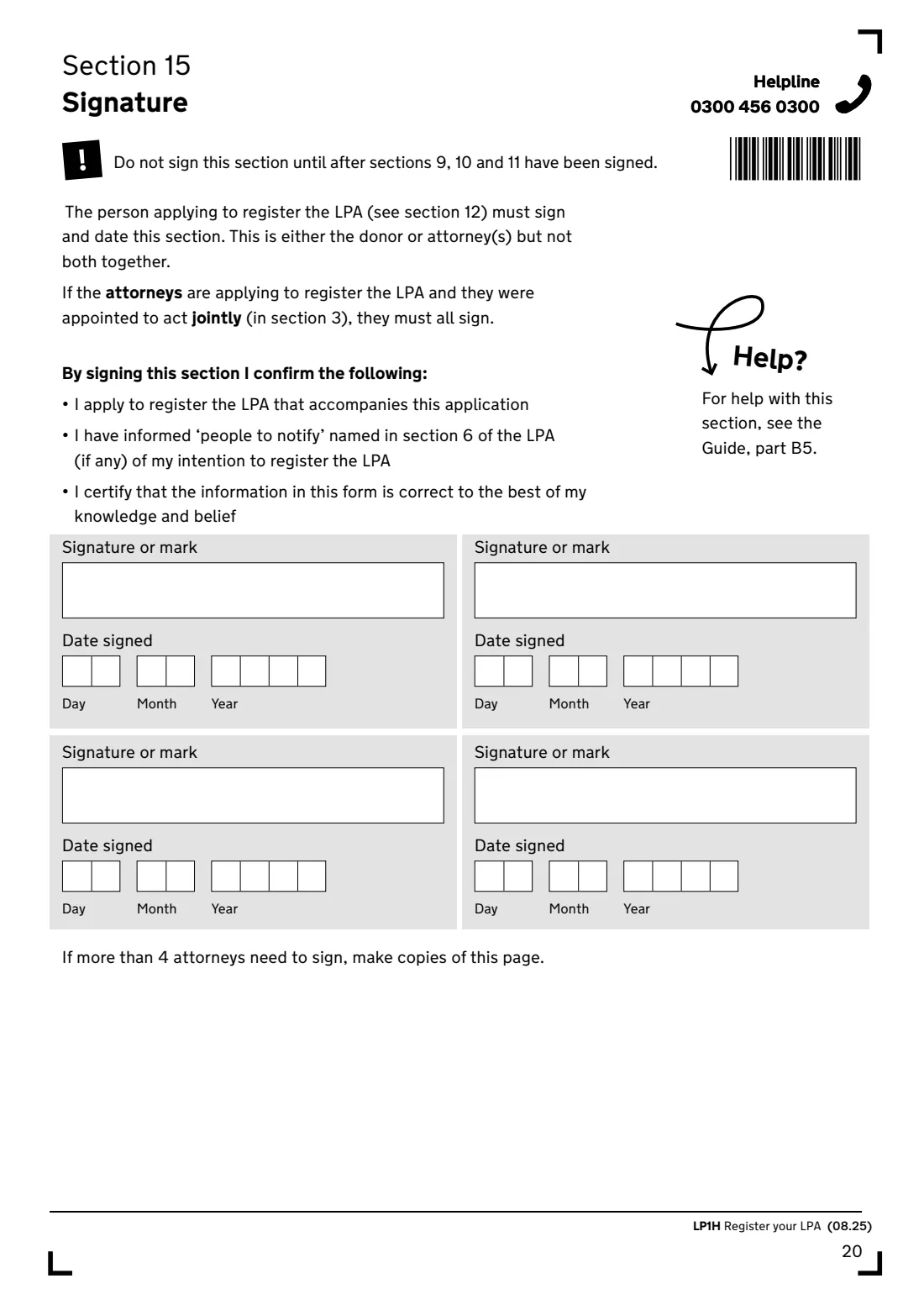
Tick the reduced-fee box and include form LPA120 if the donor has a low income, or the repeat application box if a previous application was rejected within the last 3 months. The applicant signs section 15 last.
Common mistakes to avoid
- Signing both Option A and Option B in section 5, or neither. Sign one option only.
- Signing section 5 on a different occasion from section 9, or after the certificate provider has signed. The donor signs both together, in front of a witness, first.
- Getting the signing order wrong: donor, then certificate provider, then attorneys and replacements, then the applicant.
- Using an attorney or replacement as the donor's witness, or the donor as an attorney's witness.
- Choosing a certificate provider who is a relative, in-law or partner of the donor or an attorney.
- Writing instructions that clash with your life-sustaining treatment choice or with an existing advance decision.
- Sending an incomplete form — include every page, even blank ones, and all continuation sheets used.
- Assuming the LPA works as soon as it is signed. It must be registered by the OPG first, and it only applies when you lack capacity.
After you fill it out
Print the completed PDF from FileIt and arrange the signing. The donor signs section 5 and section 9 together in front of a witness; the certificate provider then signs section 10; each attorney and replacement signs section 11 in front of a witness; and finally the applicant signs section 15 after sending form LP3 to any people to notify. Every signature is in ink on paper, so FileIt's e-signature option isn't used for an LPA.
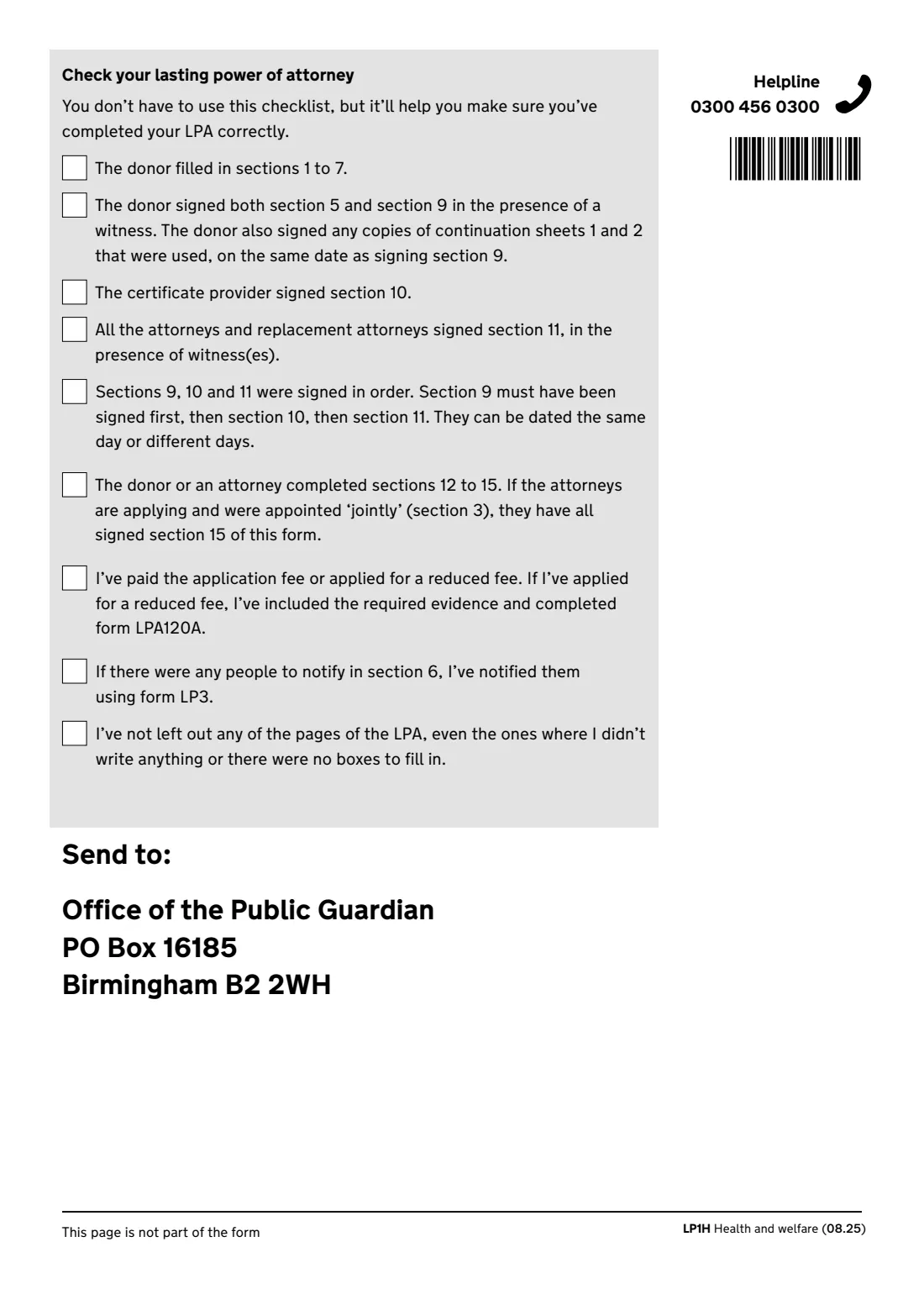
Post the whole form, including blank pages, to the address printed in the registration section: Office of the Public Guardian, PO Box 16185, Birmingham B2 2WH, with a cheque or form LPA120 if they apply. The OPG will register the LPA or tell you what needs correcting.
Keep a scan of the signed form, and later the registered LPA, in the donor's FileIt folder, and tell your attorneys and GP where it is. Review it after major life events; while you have capacity you can cancel it and make a new one.
Fill out LP1H online with FileIt
- Pick the person. Choose someone from People and FileIt fills in their name, date of birth, address and other details it already knows.
- Answer plain-language questions. One part of the form at a time, with the official help text beside each question — 215 fields in all. Your answers save as you go.
- Check the live preview. Watch your answers land on the real Office of the Public Guardian (OPG) form, and let FileIt do any worksheet arithmetic.
- Generate the official PDF. FileIt prints your answers into the agency’s own PDF and files it in that person’s folder in your vault.
FileIt fills the form — it never files or submits anything for you. Deliver the finished form to whoever asked for it, the way the form’s instructions say.
Start LP1H now — it’s freeLP1H: frequently asked questions
What does an LP1H health and welfare LPA cover?
It covers decisions about your health care and medical treatment, including life-sustaining treatment if you choose Option A, where you live, and day-to-day matters such as diet and routine. It does not cover money or property — that's the LP1F.
When can a health and welfare LPA be used?
Only after it has been registered by the Office of the Public Guardian, and only when you lack the mental capacity to make the particular decision yourself. If you can make the decision, your attorneys can't make it for you.
What is the difference between Option A and Option B?
Option A gives your attorneys authority to give or refuse consent to life-sustaining treatment on your behalf. Option B does not; doctors will instead take your attorneys' views and your written wishes into account. You choose by signing one option only, in front of a witness.
Should I make an LP1H and an LP1F?
They do different jobs, so many people make both. The LP1H covers health and care decisions and can only be used when you lack capacity; the LP1F covers money and property and can, if you allow it, be used as soon as it is registered.
Can I fill in the LP1H online?
Yes. FileIt lets you complete the LP1H in a guided online form for free and prints your answers into the OPG's official PDF, ready to print and sign in ink. The OPG also offers its own online LPA service, mentioned on the front of the form.
Where do I send my completed LP1H?
Post the full signed form to Office of the Public Guardian, PO Box 16185, Birmingham B2 2WH, as printed in the registration section. Include all pages and any continuation sheets. FileIt doesn't post or submit it for you.
Who can witness the donor's signature on an LP1H?
Anyone aged 18 or over who is not an attorney or replacement attorney under this LPA. The certificate provider can be the witness. The same witness normally watches you sign both section 5 and section 9.
How much is the fee to register a health and welfare LPA?
The form doesn't state the fee and asks you to check the current amount on GOV.UK. A reduced fee may be available for donors on a low income using form LPA120.
Official sources
- Blank form (PDF), published by Office of the Public Guardian (OPG): https://assets.publishing.service.gov.uk/media/68a83d5d3a052c9c504c8d8f/20250822-LP1H-create-and-register-your-lasting-power-of-attorney.pdf
- Official instructions and guidance: https://www.gov.uk/government/publications/lasting-power-of-attorney-forms/lp12-make-and-register-your-lasting-power-of-attorney-a-guide-web-version
- Edition shown on this page: LP1H Health and welfare (08.25) (checked 2026-09-25).
FileIt is not affiliated with or endorsed by Office of the Public Guardian (OPG) or any government. This page explains the form in general terms and is not legal, tax or immigration advice. Always read the official instructions, and check that you are using the edition the recipient accepts. Page last reviewed 2026-09-25.