
What is LP1F?
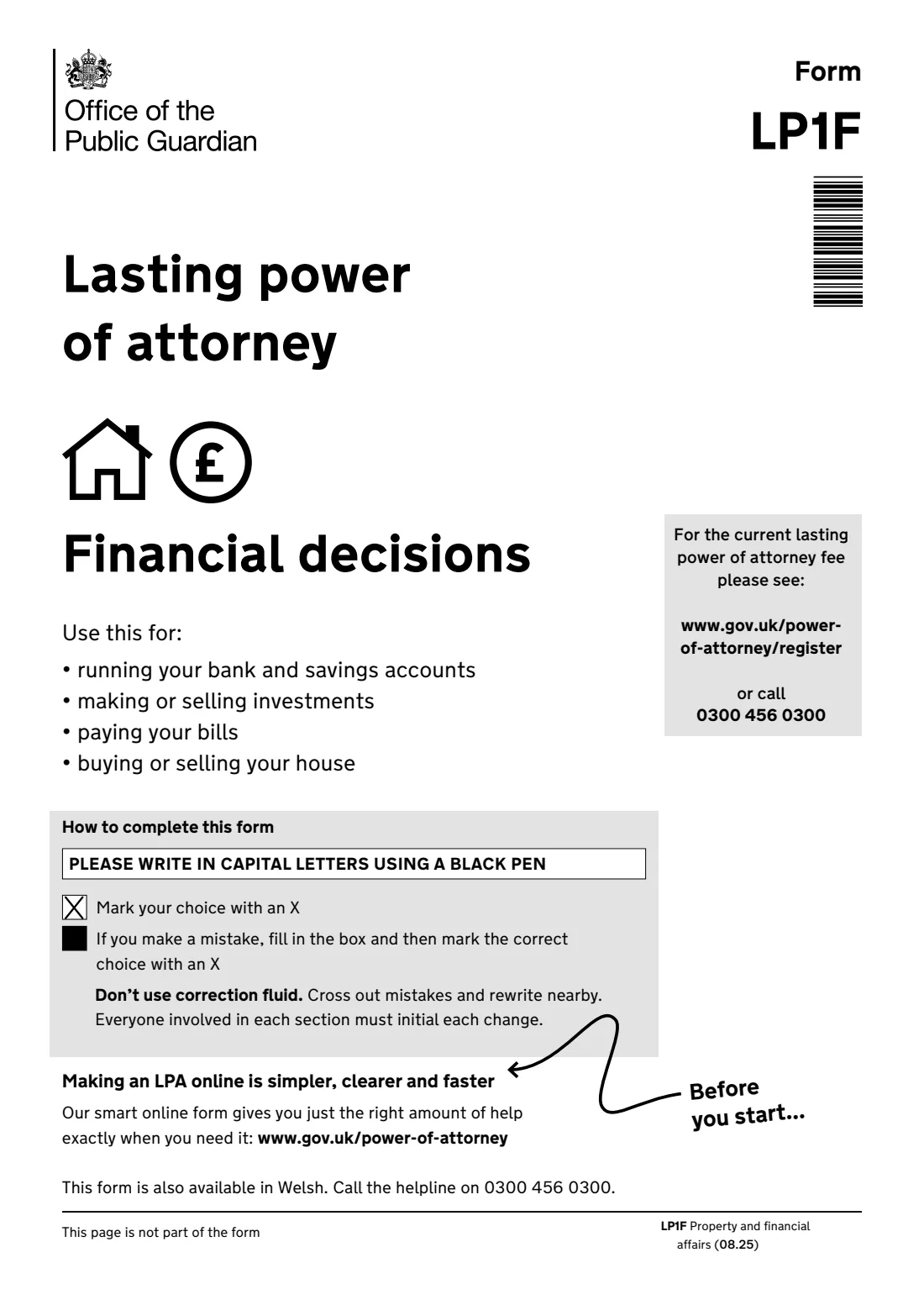
Form LP1F is the paper version of a lasting power of attorney (LPA) for property and financial affairs, published by the Office of the Public Guardian (OPG). It lets you, the 'donor', appoint one or more 'attorneys' to make decisions about your money and property — running your bank and savings accounts, paying your bills, collecting a benefit or pension, making or selling investments, and buying or selling your home. Once it is registered, and if you allow it, your attorneys can help you even while you can still make decisions yourself.
An LPA is a legal document (a deed), so the rules about who signs, in what order and in front of whom are strict. A mistake can stop the LPA from being registered, and if it is only discovered after you have lost mental capacity it may be impossible to fix. The form is 20-plus pages long and repeats many names and addresses, which is where most errors creep in.
FileIt walks you through each section of the LP1F in plain language and prints your answers, in capital letters, into the OPG's own official PDF. Names, dates of birth and addresses can be pre-filled from the People records already in your FileIt vault, the finished PDF is saved to the donor's folder, and you then print it, sign it in ink in the right order and post it to the OPG yourself. FileIt never sends anything to the OPG on your behalf.
- Who fills it
- The donor (the person making the LPA), aged 18 or over with mental capacity; the registration part can be completed by the donor or the attorneys
- Given to
- The Office of the Public Guardian (OPG), by post, to be registered
- When
- Any time while the donor still has mental capacity — registering straight away is recommended
- Signatures
- In ink, in order: donor (witnessed), certificate provider, each attorney and replacement attorney (witnessed), then the applicant
- Edition
- LP1F Property and financial affairs (08.25)
- Covers
- England and Wales
Who needs to fill out LP1F?
- Any adult in England or Wales who wants to choose, in advance, who will look after their money and property if they can no longer do it themselves.
- People who would like help with banking and bills now — for example while travelling, or because a physical condition makes visiting the bank or signing documents difficult.
- Couples who want each other (and perhaps adult children) to be able to deal with joint and sole accounts, pensions and the family home.
- Anyone who owns property or investments that might need to be sold or managed during a long illness or stay in care.
- Families planning ahead after a diagnosis such as dementia, while the person can still understand and make the LPA themselves.
- It is not for someone who has already lost mental capacity: an LPA can't be made on their behalf, and a different court process applies instead.
When to use LP1F
- Make it while you are well — you must have mental capacity when you sign, and your certificate provider must be satisfied that you understand it.
- Register it soon after everyone has signed. The form itself says you don't have to register immediately, but doing so means any mistakes can be put right while you can still sign a new form.
- Consider it alongside a will. Your attorneys can't use this LPA to change your will, and the LPA ends when you die.
- Revisit it after big life changes — separation, divorce or the death of an attorney can affect whether an attorney can still act, which is why replacement attorneys are worth considering.
- If you also want someone to make decisions about your health and care, you need a separate health and welfare LPA (form LP1H).
What you need before you start
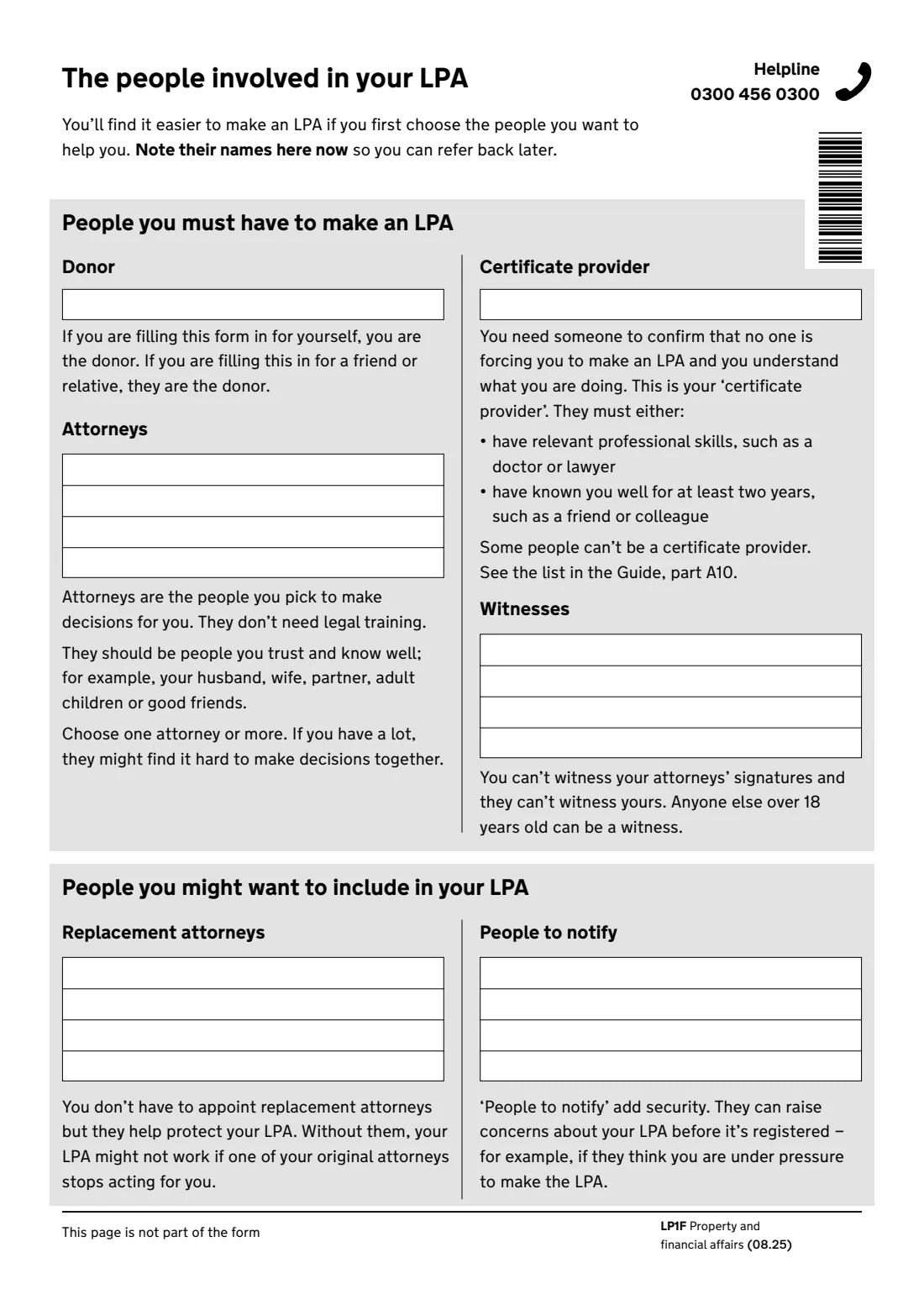
- Your full name (all first names), any other names you are known by, date of birth, address and optional email address.
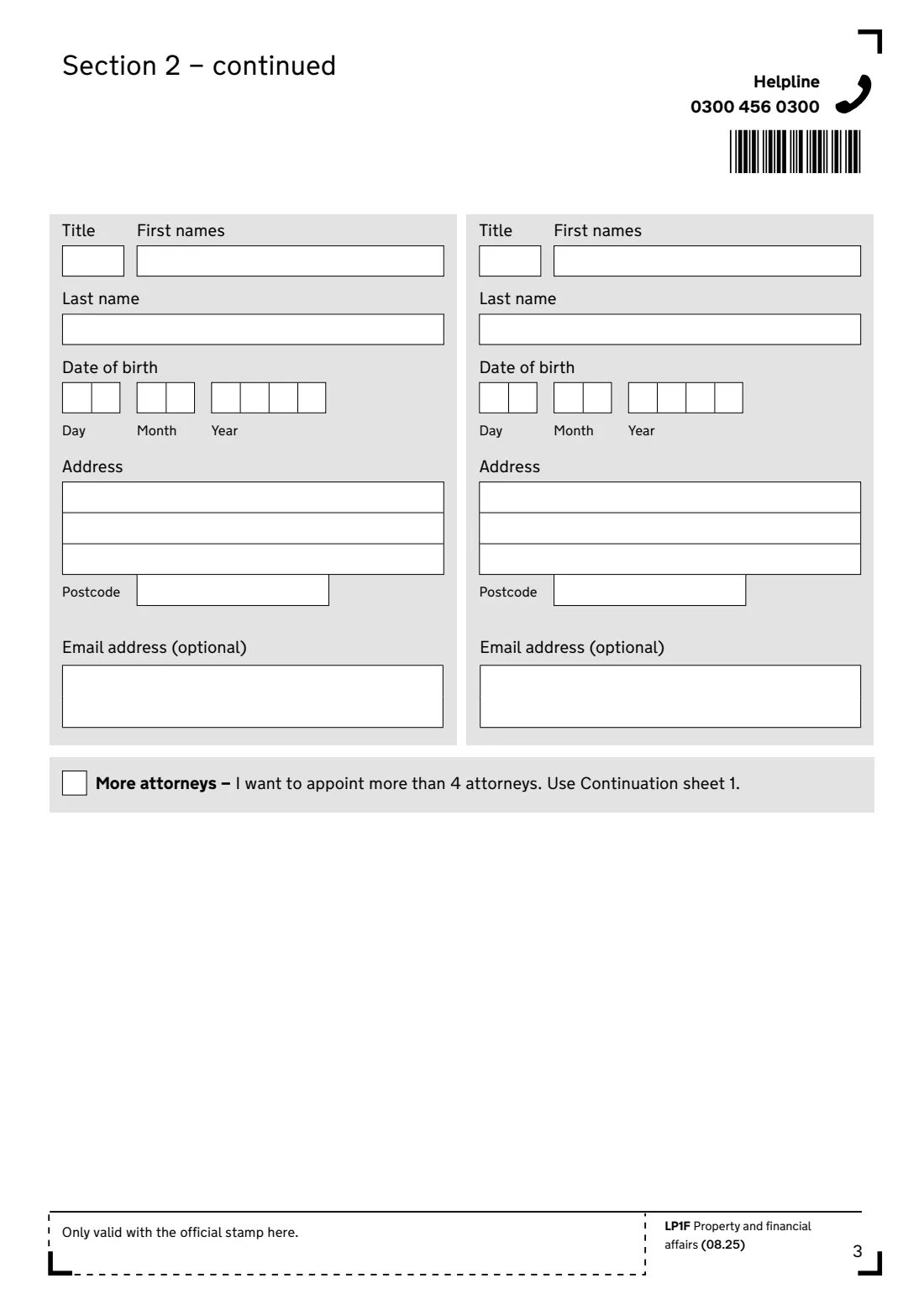
- The full names, dates of birth and addresses of each attorney — the form has room for four, with Continuation sheet 1 for more.
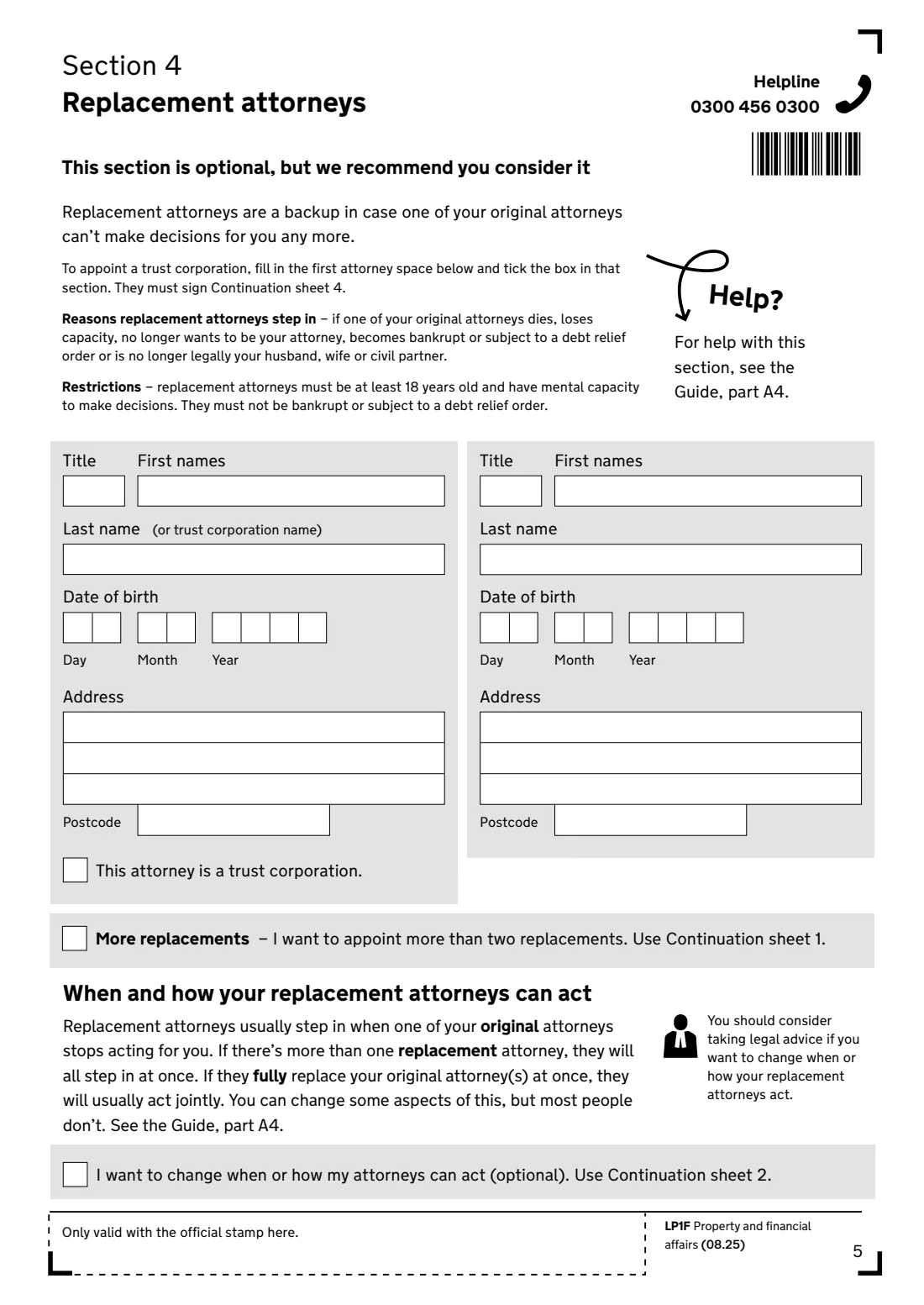
- Details of any replacement attorneys you want as a backup (room for two on the form).
- The name and address of your certificate provider — someone who has known you personally for at least 2 years, or a professional such as your GP or a solicitor.
- Names and addresses of up to five 'people to notify', if you want any, and copies of form LP3 to send them before registering.
- A decision on how your attorneys should work together (jointly and severally, jointly, or a mix) and when they can act.
- Any preferences or instructions you want written into the LPA — ideally checked against the examples in the OPG guide (LP12).
- Adult witnesses who are not attorneys or replacement attorneys, available on the day the donor signs.
- Payment details for the registration fee (card or cheque), or form LPA120 and proof of eligibility if applying for a reduced fee.
- A trust corporation's details and Continuation sheet 4, if you are appointing one (for example a bank's trust department).
What’s on LP1F
The 2025 edition has 24 pages. FileIt asks for it in 13 parts:
- Section 1: The donorDonor
- Section 2: The attorneysAttorney
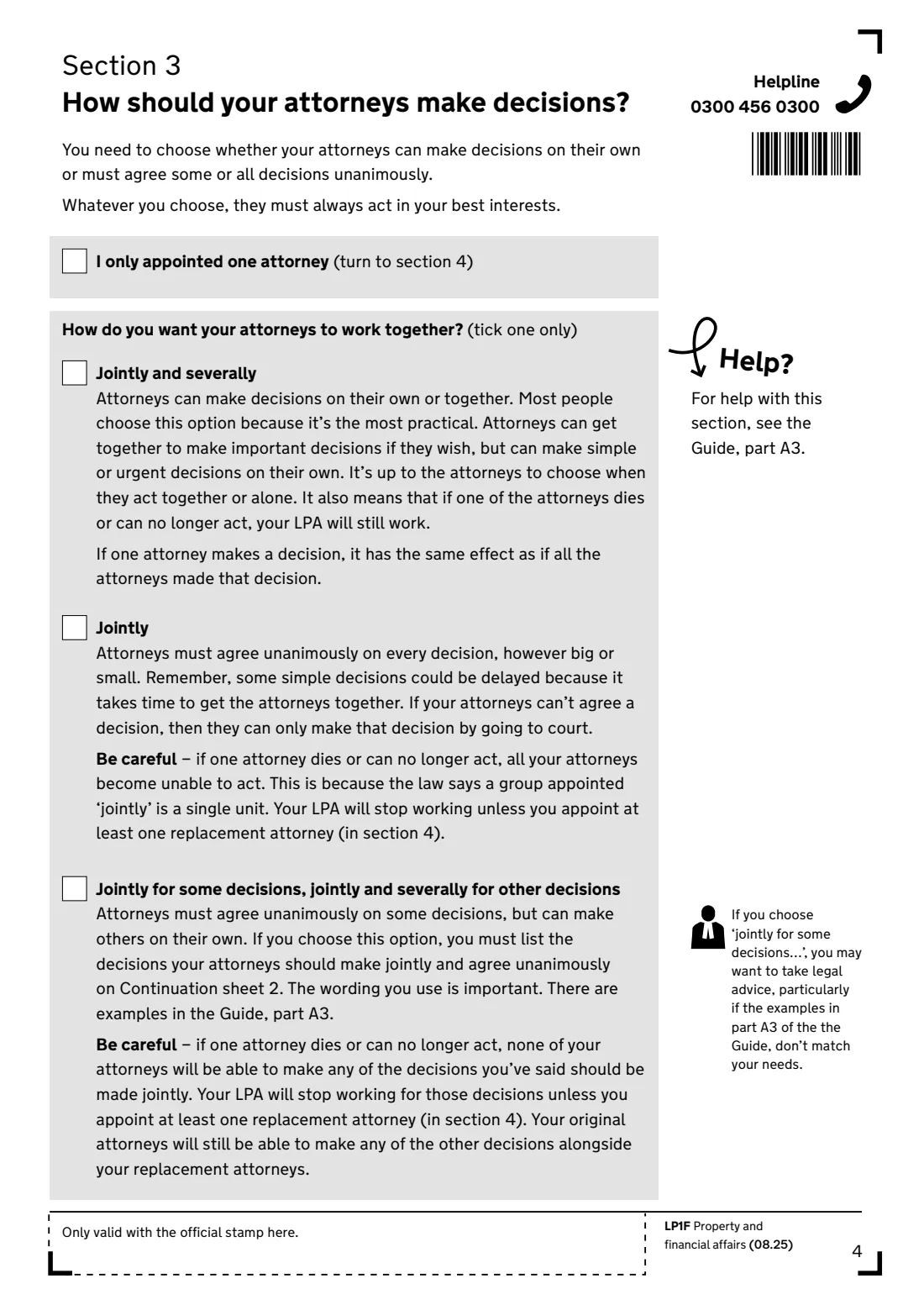
- Section 3: How should your attorneys make decisions?Donor
- Section 4: Replacement attorneysReplacement attorney
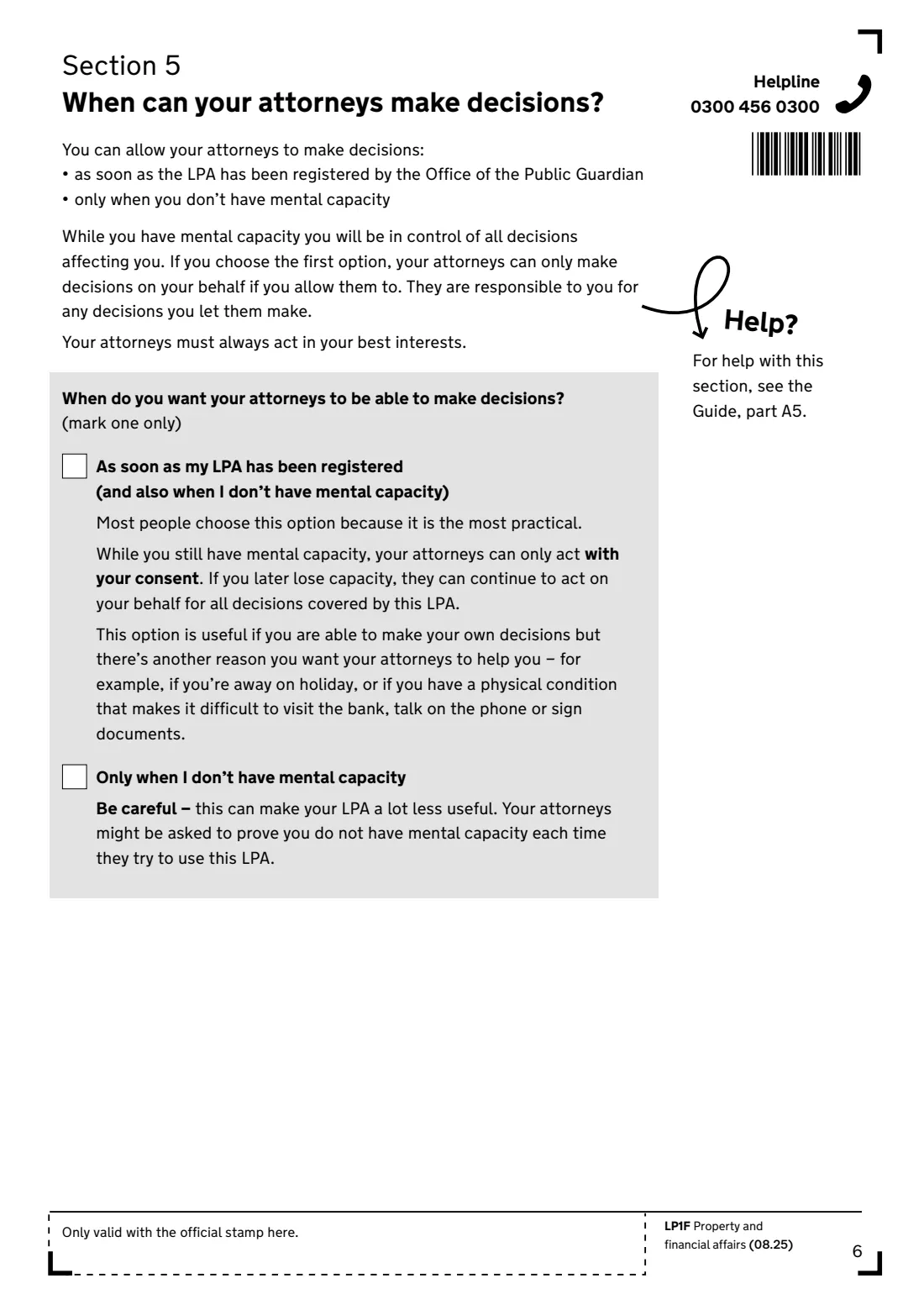
- Section 5: When can your attorneys make decisions?Donor
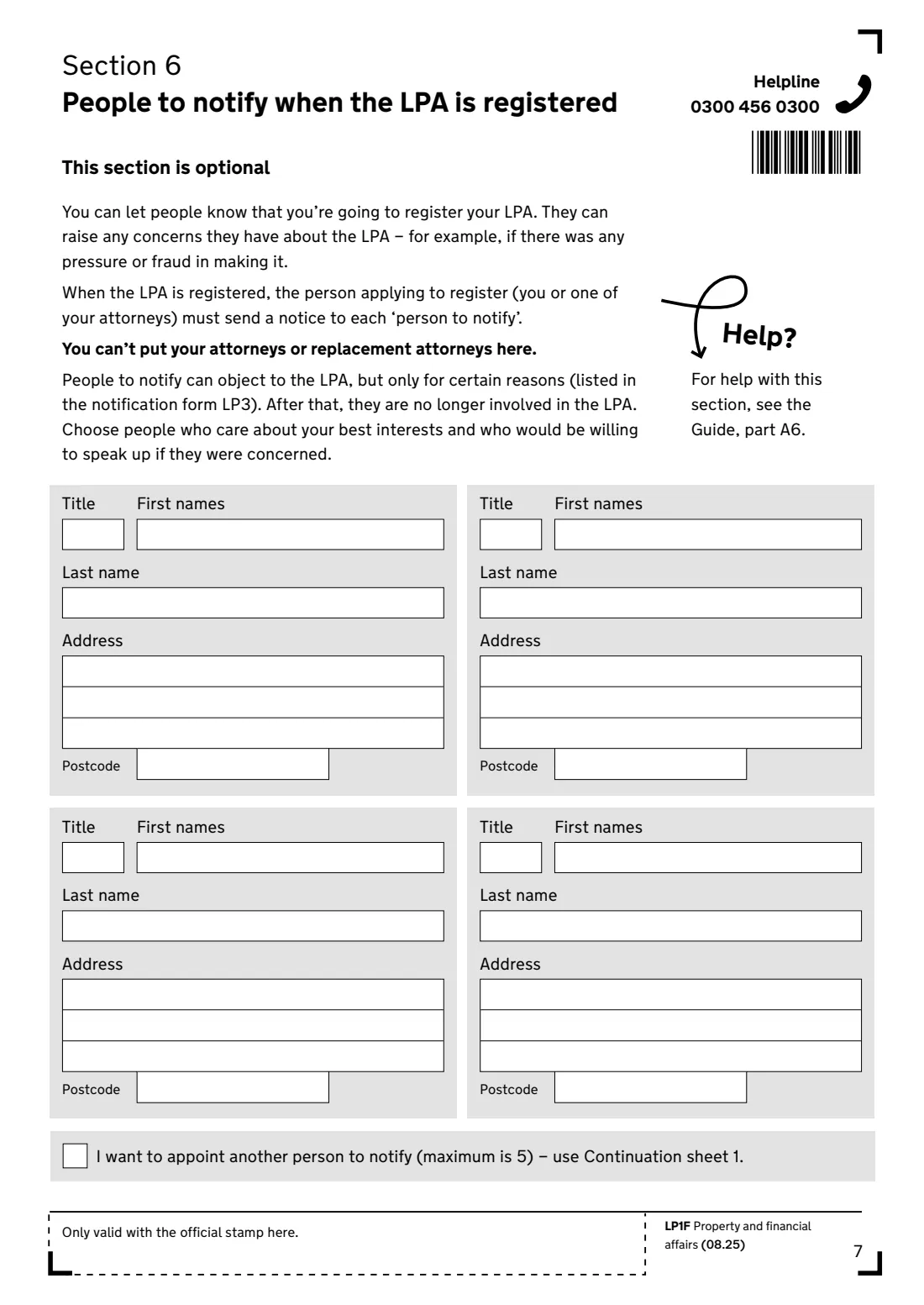
- Section 6: People to notify when the LPA is registeredPerson to notify
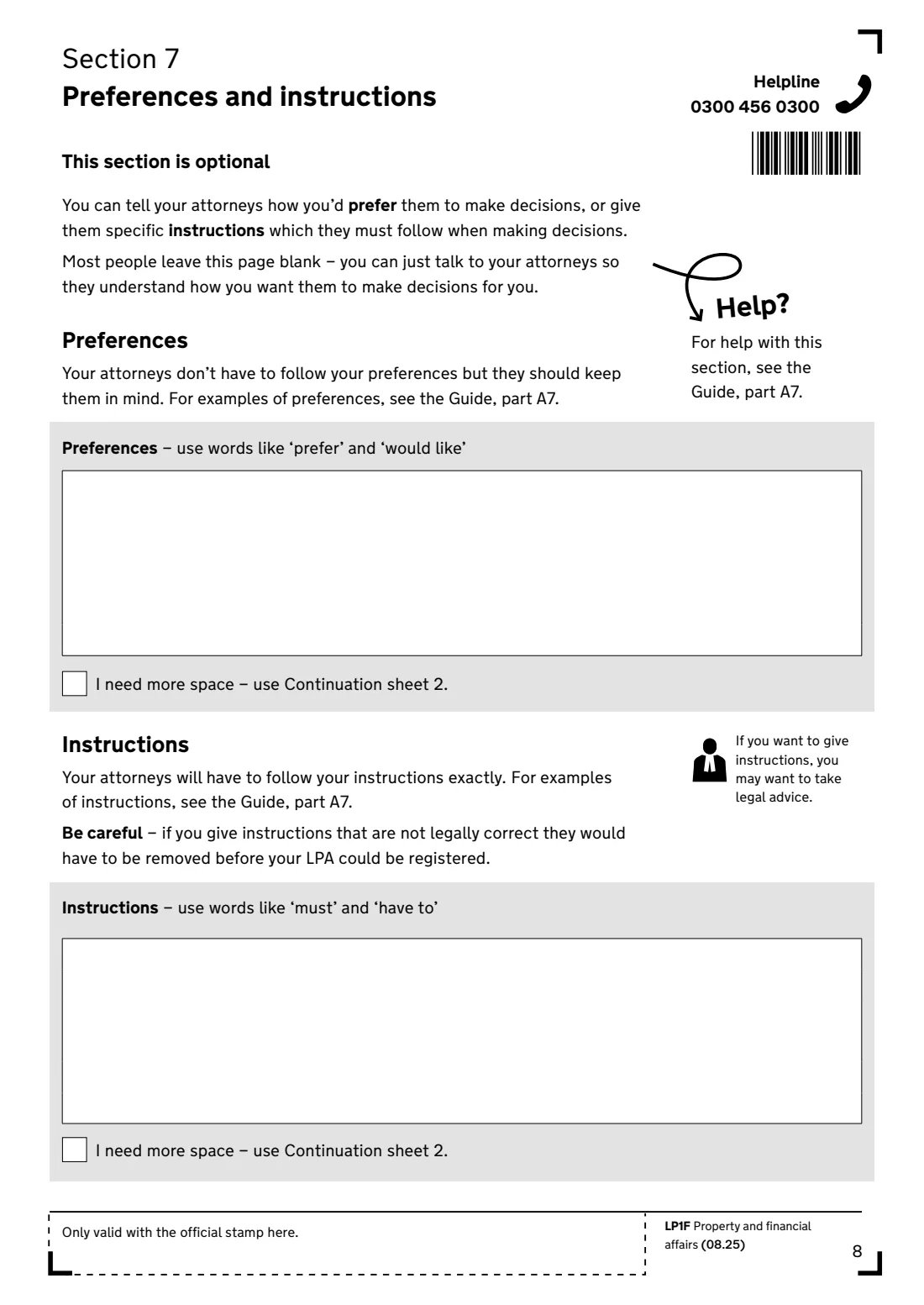
- Section 7: Preferences and instructionsDonor
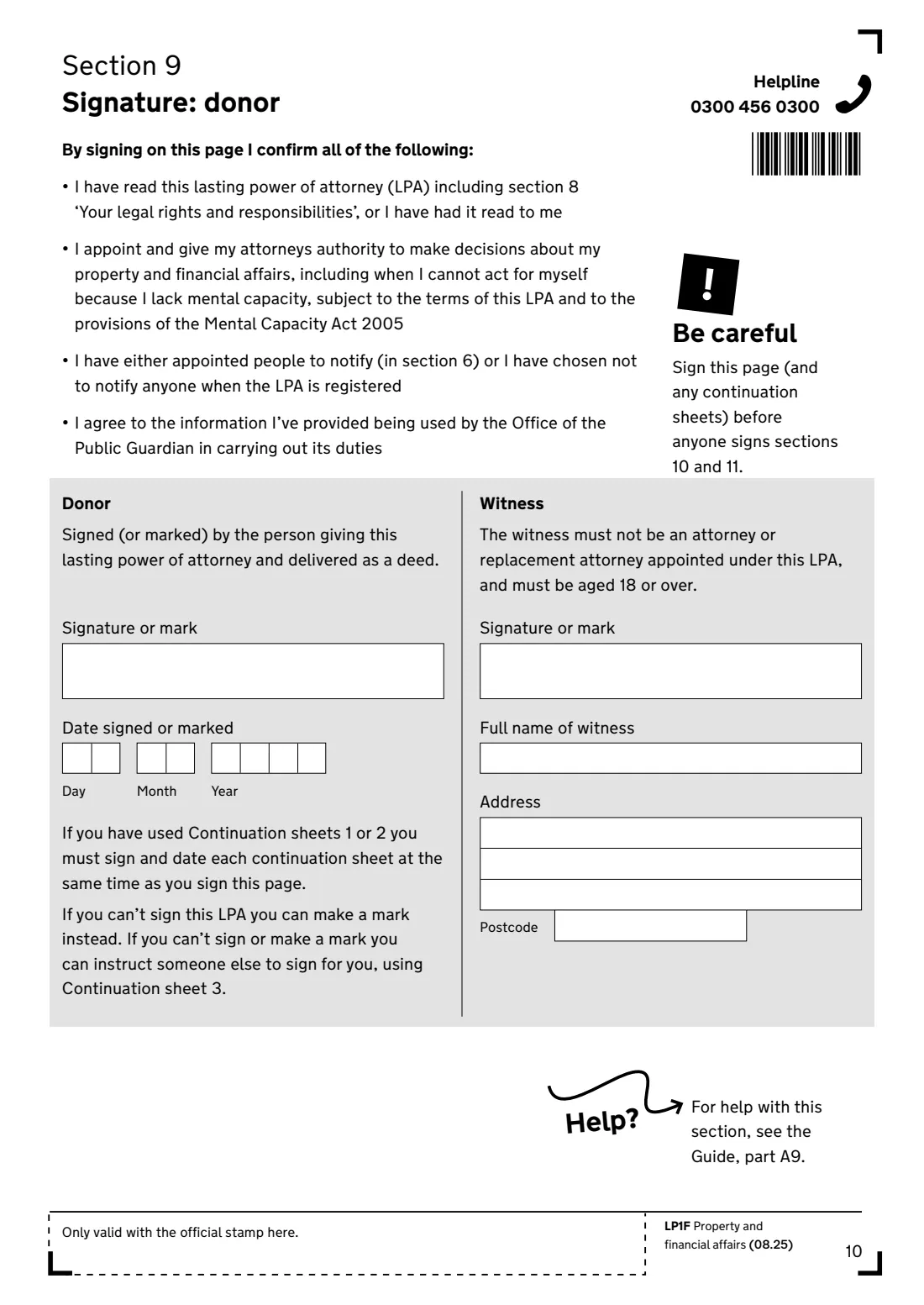
- Section 9: Signature — donorDonor
- Section 9: Witness to the donor's signatureWitness
- Section 10: Signature — certificate providerCertificate provider
- Section 11: Signature — attorneys and replacement attorneysAttorney
- Sections 12–15: Register the LPAApplicant (registration)
- Checklist: Check your lasting power of attorneyApplicant (registration)
How to fill out LP1F, step by step
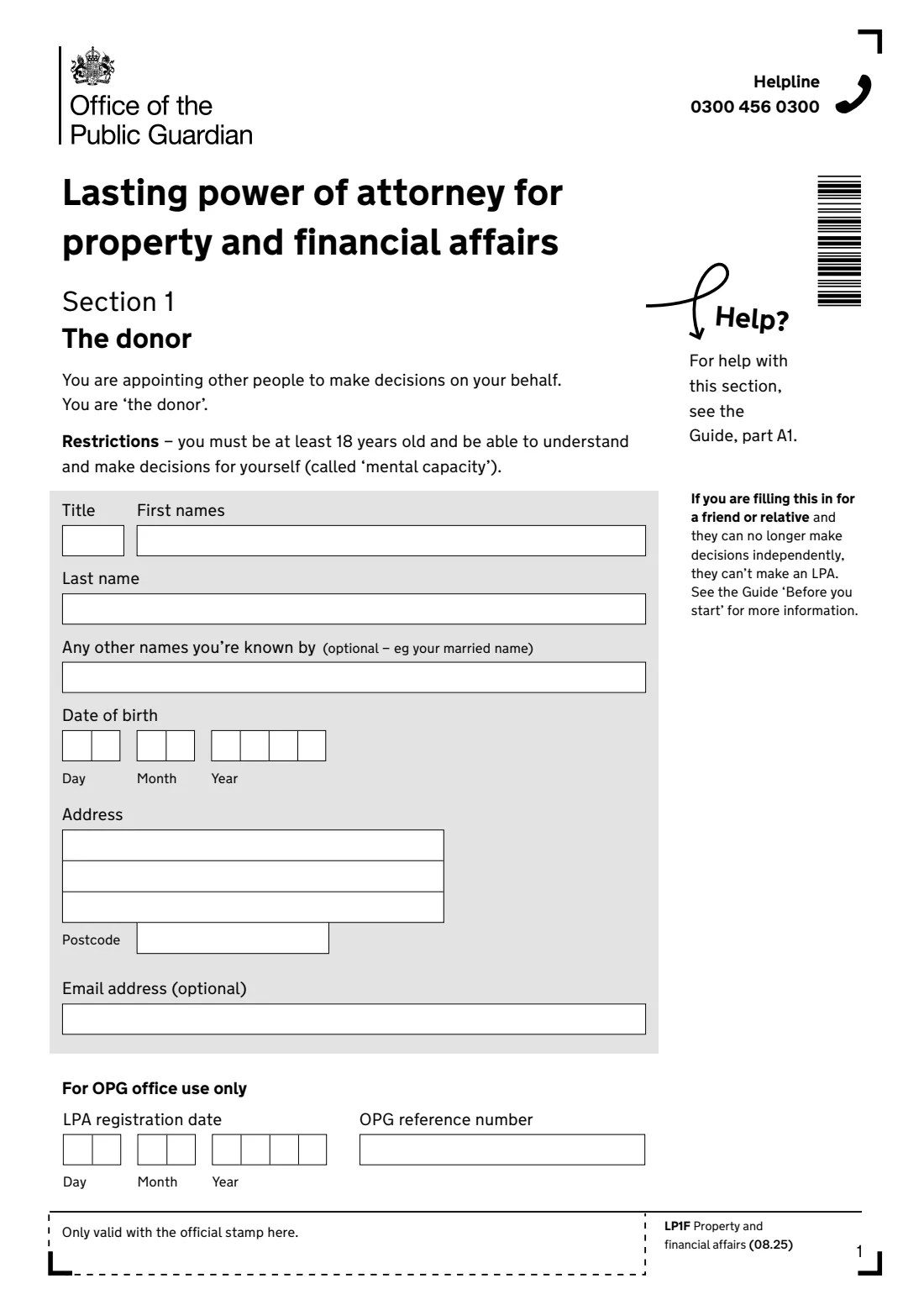
1 Section 1: The donor
This is you — the person giving the power. Write every first name exactly as it appears on your passport or other ID, and list any other names you use, such as a married name. The form must be written in capital letters with a black pen; FileIt prints it that way for you.
If you are filling the form in for a relative who can no longer make decisions independently, stop here: they can't make an LPA.
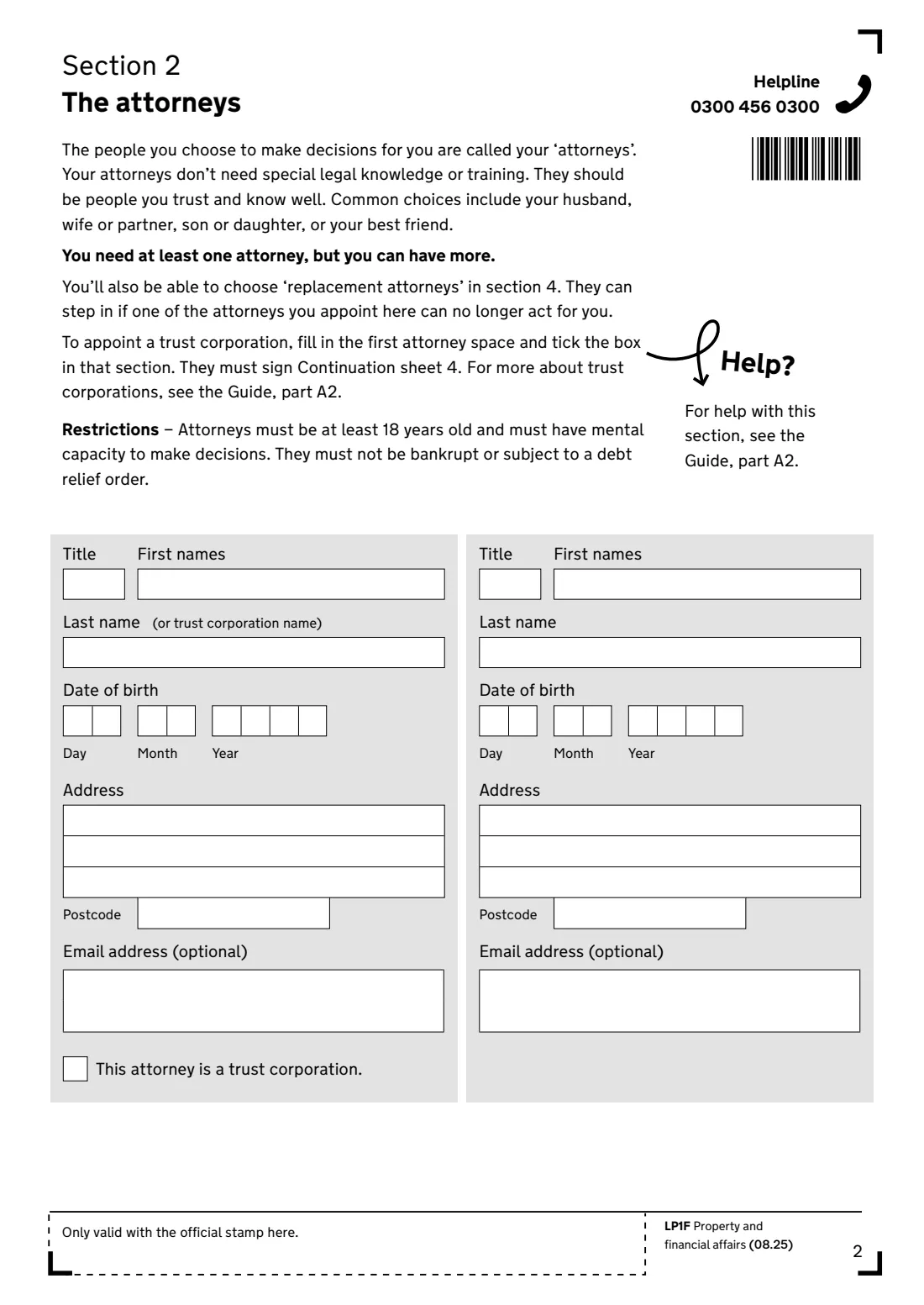
2 Section 2: The attorneys
List the people who will make financial decisions for you. They don't need legal knowledge, but they must be at least 18, have mental capacity, and must not be bankrupt or subject to a debt relief order. Common choices are a spouse or partner, adult children or close friends.
The LP1F — unlike the health and welfare form — lets you appoint a trust corporation, such as a bank's trust department. It goes in the first attorney space, with its box ticked, and it signs Continuation sheet 4 instead of section 11.
3 Section 3: How should your attorneys make decisions?
If you have more than one attorney, choose how they work together. 'Jointly and severally' lets them act together or alone, and the form notes that most people choose it because it is the most practical and the LPA keeps working if one attorney drops out. 'Jointly' means every decision must be unanimous, and if one attorney dies or can no longer act the whole LPA stops working unless you have a replacement.
The mixed option ('jointly for some decisions') needs a carefully worded list on Continuation sheet 2. The OPG suggests taking legal advice if the examples in the guide don't fit. With just one attorney, FileIt ticks 'I only appointed one attorney' for you.
4 Section 4: Replacement attorneys
Replacements are optional but recommended. They step in if an original attorney dies, loses capacity, no longer wants to act, becomes bankrupt or subject to a debt relief order, or is no longer legally your husband, wife or civil partner. The same age, capacity and bankruptcy rules apply.
By default all replacements step in at once when an original attorney stops acting. You can change when or how they act on Continuation sheet 2, but most people don't.
5 Section 5: When can your attorneys make decisions?
This choice is specific to the financial LPA. You can let your attorneys act as soon as the LPA is registered (with your consent while you still have capacity), or only when you don't have mental capacity.
The form warns that the second option can make the LPA far less useful, because your attorneys may have to prove you lack capacity each time they use it. The first option is also what lets an attorney help while you're away or unwell.
6 Section 6: People to notify when the LPA is registered
Optional. These are people who will be told the LPA is being registered and can raise concerns — for example, if they think you were pressured. You can name up to five (four on the form, the fifth on Continuation sheet 1), but not your attorneys or replacements. Whoever applies to register must send each person form LP3 first.
7 Section 7: Preferences and instructions
Most people leave this blank and simply talk to their attorneys. Preferences ('I would like…') are wishes your attorneys should bear in mind; instructions ('my attorneys must…') have to be followed exactly.
Instructions that aren't legally correct have to be removed before the LPA can be registered, so keep them clear and consider advice. About nine printed lines fit in each box; FileIt splits your text to fit and lets you flag when you are continuing on Continuation sheet 2.
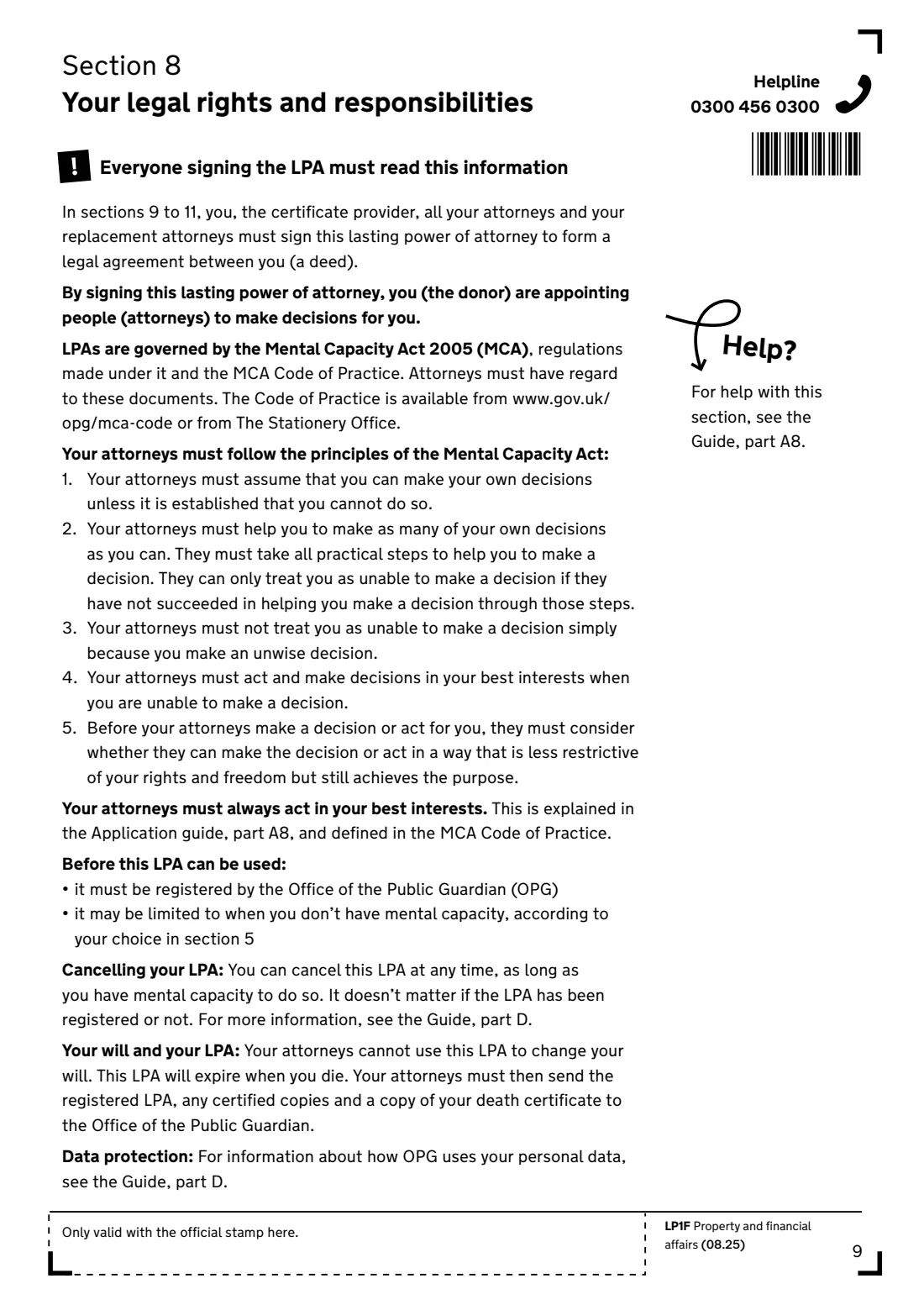
8 Section 8: Your legal rights and responsibilities
Nothing to fill in, but everyone who signs must read it first. It sets out the principles of the Mental Capacity Act 2005 that attorneys must follow — assume the donor can decide, help them decide, don't treat an unwise decision as incapacity, act in their best interests and choose the least restrictive option — and explains that you can cancel the LPA at any time while you have capacity.
9 Section 9: Signature — donor
The donor signs (or makes a mark) and dates this page in front of a witness aged 18 or over who is not an attorney or replacement attorney. Your certificate provider can be your witness. Sign any Continuation sheets 1 or 2 at the same time.
This must happen before anyone signs sections 10 and 11. If you can't sign or make a mark, someone can sign for you using Continuation sheet 3.
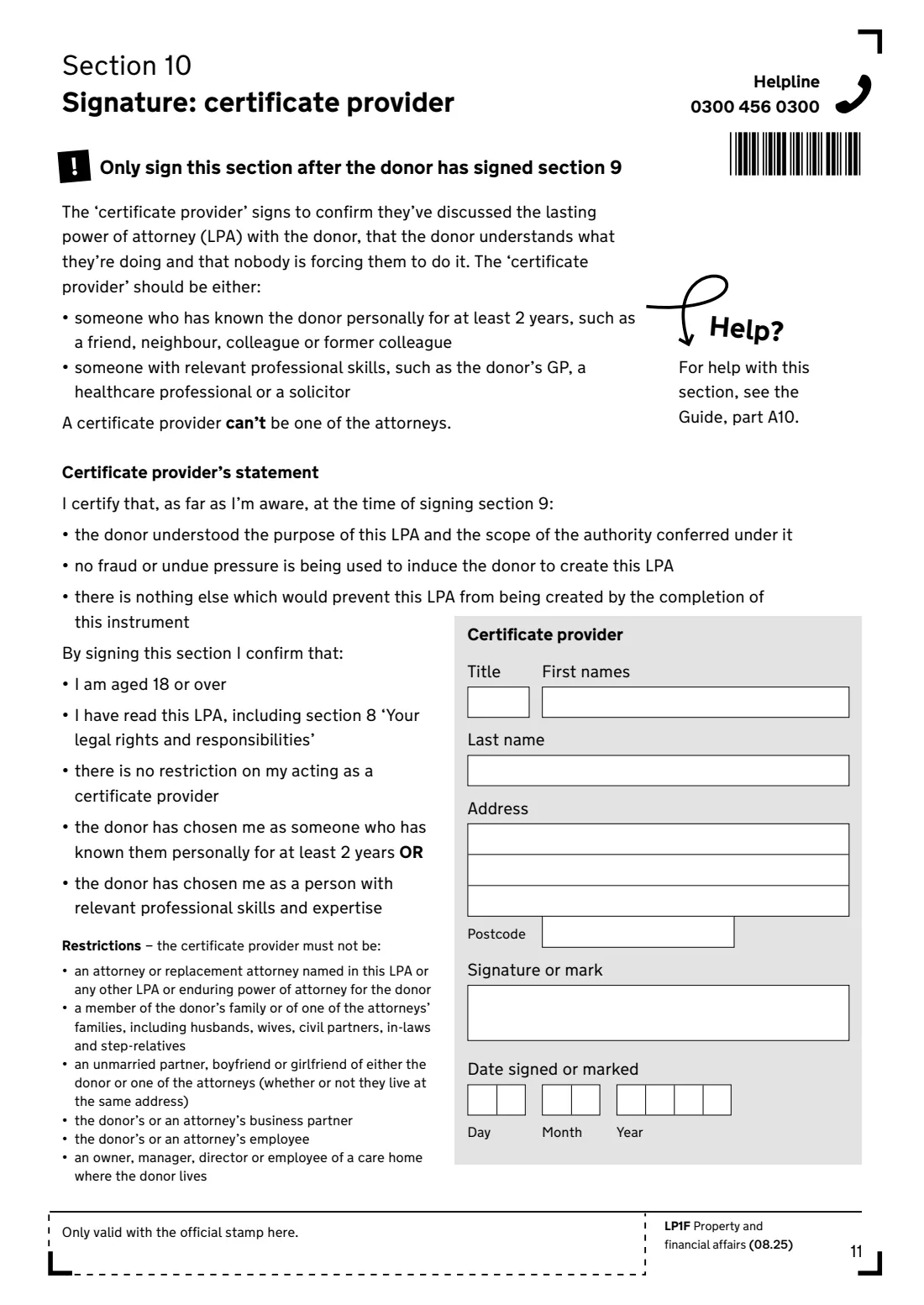
10 Section 10: Signature — certificate provider
Only after the donor has signed, the certificate provider confirms they've discussed the LPA with you, that you understand it and that nobody is forcing you. They must either have known you personally for at least 2 years or have relevant professional skills.
They can't be an attorney or replacement in this or any other LPA for you, a member of your or an attorney's family, a partner of you or an attorney, a business partner or employee, or someone who owns, manages or works at a care home where you live.
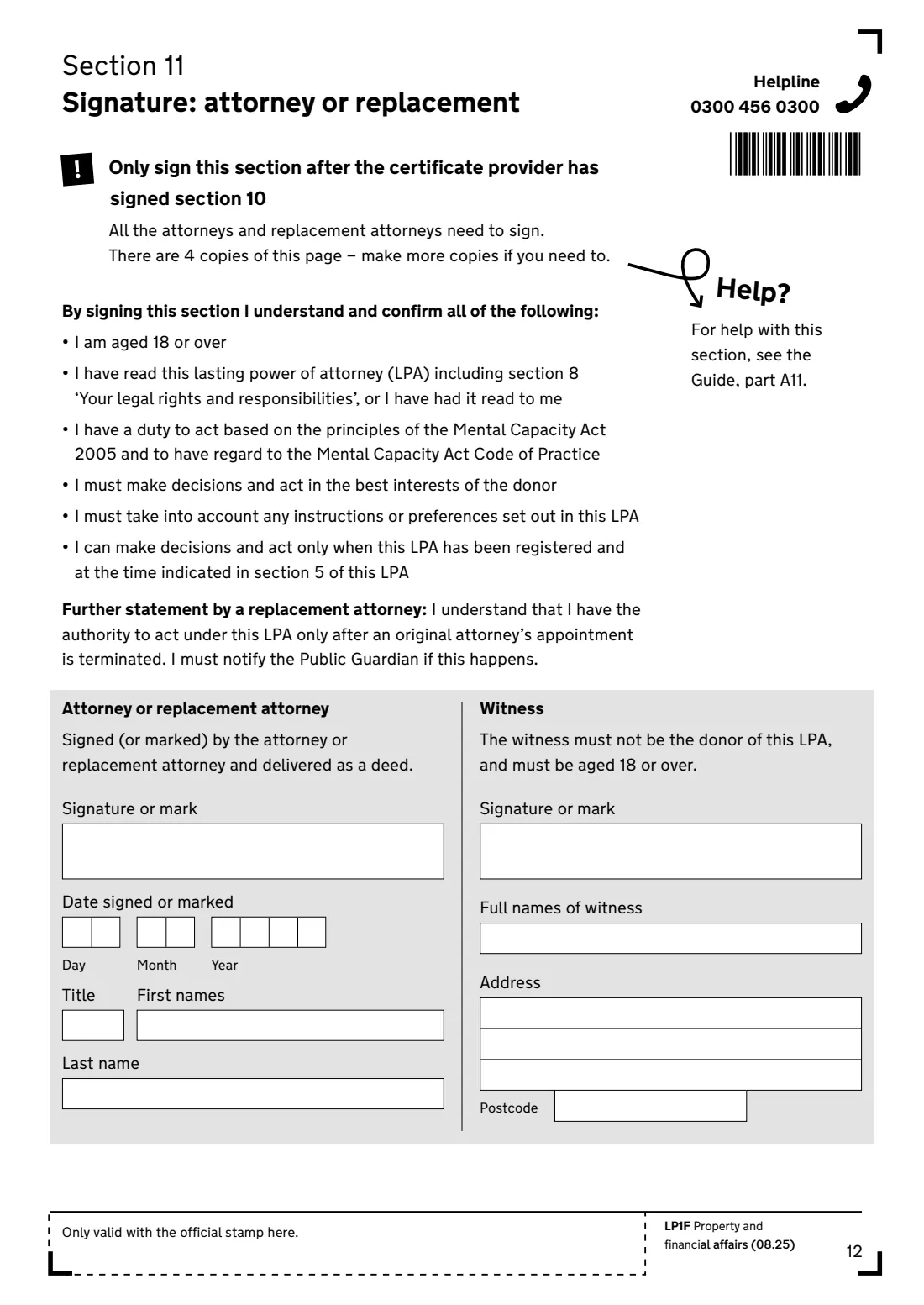
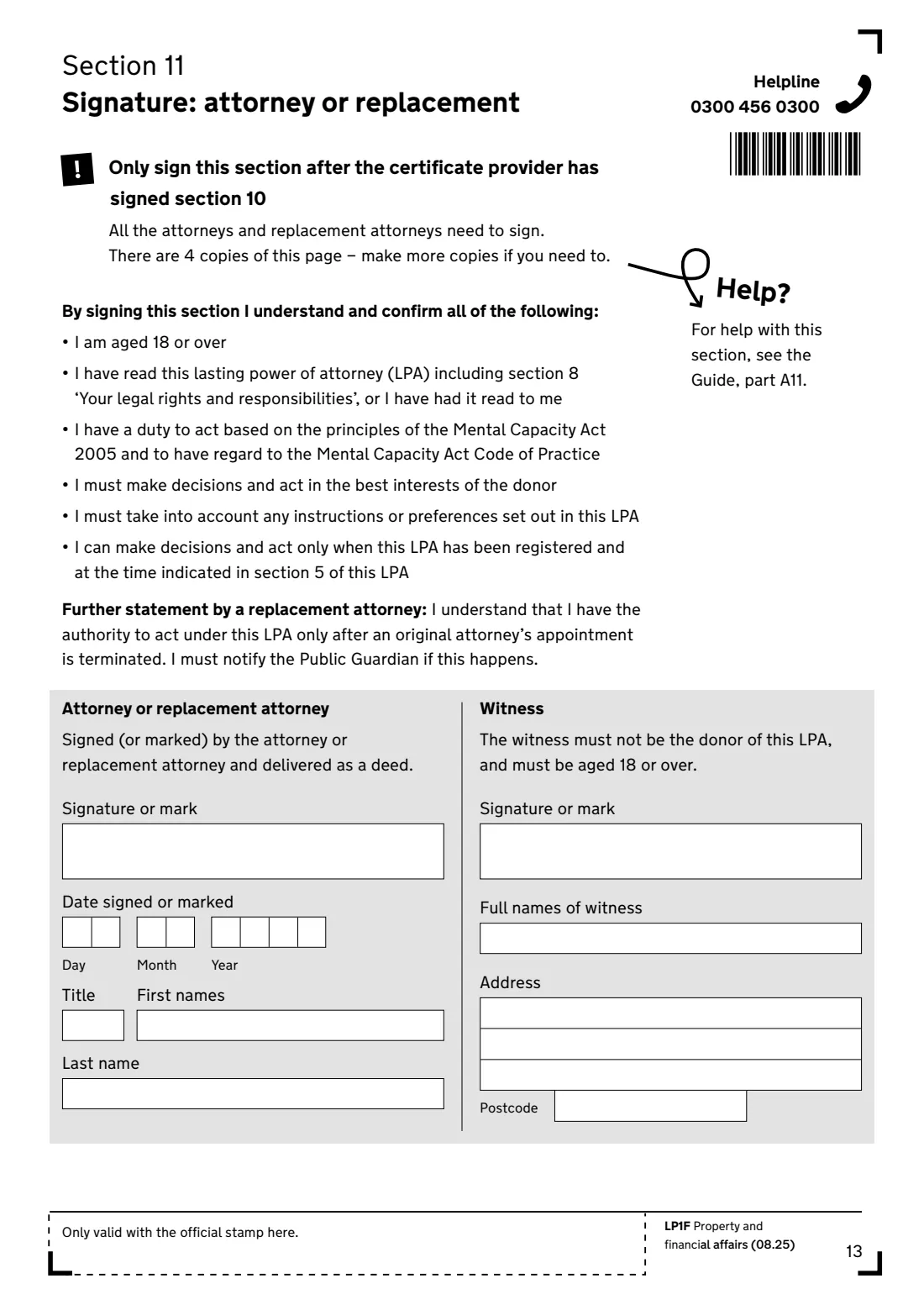
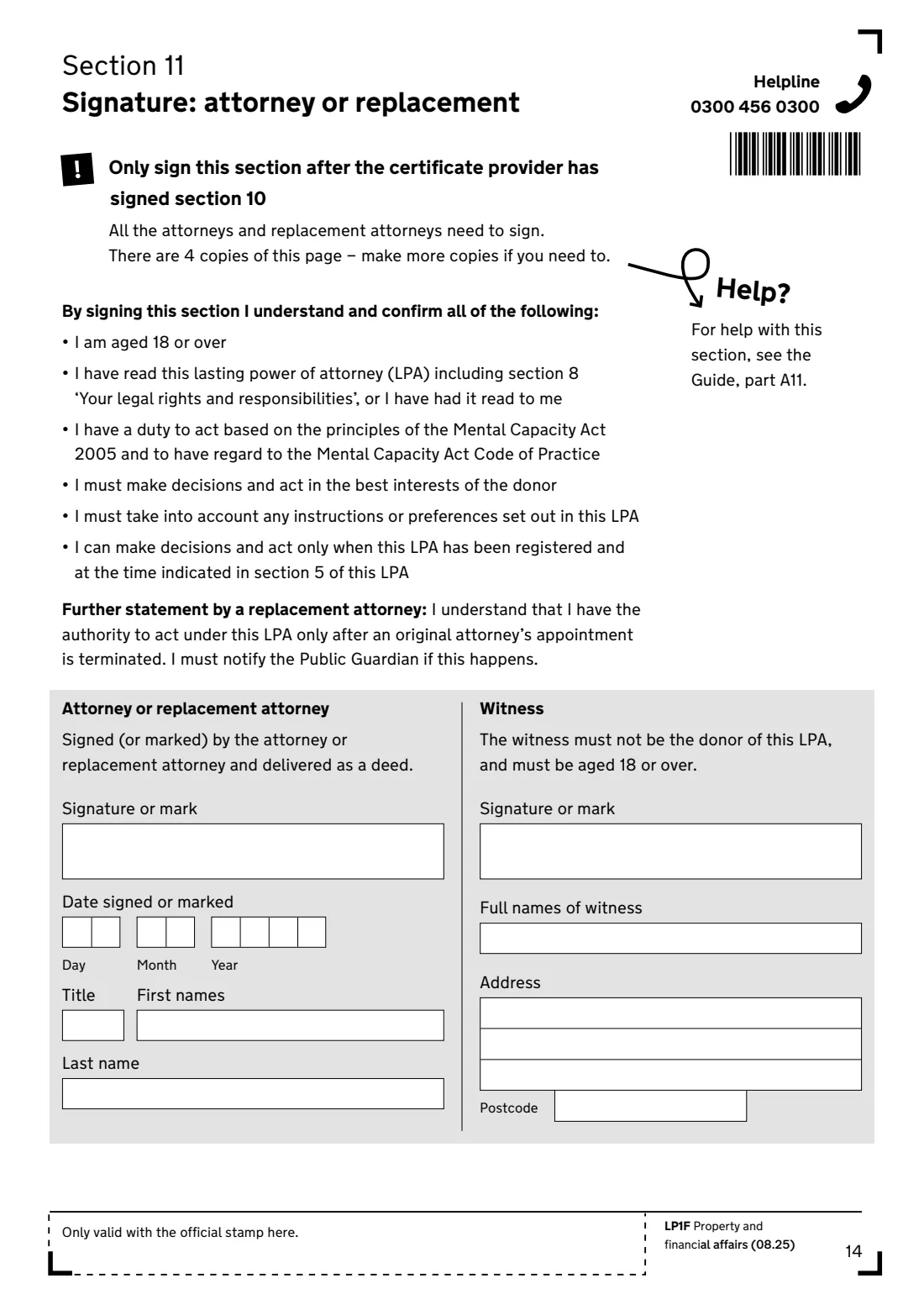
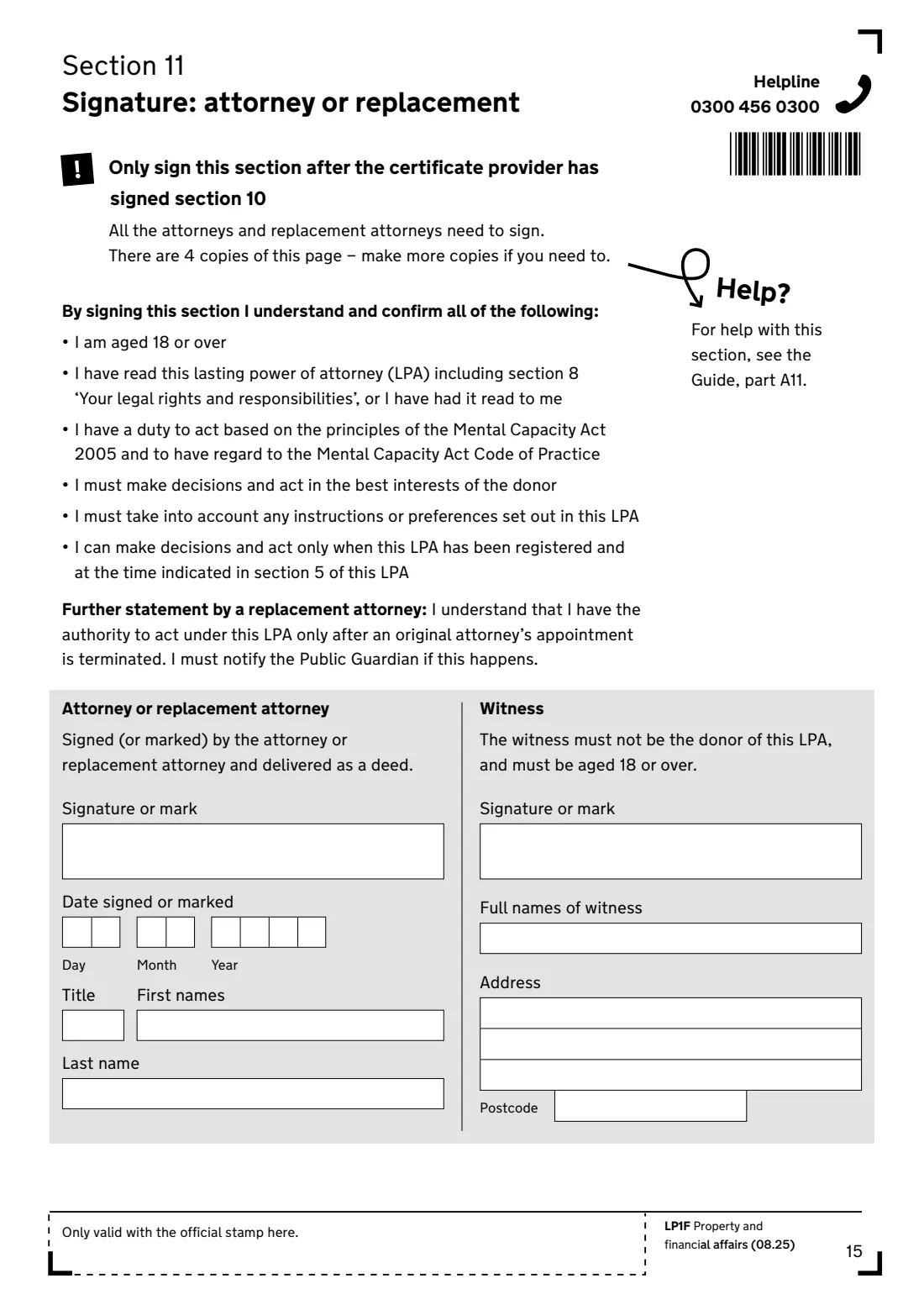
11 Section 11: Signature — attorneys and replacement attorneys
After the certificate provider, every attorney and replacement attorney signs their own copy of this page in front of an adult witness who is not the donor (attorneys can witness each other). The form contains four copies; photocopy a blank one if more people need to sign. FileIt fills the names onto the copies in the order you listed them.
12 Sections 12 to 15: Register the LPA
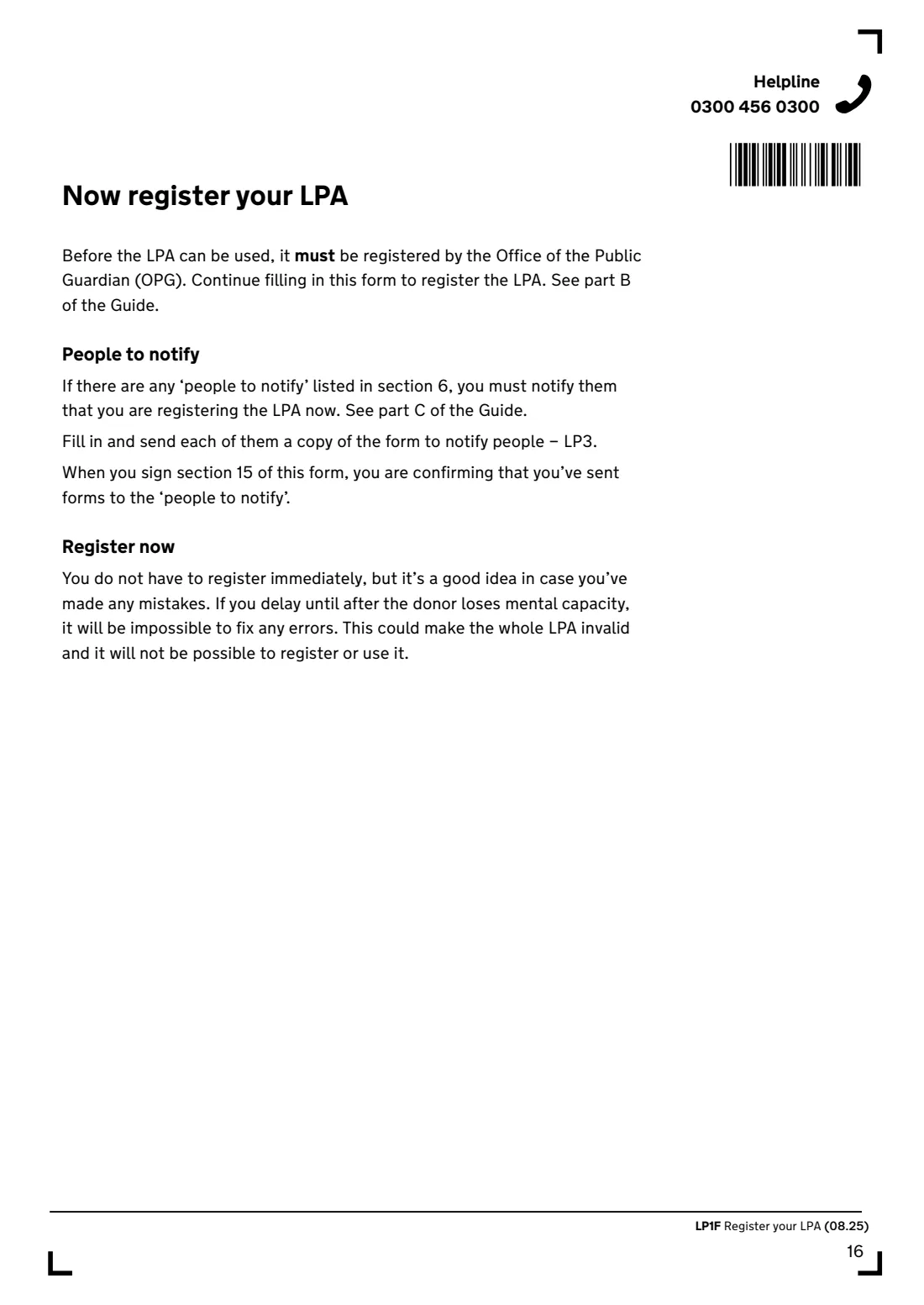
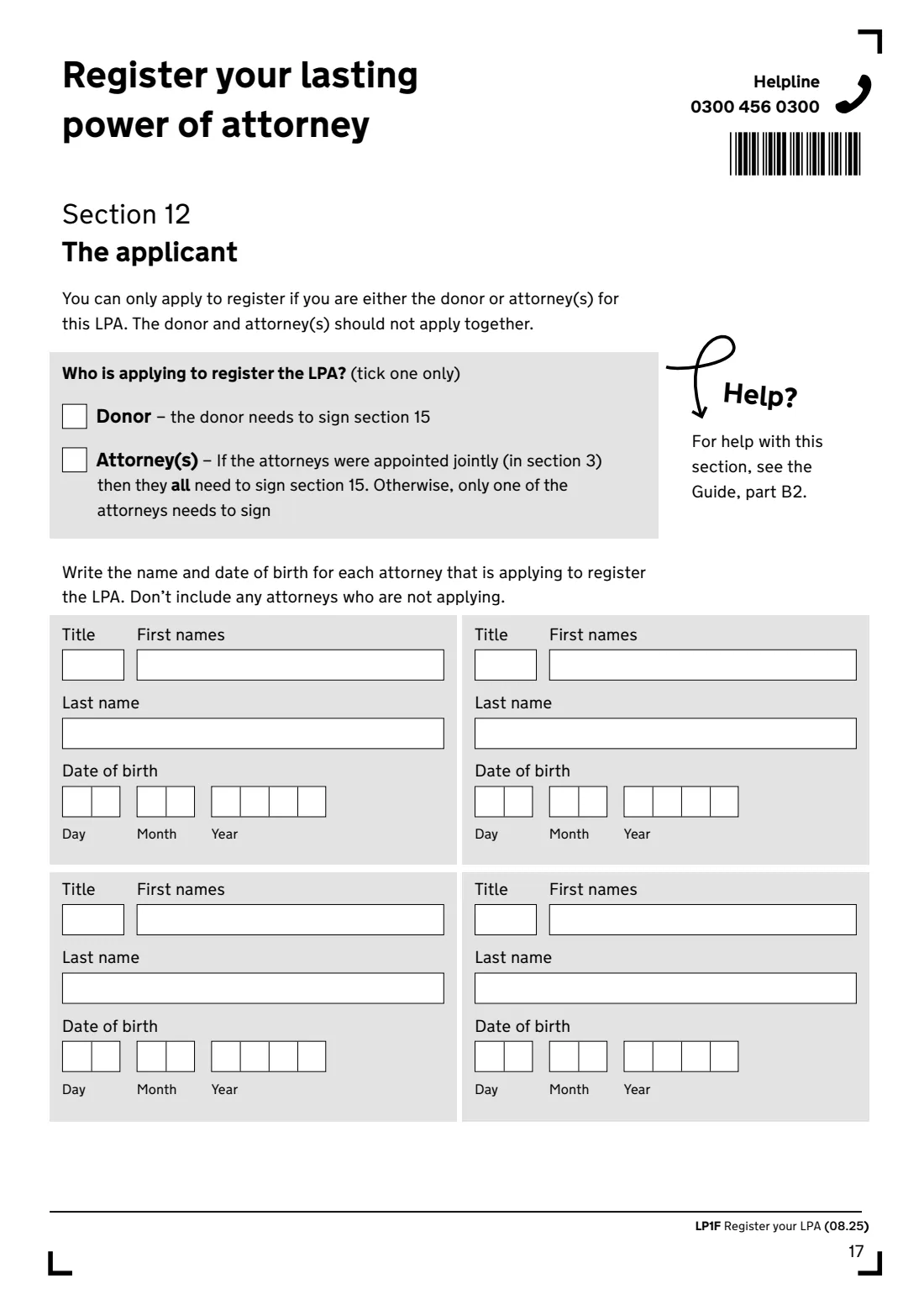
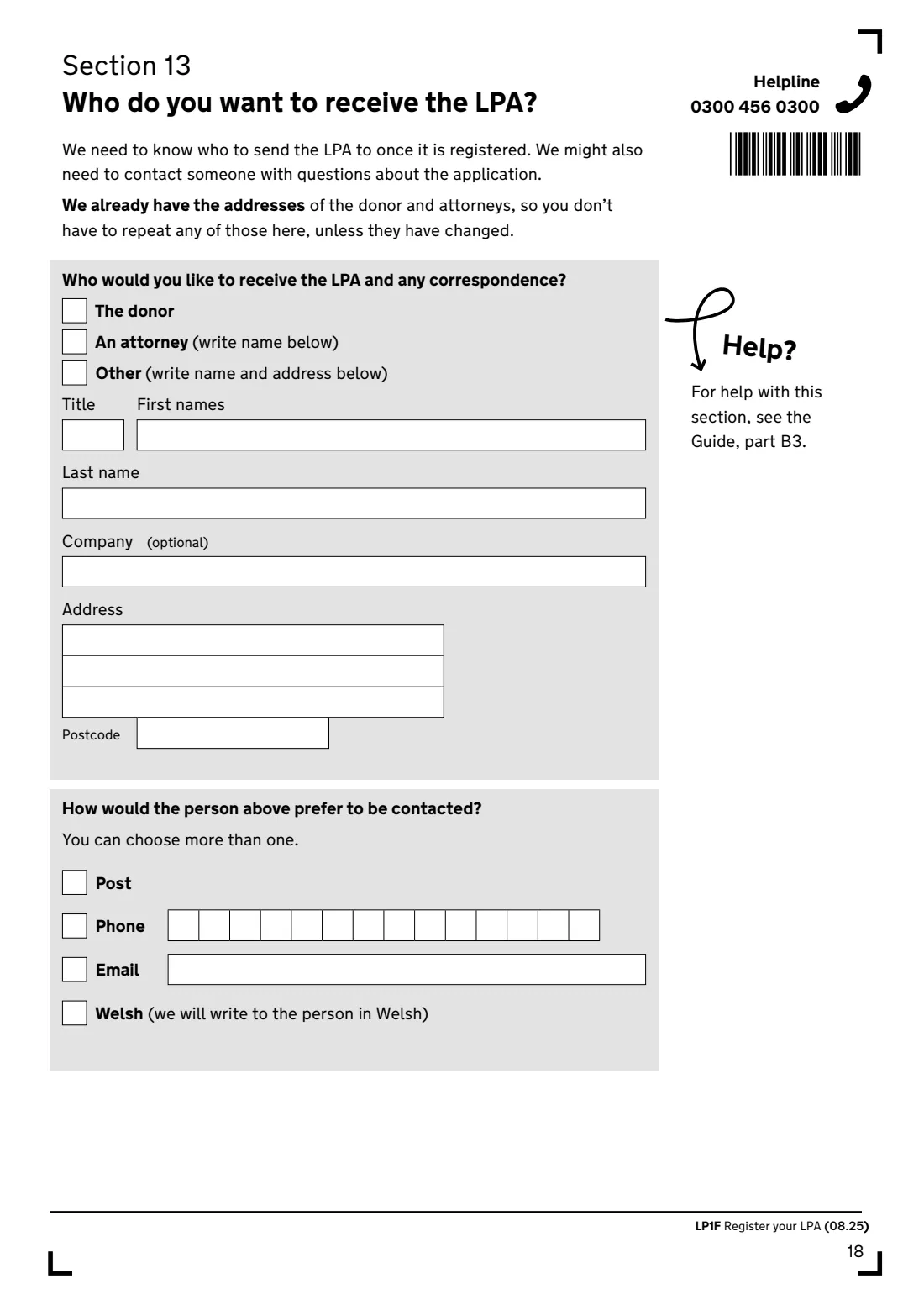
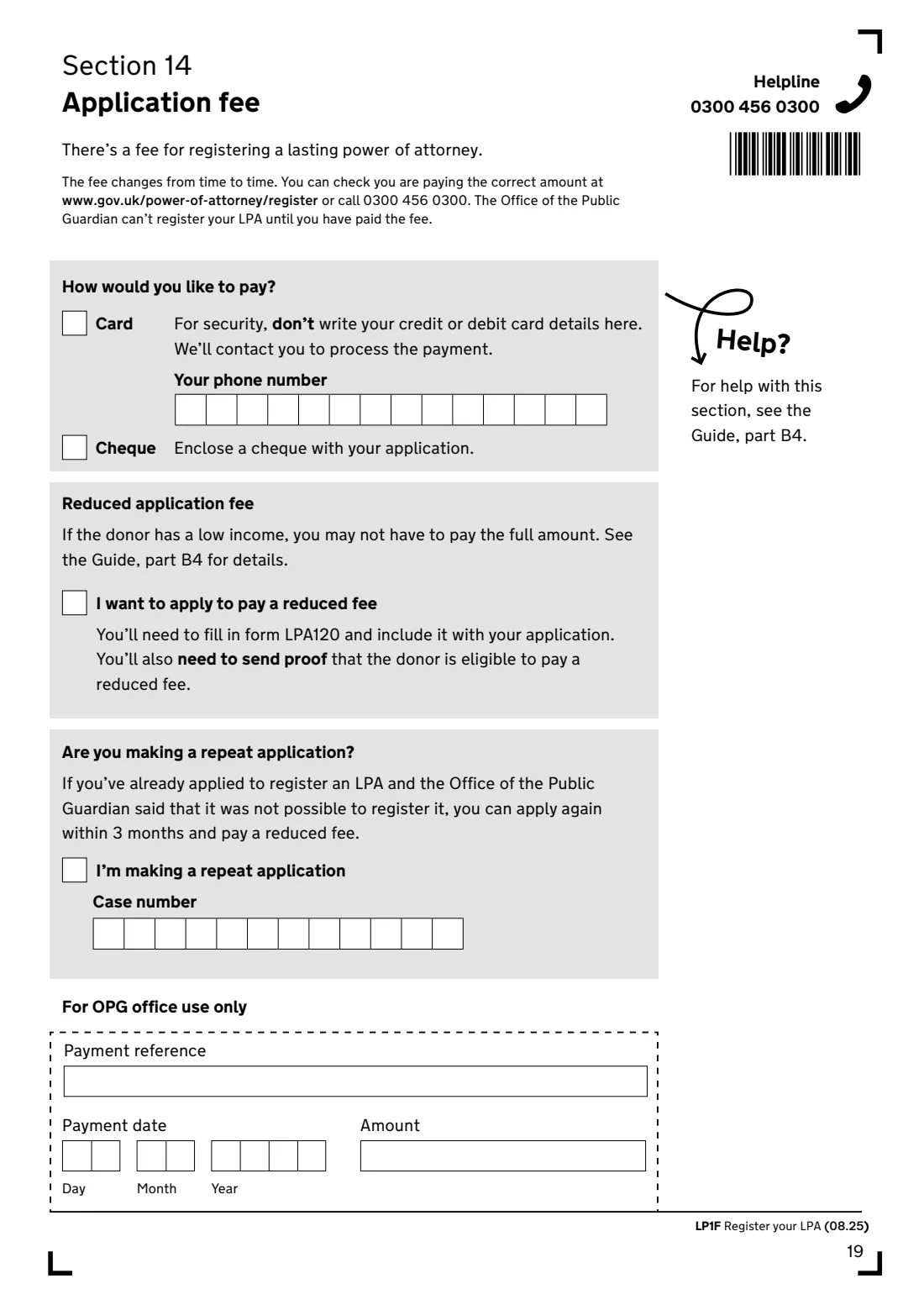
The donor or the attorney(s) — not both together — apply to register. You choose who receives the registered LPA and letters, how the OPG should contact them, and how to pay the fee (the OPG phones for a card payment, or you enclose a cheque). The form does not print the fee; check the current amount on GOV.UK before you send it.
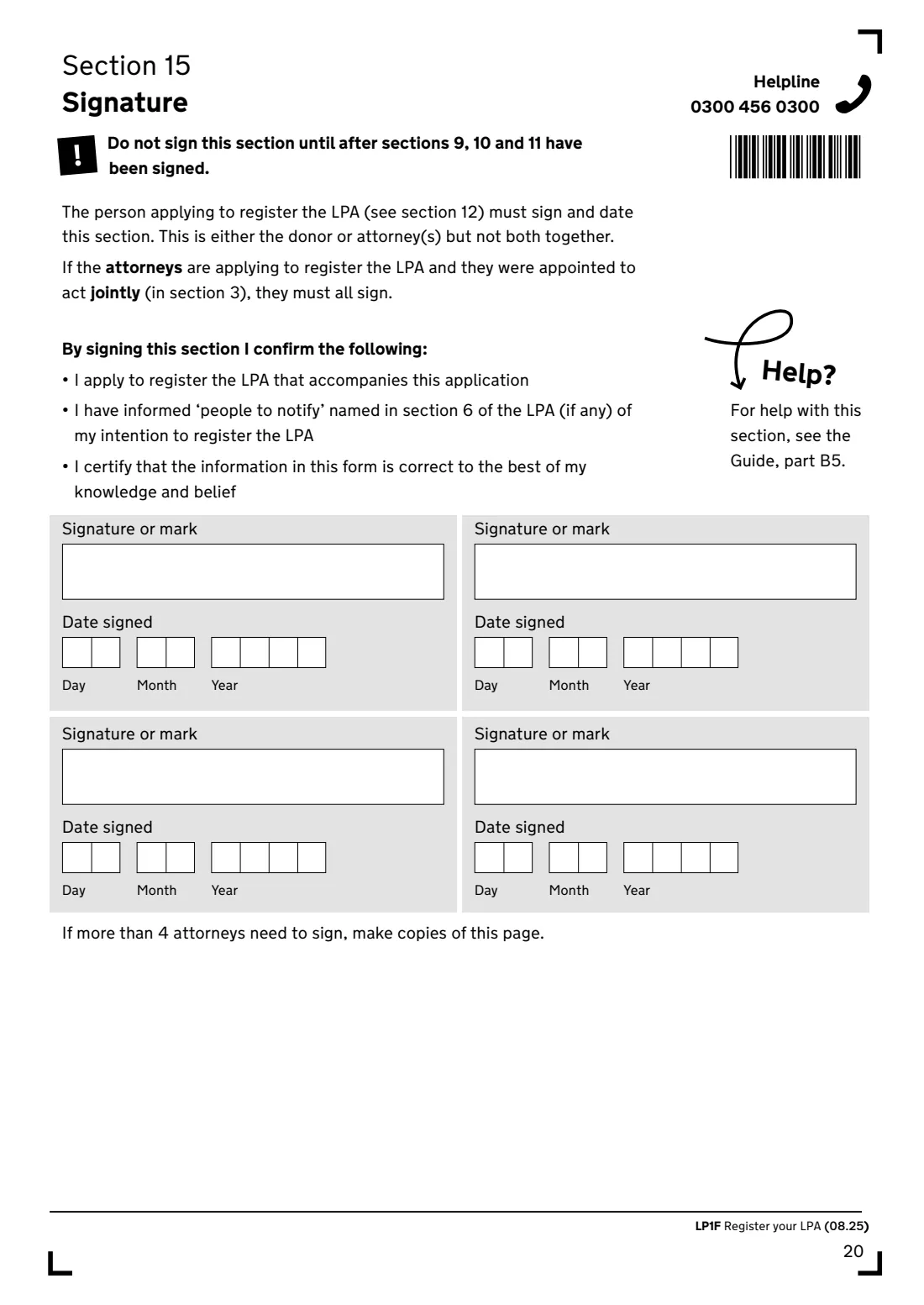
If the donor has a low income, tick the reduced-fee box and include form LPA120 with proof. If a previous application was rejected, you can make a repeat application within 3 months. The applicant signs section 15 last, confirming any people to notify have been sent LP3.
Common mistakes to avoid
- Signing out of order. The donor must sign section 9 before the certificate provider signs section 10, and both before the attorneys sign section 11. Signing out of order is one of the commonest reasons an LPA can't be registered.
- Using the wrong witness. An attorney or replacement can't witness the donor's signature, and the donor can't witness an attorney's.
- Choosing an ineligible certificate provider, such as a relative, an in-law or a partner of an attorney. Check the list printed in section 10 before you ask someone.
- Picking 'jointly' without a replacement attorney, so the whole LPA stops working if one attorney dies or can no longer act.
- Writing instructions that conflict with the LPA or aren't legally correct — they will be removed, and registration may be delayed.
- Leaving pages out. Post every page, including blank ones and the continuation sheets you used.
- Using correction fluid. Cross out mistakes and rewrite nearby, and have everyone involved in that section initial each change.
- Waiting to register until the donor has lost capacity, when any error can no longer be corrected.
After you fill it out
Print the completed PDF from FileIt and gather everyone for signing in the correct order, all in ink. An LPA is a deed that has to be signed on paper by the donor, certificate provider, attorneys and witnesses, so FileIt's e-signature option isn't used for this form. Sections 9, 10 and 11 can be signed on the same day or different days, as long as the order is kept. If you named people to notify, send each of them form LP3 before the applicant signs section 15.
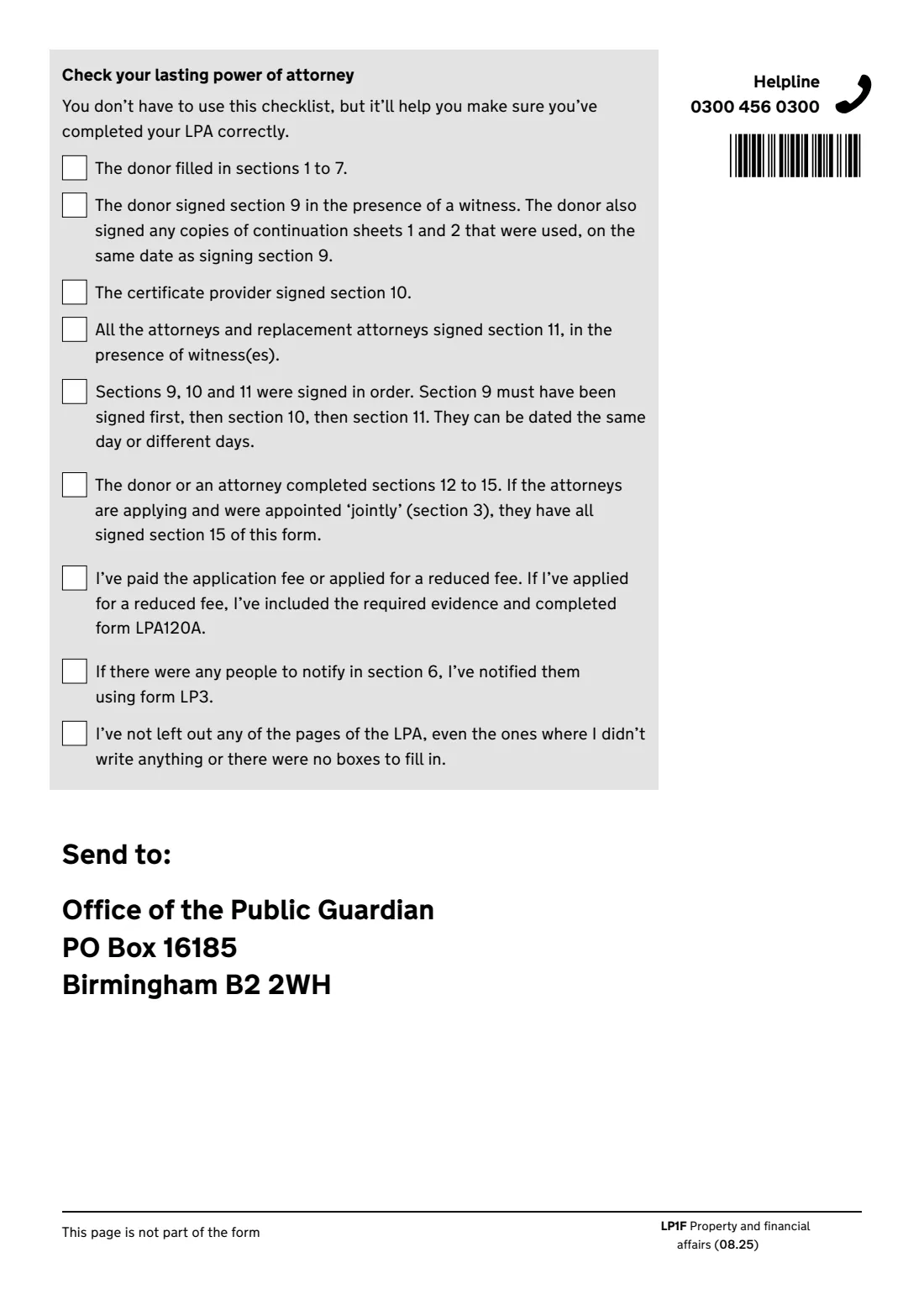
Post the whole form — every page, including blank ones — to the address printed in the form: Office of the Public Guardian, PO Box 16185, Birmingham B2 2WH, with a cheque if you chose that payment method and form LPA120 if you are applying for a reduced fee. The OPG checks the LPA and, if there is a problem, will tell you what needs fixing. The LPA can only be used once it has been registered.
Keep a scan of the signed form and, later, the registered LPA in the donor's FileIt folder, so the family knows where it is. If circumstances change — an attorney dies, a marriage ends, or you want different people — review the LPA; while you have mental capacity you can cancel it and make a new one.
Fill out LP1F online with FileIt
- Pick the person. Choose someone from People and FileIt fills in their name, date of birth, address and other details it already knows.
- Answer plain-language questions. One part of the form at a time, with the official help text beside each question — 209 fields in all. Your answers save as you go.
- Check the live preview. Watch your answers land on the real Office of the Public Guardian (OPG) form, and let FileIt do any worksheet arithmetic.
- Generate the official PDF. FileIt prints your answers into the agency’s own PDF and files it in that person’s folder in your vault.
FileIt fills the form — it never files or submits anything for you. Deliver the finished form to whoever asked for it, the way the form’s instructions say.
Start LP1F now — it’s freeLP1F: frequently asked questions
What is form LP1F used for?
LP1F is the Office of the Public Guardian's form for making a lasting power of attorney for property and financial affairs in England and Wales. It lets you appoint attorneys to manage things like your bank accounts, bills, pensions, benefits, investments and home. It does not cover health or care decisions — those need form LP1H.
What is the difference between LP1F and LP1H?
LP1F covers money and property; LP1H covers health and welfare, such as medical treatment and where you live. A financial LPA can be used as soon as it is registered if you allow it, whereas a health and welfare LPA can only be used when you lack capacity to make the decision. Many people make both, often naming the same attorneys.
Can I fill in the LP1F online?
Yes. With FileIt you answer each section in a guided web form, and FileIt prints your answers into the OPG's official LP1F PDF, ready to print, sign and post. FileIt is free to use for filling forms. The OPG also runs its own online service for making an LPA, mentioned on the front of the form.
Where do I send the completed LP1F?
Post the complete signed form to the Office of the Public Guardian, PO Box 16185, Birmingham B2 2WH — the address given in the registration section. Include every page and any continuation sheets, plus your cheque or form LPA120 if relevant. FileIt does not send it for you.
Who can be a certificate provider for an LPA?
Someone aged 18 or over who has known you personally for at least 2 years, such as a friend, neighbour or colleague, or someone with relevant professional skills, such as your GP or a solicitor. They can't be an attorney, a family member of yours or an attorney, a partner, a business partner or employee, or someone connected with a care home where you live.
Does the LP1F have to be signed in a particular order?
Yes. The donor signs section 9 first, then the certificate provider signs section 10, then all attorneys and replacements sign section 11, and finally the applicant signs section 15. The dates can be the same or different, but the order must be kept.
How much does it cost to register a lasting power of attorney?
The LP1F doesn't print the fee — it tells you to check the current amount on GOV.UK. If the donor has a low income you can apply for a reduced fee using form LPA120, and a repeat application within 3 months of a rejected one also attracts a reduced fee.
Can my attorneys use the LPA while I still have mental capacity?
Only if you choose 'As soon as my LPA has been registered' in section 5, and even then they can only act with your consent while you have capacity. If you choose 'Only when I don't have mental capacity', they may need to prove your lack of capacity each time.
Can I use a bank as my attorney?
The LP1F allows a trust corporation, such as a bank's trust department, to be appointed. It goes in the first attorney space with the trust corporation box ticked, and it signs Continuation sheet 4 rather than section 11.
Official sources
- Blank form (PDF), published by Office of the Public Guardian (OPG): https://assets.publishing.service.gov.uk/media/68e51ea8dadf7616351e4ee4/102025-LP1F-Lasting-power-of-attorney-financial-decisions.pdf
- Official instructions and guidance: https://www.gov.uk/government/publications/lasting-power-of-attorney-forms/lp12-make-and-register-your-lasting-power-of-attorney-a-guide-web-version
- Edition shown on this page: LP1F Property and financial affairs (08.25) (checked 2026-09-25).
FileIt is not affiliated with or endorsed by Office of the Public Guardian (OPG) or any government. This page explains the form in general terms and is not legal, tax or immigration advice. Always read the official instructions, and check that you are using the edition the recipient accepts. Page last reviewed 2026-09-25.