What is N215 Certificate of service?
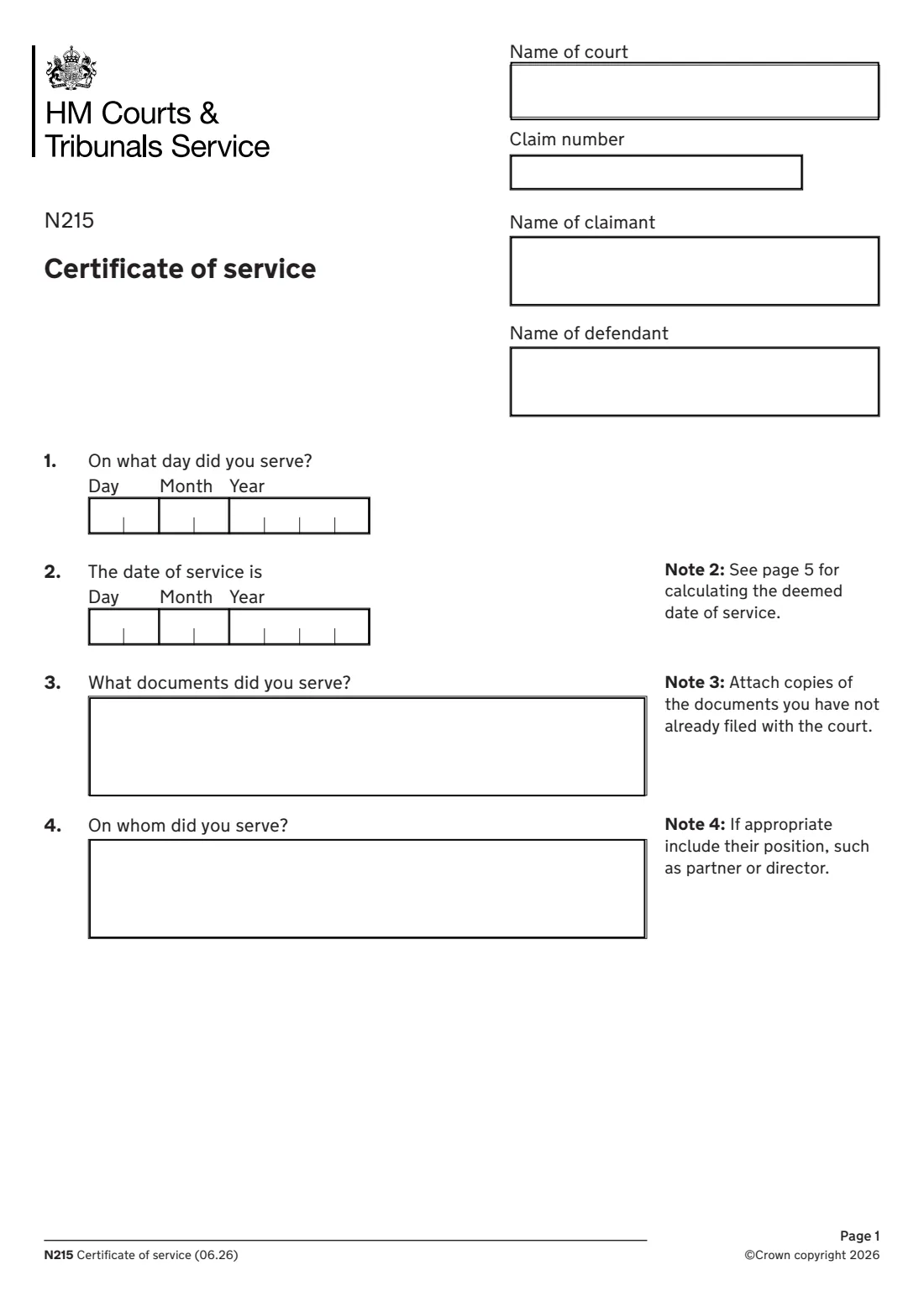
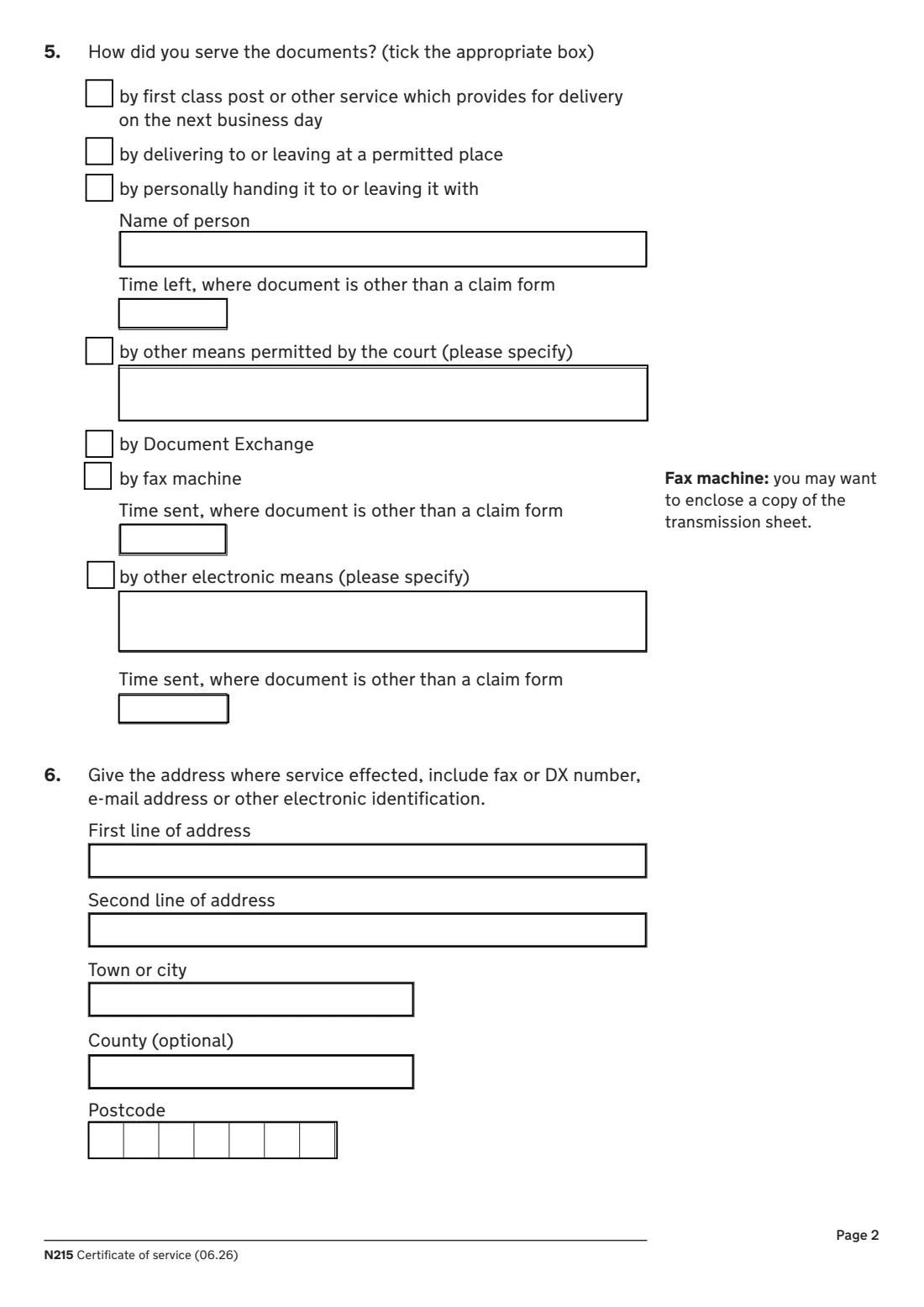
When you serve court papers yourself in a civil case in England and Wales, the court needs to know it happened and when service counts as having taken place. Form N215 is the certificate for that: you set out the documents you served, the day you served them, the deemed date of service, the method (post, document exchange, delivery to a permitted place, personal service, fax, email or another means the court allowed) and the address or electronic identification you used.
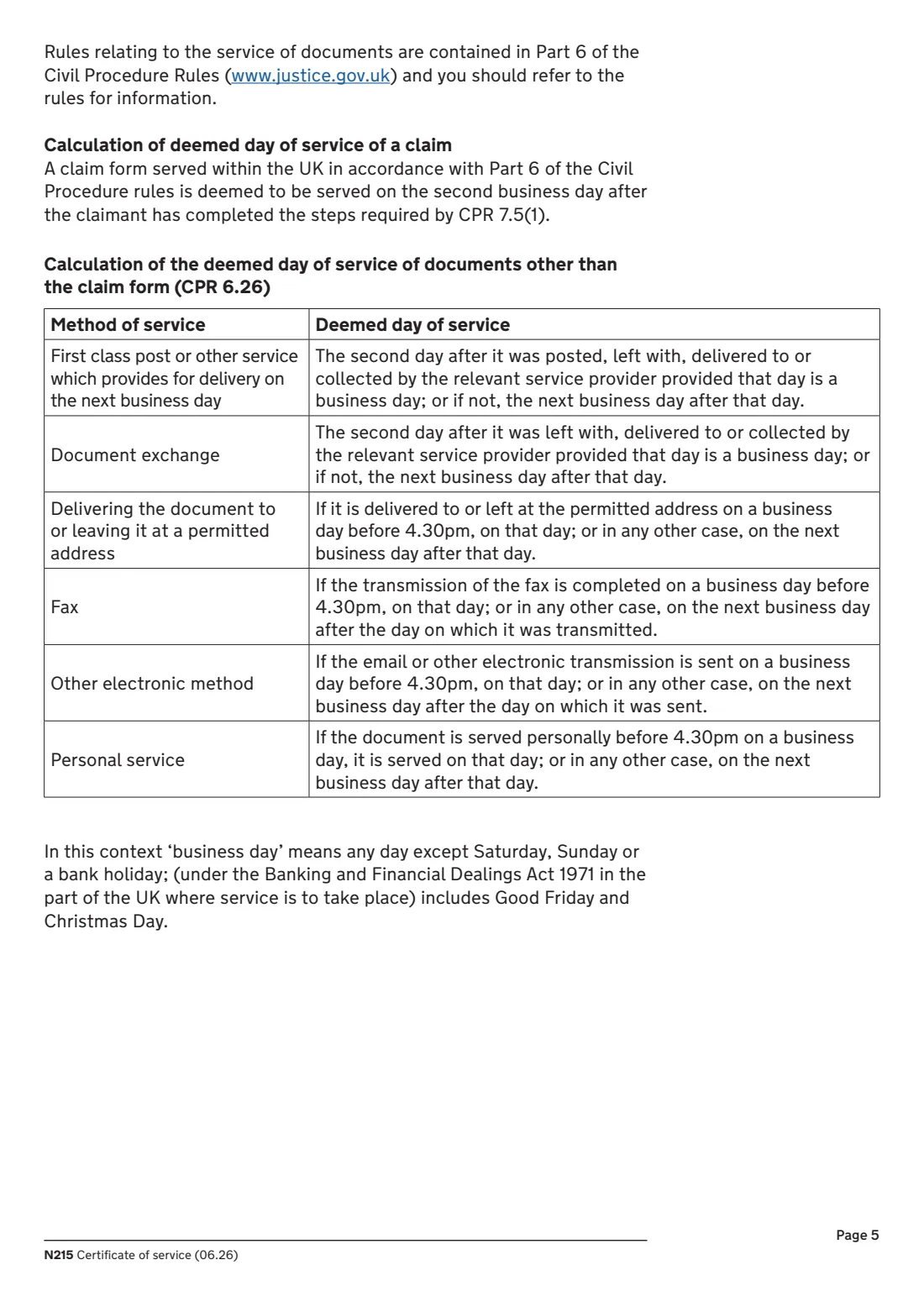
The deemed date of service matters because deadlines run from it, such as the time a defendant has to respond to a claim. Page 5 of the form sets out how to work it out under Part 6 of the Civil Procedure Rules, and FileIt repeats those rules next to the question and checks that the date you give is a weekday on or after the day you served. It doesn't calculate it for you, because bank holidays and the time of day can change the answer.
FileIt prints your answers into HMCTS's own N215 PDF (06.26 edition), with the boxes for your role and the statement of truth. You can sign it by hand or with FileIt's eSignature, then file it with the court yourself. FileIt never files anything for you.
- Who fills it
- The party who served the document, their litigation friend or legal representative
- Given to
- The court dealing with the claim
- Rules
- Civil Procedure Rules, Part 6
- Signature
- Statement of truth, signed
- Edition
- N215 (06.26)
Who needs to fill out N215 Certificate of service?
- A claimant who served the claim form on the defendant themselves rather than leaving it to the court.
- Any party who served an application notice, order, witness statement or other document and needs to prove it.
- Solicitors and legal representatives filing proof of service for a client.
- Litigation friends acting for a child or protected party.
When to use N215 Certificate of service
- After serving a claim form yourself, when the rules require you to file a certificate of service.
- When the court or another party needs proof of when and how a document was served.
- Before asking for judgment in default, so the court can see the deadline for a response has passed.
What you need before you start
- The court name, claim number and the names of the claimant and defendant, as on the claim form.
- The day you served and the deemed date of service.
- A list of the documents served, with copies of any not already filed with the court.
- The name (and, if appropriate, position) of the person served.
- The method of service and, for some methods, the time.
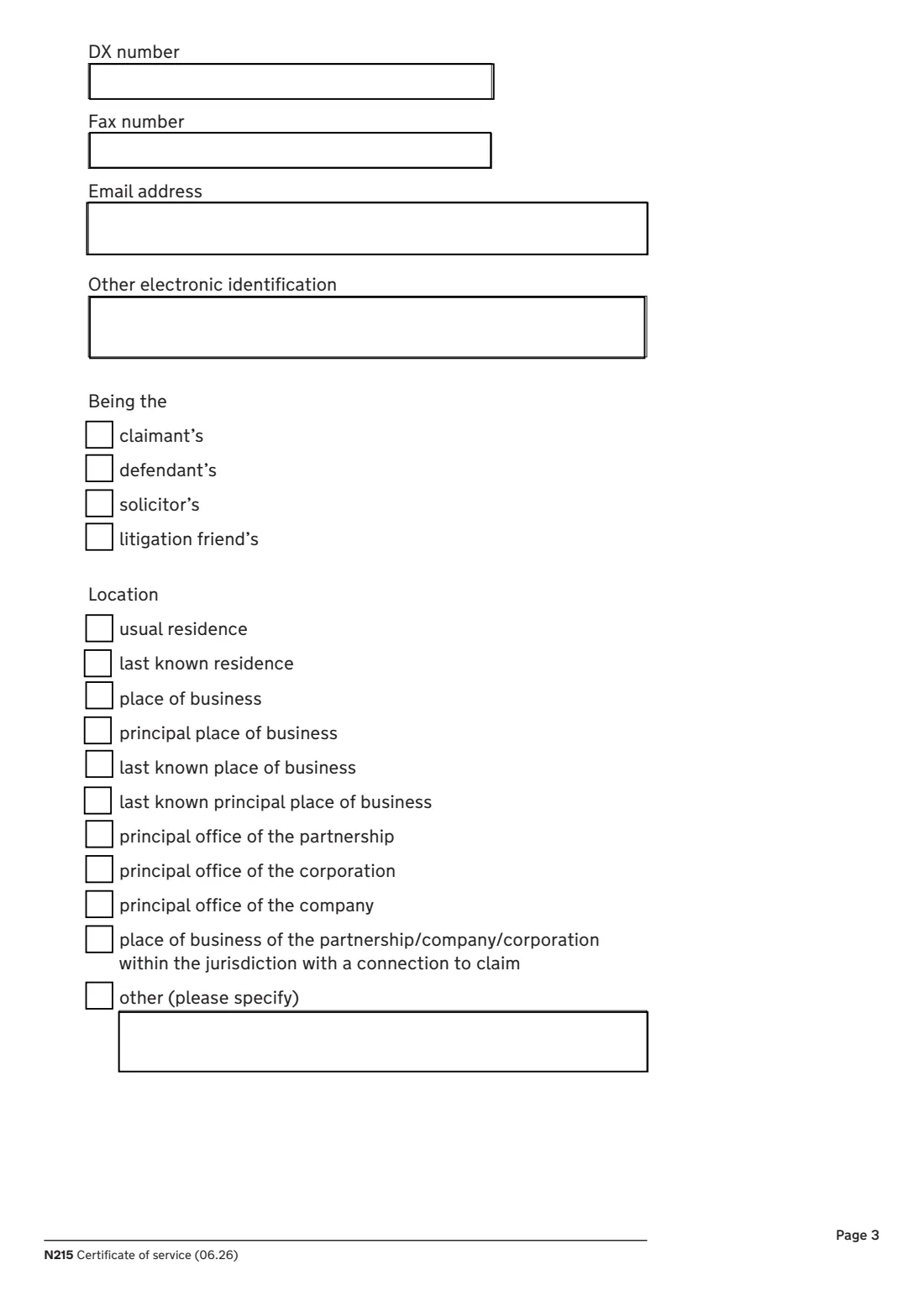
- The address, DX number, fax number, email address or other electronic identification used, and whose it was.
What’s on N215 Certificate of service
The 2026 edition has 5 pages. FileIt asks for it in 5 parts, and it is signed by Person serving:
- The claimPerson serving
- 1-4. What was served, when and on whomPerson serving
- 5. How did you serve the documents?Person serving
- 6. Where service was effectedPerson serving
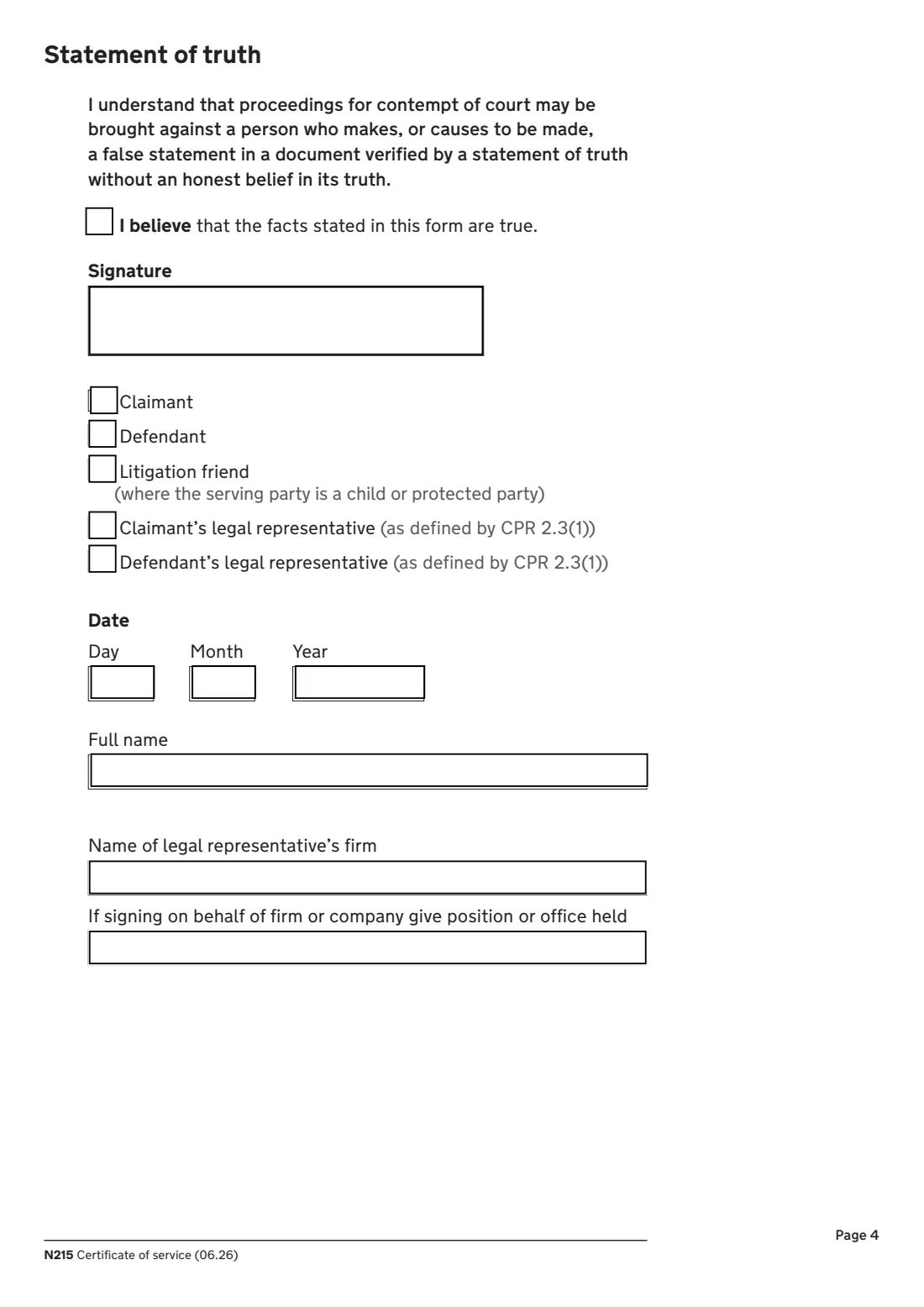
- Statement of truthPerson serving
How to fill out N215 Certificate of service, step by step
1 Court and parties
Copy the court name, claim number and the parties' names from the claim form.
2 Questions 1 and 2: dates
The day you served, then the deemed date of service from the rules on page 5. For a claim form served in the UK it's the second business day after you completed the step (posting, leaving or sending it).
3 Questions 3 and 4: what and on whom
List the documents served and the person served, including their position (such as partner or director) where that's relevant.
4 Question 5: method
Tick one method. Personal service asks for the name of the person and, for documents other than a claim form, the time. Fax and other electronic methods ask for the time sent. 'Other means permitted by the court' needs details.
5 Question 6: where
The address where service was effected, or the DX number, fax number, email address or other electronic identification. Then say whose it is (claimant's, defendant's, solicitor's, litigation friend's) and what kind of place (usual residence, principal office of the company and so on).
6 Statement of truth
Tick 'I believe that the facts stated in this form are true', say who is signing, and give the date and full name. A legal representative also gives the firm name and position.
Common mistakes to avoid
- Giving the day you posted as the date of service. The deemed date is usually later.
- A deemed date that falls on a weekend or bank holiday.
- Leaving out the time for personal, fax or electronic service of documents other than a claim form, where the 4.30pm cut-off matters.
- Not attaching copies of documents that haven't already been filed with the court.
- Forgetting to tick the statement of truth.
After you fill it out
Sign the statement of truth and file the N215 with the court dealing with the claim, with copies of any documents not already filed. FileIt doesn't send it for you.
Keep a copy with your proof of posting, delivery note or email in the case's FileIt folder.
Note the deadline for the other side's response, which runs from the deemed date of service.
Fill out N215 Certificate of service online with FileIt
- Pick the person. Choose someone from People and FileIt fills in their name, date of birth, address and other details it already knows.
- Answer plain-language questions. One part of the form at a time, with the official help text beside each question — 34 fields in all. Your answers save as you go.
- Check the live preview. Watch your answers land on the real HM Courts & Tribunals Service form, and let FileIt do any worksheet arithmetic.
- Generate the official PDF. FileIt prints your answers into the agency’s own PDF and files it in that person’s folder in your vault. Sign it, or send it for e-signature.
FileIt fills the form — it never files or submits anything for you. Deliver the finished form to whoever asked for it, the way the form’s instructions say.
Start N215 Certificate of service now — it’s freeN215 Certificate of service: frequently asked questions
What's the difference between the day I served and the date of service?
Question 1 is the day you actually posted, delivered or sent the document. Question 2 is the deemed date of service under Part 6 of the Civil Procedure Rules, which page 5 of the form explains. Deadlines run from the deemed date.
How is the deemed date worked out for a claim form?
The form says a claim form served within the UK under Part 6 is deemed served on the second business day after the claimant completed the steps required by CPR 7.5(1).
What counts as a business day?
Any day except Saturday, Sunday or a bank holiday in the part of the UK where service takes place. The form notes that this includes Good Friday and Christmas Day.
Can I sign N215 electronically?
FileIt places a signature box for its eSignature. The Civil Procedure Rules (CPR 5.3) allow a required signature to be printed by computer or other mechanical means, but check with the court if you're unsure. You can always print and sign by hand.
Does FileIt file the certificate with the court?
No. FileIt fills the official form and keeps a copy in your vault. You file it with the court yourself.
Official sources
- Blank form (PDF), published by HM Courts & Tribunals Service: https://assets.publishing.service.gov.uk/media/6a2924c16d178a6fb7e31fe7/N215_0626_save.pdf
- Official instructions and guidance: https://www.gov.uk/government/publications/form-n215-certificate-of-service
- Edition shown on this page: N215 Certificate of service (06.26) (checked 2026-10-01).
FileIt is not affiliated with or endorsed by HM Courts & Tribunals Service or any government. This page explains the form in general terms and is not legal, tax or immigration advice. Always read the official instructions, and check that you are using the edition the recipient accepts. Page last reviewed 2026-10-01.