What is N1 claim form?
Form N1 is the claim form under Part 7 of the Civil Procedure Rules. You use it to start a court claim against a person, a business or another organisation, whether you want money back or the court to order something else. The person bringing the claim is the claimant; the person being sued is the defendant.
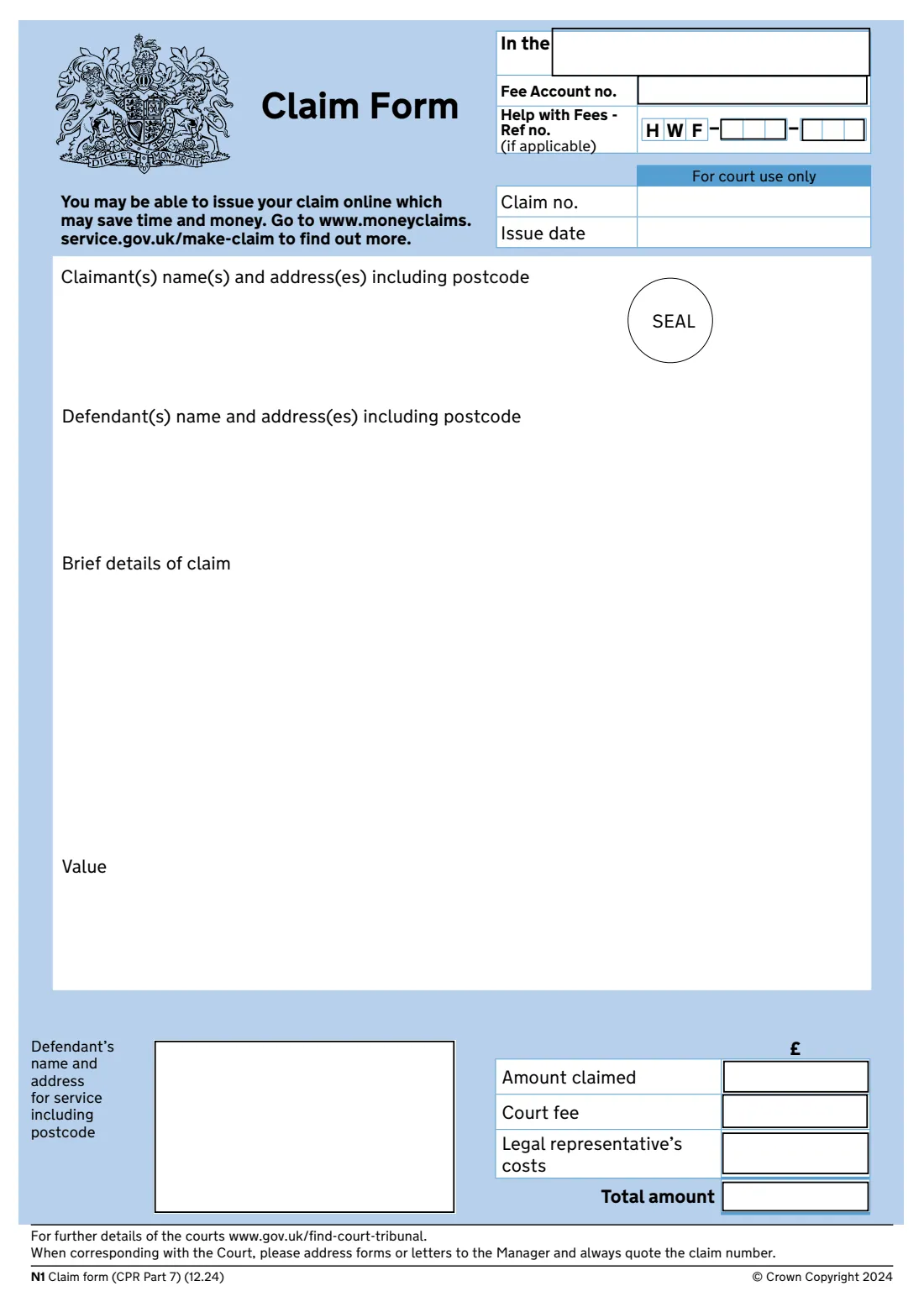
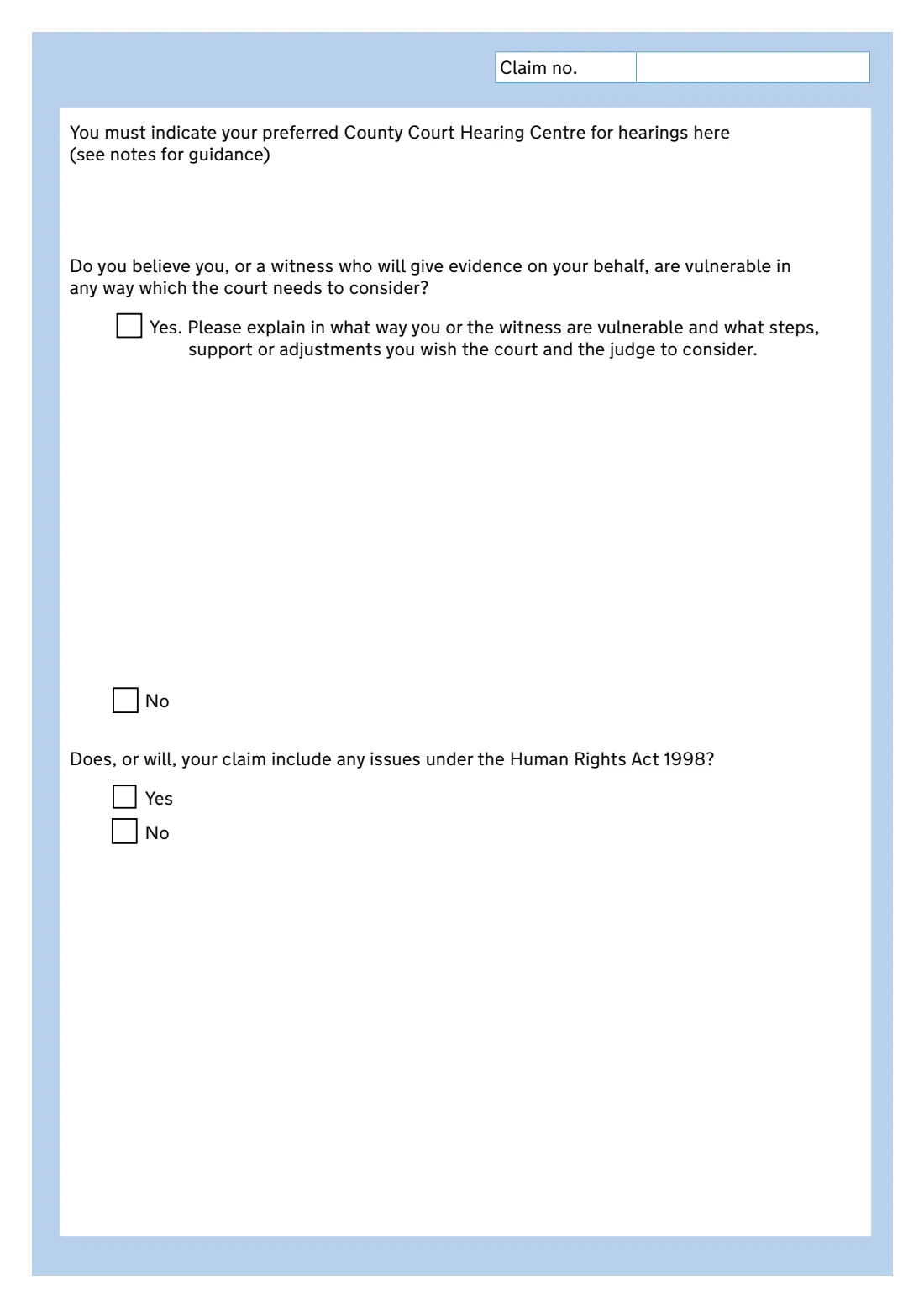
The form asks for the court, the claimant's and defendant's names and addresses, brief details of the claim, its value, the amounts claimed and the court fee, a preferred hearing centre, whether anyone involved is vulnerable, whether the Human Rights Act is involved, the particulars of claim, a statement of truth, and the address where documents should be sent.
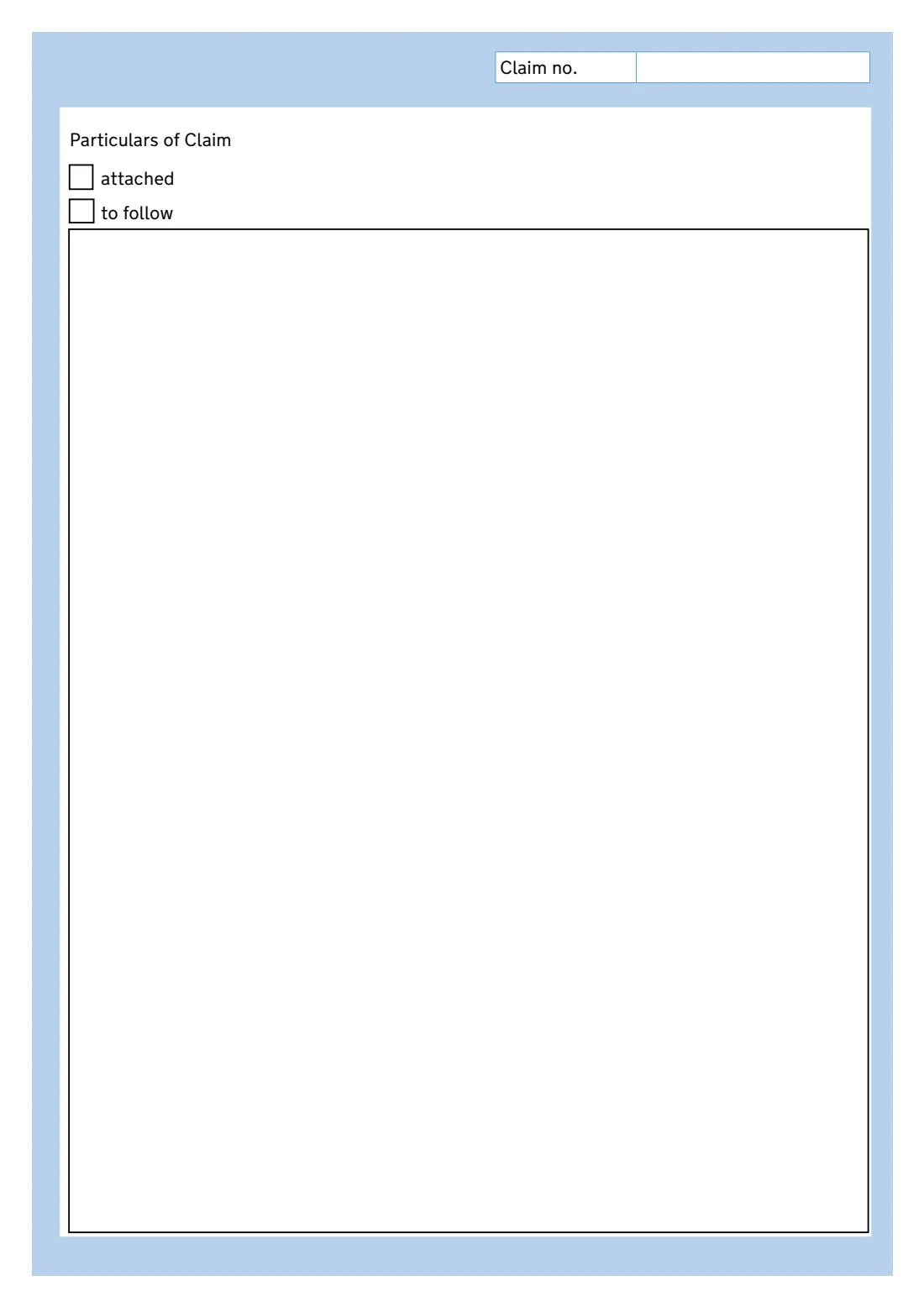
FileIt walks you through each box in plain English, builds the Value statement from the wording in the official N1A notes, adds up the total, and prints everything into HMCTS's own N1 PDF. Names with accents print correctly, and long particulars wrap inside the page 3 box. You print it, sign the statement of truth, and send it to the court yourself. FileIt never files it for you. If your claim is only for money, the online Money Claim service may be quicker.
- Who fills it
- The claimant, or their solicitor or litigation friend
- Given to
- The court, with the fee. Money-only County Court claims go to the Civil National Business Centre in Northampton (see the N1A notes)
- Where
- County Court and High Court, England and Wales
- Signatures
- The statement of truth, signed and dated by the claimant or their representative
- Edition
- N1 (12.24)
- Read first
- N1A Notes for claimant on completing a claim form
Who needs to fill out N1 claim form?
- Anyone who wants to sue a person, sole trader, partnership or company in England and Wales and chooses the paper route.
- Claimants whose claim is for something other than a fixed sum of money, or who can't use the online money claim service.
- Small businesses chasing an unpaid invoice or a failed contract.
- Tenants, homeowners and consumers with a dispute over work, goods or a deposit that couldn't be settled another way.
- A litigation friend bringing a claim for a child or a protected party.
- Solicitors issuing a claim for a client (the form has boxes for the firm, a fee account number and a DX number).
When to use N1 claim form
- After you've tried to settle the dispute. The N1A notes ask you to consider alternative dispute resolution, such as mediation, before going to court.
- When you are ready to start proceedings and can pay the court fee, or have applied for Help with Fees.
- One claim form covers the claim, but the defendant copy is served on each defendant: the notes ask for one copy for you, one for the court and one for each defendant.
What you need before you start
- Your full name, title and address with postcode, and a phone number and email if you want to be contacted that way.
- Each defendant's full name (and trading name, 'a firm' or company suffix where that applies) and their address with postcode.
- A short summary of the claim and what you want the court to order.
- The amount you're claiming, or which value band you expect to recover, plus any interest you have worked out.
- The current court fee, or your Help with Fees reference (HWF-xxx-xxx).
- The name of the County Court hearing centre you would prefer.
- The facts you rely on, for the particulars of claim, and copies of any documents you will attach.
- Your solicitor's firm name, reference and DX number, if a solicitor is acting for you.
What’s on N1 claim form
The 2024 edition has 5 pages. FileIt asks for it in 8 parts, and it is signed by Claimant (or their legal representative):
- Court and feeClaimant (or their legal representative)
- Claimant and defendantClaimant (or their legal representative)
- Brief details and valueClaimant (or their legal representative)
- AmountsClaimant (or their legal representative)
- Hearing centre, vulnerability and human rightsClaimant (or their legal representative)
- Particulars of claimClaimant (or their legal representative)
- Statement of truthClaimant (or their legal representative)
- Address for documentsClaimant (or their legal representative)
How to fill out N1 claim form, step by step
1 Court and fee
Write the court where the claim is to be issued. For a County Court claim that is only for money, the notes say to write 'County Court Money Claims Centre'. Solicitors can add their fee account number. If you have applied for Help with Fees, add the reference and FileIt splits it across the HWF boxes.
2 Claimant and defendant
Give your full name, title and address with postcode, then the same for everyone you are suing. The N1A notes explain how to name a sole trader ('trading as'), a partnership ('a firm'), a company (with 'Ltd' or 'LLP' and its registered office) or a child ('a child by ... his litigation friend'). An address without a postcode needs a judge's permission before the claim can be served.
The box at the bottom left of page 1 is for the one defendant this copy will be served on, so you prepare one claim form for each defendant.
3 Brief details and value
Brief details is a short statement of what the claim is about and the remedy you want. For a fixed sum, put the amount in 'Amount claimed'. Otherwise say what you expect to recover: not more than £10,000; more than £10,000 but not more than £25,000; more than £25,000; or that you cannot say. Claims of up to £5,000 that include personal injury or housing disrepair need an extra sentence, which the notes give word for word.
4 Amounts
Enter the amount claimed, the court fee and, only when a legal representative was instructed, their fixed costs. FileIt works out the total.
5 Hearing centre, vulnerability and human rights
Name the County Court hearing centre you'd prefer; the court takes it into account if the case has to be transferred. Say whether you or a witness is vulnerable, and if so explain how and what support or adjustments you'd like. Then say whether the claim raises any issue under the Human Rights Act 1998.
6 Particulars of claim
Set out the facts you rely on, any interest you claim, and whether you seek aggravated or exemplary damages. You can write them on page 3, tick 'attached' and add separate sheets, or tick 'to follow' and serve them later.
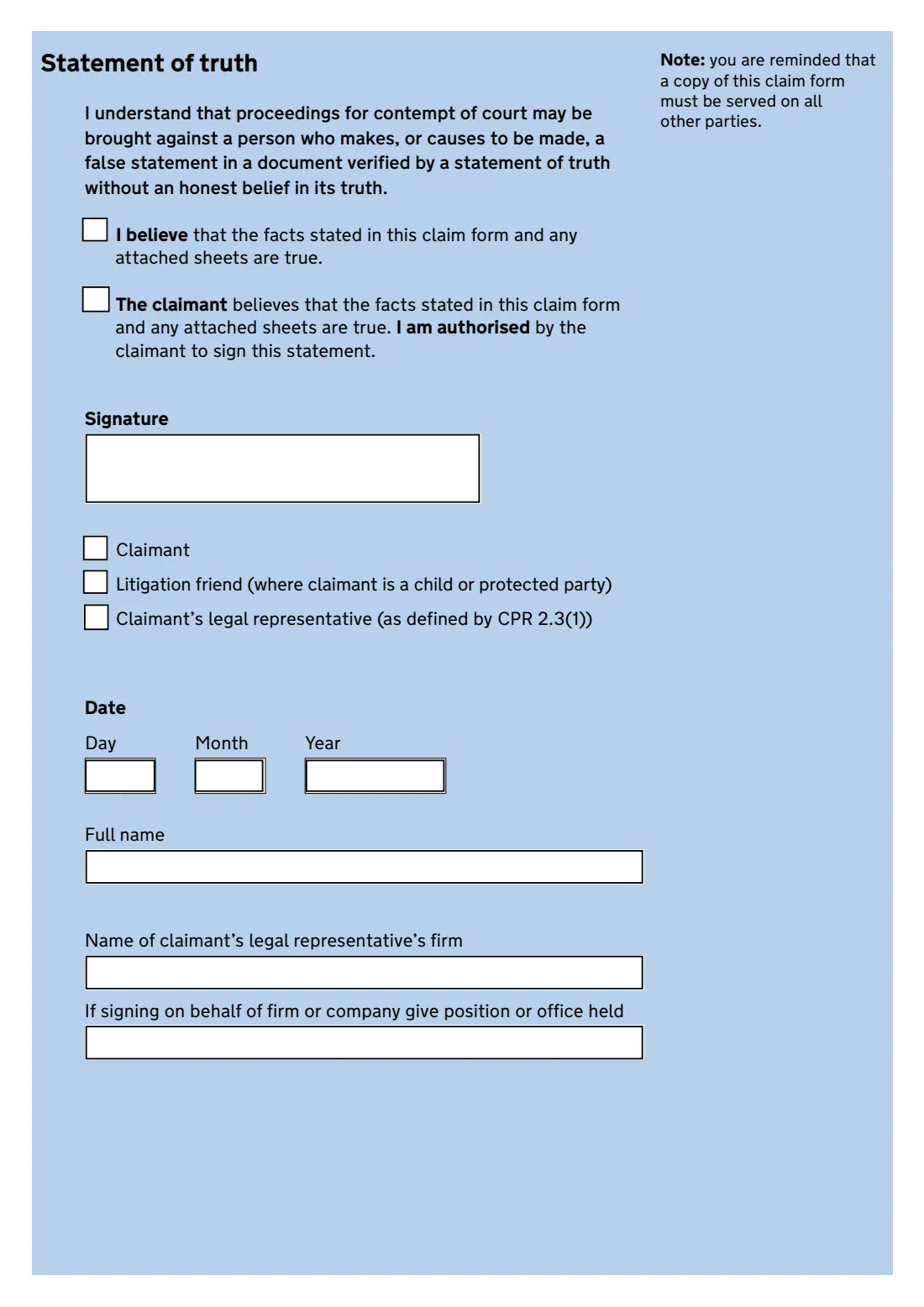
7 Statement of truth and address
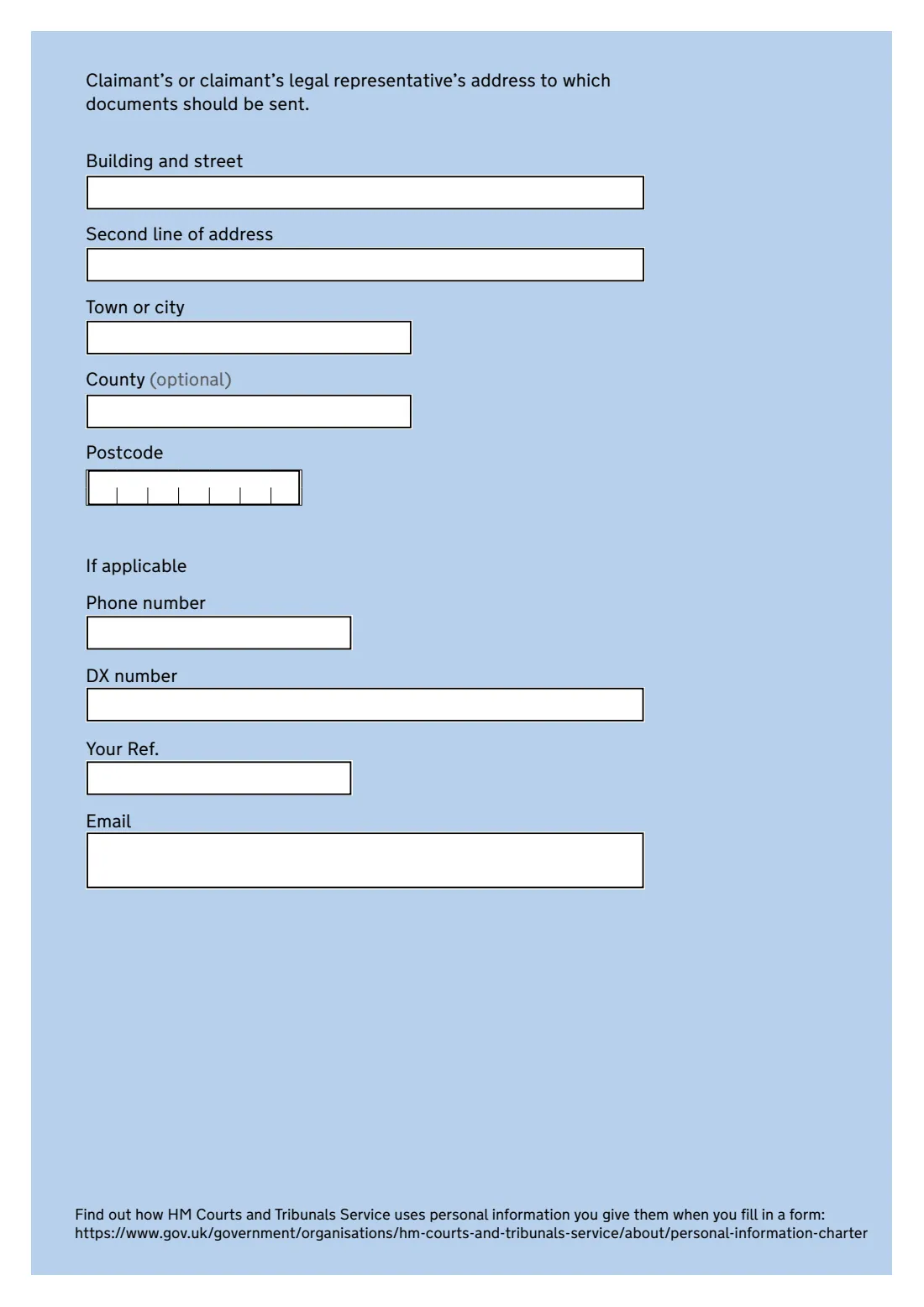
Tick the statement that fits: 'I believe' if you are the claimant, or 'The claimant believes... I am authorised' if you sign for them, for example as their solicitor. Tick who is signing, then give the date, your full name, and the firm and position if they apply. The last page is the address where documents should be sent, with a phone number, DX number, reference and email if you have them.
Common mistakes to avoid
- Leaving out the postcode for a defendant. Without it the claim can't be served unless a judge gives permission.
- Suing a business under the wrong name. Check the company's registered name, or name the owner 'trading as' the business.
- Giving no value, or a value that doesn't match the wording in the N1A notes.
- Ticking 'I believe' when a solicitor is signing for the claimant. They tick the second statement.
- Forgetting to send enough copies: one for the court, one for you and one for each defendant.
- Not trying to settle first. Courts expect you to have considered mediation or another way of resolving the dispute.
After you fill it out
Print the claim form, check every page, and sign and date the statement of truth. Attach the particulars if you ticked 'attached'.
Make copies: the notes ask for one for yourself, one for the court and one for each defendant, together with the defendant's notes for guidance.
Send the form and the fee to the court. The N1A notes say a claim for a sum of money goes to the Civil National Business Centre, St Katharine's House, 21–27 St Katharine's Street, Northampton, NN1 2LH, and a High Court claim or a claim for anything other than money goes to a court office. FileIt doesn't file it for you.
Keep a copy with the claim number and issue date once the court seals it. For a money claim of £10,000 or less, the notes say you'll be required to attend mediation if the defendant disputes it.
Fill out N1 claim form online with FileIt
- Pick the person. Choose someone from People and FileIt fills in their name, date of birth, address and other details it already knows.
- Answer plain-language questions. One part of the form at a time, with the official help text beside each question — 38 fields in all. Your answers save as you go.
- Check the live preview. Watch your answers land on the real HM Courts & Tribunals Service (HMCTS) form, and let FileIt do any worksheet arithmetic.
- Generate the official PDF. FileIt prints your answers into the agency’s own PDF and files it in that person’s folder in your vault. Sign it, or send it for e-signature.
FileIt fills the form — it never files or submits anything for you. Deliver the finished form to whoever asked for it, the way the form’s instructions say.
Start N1 claim form now — it’s freeN1 claim form: frequently asked questions
What is form N1 used for?
It starts a civil claim under Part 7 of the Civil Procedure Rules in the County Court or the High Court of England and Wales, against a person or organisation, for money or for another remedy.
Can I make my claim online instead?
If your claim is only for money, the form itself points you to the online money claim service at www.moneyclaims.service.gov.uk, which may save time and money. The paper N1 is for claims that can't or don't go online.
What do I write in the Value box?
For a fixed sum, put the amount in 'Amount claimed'. Otherwise the N1A notes ask you to write 'I expect to recover' followed by not more than £10,000, more than £10,000 but not more than £25,000, or more than £25,000, or 'I cannot say how much I expect to recover'. FileIt offers these as choices.
Where do I send the N1?
According to the N1A notes, a claim for a sum of money goes to the Civil National Business Centre in Northampton; a High Court claim or a claim for anything other than money goes to a court office with the fee.
Who signs the statement of truth?
The claimant, their solicitor or their litigation friend. For a company, a director or other officer signs. Anyone signing a false statement without an honest belief in its truth can face proceedings for contempt of court.
Do I have to write the particulars of claim on the form?
No. You can write them on page 3, attach them on separate sheets, or tick 'to follow' and serve them separately.
Does FileIt send the claim to court?
No. FileIt prepares the official PDF with your answers printed in. You sign it and send it to the court with the fee yourself.
Official sources
- Blank form (PDF), published by HM Courts & Tribunals Service (HMCTS): https://assets.publishing.service.gov.uk/media/674d7ea12e91c6fb83fb5162/N1_1224.pdf
- Official instructions and guidance: https://assets.publishing.service.gov.uk/media/664caaaaf34f9b5a56adcba2/N1A_0524.pdf
- Edition shown on this page: N1 Claim form (CPR Part 7) (12.24) (checked 2026-09-28).
FileIt is not affiliated with or endorsed by HM Courts & Tribunals Service (HMCTS) or any government. This page explains the form in general terms and is not legal, tax or immigration advice. Always read the official instructions, and check that you are using the edition the recipient accepts. Page last reviewed 2026-09-28.