What is LOC020 deed poll (change of name)?
LOC020 is the deed poll an adult signs to change their name and have the change enrolled with the High Court. Enrolling puts the name change on public record, and the Deed Poll Office seals the deed and returns it to you as proof of your new name. It applies in England, Wales and Northern Ireland; Scotland has its own rules.
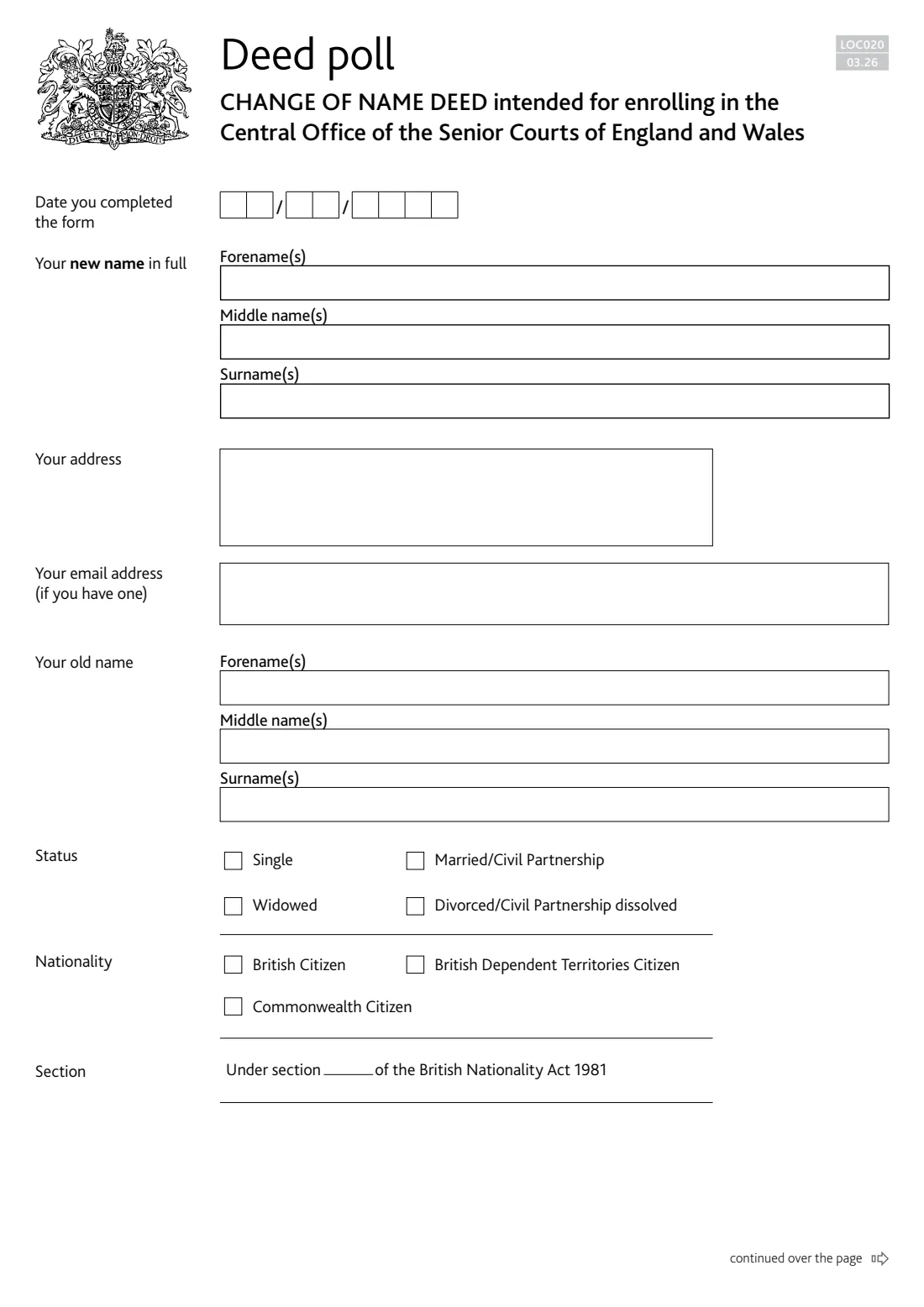
On the form you give your new name in full and your old name in full, your address and email, your relationship status, your nationality and the section of the British Nationality Act 1981 that makes you a citizen, and who will use the new name. You then sign it in both your new and your old name in front of two witnesses, who add their names, addresses and occupations.
FileIt asks each question in plain English, repeats your names wherever the deed needs them, ticks the boxes for the name parts you give, and prints it all into HMCTS's own LOC020 PDF, including names with accents such as Ł or Ș. You print it single-sided, sign it with your witnesses and post it yourself. FileIt never submits it.
- Who fills it
- An adult (18 or over) changing their own name
- Given to
- The Deed Poll Office, King's Bench Division, Royal Courts of Justice, by post
- Where
- England, Wales and Northern Ireland
- Signatures
- You sign in your new and old names, in front of two witnesses who sign too
- Edition
- LOC020 (03.26)
- Goes with
- LOC021 statutory declaration, LOC027 exhibit cover sheets and your exhibits
Who needs to fill out LOC020 deed poll (change of name)?
- Adults who want their change of name on public record through the High Court, rather than an unenrolled deed poll they make themselves.
- British citizens, Commonwealth citizens and British Dependent Territories citizens. You must be one of these to enrol a deed poll.
- People changing their name after marriage, divorce, the end of a civil partnership or bereavement who want an enrolled deed.
- Anyone who needs an official, sealed record of their new name for passports, driving licences, banks or other records.
- Not for children: a child's name change follows a separate process on GOV.UK.
When to use LOC020 deed poll (change of name)
- When you've decided on your new name and are ready to apply by post. If you apply online instead, the form is filled in for you and emailed to you to print and sign.
- Before you post the application: it goes with the LOC021 statutory declaration, exhibit cover sheets (LOC027) and copies of your documents.
- Once for each person changing their name. The forms are sent back if they contain mistakes, so check them before you post.
What you need before you start
- Your new name and your old name in full, including all middle names.
- Your address and, if you have one, your email address.
- Your status: single, married or in a civil partnership, widowed, or divorced or civil partnership dissolved.
- Your nationality and the British Nationality Act 1981 section that applies to you (usually 1(1), 6(1), 11(1) or 37(1)).
- Two witnesses, with their full names, addresses and occupations, who will watch you sign and then sign themselves.
- For the application itself: a copy of your birth certificate, valid passport or certificate of naturalisation, and any other documents GOV.UK asks for, such as your spouse's written consent or a decree absolute.
What’s on LOC020 deed poll (change of name)
The 2026 edition has 3 pages. FileIt asks for it in 5 parts, and it is signed by Person changing their name and First witness and Second witness:
- Your new and old namePerson changing their name
- Address, status and nationalityPerson changing their name
- Who will use the new namePerson changing their name
- Witness 1First witness
- Witness 2Second witness
How to fill out LOC020 deed poll (change of name), step by step
1 Date and your names
The date you complete the form is the date of the deed. Then give your new name in full (forenames, middle names, surnames) and your old name in full. The guidance says to include every part of both names, and the deed must have no crossings out or mistakes, which is easier when it's typed.
2 Address, status and nationality
Give your address and email. Your address is published in The Gazette with your name change; if you have a strong reason it shouldn't be, explain it in your application. Tick your status. If you're married or in a civil partnership you need your husband's, wife's or partner's written permission to change your name. Then tick British Citizen, British Dependent Territories Citizen or Commonwealth Citizen, and give the section of the British Nationality Act 1981 that qualifies you. The GOV.UK guidance explains sections 1(1), 6(1), 11(1) and 37(1).
3 Who will use the new name
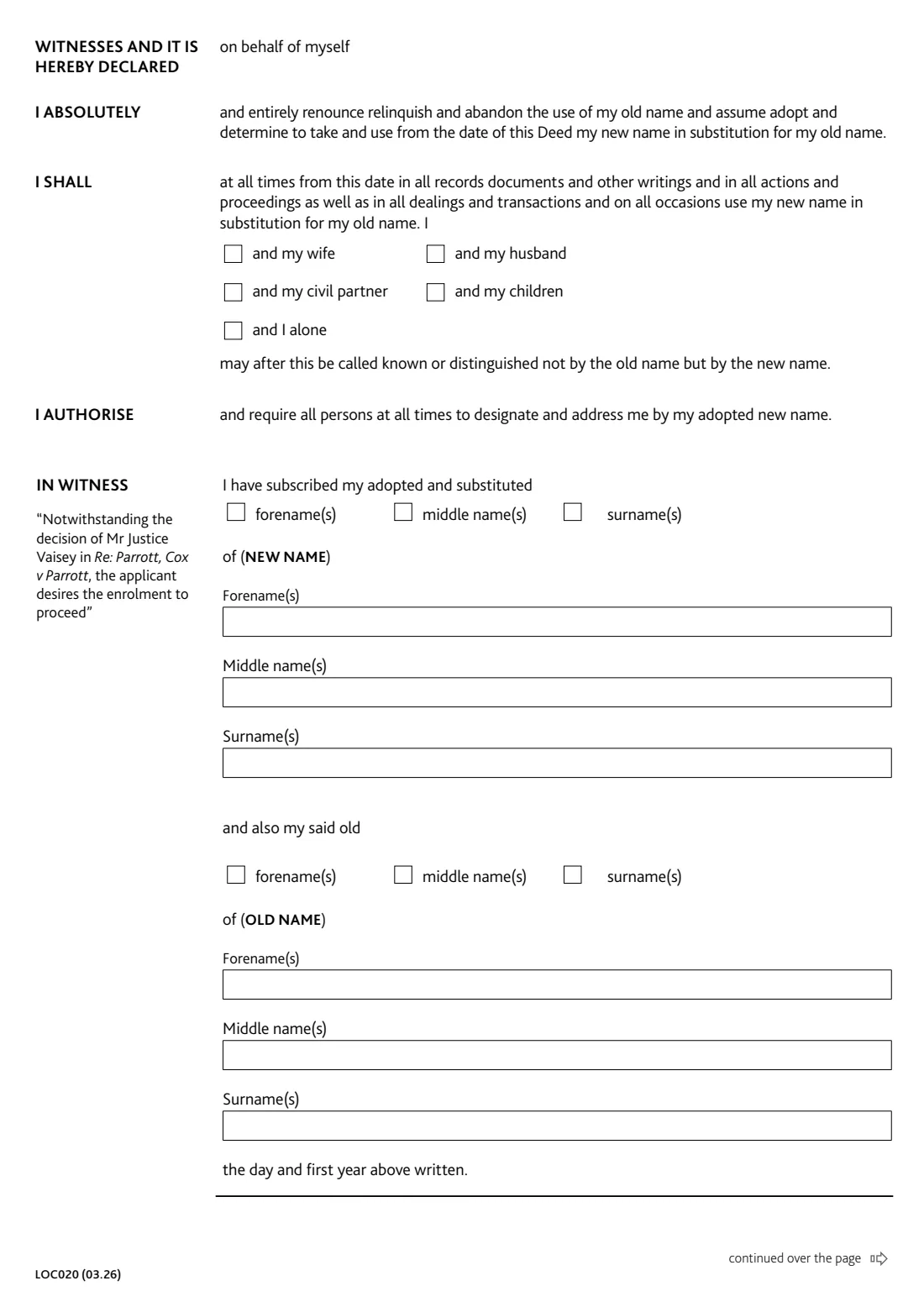
Most adults tick 'and I alone'. The deed also has boxes for a wife, husband, civil partner or children. The page 2 wording then repeats your new and old names, and FileIt ticks the forename, middle name and surname boxes for the parts you've given.
4 Signing and witnesses
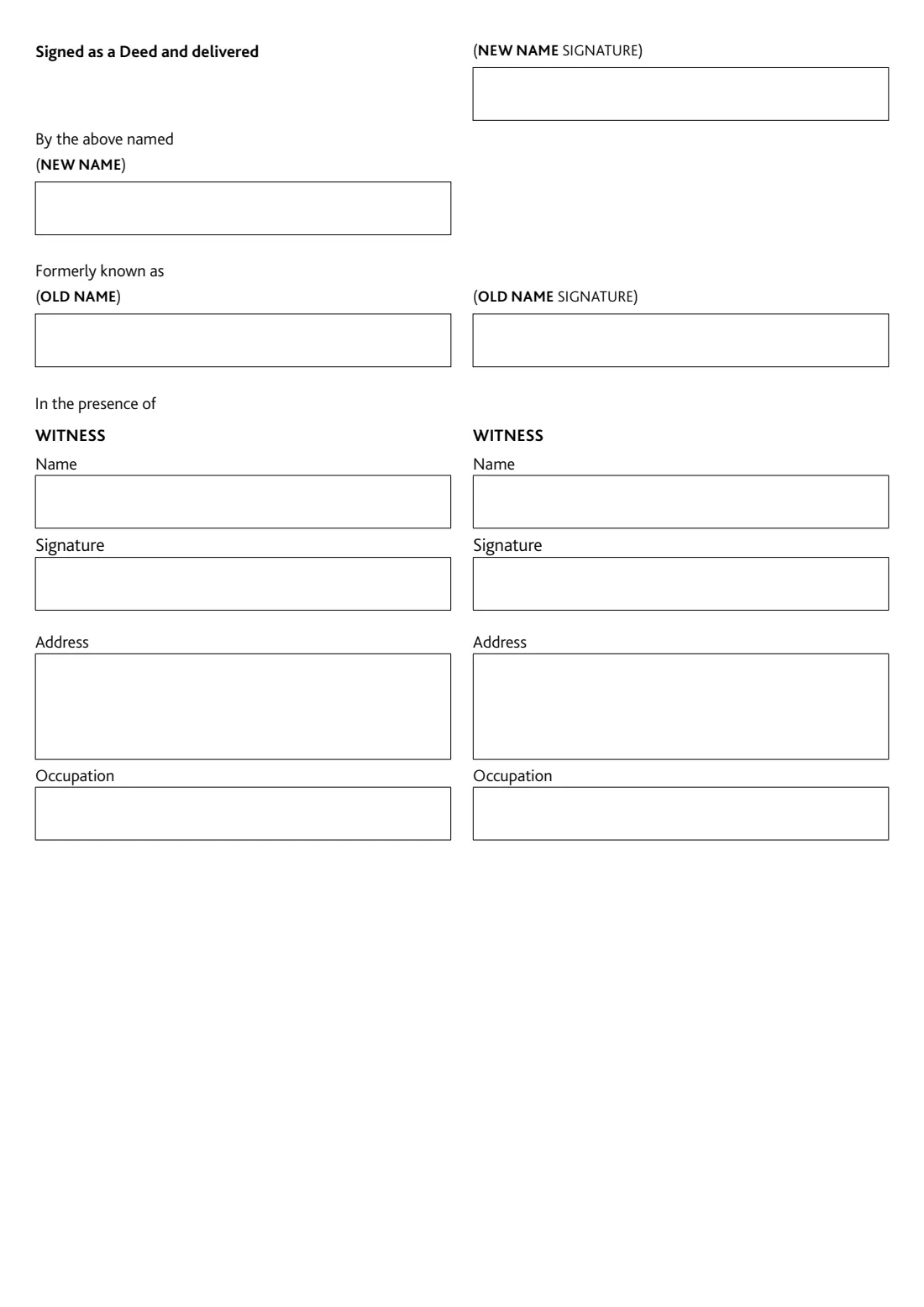
On page 3 your new and old names are printed beside the two signature boxes. Sign once in your new name and once in your old name, in front of two witnesses. Each witness writes their name, address and occupation and signs in their own box.
Common mistakes to avoid
- Leaving out a middle name, or giving a name part that doesn't match your documents.
- Printing double-sided. The guidance says the deed must be printed single-sided.
- Crossing out or correcting by hand. The deed must have no crossings out or mistakes.
- Signing without both witnesses present, or forgetting to sign in both your new and old names.
- Choosing the wrong British Nationality Act section, or leaving it blank.
- Not including the statutory declaration (LOC021), exhibit cover sheets and document copies. An application with mistakes is sent back.
After you fill it out
Print the deed single-sided and check every page. Sign it in your new and old names in front of your two witnesses, and ask them to sign too.
Make a photocopy of the signed deed for your exhibits. The court keeps the photocopy and returns the original to you as your copy.
Complete LOC021 and LOC027, which are signed in front of a solicitor or another authorised witness, then post everything to the Deed Poll Office, King's Bench Division, Room E15, The Royal Courts of Justice, Strand, London WC2A 2LL. GOV.UK gave the fee as £53.05 when this page was reviewed, payable by phone to the High Court Fees Office, or by postal order or cheque. FileIt doesn't post it for you.
Enrolment can take several months. Once approved, the Deed Poll Office seals your deed and posts it back, and a notice is published in The Gazette. Keep the sealed deed in your FileIt vault and use it to update your passport, driving licence and other records.
Fill out LOC020 deed poll (change of name) online with FileIt
- Pick the person. Choose someone from People and FileIt fills in their name, date of birth, address and other details it already knows.
- Answer plain-language questions. One part of the form at a time, with the official help text beside each question — 31 fields in all. Your answers save as you go.
- Check the live preview. Watch your answers land on the real HM Courts & Tribunals Service (HMCTS) — King's Bench Division, Deed Poll Office form, and let FileIt do any worksheet arithmetic.
- Generate the official PDF. FileIt prints your answers into the agency’s own PDF and files it in that person’s folder in your vault. Sign it, or send it for e-signature.
FileIt fills the form — it never files or submits anything for you. Deliver the finished form to whoever asked for it, the way the form’s instructions say.
Start LOC020 deed poll (change of name) now — it’s freeLOC020 deed poll (change of name): frequently asked questions
What is an enrolled deed poll?
A deed poll enrolled with the High Court puts your change of name on public record. The Deed Poll Office seals the deed and sends it back to you, and a notice appears in The Gazette. You can also make your own unenrolled deed poll, which isn't put on public record.
Who can use LOC020?
Adults (18 or over) who are British citizens, Commonwealth citizens or British Dependent Territories citizens, in England, Wales or Northern Ireland. A child's name change has a separate process.
Who can be a witness?
You must sign the deed in front of two witnesses, who then sign it too and add their names, addresses and occupations. The statutory declaration (LOC021) is different: it's signed in front of a solicitor or another authorised witness.
How much does it cost to enrol a deed poll?
GOV.UK gave the fee as £53.05 when this page was reviewed. Check the current fee, and whether you can get help with fees, before you apply.
Is my new name published?
Yes. A public record of your name change and your address is published in The Gazette. If you have a strong reason why your details shouldn't be published, explain it in your application; the judge may agree to publish only your first name or surname.
What else do I send with the deed?
The statutory declaration (LOC021), a cover sheet for each exhibit (LOC027) and copies of documents such as your birth certificate, passport or naturalisation certificate, plus anything else GOV.UK asks for.
Does FileIt submit the deed poll?
No. FileIt prepares the official LOC020 PDF with your answers printed in. You print it, sign it with your witnesses and post it yourself.
Official sources
- Blank form (PDF), published by HM Courts & Tribunals Service (HMCTS) — King's Bench Division, Deed Poll Office: https://assets.publishing.service.gov.uk/media/69bd2860b920af63be1c7572/LOC020_0326_save.pdf
- Official instructions and guidance: https://www.gov.uk/government/publications/enrol-a-deed-poll-with-the-court-to-change-your-name-form-loc020/how-to-complete-the-adult-deed-poll-form
- Edition shown on this page: LOC020 (03.26) (checked 2026-09-28).
FileIt is not affiliated with or endorsed by HM Courts & Tribunals Service (HMCTS) — King's Bench Division, Deed Poll Office or any government. This page explains the form in general terms and is not legal, tax or immigration advice. Always read the official instructions, and check that you are using the edition the recipient accepts. Page last reviewed 2026-09-28.