What is N244 Application notice?
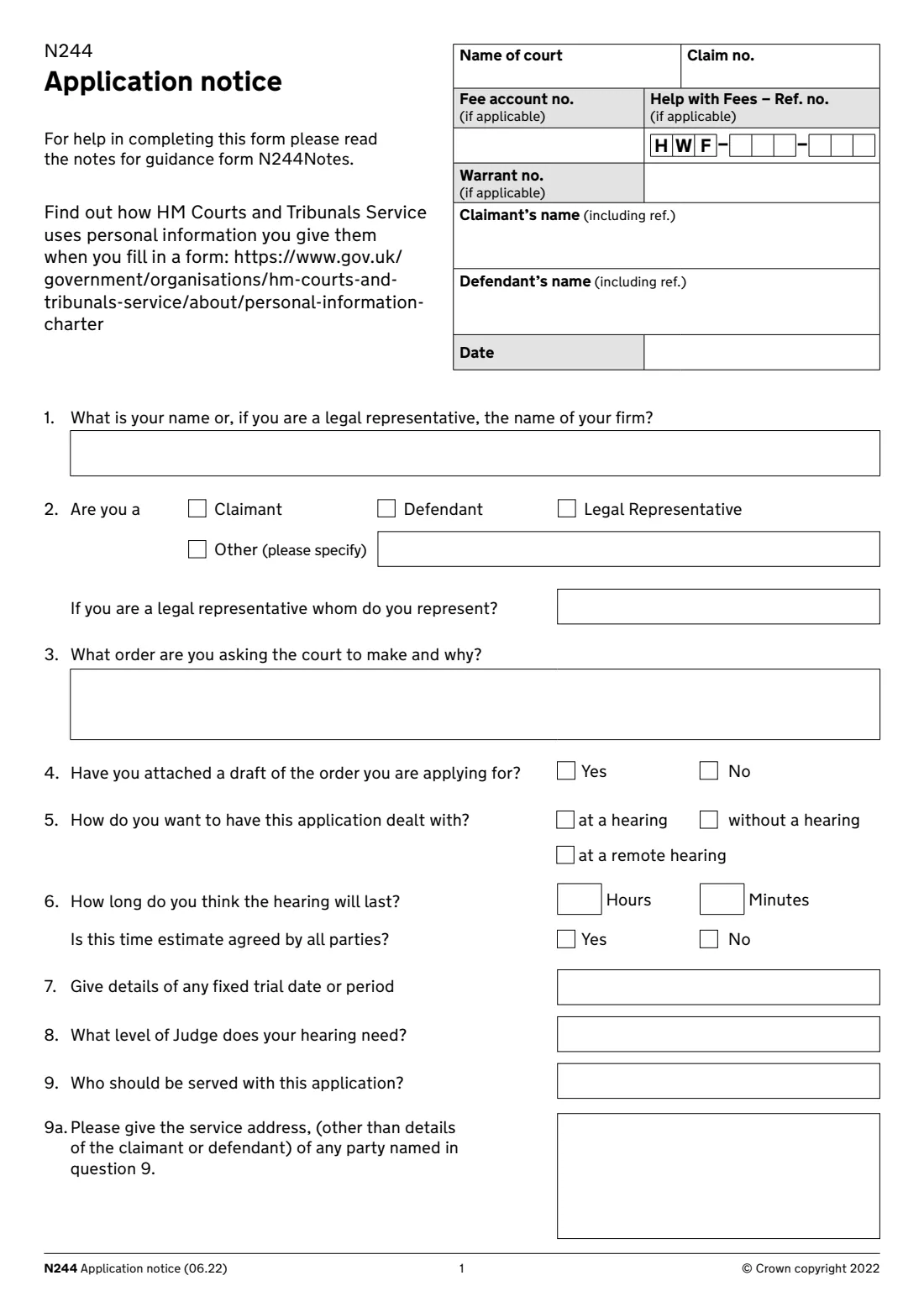
Form N244 is the application notice you use to ask a civil court to make an order in a case, for example to set aside or vary a judgment, to suspend an enforcement process, or to adjourn a hearing. It sets out what order you want and why, how you want the application dealt with, who should be served, the information you rely on, and whether you or a witness are vulnerable.
HMCTS asks you to read its guidance, 'How to complete the N244 application notice', before filling it in. Court staff can't give legal advice. A court fee is usually payable depending on the type of application, and if you can't afford it you can apply for Help with Fees (form EX160, or online). Some applications need a different form, such as the Commercial Court's N244(CC).
FileIt walks you through all 11 questions and the statement of truth, and prints your answers into HMCTS's own N244 PDF, wrapping long answers inside the boxes. You sign it and file it with the court yourself. FileIt never sends it.
- Who fills it
- The applicant (claimant, defendant or someone else), their litigation friend or their legal representative
- Sent to
- The court dealing with the case, with the fee or a Help with Fees application
- Length
- 5 pages: 11 questions, the statement of truth and your address
- Signatures
- Statement of truth signed and dated on page 4
- Edition
- N244 (06.22)
- Copies
- One copy for the court and one for each party to be served, as HMCTS's guidance says
Who needs to fill out N244 Application notice?
- A claimant or defendant in a civil case who wants the court to make an order, such as setting aside a default judgment made against them.
- Someone who wants to vary a judgment or suspend enforcement, for example of a warrant.
- A party asking to adjourn a hearing, or for a summons or order for a witness to attend.
- A solicitor or other legal representative applying for their client, or a litigation friend for a child or protected party.
When to use N244 Application notice
- When you need the court to make an order in a case that has already started, and no more specific form applies.
- Before an enforcement step or hearing you want the court to change. HMCTS's guidance says no fee is payable for an application by consent to adjourn a hearing if the court receives it at least 14 days before the hearing date.
- Not for a domestic abuse protection order, a defence in certain property cases, a Commercial Court order or payments out of court funds without the extra forms and guidance HMCTS lists for those.
What you need before you start
- The name of the court, the claim number and the claimant's and defendant's names, from the claim form or court papers.
- A clear statement of the order you want and why, and a draft of the order if you have one.
- Whether you want a hearing, and a time estimate if you know it (if not, leave it blank rather than guess).
- Who should be served with the application and, for anyone other than the claimant or defendant, their address.
- The evidence you rely on: a witness statement, your statement of case, or facts written on the form.
- The fee, a Fee Account number, or a Help with Fees reference or EX160 application.
What’s on N244 Application notice
The 2022 edition has 5 pages. FileIt asks for it in 7 parts, and it is signed by Applicant:
- Court and case detailsApplicant
- Questions 1-3: You and the order you wantApplicant
- Questions 5-9: The hearing and who to serveApplicant
- Question 10: The information you rely onApplicant
- Question 11: VulnerabilityApplicant
- Statement of truthApplicant
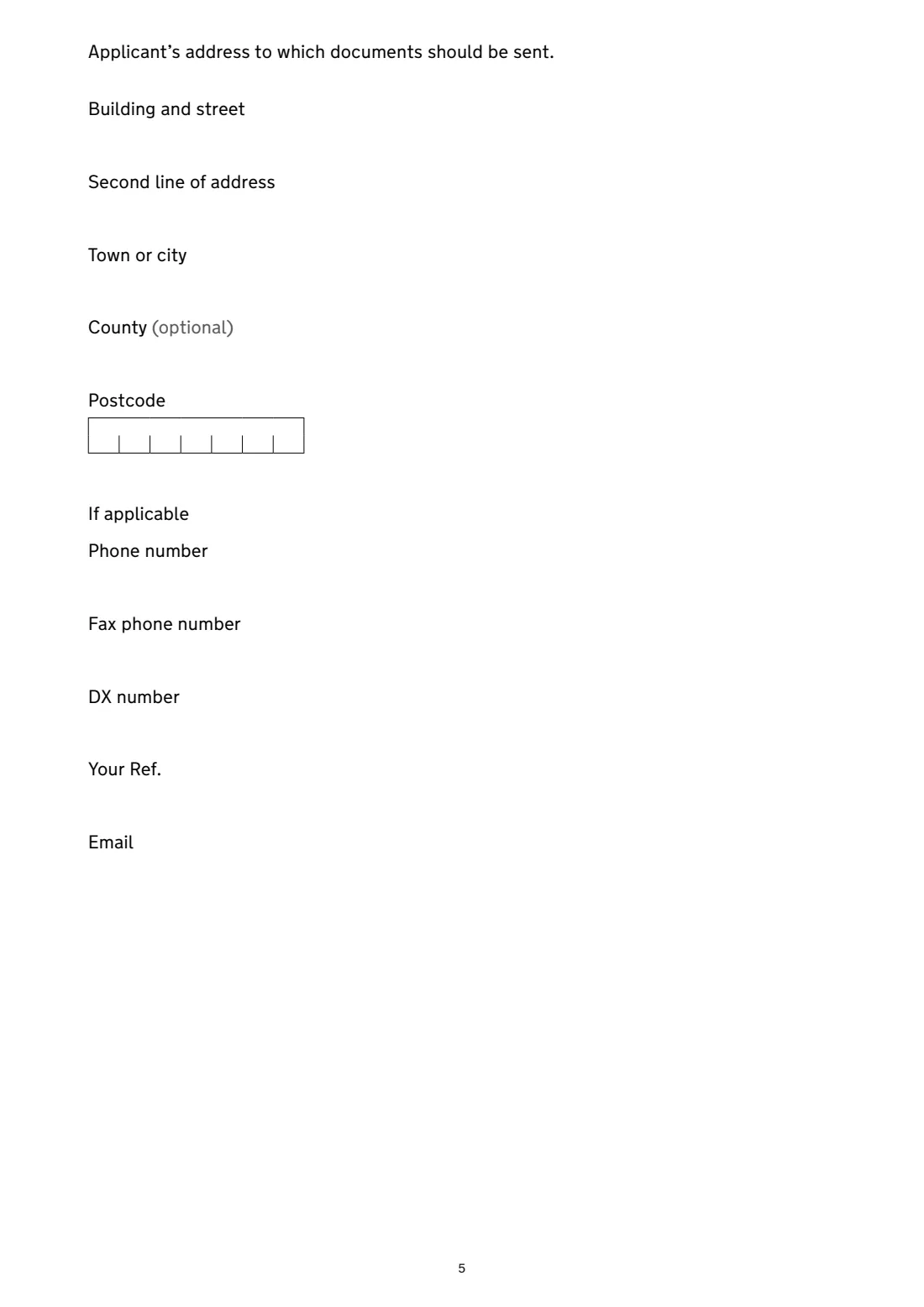
- Applicant's address for documentsApplicant
How to fill out N244 Application notice, step by step
1 Court and case details
The court name, claim number, any Fee Account, Help with Fees or warrant number, the claimant's and defendant's names with their references, and the date.
2 Questions 1 to 4: You and the order
Your name (or your firm's), whether you're the claimant, defendant, a legal representative (and whom you represent) or someone else, the order you want and why, and whether you've attached a draft order.
3 Questions 5 to 9: Hearing and service
At a hearing, without a hearing, or at a remote hearing. The court only deals with an application without a hearing where the parties agree the order or agree it can be dealt with that way, or where it doesn't think a hearing is appropriate. Remote hearings are only available where at least one party is legally represented. Then the time estimate, any fixed trial date, the level of judge and who should be served.
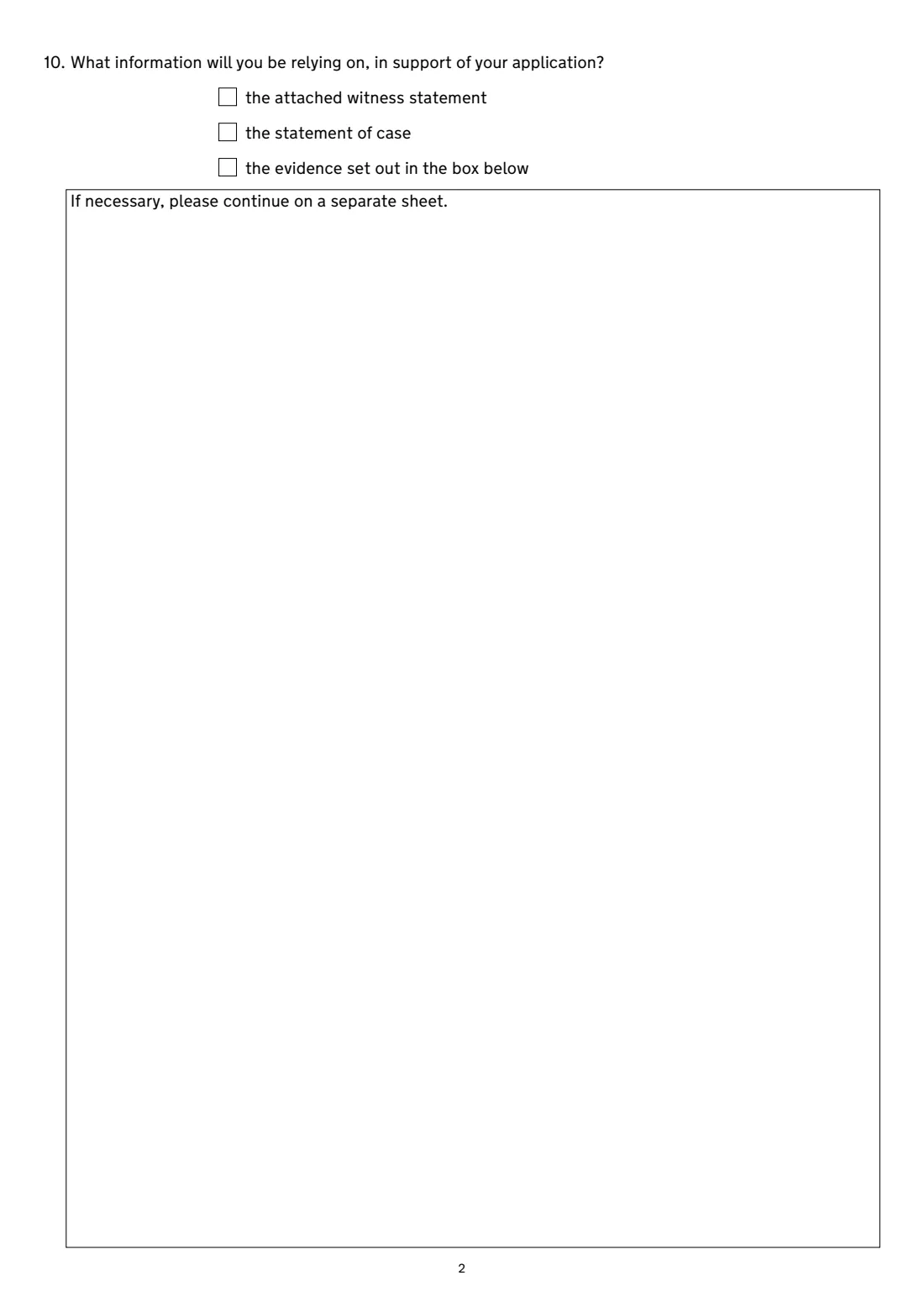
4 Question 10: Your evidence
Tick whether you rely on an attached witness statement, your statement of case (such as the particulars of claim or defence), or evidence written in the box on page 2. Section 10 is covered by the statement of truth.
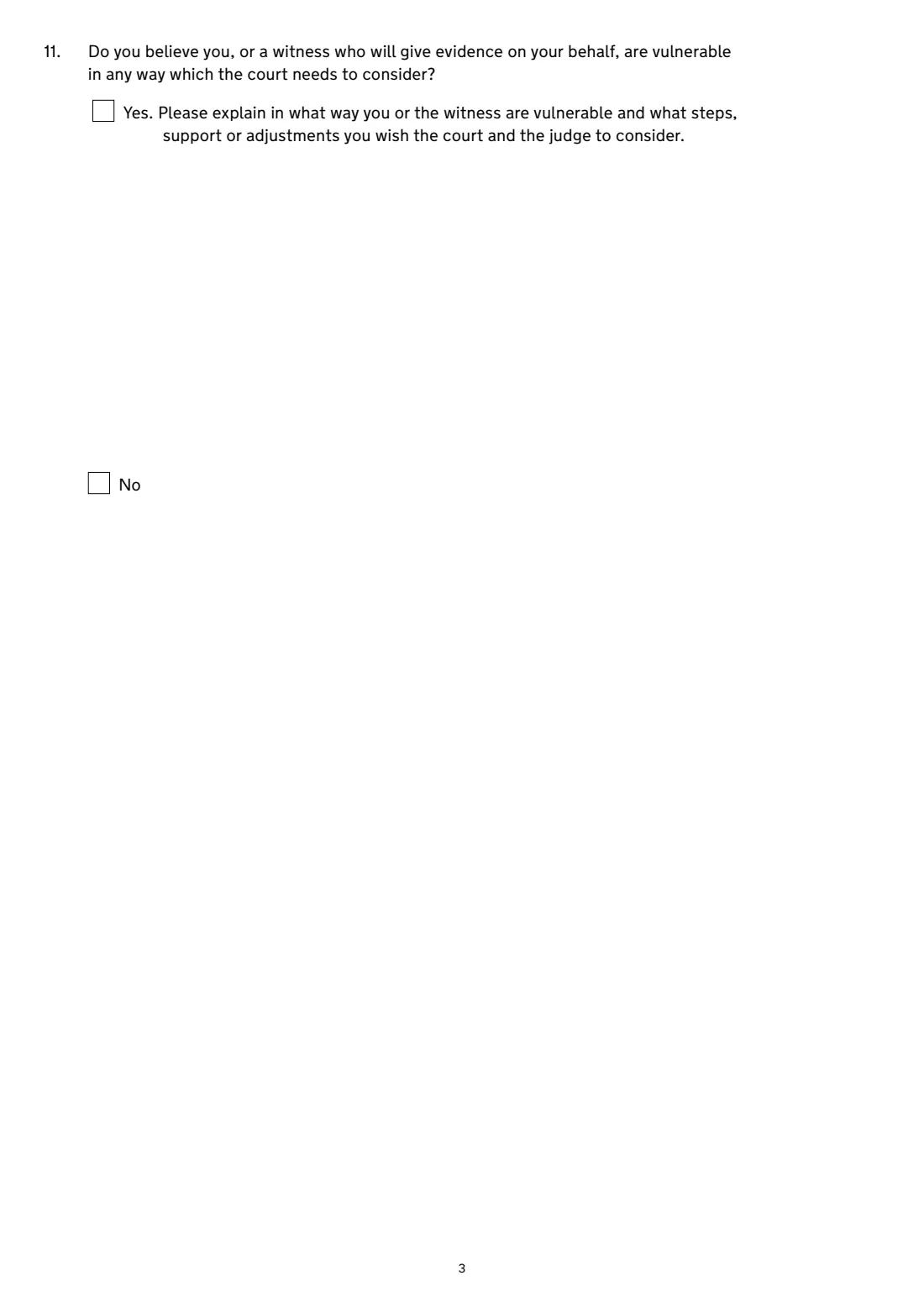
5 Question 11: Vulnerability
Tell the court if you, or a witness giving evidence for you, are vulnerable in any way it needs to consider, and what support or adjustments you'd like.
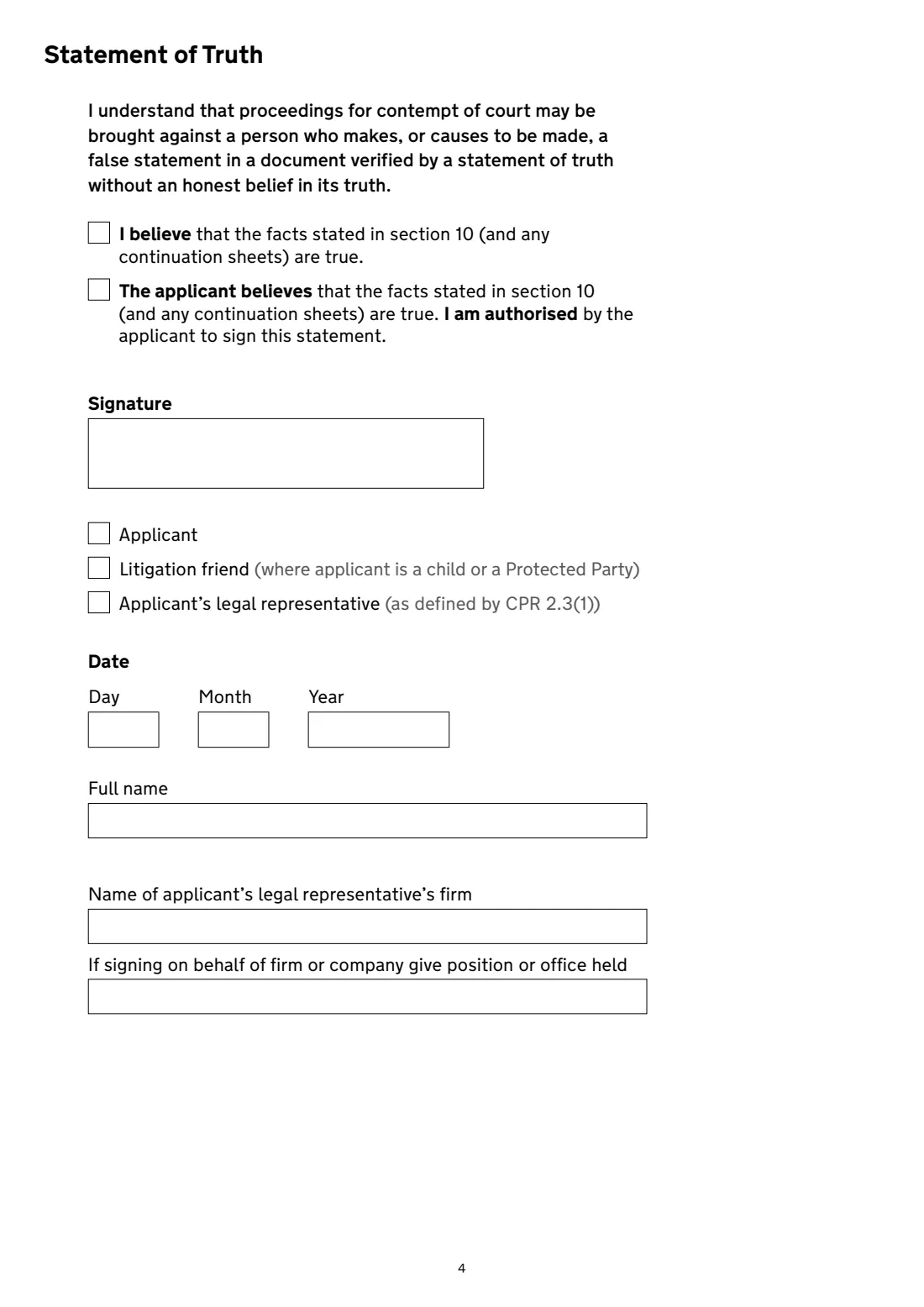
6 Statement of truth and address
Tick 'I believe' if you're the applicant or litigation friend, or 'The applicant believes' if you're the legal representative, sign and date it, and give your full name, firm and position. Then the address where documents should be sent, with phone, DX, reference and email if you agree to be contacted that way.
Common mistakes to avoid
- Being vague about the order you want. Say exactly what you're asking for and why, for example 'to set aside a judgment against me because...'.
- Guessing the hearing length. HMCTS says to leave it blank if you don't know.
- Ticking 'the evidence set out in the box below' and leaving the box empty, or relying on a witness statement you haven't attached.
- Ticking the wrong statement of truth for who is signing.
- Forgetting the fee or a Help with Fees application.
- Not making enough copies: one for the court and one for each party to be served.
After you fill it out
Print the N244 from FileIt, check every page, and sign and date the statement of truth, or send it for signature with FileIt's eSignature.
Send it to the court dealing with your case with the fee (or your Help with Fees application), any draft order and witness statement, and enough copies for the court and each party to be served.
If you asked for a hearing, tell the court in a covering letter about any dates in the next 6 weeks you can't attend. Keep a copy in the case folder in your FileIt vault.
Fill out N244 Application notice online with FileIt
- Pick the person. Choose someone from People and FileIt fills in their name, date of birth, address and other details it already knows.
- Answer plain-language questions. One part of the form at a time, with the official help text beside each question — 47 fields in all. Your answers save as you go.
- Check the live preview. Watch your answers land on the real HM Courts & Tribunals Service (HMCTS) form, and let FileIt do any worksheet arithmetic.
- Generate the official PDF. FileIt prints your answers into the agency’s own PDF and files it in that person’s folder in your vault. Sign it, or send it for e-signature.
FileIt fills the form — it never files or submits anything for you. Deliver the finished form to whoever asked for it, the way the form’s instructions say.
Start N244 Application notice now — it’s freeN244 Application notice: frequently asked questions
Is there a fee for an N244?
A court fee is payable depending on the type of application, for example to set aside a judgment, vary a judgment or suspend enforcement. HMCTS's guidance says no fee is payable for an application by consent to adjourn a hearing if the court receives it at least 14 days before the hearing. Check the current court fees on GOV.UK.
What if I can't afford the fee?
You may be eligible for help with fees. Apply with form EX160 or online, and send the application with your N244.
Will there be a hearing?
Most applications need a hearing, which you'll be expected to attend. The court only deals with an application without a hearing where the parties agree the order, or agree it can be dealt with without a hearing, or where it doesn't think a hearing is appropriate.
Can I ask for a telephone or video hearing?
Remote hearings are only available where at least one party is legally represented, not every application is suitable, and the court may refuse the request.
What evidence do I need?
Whatever supports the order you're asking for. You can attach a witness statement, rely on your particulars of claim or defence, or write the facts in the box on page 2. All of it is verified by the statement of truth.
What does signing the statement of truth mean?
Proceedings for contempt of court may be brought against a person who makes, or causes to be made, a false statement in a document verified by a statement of truth without an honest belief in its truth.
Can court staff help me fill it in?
They can't give legal advice. You may qualify for legal aid, or you can contact your local Citizens Advice.
Official sources
- Blank form (PDF), published by HM Courts & Tribunals Service (HMCTS): https://assets.publishing.service.gov.uk/media/65eb1c6b5b652445f6f21b01/N244_0622_save.pdf
- Official instructions and guidance: https://www.gov.uk/government/publications/form-n244-application-notice
- Edition shown on this page: N244 (06.22) (checked 2026-09-28).
FileIt is not affiliated with or endorsed by HM Courts & Tribunals Service (HMCTS) or any government. This page explains the form in general terms and is not legal, tax or immigration advice. Always read the official instructions, and check that you are using the edition the recipient accepts. Page last reviewed 2026-09-28.