What is the massage intake & consent form template?
Filling in a clipboard form in the waiting room a few minutes before a massage rarely gives a therapist enough time to actually read it. This template lets clients complete their intake before they arrive — what they want from the session, which areas to focus on or avoid, preferred pressure, and a health screening for conditions that mean a massage should be adapted or postponed.
The health check is the heart of the form: a checklist of common contraindications, from fever and skin conditions to blood clots, pregnancy and recent surgery, only opens a details box if something is ticked, and pregnancy specifically asks how many weeks along the client is. That keeps the form quick for a client with nothing to report, while making sure anything relevant reaches the therapist before hands-on work begins.
Every submission is saved as a signed PDF in the practice's FileIt vault, so the therapist has the full intake and consent on file ahead of the appointment, and it's there again for reference at every future visit.
- Best for
- Massage therapists, spas and bodywork practitioners taking new or returning clients
- Filled in by
- The client, ahead of their appointment
- Time to complete
- About 8-10 minutes
- Includes
- A health screening checklist with conditional follow-ups, a pressure scale, and signed consent
Who uses a massage intake & consent form?
- A spa or clinic collecting intake forms from new clients before their first appointment
- A sports massage therapist who needs specific focus areas and pressure preferences ahead of a session
- Screening for pregnancy, recent surgery, blood clots or other conditions that change how a session should be run
- A mobile or independent therapist who wants a signed consent and health record on file for every client
- A returning client updating their health information before a new series of sessions
- A practice that wants therapist preference (male or female) captured as part of the intake
Questions on this massage intake & consent form
23 questions over 4 pages · includes signature, conditional questions, multiple pages, consent checkbox, ratings.
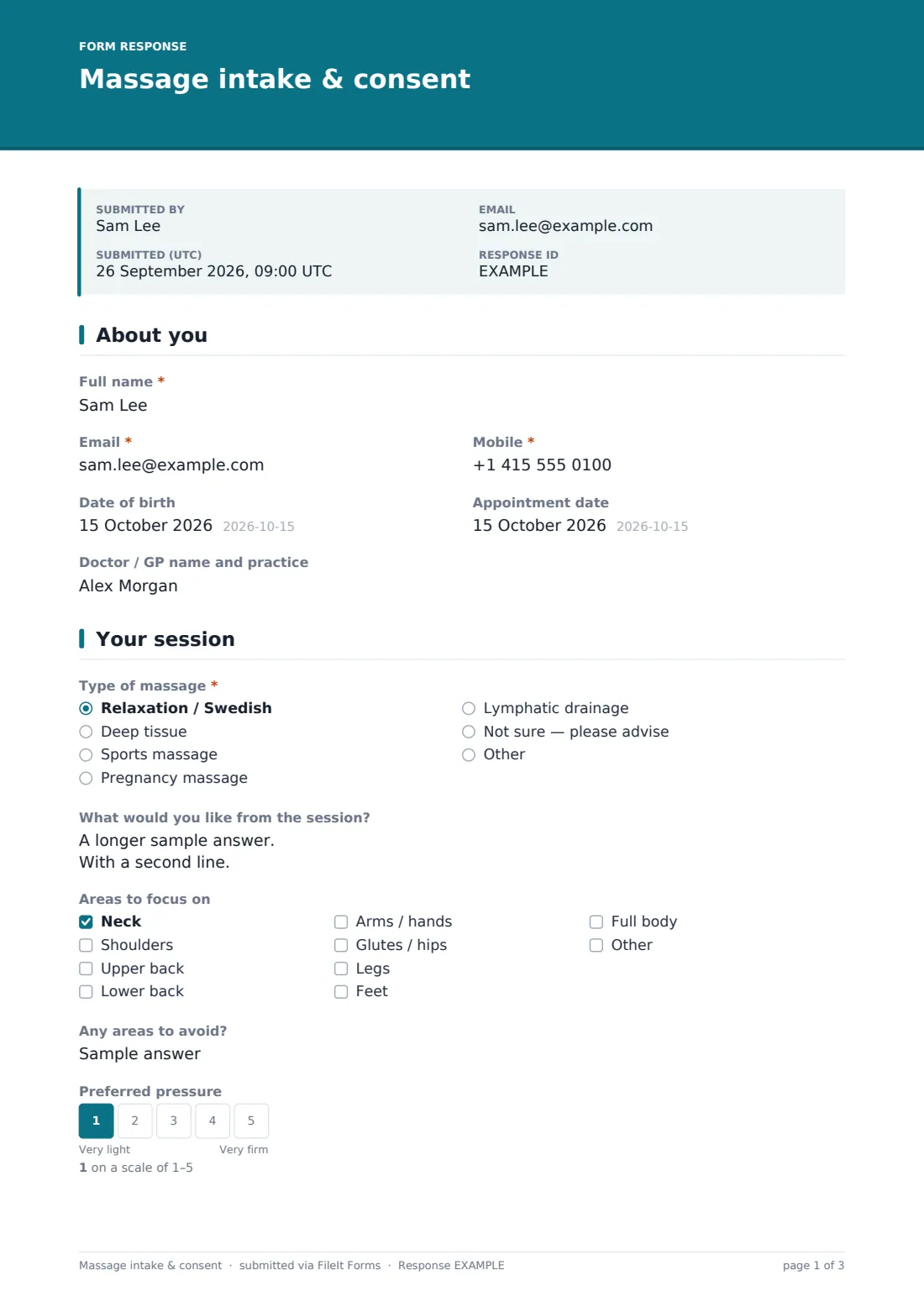
1 About you
- Full name*
- Email*
- Mobile*
- Date of birth
- Appointment date
- Doctor / GP name and practice
2 Your session
- Type of massage* Relaxation / Swedish · Deep tissue · Sports massage · Pregnancy massage · Lymphatic drainage · Not sure — please advise
- What would you like from the session?
- Areas to focus on Neck · Shoulders · Upper back · Lower back · Arms / hands · Glutes / hips · Legs · Feet · Full body
- Any areas to avoid?
- Preferred pressure
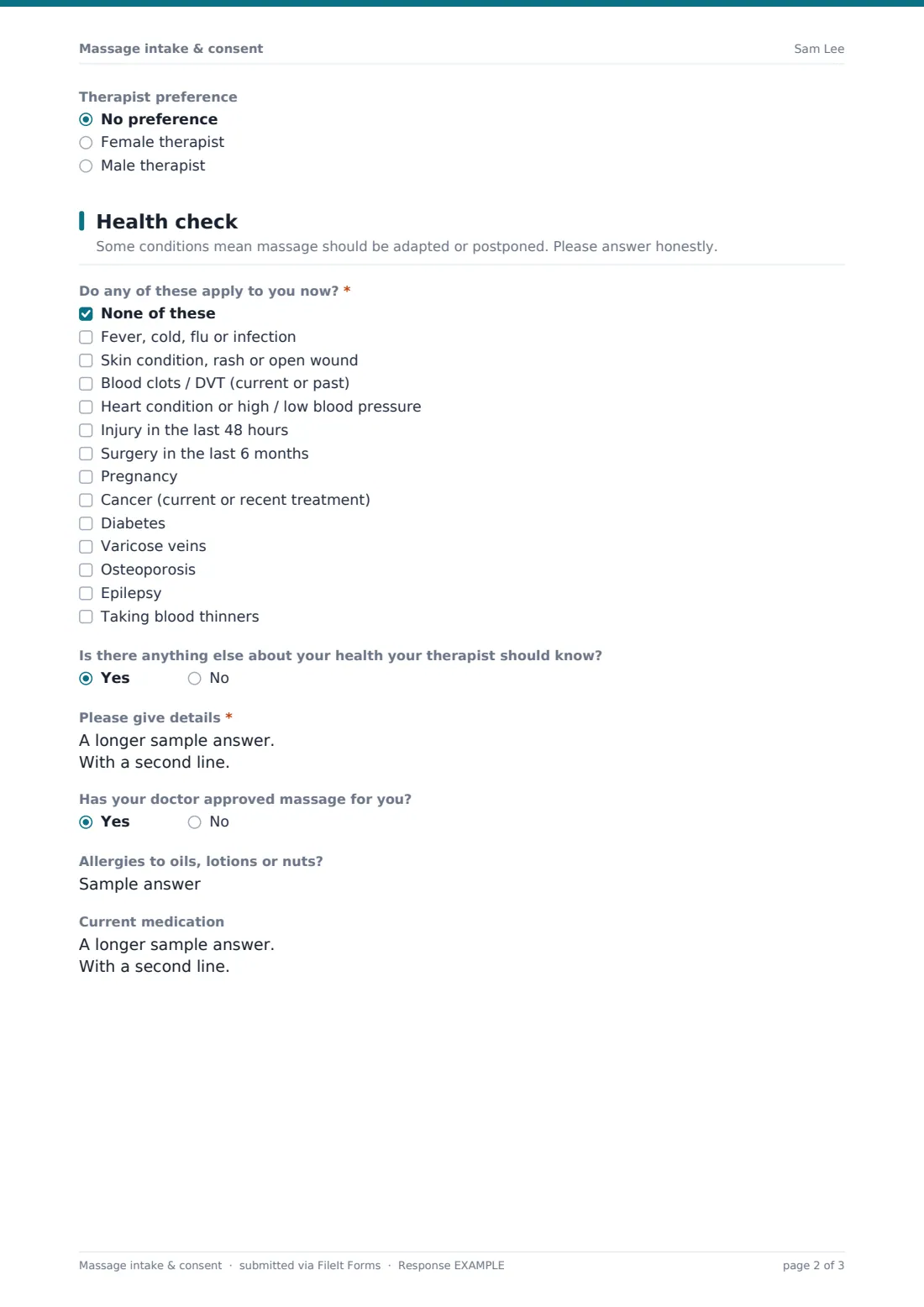
- Therapist preference No preference · Female therapist · Male therapist
3 Health check
- Do any of these apply to you now?* None of these · Fever, cold, flu or infection · Skin condition, rash or open wound · Blood clots / DVT (current or past) · Heart condition or high / low blood pressure · Injury in the last 48 hours · Surgery in the last 6 months · Pregnancy · Cancer (current or recent treatment) · Diabetes · Varicose veins · Osteoporosis
- Is there anything else about your health your therapist should know?
- Please give details* asked only when it applies
- How many weeks pregnant?* asked only when it applies
- Has your doctor approved massage for you? asked only when it applies
- Allergies to oils, lotions or nuts?
- Current medication
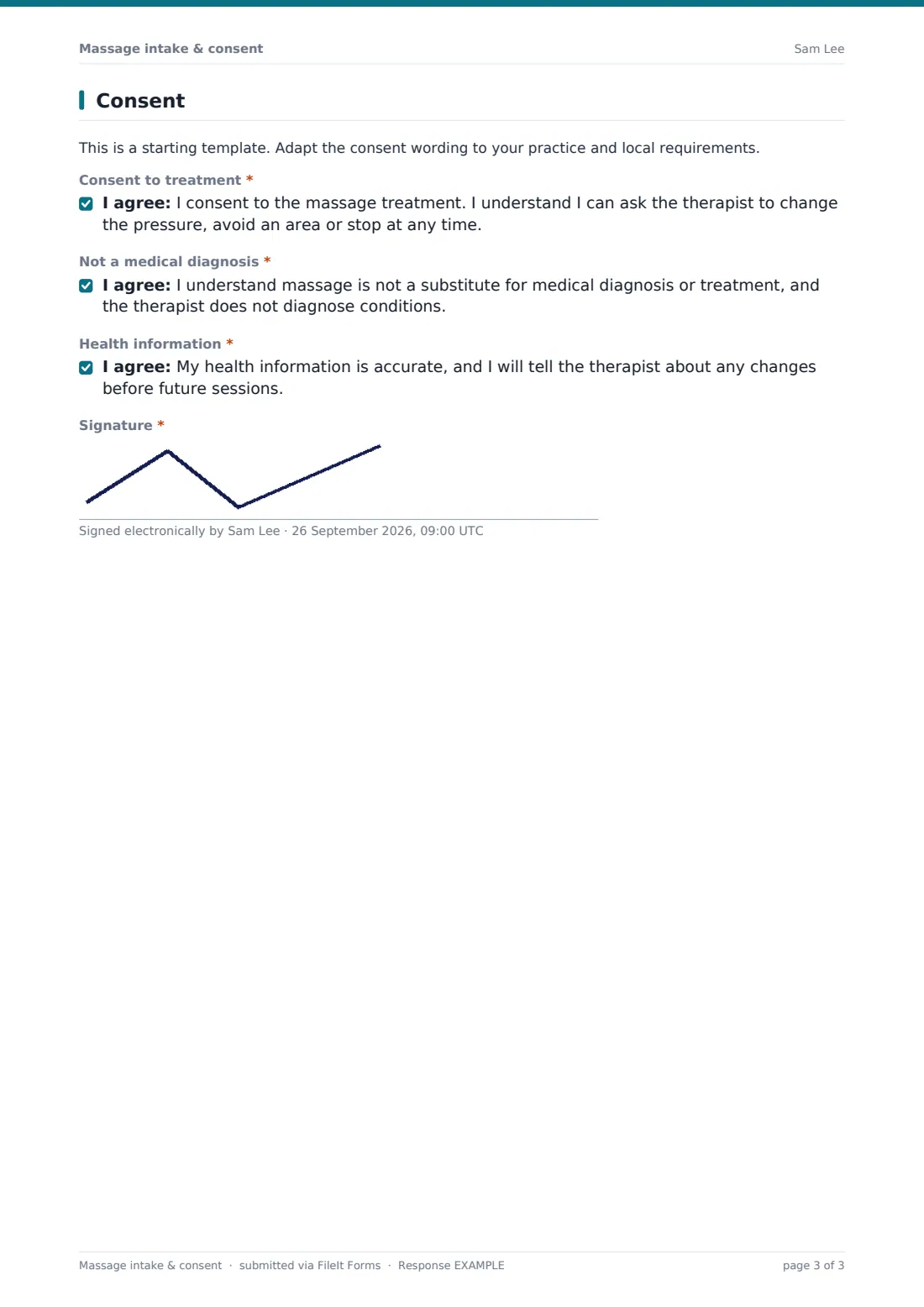
4 Consent
- Consent to treatment*
- Not a medical diagnosis*
- Health information*
- Signature*
The massage intake & consent form, page by page
1 About you
The form collects the client's name, email, mobile, date of birth, appointment date and an optional GP or doctor's name and practice — useful context if a doctor's approval is later needed for a specific condition.
2 Your session
Clients choose the type of massage — relaxation or Swedish, deep tissue, sports, pregnancy, lymphatic drainage, or "not sure, please advise" — and describe what they'd like from the session, such as relief from tight shoulders or recovery after a race. A checklist of focus areas (neck, shoulders, upper or lower back, arms, glutes, legs, feet, or full body) sits alongside an open box for any areas to avoid, a 1-5 pressure scale from very light to very firm, and an optional therapist preference.
3 Health check
A description reminds clients that some conditions mean massage should be adapted or postponed, and to answer honestly. A checklist covers common contraindications — fever or infection, a skin condition or open wound, blood clots, a heart condition or blood pressure issue, a recent injury or surgery, pregnancy, cancer, diabetes, varicose veins, osteoporosis, epilepsy, or blood thinners — or "none of these." Choosing pregnancy opens a question for how many weeks along the client is.
A further yes/no question catches anything else about the client's health the therapist should know, opening a details box that's required if anything was ticked above, and — where relevant — asking whether a doctor has approved massage for the client. Separate boxes cover allergies to oils, lotions or nuts, and current medication.
4 Consent
A note reminds practices to adapt the consent wording to their own requirements. The client then gives three separate consents: to the treatment itself, understanding they can ask the therapist to change pressure, avoid an area, or stop at any time; that massage is not a substitute for medical diagnosis and the therapist does not diagnose conditions; and that the health information given is accurate and they'll report any changes before future sessions. The form closes with a signature.
Make the template yours
- Add a question about any previous massage experience or reactions to past sessions
- Adjust the contraindications checklist to match conditions relevant to your specific modality, such as hot stone or prenatal massage
- Add a field for the specific therapist assigned, if your practice has more than one
- File completed intakes into a vault folder per client so history builds up over repeat visits
- Turn on an emailed PDF copy to the client so they have their own record of what they consented to
- Add a question about scent sensitivities if your practice uses essential oils or scented products
- Adapt the consent statements to reflect your jurisdiction's requirements for informed consent
Tips for a better massage intake & consent form
- Review the health screening before the client arrives, not during the session, so any concerns can be addressed calmly
- Ask about doctor approval for any condition where it's genuinely relevant, and keep a record of that approval on file
- Reassure clients that honest answers about sensitive health information lead to a safer, better session — not a refusal
- Update the intake at each new series of sessions rather than relying on one form from months or years earlier
- Keep the consent language plain and specific about what the client is agreeing to, rather than generic boilerplate
- Never rely on this form as a substitute for medical advice — refer clients to their doctor for anything outside your scope
Every response becomes a PDF in your vault
As soon as the client submits the intake, FileIt saves it as a signed PDF in the practice's vault, and the therapist is notified by email. If an emailed copy to the respondent is switched on, the client also receives their own PDF confirming what they submitted.
From there, most therapists review the health screening and preferences before the appointment, adjusting the session plan as needed, and use the Responses table to keep a history of intake forms for returning clients over time.
- Start from this template. It opens in the FileIt Forms designer — change any question, add pages, set the rules for when questions appear.
- Share it. Turn on a public link, or send it to people by email, each with their own link. They don’t need a FileIt account.
- Get the answers as PDFs. Each response is saved as a PDF in the vault folder you choose, with uploaded files attached — and listed in a Responses table you can export to CSV.
Massage intake & consent form: frequently asked questions
Is this massage intake and consent form template free?
Yes. It's included in FileIt's Forms app on every plan, including free, and every question can be edited to match your practice.
Does the client need a FileIt account to fill it in?
No. Share the form by public link or send it by email ahead of an appointment — clients don't need a FileIt account.
How do I get a copy of a completed intake?
Every submission is saved automatically as a PDF in your vault, and you can turn on an emailed PDF copy sent to the client as well.
Is this consent form legally sufficient on its own?
It's a starting point — adapt the wording to your own practice, modality and local requirements for informed consent before relying on it.
What happens if a client reports a contraindication like a blood clot or recent surgery?
The form opens a details box asking for more information and, where relevant, whether a doctor has approved massage, so the therapist can decide how to proceed safely.
Can a client update their intake before a later visit?
Yes — the form allows multiple responses, so clients can submit an updated intake whenever their health information changes.
Does massage replace medical treatment?
No — the consent explicitly states that massage is not a substitute for medical diagnosis or treatment, and the therapist does not diagnose conditions.