What is the home energy assessment form template?
A home energy assessment (or energy audit) looks at how a home uses energy and where it loses heat, then recommends the improvements worth making first. This template combines what the homeowner knows — heating system, bills, rooms that are always cold — with what the assessor sees on the visit.
The first two pages cover what the household knows — household details, goals, heating and hot water, controls, cooling, annual costs and any comfort problems, with an upload for recent bills — and are easiest to go through with the homeowner at the start of the visit. The assessor then rates insulation, windows, doors and draught-proofing, records glazing, lighting, older appliances, existing renewables and roof orientation, and adds photos.
The recommendations page turns all of that into a ticked list of measures, the top priorities in order, a rough cost and the no-cost changes the household can make today. It's saved to your FileIt vault as a PDF you can hand straight to the homeowner.
- Best for
- Energy assessors, retrofit coordinators, installers and homeowners
- Filled in by
- The assessor, going through pages 1–2 with the homeowner during the visit
- Time to complete
- About 10 minutes with the homeowner, then alongside the walk-round
- Includes
- Bills upload, comfort checklist, insulation grid, air-test result, photos, prioritised recommendations
Who uses a home energy assessment form?
- An energy assessor recording a walk-through audit and handing over recommendations the same day
- A heat pump or solar installer checking whether a home is ready before quoting
- A community energy group running free home assessments for residents
- A landlord assessing a rental property ahead of efficiency upgrades
- A homeowner working through their own home before asking for quotes
- A weatherization programme gathering consistent details from every household it visits
Questions on this home energy assessment form
37 questions over 4 pages · includes signature, file upload, conditional questions, multiple pages, ratings.
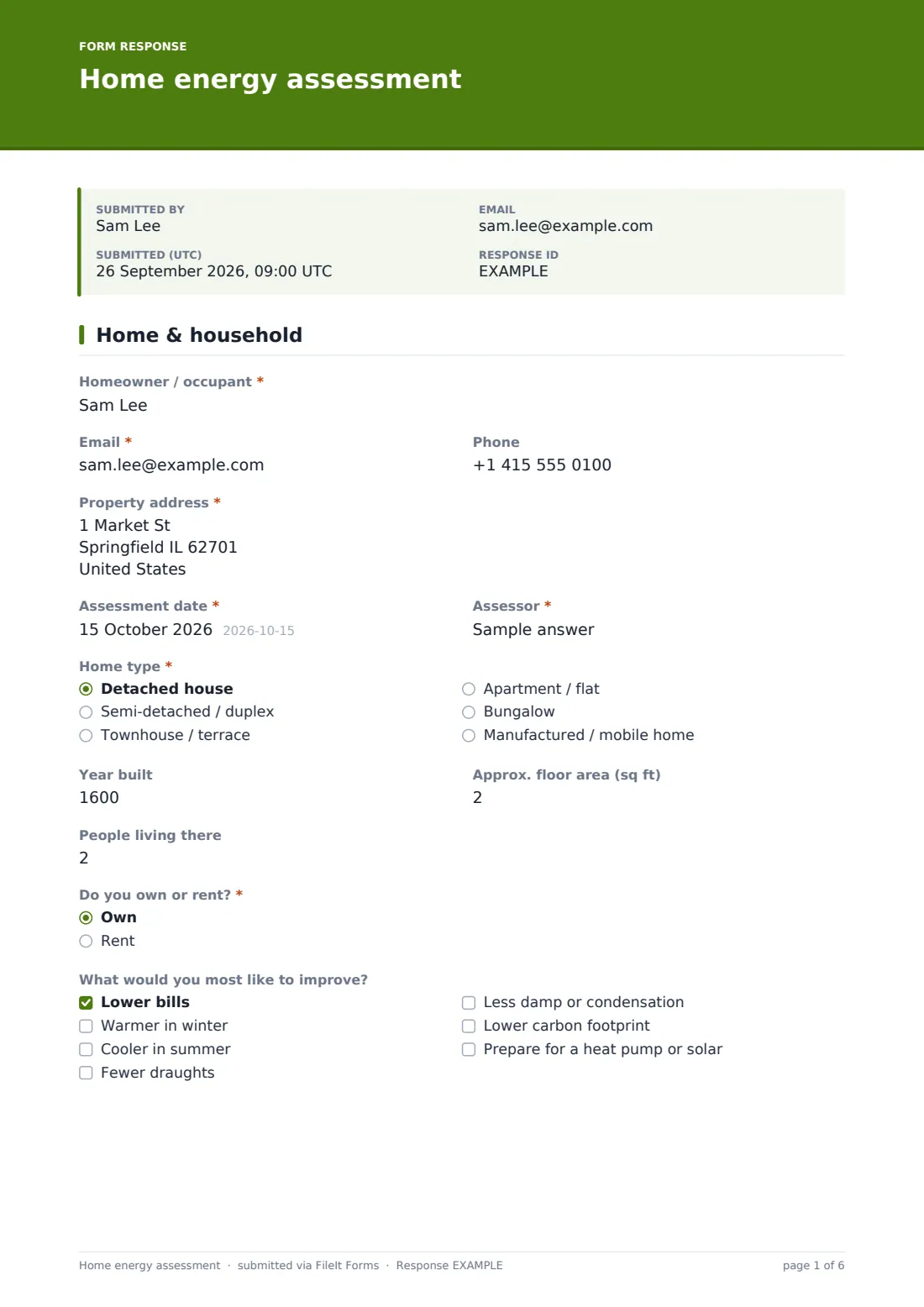
1 Home & household
- Homeowner / occupant*
- Email*
- Phone
- Property address*
- Assessment date*
- Assessor*
- Home type* Detached house · Semi-detached / duplex · Townhouse / terrace · Apartment / flat · Bungalow · Manufactured / mobile home
- Year built
- Approx. floor area (sq ft)
- People living there
- Do you own or rent?* Own · Rent
- What would you most like to improve? Lower bills · Warmer in winter · Cooler in summer · Fewer draughts · Less damp or condensation · Lower carbon footprint · Prepare for a heat pump or solar
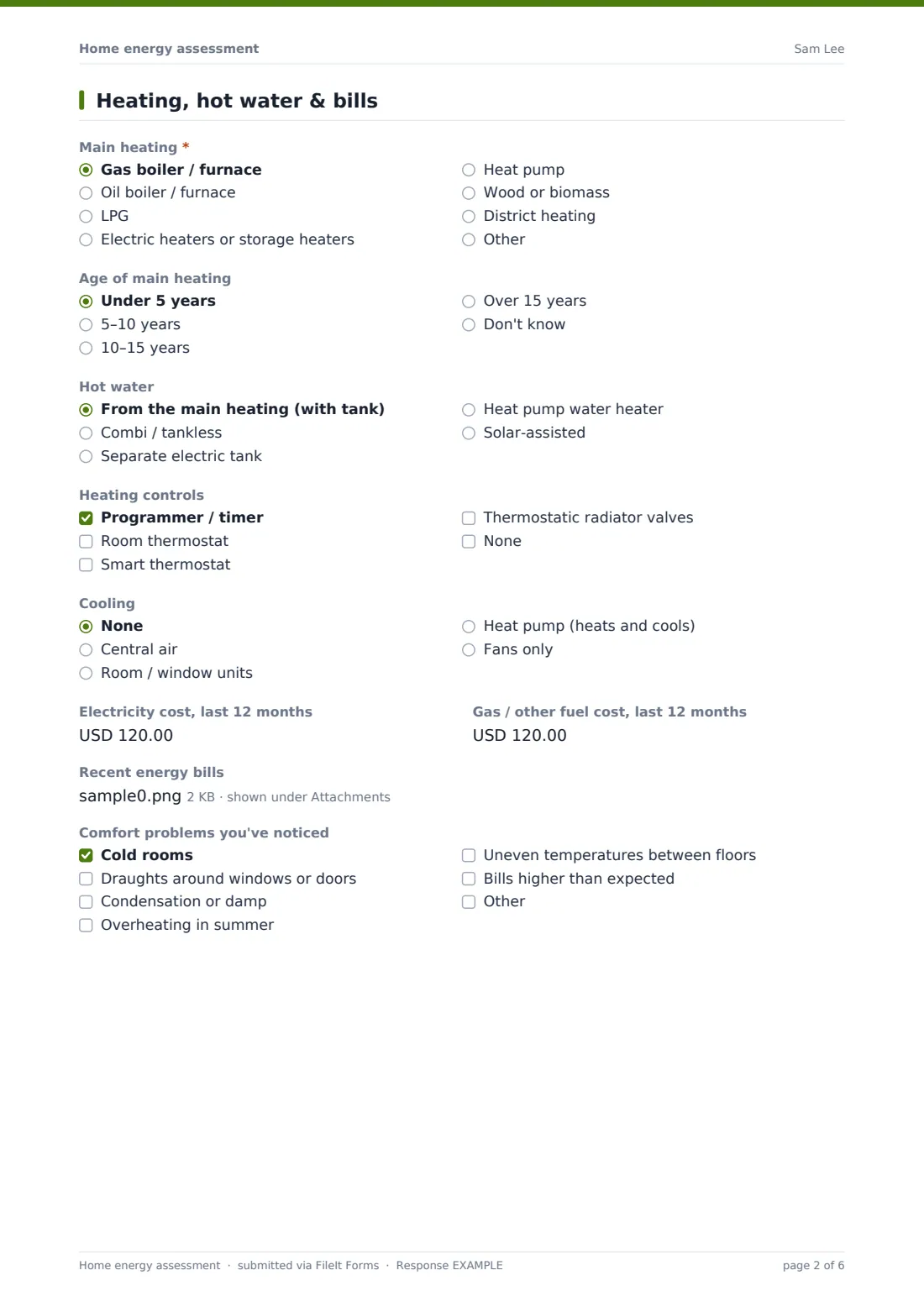
2 Heating, hot water & bills
- Main heating* Gas boiler / furnace · Oil boiler / furnace · LPG · Electric heaters or storage heaters · Heat pump · Wood or biomass · District heating · Other
- Age of main heating Under 5 years · 5–10 years · 10–15 years · Over 15 years · Don't know
- Hot water From the main heating (with tank) · Combi / tankless · Separate electric tank · Heat pump water heater · Solar-assisted
- Heating controls Programmer / timer · Room thermostat · Smart thermostat · Thermostatic radiator valves · None
- Cooling None · Central air · Room / window units · Heat pump (heats and cools) · Fans only
- Electricity cost, last 12 months
- Gas / other fuel cost, last 12 months
- Recent energy bills
- Comfort problems you've noticed Cold rooms · Draughts around windows or doors · Condensation or damp · Overheating in summer · Uneven temperatures between floors · Bills higher than expected
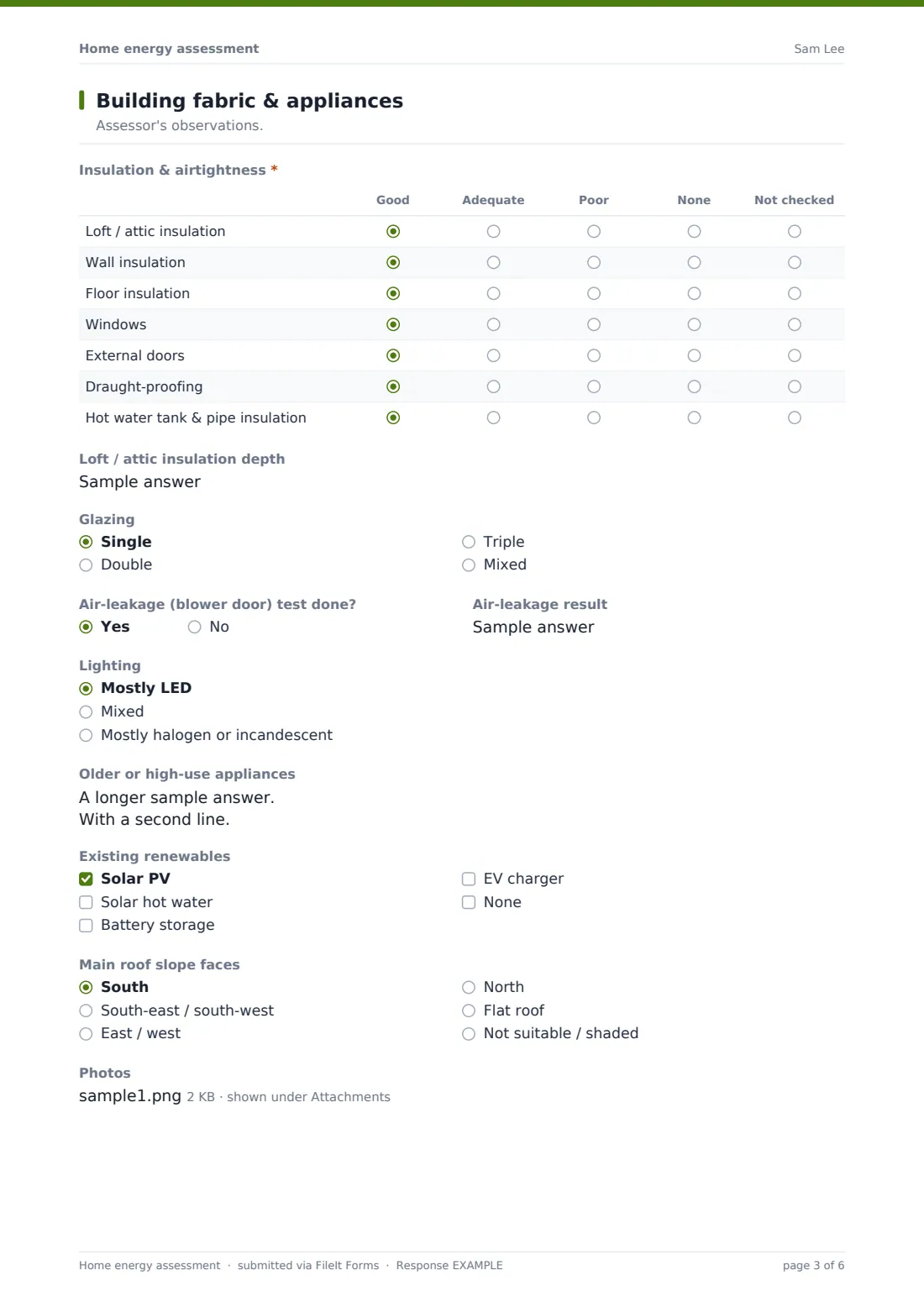
3 Building fabric & appliances
- Insulation & airtightness* Good · Adequate · Poor · None · Not checked
- Loft / attic insulation depth
- Glazing Single · Double · Triple · Mixed
- Air-leakage (blower door) test done?
- Air-leakage result asked only when it applies
- Lighting Mostly LED · Mixed · Mostly halogen or incandescent
- Older or high-use appliances
- Existing renewables Solar PV · Solar hot water · Battery storage · EV charger · None
- Main roof slope faces South · South-east / south-west · East / west · North · Flat roof · Not suitable / shaded
- Photos
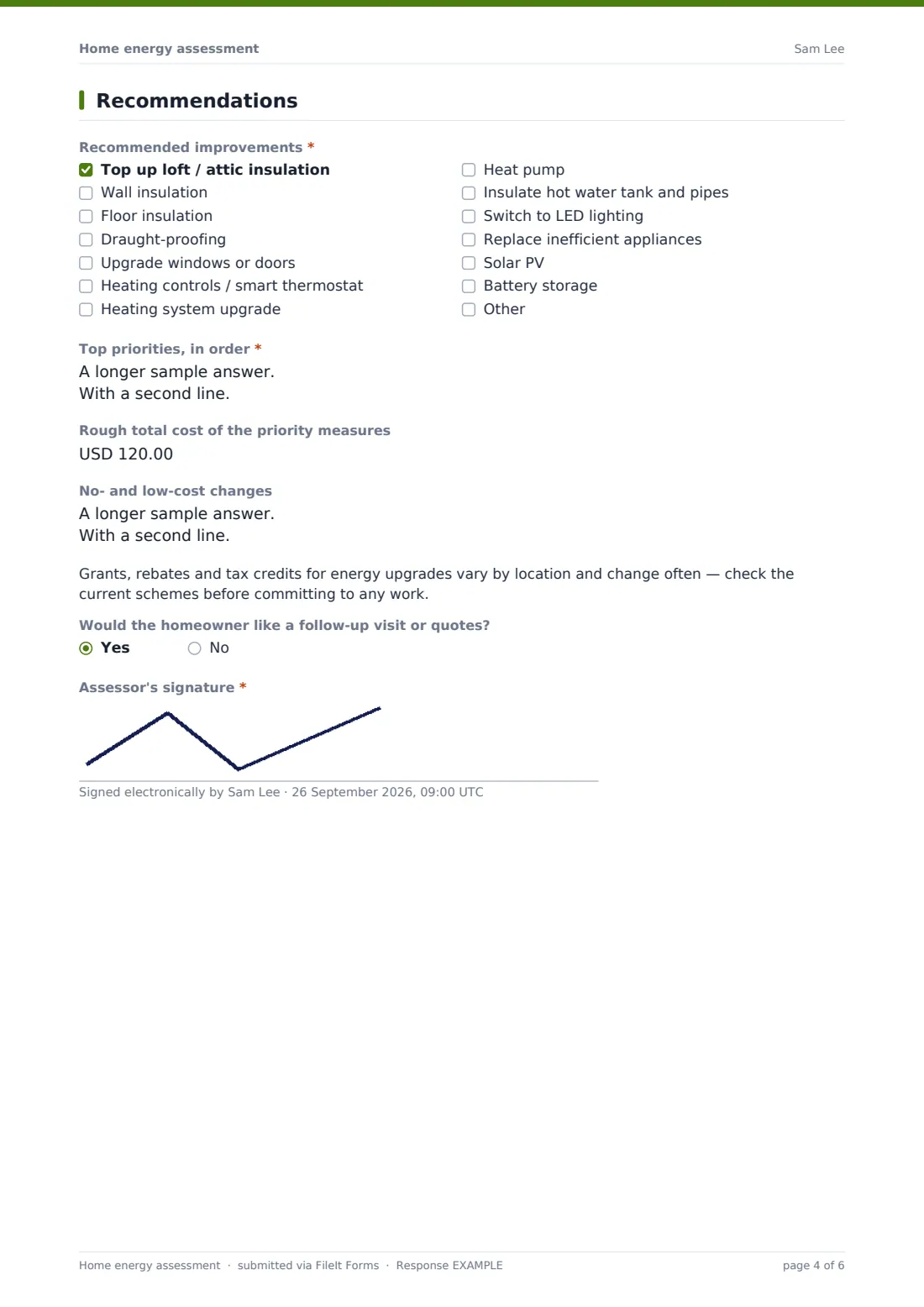
4 Recommendations
- Recommended improvements* Top up loft / attic insulation · Wall insulation · Floor insulation · Draught-proofing · Upgrade windows or doors · Heating controls / smart thermostat · Heating system upgrade · Heat pump · Insulate hot water tank and pipes · Switch to LED lighting · Replace inefficient appliances · Solar PV
- Top priorities, in order*
- Rough total cost of the priority measures
- No- and low-cost changes
- Would the homeowner like a follow-up visit or quotes?
- Assessor's signature*
The home energy assessment form, page by page
1 Home & household
Contact details, property address, assessment date and assessor, then the home type, year built, floor area and number of occupants. Renters see a note that most improvements need the landlord's permission. The homeowner can tick their goals — lower bills, warmth, fewer draughts, less damp, a lower carbon footprint or getting ready for a heat pump or solar.
2 Heating, hot water & bills
Main heating fuel and its age, hot water type, heating controls and cooling, then the last 12 months of electricity and gas or other fuel costs with an upload for bills. A checklist of comfort problems — cold rooms, draughts, condensation, overheating, uneven temperatures — shows the assessor where to look.
3 Building fabric & appliances
The assessor rates loft, wall and floor insulation, windows, doors, draught-proofing and tank and pipe insulation as Good, Adequate, Poor, None or Not checked. Loft insulation depth, glazing type and an optional air-leakage test result follow, then lighting, older appliances, existing renewables, roof orientation and up to 10 photos.
4 Recommendations
A checklist of improvements — insulation, draught-proofing, windows, controls, heating upgrades, heat pumps, LED lighting, appliances, solar and batteries — then the top priorities in order, a rough total cost and no- or low-cost changes. A note reminds everyone that grants and rebates vary by location, and the assessor signs.
Make the template yours
- Switch floor area and loft depth to the units your market uses
- Change the currency on the bill and cost fields
- Copy pages 1–2 into a separate pre-visit questionnaire if you want homeowners to answer them before you arrive
- Add fields for the local rating your programme uses, such as an energy score before and after
- Tailor the recommendations list to the measures your organisation installs or funds
- File each assessment under the household so repeat visits sit together
Tips for a better home energy assessment form
- Ask for a full year of bills — a single month hides the seasonal pattern
- Start with the comfort problems the household reports; they usually point at the biggest losses
- Fabric first: insulation and draught-proofing often make sense before changing the heating system
- Keep the priority list short — three measures a household will actually do beat ten they won't
- Photograph the loft, heating system and any damp so the homeowner can show installers
- Always include a few no-cost changes the household can make this week
Every response becomes a PDF in your vault
When the assessment is submitted, FileIt saves a PDF with every answer, the uploaded bills and photos, and the assessor's signature, files it in the vault folder you chose and notifies the form owner. The homeowner gets a copy if emailed copies are on.
Assessors can track visits in the Responses table and export to CSV for programme reporting. Quotes, grant applications and installation happen outside the form — the PDF gives installers the background they need.
- Start from this template. It opens in the FileIt Forms designer — change any question, add pages, set the rules for when questions appear.
- Share it. Turn on a public link, or send it to people by email, each with their own link. They don’t need a FileIt account.
- Get the answers as PDFs. Each response is saved as a PDF in the vault folder you choose, with uploaded files attached — and listed in a Responses table you can export to CSV.
Home energy assessment form: frequently asked questions
Is this home energy assessment template free?
Yes. It's included in the Forms app on every FileIt account, including the free plan.
Is this an official energy rating or certificate?
No. It's a practical assessment record. Official ratings and certificates follow their own methods and must be produced by accredited assessors where they're required.
Can the homeowner fill in part of it before the visit?
Not on this form — one submission covers the whole assessment, including the assessor's required ratings and recommendations. Go through pages 1 and 2 with the homeowner at the start of the visit, or copy them into a separate pre-visit form and send that link first.
Does it calculate savings?
No. It records the recommendations and a rough cost; savings estimates depend on tools and data outside the form.
Can I upload energy bills?
Yes — up to 6 PDFs or photos of bills.
Does it tell me which grants I qualify for?
No. A note reminds everyone to check current local grants, rebates and tax credits, which change often.