What is the home care assessment form template?
Working out what care someone needs at home usually means asking about several different things at once: how they get around, how much help they need with washing, dressing and meals, whether the home itself is safe, and how often and when support should happen. This home care assessment template gathers all of that in one structured form, whether it's completed by the person themselves, a family member, or a health or care professional on their behalf.
An online form works well here because it can be filled in gradually rather than in a single rushed visit — the cover note itself says to answer what you can and go through the rest together. Conditional logic keeps it relevant: falls detail and dietary detail only expand when needed, so the form stays focused on the person.
The completed, signed assessment becomes a PDF in your FileIt vault the moment it's submitted, giving a care coordinator a single, private starting point to plan the right level of support before their first home visit.
- Best for
- Home care and domiciliary care providers, and families arranging care
- Filled in by
- The person needing care, a family member, or a care professional
- Time to complete
- About 10 minutes
- Includes
- An activities-of-daily-living matrix, a home safety checklist, care preferences
Who uses a home care assessment form?
- A family arranges home care assessment for an elderly parent living alone
- A care agency completes an initial assessment before assigning a carer
- A hospital discharge team gathers home details ahead of a client returning home
- A person completes their own assessment ahead of arranging support for themselves
- A care coordinator identifies home safety hazards, like poor lighting or loose rugs, before care starts
- A family requests carer preferences, such as language spoken, as part of the assessment
Questions on this home care assessment form
27 questions over 5 pages · includes signature, conditional questions, multiple pages, consent checkbox, ratings.
1 About the person
- Name of the person needing care*
- Their date of birth
- Who is completing this form?* The person themselves · A family member or friend · A health or care professional
- Your name and relationship or role* asked only when it applies
- Contact email*
- Contact phone*
- Where care will be provided*
- Living situation Lives alone · Lives with a partner or family · Lives with others (e.g. shared house)
2 Mobility & personal care
- Getting around* Independent · Uses a stick or frame · Uses a wheelchair · Needs one person to help · Needs two people or equipment such as a hoist
- Any falls in the last 12 months?*
- What happened, and how often? asked only when it applies
- How much help is needed with… No help · Some help · Full help · Not applicable
3 Meals & household
- Meals Prepares own meals · Needs reminding or some help · Needs meals prepared · Needs help to eat
- Dietary needs Diabetic · Soft or pureed food · Vegetarian or vegan · Food allergy or intolerance · Cultural or religious diet
- Food likes, dislikes and allergies asked only when it applies
- Which household tasks need support? Shopping · Cleaning · Laundry · Post and bills · Getting to appointments · Pet care · Company and outings
4 Home safety
- Which of these are in place at home? Working smoke alarms · Carbon monoxide alarm · Grab rails · Secure stair rails · Good lighting, including at night · Clear walkways (no loose rugs or cables) · Personal alarm · Key safe · Working heating
- Any hazards or concerns in the home?
- Access instructions for carers
- Are there pets in the home?
- What pets? asked only when it applies
5 Care wanted
- How often is care needed?* A few times a week · Once a day · Several times a day · Live-in or overnight · Not sure yet
- Preferred start date
- Preferred times of day Morning · Lunchtime · Teatime · Evening · Overnight
- Preferences for carers
- Sharing information*
- Signature*
The home care assessment form, page by page
1 About the person
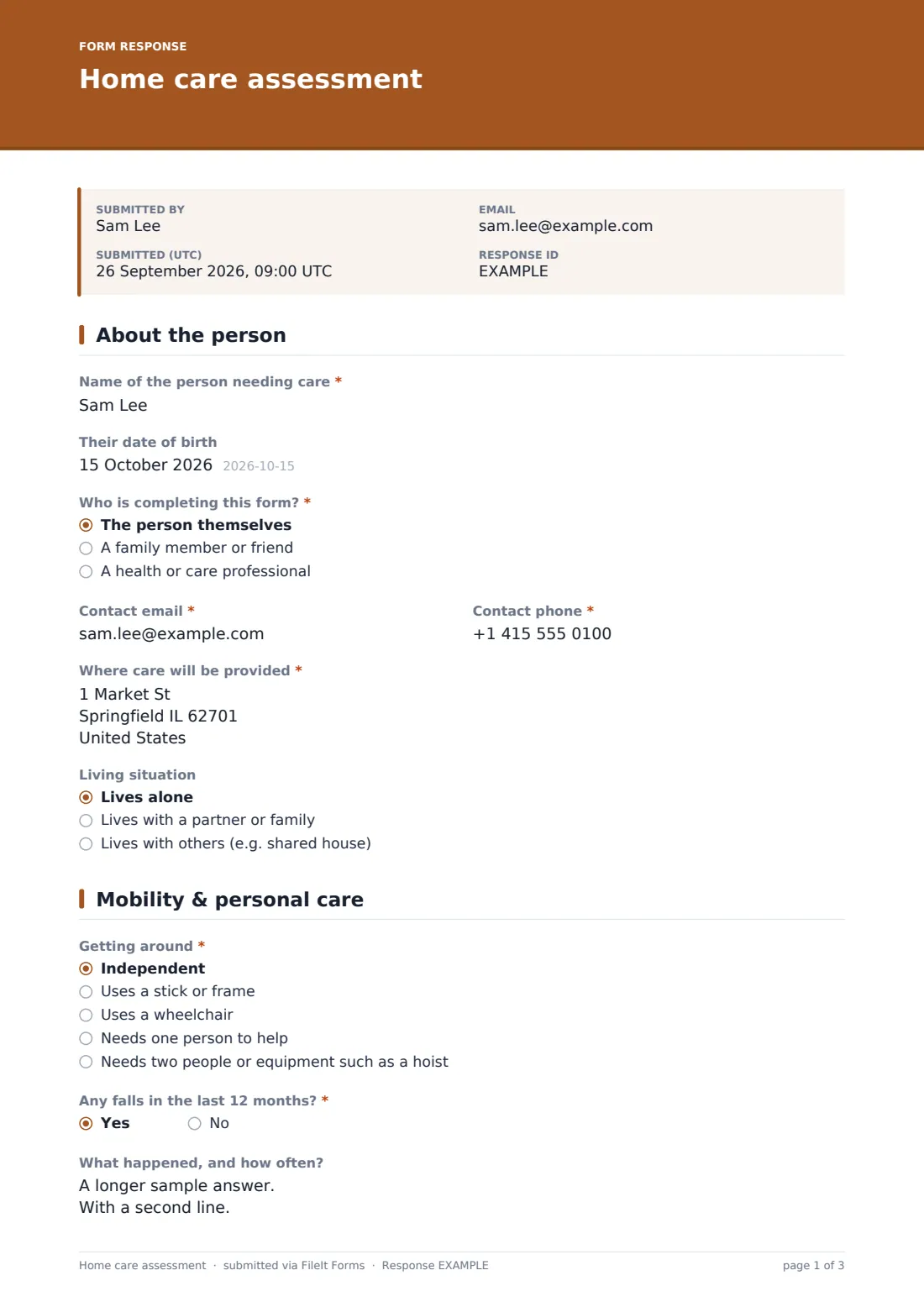
The assessment opens with Name of the person needing care, an optional Date of birth, and Who is completing this form — the person themselves, a family member or friend, or a health or care professional — with anyone other than the person themselves giving their own name and relationship or role. A Contact email and phone, Where care will be provided, and an optional Living situation (alone, with a partner or family, or with others) set the scene.
2 Mobility & personal care
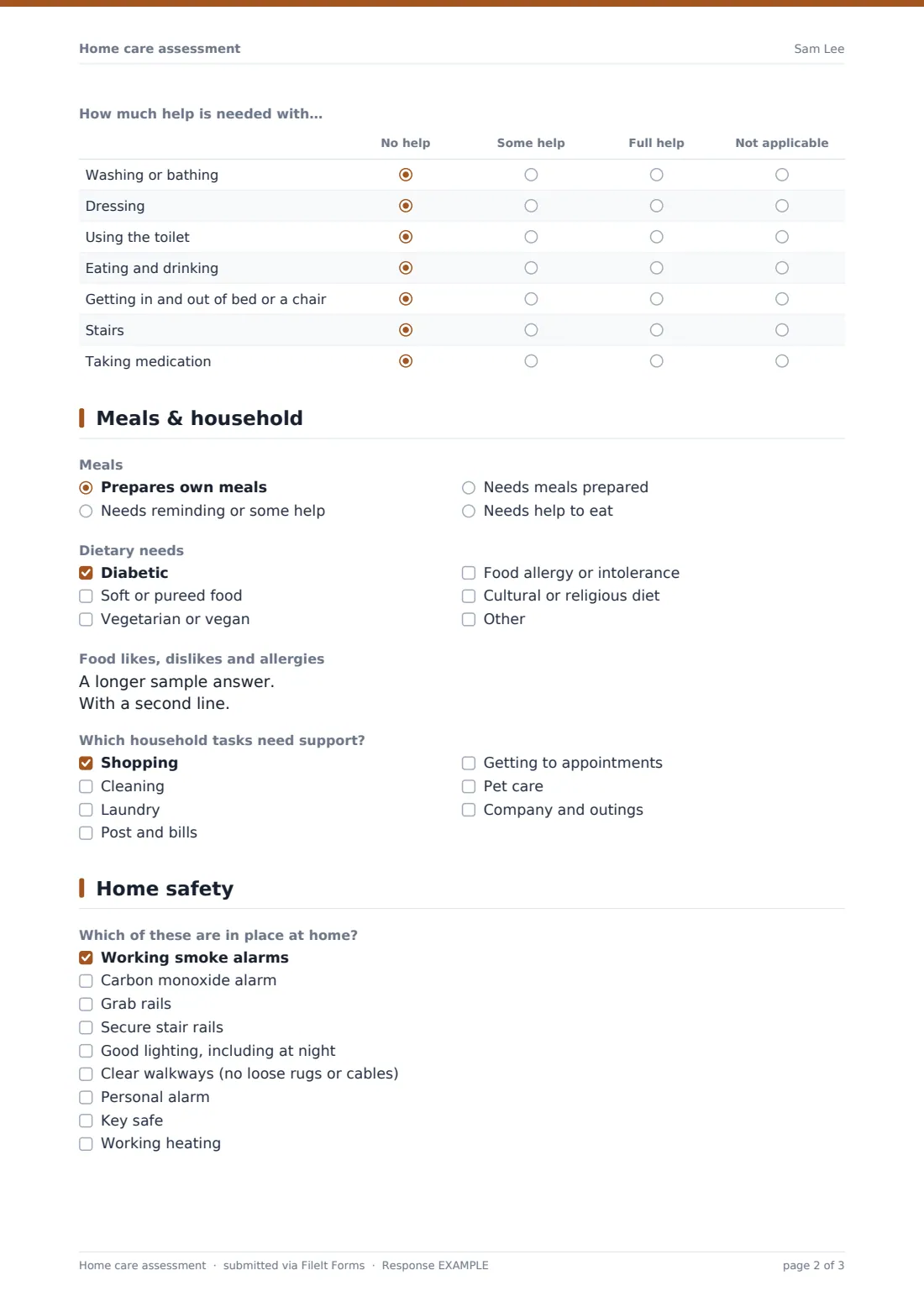
A required Getting around choice ranges from independent through using an aid or wheelchair, to needing one or two helpers. A required yes/no on falls in the last 12 months reveals a box for what happened. A matrix then rates how much help is needed with washing, dressing, the toilet, eating, transfers, stairs and medication, as no help, some help, full help or not applicable.
3 Meals & household
A Meals question (prepares own, needs reminding, needs meals prepared, or needs help to eat) sits alongside a Dietary needs checklist — diabetic, soft or pureed food, vegetarian or vegan, allergy or intolerance, or a cultural or religious diet — which, if any box is ticked, reveals a box for likes, dislikes and allergies. A separate checklist covers which household tasks need support, from shopping and cleaning to appointments and company.
4 Home safety
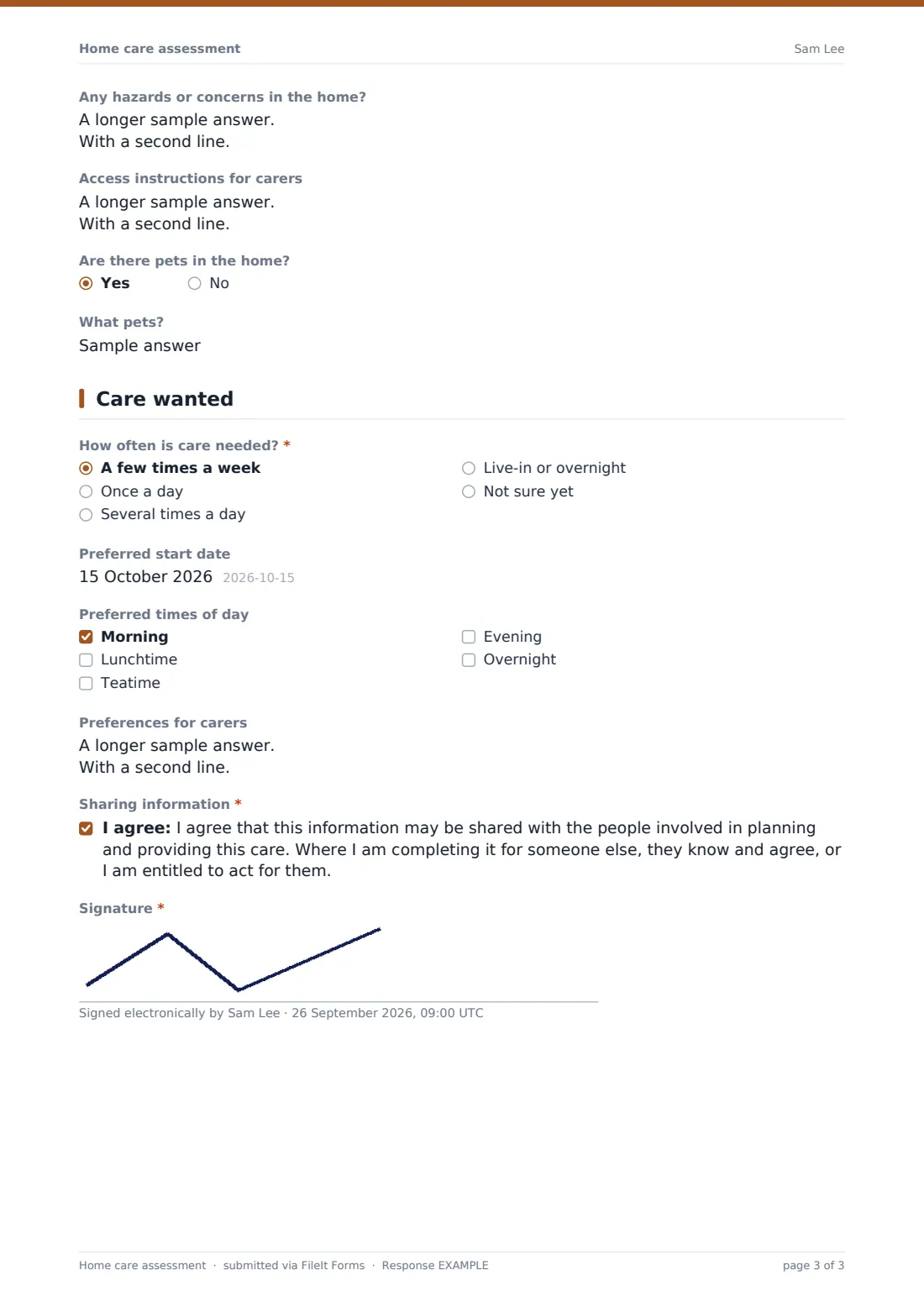
A checklist covers what's already in place — smoke and carbon monoxide alarms, grab rails, secure stair rails, good lighting, clear walkways, a personal alarm, a key safe and working heating — plus an optional box for hazards such as steep stairs. Access instructions for carers cover parking and which door to use, with a note not to write key safe codes here, and a yes/no on pets reveals what pets are in the home.
5 Care wanted
How often is care needed, a Preferred start date, and Preferred times of day set out the shape of the support. An optional Preferences for carers box covers language, gender or cultural and faith needs. A consent statement confirms the information may be shared with those providing care, and that anyone completing it on the person's behalf either has their agreement or is entitled to act for them, closed with a signature.
Make the template yours
- Adjust the activities-of-daily-living matrix rows to match your own assessment framework
- Add a question about existing care packages or other services already in place
- Set the vault folder per client so each person's assessment and any later reviews sit together
- Add a risk-rating field if your organisation scores home safety hazards formally
- Turn on a follow-up reminder to reassess after a set period, since needs often change over time
- Add fields for GP or key contact details if your service liaises directly with healthcare providers
Tips for a better home care assessment form
- Reassure whoever is completing the form that it's fine to leave a question blank and go through it together later
- Take home safety answers seriously and follow up on hazards like loose rugs or poor lighting promptly
- Keep access instructions practical and specific, and never store key safe codes directly in the form
- Revisit the assessment periodically rather than treating it as a one-time document, since care needs change
- This assessment supports care planning; it isn't a medical diagnosis, so involve a qualified professional for any clinical decisions
Every response becomes a PDF in your vault
As soon as the assessment is submitted and signed, FileIt saves it as a PDF in the vault folder you've set up for that client, and your care coordination team gets an immediate email notification so a home visit can be arranged without delay.
Coordinators typically review the Responses table to plan the right level and timing of support, and refer back to the home safety section when briefing carers. Because the assessment is stored as a signed PDF, it stays as a clear starting record later reviews can be compared against.
- Start from this template. It opens in the FileIt Forms designer — change any question, add pages, set the rules for when questions appear.
- Share it. Turn on a public link, or send it to people by email, each with their own link. They don’t need a FileIt account.
- Get the answers as PDFs. Each response is saved as a PDF in the vault folder you choose, with uploaded files attached — and listed in a Responses table you can export to CSV.
Home care assessment form: frequently asked questions
Is this home care assessment form template free?
Yes, it's included in the Forms app on every FileIt account, including the free plan, and every question can be edited.
Does the person needing care need a FileIt account to complete it?
No. Anyone completing it — the person themselves, a family member or a professional — fills it in and signs it from a shared link, with no account needed.
How do we get completed assessments as PDFs?
Every submission, including the signature, is automatically saved as a PDF in the vault folder you set up for this form.
Can a family member complete this assessment on someone else's behalf?
Yes — the form asks who is completing it, and the final consent statement covers completing it for someone else with their knowledge or on their behalf.
Does this assessment replace a professional care needs assessment?
No — it's a structured starting point to inform care planning. A qualified care or health professional should still be involved in any clinical or funding decisions.
What kind of home safety questions does the form ask?
It checks for things like working smoke alarms, grab rails, lighting, clear walkways and a personal alarm, and leaves room to note any hazards or concerns.
Can we request this assessment be updated over time?
Yes — since the form allows multiple responses, you can ask a client or family to resubmit it periodically as needs change.