What is the falls risk assessment form template?
Falls are rarely down to one cause. A useful assessment looks at the person's history, how they walk, their health and medicines, and where they live, and ends with a plan they agree to. This template follows that order and keeps the whole assessment in one signed record.
Questions adapt as you go: falls in the last year open questions about how they happened, injuries and whether the person could get up. The assessor records walking aid and balance, an optional Timed Up and Go result, health factors and medicines known to raise risk. The home hazards checklist appears when the assessment is in the person's own home, and any setting has room for environment notes.
The assessment closes with an overall risk level, agreed actions, the person's agreement and a review date, saved as a PDF in your FileIt vault.
- Best for
- Community nurses, occupational therapists, physiotherapists, care homes and home care providers
- Filled in by
- The assessor, with the person
- Time to complete
- About 15 minutes
- Includes
- Falls history follow-ups, Timed Up and Go field, risk medicines, home hazards, actions and review date
Who uses a falls risk assessment form?
- Assessment after a fall at home
- Admission assessment in a care home
- Home care onboarding for an older client
- Hospital discharge planning
- Annual review for people at known risk
- Falls prevention clinics and exercise programmes
Questions on this falls risk assessment form
30 questions over 5 pages · includes signature, conditional questions, multiple pages.
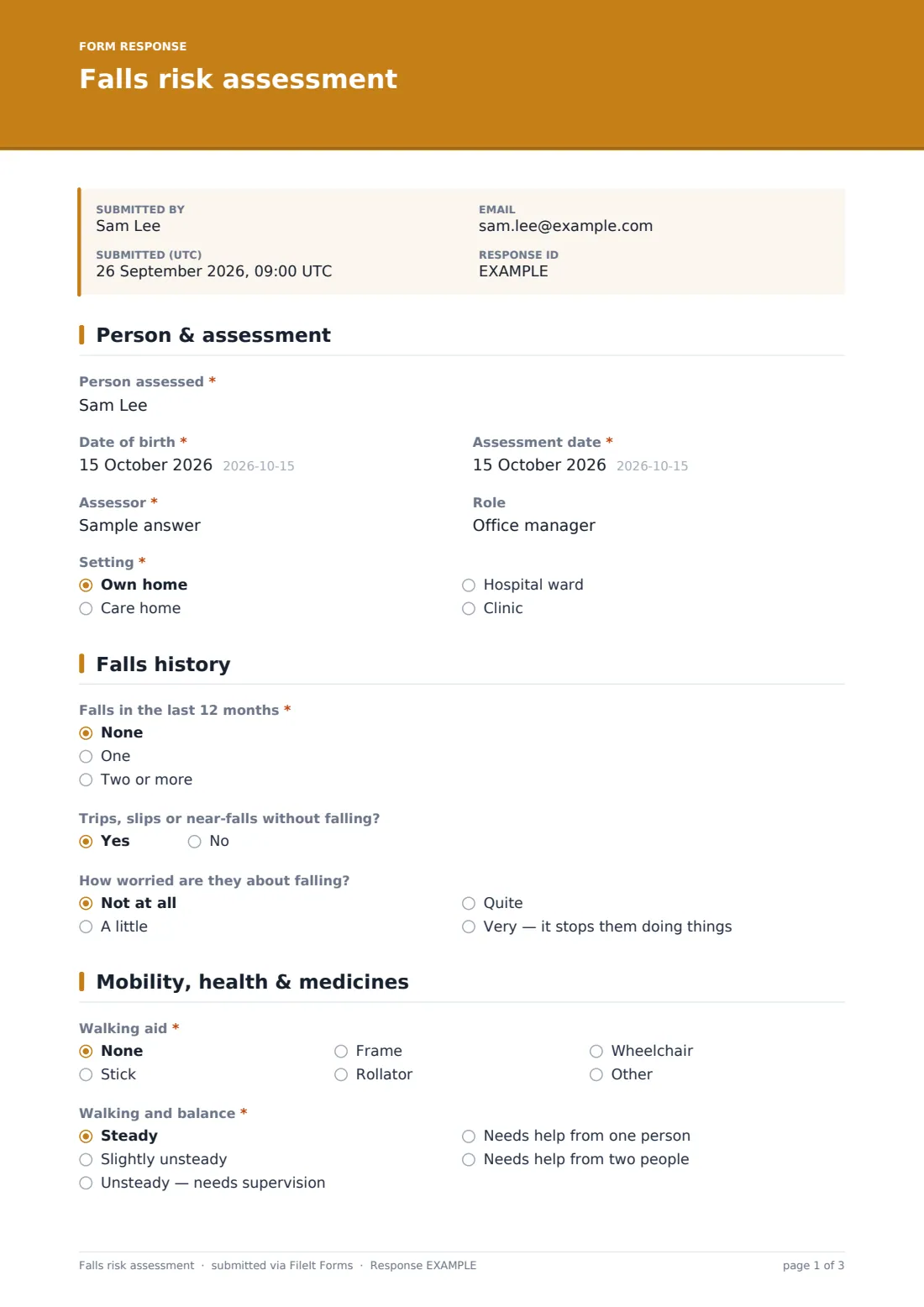
1 Person & assessment
- Person assessed*
- Date of birth*
- Assessment date*
- Assessor*
- Role
- Setting* Own home · Care home · Hospital ward · Clinic
2 Falls history
- Falls in the last 12 months* None · One · Two or more
- When, where and how did they happen? asked only when it applies
- Any injury from a fall? asked only when it applies
- Unable to get up without help, or on the floor for over an hour? asked only when it applies
- Trips, slips or near-falls without falling?
- How worried are they about falling? Not at all · A little · Quite · Very — it stops them doing things
3 Mobility, health & medicines
- Walking aid* None · Stick · Frame · Rollator · Wheelchair
- Walking and balance* Steady · Slightly unsteady · Unsteady — needs supervision · Needs help from one person · Needs help from two people
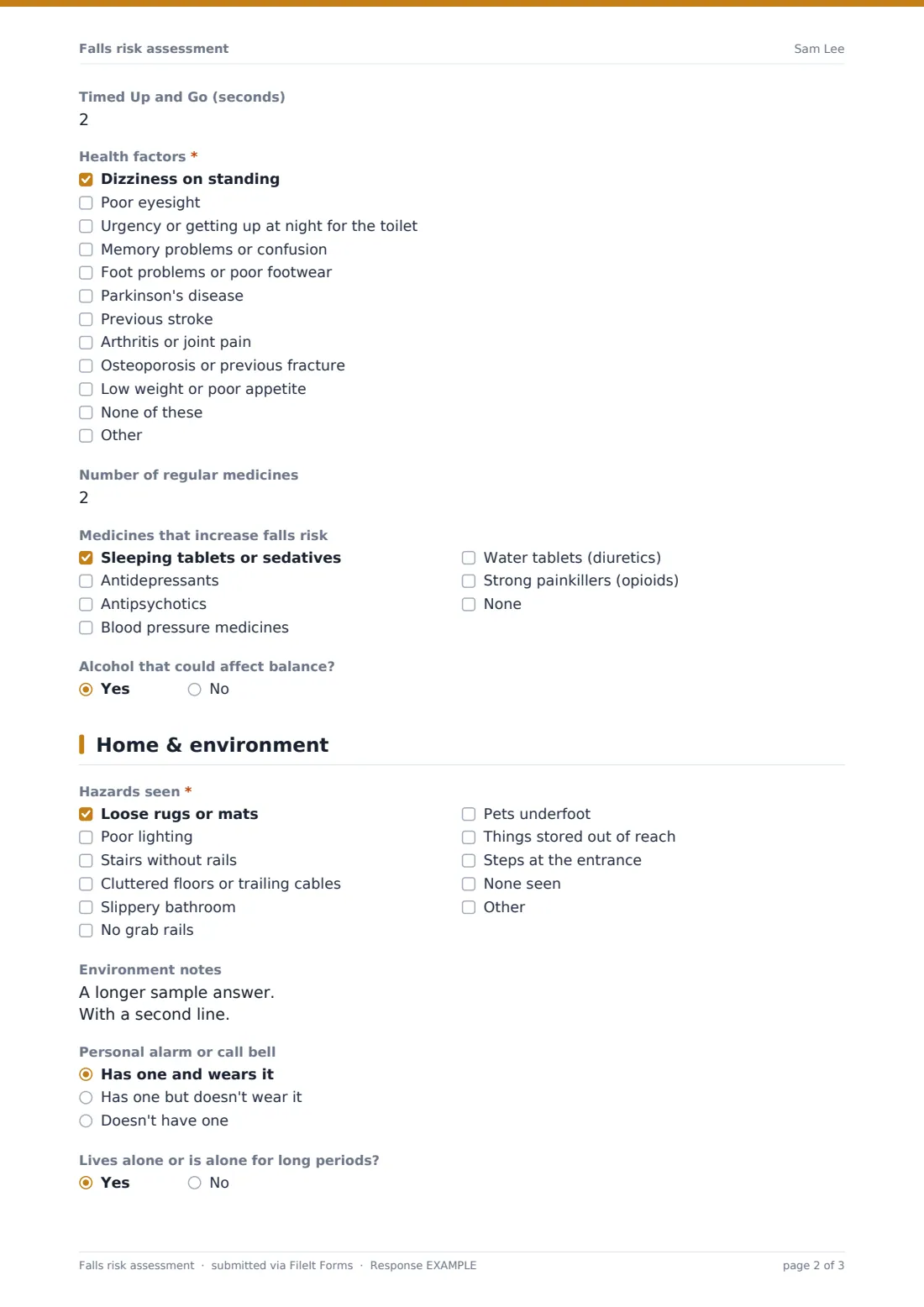
- Timed Up and Go (seconds)
- Health factors* Dizziness on standing · Poor eyesight · Urgency or getting up at night for the toilet · Memory problems or confusion · Foot problems or poor footwear · Parkinson's disease · Previous stroke · Arthritis or joint pain · Osteoporosis or previous fracture · Low weight or poor appetite · None of these
- Number of regular medicines
- Medicines that increase falls risk Sleeping tablets or sedatives · Antidepressants · Antipsychotics · Blood pressure medicines · Water tablets (diuretics) · Strong painkillers (opioids) · None
- Alcohol that could affect balance?
4 Home & environment
- Hazards seen* asked only when it applies Loose rugs or mats · Poor lighting · Stairs without rails · Cluttered floors or trailing cables · Slippery bathroom · No grab rails · Pets underfoot · Things stored out of reach · Steps at the entrance · None seen
- Environment notes
- Personal alarm or call bell Has one and wears it · Has one but doesn't wear it · Doesn't have one
- Lives alone or is alone for long periods?
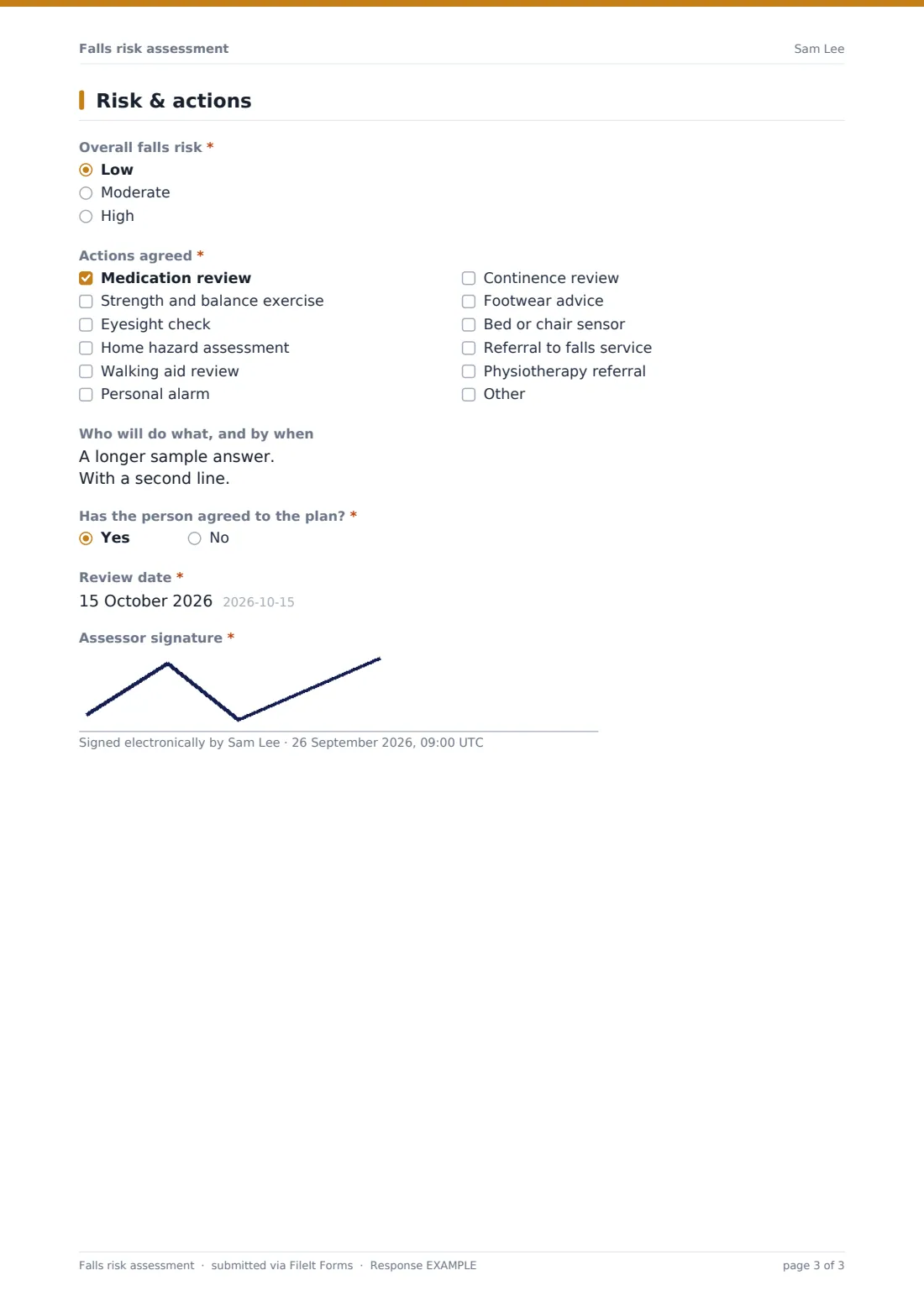
5 Risk & actions
- Overall falls risk* Low · Moderate · High
- Actions agreed* Medication review · Strength and balance exercise · Eyesight check · Home hazard assessment · Walking aid review · Personal alarm · Continence review · Footwear advice · Bed or chair sensor · Referral to falls service · Physiotherapy referral
- Who will do what, and by when
- Has the person agreed to the plan?*
- Their views and what was agreed instead asked only when it applies
- Review date*
- Assessor signature*
The falls risk assessment form, page by page
1 Person & assessment
Name and date of birth of the person assessed, the assessment date, assessor and role, and the setting — own home, care home, hospital ward or clinic.
2 Falls history
Falls in the last 12 months. If any, how they happened, whether they caused injury, and whether the person was unable to get up without help or lay on the floor for over an hour. Near-falls and how worried they are about falling.
3 Mobility, health & medicines
Walking aid and balance, an optional Timed Up and Go in seconds, a checklist of health factors from dizziness and eyesight to osteoporosis, the number of regular medicines, medicines that raise falls risk and alcohol.
4 Home & environment
A hazards checklist for home assessments, notes on any environment, personal alarm use, and whether the person lives or is often alone.
5 Risk & actions
Overall risk — low, moderate or high — agreed actions such as medication review, strength and balance exercise, eyesight check or referral, who will do what by when, whether the person agrees (with their views if not), a review date and the assessor's signature.
Make the template yours
- Add the scoring tool your organisation uses as extra questions
- Rename the actions to match your local services and referral routes
- Remove the Timed Up and Go field if you don't use it
- Add a photo upload for home hazards
- File assessments into each person's folder
- Notify the care coordinator when risk is high
Tips for a better falls risk assessment form
- Ask about falls directly — people often don't mention them
- Watch the person walk and stand rather than relying on what they say
- A medication review is one of the most useful actions for many people
- Agree actions with the person, not for them
- Reassess after any new fall, not just on the review date
Every response becomes a PDF in your vault
The signed assessment is saved as a PDF in your FileIt vault and the people you choose are emailed.
Use the Responses table to find high-risk assessments and upcoming review dates.
- Start from this template. It opens in the FileIt Forms designer — change any question, add pages, set the rules for when questions appear.
- Share it. Turn on a public link, or send it to people by email, each with their own link. They don’t need a FileIt account.
- Get the answers as PDFs. Each response is saved as a PDF in the vault folder you choose, with uploaded files attached — and listed in a Responses table you can export to CSV.
Falls risk assessment form: frequently asked questions
Is this falls risk assessment free?
Yes. It's part of FileIt's Forms app on every account, including the free plan.
Is it a validated scoring tool?
No. It's a structured assessment record. The assessor judges the overall risk; add your organisation's scoring tool if you use one.
Does the home hazards checklist always show?
It shows when the setting is the person's own home. Environment notes are available in every setting.
Can I record a Timed Up and Go test?
Yes, as an optional number of seconds.
What if the person disagrees with the plan?
Answer No to agreement and record their views and what was agreed instead.
Where are completed assessments stored?
Each one is saved as a PDF in your FileIt vault.