What is Death Notice J294?
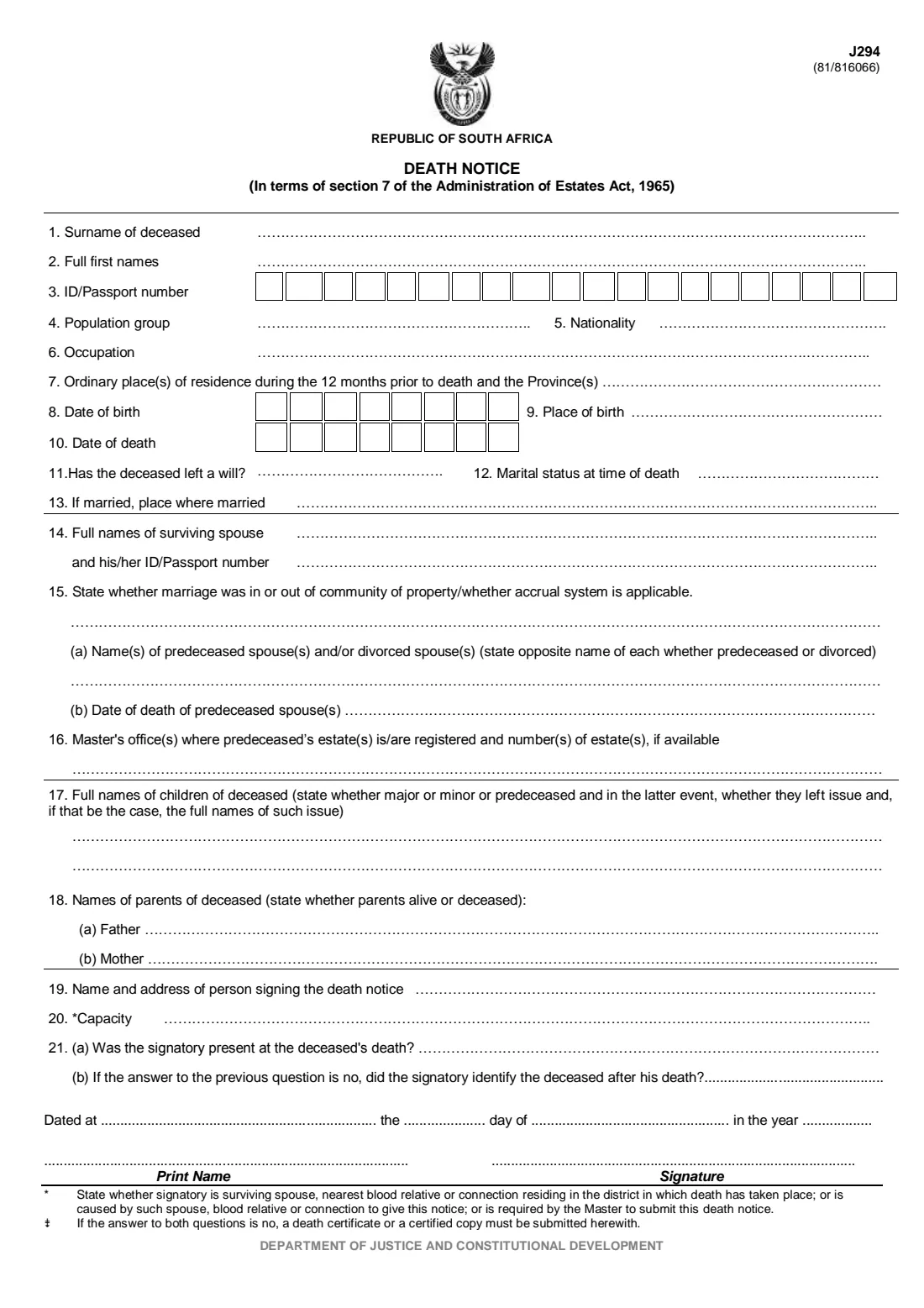
The J294 Death Notice is the form, made under section 7 of the Administration of Estates Act, 1965, that reports a person's death and their estate to the Master of the High Court. It records who the deceased was, whether they left a will, their marriage and property regime, their children and parents, and who is giving the notice.
The Master's office says an estate must be reported by an interested party within 14 days of the death, to the Master's office in whose area the deceased normally lived. The death notice is required whatever the size of the estate — both for estates above R250 000, which need letters of executorship, and for smaller estates, where the Master may issue letters of authority instead.
FileIt asks each question in plain language and prints your answers into the Department of Justice's own J294 PDF, including the 13-digit ID and the dates in their boxes. You print and sign it, then lodge it with the rest of the reporting documents.
- Who fills it
- The surviving spouse, nearest relative or another interested person (the informant)
- Lodged with
- The Master of the High Court, or a Master's service point at a Magistrate's Office
- Deadline
- Within 14 days of the date of death
- Signatures
- The informant signs and prints their name at the bottom
- Pages
- 1
- Agency
- Department of Justice and Constitutional Development — Master of the High Court
Who needs to fill out Death Notice J294?
- The surviving spouse or life partner of someone who has died in South Africa.
- A child, parent, brother or sister or other close relative reporting a family member's estate.
- A person nominated as executor in the will, or anyone holding the deceased's property or will.
- Families reporting an estate of any size — the J294 is on the Master's document list for estates both above and below R250 000.
When to use Death Notice J294
- After someone dies, to report their estate to the Master — the Master's office says within 14 days of the death.
- Together with the death certificate, inventory (J243), any original will and the other reporting documents.
- When the Master asks you to submit a death notice for an estate.
What you need before you start
- The deceased's full names, surname and 13-digit ID number (or passport number).
- Their date and place of birth, date of death, nationality and occupation.
- Where they normally lived in the 12 months before death, and the province.
- Whether there is a will, their marital status, where they married, and the surviving spouse's names and ID number.
- Whether the marriage was in or out of community of property, and whether the accrual system applies.
- Names of any predeceased or divorced spouses, and where a predeceased spouse's estate was registered.
- Full names of every child (major, minor or predeceased) and of the deceased's parents.
- Your own name, address and relationship to the deceased.
What’s on Death Notice J294
The 2013 edition has 1 page. FileIt asks for it in 4 parts, and it is signed by Person reporting the death:
- Questions 1–10: The deceasedPerson reporting the death
- Questions 11–16: Will and marriagePerson reporting the death
- Questions 17–18: Children and parentsPerson reporting the death
- Questions 19–21: Person signing the death noticePerson reporting the death
How to fill out Death Notice J294, step by step
1 Questions 1–10: The deceased
Enter the surname and all first names exactly as on the ID document, then the ID or passport number — one character per box. Population group, nationality and occupation follow. Question 7 asks where the deceased ordinarily lived in the last 12 months and the province(s); this decides which Master's office deals with the estate. Dates of birth and death print in the eight boxes as year, month and day.
2 Questions 11–15: Will and marriage
Say whether the deceased left a will — if so, the original must be lodged with the Master. Give the marital status at death; if married, where the marriage took place, the surviving spouse's full names and ID number, and whether the marriage was in or out of community of property and whether the accrual system applies.
Question 15(a) lists any spouse who died earlier or was divorced from the deceased, marked "predeceased" or "divorced", with the dates of death of any predeceased spouse.
3 Question 16: Earlier estates
If a predeceased spouse's estate was reported, give the Master's office and the estate number, if you have it.
4 Questions 17–18: Children and parents
List the full names of all the deceased's children, saying for each whether they are a major, a minor or predeceased — and for a predeceased child, whether they left children of their own, with those children's full names. Then give the father's and mother's names and whether each is alive or deceased.
5 Questions 19–21: You, the informant
Give your name and address and your capacity — for example surviving spouse, son or nominated executor. Say whether you were present at the death and, if not, whether you identified the deceased afterwards. The form notes that if both answers are no, a death certificate or certified copy must be submitted with it. Finish with the place and date, then print your name and sign.
Common mistakes to avoid
- Waiting too long — the Master's office says the estate must be reported within 14 days of the death.
- Lodging the J294 on its own. The Master's list also includes the death certificate, the inventory (J243), any original will and, where there is no valid will, the next-of-kin affidavit (J192).
- Leaving out children who have died without saying whether they left children of their own.
- Not stating whether a parent is alive or deceased in question 18.
- Getting the ID number wrong or leaving out a first name, so the details don't match the death certificate.
- Faxing the documents — the Master's office says faxed reporting documents are not accepted.
After you fill it out
Sign the notice and lodge it with the other reporting documents at the Master's office for the area where the deceased lived (the Master's office also lists online reporting). The documents must be posted to or handed in at the Master's office; faxes are not accepted. Magistrates' Offices act as service points only where there is no valid will and the estate is below R125 000 in areas without PEAS.
For an estate above R250 000 the Master's list adds the J243 inventory, the J192 next-of-kin affidavit if there is no valid will, nominations for executor and the J190 acceptance of trust. For a smaller estate it adds the J243 inventory with proof of values, a list of creditors if any, and the J155 acceptance of Master's directions.
The Master opens a file, an examiner checks the documents, and the will (if any) is considered. FileIt keeps a copy of the completed notice in the deceased's vault folder alongside the death certificate.
Fill out Death Notice J294 online with FileIt
- Pick the person. Choose someone from People and FileIt fills in their name, date of birth, address and other details it already knows.
- Answer plain-language questions. One part of the form at a time, with the official help text beside each question — 32 fields in all. Your answers save as you go.
- Check the live preview. Watch your answers land on the real Department of Justice and Constitutional Development — Master of the High Court form, and let FileIt do any worksheet arithmetic.
- Generate the official PDF. FileIt prints your answers into the agency’s own PDF and files it in that person’s folder in your vault. Sign it, or send it for e-signature.
FileIt fills the form — it never files or submits anything for you. Deliver the finished form to whoever asked for it, the way the form’s instructions say.
Start Death Notice J294 now — it’s freeDeath Notice J294: frequently asked questions
Who may sign a death notice?
The form's footnote says the signatory is the surviving spouse, the nearest blood relative or connection living in the district where the death happened, someone they asked to give the notice, or someone the Master required to submit it.
Where do I lodge the J294?
At the Master of the High Court's office in whose area the deceased normally lived in the 12 months before death. A Magistrate's Office service point can only take the estate when there is no valid will and the gross value is below R125 000 in areas without PEAS.
How long do I have?
The Master's office says an estate must be reported within 14 days of the date of death.
Is the J294 the same as the death certificate?
No. The death certificate comes from Home Affairs. The J294 death notice is a separate form that reports the estate to the Master, and it is lodged together with a copy of the death certificate.
Do I need the J294 for a small estate?
Yes. The Master's list for estates under R250 000, where letters of authority may be issued, still starts with the completed J294 death notice.
Can I fill in the J294 on a computer?
Yes. FileIt asks the questions in plain language and prints your answers into the official PDF, which you then print, sign and lodge.
Official sources
- Blank form (PDF), published by Department of Justice and Constitutional Development — Master of the High Court: https://www.justice.gov.za/master/m_forms/J294.pdf
- Official instructions and guidance: https://www.justice.gov.za/master/deceased-how.html
- Edition shown on this page: J294 (81/816066) (checked 2026-09-28).
FileIt is not affiliated with or endorsed by Department of Justice and Constitutional Development — Master of the High Court or any government. This page explains the form in general terms and is not legal, tax or immigration advice. Always read the official instructions, and check that you are using the edition the recipient accepts. Page last reviewed 2026-09-28.