What is BSP1 Bereavement Support Payment?
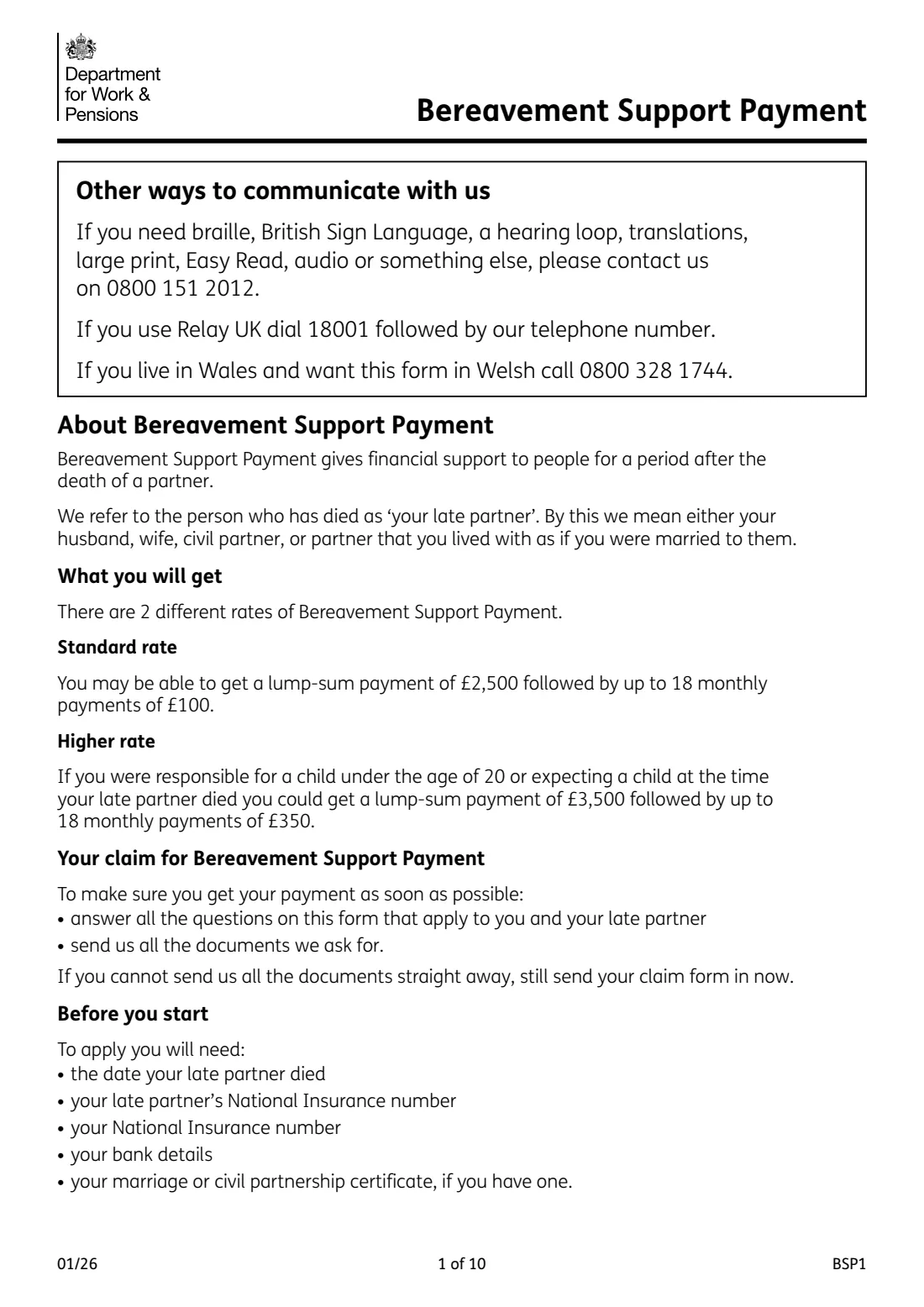
Form BSP1 is the Department for Work and Pensions (DWP) claim form for Bereavement Support Payment, the benefit that gives financial support for a period after your partner dies. The form calls the person who has died 'your late partner', meaning your husband, wife or civil partner, or a partner you lived with as if you were married to them.
The 01/26 edition prints two rates. The standard rate may be a lump sum of £2,500 followed by up to 18 monthly payments of £100. The higher rate, if you were responsible for a child under 20 or expecting a child when your partner died, could be a lump sum of £3,500 followed by up to 18 monthly payments of £350. Answering every question that applies and sending the documents asked for helps DWP pay you as soon as possible, and the form says to send it in even if some documents are still to come.
Filling in forms is hard in the weeks after a death. FileIt takes you through the 34 questions one at a time in plain English and skips the ones your answers make unnecessary, such as the marriage questions if you weren't married or the Child Benefit questions if you had no dependent children. It prints your answers into DWP's own BSP1 PDF, including the National Insurance, sort code and account number boxes. Names and dates can be pre-filled from the People records in your FileIt vault, and the finished PDF is saved in your folder. You print it, sign it by hand and send it yourself. FileIt never submits it.
- Who fills it
- The surviving husband, wife, civil partner or partner who is claiming
- Given to
- DWP Bereavement Support Payment, Mail Handling Site A, Wolverhampton WV98 2BS, or a Jobcentre Plus office
- Rates (01/26 edition)
- Standard: £2,500 then up to 18 × £100. Higher: £3,500 then up to 18 × £350
- Signatures
- The claimant signs and dates the declaration by hand
- Edition
- BSP1 01/26 (Version 4.0)
- Length
- 10 pages, 34 questions
Who needs to fill out BSP1 Bereavement Support Payment?
- A husband, wife or civil partner whose partner has died and who wants to claim Bereavement Support Payment by post rather than by phone.
- A surviving partner who lived with the person who died as if they were married. Unmarried partners can only claim in some circumstances, so check the GOV.UK guidance first.
- Parents who were responsible for a child under 20 when their partner died, or who were expecting a baby, since they may qualify for the higher rate.
- Someone whose partner lived or worked abroad, because the form collects the countries, dates and foreign social security numbers.
- Someone whose partner died because of an accident at work or an illness connected with their work.
- A family member or friend helping a bereaved relative with the paperwork. The claimant still signs it.
When to use BSP1 Bereavement Support Payment
- After the death of your husband, wife, civil partner or partner, as soon as you can. The form says to send it as soon as possible.
- Don't wait for the death certificate. If you have an interim death certificate or a coroner's letter, send it. If you have no certificates yet, the form still asks you to send the claim now.
- Claiming early matters because payments depend on how soon you claim. GOV.UK explains the time limits, so check them if some months have passed.
- It's a one-off claim. Once you're being paid, report changes in your circumstances to DWP straight away rather than filling in a new form.
What you need before you start
- Your National Insurance number, date of birth, address, mobile number and email address.
- Your late partner's full name, National Insurance number, last address (or 'not known') and date of death.
- Your original marriage or civil partnership certificate, if you have one. DWP asks for the original, not a photocopy, and returns it.
- The date and country of your marriage or civil partnership, the religion the ceremony was held under, and your surname before you married.
- An interim death certificate or coroner's letter, if you have one.
- Whether your partner paid National Insurance contributions, and whether they were employed or self-employed.
- Details of any countries outside the UK your partner lived or worked in: dates, whether they paid into that country's social security scheme and their reference number.
- Whether you had dependent children or were expecting a child, and your Child Benefit position.
- Bank, building society or credit union details: account holder's name as on the statement, sort code, account number and any roll or reference number.
What’s on BSP1 Bereavement Support Payment
The 2026 edition has 10 pages. FileIt asks for it in 10 parts:
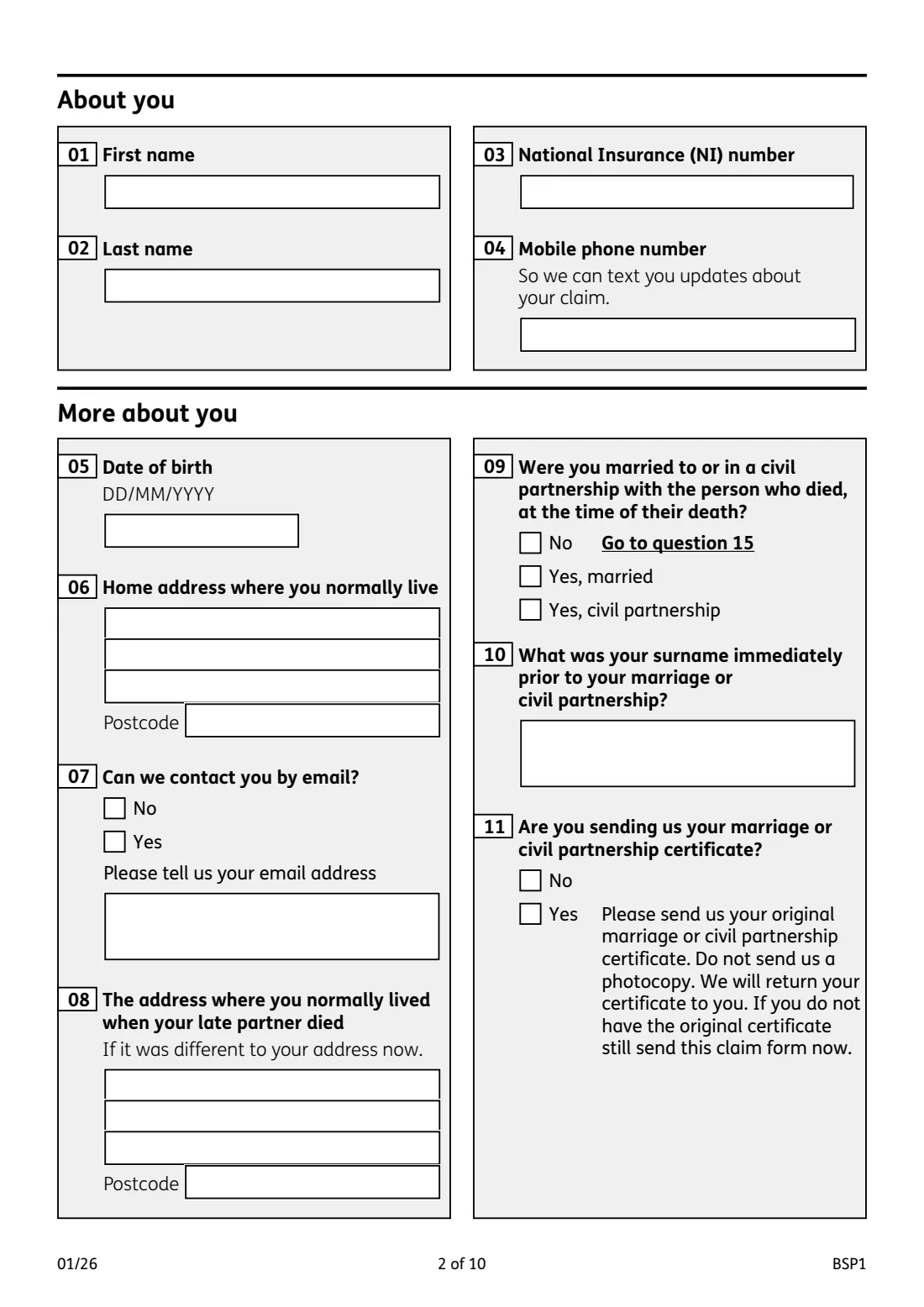
- About you (01-07)Claimant
- Your address when your late partner died (08)Claimant
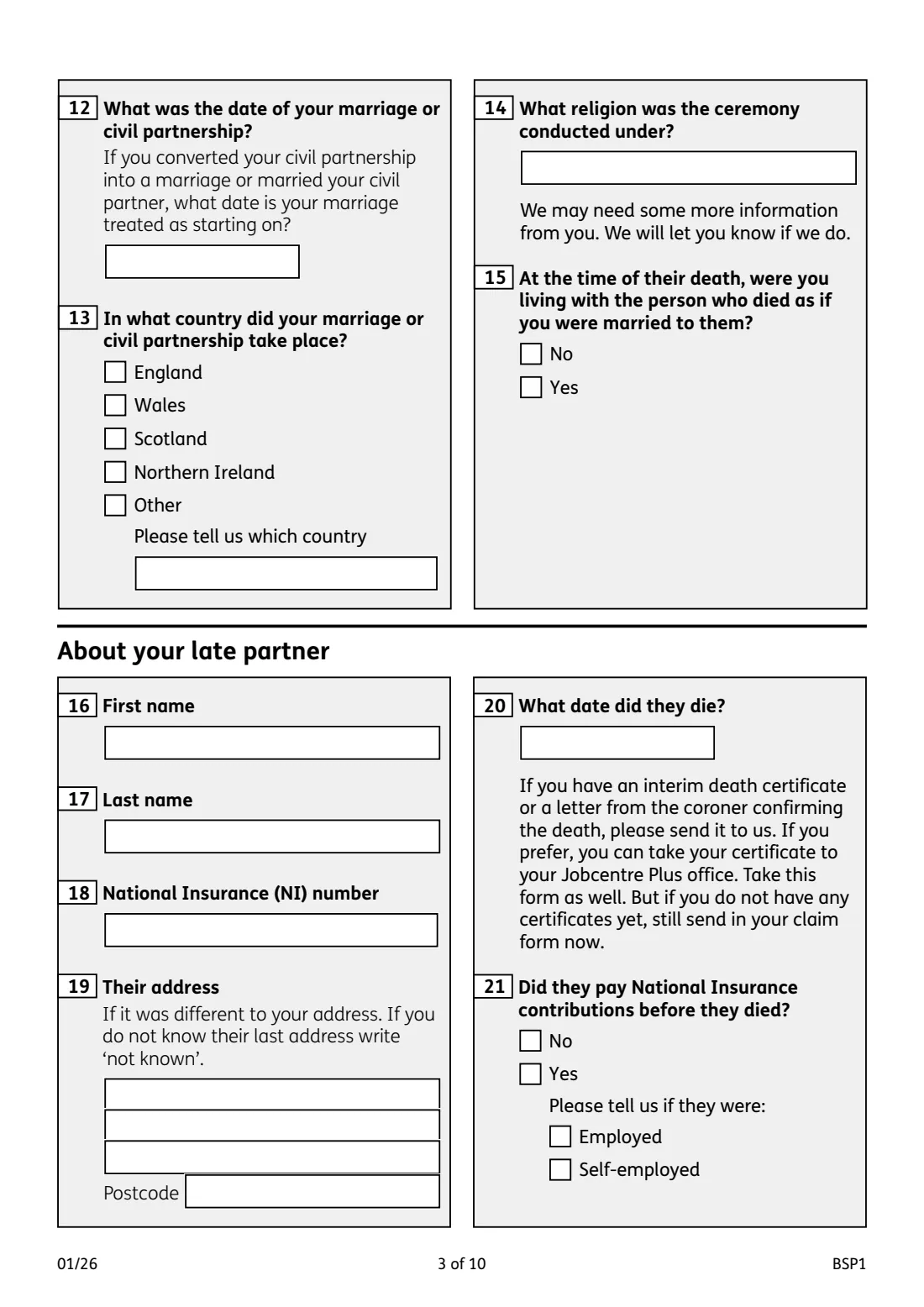
- Your marriage, civil partnership or living together (09-15)Claimant
- About your late partner (16-21)Claimant
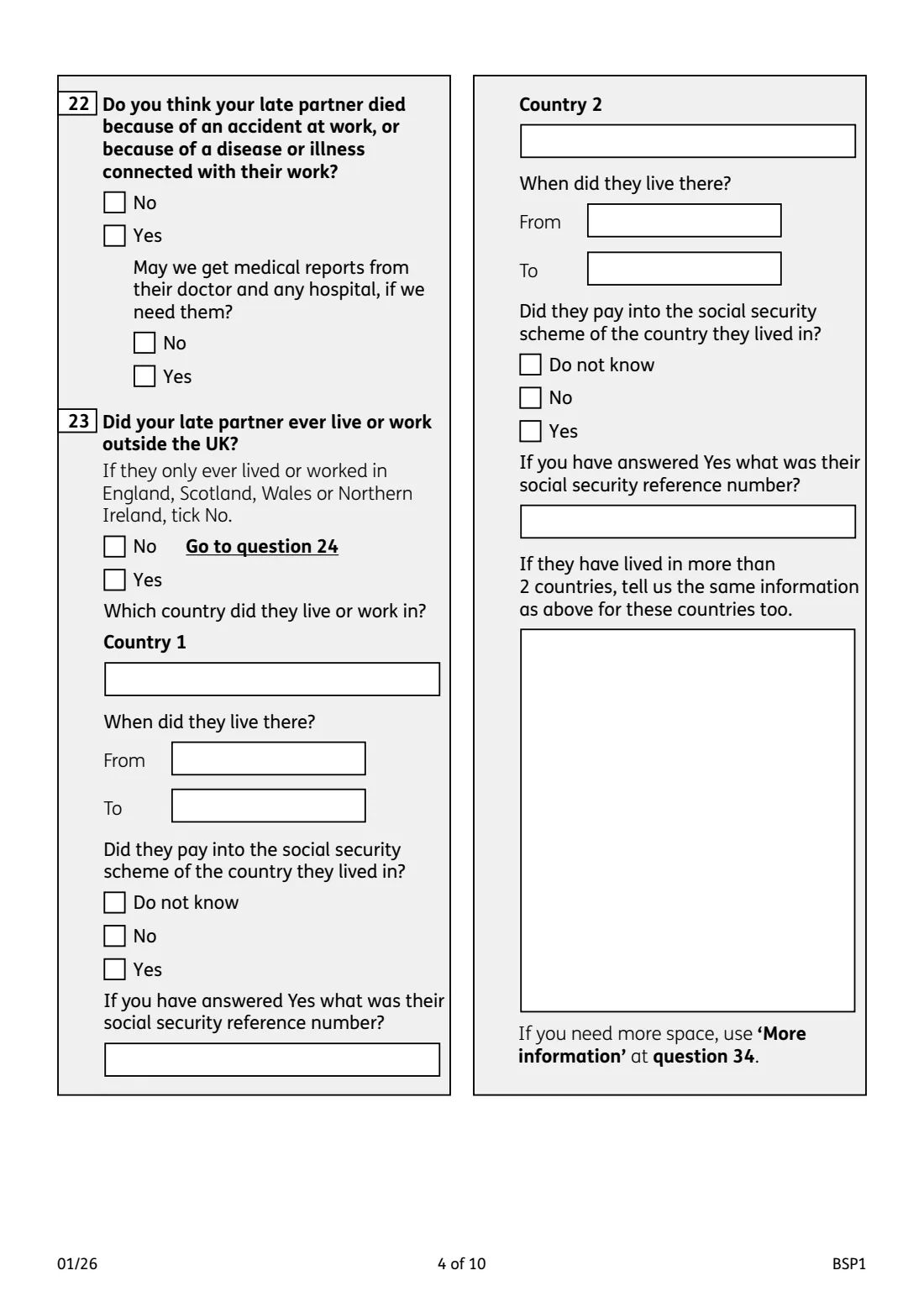
- Their work and time outside the UK (22-23)Claimant
- A second country they lived or worked in (23)Claimant
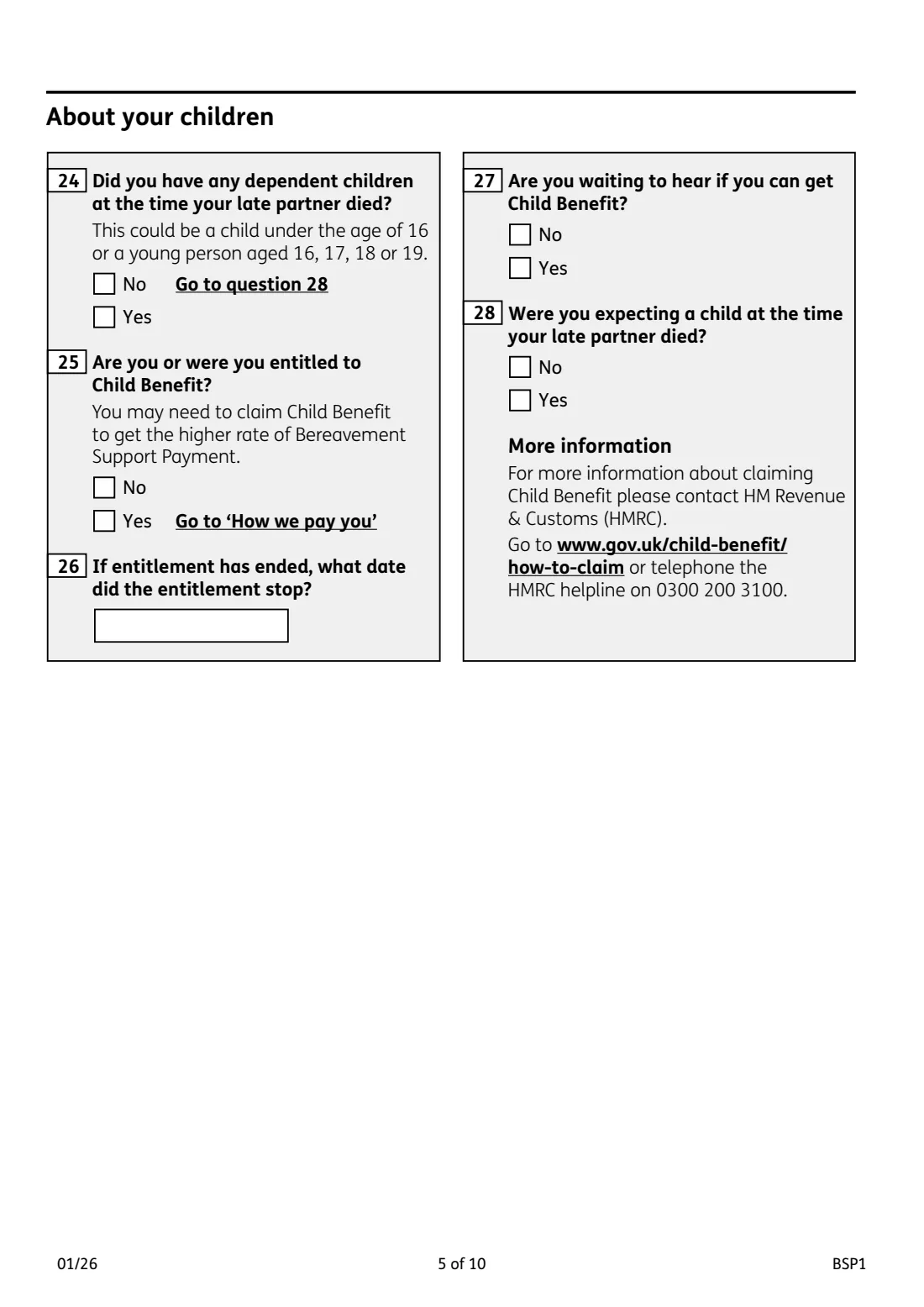
- About your children (24-28)Claimant
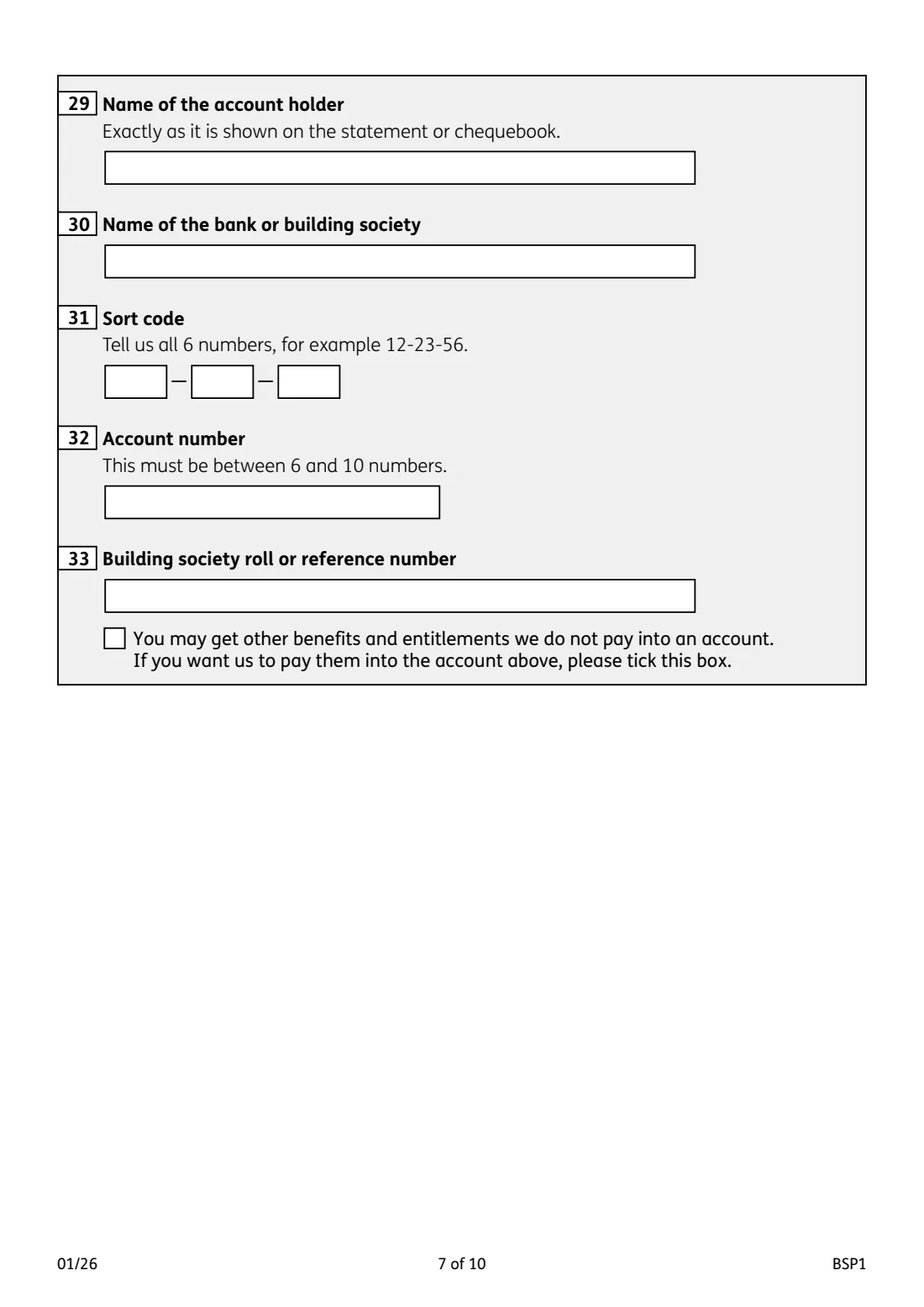
- How we pay you (29-33)Claimant
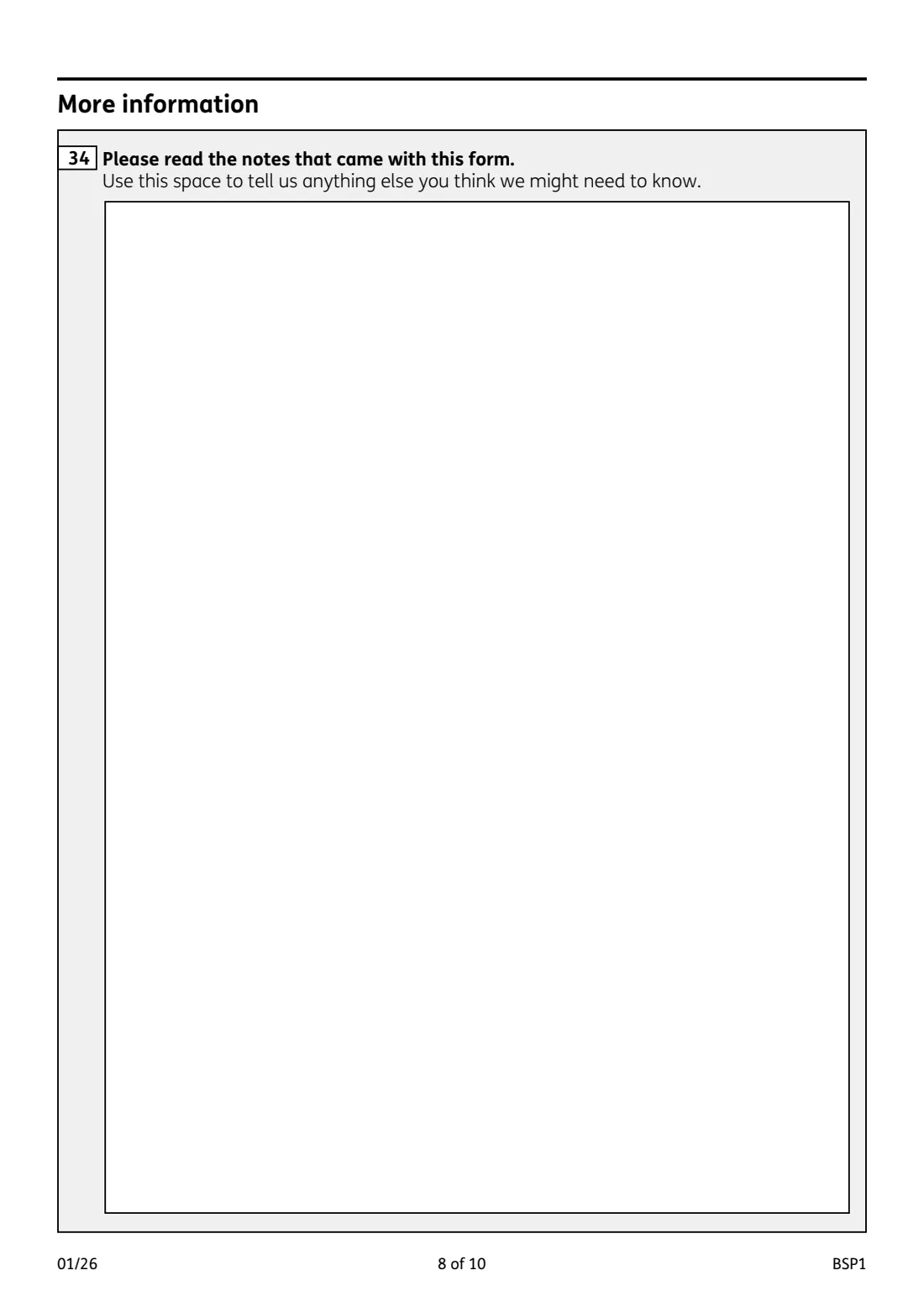
- More information (34)Claimant
- DeclarationClaimant
How to fill out BSP1 Bereavement Support Payment, step by step
1 About you (questions 01 to 04)
Your first name, last name, National Insurance number and a mobile number so DWP can text you updates about your claim.
Write your names as they appear on official documents. FileIt checks that the National Insurance number has the right shape (two letters, six numbers, then A, B, C or D) and prints it into the boxes without spaces.
2 More about you (questions 05 to 08)
Your date of birth, the home address where you normally live, and whether DWP can contact you by email.
Question 08 asks for the address where you normally lived when your partner died, but only if it's different from your address now. In FileIt it's a part you switch on only if you need it.
3 Marriage or civil partnership (questions 09 to 14)
Question 09 asks if you were married to or in a civil partnership with the person who died at the time of their death. If not, you go straight to question 15.
If you were, give your surname immediately before the marriage or partnership, say whether you're sending the certificate, and give the date and country of the marriage and the religion it was held under. If you converted a civil partnership into a marriage, give the date your marriage is treated as starting on.
4 Living together (question 15)
Were you living with the person who died as if you were married to them? This is the key question for partners who weren't married or in a civil partnership. FileIt flags it if you answer No to both question 09 and question 15, because the payment is only for a husband, wife, civil partner or a partner you lived with in that way.
5 About your late partner (questions 16 to 21)
Their first and last names, National Insurance number, their address if it was different from yours ('not known' if you don't know it), and the date they died.
Question 21 asks whether they paid National Insurance contributions before they died and, if so, whether they were employed or self-employed. If you're not sure, the National Insurance number lets DWP check their record.
6 Work-related death and time abroad (questions 22 and 23)
Question 22 asks if you think your partner died because of an accident at work or a disease or illness connected with their work. If so, you're asked whether DWP may get medical reports from their doctor and any hospital.
Question 23 asks whether they ever lived or worked outside the UK (England, Scotland, Wales and Northern Ireland count as the UK). For up to two countries give the dates, whether they paid into that country's social security scheme and their reference number. There's a box for any further countries, and question 34 if you need more space.
7 About your children (questions 24 to 28)
Did you have any dependent children when your partner died, meaning a child under 16 or a young person aged 16 to 19? If so, question 25 asks whether you are or were entitled to Child Benefit. The form points out that you may need to claim Child Benefit to get the higher rate.
If you're not entitled, give the date entitlement stopped (if it has ended) and say whether you're waiting to hear about a Child Benefit claim. Question 28 asks whether you were expecting a child when your partner died.
8 How we pay you (questions 29 to 33)
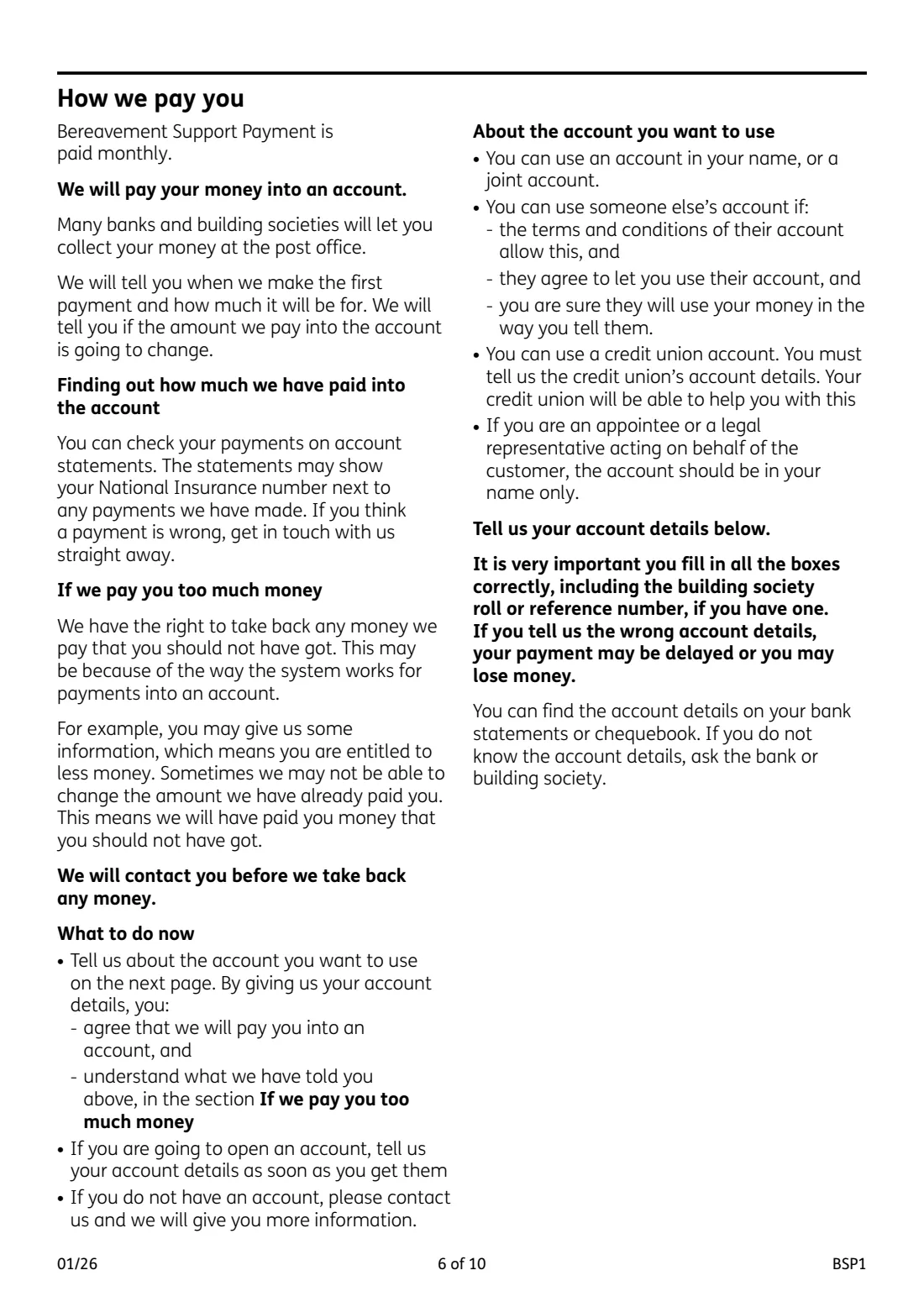
Bereavement Support Payment is paid monthly into an account. It can be in your name, a joint account, a credit union account, or someone else's account if its terms allow it and they agree. Give the account holder's name exactly as on the statement, the bank or building society, the six-number sort code, the 6 to 10 number account number and any building society roll or reference number.
By giving the details you agree to be paid into an account, and you accept that DWP can take back money it paid that you shouldn't have got. A final tick box lets you have other benefits that DWP doesn't normally pay into an account paid there too.
9 More information (question 34)
A full page to tell DWP anything else it might need to know: extra countries your partner lived in, documents that will follow, or anything unusual about your situation.
10 Declaration
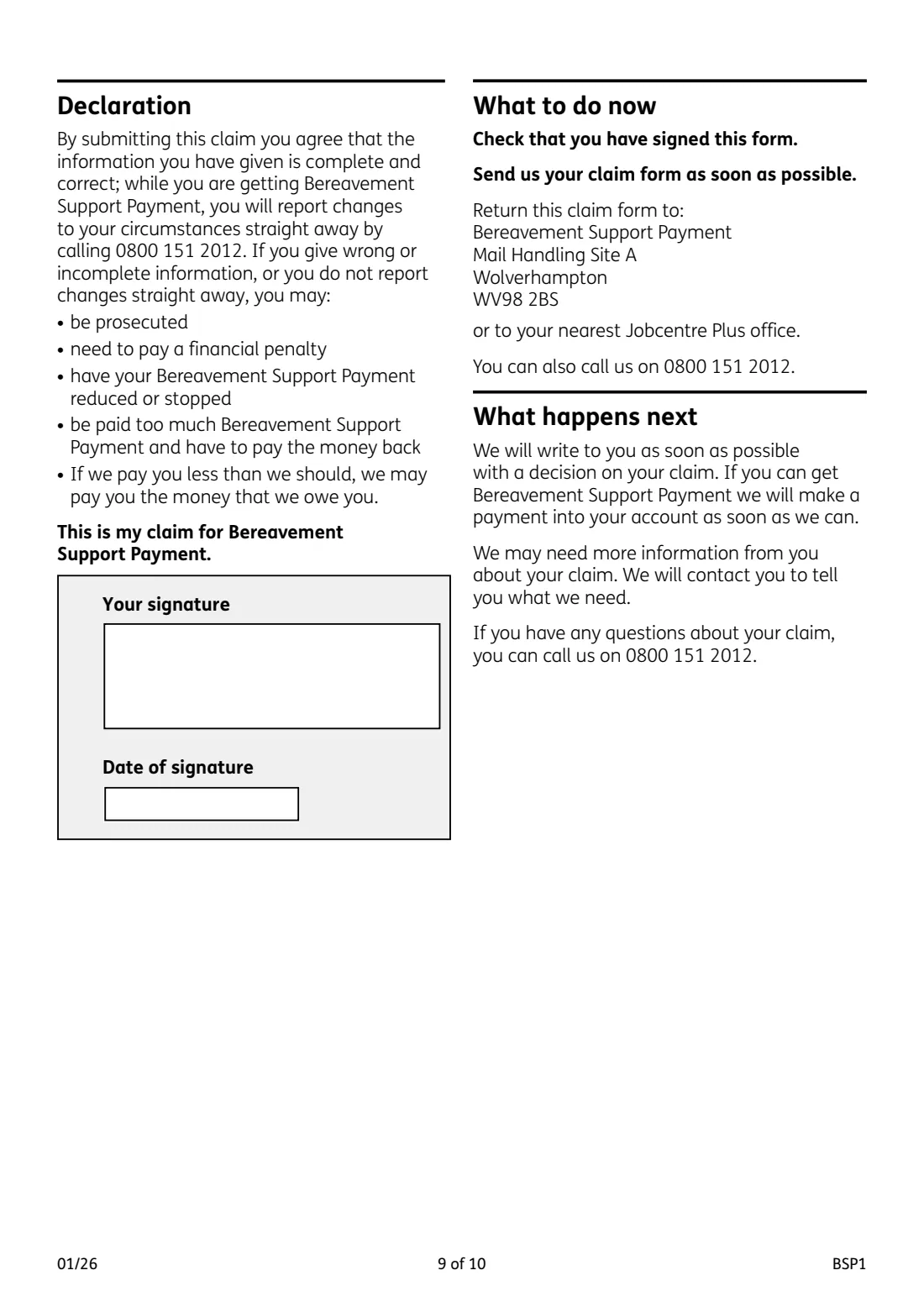
By signing you agree that the information is complete and correct, and that while you get Bereavement Support Payment you'll report changes in your circumstances straight away. The form warns that wrong or incomplete information, or not reporting changes, could lead to prosecution, a financial penalty, reduced or stopped payments, or having to repay an overpayment.
Sign by hand in the 'Your signature' box and add the date.
Common mistakes to avoid
- Waiting for the death certificate before claiming. The form says to send the claim now and the documents later.
- Sending a photocopy of the marriage or civil partnership certificate. DWP asks for the original and returns it.
- Mixing up the two National Insurance numbers, or giving yours in the partner's boxes. FileIt checks they're different.
- Answering question 28 after a Yes to question 25. The form sends you straight to 'How we pay you'.
- Leaving out the building society roll or reference number when the account needs one, which can delay payment or lose money.
- Not mentioning Child Benefit when you had children. You may need it to get the higher rate.
- Forgetting to sign. The form's own checklist starts with 'Check that you have signed this form.'
- Leaving countries off question 23. If your partner lived or worked abroad, list every country, using question 34 if you run out of room.
After you fill it out
Print the completed BSP1, sign it by hand in the 'Your signature' box and date it. Send it with your original marriage or civil partnership certificate and any interim death certificate or coroner's letter to Bereavement Support Payment, Mail Handling Site A, Wolverhampton WV98 2BS. You can also take it to your nearest Jobcentre Plus office.
DWP will write to you with a decision as soon as possible and may contact you for more information. If you can get the payment, it's paid into the account you gave. Keep a copy of what you sent. FileIt keeps the finished PDF in your vault so you can check your answers if DWP calls or writes.
While you're being paid, report changes in your circumstances to DWP straight away, using the number printed on the form.
Fill out BSP1 Bereavement Support Payment online with FileIt
- Pick the person. Choose someone from People and FileIt fills in their name, date of birth, address and other details it already knows.
- Answer plain-language questions. One part of the form at a time, with the official help text beside each question — 62 fields in all. Your answers save as you go.
- Check the live preview. Watch your answers land on the real Department for Work and Pensions (DWP) form, and let FileIt do any worksheet arithmetic.
- Generate the official PDF. FileIt prints your answers into the agency’s own PDF and files it in that person’s folder in your vault.
FileIt fills the form — it never files or submits anything for you. Deliver the finished form to whoever asked for it, the way the form’s instructions say.
Start BSP1 Bereavement Support Payment now — it’s freeBSP1 Bereavement Support Payment: frequently asked questions
What is form BSP1?
BSP1 is the Department for Work and Pensions claim form for Bereavement Support Payment. The surviving husband, wife, civil partner or partner fills it in after a death. It covers you, your marriage or partnership, your late partner, any children and the account to pay you into.
How much is Bereavement Support Payment?
The 01/26 edition of the form prints two rates. The standard rate may be a £2,500 lump sum followed by up to 18 monthly payments of £100. The higher rate, if you were responsible for a child under 20 or expecting a child, could be a £3,500 lump sum followed by up to 18 monthly payments of £350. DWP decides which rate applies.
Can I fill in the BSP1 online?
Yes, with FileIt. You answer the questions in a guided web form, and FileIt prints them into DWP's official BSP1 PDF and saves the finished form in your vault. You then print it, sign it by hand and send it yourself. FileIt doesn't submit it to DWP.
Where do I send the BSP1 form?
The form says to return it to Bereavement Support Payment, Mail Handling Site A, Wolverhampton WV98 2BS, or to your nearest Jobcentre Plus office. Send it as soon as possible.
Do I need the death certificate before I claim?
No. If you have an interim death certificate or a coroner's letter confirming the death, send it with the form, or take it with the form to your Jobcentre Plus office. If you don't have any certificates yet, the form says to send in your claim anyway.
Can I claim if we weren't married?
The form asks whether you were living with the person who died as if you were married to them, and unmarried partners can claim in some circumstances. Check the eligibility rules on GOV.UK before you apply.
Do I have to send my original marriage certificate?
The form asks for the original marriage or civil partnership certificate, not a photocopy, and says DWP will return it. If you don't have the original, still send the claim form now.
Is there a time limit for claiming?
Yes. How much you get depends on how soon after the death you claim, so the form asks you to send it as soon as possible. GOV.UK sets out the exact time limits.
Can someone else fill in the form for me?
A relative or friend can help with the details, and FileIt can pre-fill names and dates from the People records in your vault. The claimant still signs the declaration by hand.
Official sources
- Blank form (PDF), published by Department for Work and Pensions (DWP): https://assets.publishing.service.gov.uk/media/698c58b7d7b51513fcd8a3b1/bereavement-support-payment-form.pdf
- Official instructions and guidance: https://www.gov.uk/bereavement-support-payment/how-to-claim
- Edition shown on this page: BSP1 01/26 (Version 4.0) (checked 2026-09-26).
FileIt is not affiliated with or endorsed by Department for Work and Pensions (DWP) or any government. This page explains the form in general terms and is not legal, tax or immigration advice. Always read the official instructions, and check that you are using the edition the recipient accepts. Page last reviewed 2026-09-26.