What is Form W-9?
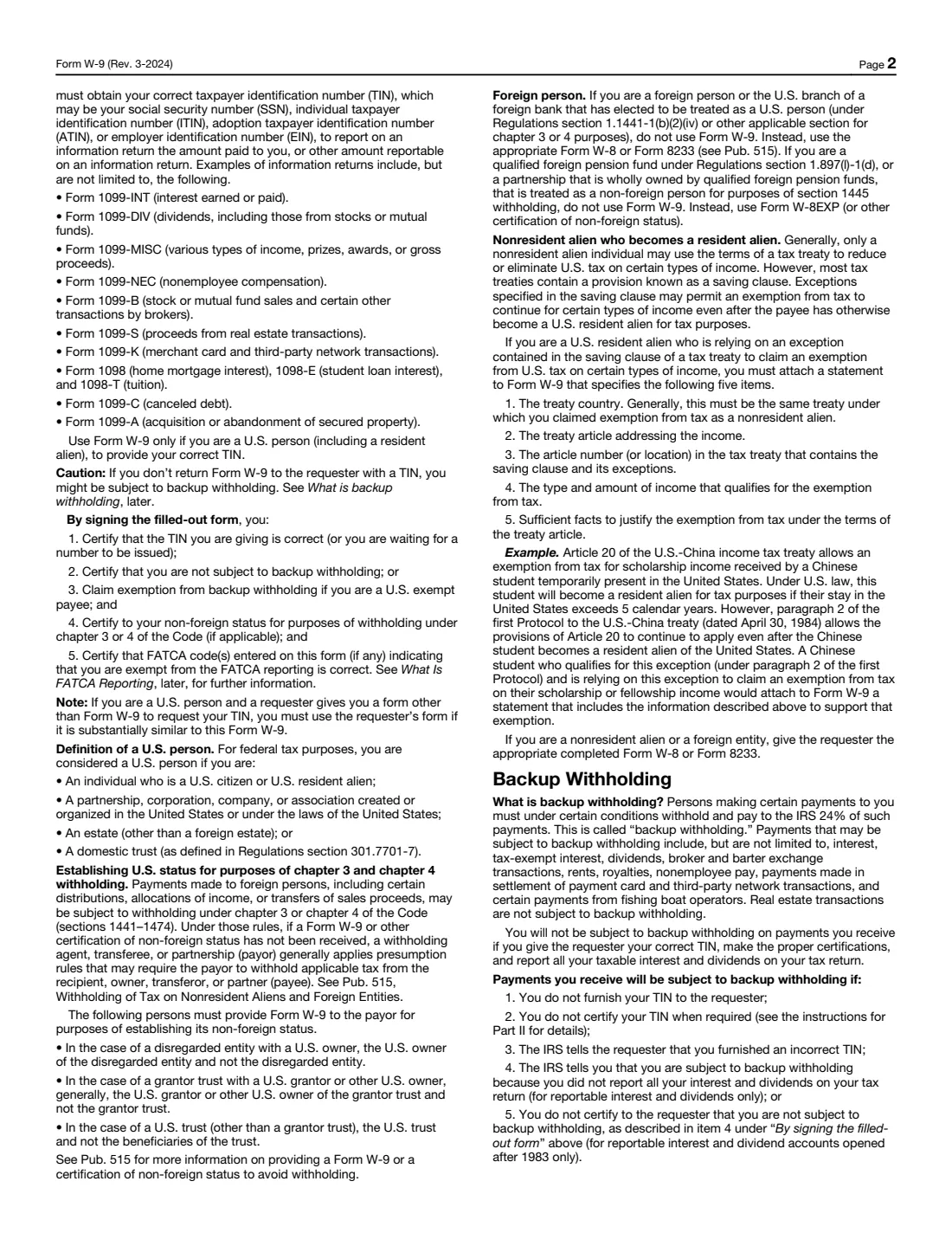
Form W-9, Request for Taxpayer Identification Number and Certification, is how you give a business your correct taxpayer identification number (TIN) — your Social Security number (SSN), individual taxpayer identification number (ITIN) or employer identification number (EIN). The business that asks for it (the requester) needs your TIN to report payments it makes to you on information returns such as Form 1099-NEC for nonemployee compensation, 1099-MISC, 1099-INT or 1099-K.
The W-9 is an Internal Revenue Service (IRS) form, but it says right at the top: give form to the requester, do not send to the IRS. By signing it you also certify, under penalties of perjury, that the number is correct, that you are not subject to backup withholding, and that you are a U.S. citizen or other U.S. person. If you don't give a requester your TIN, payments to you might be subject to backup withholding. The current version is Rev. March 2024, which added line 3b and clarified how a disregarded entity fills in line 3a.
FileIt guides you through the W-9 line by line and prints your answers into the IRS's own official PDF. It pre-fills your name, address and entity details from the People records in your vault, saves the finished PDF to your vault, and can optionally send it for e-signature. You then send the signed form to the requester yourself.
- Who fills it
- The payee — the person or business being paid. The requester may add its name and address.
- Given to
- The requester (the business or person who asked for it). Do not send it to the IRS.
- When
- When a client, bank, broker, tenant or other payer asks for it — usually before the first payment.
- Signatures
- The payee signs and dates Part II as a "U.S. person".
- Edition
- Rev. March 2024
- Agency
- Internal Revenue Service (IRS), Department of the Treasury
Who needs to fill out Form W-9?
- Freelancers, independent contractors and gig workers who will be paid by a business that files a Form 1099.
- Sole proprietors and single-member LLCs being set up as a vendor or supplier.
- Corporations, partnerships, trusts, estates and LLCs that a customer or payer needs to classify for tax reporting.
- Landlords receiving rent from a business tenant, and people receiving certain other reportable payments.
- Account holders opening accounts with banks, brokers or other financial institutions that report interest, dividends or sales.
- Only U.S. persons (including resident aliens) — foreign persons use the appropriate Form W-8 or Form 8233 instead.
When to use Form W-9
- When a new client or customer asks for a W-9 before paying you, typically as part of vendor onboarding.
- When you open a financial account that will generate reportable income such as interest or dividends.
- When your name, business name or TIN changes — the form says you must furnish a new W-9 if the name or TIN on the account changes.
- When your tax classification changes, for example a C corporation that elects to be an S corporation.
- When you are no longer an exempt payee and expect to receive reportable payments from someone to whom you claimed exemption.
What you need before you start
- Your name exactly as shown on your income tax return (for a business, as on the entity's tax return).
- Your business, trade or "doing business as" name, or the disregarded entity's name, if different.
- Your federal tax classification: individual/sole proprietor, C corporation, S corporation, partnership, trust/estate, LLC, or other.
- For an LLC that isn't disregarded: its tax classification code (C, S or P).
- Your SSN, ITIN or EIN — the one that matches the name on line 1.
- The mailing address where the requester should send your information returns, such as Form 1099.
- Any exempt payee or FATCA exemption code, if one applies to your entity (individuals usually leave these blank).
- Any account number the requester asked you to list.
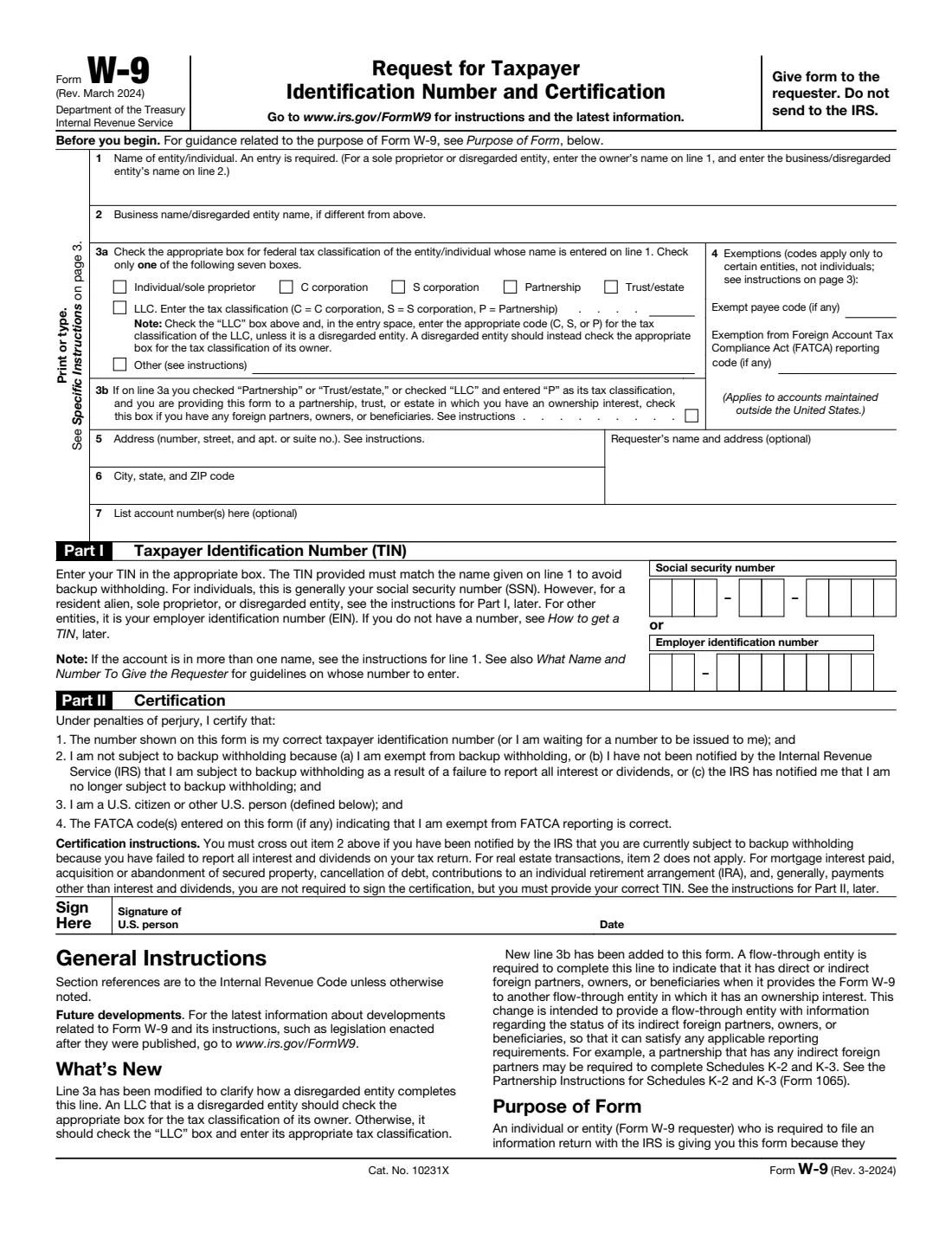
What’s on Form W-9
The 2024 edition has 6 pages. FileIt asks for it in 7 parts, and it is signed by Payee (the person giving the form):
- Lines 1–2: NamePayee (the person giving the form)
- Line 3: Federal tax classificationPayee (the person giving the form)
- Line 4: Exemptions (if any)Payee (the person giving the form)
- Lines 5–7: Address and account numbersPayee (the person giving the form)
- Part I: Taxpayer identification number (TIN)Payee (the person giving the form)
- Part II: CertificationPayee (the person giving the form)
- Requester's name and address (optional)Requester (who asked for the form)
How to fill out Form W-9, step by step
1 Line 1: Name of entity/individual
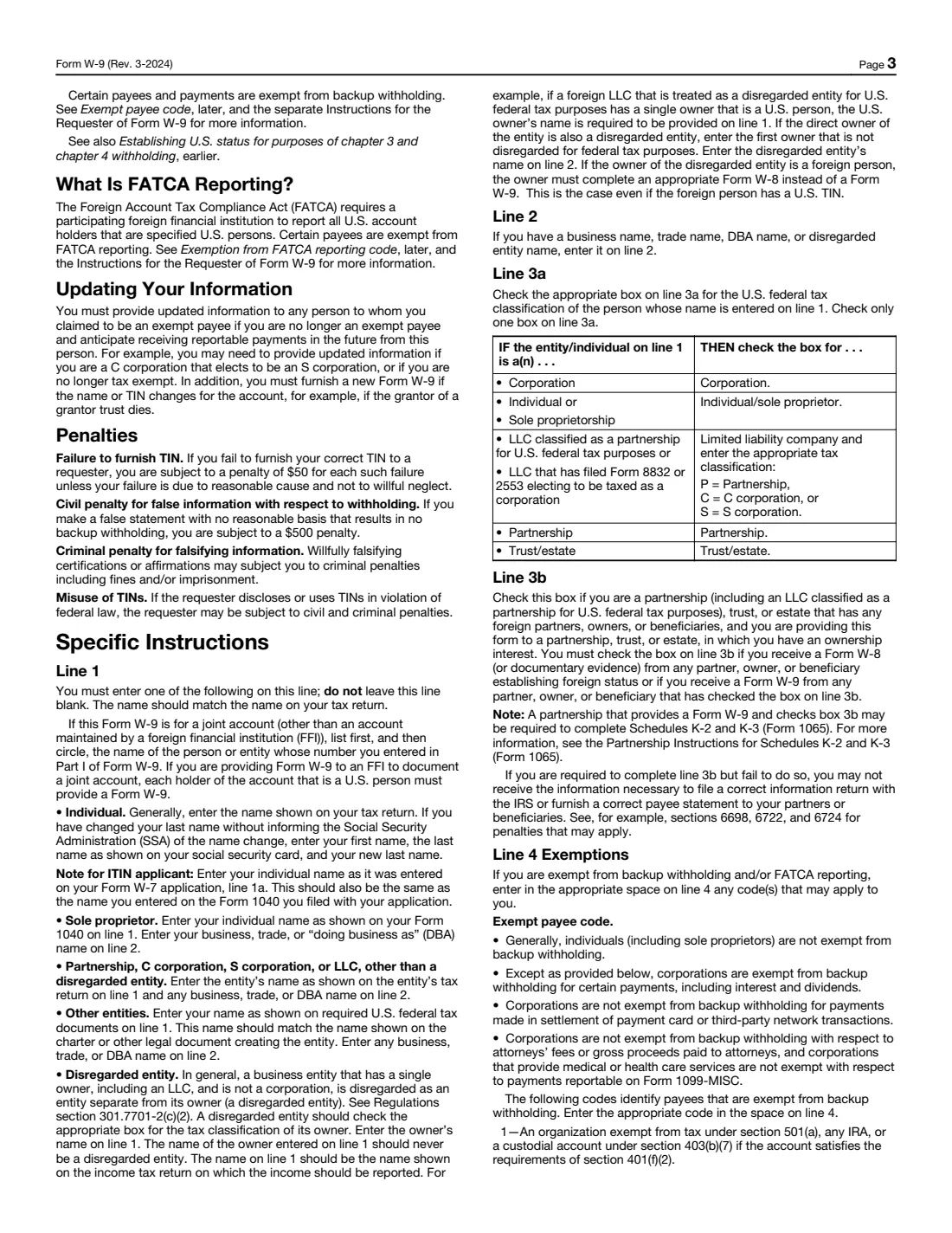
An entry is required. Individuals enter the name shown on their income tax return; if you've changed your last name without telling the Social Security Administration, the instructions say to use the name on your Social Security card and your new last name. Entities enter the name shown on the entity's tax return.
Sole proprietors and disregarded entities (such as a single-member LLC owned by one person) put the owner's name on line 1, not the business name.
2 Line 2: Business name/disregarded entity name
Fill this in only if it's different from line 1 — for example your business, trade or "doing business as" (DBA) name, or the name of your single-member LLC. Leave it blank if you are an individual being paid in your own name.
3 Line 3a: Federal tax classification
Check only one of the seven boxes, for the person or entity named on line 1: Individual/sole proprietor, C corporation, S corporation, Partnership, Trust/estate, LLC, or Other. If you check LLC, enter its tax classification code: C for C corporation, S for S corporation, or P for partnership.
The March 2024 revision clarifies an easy point of confusion: an LLC that is a disregarded entity does not check the LLC box. It checks the box for the tax classification of its owner — so a single-member LLC owned by an individual checks Individual/sole proprietor.
4 Line 3b: Foreign partners, owners, or beneficiaries
This box is new on the 2024 revision and applies only to a partnership, trust or estate (including an LLC taxed as a partnership, P) that is giving the W-9 to a partnership, trust or estate in which it has an ownership interest. Check it if the entity has any foreign partners, owners or beneficiaries. Individuals and corporations skip this line.
5 Line 4: Exemptions
These codes apply only to certain entities, not individuals — individuals and sole proprietors are generally not exempt, so most people leave line 4 blank. The exempt payee code (1 to 13) is for payees exempt from backup withholding; for example corporations generally use code 5, although not for payment card or third-party network payments, attorneys' fees, or medical and health care payments.
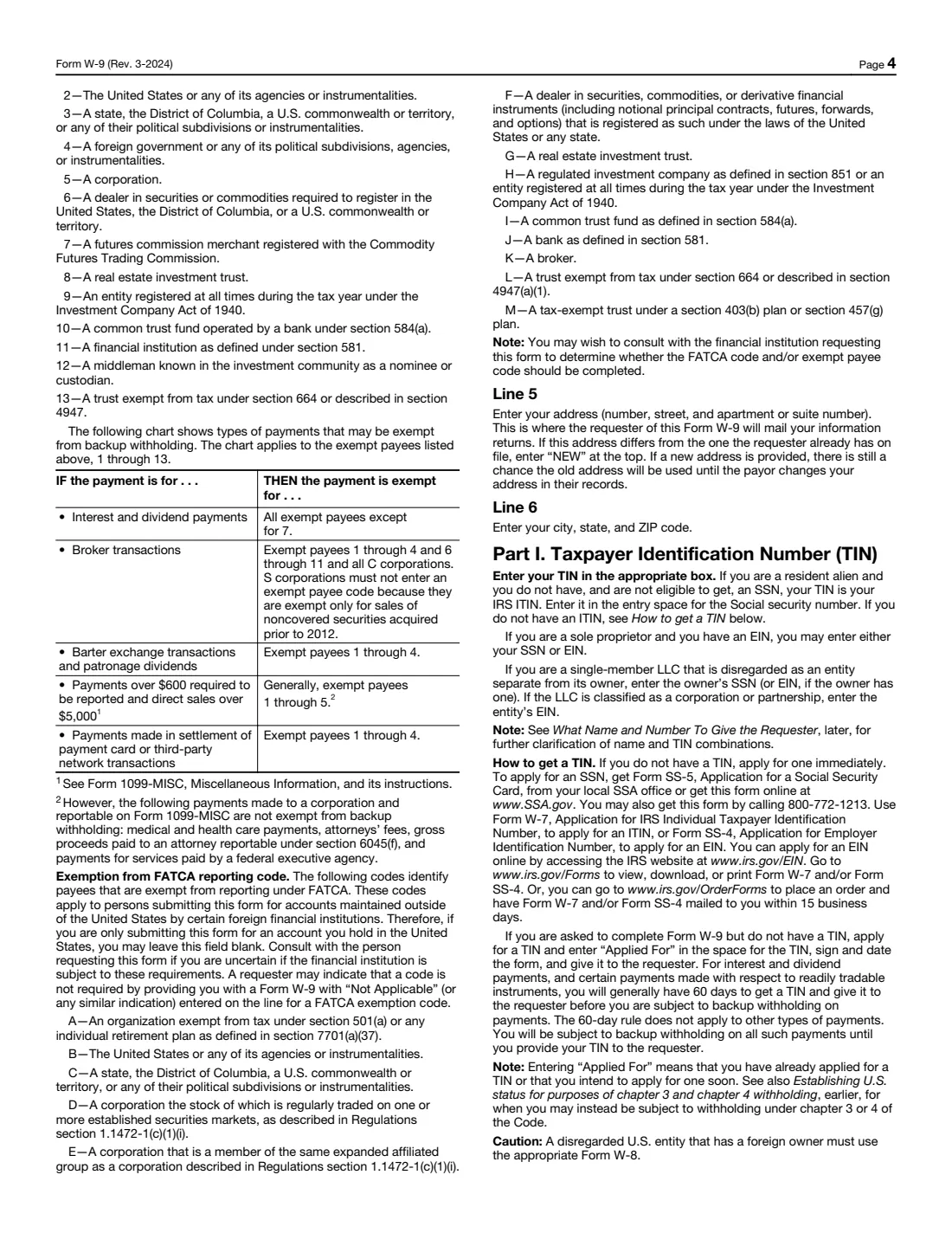
The FATCA exemption code (A to M) applies only to accounts maintained outside the United States by certain foreign financial institutions. If the form is only for an account held in the United States, leave it blank. If you're unsure, ask the requester.
6 Lines 5–6: Address; City, state, and ZIP code
Enter the address where the requester should mail your information returns, such as Form 1099. If this is a new address for a requester who already has you on file, the form can be marked to show the change.
7 Line 7: Account number(s) and Requester's name and address
Line 7 is optional — list account numbers only if the requester asked you to. The requester's name and address box is also optional; fill it in if you want the form to show who it's for.
8 Part I: Taxpayer Identification Number (TIN)
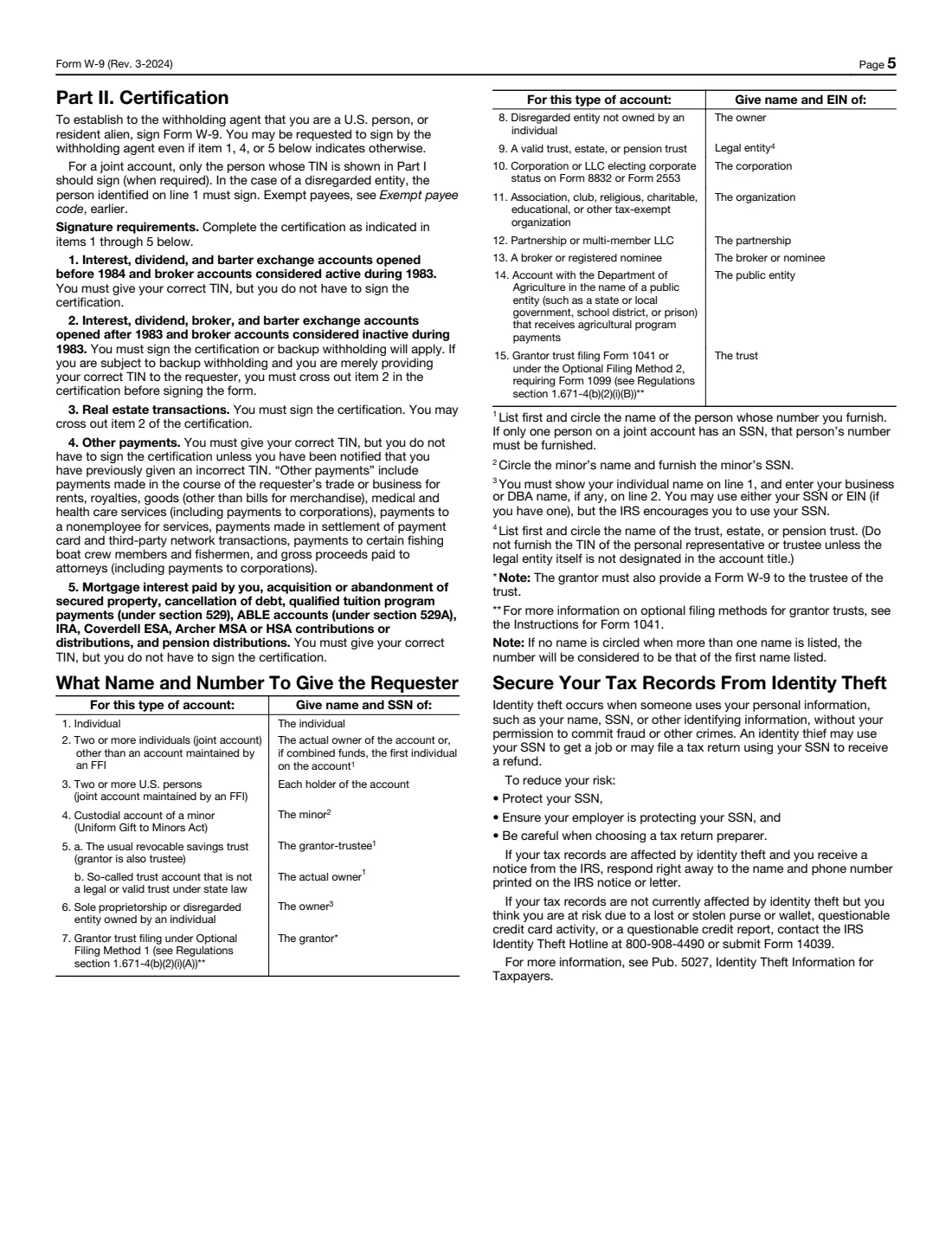
Enter your TIN in the right box. It must match the name on line 1 to avoid backup withholding. Individuals generally give their SSN. A resident alien who isn't eligible for an SSN gives their ITIN, entered in the SSN boxes. A sole proprietor with an EIN may give either their SSN or EIN. A disregarded single-member LLC gives its owner's SSN or EIN — not the LLC's own EIN. Corporations, partnerships and LLCs taxed as either give the entity's EIN.
If you don't have a TIN yet, the instructions say to apply for one immediately, write "Applied For" in the TIN space, sign and date the form, and give it to the requester.
9 Part II: Certification
By signing, you certify under penalties of perjury that (1) the TIN is correct or you are waiting for one, (2) you are not subject to backup withholding, (3) you are a U.S. citizen or other U.S. person, and (4) any FATCA code you entered is correct.
If the IRS has told you that you are currently subject to backup withholding because you failed to report all interest and dividends on your tax return, you must cross out item 2 before signing. Sign and date on the "Sign Here" line as a U.S. person.
Common mistakes to avoid
- Putting the business name on line 1 as a sole proprietor or single-member LLC. The owner's name goes on line 1 and the business name on line 2.
- Checking the LLC box for a single-member LLC that is a disregarded entity. It should check its owner's classification instead.
- Giving a TIN that doesn't match the name on line 1, such as an LLC's EIN with the owner's personal name. Mismatches can lead to backup withholding.
- Filling in an exempt payee code as an individual. Individuals and sole proprietors are generally not exempt.
- Forgetting to enter C, S or P after checking the LLC box.
- Sending the W-9 to the IRS. It goes only to the requester.
- Emailing a W-9 with your full SSN as an unprotected attachment. Ask the requester for a secure way to deliver it.
- Not sending an updated W-9 after changing your name, TIN, address or tax classification.
After you fill it out
Sign and date Part II — by hand on the printed PDF, or with FileIt's optional e-signature — and give the form to the requester by whatever method they ask for. Because the W-9 contains your SSN or EIN, use a secure delivery method where you can. Never send it to the IRS; the form itself says not to.
FileIt keeps the finished PDF in your vault folder, so you always have a copy of exactly what you gave each payer. The requester uses your TIN when filing information returns, and you'll typically receive your copy of any Form 1099 at the address on line 5.
Complete a new W-9 if your name or TIN changes, if your tax classification changes, or if you were an exempt payee and no longer are. If the IRS notifies you that you are subject to backup withholding, remember to cross out item 2 on any new W-9 you sign.
Fill out Form W-9 online with FileIt
- Pick the person. Choose someone from People and FileIt fills in their name, date of birth, address and other details it already knows.
- Answer plain-language questions. One part of the form at a time, with the official help text beside each question — 19 fields in all. Your answers save as you go.
- Check the live preview. Watch your answers land on the real Internal Revenue Service (IRS) form, and let FileIt do any worksheet arithmetic.
- Generate the official PDF. FileIt prints your answers into the agency’s own PDF and files it in that person’s folder in your vault. Sign it, or send it for e-signature.
FileIt fills the form — it never files or submits anything for you. Deliver the finished form to whoever asked for it, the way the form’s instructions say.
Start Form W-9 now — it’s freeForm W-9: frequently asked questions
Can I fill out a W-9 online?
Yes. FileIt asks you each question in plain English and prints your answers into the official IRS W-9 PDF. Filling forms is available on every FileIt account, including the free plan. You can download it, sign it or use FileIt's optional e-signature, and send it to the requester yourself.
Where do I send my W-9?
Send it to the person or business that asked for it — the requester. The form says "Give form to the requester. Do not send to the IRS."
What is the difference between a W-9 and a W-4?
A W-4 is for employees and tells an employer how much income tax to withhold from wages. A W-9 is typically for independent contractors, vendors and account holders, and simply gives a payer your taxpayer identification number so it can report payments to the IRS. Employees give a W-4; contractors usually give a W-9.
Should I use my SSN or EIN on a W-9?
Use the number that matches the name on line 1. Individuals generally use their SSN. A sole proprietor with an EIN may use either. A single-member LLC that is disregarded uses the owner's SSN or EIN, while an LLC taxed as a corporation or partnership uses its own EIN.
How do I fill out a W-9 for a single-member LLC?
If the LLC is disregarded for tax purposes, put the owner's name on line 1 and the LLC's name on line 2, check the box for the owner's classification (usually Individual/sole proprietor), and give the owner's SSN or EIN in Part I.
What is backup withholding?
It's tax a payer must withhold from certain payments and pay to the IRS under certain conditions — the form states the rate as 24%. It can apply if you don't give your TIN, give an incorrect TIN, don't certify when required, or the IRS says you under-reported interest or dividends. Giving a correct, signed W-9 generally avoids it.
What if I don't have a TIN yet?
The W-9 instructions say to apply for one immediately, write "Applied For" in the TIN space, sign and date the form and give it to the requester. You'll then need to provide the number once you receive it.
Does a W-9 expire?
The form has no expiration date printed on it for the payee. However, you must give a new W-9 when your name, TIN or tax classification changes, and a requester may ask for a fresh one on the current revision.
Can a foreign person fill out a W-9?
No. The W-9 is only for U.S. persons, including resident aliens. The form says foreign persons should instead use the appropriate Form W-8 or Form 8233.
Official sources
- Blank form (PDF), published by Internal Revenue Service (IRS): https://www.irs.gov/pub/irs-pdf/fw9.pdf
- Official instructions and guidance: https://www.irs.gov/forms-pubs/about-form-w-9
- Edition shown on this page: Rev. March 2024 (checked 2026-09-25).
FileIt is not affiliated with or endorsed by Internal Revenue Service (IRS) or any government. This page explains the form in general terms and is not legal, tax or immigration advice. Always read the official instructions, and check that you are using the edition the recipient accepts. Page last reviewed 2026-09-25.