What is Form 4868?
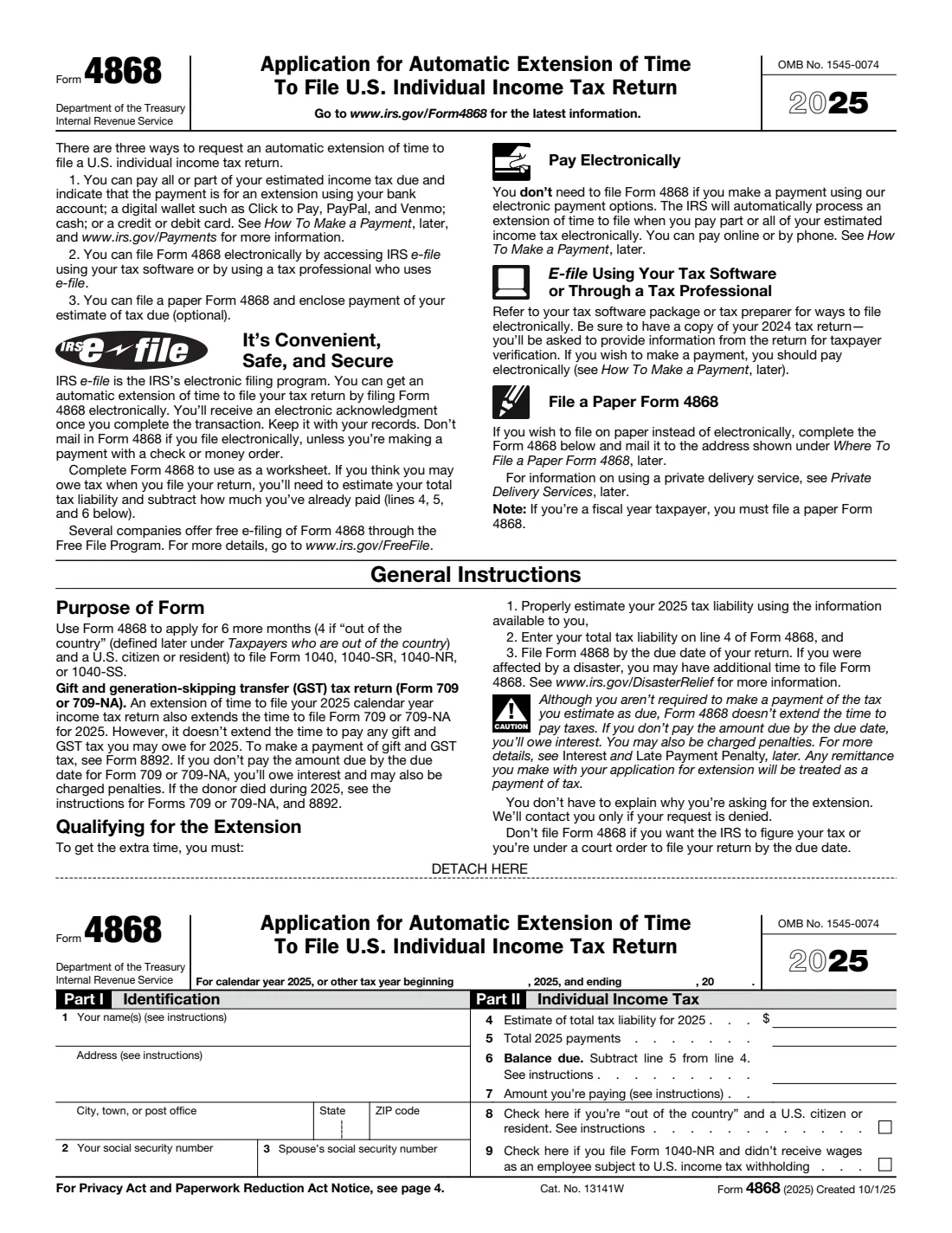
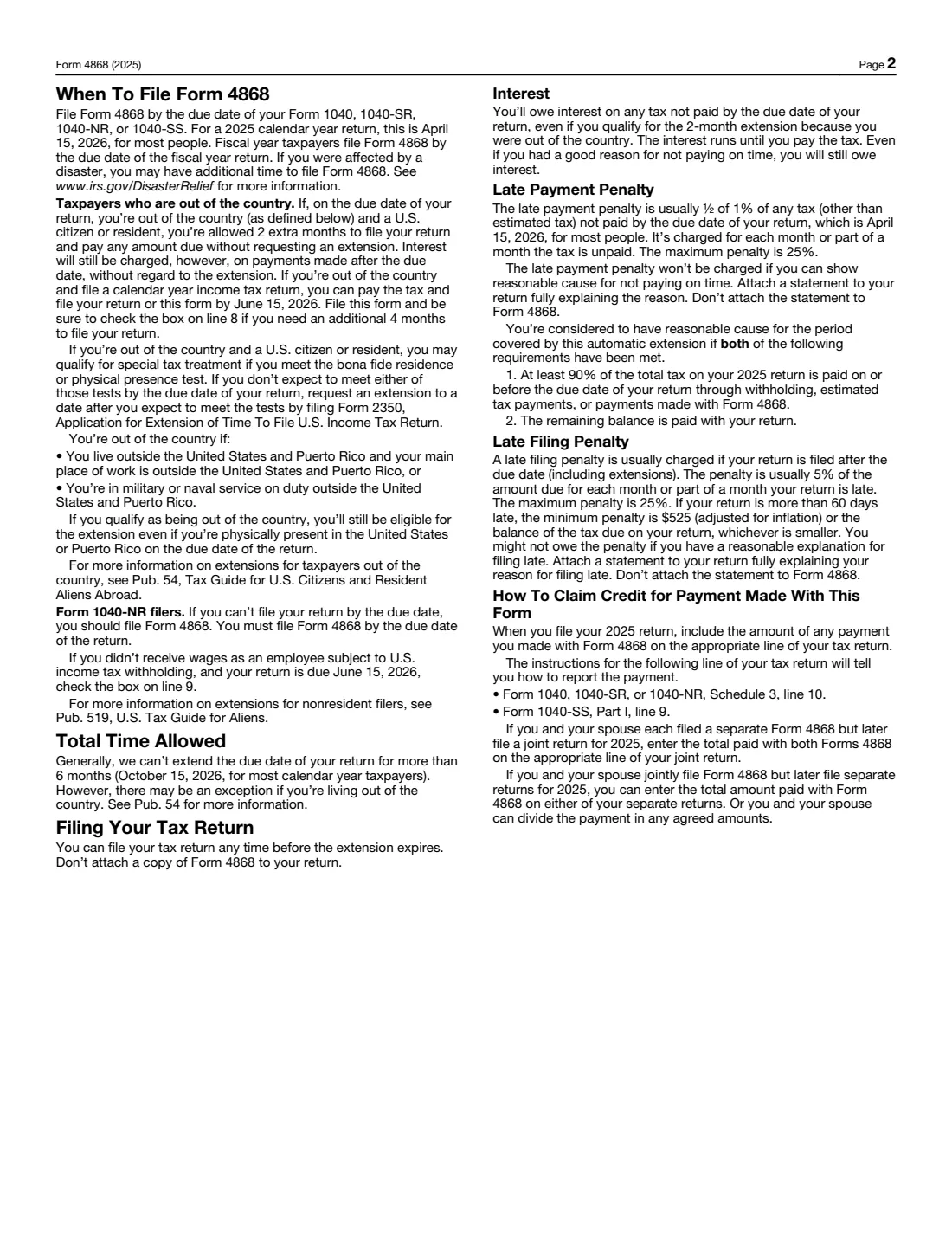
Form 4868, Application for Automatic Extension of Time To File U.S. Individual Income Tax Return, gets you 6 more months to file Form 1040, 1040-SR, 1040-NR or 1040-SS — or 4 more months if you're "out of the country" and a U.S. citizen or resident, on top of the 2 extra months you already have. For most people filing a 2025 calendar-year return, the form says the due date is April 15, 2026, and the longest extension is to October 15, 2026. You don't have to explain why you need more time; the IRS contacts you only if the request is denied.
The most important thing to know: an extension of time to file is not an extension of time to pay. You must estimate your 2025 tax and enter it on line 4. If you don't pay the balance by the regular due date, you'll owe interest and may be charged a late payment penalty. The form describes three ways to get the extension: pay all or part of your estimated tax electronically and mark it as an extension payment, e-file Form 4868 with tax software or a professional, or mail the paper voucher with or without a payment.
FileIt helps with the paper route. It walks you through the voucher at the bottom of page 1, pre-fills your name from the People records in your vault, works out line 6 (balance due) from your estimate and payments, handles the fiscal-year dates and foreign addresses, and prints your answers into the IRS's official PDF, saved in your vault. You then mail the voucher yourself — FileIt never files or e-files anything with the IRS.
- Who fills it
- Individuals filing Form 1040, 1040-SR, 1040-NR or 1040-SS — one form for both spouses if you'll file jointly.
- Sent to
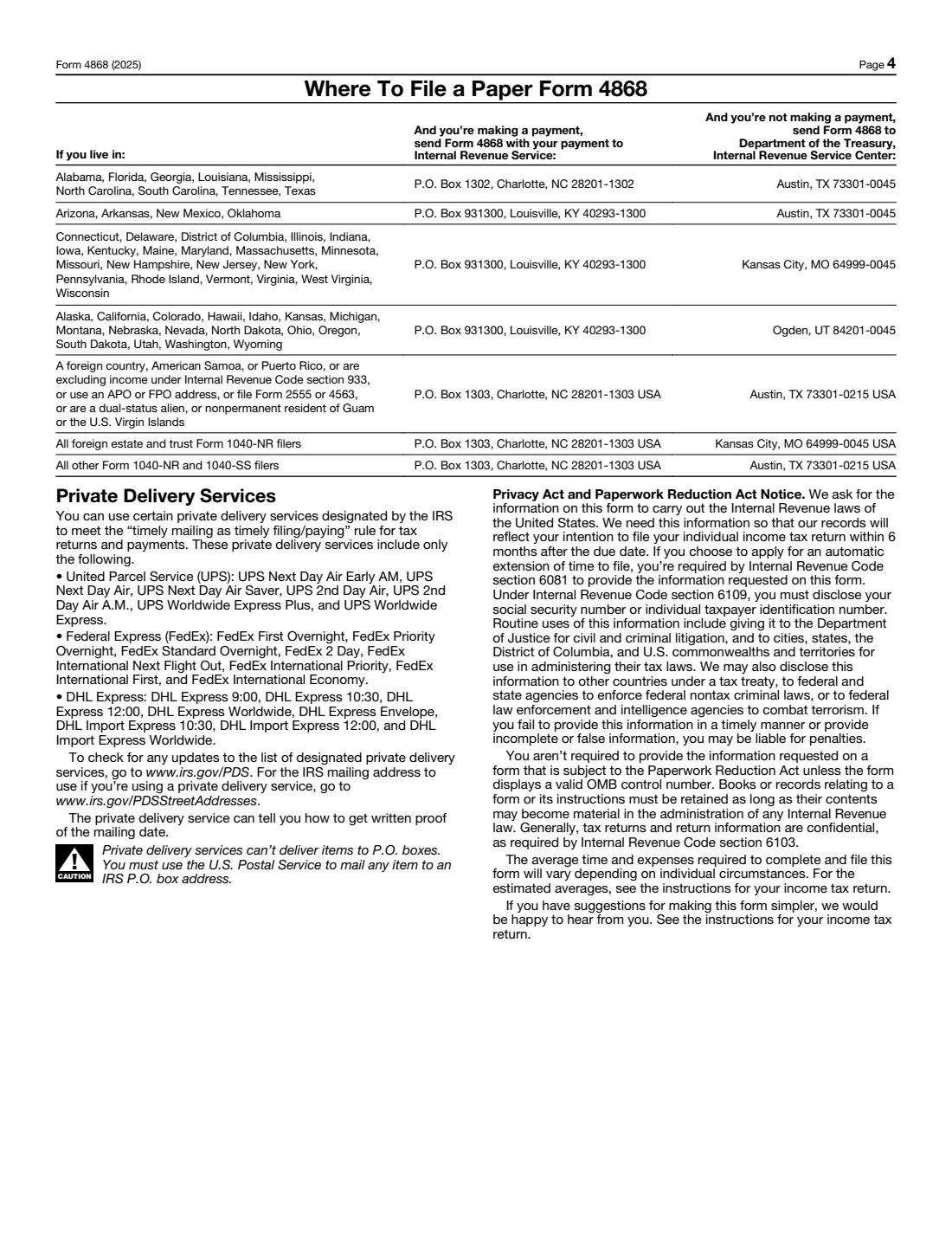
- The IRS, at the address on page 4 for where you live and whether you're enclosing a payment. Or e-file, or pay electronically instead.
- When
- By the due date of your return — April 15, 2026 for most 2025 calendar-year returns.
- Signatures
- None — the voucher has no signature line.
- Edition
- 2025 (created 10/1/25)
- Agency
- Internal Revenue Service (IRS), Department of the Treasury
Who needs to fill out Form 4868?
- Anyone who can't finish their 2025 individual income tax return by the due date and wants to avoid a late filing penalty.
- People waiting on corrected tax documents, such as late or amended 1099s or K-1s.
- Fiscal-year taxpayers, who the form says must file a paper Form 4868.
- U.S. citizens and residents living or serving abroad who need more than the automatic 2 extra months (they check line 8).
- Form 1040-NR filers who can't file on time, including those without U.S. wages subject to withholding, whose return is due June 15, 2026 (line 9).
- People who prefer a paper record of their extension request rather than paying or filing electronically.
When to use Form 4868
- Before the regular due date of your return — for most 2025 calendar-year returns, April 15, 2026. A late Form 4868 doesn't get you an extension.
- If you're out of the country on the due date: you can file the return or this form by June 15, 2026, checking line 8 for the additional 4 months.
- For a fiscal year, by the due date of the fiscal-year return.
- Not if you already paid electronically and marked the payment as an extension — the IRS then processes the extension automatically.
- Not if you want the IRS to figure your tax, or you're under a court order to file your return by the due date. The form says not to file it in those cases.
What you need before you start
- Your name and your spouse's name (if you'll file jointly), in the order they'll appear on the return.
- Your Social Security numbers, or ITINs. If you don't have one and aren't eligible for an SSN, the form says to write ITIN TO BE REQUESTED.
- Your current address, or the address where you want correspondence about the extension sent.
- A reasonable estimate of your total 2025 tax liability — the figure you expect on Form 1040 line 24.
- Your total 2025 payments so far: withholding from W-2s and 1099s, estimated tax payments and similar.
- How much you can pay now, and a check or money order if you're paying by mail.
- Your 2024 tax return, which is handy for estimating (and needed if you e-file the extension).
- Fiscal year start and end dates, if you don't use the calendar year.
What’s on Form 4868
The 2025 edition has 4 pages. FileIt asks for it in 4 parts:
- Part I: IdentificationTaxpayer
- Part II: Individual income taxTaxpayer
- Fiscal tax year (not calendar year 2025)Taxpayer
- Electronic payment confirmation (for your records)Taxpayer
How to fill out Form 4868, step by step
1 Tax year (voucher heading)
Most people leave this alone: the voucher is for calendar year 2025. If you have a fiscal tax year, enter the month and day it begins in 2025, the month and day it ends, and the year it ends. Fiscal-year taxpayers must file on paper.
2 Part I — Identification (lines 1–3)
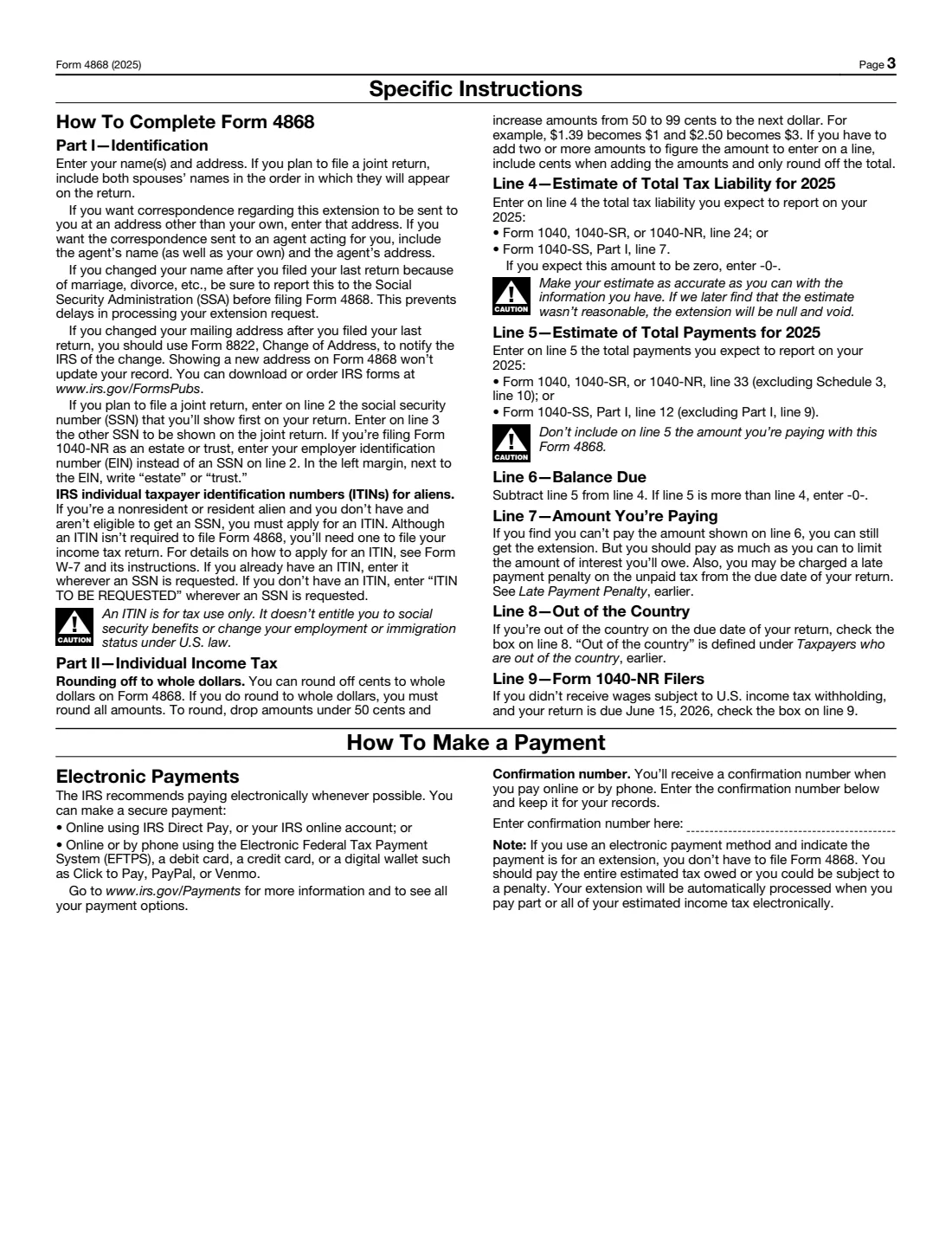
Line 1 is your name, or both names in return order if you plan to file jointly, with your address. You can enter a different address for correspondence about this extension, including an agent's name and address if someone acts for you. A new address here won't update your IRS record — use Form 8822 for that.
Line 2 is your SSN (for a joint return, the one shown first) and line 3 is your spouse's. Enter an ITIN if you have one. A 1040-NR estate or trust enters its EIN on line 2 and writes "estate" or "trust" in the left margin.
3 Line 4 — Estimate of total tax liability for 2025
Enter the total tax you expect to report on Form 1040, 1040-SR or 1040-NR line 24 (Form 1040-SS Part I line 7). If you expect zero, enter zero. The form warns that if the IRS later finds your estimate wasn't reasonable, the extension will be null and void — so make it as accurate as you can.
4 Line 5 — Total 2025 payments
Enter the total payments you expect to report on Form 1040, 1040-SR or 1040-NR line 33, excluding Schedule 3 line 10 (Form 1040-SS Part I line 12, excluding line 9). This includes tax withheld and estimated tax payments. Don't include the amount you're paying with this Form 4868.
5 Line 6 — Balance due
Subtract line 5 from line 4. If line 5 is more than line 4, enter zero. FileIt does this subtraction for you. You may round to whole dollars; if you do, round all amounts.
6 Line 7 — Amount you're paying
Enter what you're sending with the form. You can still get the extension if you can't pay the full balance, but pay as much as you can to limit interest and any late payment penalty. When you file your return, you report this payment on Schedule 3, line 10 (Form 1040-SS: Part I, line 9).
7 Line 8 — Out of the country
Check this box if you're a U.S. citizen or resident who is "out of the country" on the due date: you live outside the United States and Puerto Rico and your main place of work is outside them, or you're on military or naval duty outside them. You already have 2 extra months to file and pay; this form adds 4 more months to file. Interest still runs on tax paid after the regular due date.
8 Line 9 — Form 1040-NR filers
Check this box if you file Form 1040-NR and didn't receive wages as an employee subject to U.S. income tax withholding, so your return is due June 15, 2026.
Common mistakes to avoid
- Thinking the extension gives you more time to pay. It doesn't — interest runs on unpaid tax from the due date, and penalties can apply.
- Entering zero on line 4 without a reasonable estimate. An unreasonable estimate can make the extension void.
- Including the payment you're sending with Form 4868 in line 5. The form says not to.
- Mailing it late. It must be filed by the due date of your return to get the extension.
- Filing a paper Form 4868 after you already e-filed it or paid electronically as an extension payment — unnecessary unless you're paying by check or money order.
- Using a private delivery service to an IRS P.O. box address. The form says those services can't deliver to P.O. boxes.
- Attaching Form 4868 to your return later. The form says not to attach a copy.
- Forgetting to claim the payment you made with the extension on Schedule 3, line 10 when you file.
After you fill it out
Print the PDF, detach the voucher at the "DETACH HERE" line, and mail it by the due date to the address on page 4 that matches where you live and whether you're enclosing a payment — there's one column for mailing with a payment and another for mailing without one. The voucher has no signature. The form lists the IRS-designated private delivery services (UPS, FedEx and DHL services) that count for the timely mailing rule, but they can't deliver to P.O. boxes.
FileIt keeps a copy in your vault folder. If you paid electronically instead, record your confirmation number — FileIt can print it in the box on page 3 for your records. You don't have to explain why you want the extension; the IRS contacts you only if the request is denied.
Then file your return any time before the extended due date — October 15, 2026 for most calendar-year taxpayers. Report any payment made with Form 4868 on Schedule 3, line 10 of Form 1040, 1040-SR or 1040-NR (Form 1040-SS Part I, line 9). If you and your spouse filed separate Forms 4868 but then file jointly, enter the total paid with both.
Fill out Form 4868 online with FileIt
- Pick the person. Choose someone from People and FileIt fills in their name, date of birth, address and other details it already knows.
- Answer plain-language questions. One part of the form at a time, with the official help text beside each question — 19 fields in all. Your answers save as you go.
- Check the live preview. Watch your answers land on the real Internal Revenue Service (IRS) form, and let FileIt do any worksheet arithmetic.
- Generate the official PDF. FileIt prints your answers into the agency’s own PDF and files it in that person’s folder in your vault.
FileIt fills the form — it never files or submits anything for you. Deliver the finished form to whoever asked for it, the way the form’s instructions say.
Start Form 4868 now — it’s freeForm 4868: frequently asked questions
Can I fill out Form 4868 online?
Yes. FileIt guides you through the voucher, calculates the balance due on line 6, and prints your answers into the official IRS PDF, saved in your vault. Filling forms is available on every FileIt account, including the free plan. You then mail the paper voucher yourself; FileIt doesn't e-file.
Where do I mail Form 4868?
Page 4 of the form has a table by state (and for foreign addresses and 1040-NR filers). Each row gives one address if you're making a payment and another if you're not. Use the U.S. Postal Service for any IRS P.O. box address.
Does Form 4868 extend the time to pay my taxes?
No. It extends only the time to file. If you don't pay the amount due by the regular due date, you'll owe interest and may be charged a late payment penalty. The form explains you're considered to have reasonable cause for the extension period if at least 90% of your total tax is paid by the due date and the rest is paid with the return.
How long is the extension?
Six months — generally to October 15, 2026, for 2025 calendar-year returns. If you're out of the country and a U.S. citizen or resident, you already have 2 extra months, and Form 4868 with line 8 checked adds 4 more.
Do I need to file Form 4868 if I pay electronically?
No. The form says that if you pay part or all of your estimated income tax electronically and indicate the payment is for an extension, the IRS automatically processes the extension. Keep your confirmation number.
Do I need to sign Form 4868?
No. The paper voucher has no signature line.
Can my spouse and I file one Form 4868?
Yes, if you plan to file jointly: enter both names in return order and both SSNs. If you file separate Forms 4868 but later file jointly, you add the payments together on the joint return.
Does Form 4868 also extend my gift tax return?
An extension to file your 2025 calendar-year income tax return also extends the time to file Form 709 or 709-NA for 2025, but not the time to pay any gift and GST tax. The form points to Form 8892 for making that payment.
What if I owe nothing?
You can still file Form 4868 to extend the filing deadline. Enter zero on line 4 if you expect no tax liability, and complete lines 5 and 6.
Official sources
- Blank form (PDF), published by Internal Revenue Service (IRS): https://www.irs.gov/pub/irs-pdf/f4868.pdf
- Official instructions and guidance: https://www.irs.gov/forms-pubs/about-form-4868
- Edition shown on this page: 2025 (created 10/1/25) (checked 2026-09-26).
FileIt is not affiliated with or endorsed by Internal Revenue Service (IRS) or any government. This page explains the form in general terms and is not legal, tax or immigration advice. Always read the official instructions, and check that you are using the edition the recipient accepts. Page last reviewed 2026-09-26.