What is Form W-4P?
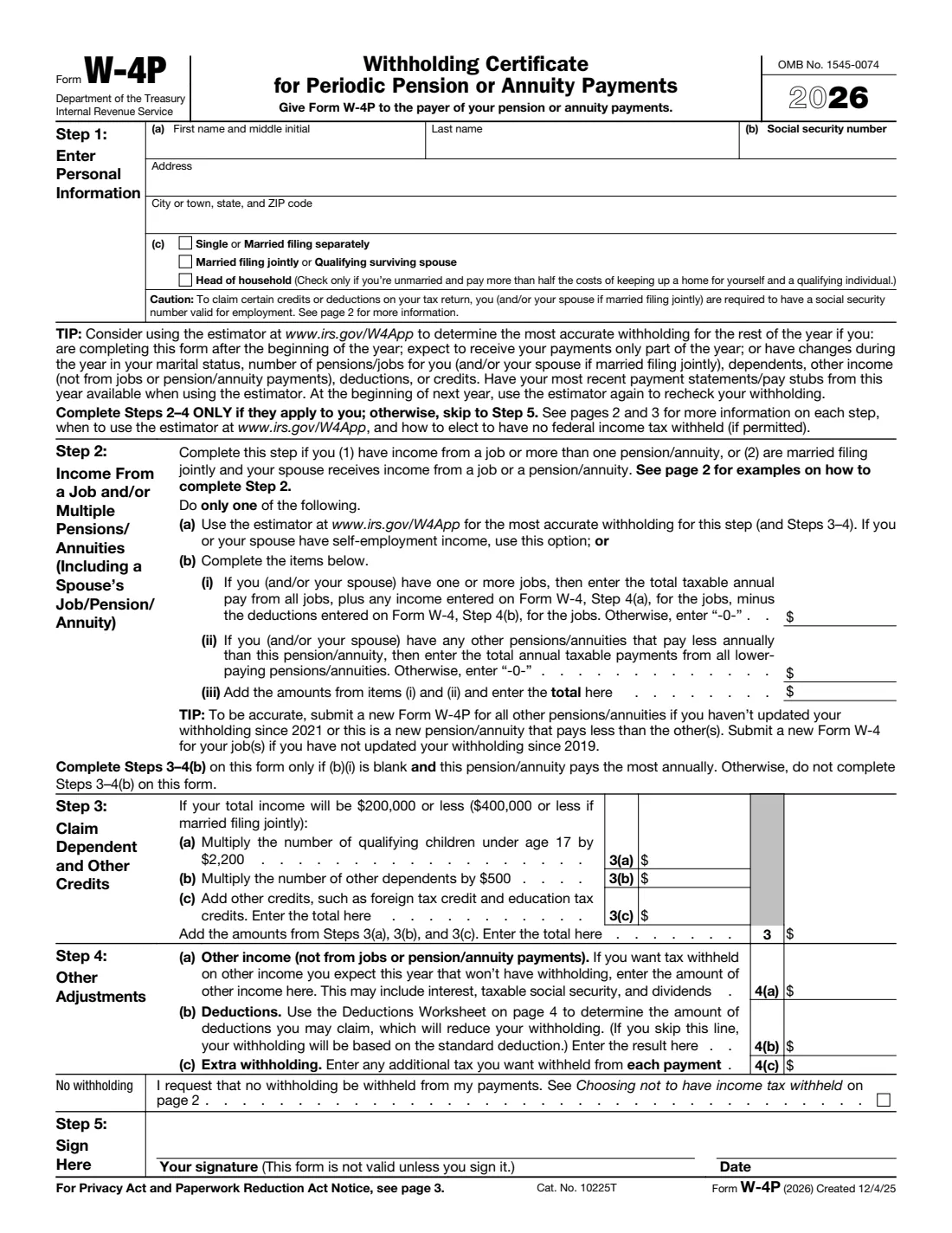
Form W-4P, the Withholding Certificate for Periodic Pension or Annuity Payments, tells the payer of your pension, annuity, profit-sharing or stock bonus plan, or IRA payments how much federal income tax to withhold. It works much like the Form W-4 employees give their employers, but it is built for retirement income: Step 2 accounts for a job and for other pensions or annuities, and there is a box to choose no withholding at all. You give the completed form to your payer, such as the pension plan administrator or insurance company, not to the IRS.
It applies only to periodic payments — installments paid at regular intervals, such as monthly, quarterly or annually, over more than one year. For a one-time or nonperiodic payment, or an eligible rollover distribution such as a lump-sum pension payment, the IRS uses a different form, Form W-4R. Getting the W-4P right matters because withholding is how most retirees pay their income tax during the year: too little can mean a bill and possibly a penalty when you file, too much means smaller payments than you needed.
FileIt walks you through each step of the 2026 W-4P in plain language and prints your answers into the IRS's own official PDF. It pre-fills your name from the People records in your vault, multiplies out the Step 3 credits, adds up Step 2(b), and does every line of the Step 4(b) Deductions Worksheet, including the standard deduction and the additional amount for people 65 or older. The finished PDF is saved in your vault folder, and you can send it for e-signature if your payer accepts that. You then give it to your payer yourself — FileIt never sends anything to the IRS or to your payer.
- Who fills it
- The person receiving the pension, annuity or IRA payments (the payee).
- Given to
- The payer of your pension or annuity. Do not send it to the IRS.
- When
- When periodic payments start, and whenever you want to change your withholding.
- Signatures
- You sign and date Step 5. The form is not valid unless you sign it.
- Edition
- 2026 (created 12/4/25)
- Agency
- Internal Revenue Service (IRS), Department of the Treasury
Who needs to fill out Form W-4P?
- Retirees receiving a monthly or other periodic pension from a former employer's plan.
- People receiving periodic payments from a commercial annuity, profit-sharing plan or stock bonus plan.
- IRA owners taking scheduled periodic distributions (IRA distributions payable on demand count as nonperiodic and use Form W-4R instead).
- Anyone with more than one pension or annuity — you submit a separate W-4P to each payer.
- Retirees who also work, or whose spouse works or receives a pension, and want withholding that reflects all that income.
- People who want no federal income tax withheld from their payments, where that choice is permitted.
When to use Form W-4P
- When you start receiving a new pension or annuity. If you don't give the payer a W-4P, it withholds as if you were single with no adjustments.
- When you marry, divorce, or your spouse starts or stops working or receiving a pension.
- When you take a job in retirement or leave one, since Step 2 depends on income from jobs.
- When your deductions or credits change, for example you or your spouse turn 65 or your itemized deductions change.
- When you owed tax or received a large refund last year and want to adjust. For payments that began before 2026, your current election stays in effect until you submit a new W-4P.
- At the start of each year, the form suggests rechecking your withholding with the IRS estimator at www.irs.gov/W4App.
What you need before you start
- Your full name, address and Social Security number.
- Your expected filing status for 2026.
- The annual taxable amount of this pension or annuity, and of any other pensions or annuities you or your spouse receive.
- Taxable annual pay from any jobs you or your spouse have, and the Step 4(a) and 4(b) amounts from the Form W-4 for those jobs.
- The number of qualifying children under 17 and other dependents, if you'll claim them here.
- Estimates of other income without withholding, such as interest, dividends and taxable Social Security.
- Estimates of deductions, if you want to use the Deductions Worksheet: itemized deductions, IRA contributions, student loan interest and similar items.
- Your most recent payment statements, especially if you're completing the form partway through the year.
What’s on Form W-4P
The 2026 edition has 4 pages. FileIt asks for it in 6 parts, and it is signed by Payee (the person receiving the pension or annuity):
- Step 1: Personal informationPayee (the person receiving the pension or annuity)
- Step 2: Income from a job and/or multiple pensions/annuitiesPayee (the person receiving the pension or annuity)
- Step 3: Claim dependent and other creditsPayee (the person receiving the pension or annuity)
- Step 4: Other adjustmentsPayee (the person receiving the pension or annuity)
- No withholdingPayee (the person receiving the pension or annuity)
- Step 4(b) — Deductions WorksheetPayee (the person receiving the pension or annuity)
How to fill out Form W-4P, step by step
1 Step 1: Enter Personal Information
Enter your name, address and Social Security number, then check your anticipated filing status: "Single or Married filing separately", "Married filing jointly or Qualifying surviving spouse", or "Head of household". The status determines the standard deduction and tax rates the payer uses to compute your withholding.
Head of household is only for someone unmarried who pays more than half the costs of keeping up a home for themselves and a qualifying individual. If you don't give an SSN, or the IRS tells the payer the number is wrong, the payer withholds as if you were single with no adjustments.
2 Step 2: Income From a Job and/or Multiple Pensions/Annuities
Complete this step if you have income from a job or more than one pension or annuity, or you're married filing jointly and your spouse receives income from a job, pension or annuity. Do only one of two options: use the IRS estimator (the form's choice if you or your spouse have self-employment income), or fill in items (i) to (iii).
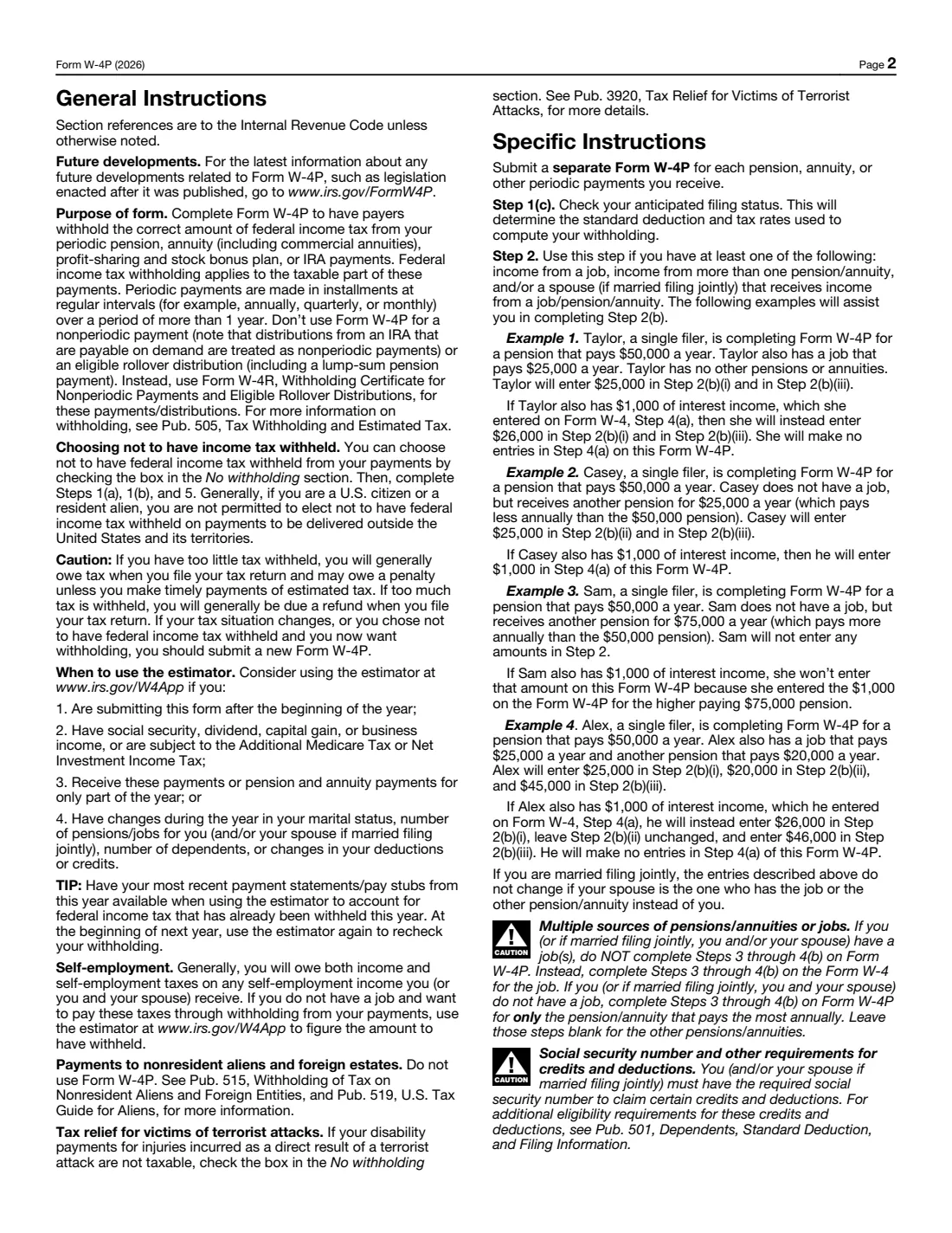
Item (i) is total taxable annual pay from all jobs, adjusted by the Step 4(a) income and Step 4(b) deductions on the W-4 for those jobs. Item (ii) is the total from other pensions or annuities that pay less each year than this one — leave out any that pay more. Item (iii) is the sum, which FileIt adds for you. Page 2 of the form has worked examples: a single filer with this $50,000 pension and a $25,000 job enters $25,000 in (i) and (iii).
3 Step 3: Claim Dependent and Other Credits
Only if your total income will be $200,000 or less ($400,000 or less if married filing jointly). On the 2026 edition you multiply qualifying children under age 17 by $2,200 and other dependents by $500, and add other credits such as the foreign tax credit and education credits. FileIt does the multiplication and the total.
The key rule: complete Steps 3 through 4(b) on this form only if Step 2(b)(i) is blank and this pension or annuity pays the most annually. If you or your spouse have a job, claim these on the Form W-4 for the job instead, and if you have several pensions, use them only on the one that pays the most.
4 Step 4: Other Adjustments
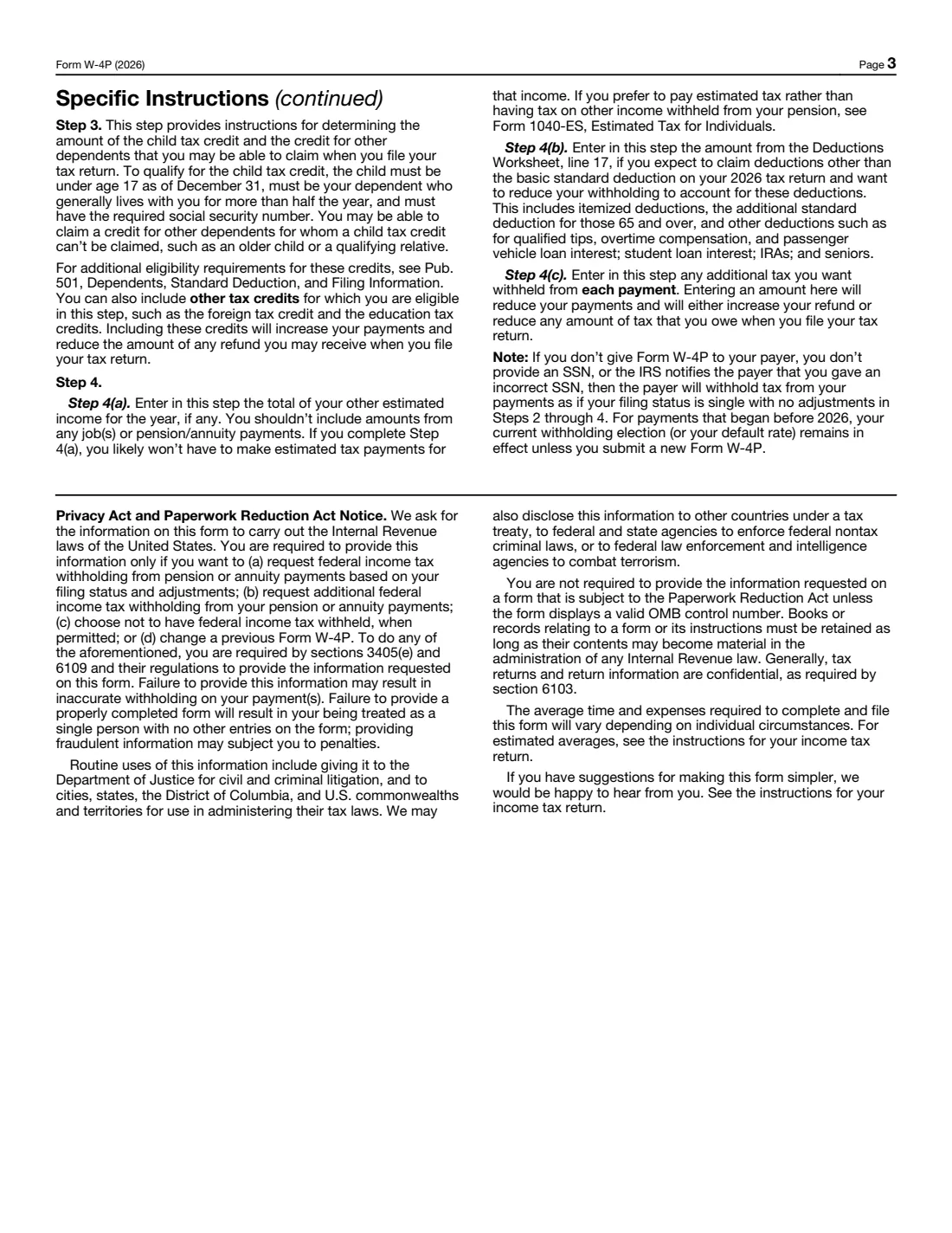
Step 4(a) is other income you expect this year that won't have withholding — interest, taxable Social Security and dividends, for example — so tax on it comes out of your pension instead of through estimated payments. Step 4(b) is the result of the Deductions Worksheet, which lowers withholding if you expect more than the basic standard deduction. Step 4(c) is any extra tax you want withheld from each payment.
If you skip 4(b), withholding is based on the standard deduction. Extra withholding in 4(c) reduces each payment but increases your refund or reduces what you owe.
5 No withholding
Check this box if you want no federal income tax withheld from your payments, then complete only Steps 1(a), 1(b) and 5. Generally, U.S. citizens and resident aliens can't choose no withholding on payments delivered outside the United States and its territories.
The form cautions that if too little tax is withheld you'll generally owe tax when you file and may owe a penalty unless you make timely estimated tax payments. You can change your mind later by submitting a new W-4P.
6 Step 5: Sign Here
Sign and date the form. The W-4P says plainly that it is not valid unless you sign it.
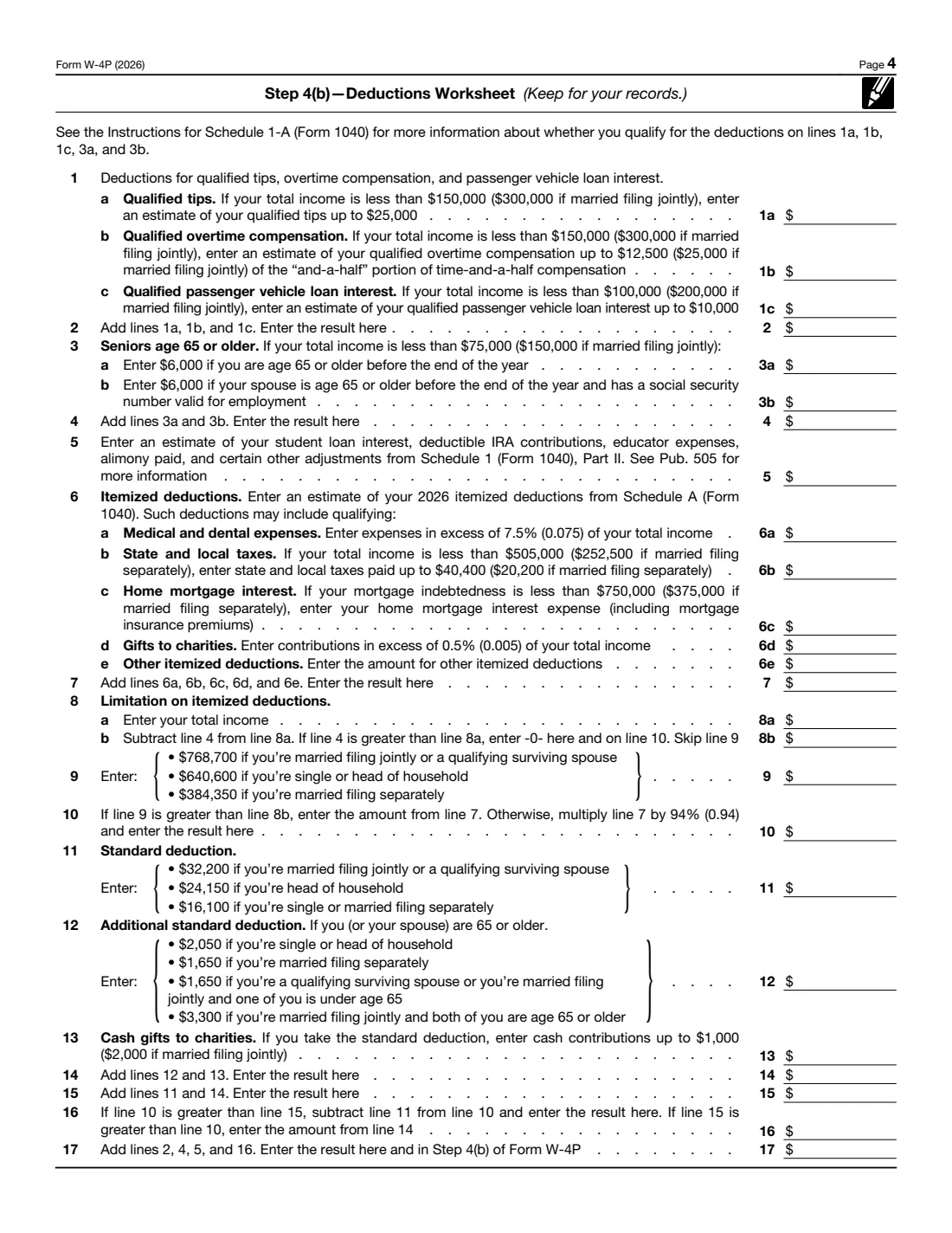
7 Step 4(b) — Deductions Worksheet
Page 4 has 17 lines. Lines 1a–1c cover qualified tips, overtime compensation and passenger vehicle loan interest; lines 3a and 3b are the $6,000 amounts for you and your spouse if 65 or older (each with income limits printed on the form); line 5 covers adjustments such as student loan interest and deductible IRA contributions; lines 6a–6e are itemized deductions, limited on lines 8–10 for very high incomes.
Lines 11 to 16 compare your itemized deductions with the standard deduction plus the additional standard deduction for people 65 or older (line 12) and any cash gifts to charity if you take the standard deduction (line 13). Line 17 adds it all up and goes into Step 4(b). FileIt fills in the standard deduction and the additional amount from your filing status and ages, and does every addition and comparison.
Common mistakes to avoid
- Using W-4P for a lump sum or rollover. Nonperiodic payments and eligible rollover distributions use Form W-4R.
- Completing Steps 3 to 4(b) on every W-4P. Use them on only the pension that pays the most, and not at all on a W-4P if you or your spouse have a job.
- Listing a pension that pays more than this one in Step 2(b)(ii). Only lower-paying pensions or annuities go there.
- Leaving out a spouse's job or pension when married filing jointly, which can leave too little withheld.
- Checking no withholding and still filling in Steps 2 to 4. With no withholding you complete only Steps 1(a), 1(b) and 5.
- Counting the same other income twice. If you already put interest income on a W-4 or another W-4P, don't enter it again here.
- Forgetting to sign — an unsigned W-4P is not valid.
- Sending the form to the IRS. It goes to your pension or annuity payer.
After you fill it out
Sign and date Step 5, by hand on the printed PDF or through FileIt's optional e-signature if your payer accepts electronically signed forms. Then give it to the payer of your pension or annuity, following their instructions — many plan administrators and insurers have their own mailing address or upload process for tax forms. Don't send it to the IRS.
FileIt saves the completed PDF in your vault folder, so you have a record of exactly what you gave each payer. The Deductions Worksheet is marked "Keep for your records" on the form; your payer only needs page 1.
Check your next payment statement to confirm the new withholding took effect. Submit a new W-4P whenever your situation changes, and recheck at the start of each year. If you have several pensions, remember that each payer needs its own W-4P.
Fill out Form W-4P online with FileIt
- Pick the person. Choose someone from People and FileIt fills in their name, date of birth, address and other details it already knows.
- Answer plain-language questions. One part of the form at a time, with the official help text beside each question — 49 fields in all. Your answers save as you go.
- Check the live preview. Watch your answers land on the real Internal Revenue Service (IRS) form, and let FileIt do any worksheet arithmetic.
- Generate the official PDF. FileIt prints your answers into the agency’s own PDF and files it in that person’s folder in your vault. Sign it, or send it for e-signature.
FileIt fills the form — it never files or submits anything for you. Deliver the finished form to whoever asked for it, the way the form’s instructions say.
Start Form W-4P now — it’s freeForm W-4P: frequently asked questions
Can I fill out Form W-4P online?
Yes. With FileIt you answer guided questions and your answers are printed into the official IRS W-4P PDF, with Step 2(b), Step 3 and the Deductions Worksheet calculated for you. Filling forms is available on every FileIt account, including the free plan. You then sign it and give it to your payer yourself.
Where do I send Form W-4P?
To the payer of your pension or annuity, not the IRS. The form's own heading says "Give Form W-4P to the payer of your pension or annuity payments." Your plan administrator or insurer will tell you how they want to receive it.
What is the difference between Form W-4P and Form W-4R?
W-4P is for periodic payments made in installments over more than one year, like a monthly pension. W-4R is for nonperiodic payments and eligible rollover distributions, such as a lump-sum payment or an IRA distribution payable on demand.
What is the difference between Form W-4P and Form W-4?
Form W-4 is for wages from a job and goes to your employer. Form W-4P is for pension and annuity payments and goes to the payer. The W-4P's Step 2 accounts for jobs and other pensions, and it has a box to choose no withholding.
Can I have no federal tax withheld from my pension?
Generally yes, by checking the No withholding box and completing only Steps 1(a), 1(b) and 5. U.S. citizens and resident aliens generally can't choose this for payments delivered outside the United States and its territories. You may owe tax and a penalty at filing time if too little is withheld.
What happens if I don't submit a W-4P?
For new payments, the form says the payer withholds as if your filing status is single with no adjustments in Steps 2 through 4. For payments that began before 2026, your current withholding election or default rate stays in effect until you submit a new W-4P.
I have two pensions. Do I fill out two W-4Ps?
Yes, one for each payer. On the W-4P for the pension that pays more, enter the smaller pension in Step 2(b)(ii) and complete Steps 3 to 4(b) there if you have no job. Leave Steps 3 to 4(b) blank on the other one.
Does the W-4P include the extra deduction for people over 65?
Yes. The 2026 Deductions Worksheet has lines 3a and 3b ($6,000 each for you and your spouse if 65 or older, subject to the income limits printed there) and line 12, the additional standard deduction. FileIt fills in line 12 from your filing status and who is 65 or older.
Official sources
- Blank form (PDF), published by Internal Revenue Service (IRS): https://www.irs.gov/pub/irs-pdf/fw4p.pdf
- Official instructions and guidance: https://www.irs.gov/forms-pubs/about-form-w-4-p
- Edition shown on this page: 2026 (created 12/4/25) (checked 2026-09-26).
FileIt is not affiliated with or endorsed by Internal Revenue Service (IRS) or any government. This page explains the form in general terms and is not legal, tax or immigration advice. Always read the official instructions, and check that you are using the edition the recipient accepts. Page last reviewed 2026-09-26.