What is SSP1 Statutory Sick Pay: employee not entitled?
Form SSP1 is the employer form an employer must fill in when an employee can't get Statutory Sick Pay (SSP), or when an employee's SSP has come or is coming to an end. It is published by the Department for Work and Pensions (DWP), and HM Revenue & Customs runs the Employer helpline printed on it. The employer fills it in and gives it to the employee. It isn't sent to DWP or HMRC by the employer.
The employee uses SSP1 to support a claim for benefits, such as Universal Credit or New Style Employment and Support Allowance. The form says why SSP can't be paid and gives the date from which it can't be paid, and it explains to the employee what to do next. The 2026/27 edition (03/26) is the one to use from April 2026.
FileIt takes you through the form in plain English: the employee's details, whether you've been paying SSP and until when, the reasons SSP isn't payable, and your declaration. Your answers are printed into DWP's own SSP1 PDF, names with accents included, and the finished form is saved in your FileIt vault. You print it, sign it by hand and give it to your employee. FileIt never sends it anywhere.
- Who fills it
- The employer (payroll, HR or a director)
- Given to
- The employee, with any fit notes covering the period SSP can't be paid for
- When (GOV.UK)
- Within 7 days of the first day off sick if SSP isn't due; within 7 days of SSP ending if it ends unexpectedly; by the start of the 23rd week if SSP will end before the sickness
- Signatures
- The employer signs the declaration by hand; an employer's stamp is optional
- Edition
- SSP1 03/26 (Version 3), 2026/27
- Length
- 6 pages, 17 numbered questions plus the reasons page
Who needs to fill out SSP1 Statutory Sick Pay: employee not entitled?
- An employer whose employee is off sick but doesn't qualify for Statutory Sick Pay at all, for example because they haven't started work yet or didn't tell you about the sickness.
- An employer whose employee has had, or will soon have had, 28 weeks of SSP in a row or in linked spells.
- An employer whose employee's contract has ended or is ending while they are sick.
- An employer whose employee is expecting a baby or has just had one, where SMP or Maternity Allowance takes over from SSP.
- Payroll bureaus and accountants who complete SSP paperwork for client businesses.
- Employees who want to know what the form they've been given means. The reasons page explains each reason to them.
When to use SSP1 Statutory Sick Pay: employee not entitled
- When an employee who is off sick doesn't qualify for SSP. GOV.UK says to send SSP1 within 7 days of their first day off sick.
- When SSP ends unexpectedly while the employee is still sick. GOV.UK says to send it within 7 days of SSP ending.
- When SSP is expected to end before the sickness does, for example at 28 weeks. GOV.UK says to send it on or before the beginning of the 23rd week.
- You can also fill it in before SSP ends if you know an employee will be off sick for more than 28 weeks, so they can apply for ESA in good time.
What you need before you start
- The employee's title, surname, other names in full and home address with postcode.
- Their National Insurance number, clock or payroll number and their PAYE tax reference, from your payroll records.
- If you've been paying SSP: the date it started and the date it ended or will end.
- The first date from which SSP can't be paid, and the reason or reasons.
- Any fit notes or other medical information the employee gave you that cover the period you can't pay SSP for.
- Your business name, address, phone number, email and your position, plus your company stamp if you use one.
What’s on SSP1 Statutory Sick Pay: employee not entitled
The 2026 edition has 6 pages. FileIt asks for it in 4 parts, and it is signed by Employer:
- About your employee (10–17)Employer
- Why your employee cannot get Statutory Sick PayEmployer
- Medical informationEmployer
- If you are an employer — declaration (01–09)Employer
How to fill out SSP1 Statutory Sick Pay: employee not entitled, step by step
1 Medical information (page 1)
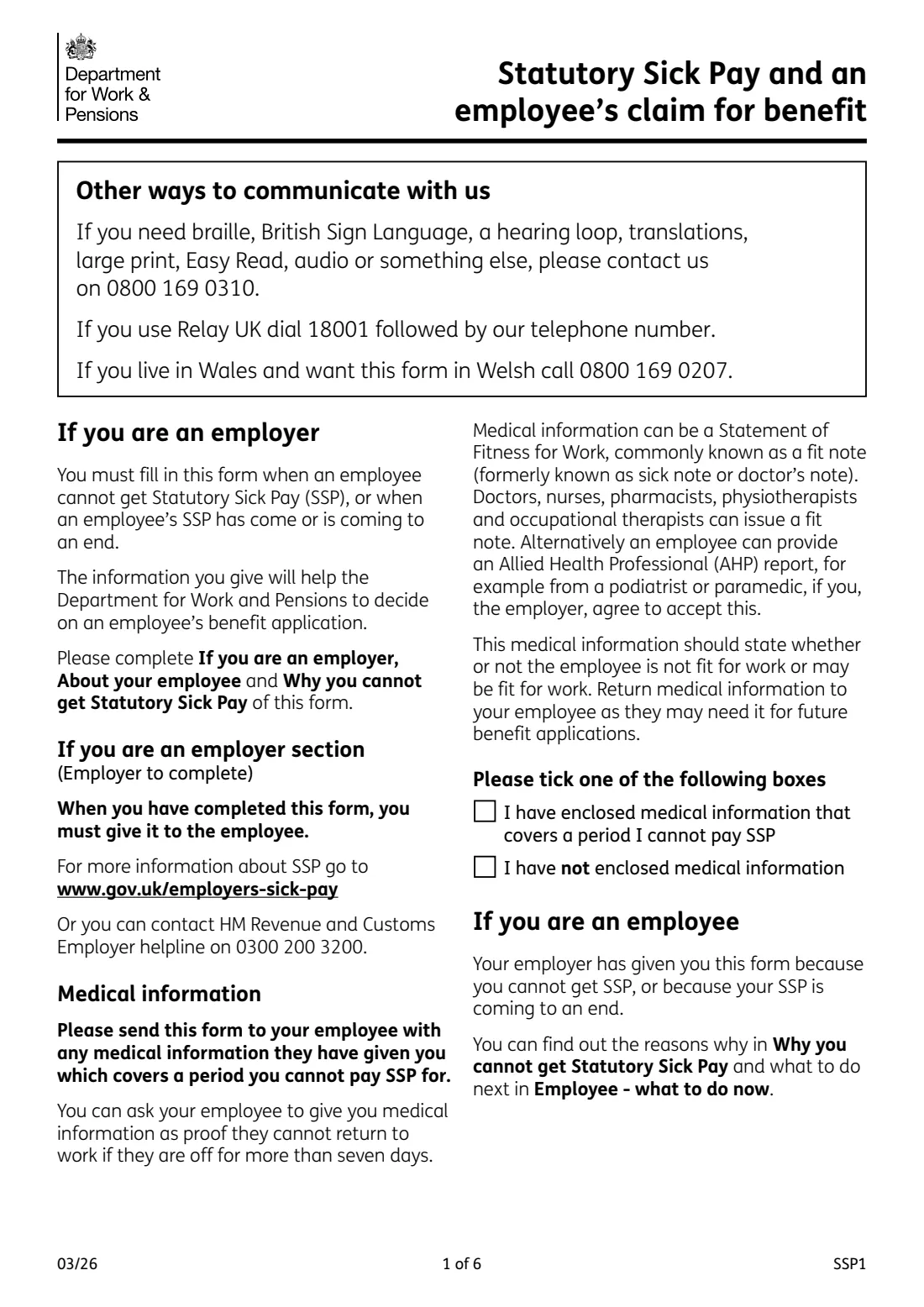
Tick whether you're sending back medical information, such as a fit note, that covers a period you can't pay SSP for. Return it to the employee with the form, because they may need it for a benefit claim.
2 Your declaration (questions 01 to 09)
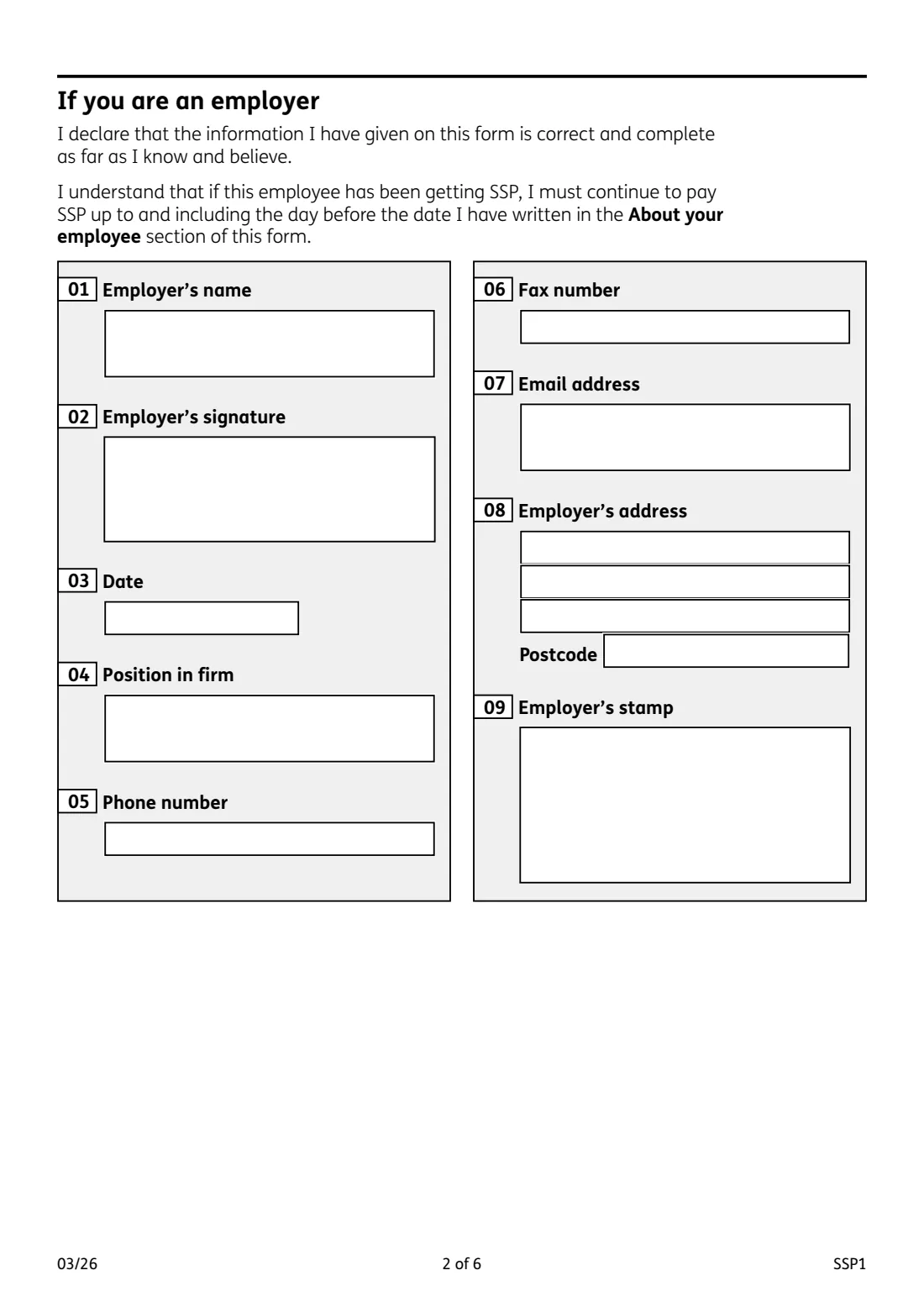
Your business name, the date, your position in the firm, phone, fax and email, and the business address. Question 02 is the signature box, signed by hand after printing, and 09 is room for a company stamp.
By signing you declare the information is correct and complete, and that if the employee has been getting SSP you'll keep paying it up to and including the day before the date you give.
3 About your employee (questions 10 to 16)
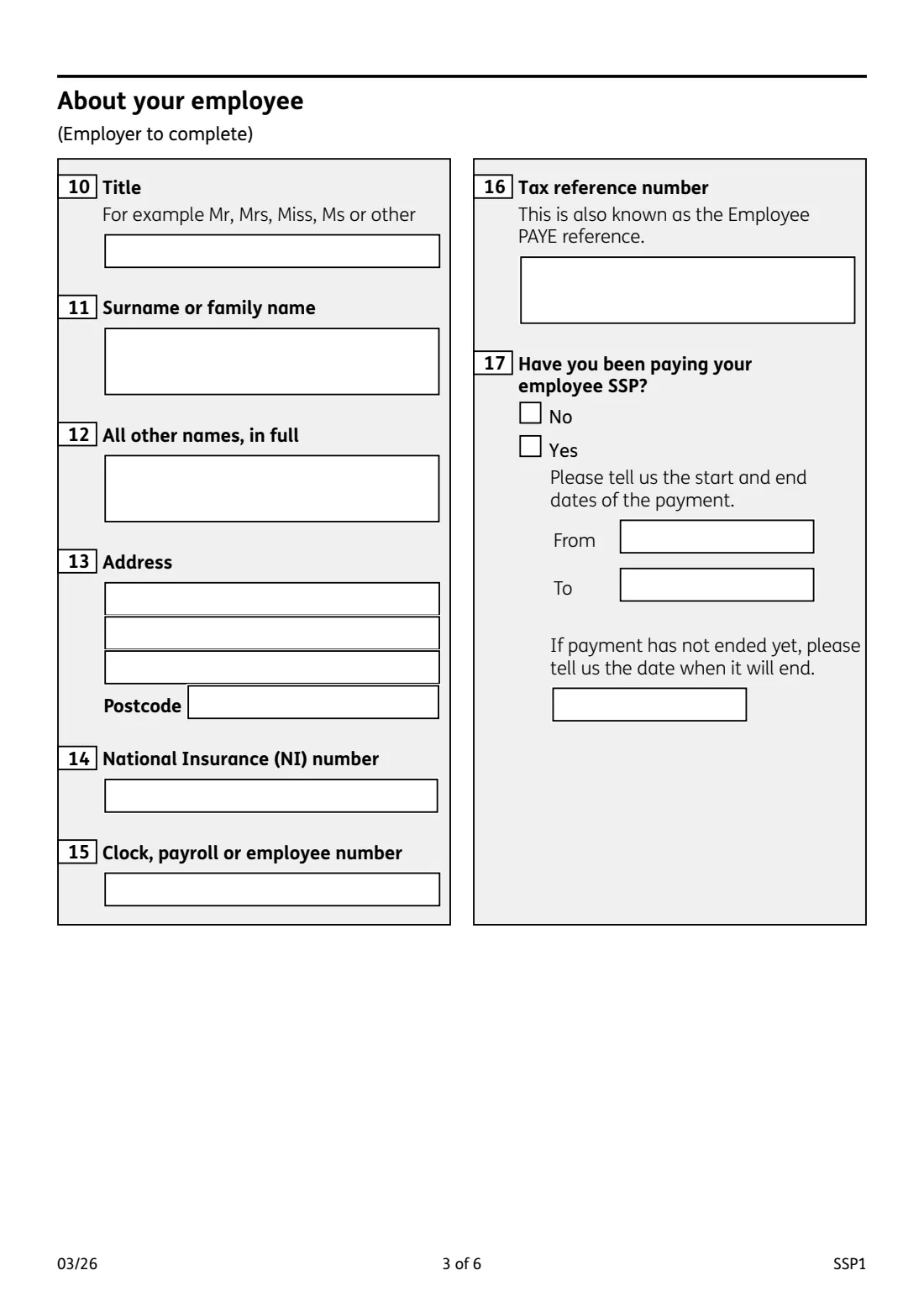
The employee's title, surname, all other names in full, home address and postcode, National Insurance number, clock or payroll number and the tax (PAYE) reference.
FileIt checks the shape of the NI number and postcode and prints accented or Polish letters in names correctly.
4 Have you been paying SSP? (question 17)
If you haven't, tick No. If you have, tick Yes and give the date SSP was paid from. If it has already ended, give the 'To' date. If it hasn't ended yet, give the date it will end. FileIt asks which case applies and fills the right box.
5 Why you cannot get Statutory Sick Pay (page 4)
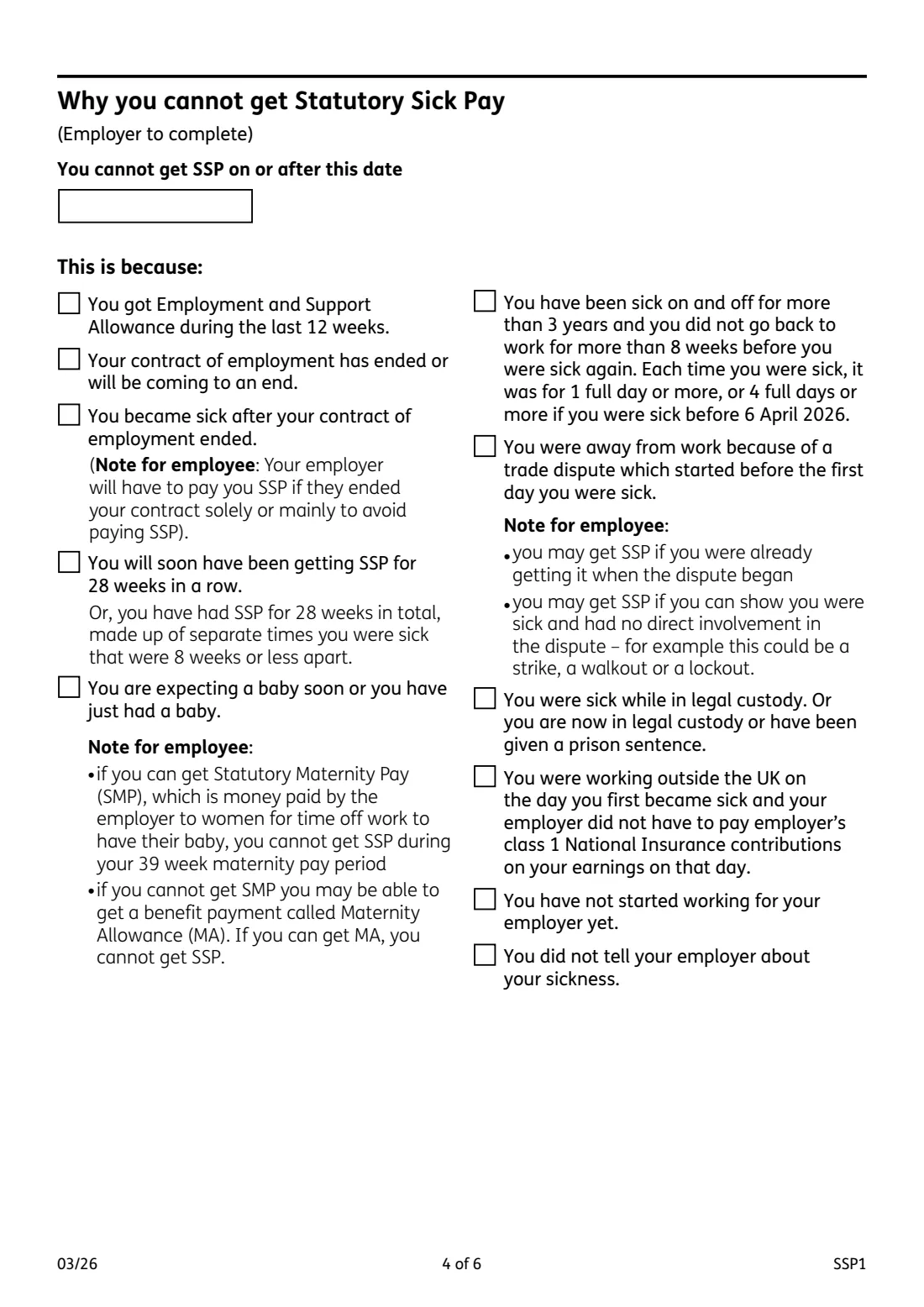
Give the date from which the employee can't get SSP, then tick each reason that applies. The reasons include: Employment and Support Allowance in the last 12 weeks, the contract ending, falling sick after the contract ended, 28 weeks of SSP, pregnancy or a recent birth, being sick on and off for more than 3 years, a trade dispute, legal custody, working abroad without employer's class 1 NICs, not having started work yet, and not telling you about the sickness.
The form addresses these to the employee ('you'), with notes explaining each one.
Common mistakes to avoid
- Using an old edition. The 2026/27 form (03/26) reflects the rules from 6 April 2026.
- Leaving out the date from which SSP can't be paid. The employee's benefit claim depends on it.
- Stopping SSP too early. The declaration says you must keep paying it up to and including the day before the date you give.
- Not ticking a reason, or ticking one that doesn't match the dates you gave.
- Keeping the employee's fit notes. Send them back with the form so they can use them for their claim.
- Missing the time limit. GOV.UK gives 7 days in most cases, or the start of the 23rd week when SSP will run out before the sickness does.
- Forgetting to sign box 02.
After you fill it out
Print the completed SSP1, sign it by hand in box 02 and add your stamp in box 09 if you have one.
Give it to the employee, with any medical information that covers the period you can't pay SSP for. The employee uses it for a claim to Universal Credit or New Style ESA. The form itself isn't a benefit claim.
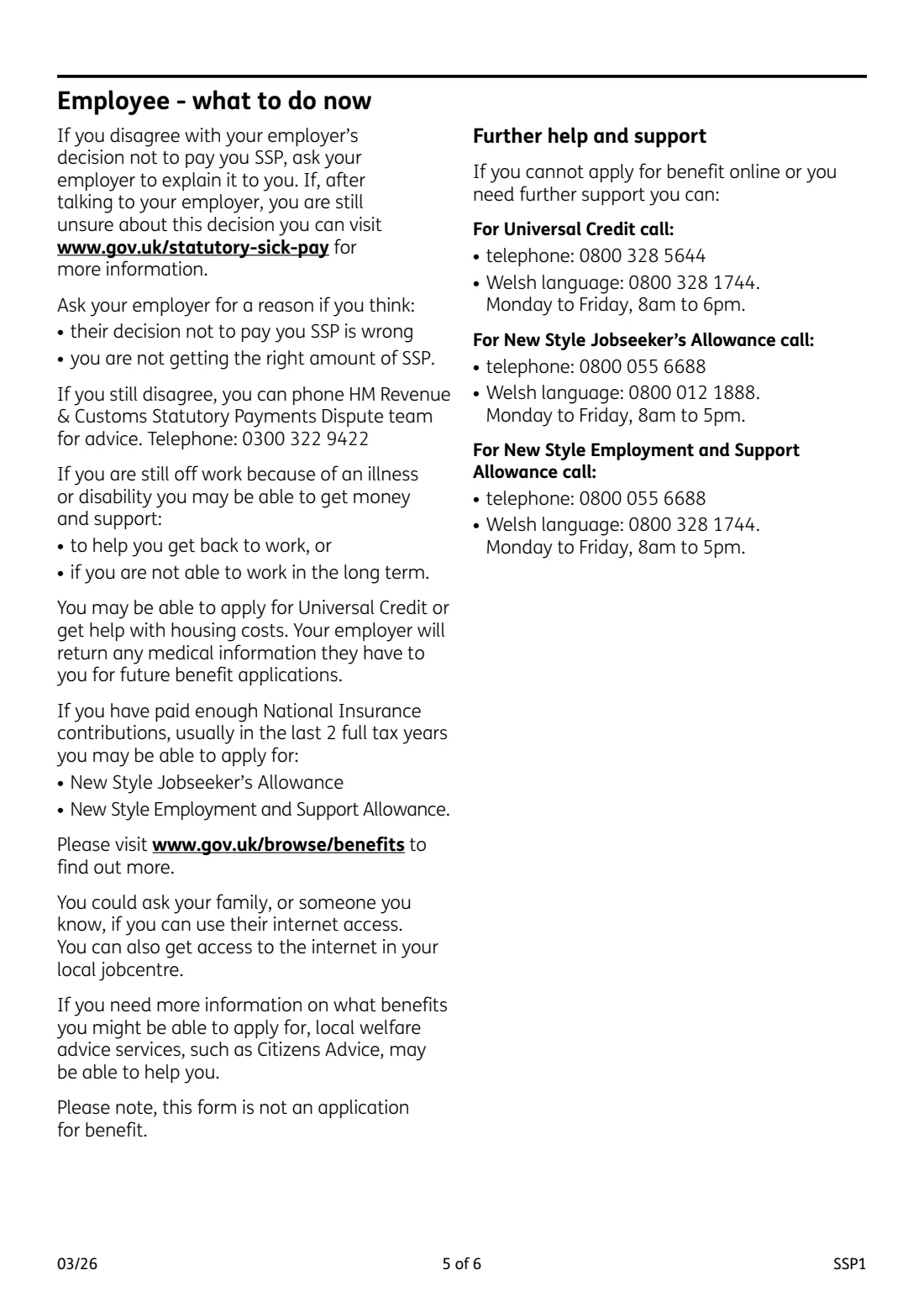
Keep a copy with your SSP records. FileIt keeps the finished PDF in your vault. If the employee disagrees with your decision, they can ask you to explain it and then contact HMRC's Statutory Payment Disputes Team, whose number is printed on the form.
Fill out SSP1 Statutory Sick Pay: employee not entitled online with FileIt
- Pick the person. Choose someone from People and FileIt fills in their name, date of birth, address and other details it already knows.
- Answer plain-language questions. One part of the form at a time, with the official help text beside each question — 39 fields in all. Your answers save as you go.
- Check the live preview. Watch your answers land on the real Department for Work and Pensions (DWP), with HM Revenue & Customs form, and let FileIt do any worksheet arithmetic.
- Generate the official PDF. FileIt prints your answers into the agency’s own PDF and files it in that person’s folder in your vault. Sign it, or send it for e-signature.
FileIt fills the form — it never files or submits anything for you. Deliver the finished form to whoever asked for it, the way the form’s instructions say.
Start SSP1 Statutory Sick Pay: employee not entitled now — it’s freeSSP1 Statutory Sick Pay: employee not entitled: frequently asked questions
What is form SSP1?
SSP1 is the employer form used when an employee can't get Statutory Sick Pay, or when their SSP has ended or is ending. The employer fills it in and gives it to the employee, who uses it to claim benefits such as Universal Credit or New Style Employment and Support Allowance.
When do I have to give an employee form SSP1?
GOV.UK says within 7 days of their first day off sick if they don't qualify for SSP, within 7 days of SSP ending if it ends unexpectedly while they're still sick, or on or before the beginning of the 23rd week if SSP is expected to end before their sickness does.
Do I send SSP1 to HMRC or DWP?
No. You give the completed form to your employee. They use it to support their own benefit claim.
Can I fill in SSP1 online?
Yes, with FileIt. You answer the questions on screen, FileIt prints them into the official SSP1 PDF and saves it in your vault, and you print, sign and hand it over. FileIt doesn't send it anywhere.
Which SSP1 should I use from April 2026?
The 2026/27 edition, dated 03/26 and headed 'from April 2026' on GOV.UK. A Welsh-language SSP1W is also published.
What if my employee disagrees?
The form tells them to ask you to explain your decision first. If they still disagree, they can phone HMRC's Statutory Payment Disputes Team for advice. The number is printed on page 5.
Do I have to return the employee's fit notes?
The form asks you to send any medical information the employee gave you that covers a period you can't pay SSP for back with the form, because they may need it for a benefit claim.
Official sources
- Blank form (PDF), published by Department for Work and Pensions (DWP), with HM Revenue & Customs: https://assets.publishing.service.gov.uk/media/69ca7cce95a323ea3496ed27/SSP1_from_April_2026.pdf
- Official instructions and guidance: https://www.gov.uk/government/publications/statutory-sick-pay-employee-not-entitled-form-for-employers
- Edition shown on this page: SSP1 03/26 (Version 3), for 2026/27 — from April 2026 (checked 2026-09-28).
FileIt is not affiliated with or endorsed by Department for Work and Pensions (DWP), with HM Revenue & Customs or any government. This page explains the form in general terms and is not legal, tax or immigration advice. Always read the official instructions, and check that you are using the edition the recipient accepts. Page last reviewed 2026-09-28.