What is the street outreach contact log form template?
Outreach teams meet people at night, in doorways and encampments, often several times before someone accepts help. Each contact matters: where someone was found, how long they've been out, what they need and whether they agreed to a referral. Notes on paper or in a phone get lost between shifts.
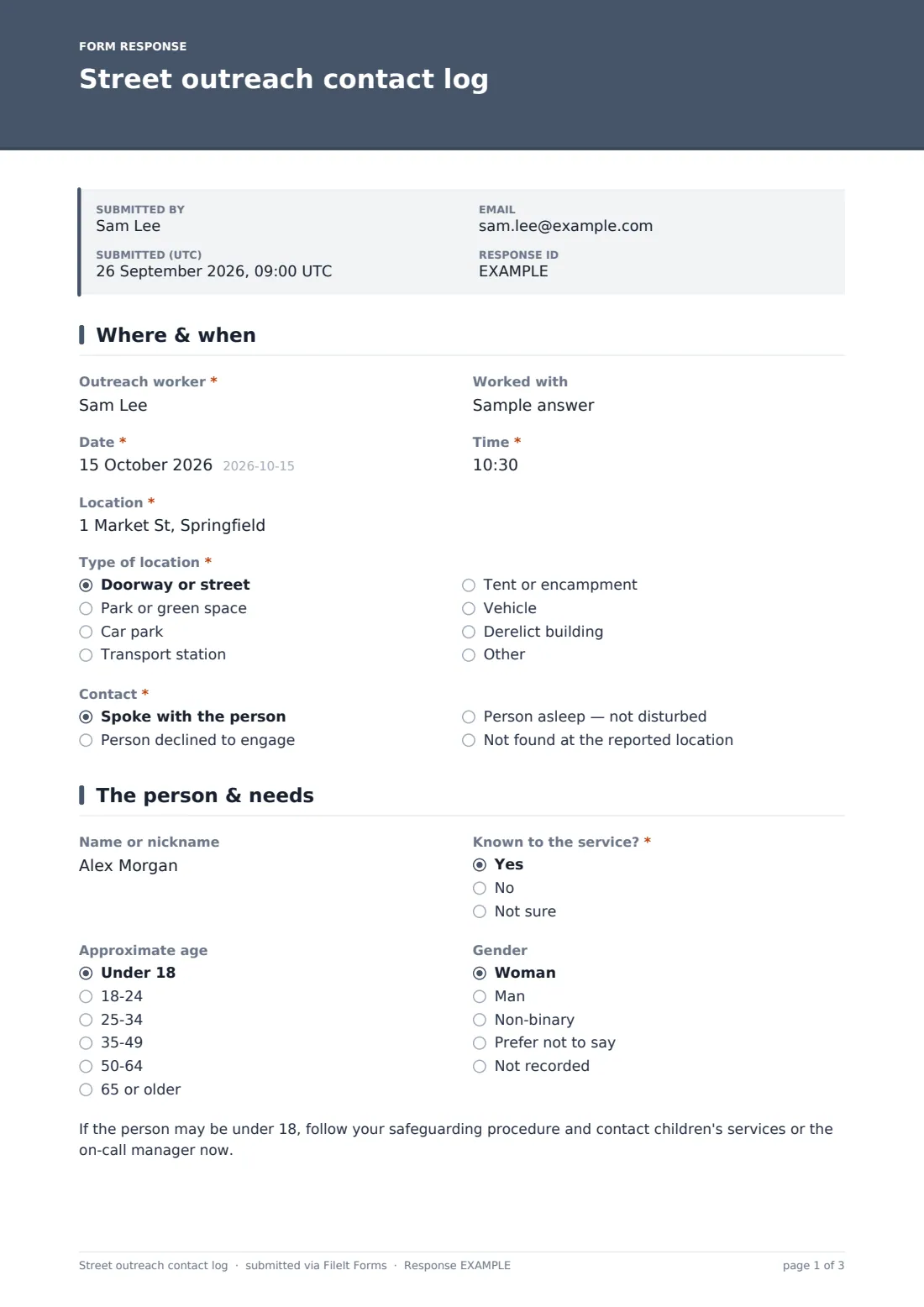
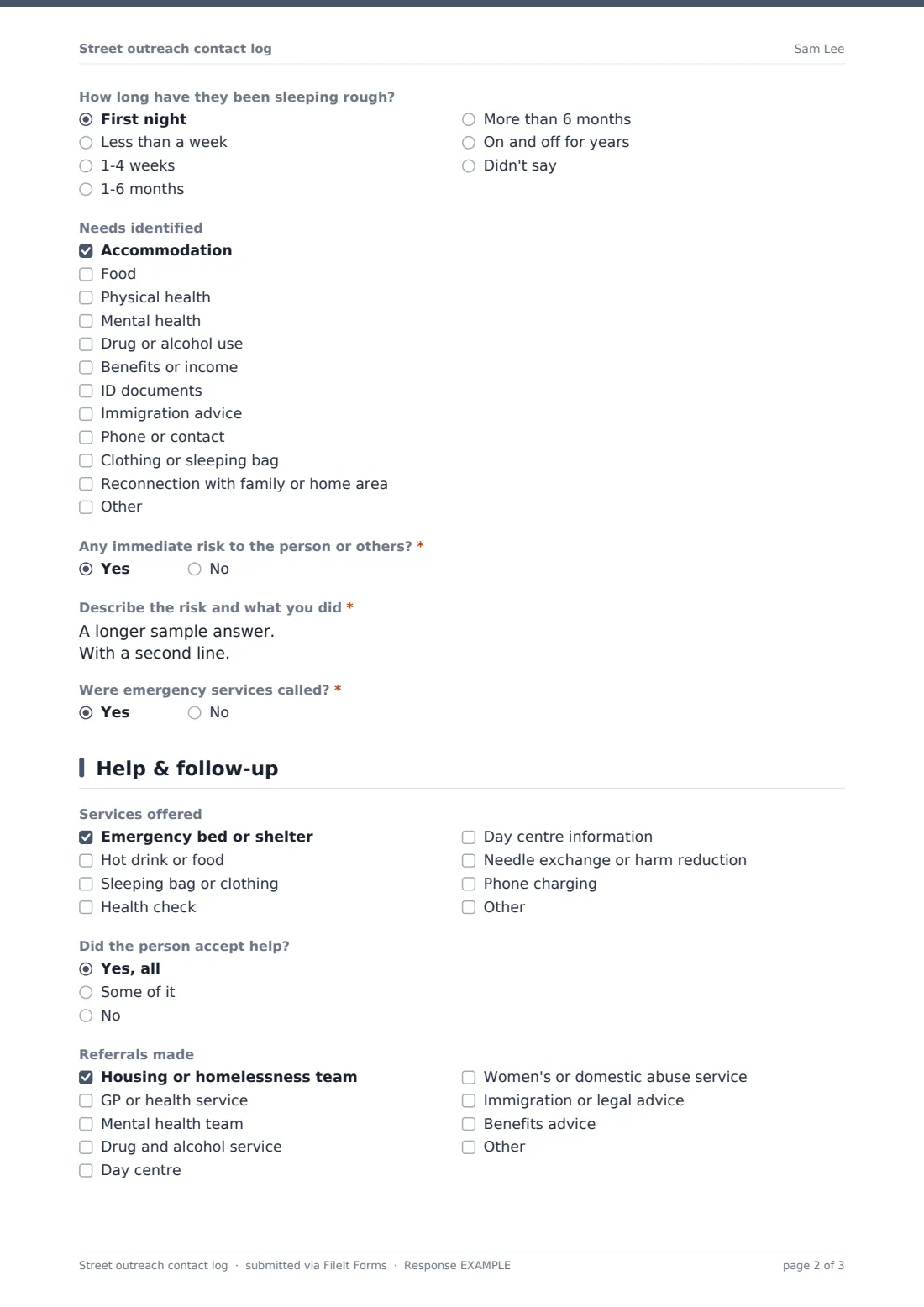
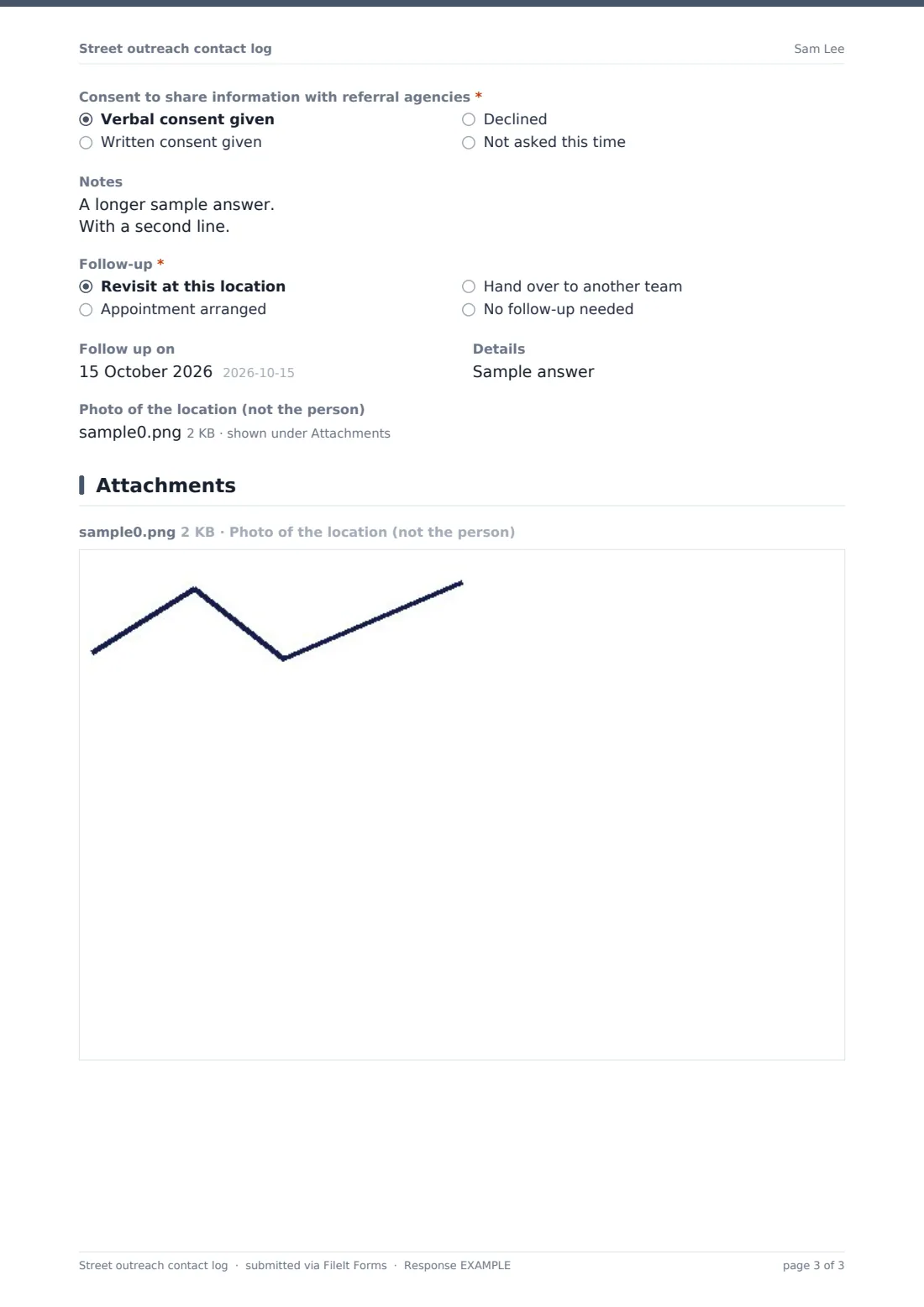
This log is built to be filled in on a phone straight after a contact. The first page records the worker, date, time and location, and whether the person engaged, declined, was asleep or wasn't found. The second covers name or nickname, approximate age, how long they've been sleeping rough, needs identified and any immediate risk. The third records services offered, referrals, consent to share, notes and follow-up.
Every contact is filed as a PDF in your FileIt vault, giving the team a dated record of each person's journey.
- Best for
- Homelessness outreach teams, night shelters, soup runs and faith-based outreach
- Filled in by
- Outreach workers and volunteers on shift
- Time to complete
- About 3-5 minutes per contact
- Includes
- Location and contact type, needs checklist, risk follow-ups, under-18 safeguarding prompt, referrals, consent to share and follow-up date
Who uses a street outreach contact log form?
- A council-funded outreach team logging contacts on early-morning shifts
- A charity soup run recording who it met and what they needed
- Responding to a public report of someone sleeping rough
- A winter shelter team checking on people who declined a bed
- A faith group's night patrol recording referrals to day centres
Questions on this street outreach contact log form
25 questions over 3 pages · includes file upload, conditional questions, multiple pages.
1 Where & when
- Outreach worker*
- Worked with
- Date*
- Time*
- Location*
- Type of location* Doorway or street · Park or green space · Car park · Transport station · Tent or encampment · Vehicle · Derelict building · Other
- Contact* Spoke with the person · Person declined to engage · Person asleep — not disturbed · Not found at the reported location
2 The person & needs
- Name or nickname
- Known to the service?* Yes · No · Not sure
- Approximate age Under 18 · 18-24 · 25-34 · 35-49 · 50-64 · 65 or older
- Gender Woman · Man · Non-binary · Prefer not to say · Not recorded
- How long have they been sleeping rough? First night · Less than a week · 1-4 weeks · 1-6 months · More than 6 months · On and off for years · Didn't say
- Needs identified Accommodation · Food · Physical health · Mental health · Drug or alcohol use · Benefits or income · ID documents · Immigration advice · Phone or contact · Clothing or sleeping bag · Reconnection with family or home area
- Any immediate risk to the person or others?*
- Describe the risk and what you did* asked only when it applies
- Were emergency services called?* asked only when it applies
3 Help & follow-up
- Services offered Emergency bed or shelter · Hot drink or food · Sleeping bag or clothing · Health check · Day centre information · Needle exchange or harm reduction · Phone charging
- Did the person accept help? asked only when it applies Yes, all · Some of it · No
- Referrals made Housing or homelessness team · GP or health service · Mental health team · Drug and alcohol service · Day centre · Women's or domestic abuse service · Immigration or legal advice · Benefits advice
- Consent to share information with referral agencies* Verbal consent given · Written consent given · Declined · Not asked this time
- Notes
- Follow-up* Revisit at this location · Appointment arranged · Hand over to another team · No follow-up needed
- Follow up on asked only when it applies
- Details asked only when it applies
- Photo of the location (not the person)
The street outreach contact log form, page by page
1 Where & when
Workers record their name, who they worked with, the date and time, the location — a street, landmark or what3words — and the type of location, from a doorway to a tent, vehicle or derelict building. "Contact" records whether they spoke with the person, the person declined, was asleep and not disturbed, or wasn't found at the reported location.
2 The person & needs
Workers note a name or nickname, whether the person is known to the service, approximate age and gender. Choosing under 18 shows a prompt to follow the safeguarding procedure straight away. They record how long the person has been sleeping rough and tick any needs identified — accommodation, food, physical and mental health, drug or alcohol use, income, ID, immigration advice and more.
"Any immediate risk to the person or others?" is required. A yes asks what the risk was and what was done, with a reminder to call emergency services first, and whether they were called.
3 Help & follow-up
Workers tick services offered and, when they spoke with the person, whether help was accepted. They record referrals made and the person's consent to share information — verbal, written, declined or not asked. A notes box asks for facts rather than opinions. The follow-up — revisit, appointment, handover or none — asks for a date and details, and a photo of the location, not the person, can be added.
Make the template yours
- Replace the referral list with your local services
- Add the area or patch names your team uses as a dropdown
- Add your own risk categories or a link to your safeguarding procedure
- Send each worker a personal link with their name filled in
- Notify the team leader by email on every log with an immediate risk
- File logs into a folder per person once they're known to the service
Tips for a better street outreach contact log form
- Log the contact as soon as it's safe to, not at the end of a long shift
- Record what the person said in their words, and keep opinions out of notes
- Always ask about consent before making a referral, and record the answer
- Never photograph a person without their permission — the form only asks for the location
- Review follow-up dates at each shift handover so nobody is missed
Every response becomes a PDF in your vault
Each contact is saved as a PDF in your FileIt vault with any location photos, and the team lead is notified by email. Workers don't receive a copy by default, so personal details don't sit in their inbox.
The Responses table gives you every contact by date, location and follow-up, and the CSV export helps with shift handovers and monthly reporting.
- Start from this template. It opens in the FileIt Forms designer — change any question, add pages, set the rules for when questions appear.
- Share it. Turn on a public link, or send it to people by email, each with their own link. They don’t need a FileIt account.
- Get the answers as PDFs. Each response is saved as a PDF in the vault folder you choose, with uploaded files attached — and listed in a Responses table you can export to CSV.
Street outreach contact log form: frequently asked questions
Is the street outreach contact log free?
Yes. It's a FileIt Forms starter template and available on every plan.
Can workers use it offline?
No. The form needs a connection to submit. Workers in a signal blackspot can note details and submit the log when they're back in coverage.
Does it record the person's full identity?
It asks only for a name or nickname and an approximate age, so it works for people who don't want to give their details.
What happens when someone may be under 18?
Choosing under 18 shows a prompt to follow your safeguarding procedure immediately. Edit it to name your on-call contact.
Can this replace our case management system?
It's a contact log. If you use a case management system, export the responses or copy the details across — FileIt doesn't sync with other systems.
Who can see the logs?
Logs are filed in your FileIt vault and visible to the people you give access to. Follow your organisation's data protection policy.