What is the running coach intake form template?
A running plan is only as good as what the coach knows about the runner. Someone running 15 km a week with a sore Achilles needs a very different first month from someone running 60 km injury-free. This intake template asks new athletes the questions a coach would otherwise spend the first call on, so that call can be about the plan instead.
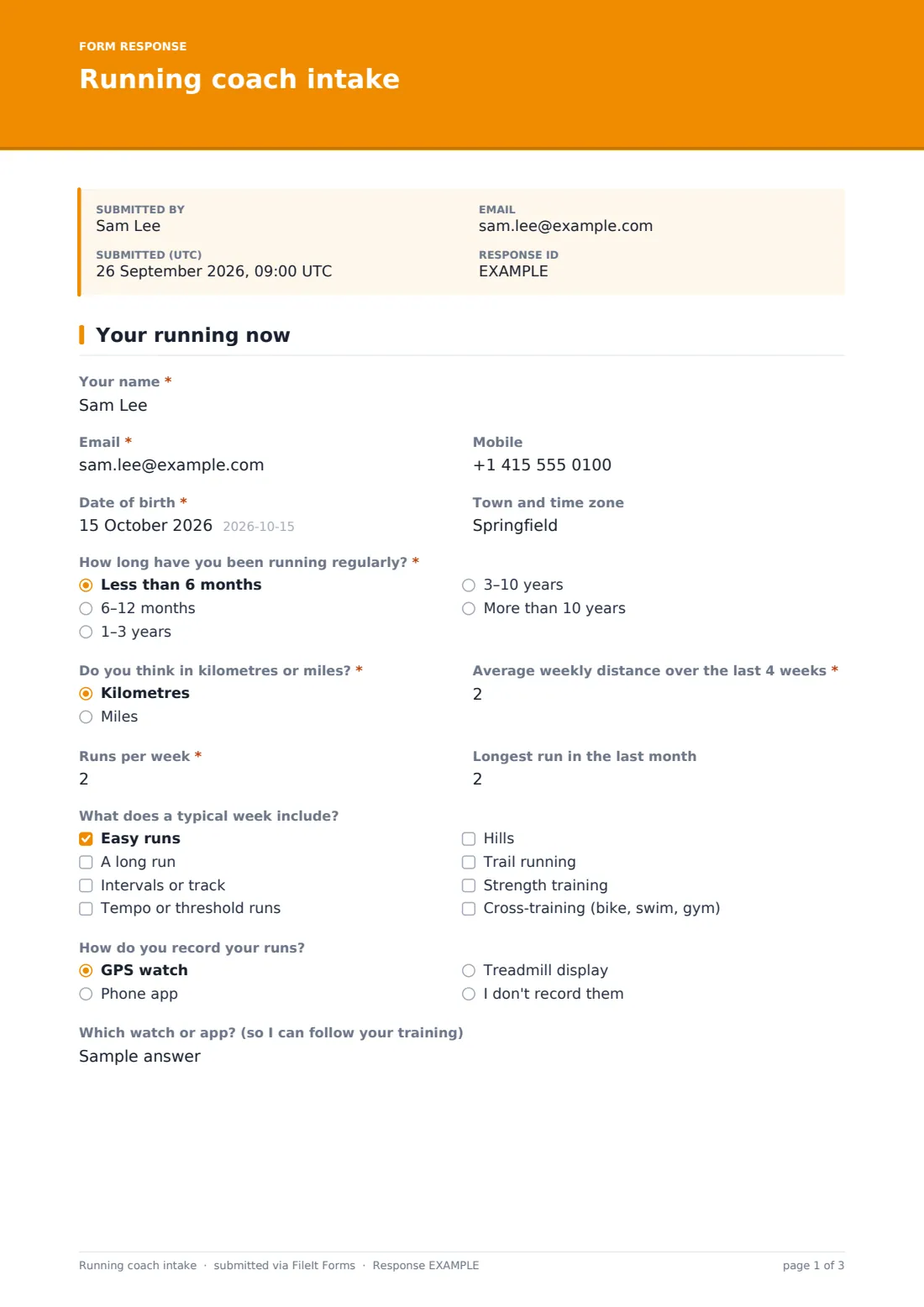
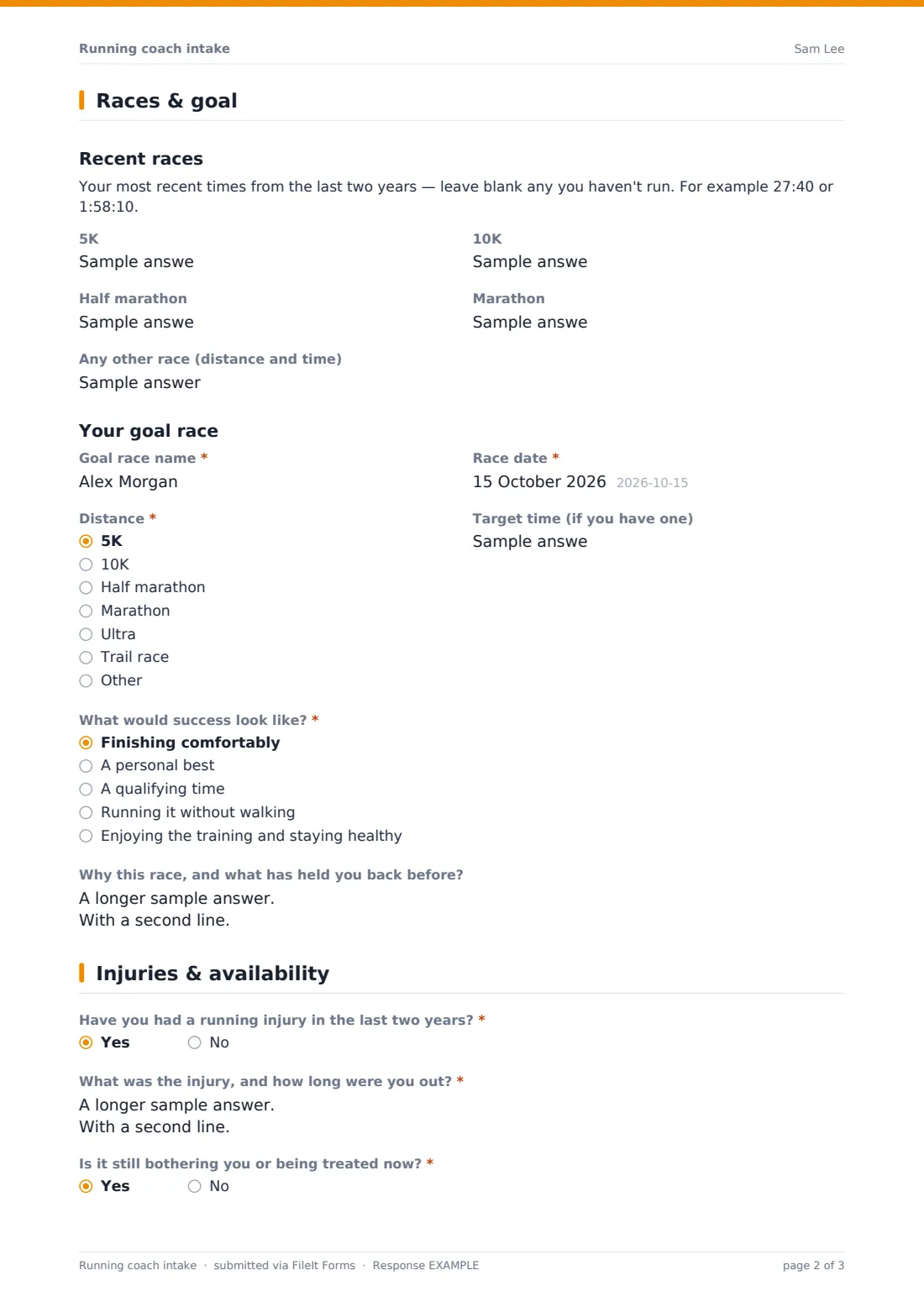
The first page captures the runner's current training: how long they've been running, whether they think in kilometres or miles, average weekly distance over the last four weeks, runs per week, longest recent run, what a typical week includes and how they record their runs. The second page asks for recent times at 5K, 10K, half marathon and marathon, then the goal race — name, date, distance, target time — and what success would look like, from finishing comfortably to a qualifying time.
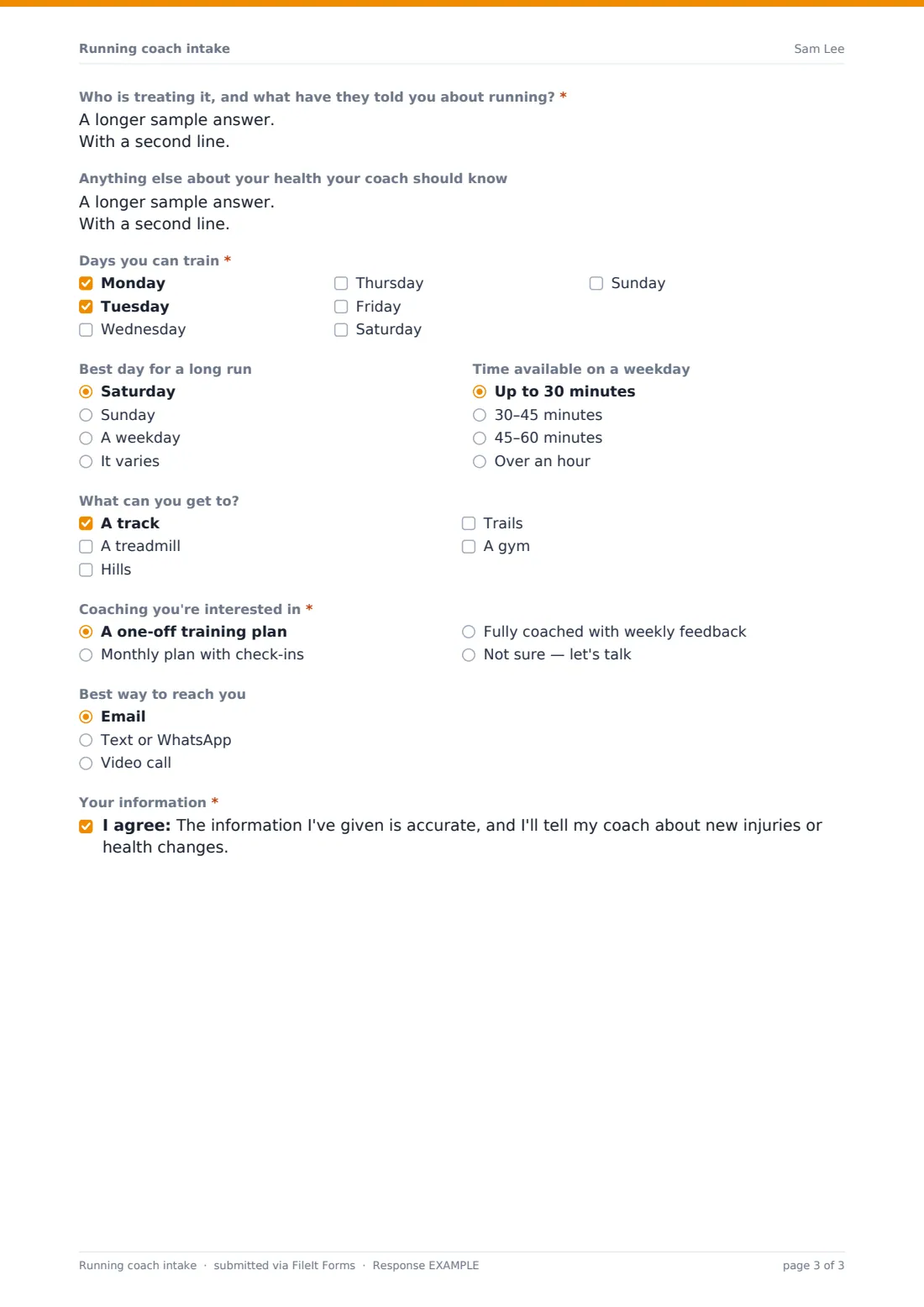
The third page covers injuries and time. A running injury in the last two years asks what it was and how long they were out; if it's still bothering them, they're asked who is treating it and what they've been told about running. Then the days they can train, best long-run day, weekday time, access to tracks, hills or a gym, and the kind of coaching they want. Each intake is saved as a PDF in your FileIt vault.
- Best for
- Running coaches, run clubs, online coaching services and triathlon coaches
- Filled in by
- The runner
- Time to complete
- About 6 minutes
- Includes
- Weekly mileage, recent race times, goal race, injury history and treatment, availability
Who uses a running coach intake form?
- An online coach sends the form to every new athlete before the first call
- A first-time marathoner shares their goal race and current weekly distance
- A runner coming back from a stress fracture explains what their physio has said
- A run club collects intakes for a 12-week half-marathon group
- A coach compares a runner's recent 10K time with their marathon goal
- A triathlon coach uses the run section for a new client's running block
Questions on this running coach intake form
36 questions over 3 pages · includes conditional questions, multiple pages, consent checkbox.
1 Your running now
- Your name*
- Email*
- Mobile
- Date of birth*
- Town and time zone
- How long have you been running regularly?* Less than 6 months · 6–12 months · 1–3 years · 3–10 years · More than 10 years
- Do you think in kilometres or miles?* Kilometres · Miles
- Average weekly distance over the last 4 weeks*
- Runs per week*
- Longest run in the last month
- What does a typical week include? Easy runs · A long run · Intervals or track · Tempo or threshold runs · Hills · Trail running · Strength training · Cross-training (bike, swim, gym)
- How do you record your runs? GPS watch · Phone app · Treadmill display · I don't record them
- Which watch or app? (so I can follow your training) asked only when it applies
2 Races & goal
- 5K
- 10K
- Half marathon
- Marathon
- Any other race (distance and time)
- Goal race name*
- Race date*
- Distance* 5K · 10K · Half marathon · Marathon · Ultra · Trail race · Other
- Target time (if you have one)
- What would success look like?* Finishing comfortably · A personal best · A qualifying time · Running it without walking · Enjoying the training and staying healthy
- Why this race, and what has held you back before?
3 Injuries & availability
- Have you had a running injury in the last two years?*
- What was the injury, and how long were you out?* asked only when it applies
- Is it still bothering you or being treated now?* asked only when it applies
- Who is treating it, and what have they told you about running?* asked only when it applies
- Anything else about your health your coach should know
- Days you can train* Monday · Tuesday · Wednesday · Thursday · Friday · Saturday · Sunday
- Best day for a long run Saturday · Sunday · A weekday · It varies
- Time available on a weekday Up to 30 minutes · 30–45 minutes · 45–60 minutes · Over an hour
- What can you get to? A track · A treadmill · Hills · Trails · A gym
- Coaching you're interested in* A one-off training plan · Monthly plan with check-ins · Fully coached with weekly feedback · Not sure — let's talk
- Best way to reach you Email · Text or WhatsApp · Video call
- Your information*
The running coach intake form, page by page
1 Your running now
Name, email, optional mobile, date of birth and town and time zone. Required: how long they've been running, kilometres or miles, average weekly distance over 4 weeks and runs per week. Longest recent run, a checklist of what a typical week includes, how runs are recorded — anyone who records them is asked which watch or app.
2 Races & goal
Optional recent times for 5K, 10K, half marathon, marathon and any other race. A required goal race name, race date and distance, an optional target time, a required 'What would success look like?' and a box for why this race and what has held them back before.
3 Injuries & availability
A required 'Have you had a running injury in the last two years?' — a yes asks what and how long, and whether it's still being treated; if so, who is treating it and what they've said about running. Other health notes, the days they can train (at least two), best long-run day, weekday time, access to facilities, a required coaching choice, contact preference and a required accuracy statement.
Make the template yours
- Rename the coaching options to your own packages and prices
- Add a question about heart-rate zones or recent lab tests if you use them
- Change the race distances to suit trail, ultra or track runners
- Add an upload for a recent training log export
- Add your terms and a signature if clients agree to a coaching contract on the same form
- File intakes in a vault folder per training group
Tips for a better running coach intake form
- Read the injury answers first — they shape the first few weeks more than the goal does
- Compare the goal race date with today's weekly distance to set realistic expectations on the first call
- Ask runners to repeat the intake for each new training block
- Check with the runner before contacting anyone treating them
- Use the Responses export to group a club's runners by goal race and current distance
Every response becomes a PDF in your vault
Each intake is saved as a PDF in your FileIt vault, and you can be emailed when one comes in. The runner sees your confirmation and can receive a copy.
Search the Responses table by name before a call, or sort an export by race date to see whose goal race is coming up first.
- Start from this template. It opens in the FileIt Forms designer — change any question, add pages, set the rules for when questions appear.
- Share it. Turn on a public link, or send it to people by email, each with their own link. They don’t need a FileIt account.
- Get the answers as PDFs. Each response is saved as a PDF in the vault folder you choose, with uploaded files attached — and listed in a Responses table you can export to CSV.
Running coach intake form: frequently asked questions
Is the running coach intake template free?
Yes. It's one of the starter templates in the FileIt Forms app, included on the free plan.
Does FileIt write the training plan?
No. The form collects the runner's information; the coach writes the plan.
What if I don't know my race times?
Every race-time box is optional. Leave blank any distance you haven't run recently.
Why does it ask about current treatment?
If an injury is still being treated, the coach needs to know what the runner has been told so the plan fits around it. FileIt doesn't assess injuries.
Can I use miles instead of kilometres?
Yes. Runners choose their unit and enter distances in it.
Does the runner need a FileIt account?
No. They fill it in from a link.