
What is the roof inspection report form template?
Homeowners, buyers, property managers and insurers all ask for roof inspections for different reasons, but they want the same answer: what condition is the roof in, is anything leaking, and what will it cost to put right. This template gives roofers and inspectors a clear, consistent way to give it.
The form covers how the roof was inspected, the covering type and age, condition grids for the covering and for flashing, edges and drainage, and an attic check that opens only if the attic was inspected. Storm-damage inspections ask for the date of the event, and an active leak requires its location.
Photos are required, because a roof report without them is hard to act on. Each report is filed as a PDF in your FileIt vault with every photo attached, ready to send to the client or to support an insurance claim.
- Best for
- Roofing contractors, home inspectors and property managers
- Filled in by
- The roofer or inspector after the inspection
- Time to complete
- About 10 minutes
- Includes
- Condition grids, attic check, required photos, cost estimate, signature
Who uses a roof inspection report form?
- A roofer inspects a house after a storm for the owner's insurance claim
- A home inspector reports on the roof for a buyer
- A property manager schedules yearly roof checks across several buildings
- A contractor investigates a leak before quoting a repair
- An owner wants to know whether to repair or replace an ageing roof
- A landlord keeps a maintenance record for each property
Questions on this roof inspection report form
34 questions over 4 pages · includes signature, file upload, conditional questions, multiple pages, ratings.
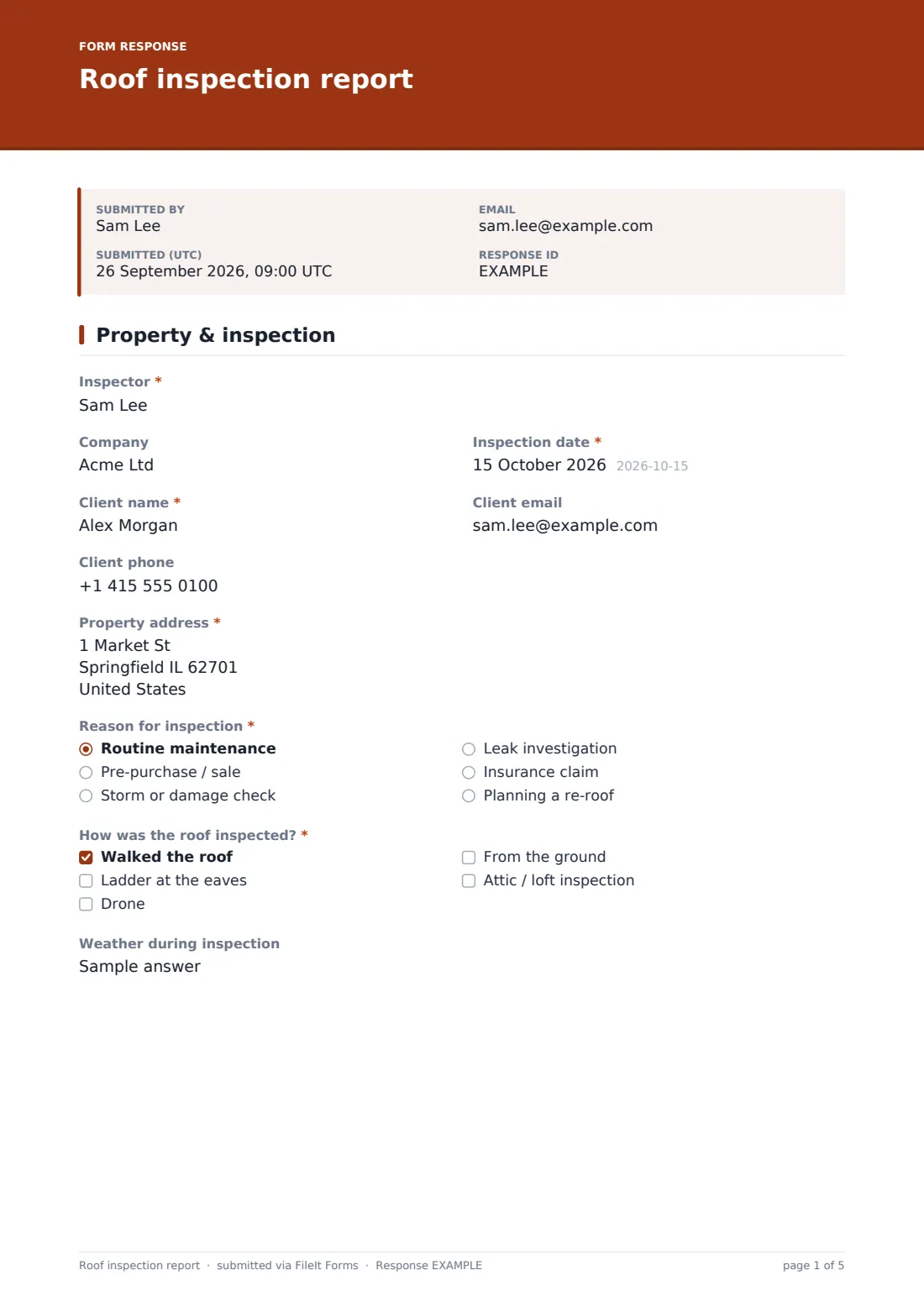
1 Property & inspection
- Inspector*
- Company
- Inspection date*
- Client name*
- Client email
- Client phone
- Property address*
- Reason for inspection* Routine maintenance · Pre-purchase / sale · Storm or damage check · Leak investigation · Insurance claim · Planning a re-roof
- Date of the storm or damage asked only when it applies
- How was the roof inspected?* Walked the roof · Ladder at the eaves · Drone · From the ground · Attic / loft inspection
- Weather during inspection
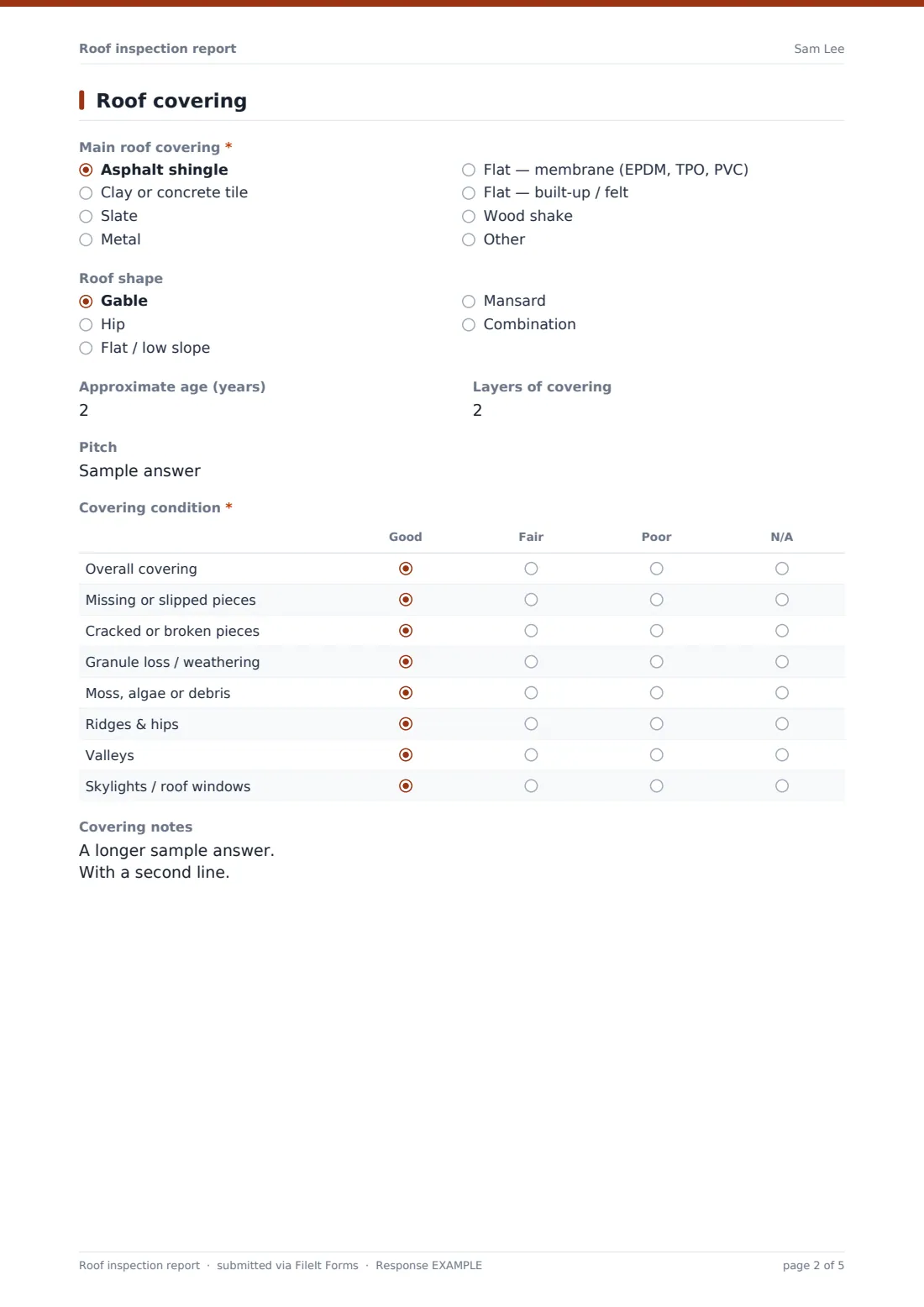
2 Roof covering
- Main roof covering* Asphalt shingle · Clay or concrete tile · Slate · Metal · Flat — membrane (EPDM, TPO, PVC) · Flat — built-up / felt · Wood shake · Other
- Roof shape Gable · Hip · Flat / low slope · Mansard · Combination
- Approximate age (years)
- Layers of covering
- Pitch
- Covering condition* Good · Fair · Poor · N/A
- Covering notes
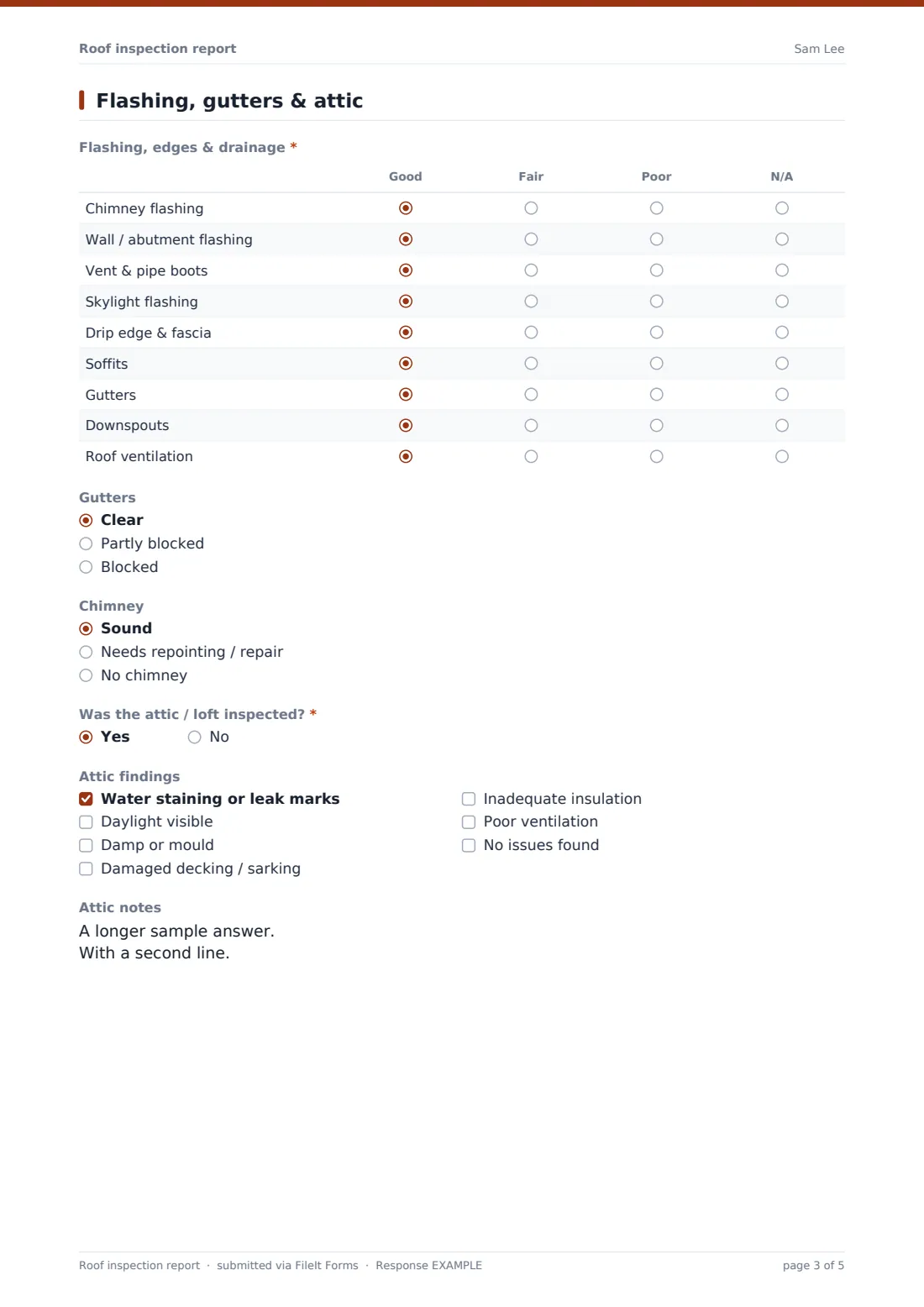
3 Flashing, gutters & attic
- Flashing, edges & drainage* Good · Fair · Poor · N/A
- Gutters Clear · Partly blocked · Blocked
- Chimney Sound · Needs repointing / repair · No chimney
- Was the attic / loft inspected?*
- Attic findings asked only when it applies Water staining or leak marks · Daylight visible · Damp or mould · Damaged decking / sarking · Inadequate insulation · Poor ventilation · No issues found
- Attic notes asked only when it applies
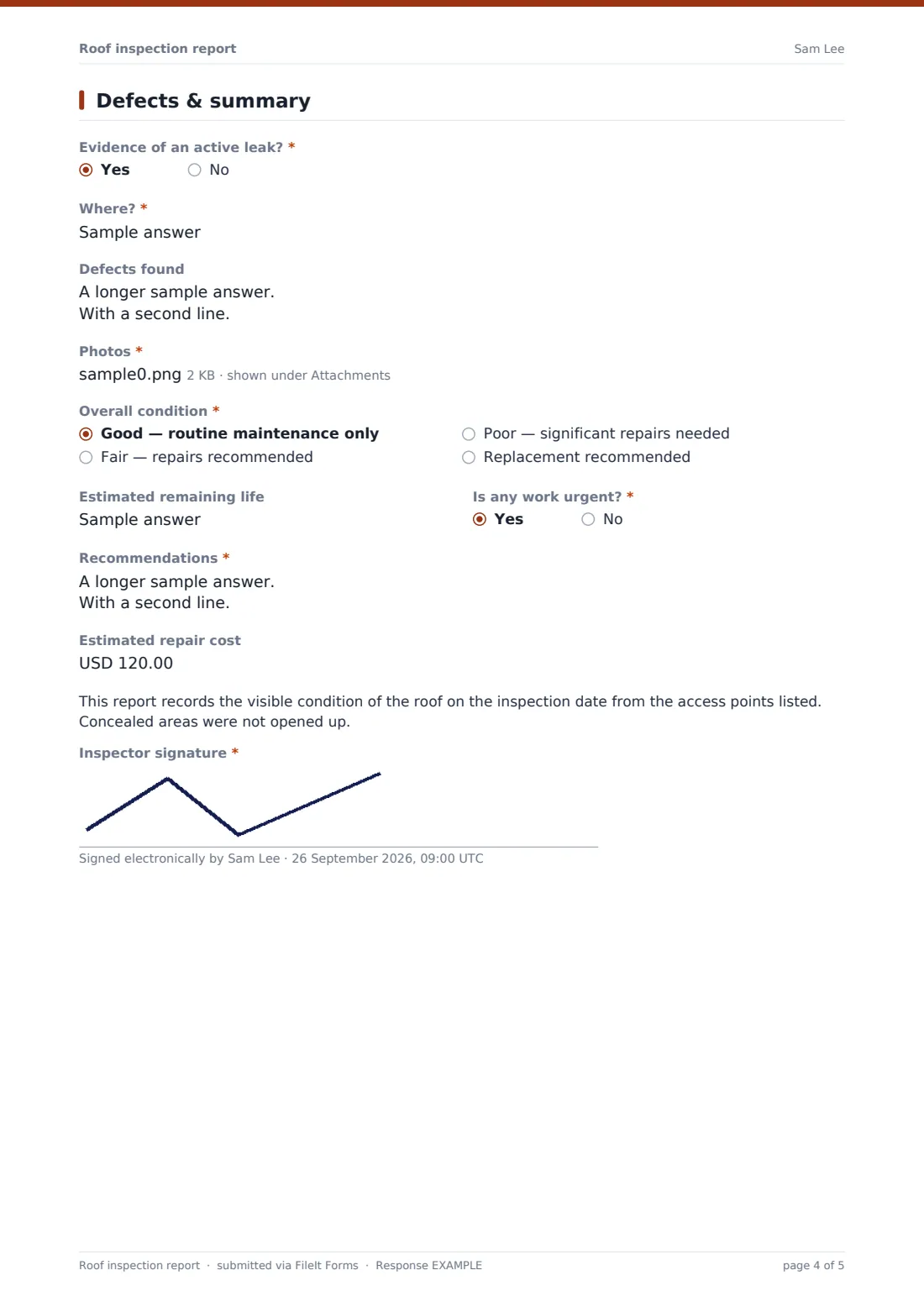
4 Defects & summary
- Evidence of an active leak?*
- Where?* asked only when it applies
- Defects found
- Photos*
- Overall condition* Good — routine maintenance only · Fair — repairs recommended · Poor — significant repairs needed · Replacement recommended
- Estimated remaining life
- Is any work urgent?*
- Recommendations*
- Estimated repair cost
- Inspector signature*
The roof inspection report form, page by page
1 Property & inspection
The inspector and company, inspection date, client details and property address come first. The reason is required: routine maintenance, pre-purchase, storm or damage check, leak investigation, insurance claim, or planning a re-roof. A storm check asks for the date of the event. The inspector ticks how the roof was inspected — walked, ladder at the eaves, drone, from the ground, or from the attic — and notes the weather.
2 Roof covering
The main covering is required, from asphalt shingle and tile to slate, metal, flat membranes and wood shake, followed by the roof shape, approximate age, layers and pitch. A required grid rates eight aspects of the covering — overall condition, missing or slipped pieces, cracked pieces, weathering, moss and debris, ridges and hips, valleys and skylights — as good, fair, poor or N/A.
3 Flashing, gutters & attic
A second required grid rates chimney, wall and vent flashing, skylight flashing, drip edge and fascia, soffits, gutters, downspouts and ventilation. Gutters are clear, partly blocked or blocked, and the chimney is sound, needs repair, or absent. If the attic was inspected, a checklist records findings such as staining, daylight, damp, damaged decking, insulation and ventilation, with notes.
4 Defects & summary
An active leak requires its location. Defects are listed one per line with location, defect and severity, and photos are required. The overall condition runs from good to replacement recommended, with estimated remaining life, whether any work is urgent, required recommendations and an estimated cost. A note records that the report covers the visible condition from the access points listed, and the inspector signs.
Make the template yours
- Add roof coverings common in your area to the dropdown
- Add rows to the grids for features you see often, such as solar panels or parapet walls
- Edit the scope note to match your own terms of inspection
- File reports by property or by client
- Turn off the emailed copy in settings if you want to review reports before the client receives them
- Change the currency on the repair estimate
Tips for a better roof inspection report form
- Photograph each slope wide before the close-ups, so the defects have context
- Record how you accessed the roof — it explains what you could and couldn't see
- Check the attic whenever you can; it often shows leaks the roof surface hides
- Give a realistic remaining life range rather than a single number
- Separate urgent work from recommendations that can wait
- Note the weather — a dry day can hide a leak
Every response becomes a PDF in your vault
Each inspection is filed as a PDF in your FileIt vault with all photos attached. If you entered the client's email, they receive a copy as soon as it's submitted.
Roofers typically follow up urgent items with a quote, and property managers keep yearly reports in each building's folder to track the roof's condition over time.
- Start from this template. It opens in the FileIt Forms designer — change any question, add pages, set the rules for when questions appear.
- Share it. Turn on a public link, or send it to people by email, each with their own link. They don’t need a FileIt account.
- Get the answers as PDFs. Each response is saved as a PDF in the vault folder you choose, with uploaded files attached — and listed in a Responses table you can export to CSV.
Roof inspection report form: frequently asked questions
Is this roof inspection report template free?
Yes. It's included with the Forms app on every FileIt account, including the free plan, and you can edit any question to fit the way you work.
Can I use it for an insurance claim?
Yes. Choose storm or damage check or insurance claim as the reason, record the event date, and attach photos of every defect. The insurer decides what the policy covers.
Can I include drone photos?
Yes. Tick drone as an inspection method and upload up to ten images.
Does it cover flat roofs?
Yes. Flat membrane and built-up roofs are in the covering list, and the grids work for both pitched and flat roofs.
Are photos required?
Yes, at least one — a roof report is hard to act on without them. You can make the field optional if you prefer.
Can homeowners use it?
It's written for roofers and inspectors, but an owner can use it to record their own checks, especially after a storm.