What is the mediation intake form template?
A mediator's first job is to understand the situation and decide whether mediation is suitable at all. That means knowing who's involved, what the disagreement is about, whether the other side knows, whether there are court dates — and whether anyone is afraid.
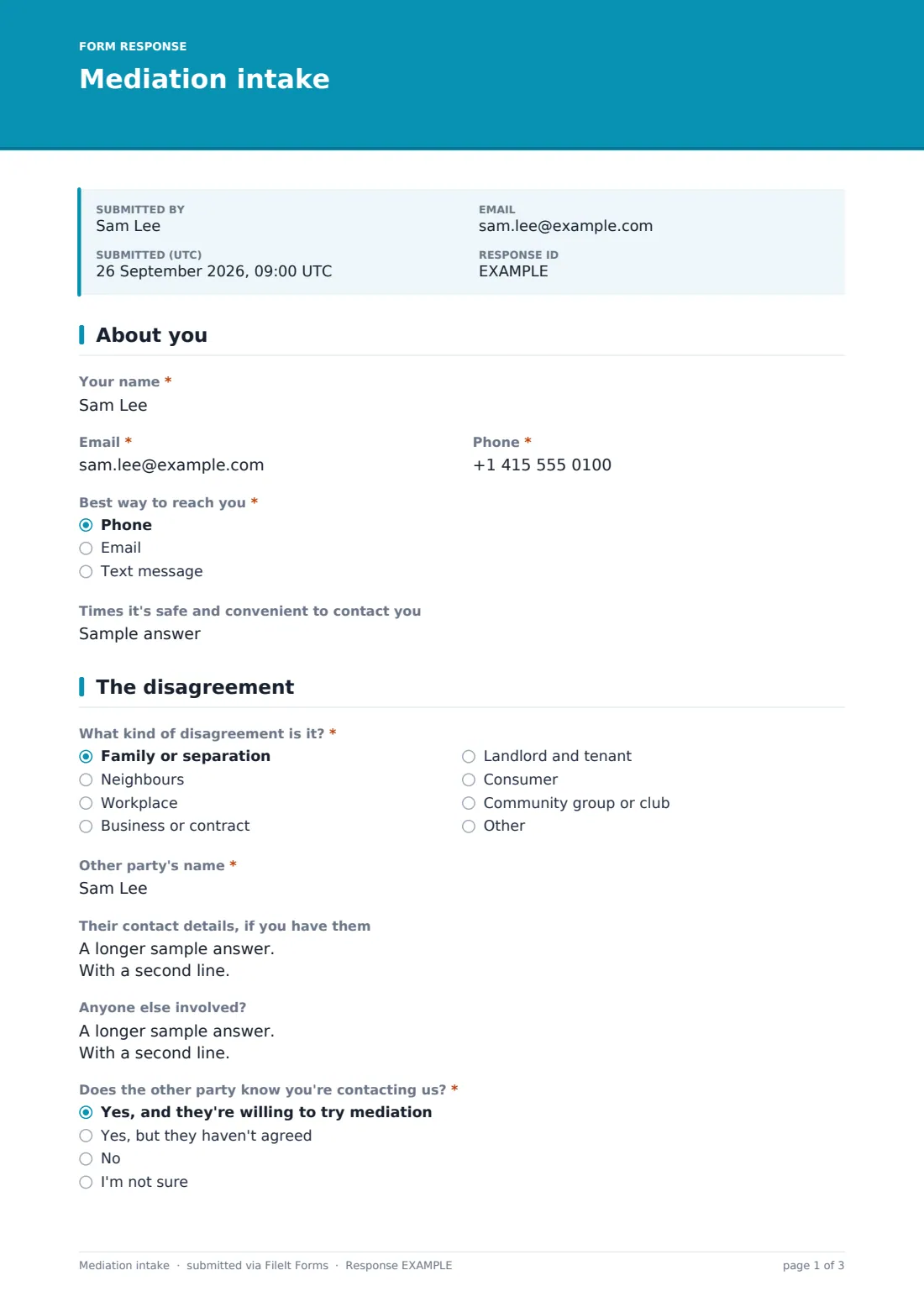
This template gathers those details before the first conversation. It covers contact preferences and safe times to call, the kind of disagreement and the other party, whether they know and are willing, a summary, how long it has been going on, what's been tried and any deadlines.
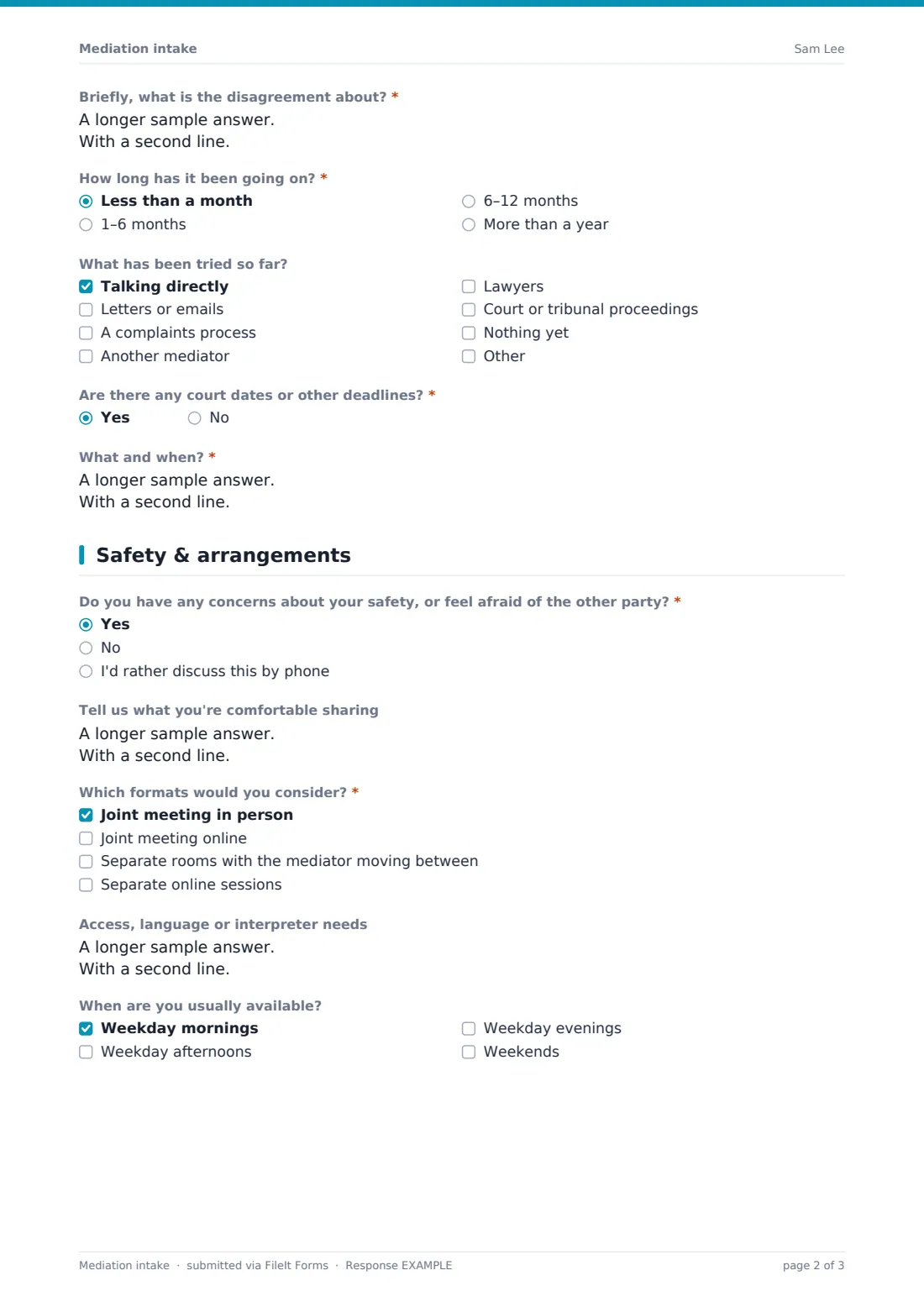
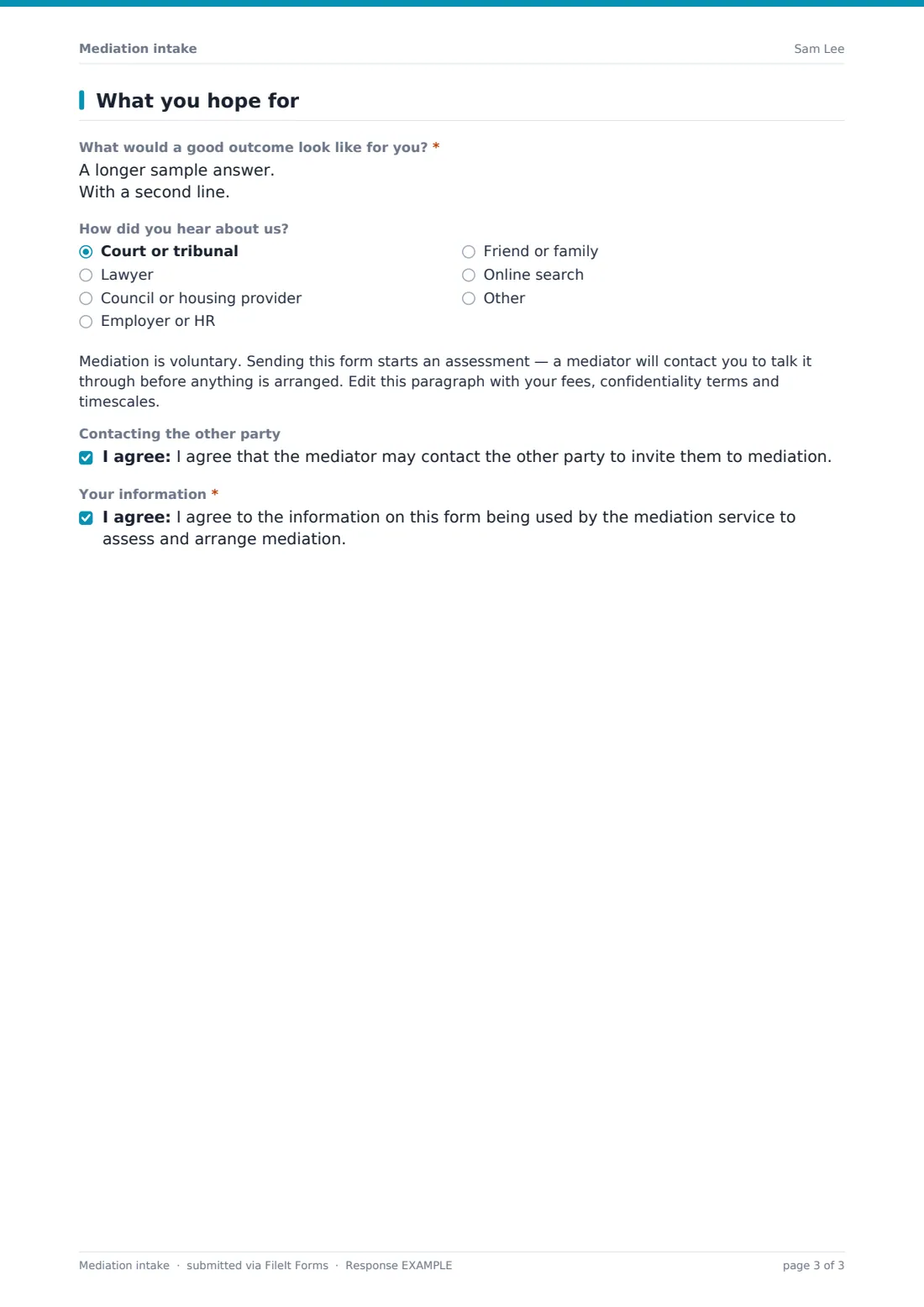
A separate page asks about safety, offers formats from joint meetings to separate rooms, and records access needs and availability. It ends with what a good outcome would look like and consent to contact the other party. Each intake is saved as a PDF in your FileIt vault.
- Best for
- Community mediation services, family mediators, workplace mediators and dispute resolution practices
- Filled in by
- The person asking for mediation
- Time to complete
- About 6 minutes
- Includes
- Contact preferences, dispute type, other party and awareness, history and deadlines, safety screening, formats, availability and consents
Who uses a mediation intake form?
- Neighbour disputes referred by a council or housing provider
- Workplace disagreements referred by HR
- Family or separation mediation enquiries
- Landlord and tenant disputes
- Small business or contract disagreements
- Disputes within a club or community group
Questions on this mediation intake form
24 questions over 4 pages · includes conditional questions, multiple pages, consent checkbox.
1 About you
- Your name*
- Email*
- Phone*
- Best way to reach you* Phone · Email · Text message
- Times it's safe and convenient to contact you
2 The disagreement
- What kind of disagreement is it?* Family or separation · Neighbours · Workplace · Business or contract · Landlord and tenant · Consumer · Community group or club · Other
- Other party's name*
- Their contact details, if you have them
- Anyone else involved?
- Does the other party know you're contacting us?* Yes, and they're willing to try mediation · Yes, but they haven't agreed · No · I'm not sure
- Briefly, what is the disagreement about?*
- How long has it been going on?* Less than a month · 1–6 months · 6–12 months · More than a year
- What has been tried so far? Talking directly · Letters or emails · A complaints process · Another mediator · Lawyers · Court or tribunal proceedings · Nothing yet
- Are there any court dates or other deadlines?*
- What and when?* asked only when it applies
3 Safety & arrangements
- Do you have any concerns about your safety, or feel afraid of the other party?* Yes · No · I'd rather discuss this by phone
- Tell us what you're comfortable sharing asked only when it applies
- Which formats would you consider?* Joint meeting in person · Joint meeting online · Separate rooms with the mediator moving between · Separate online sessions
- Access, language or interpreter needs
- When are you usually available? Weekday mornings · Weekday afternoons · Weekday evenings · Weekends
4 What you hope for
- What would a good outcome look like for you?*
- How did you hear about us? Court or tribunal · Lawyer · Council or housing provider · Employer or HR · Friend or family · Online search · Other
- Contacting the other party
- Your information*
The mediation intake form, page by page
1 About you
Name, email, phone and 'Best way to reach you' — phone, email or text — are required. 'Times it's safe and convenient to contact you' is optional.
2 The disagreement
'What kind of disagreement is it?' covers family or separation, neighbours, workplace, business or contract, landlord and tenant, consumer, community group or club, and other. The other party's name is required, with optional contact details and anyone else involved. 'Does the other party know you're contacting us?' separates willing, aware but not agreed, no and not sure. 'Briefly, what is the disagreement about?' and 'How long has it been going on?' are required. 'What has been tried so far?' runs from talking directly to lawyers and court. 'Are there any court dates or other deadlines?' is required; yes asks what and when.
3 Safety & arrangements
'Do you have any concerns about your safety, or feel afraid of the other party?' — yes, no, or 'I'd rather discuss this by phone'. Yes opens an optional box with help text saying a mediator will talk about suitability and safety. 'Which formats would you consider?' includes joint meetings in person or online, separate rooms with the mediator moving between, and separate online sessions. Access, language or interpreter needs and usual availability are optional.
4 What you hope for
'What would a good outcome look like for you?' is required, and 'How did you hear about us?' is optional. An editable paragraph says mediation is voluntary and that the form starts an assessment. An optional consent lets the mediator contact the other party, and a required consent covers using the information to assess and arrange mediation.
Make the template yours
- Fill in the paragraph with your fees, confidentiality terms and response time
- Edit the dispute types to the areas you cover
- Add referral sources you work with to 'How did you hear about us?'
- Remove formats you don't offer
- File each intake to a restricted folder
- Make a copy for the other party with the wording adjusted
Tips for a better mediation intake form
- Read the safety answer first and call within a day if it's yes or 'discuss by phone'
- Use the safe contact times exactly as given
- Don't contact the other party unless the consent was ticked
- Check court deadlines before booking sessions
- Offer shuttle mediation when there's tension, even without safety concerns
- Keep the intake confidential from the other party
Every response becomes a PDF in your vault
Each intake is saved as a PDF titled with the person's name in your chosen vault folder, and they're emailed a copy. Set your notification address so new intakes reach the mediator on duty.
Search the Responses tab by name or dispute type, and export to CSV to track enquiries, referral sources and how many go on to mediation.
- Start from this template. It opens in the FileIt Forms designer — change any question, add pages, set the rules for when questions appear.
- Share it. Turn on a public link, or send it to people by email, each with their own link. They don’t need a FileIt account.
- Get the answers as PDFs. Each response is saved as a PDF in the vault folder you choose, with uploaded files attached — and listed in a Responses table you can export to CSV.
Mediation intake form: frequently asked questions
Is this mediation intake template free?
Yes. It's a starter template in the FileIt Forms app, available on every account.
Does it screen for safety?
It asks a direct safety question and offers to discuss it by phone. It records the answer; the assessment itself is up to your mediators.
Can I use it for family mediation?
Yes, it includes family or separation disputes. FileIt also has a separate family law intake template for law firms.
Can the other party fill it in too?
Yes. Make a copy with wording for the second party and send them a request.
Do people need a FileIt account?
No. They open the link and submit.
Is this legal advice?
No. It's a starting template. Rules differ between countries, states and sectors, so check the wording against your own situation and take advice where you need it.