What is the invention disclosure form template?
Inventions often go unreported because nobody knows how to report them, or the form is a daunting legal document. By the time the IP team hears about an idea, it may already have been demoed to a customer or presented at a conference.
This template asks the questions a patent attorney or tech-transfer office will ask first, in plain language: who contributed, what the invention does and how it works, when it was conceived and first recorded, whether it's been built, and — most importantly — whether it's been shared outside the organization or soon will be. Follow-up questions only appear when relevant.
Each disclosure is saved as a signed, dated PDF in the vault folder you choose, with drawings and notes attached.
- Best for
- R&D teams, universities, start-ups and IP or tech-transfer offices
- Filled in by
- The lead inventor, on behalf of all contributors
- Time to complete
- About 20 minutes
- Includes
- Co-inventor details, technical description, drawing uploads, key dates, disclosure warning, prior art, funding and ownership, declaration
Who uses a invention disclosure form?
- Engineers reporting a new feature or technique they think is novel
- University researchers notifying a tech-transfer office
- Start-ups building an IP record before fundraising
- Companies running an internal innovation or patent-incentive program
- Capturing ideas before a planned conference paper or product launch
- Documenting grant-funded work where reporting inventions is required
Questions on this invention disclosure form
34 questions over 5 pages · includes signature, file upload, conditional questions, multiple pages, consent checkbox.
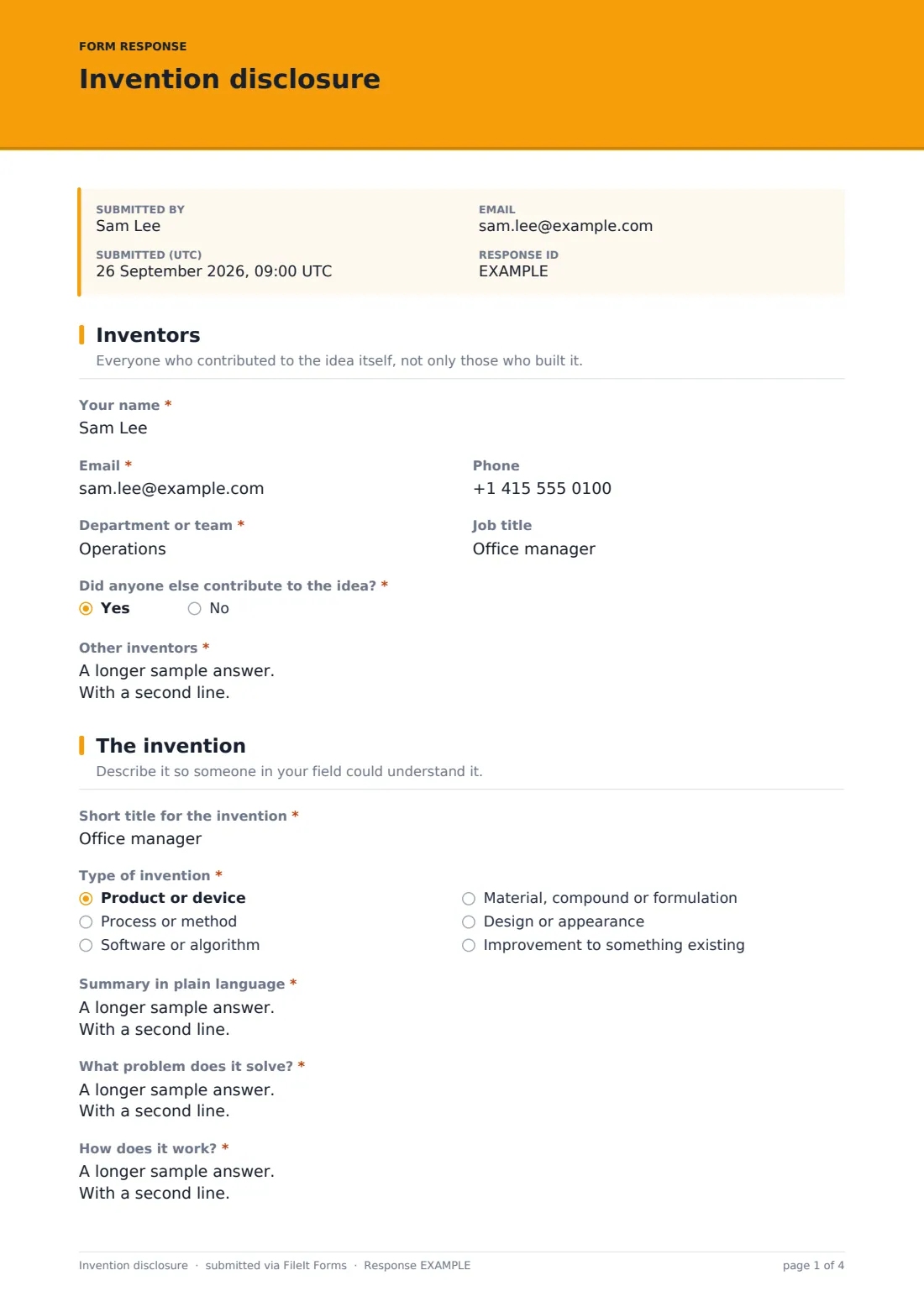
1 Inventors
- Your name*
- Email*
- Phone
- Department or team*
- Job title
- Did anyone else contribute to the idea?*
- Other inventors* asked only when it applies
2 The invention
- Short title for the invention*
- Type of invention* Product or device · Process or method · Software or algorithm · Material, compound or formulation · Design or appearance · Improvement to something existing
- Summary in plain language*
- What problem does it solve?*
- How does it work?*
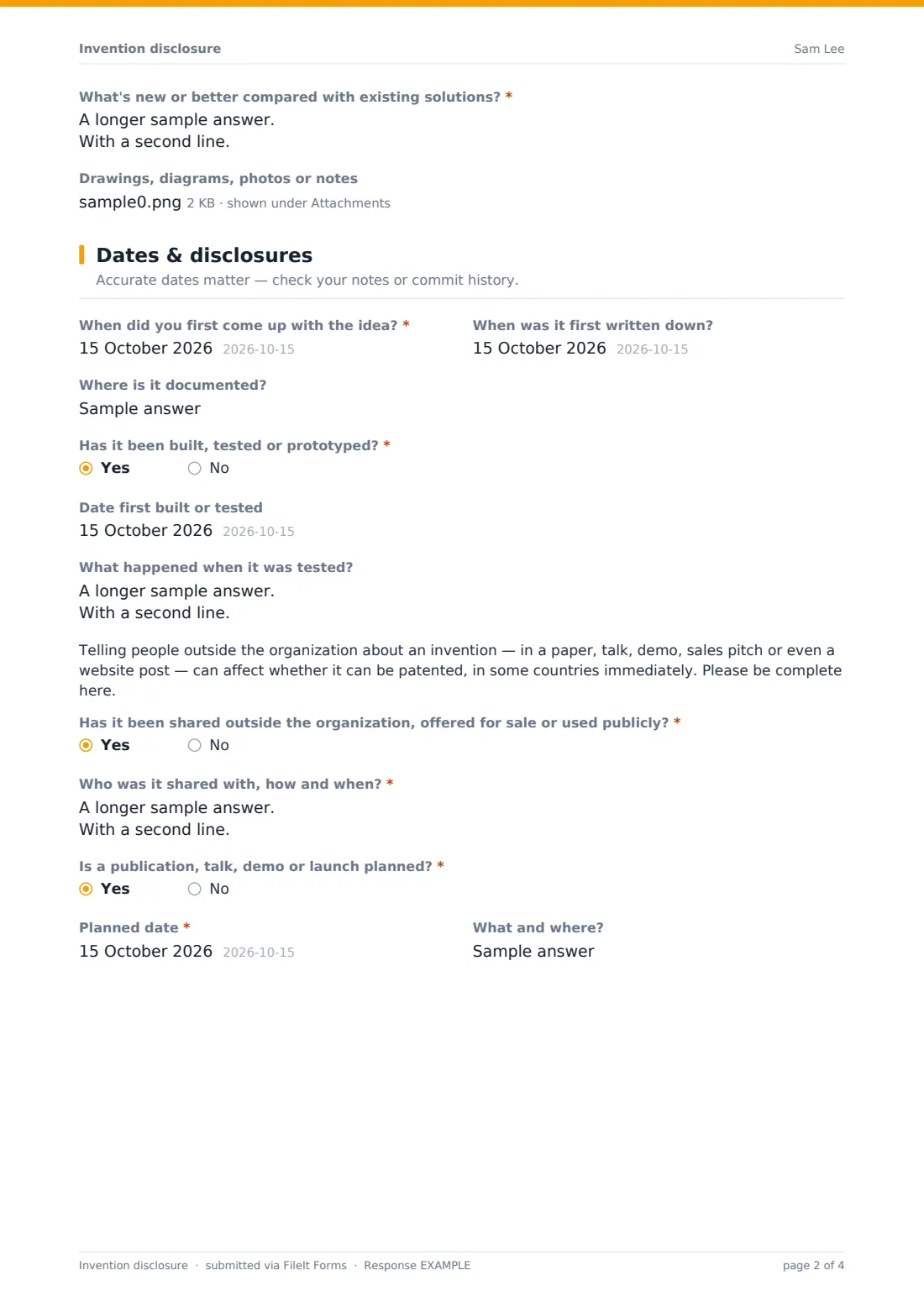
- What's new or better compared with existing solutions?*
- Drawings, diagrams, photos or notes
3 Dates & disclosures
- When did you first come up with the idea?*
- When was it first written down?
- Where is it documented?
- Has it been built, tested or prototyped?*
- Date first built or tested asked only when it applies
- What happened when it was tested? asked only when it applies
- Has it been shared outside the organization, offered for sale or used publicly?*
- Who was it shared with, how and when?* asked only when it applies
- Is a publication, talk, demo or launch planned?*
- Planned date* asked only when it applies
- What and where? asked only when it applies
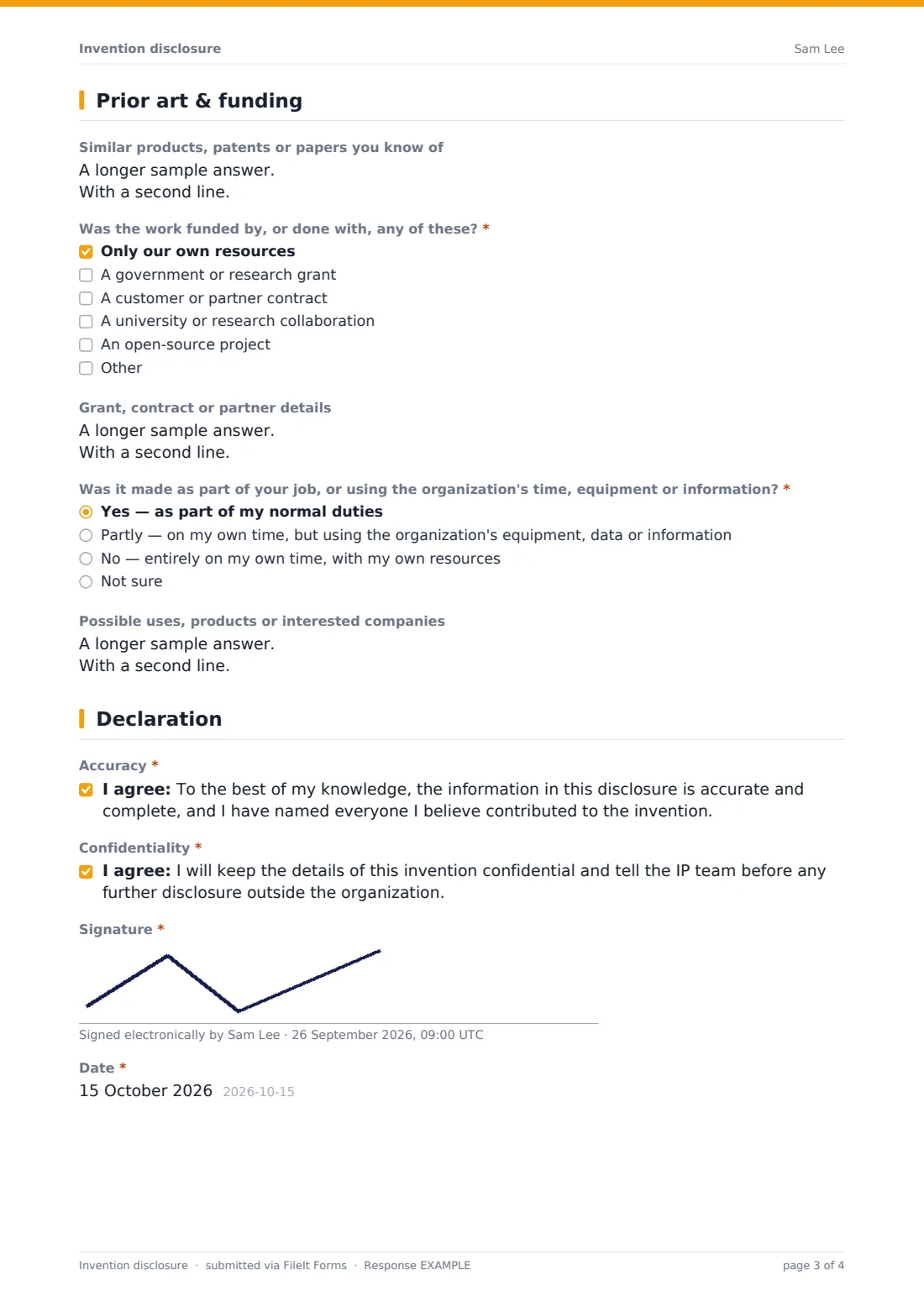
4 Prior art & funding
- Similar products, patents or papers you know of
- Was the work funded by, or done with, any of these?* Only our own resources · A government or research grant · A customer or partner contract · A university or research collaboration · An open-source project
- Grant, contract or partner details
- Was it made as part of your job, or using the organization's time, equipment or information?* Yes — as part of my normal duties · Partly — on my own time, but using the organization's equipment, data or information · No — entirely on my own time, with my own resources · Not sure
- Possible uses, products or interested companies
5 Declaration
- Accuracy*
- Confidentiality*
- Signature*
- Date*
The invention disclosure form, page by page
1 Inventors
The submitter's name, email and department are required; phone and job title optional. If anyone else contributed to the idea, a required box lists each co-inventor with their affiliation, email and contribution.
2 The invention
A short title and the type — product, process, software, material, design or improvement — come first. Four required text questions follow: a plain-language summary, the problem it solves, how it works, and what's new compared with existing solutions. Up to eight drawings, photos or notes can be uploaded.
3 Dates & disclosures
The conception date is required, with optional first-recorded date and where it's documented — a notebook page or commit. Has it been built or tested? reveals a date and results if yes. A warning explains that sharing an invention outside the organization can affect patentability, then two required questions ask about past disclosures (with who, how and when) and planned ones (with a date).
4 Prior art & funding
Known similar products, patents or papers are optional, with reassurance that listing them helps. A required checklist asks how the work was funded — own resources, grant, customer contract, university collaboration, open-source project or other — with optional details. A required question asks whether the invention was made as part of the person's job or with the organization's equipment or information — the starting point for deciding who owns it — and possible uses close the page.
5 Declaration
Two statements confirm the disclosure is accurate with all contributors named, and that the details will be kept confidential. Signature and date complete it.
Make the template yours
- Add your IP team's contact and your internal review process to the cover text
- Add fields your office needs, such as a project code or cost centre
- Reword the funding options to match the grants and partners you work with
- Route disclosures to a restricted IP folder
- Add IP counsel to the notification emails so urgent disclosures are seen quickly
- Pair with an NDA acknowledgement for external collaborators
Tips for a better invention disclosure form
- Encourage people to disclose early — a rough disclosure now is better than a polished one after a public talk
- Flag any planned publication or launch date and review those disclosures first
- Keep lab notebooks, commits and drawings that support the dates given
- Name everyone who contributed to the idea; inventorship is a legal question, so let counsel decide
- Treat disclosures as confidential and limit who can open them
- This form collects information — it isn't a patent application and doesn't protect the invention by itself
Every response becomes a PDF in your vault
Each disclosure is filed as a signed PDF in your IP folder, with uploaded drawings attached to the response. The IP team is notified, and the inventor gets a copy.
Use the Responses table to triage: filter for disclosures with a publication, talk or launch planned so urgent ones are seen first, filter by type or department, and export the list to your IP docket.
- Start from this template. It opens in the FileIt Forms designer — change any question, add pages, set the rules for when questions appear.
- Share it. Turn on a public link, or send it to people by email, each with their own link. They don’t need a FileIt account.
- Get the answers as PDFs. Each response is saved as a PDF in the vault folder you choose, with uploaded files attached — and listed in a Responses table you can export to CSV.
Invention disclosure form: frequently asked questions
Is this invention disclosure template free to use?
Yes. It's one of FileIt's ready-made templates, and every FileIt account, including the free plan, includes the Forms app and its full library of templates.
Do people filling in this form need a FileIt account?
No. Anyone with the link, or an emailed request, can complete and submit the form without creating a FileIt account. Only the form owner needs one.
Does submitting this form file a patent?
No. It records the invention so your IP team or attorney can decide whether and how to protect it. Filing a patent is a separate legal process.
Why does the form ask so much about public disclosure?
Sharing an invention publicly before filing can limit or rule out patent protection in many countries. Knowing what has been or will be shared helps your team act in time.
Who counts as an inventor?
Generally, anyone who contributed to the idea itself, not only those who built or tested it. Inventorship has legal rules, so list everyone who may have contributed and let counsel decide.
Can inventors attach drawings or code?
Yes. Up to eight files — PDFs, images, Word, Excel or text files — can be uploaded with the disclosure.
Is this legal advice?
No. It's a starting template for collecting information. Your IP counsel should advise on protection.