
What is the electrical inspection report form template?
An electrical inspection report tells a property owner, landlord, buyer or insurer whether an installation is in a safe condition and what needs doing if it isn't. It has to be clear about what was tested, what couldn't be reached, and how serious each defect is.
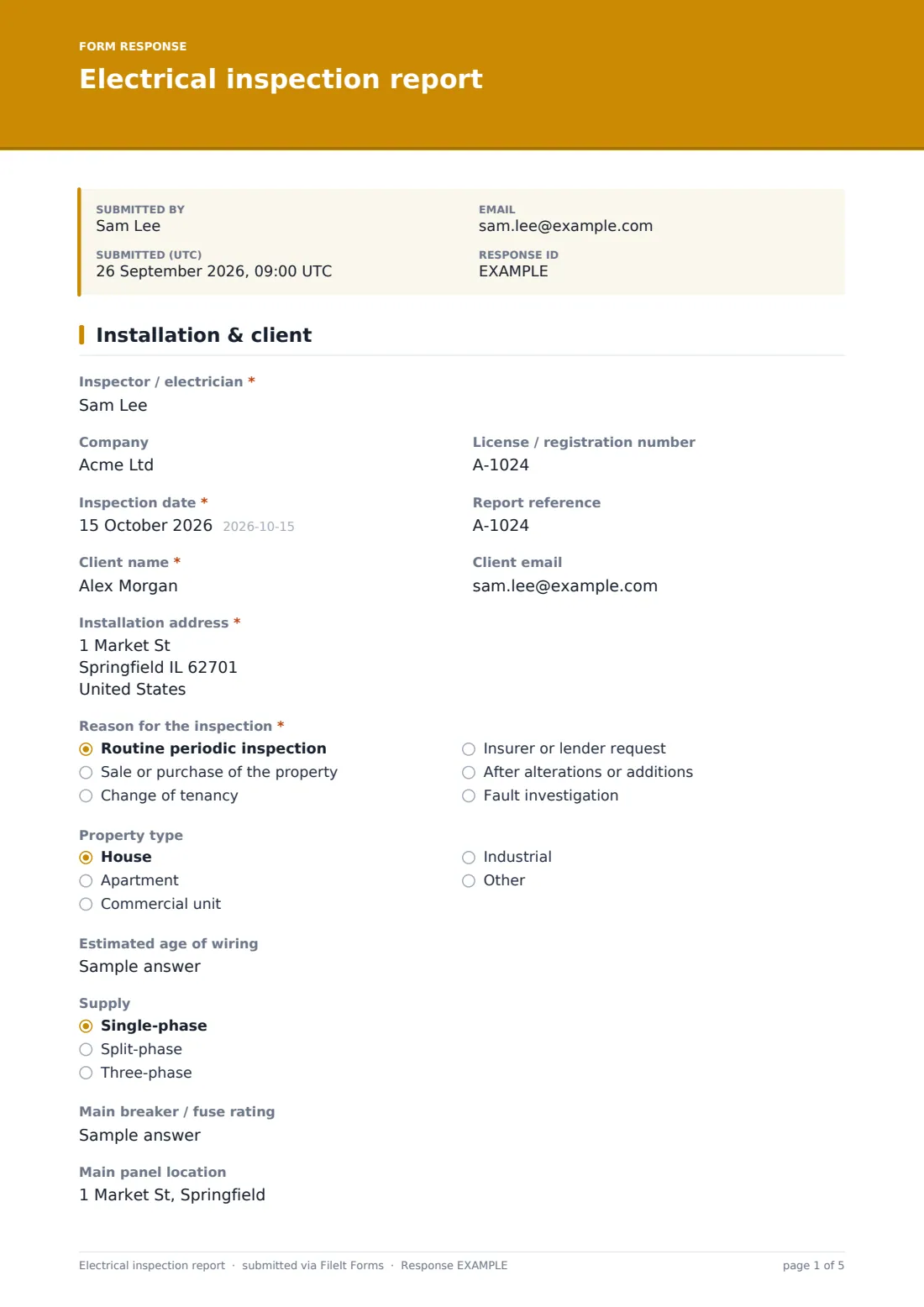
This template gives electricians a consistent structure across four pages: the installation and the reason for the inspection, a test results grid and a visual inspection grid, defects with their urgency and recommended remedial work, and an overall outcome with a signed declaration. The full circuit schedule or test sheet can be attached as a file.
The defect categories are plain-language — danger present, potentially dangerous, improvement recommended, further investigation — so you can map them to whatever classification your local standard uses. Each report is filed as a PDF in your FileIt vault.
- Best for
- Electricians, electrical contractors and inspection companies
- Filled in by
- The electrician carrying out the inspection
- Time to complete
- About 10–15 minutes after testing
- Includes
- Test and visual grids, defect urgency, circuit schedule upload, signed declaration
Who uses a electrical inspection report form?
- A periodic inspection of a rented home before a new tenancy
- A condition report for a buyer before a house purchase
- An inspection requested by an insurer or lender
- Checking an installation after an extension or rewire
- Investigating nuisance tripping or a burning smell
- A facilities team inspecting a commercial unit
Questions on this electrical inspection report form
34 questions over 4 pages · includes signature, file upload, conditional questions, multiple pages, consent checkbox, ratings.
1 Installation & client
- Inspector / electrician*
- Company
- License / registration number
- Inspection date*
- Report reference
- Client name*
- Client email
- Installation address*
- Reason for the inspection* Routine periodic inspection · Sale or purchase of the property · Change of tenancy · Insurer or lender request · After alterations or additions · Fault investigation
- Property type House · Apartment · Commercial unit · Industrial · Other
- Estimated age of wiring
- Supply Single-phase · Split-phase · Three-phase
- Main breaker / fuse rating
- Main panel location
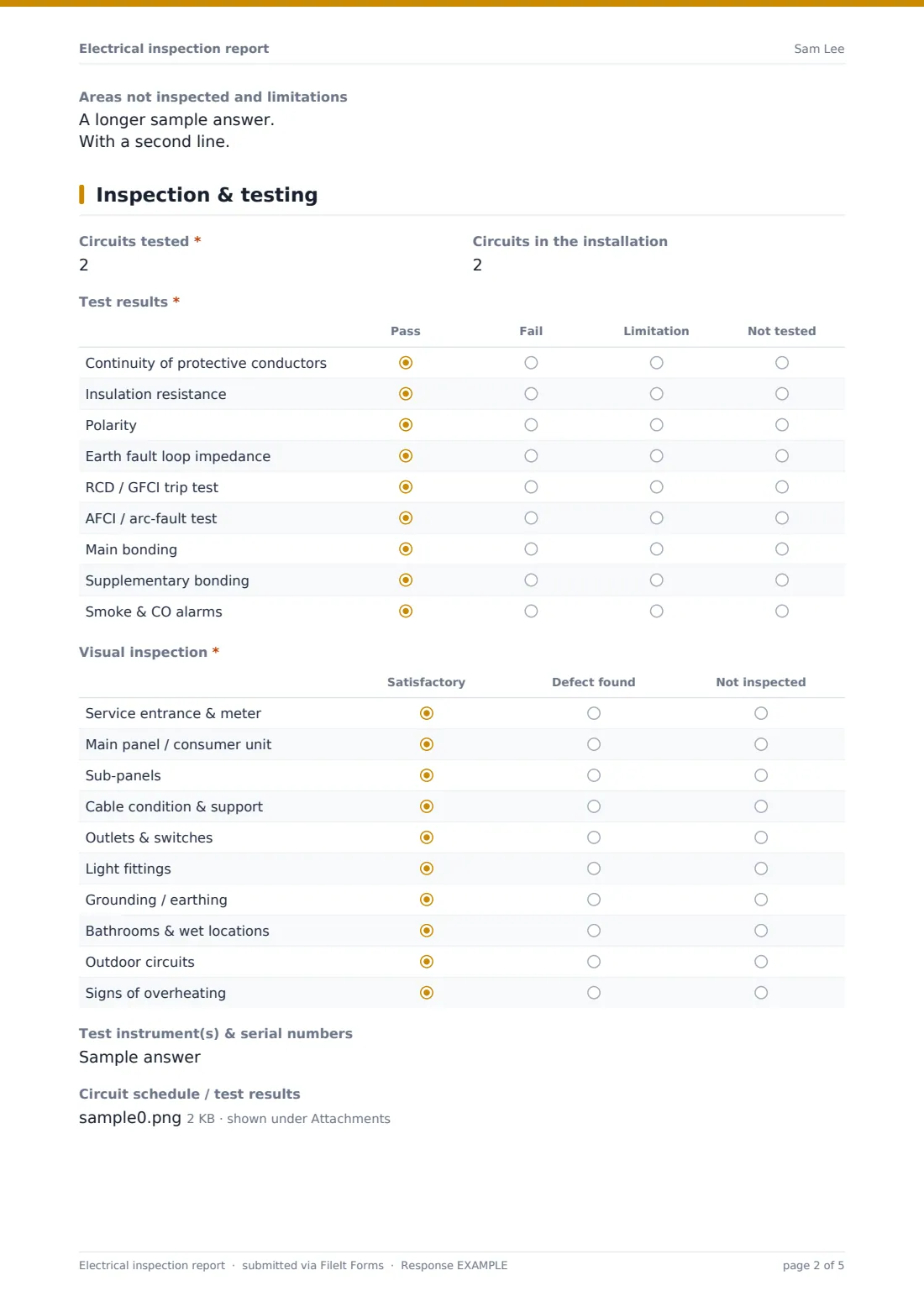
- Areas not inspected and limitations
2 Inspection & testing
- Circuits tested*
- Circuits in the installation
- Test results* Pass · Fail · Limitation · Not tested
- Visual inspection* Satisfactory · Defect found · Not inspected
- Test instrument(s) & serial numbers
- Circuit schedule / test results
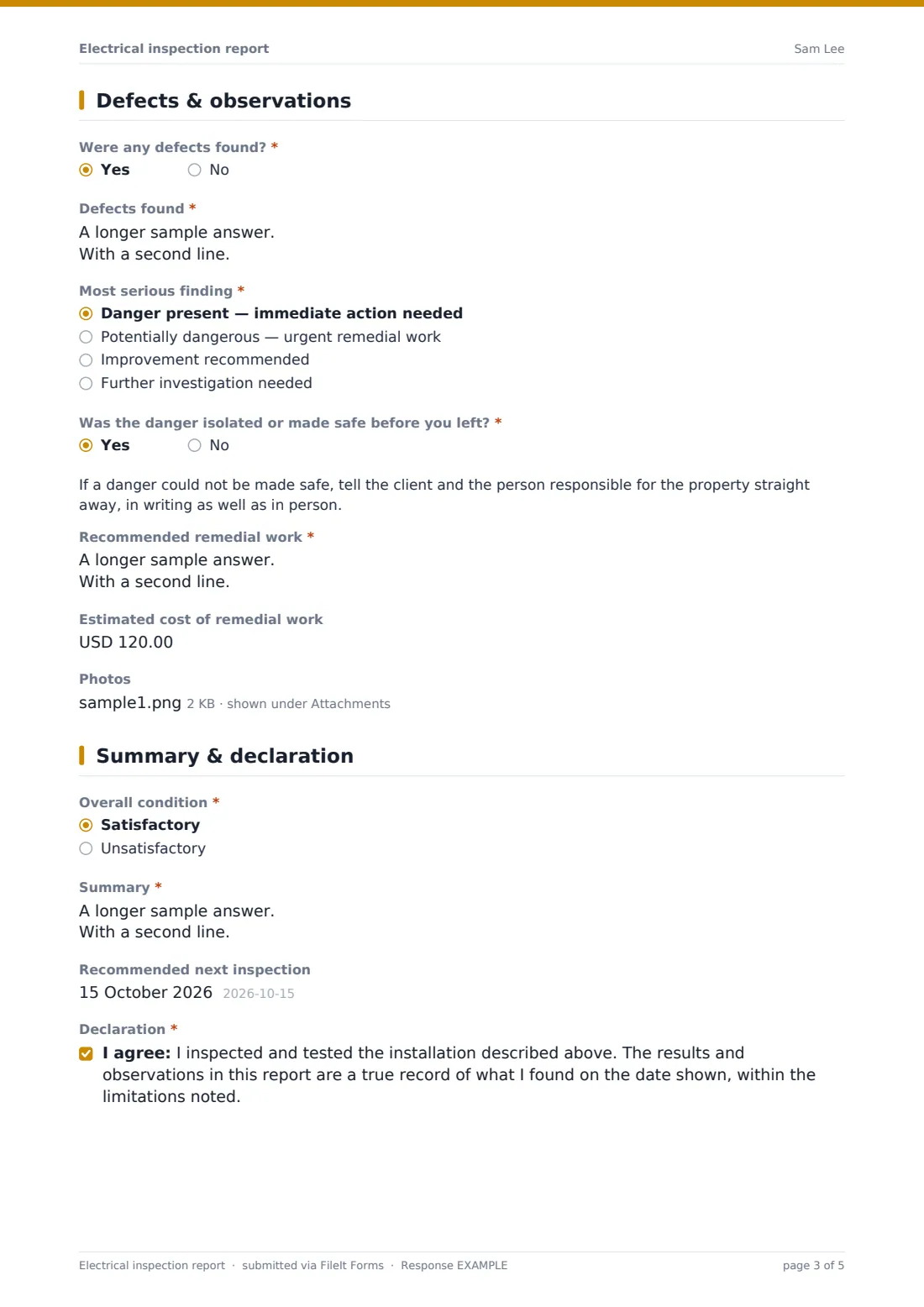
3 Defects & observations
- Were any defects found?*
- Defects found* asked only when it applies
- Most serious finding* asked only when it applies Danger present — immediate action needed · Potentially dangerous — urgent remedial work · Improvement recommended · Further investigation needed
- Was the danger isolated or made safe before you left?* asked only when it applies
- Recommended remedial work* asked only when it applies
- Estimated cost of remedial work asked only when it applies
- Photos
4 Summary & declaration
- Overall condition* Satisfactory · Unsatisfactory
- Summary*
- Recommended next inspection
- Declaration*
- Inspector signature*
- Client signature (report received)
The electrical inspection report form, page by page
1 Installation & client
The electrician's name, company, license or registration number, the inspection date and a report reference come first, then the client and installation address. The reason for the inspection is required: routine periodic, sale or purchase, change of tenancy, insurer or lender request, after alterations, or fault investigation.
The property type, estimated age of the wiring, supply type, main breaker rating and panel location describe the installation. A limitations field records areas not inspected, anything not isolated, or sampling agreed with the client.
2 Inspection & testing
The number of circuits tested is required, with the total in the installation. A required grid records the results of nine tests — continuity of protective conductors, insulation resistance, polarity, earth fault loop impedance, RCD/GFCI, AFCI, main and supplementary bonding, and smoke and CO alarms — as pass, fail, limitation or not tested.
A second grid records the visual inspection of ten areas, from the service entrance and panels to wet locations, outdoor circuits and signs of overheating. The test instruments and serial numbers can be noted, and the circuit schedule or test results uploaded.
3 Defects & observations
If defects were found, they're listed one per line with location, what's wrong and urgency, and the most serious finding is chosen from four levels. If danger is present, the form asks whether it was isolated or made safe and reminds the electrician to tell the client and the person responsible for the property in writing. Recommended remedial work is required, with an optional cost estimate. Photos can be attached.
4 Summary & declaration
The overall condition is satisfactory or unsatisfactory, followed by a required written summary and a recommended next inspection date. The electrician confirms the declaration that the report is a true record within the limitations noted, and signs. The client can sign to acknowledge receiving the report.
Make the template yours
- Rename the urgency levels to match the classification codes your local standard uses
- Add or remove tests in the grid to match your inspection scope
- Add fields for your regulator's scheme or certificate numbers
- File reports by property for landlords with several addresses
- Notify the landlord or agent automatically on submission
- Change the currency on the remedial cost estimate
Tips for a better electrical inspection report form
- Be explicit about limitations — what wasn't inspected matters as much as what was
- Attach the full circuit schedule rather than retyping it
- Photograph every defect you classify as dangerous or urgent
- Write the summary for the client, not for another electrician
- Make dangerous situations safe before leaving wherever you can
- Recommend the next inspection date on every report
Every response becomes a PDF in your vault
The report is filed as a PDF in your FileIt vault with the circuit schedule and photos attached. If you entered the client's email, a copy of the PDF is emailed to them automatically.
Contractors often filter the Responses table for unsatisfactory reports to follow up with remedial quotes, and landlords keep each property's reports in its own folder.
- Start from this template. It opens in the FileIt Forms designer — change any question, add pages, set the rules for when questions appear.
- Share it. Turn on a public link, or send it to people by email, each with their own link. They don’t need a FileIt account.
- Get the answers as PDFs. Each response is saved as a PDF in the vault folder you choose, with uploaded files attached — and listed in a Responses table you can export to CSV.
Electrical inspection report form: frequently asked questions
Is this electrical inspection report template free?
Yes. It's included with the Forms app on every FileIt account, including the free plan, and you can edit any question to fit the way you work.
Is this an official certificate?
No. It's a structured report you can adapt. Where your region requires a specific certificate format, use that format as well, or adapt this template to match it.
Can I attach my test results?
Yes. Upload up to three files — PDFs, spreadsheets, CSVs or images — of the circuit schedule or test sheets.
How are defects classified?
Four plain-language levels: danger present, potentially dangerous, improvement recommended, and further investigation. Rename them to match your local codes.
Can the client sign?
Yes. There's an optional client signature to acknowledge they received the report.
Can I use it for commercial properties?
Yes. Choose the property type, and add rows to the grids for anything specific to the installation.