What is REG 227?
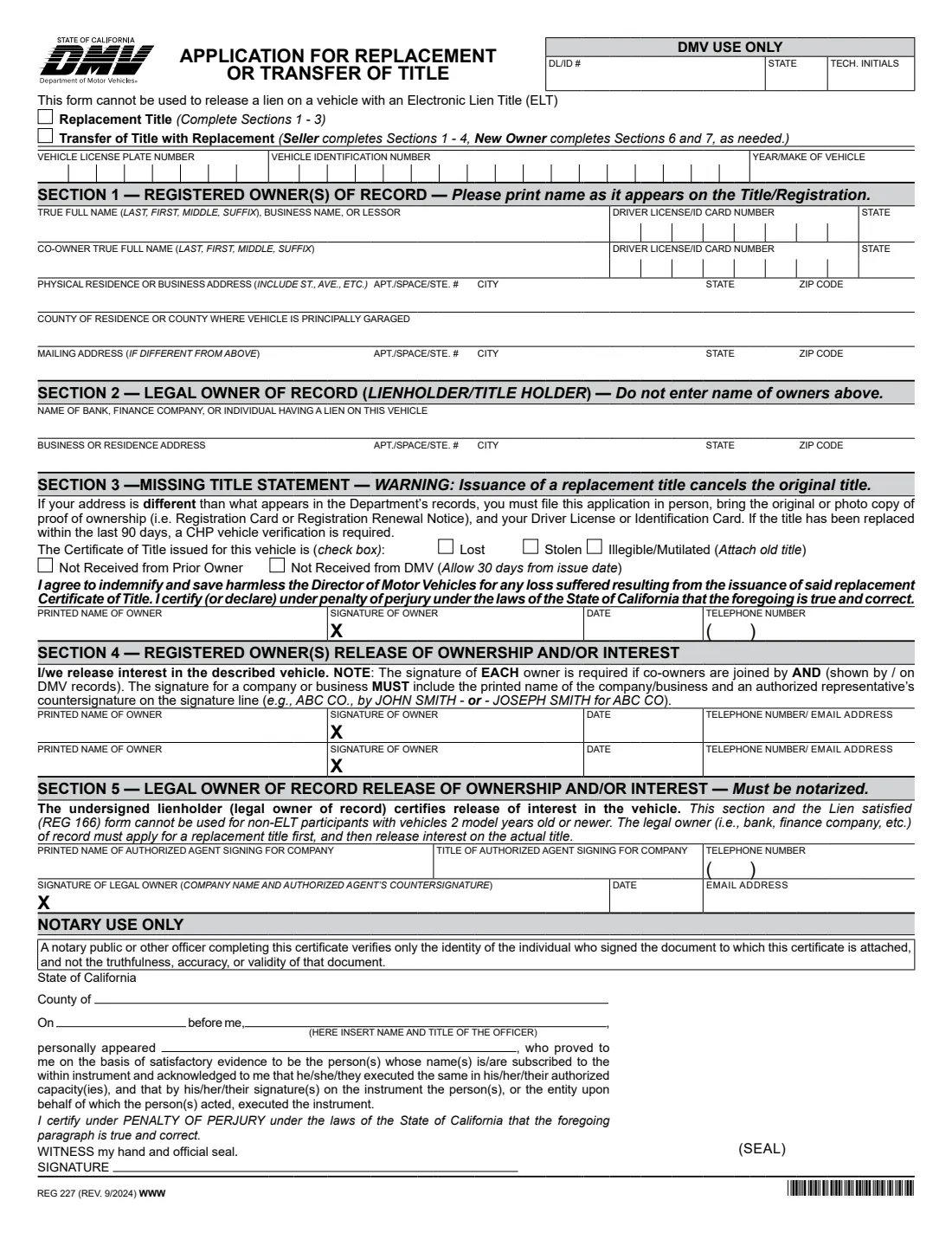
REG 227 is the California Department of Motor Vehicles' Application for Replacement or Transfer of Title. Californians call the certificate of title the "pink slip". When yours is lost, stolen, illegible, or never arrived, REG 227 asks the DMV for a replacement. The same form also works as a transfer: if you are selling or giving away a vehicle and don't have the title to sign over, you release ownership on the front and the new owner completes the back. The current edition is REG 227 (Rev. 9/2024).
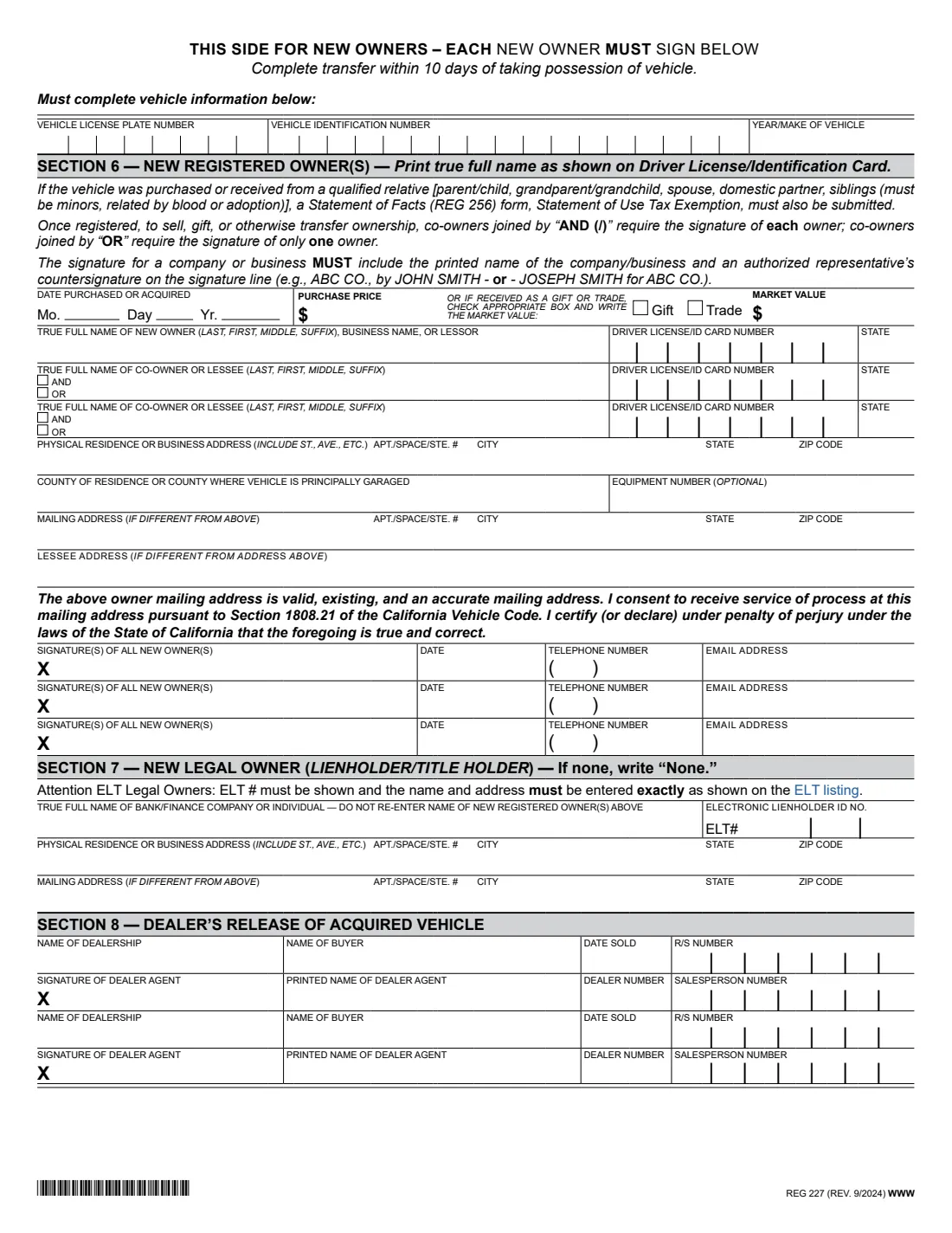
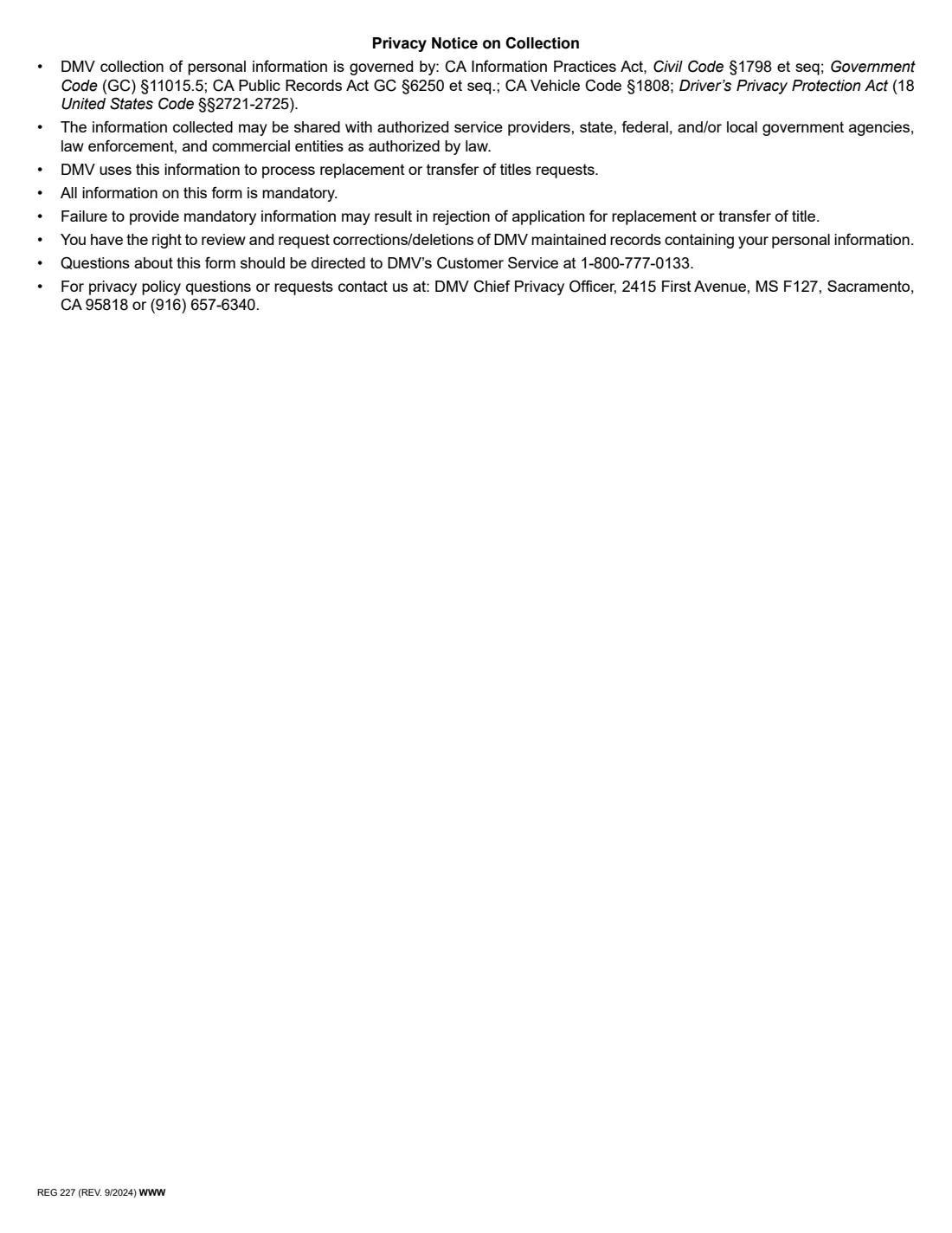
Page one is for the registered owner: the vehicle, the owners of record and their addresses, any lienholder, the missing title statement, the owners' release (for a transfer), and a notarized release by the lienholder if needed. Page two is for new owners: the purchase date and price (or market value for a gift or trade), each new owner's name and license number, addresses, any new lienholder, and a dealer's release when a dealer was in the chain. Page three is the DMV's privacy notice. Issuing a replacement cancels the original title.
FileIt walks you through the form in plain English, prints the plate, VIN and each license number one character per box, and fills in the DMV's own PDF. It pre-fills names from the People records in your vault, keeps the finished PDF in your vault, and can send it for e-signature to co-owners and the buyer. FileIt doesn't submit anything to the DMV.
- Who fills it
- The registered owner (sections 1–4); for a transfer, the new owner (sections 6–7); a lienholder or dealer only if they release interest.
- Where it goes
- The California DMV. If your address differs from DMV records, you must apply in person with proof of ownership and your license or ID.
- When
- When the title is lost, stolen, damaged or not received, or when selling without it. The new owner must complete the transfer within 10 days of taking possession.
- Signatures
- Each owner of record (all owners when joined by AND), each new owner, and a notarized signature for a lienholder release.
- Edition
- REG 227 (Rev. 9/2024), 3 pages (the third is the privacy notice), instructions printed on the form.
- Agency
- California Department of Motor Vehicles
Who needs to fill out REG 227?
- California vehicle owners whose certificate of title is lost, stolen, illegible or mutilated.
- Owners who never received their title from the DMV (allow 30 days from the issue date) or from the prior owner.
- Sellers who need to transfer ownership but can't find the title.
- Buyers completing a purchase where the seller used REG 227 instead of the title.
- Lienholders releasing interest on a vehicle, and dealers releasing an acquired vehicle.
When to use REG 227
- As soon as you realise the title is missing and you need it, for example before selling.
- When you sell or gift a vehicle without the original title: the seller completes sections 1–4 and the buyer sections 6 and 7.
- Not for releasing a lien on a vehicle with an Electronic Lien Title (ELT). The form says it can't be used for that.
What you need before you start
- The license plate number, VIN, and year and make.
- The names exactly as on the title or registration, and each owner's driver license or ID number.
- Your residence and mailing addresses and county.
- The lienholder's name and address, if there is a loan on the vehicle.
- For a transfer: the buyer's details, date purchased, and the price (or market value for a gift or trade).
- If the vehicle came from a qualified relative, a Statement of Facts (REG 256) for the use tax exemption.
- If your address differs from DMV records: the original or a photo copy of proof of ownership and your license or ID card, in person.
What’s on REG 227
The 2024 edition has 3 pages. FileIt asks for it in 15 parts, and it is signed by Registered owner (seller) and Co-owner of record and Legal owner (lienholder) and New owner (buyer) and New co-owner 1 and New co-owner 2 and Dealer:
- What are you applying for?Registered owner (seller)
- VehicleRegistered owner (seller)
- Section 1: Registered owner of recordRegistered owner (seller)
- Section 1: Co-owner of recordCo-owner of record
- Section 1: AddressesRegistered owner (seller)
- Section 2: Legal owner of record (lienholder/title holder)Registered owner (seller)
- Section 3: Missing title statementRegistered owner (seller)
- Section 4: Registered owner(s) release of ownershipRegistered owner (seller)
- Section 5: Legal owner of record release (must be notarized)Legal owner (lienholder)
- Section 6: New registered ownerNew owner (buyer)
- Section 6: New co-owner or lessee 1New co-owner 1
- Section 6: New co-owner or lessee 2New co-owner 2
- Section 6: New owner's addressesNew owner (buyer)
- Section 7: New legal owner (lienholder/title holder)New owner (buyer)
- Section 8: Dealer's release of acquired vehicleDealer
How to fill out REG 227, step by step
1 Replacement or transfer
Tick Replacement Title to get a duplicate of your own title (sections 1–3), or Transfer of Title with Replacement when you are selling or giving the vehicle away (the seller completes 1–4 and the new owner 6 and 7). Then give the plate number, the VIN, and the year and make; they print on both pages.
2 Sections 1–2: Owners and lienholder of record
Print the true full name (last, first, middle, suffix), business name or lessor as it appears on the title, with each owner's license or ID number and state. Add the physical address, county, a different mailing address if you have one, and any bank or finance company holding a lien.
3 Section 3: Missing title statement
Say what happened to the title: lost, stolen, illegible or mutilated (attach it), not received from the prior owner, or not received from DMV. The owner prints their name, signs, dates and gives a telephone number, agreeing to indemnify the DMV. If the title was replaced within the last 90 days, a CHP vehicle verification is required.
4 Sections 4–5: Releases
For a transfer, each owner prints their name, signs and gives a telephone number or email address to release ownership; co-owners joined by AND must all sign. A business signs with its printed name and an authorized representative's countersignature. A lienholder releasing interest completes section 5 (agent's name, title, telephone and email), which must be notarized.
5 Sections 6–8: New owners and dealer
The buyer gives the date purchased, the price or market value, their name and license number, up to two co-owners joined by AND or OR, the addresses and county, and any lessee address, then each new owner signs and gives a date, telephone number and email address. Section 7 names any new lienholder with its ELT number, or says None. Section 8 is for a dealer's release.
Common mistakes to avoid
- Writing a name differently from the title or registration.
- Using REG 227 to release a lien on an Electronic Lien Title vehicle.
- Mailing the form when your address has changed. You must apply in person in that case.
- Leaving out a co-owner's signature when the owners are joined by AND.
- Forgetting the notary for a lienholder release in section 5.
- Missing the 10-day window for the new owner to complete the transfer.
After you fill it out
Sign where your section asks (and have co-owners, the buyer and any lienholder sign), then submit it to the DMV with the fees the DMV charges and any documents it asks for.
Once the replacement is issued, the original title is cancelled, so don't use it even if it turns up.
FileIt keeps the completed REG 227 in your vault with your other vehicle records.
Fill out REG 227 online with FileIt
- Pick the person. Choose someone from People and FileIt fills in their name, date of birth, address and other details it already knows.
- Answer plain-language questions. One part of the form at a time, with the official help text beside each question — 127 fields in all. Your answers save as you go.
- Check the live preview. Watch your answers land on the real California Department of Motor Vehicles form, and let FileIt do any worksheet arithmetic.
- Generate the official PDF. FileIt prints your answers into the agency’s own PDF and files it in that person’s folder in your vault. Sign it, or send it for e-signature.
FileIt fills the form — it never files or submits anything for you. Deliver the finished form to whoever asked for it, the way the form’s instructions say.
Start REG 227 now — it’s freeREG 227: frequently asked questions
Can I fill out REG 227 online?
Yes. FileIt lets you fill it in on screen and prints your answers into the official California DMV PDF. You sign it and submit it to the DMV yourself.
Can I sell my car without the pink slip?
Yes. Tick Transfer of Title with Replacement: you complete sections 1–4 and sign the release, and the buyer completes sections 6 and 7.
Does REG 227 need a notary?
Only section 5, the legal owner (lienholder) release of interest, must be notarized.
What if my title never arrived from the DMV?
Choose "Not Received from DMV" in section 3. The form asks you to allow 30 days from the issue date first.
Official sources
- Blank form (PDF), published by California Department of Motor Vehicles: https://www.dmv.ca.gov/portal/file/reg-227-pdf/
- Official instructions and guidance: https://www.dmv.ca.gov/portal/file/reg-227-pdf/
- Edition shown on this page: REG 227 (Rev. 9/2024) (checked 2026-09-28).
FileIt is not affiliated with or endorsed by California Department of Motor Vehicles or any government. This page explains the form in general terms and is not legal, tax or immigration advice. Always read the official instructions, and check that you are using the edition the recipient accepts. Page last reviewed 2026-09-28.