What is Form 130-U?
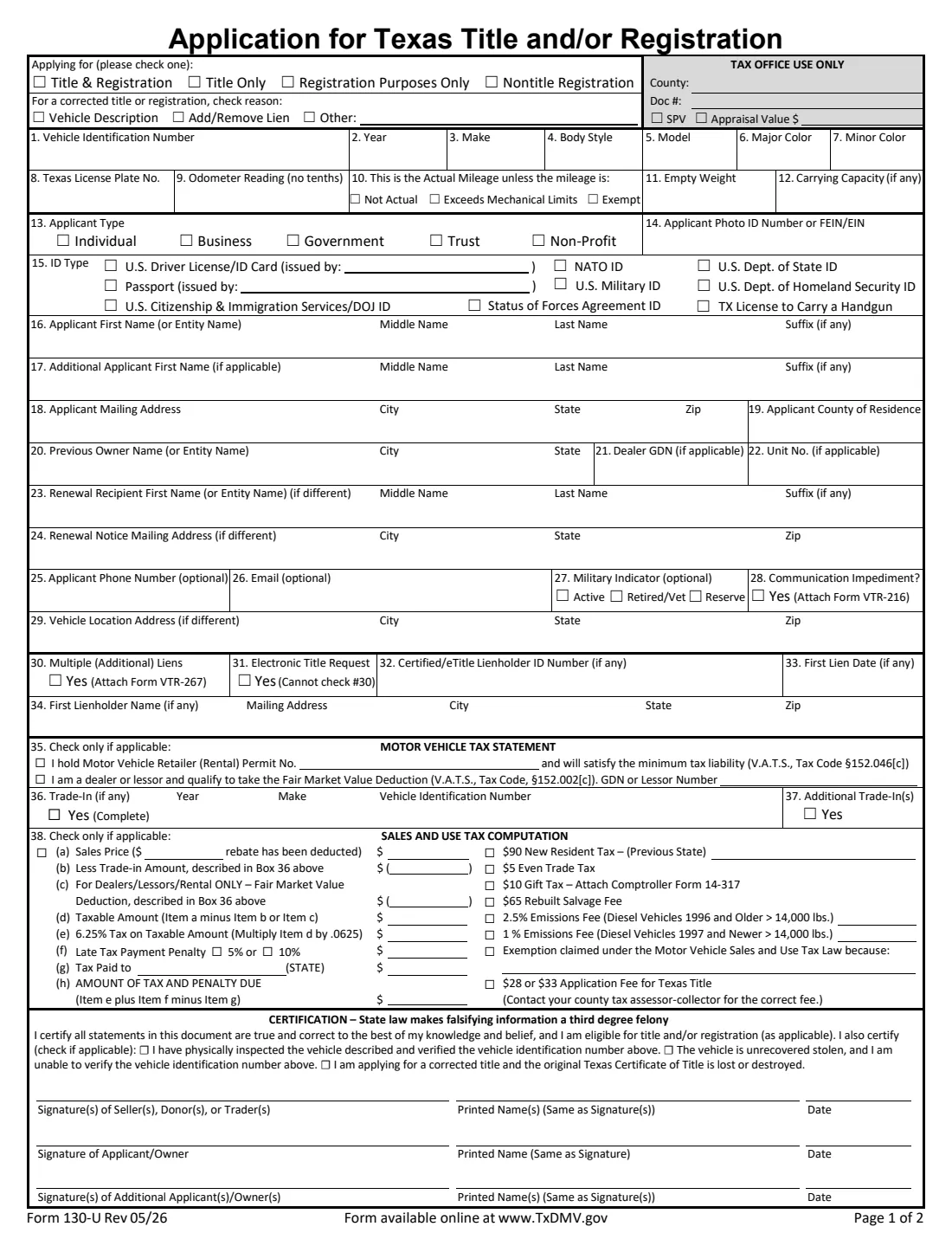
Form 130-U is the Texas Department of Motor Vehicles' Application for Texas Title and/or Registration. When you buy a vehicle from a private seller, move to Texas with a vehicle, or receive one as a gift, you fill in the 130-U and file it at a county tax assessor-collector's office with the signed title, proof of insurance if you are registering it, a government-issued photo ID, and the fees and motor vehicle tax due. The current edition is Rev 05/26, with detailed instructions in form VTR-130-UIF.
The form covers the vehicle description, the applicant and any additional applicant, the previous owner, renewal and vehicle location addresses, liens, trade-ins, and box 38's sales and use tax computation. Texas charges 6.25% motor vehicle sales and use tax on the sales price less any trade-in, with flat taxes instead for new residents ($90), even trades ($5) and qualifying gifts ($10). The buyer's original signature is required; the seller signs too.
FileIt asks each question in plain English, works out the taxable amount, the 6.25% tax, any late payment penalty and the total in box 38, and prints everything into TxDMV's own PDF, each name part under its own printed heading. The finished form is saved in your vault and can be sent for e-signature to the seller. FileIt never files anything: you take the form to the county tax office.
- Who fills it
- The buyer or new owner (applicant), with any additional applicant. The seller, donor or trader signs and prints their name.
- Where it goes
- A county tax assessor-collector's office, with the fees, tax, title and supporting documents.
- When
- Within 30 days of the sale. The sales and use tax is due within 30 days of the purchase or of bringing the vehicle into Texas.
- Tax
- 6.25% of the sales price less trade-in; $90 new resident tax; $5 even trade; $10 gift tax (with Comptroller Form 14-317).
- Edition
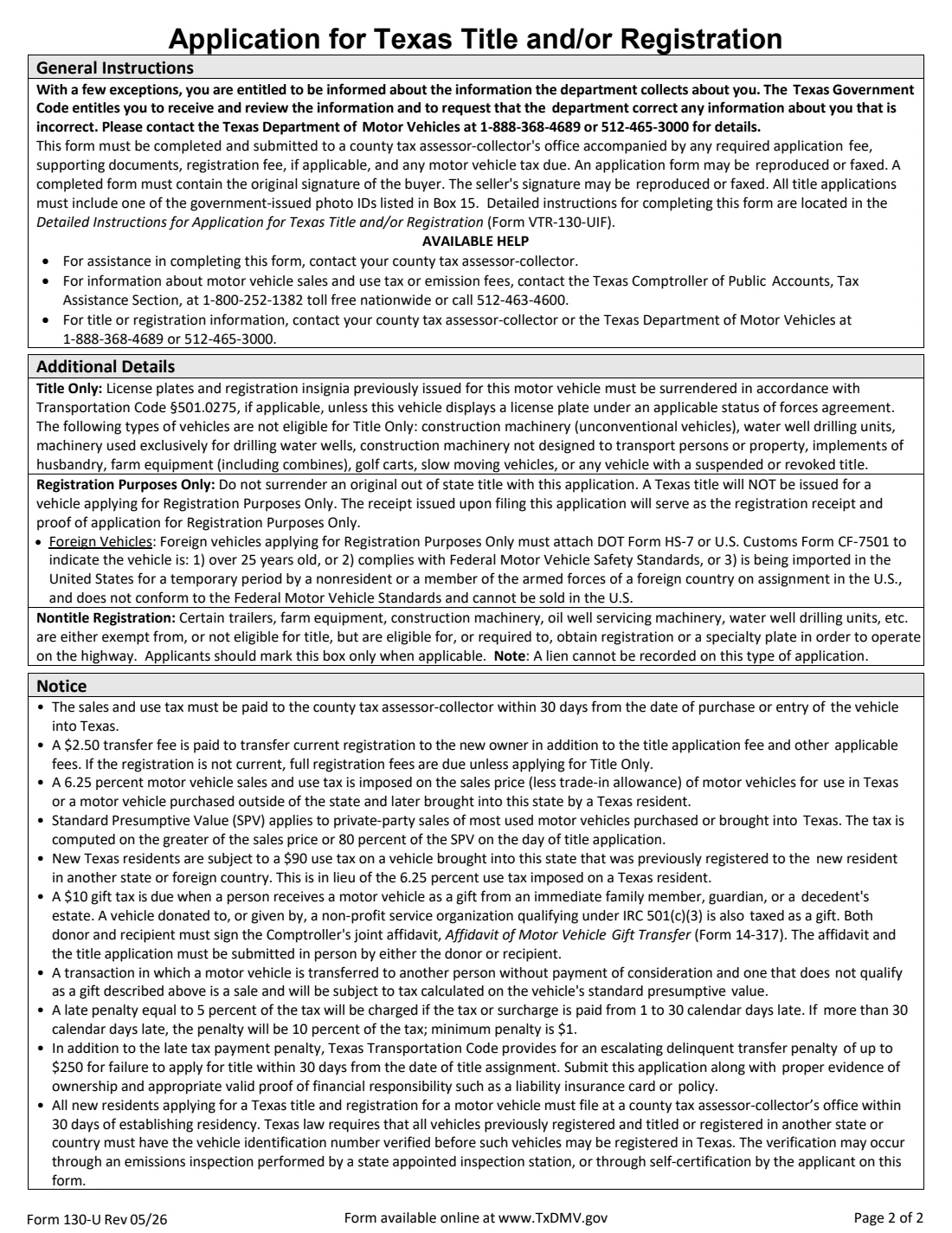
- Form 130-U Rev 05/26 (page 2 is the general instructions).
- Agency
- Texas Department of Motor Vehicles (TxDMV)
Who needs to fill out Form 130-U?
- Anyone who bought a vehicle from a private seller in Texas.
- New Texas residents titling and registering a vehicle from another state or country; they must file within 30 days of establishing residency.
- People receiving a vehicle as a gift from an immediate family member, guardian, estate or qualifying non-profit.
- Owners asking for a corrected title (vehicle description, adding or removing a lien).
- Anyone applying for title only, registration purposes only, or nontitle registration of trailers and equipment.
When to use Form 130-U
- Right after you buy a vehicle: file within 30 days of the sale to avoid penalties.
- When you move to Texas with a vehicle registered in another state.
- When you need to correct a Texas title or add or remove a lien.
- When a family member gives you a vehicle as a gift.
What you need before you start
- The title (or other ownership document) properly assigned to you by the seller.
- Proof of insurance in your name if you are registering the vehicle.
- One of the government-issued photo IDs listed in box 15, and its number.
- The vehicle's VIN, year, make, body style, model, colors, plate number, odometer reading and empty weight.
- The seller's name, city and state, and the lienholder's name, address and lien date if you financed it.
- The sales price, any rebate and trade-in amount, and any tax already paid to another state.
- For a gift, the Comptroller's Affidavit of Motor Vehicle Gift Transfer (Form 14-317) signed by both donor and recipient.
What’s on Form 130-U
The 2026 edition has 2 pages. FileIt asks for it in 12 parts, and it is signed by Seller, donor or trader and Applicant/owner (buyer) and Additional applicant:
- Applying forApplicant/owner (buyer)
- Boxes 1–12: VehicleApplicant/owner (buyer)
- Boxes 13–19: ApplicantApplicant/owner (buyer)
- Box 17: Additional applicantAdditional applicant
- Boxes 20–22: SellerApplicant/owner (buyer)
- Boxes 23–24: Renewal recipient (if different)Applicant/owner (buyer)
- Boxes 25–29: Contact and other detailsApplicant/owner (buyer)
- Boxes 30–34: LiensApplicant/owner (buyer)
- Box 35: Motor vehicle tax statement (rental companies, dealers and lessors)Applicant/owner (buyer)
- Boxes 36–37: Trade-inApplicant/owner (buyer)
- Box 38: Sales and use tax computationApplicant/owner (buyer)
- CertificationApplicant/owner (buyer)
How to fill out Form 130-U, step by step
1 Applying for and boxes 1–12: Vehicle
Check title & registration, title only, registration purposes only, or nontitle registration. Copy the vehicle description from the title: VIN, year, make, body style (like 4D or PK), model, major and minor color, Texas plate, odometer reading without tenths and the odometer brand, empty weight and any carrying capacity.
2 Boxes 13–19: Applicant
Choose the applicant type, give the photo ID number (or FEIN/EIN for an entity) and the ID type, then the applicant's first, middle and last name and suffix (or entity name), any additional applicant, the mailing address and the county of residence.
3 Boxes 20–29: Seller, renewal and contact
Enter the previous owner's name, city and state as on the title, a dealer GDN or fleet unit number if any, the renewal notice recipient and address if different, your phone and email, the optional military indicator, a communication impediment (with Form VTR-216), and where the vehicle is kept if that differs from your mailing address.
4 Boxes 30–37: Liens and trade-in
For a financed vehicle give the first lienholder and lien date; box 30 is for additional liens (Form VTR-267) and box 31 requests an electronic title (with the 11-digit certified lienholder ID in box 32). With no lien, box 34 says NONE. Box 35 is only for rental companies, dealers and lessors. Describe any trade-in in box 36.
5 Box 38: Sales and use tax
Enter the sales price after any rebate and the trade-in amount; FileIt computes the taxable amount, 6.25% tax, any 5% or 10% late penalty (minimum $1), tax paid to another state and the total due. Or check the flat $90 new resident, $5 even trade, $10 gift, or $65 rebuilt salvage fee, the diesel emissions fee, an exemption with its reason, and the $28 or $33 title application fee. For most private-party used vehicle sales the county computes the tax on the greater of the price or 80% of the Standard Presumptive Value.
6 Certification and signatures
Check the VIN self-certification if you inspected the vehicle, or the stolen or lost-title statements if they apply. The seller signs and prints their name, the applicant signs and prints theirs, and any additional applicant does the same, each with the date. Falsifying information is a third-degree felony.
Common mistakes to avoid
- Waiting past 30 days: the tax penalty is 5% if 1 to 30 days late and 10% after that, and a delinquent transfer penalty of up to $250 can apply.
- Forgetting the seller's signature and printed name.
- Entering a sales price below the Standard Presumptive Value without expecting the county to use the higher figure.
- Checking both multiple liens (box 30) and electronic title (box 31). The instructions say #31 can't be checked when #30 is.
- Leaving box 34 blank when there is no lien instead of writing NONE.
- Not bringing a photo ID from box 15; every title application needs one.
After you fill it out
Sign it (the buyer's original signature is required), have the seller sign, and take it with the title, insurance, ID and payment to a county tax assessor-collector's office within 30 days of the sale.
A $2.50 transfer fee applies when current registration moves to you, on top of the title application fee and other fees. If the registration isn't current, full registration fees are due unless you apply for title only.
FileIt keeps the completed 130-U in your vault with your other vehicle records.
Fill out Form 130-U online with FileIt
- Pick the person. Choose someone from People and FileIt fills in their name, date of birth, address and other details it already knows.
- Answer plain-language questions. One part of the form at a time, with the official help text beside each question — 106 fields in all. Your answers save as you go.
- Check the live preview. Watch your answers land on the real Texas Department of Motor Vehicles form, and let FileIt do any worksheet arithmetic.
- Generate the official PDF. FileIt prints your answers into the agency’s own PDF and files it in that person’s folder in your vault. Sign it, or send it for e-signature.
FileIt fills the form — it never files or submits anything for you. Deliver the finished form to whoever asked for it, the way the form’s instructions say.
Start Form 130-U now — it’s freeForm 130-U: frequently asked questions
Can I fill out the 130-U online?
Yes. FileIt lets you fill it in on screen, works out the box 38 tax lines, and prints your answers into the official TxDMV PDF. You sign it and file it at your county tax office yourself.
How much is Texas vehicle sales tax?
6.25% of the sales price less any trade-in. New residents pay a $90 use tax instead, an even trade is $5 and a qualifying gift is $10.
How long do I have to file?
Within 30 days of the date of sale. New residents file within 30 days of establishing residency.
Does the seller have to sign?
Yes, the seller, donor or trader signs and prints their name in the certification. The seller's signature may be reproduced or faxed; the buyer's must be original.
Where do I submit the 130-U?
At a county tax assessor-collector's office: in the county where the sale occurred, where the lienholder is, where you live, or any county willing to accept it.
Official sources
- Blank form (PDF), published by Texas Department of Motor Vehicles: https://www.txdmv.gov/sites/default/files/form_files/Form-130-U.pdf
- Official instructions and guidance: https://www.txdmv.gov/sites/default/files/form_files/VTR-130-UIF.pdf
- Edition shown on this page: Form 130-U Rev 05/26 (checked 2026-09-28).
FileIt is not affiliated with or endorsed by Texas Department of Motor Vehicles or any government. This page explains the form in general terms and is not legal, tax or immigration advice. Always read the official instructions, and check that you are using the edition the recipient accepts. Page last reviewed 2026-09-28.