What is Form I-130?
Form I-130, Petition for Alien Relative, asks U.S. Citizenship and Immigration Services (USCIS) to recognize a qualifying family relationship. A U.S. citizen can petition for a spouse, children, parents (if the citizen is at least 21) and brothers and sisters (also at least 21). A lawful permanent resident can petition for a spouse and unmarried children. File a separate Form I-130 for each relative; when you petition for your spouse, also submit Form I-130A, Supplemental Information for Spouse Beneficiary.
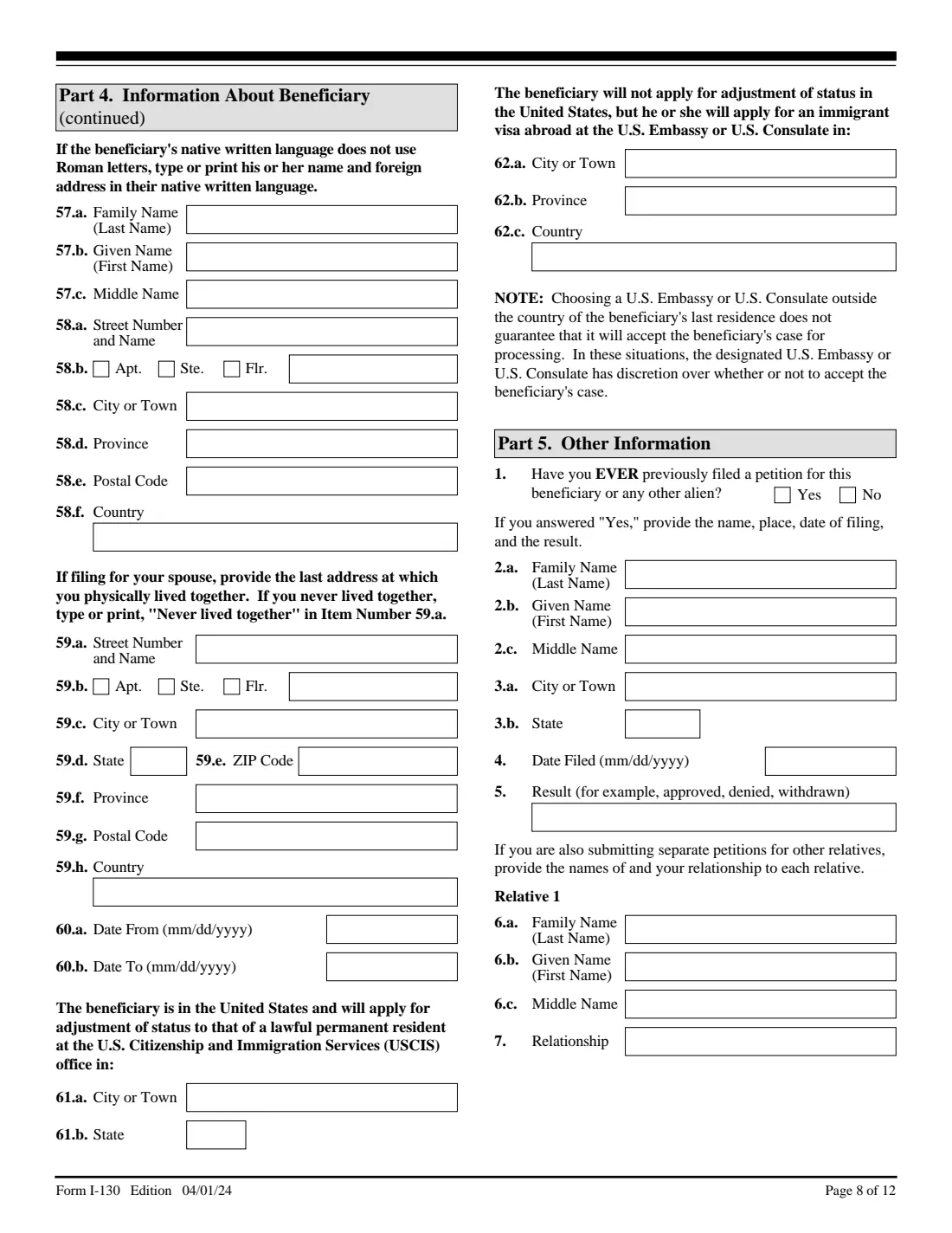
Approval doesn't give a green card by itself. The relative then applies for one: with Form I-485 if they are in the United States and a visa number is available, or through an immigrant visa at a U.S. Embassy or Consulate abroad. Some relatives must wait until an immigrant visa number is available. The form asks which route the relative will take (Part 4, item 61 or 62); USCIS says to answer exactly one of the two.
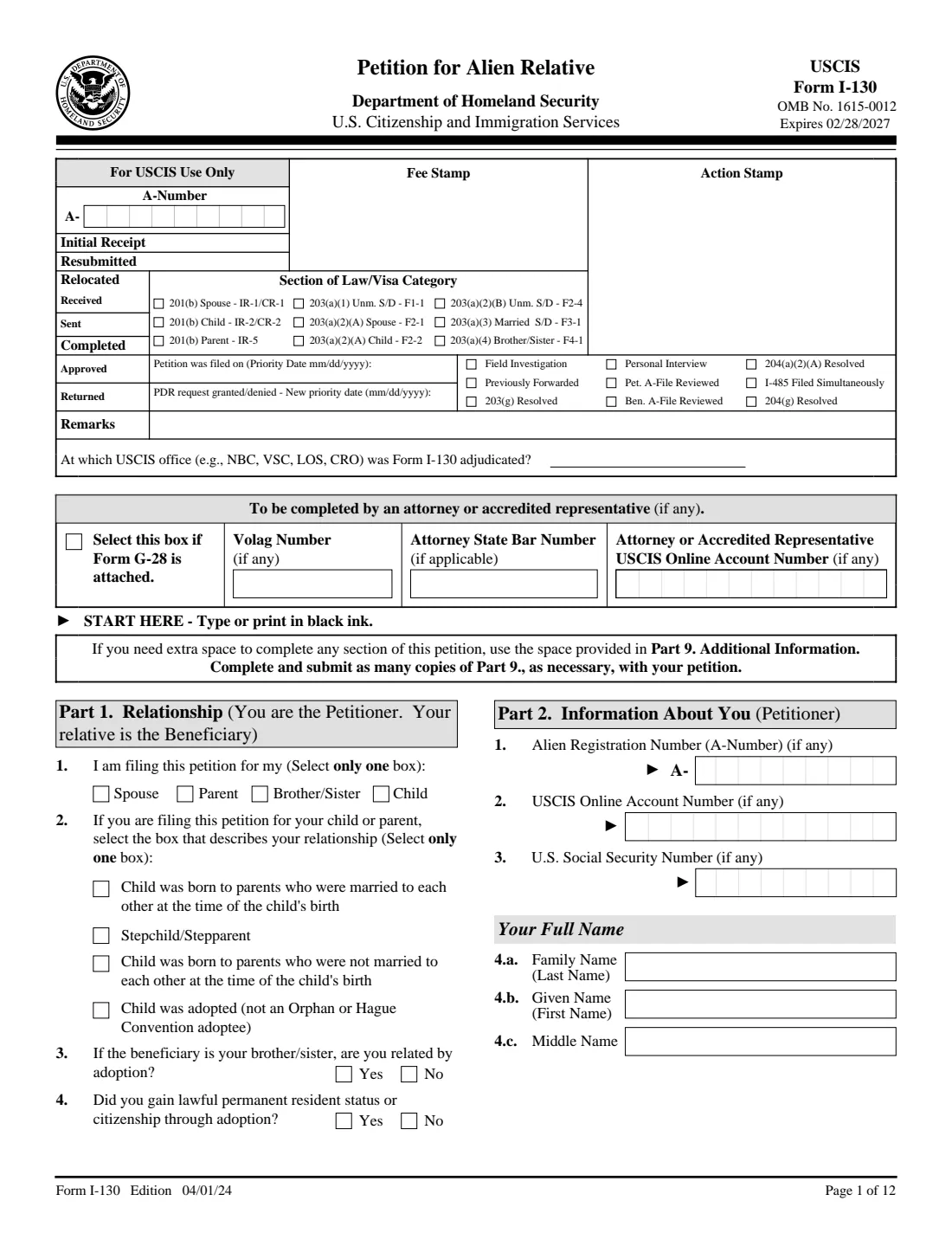
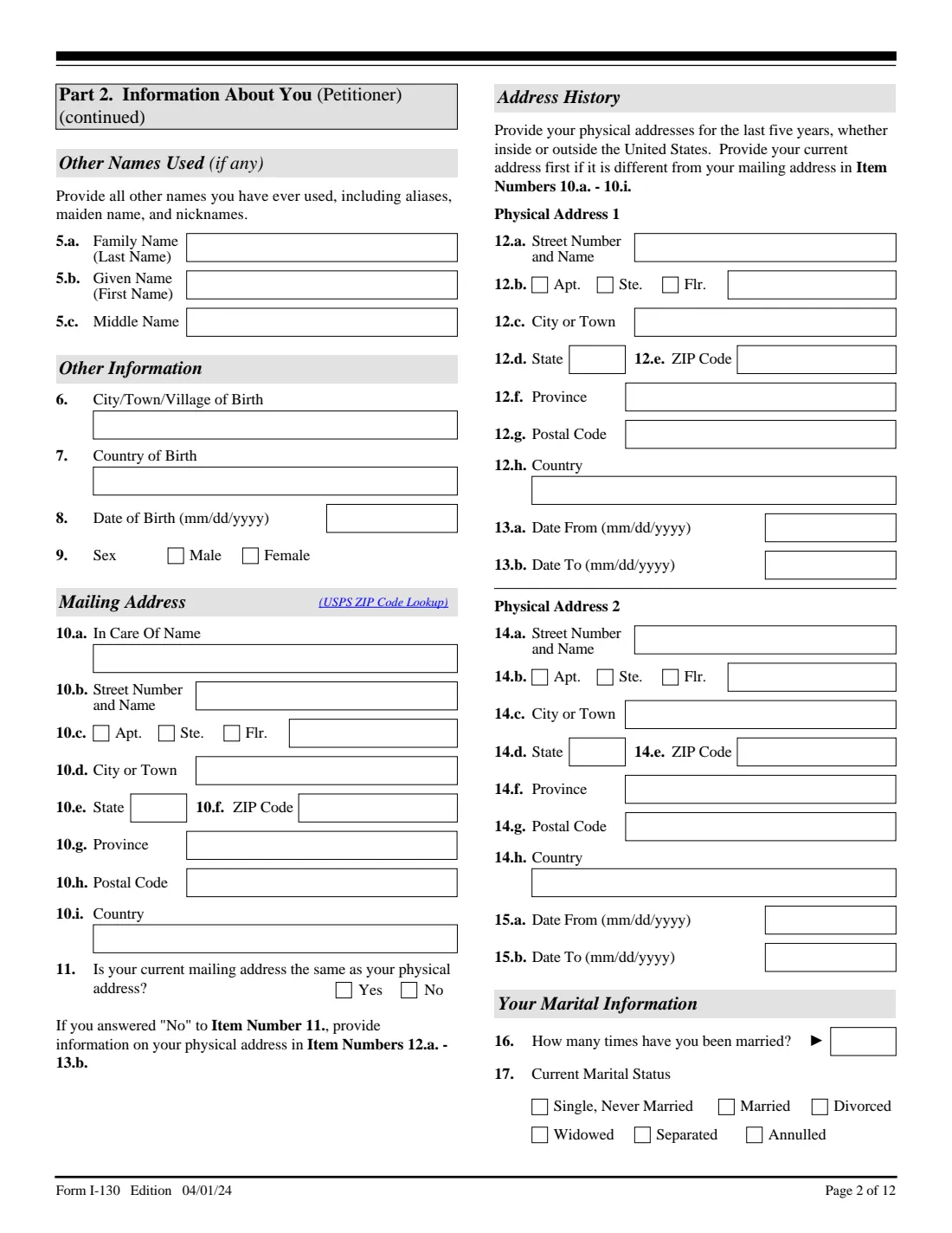
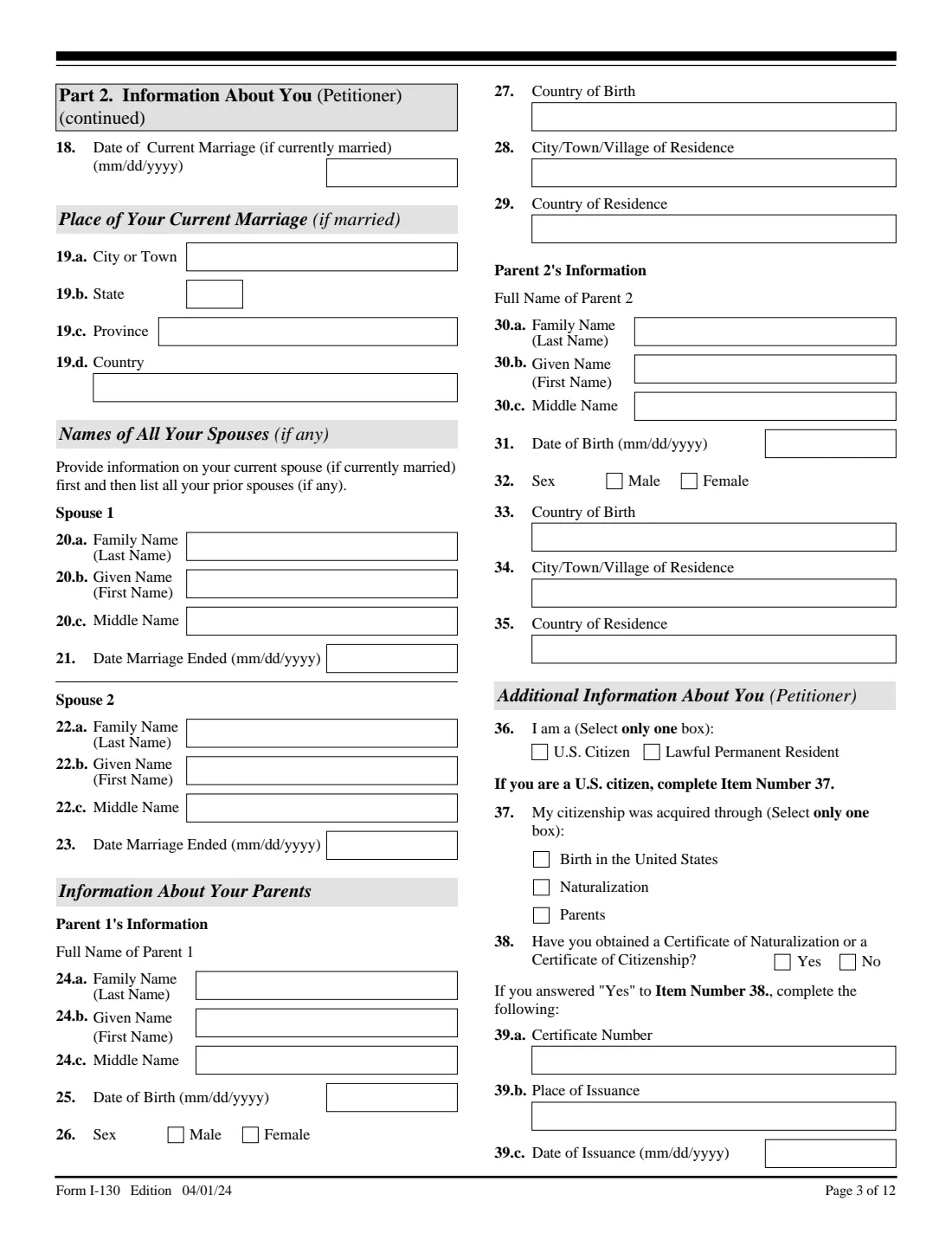
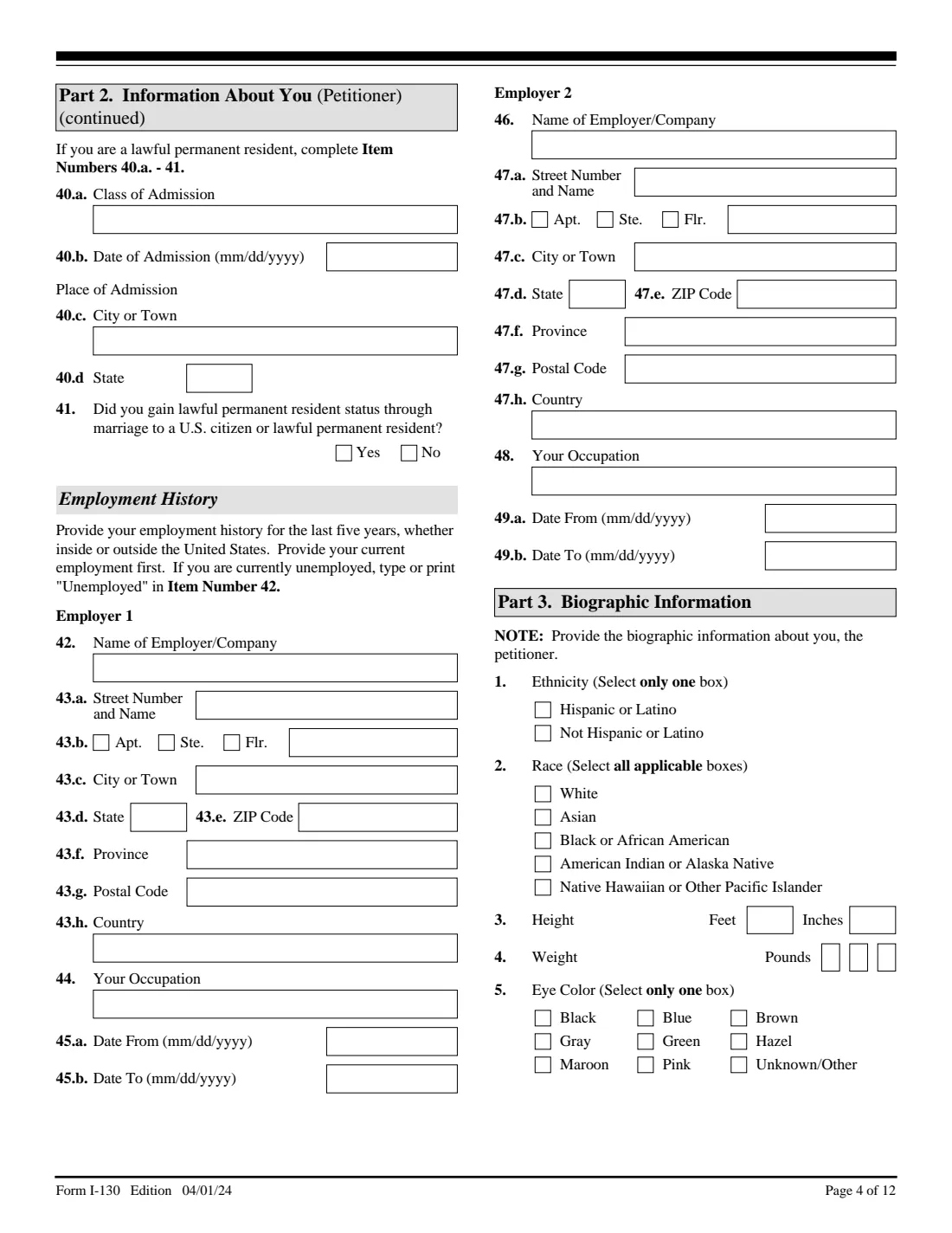
The edition in FileIt is dated 04/01/24, the current edition on the USCIS Form I-130 page. The form is 12 pages and asks about you, your address and job history, your parents and marriages, and the same for your relative. FileIt guides you through it in plain English, shows only the questions that apply to your relationship and status, checks who can petition for whom, and prints your answers into the official USCIS PDF. You print it, sign it by hand and mail it yourself, or you can file online with USCIS instead; FileIt never files anything.
- Who fills it
- The petitioner: a U.S. citizen or lawful permanent resident. The relative is the beneficiary.
- Given to
- U.S. Citizenship and Immigration Services (USCIS): online, or by mail to the lockbox the Form I-130 page gives for where you live.
- When
- Whenever you want to start the immigration process for a relative. File one petition per relative.
- Signatures
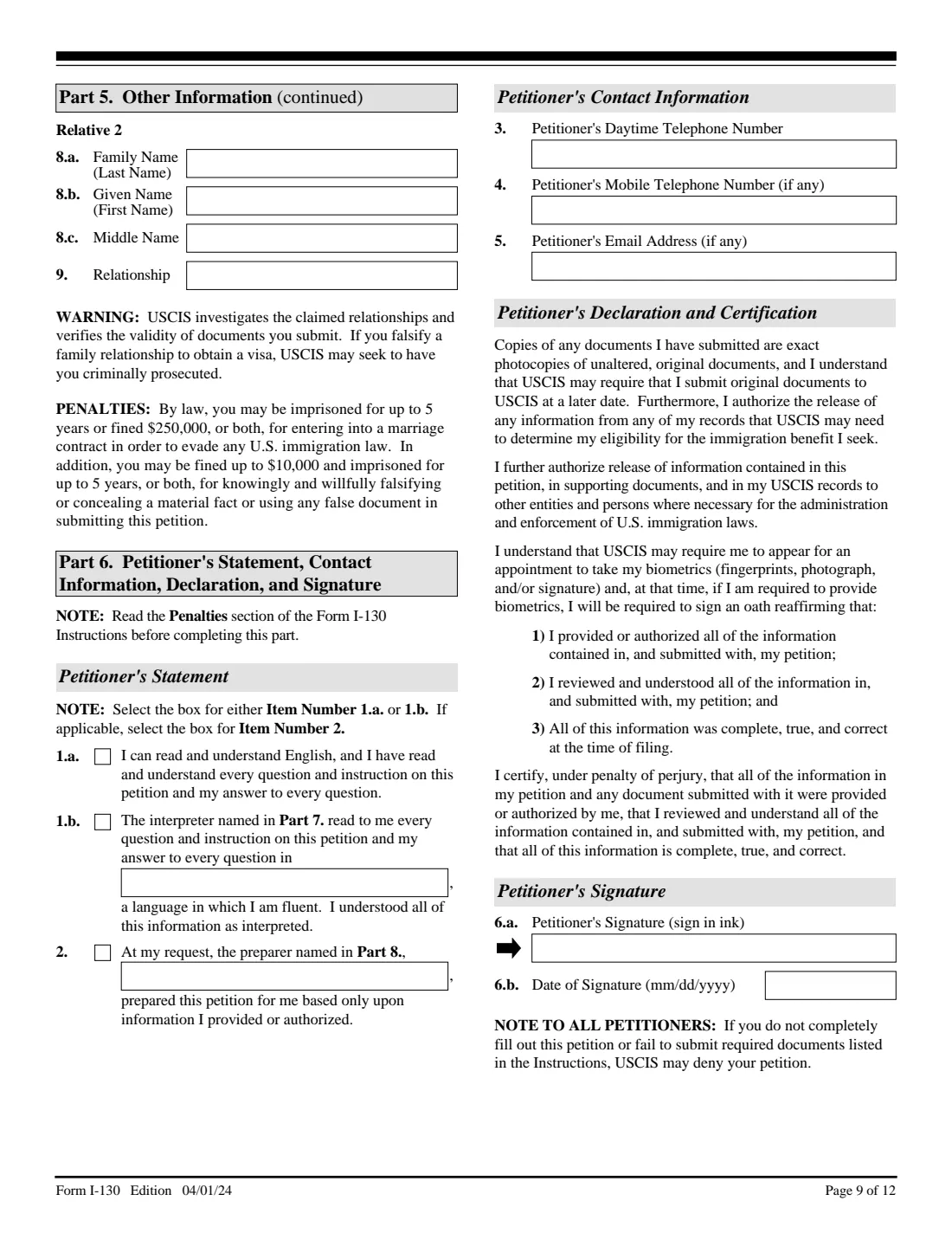
- The petitioner signs Part 6 in ink. An interpreter (Part 7) and a preparer (Part 8) sign if they helped. USCIS rejects an unsigned petition.
- Edition
- 04/01/24 (OMB No. 1615-0012, expires 02/28/2027)
- Agency
- U.S. Citizenship and Immigration Services (USCIS), Department of Homeland Security
Who needs to fill out Form I-130?
- U.S. citizens petitioning for a spouse, a child (any age, married or unmarried), a parent, or a brother or sister. Petitions for a parent or sibling need the citizen to be at least 21.
- Lawful permanent residents petitioning for a spouse or an unmarried son or daughter.
- Anyone whose relative will apply for a green card through family, in the U.S. (Form I-485) or abroad (immigrant visa).
- Not for grandparents, grandchildren, nieces, nephews, uncles, aunts, cousins or in-laws: those relationships don't qualify.
When to use Form I-130
- To start your relative's family-based green-card case. For some close relatives of U.S. citizens who are in the United States, Form I-485 can be filed together with the I-130; the USCIS page and instructions explain when.
- As early as possible for relatives in preference categories, because their place in line (the priority date) is usually the date USCIS receives the petition.
- Again for each additional relative: every beneficiary needs their own Form I-130.
What you need before you start
- Proof of your status: a U.S. passport, birth certificate, naturalization or citizenship certificate, or a copy of your green card.
- Proof of the relationship, such as a marriage certificate, birth certificates showing the shared parent, or adoption records, plus proof that earlier marriages ended.
- Your addresses and jobs for the last five years, your parents' details, and your marriage history.
- Your relative's full name, date and place of birth, addresses (current, intended U.S. address and address abroad), marital history, spouse and children, passport, and current employer.
- If your relative is in the U.S.: their I-94 number, class of admission, date of arrival and how long they may stay.
- For a spouse petition: Form I-130A for your spouse, and the last address where you lived together.
- Your relative's name and foreign address in their native alphabet, if their language doesn't use Roman letters.
What’s on Form I-130
The 2024 edition has 12 pages. FileIt asks for it in 22 parts:
- Attorney or accredited representative (page 1)Preparer
- Part 1. RelationshipPetitioner
- Part 2. Information about you (petitioner)Petitioner
- Part 2. Your mailing address and address historyPetitioner
- Part 2. Your marital information and spousesPetitioner
- Part 2. Information about your parentsPetitioner
- Part 2. Your citizenship or permanent residencePetitioner
- Part 2. Your employment historyPetitioner
- Part 3. Biographic information (about you, the petitioner)Petitioner
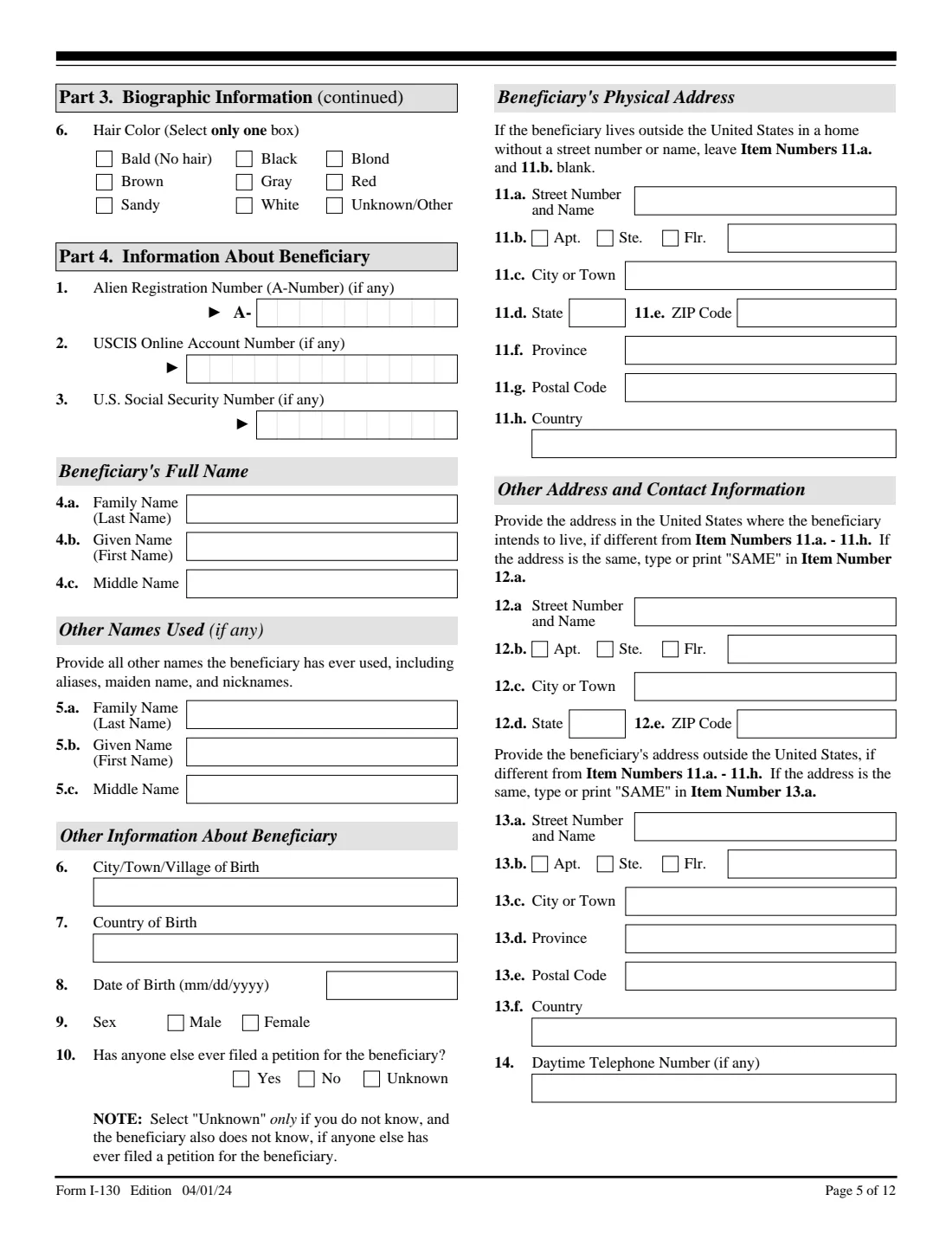
- Part 4. Information about the beneficiaryPetitioner
- Part 4. Beneficiary's addresses and contact informationPetitioner
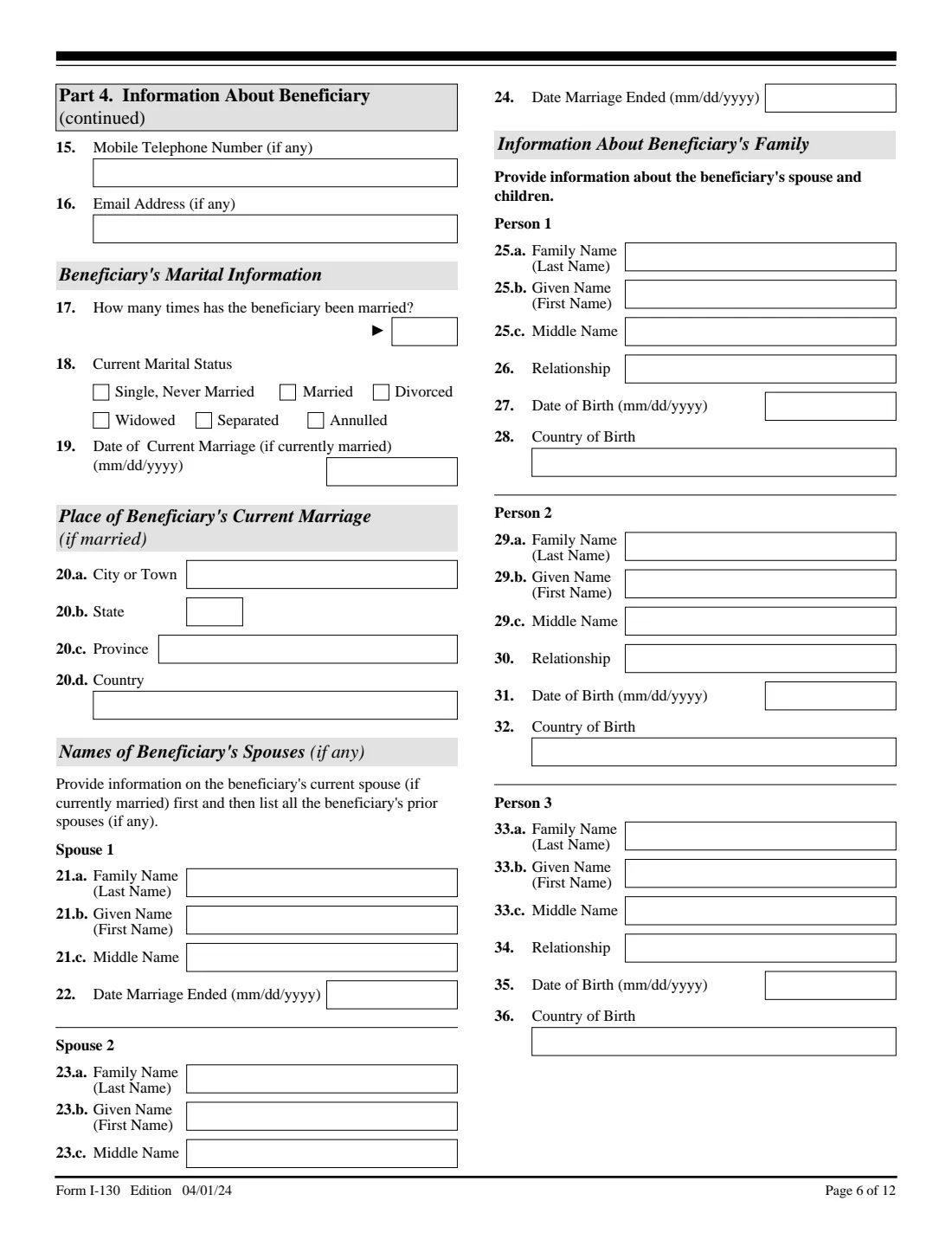
- Part 4. Beneficiary's marital information and spousesPetitioner
- Part 4. Beneficiary's spouse and childrenPetitioner
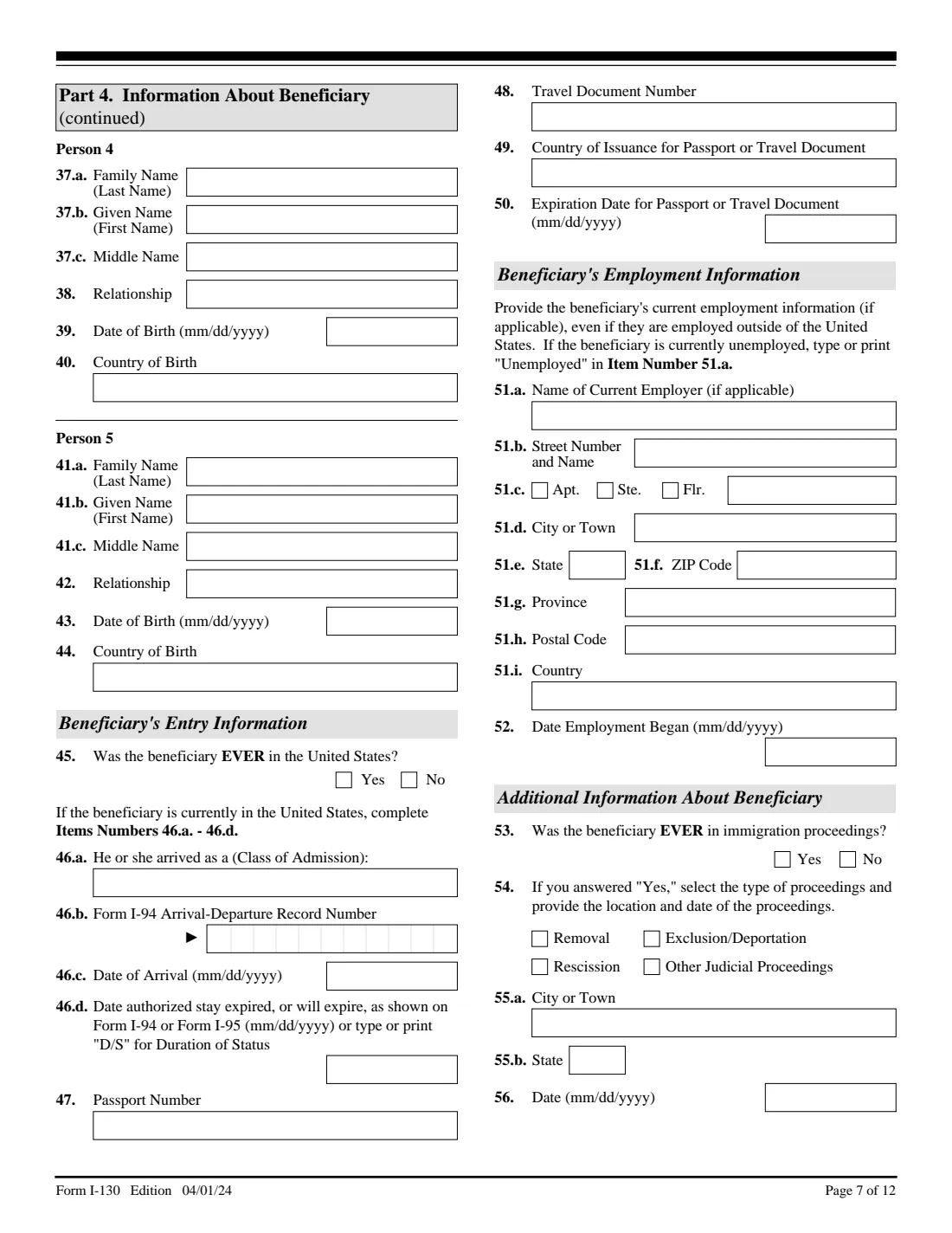
- Part 4. Beneficiary's entry information and passportPetitioner
- Part 4. Beneficiary's employment and immigration proceedingsPetitioner
- Part 4. Beneficiary's name and address in their native alphabetPetitioner
- Part 4. Last address together, and where the beneficiary will applyPetitioner
- Part 5. Other informationPetitioner
- Part 6. Petitioner's statement, contact information, declaration and signaturePetitioner
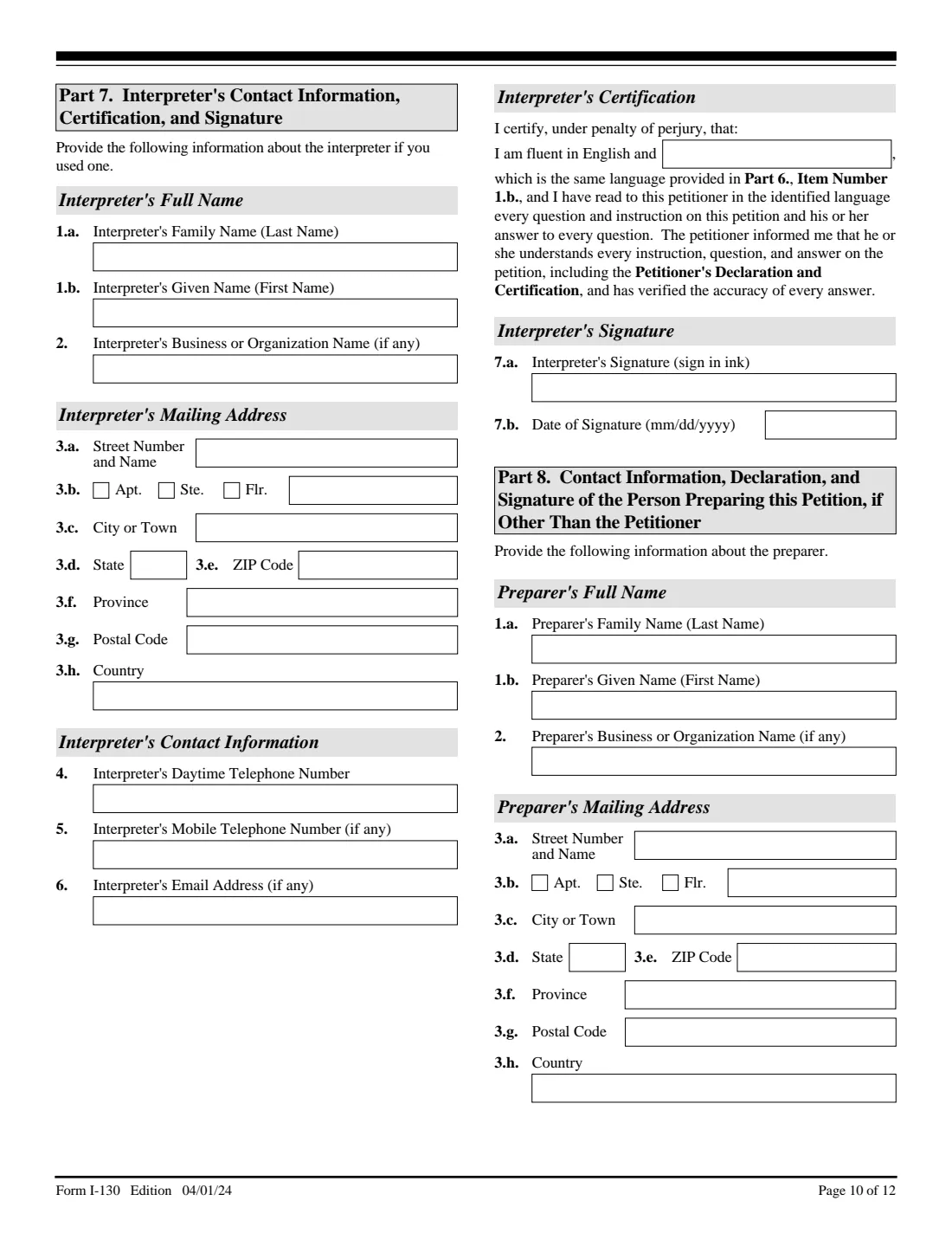
- Part 7. Interpreter's contact information, certification and signatureInterpreter
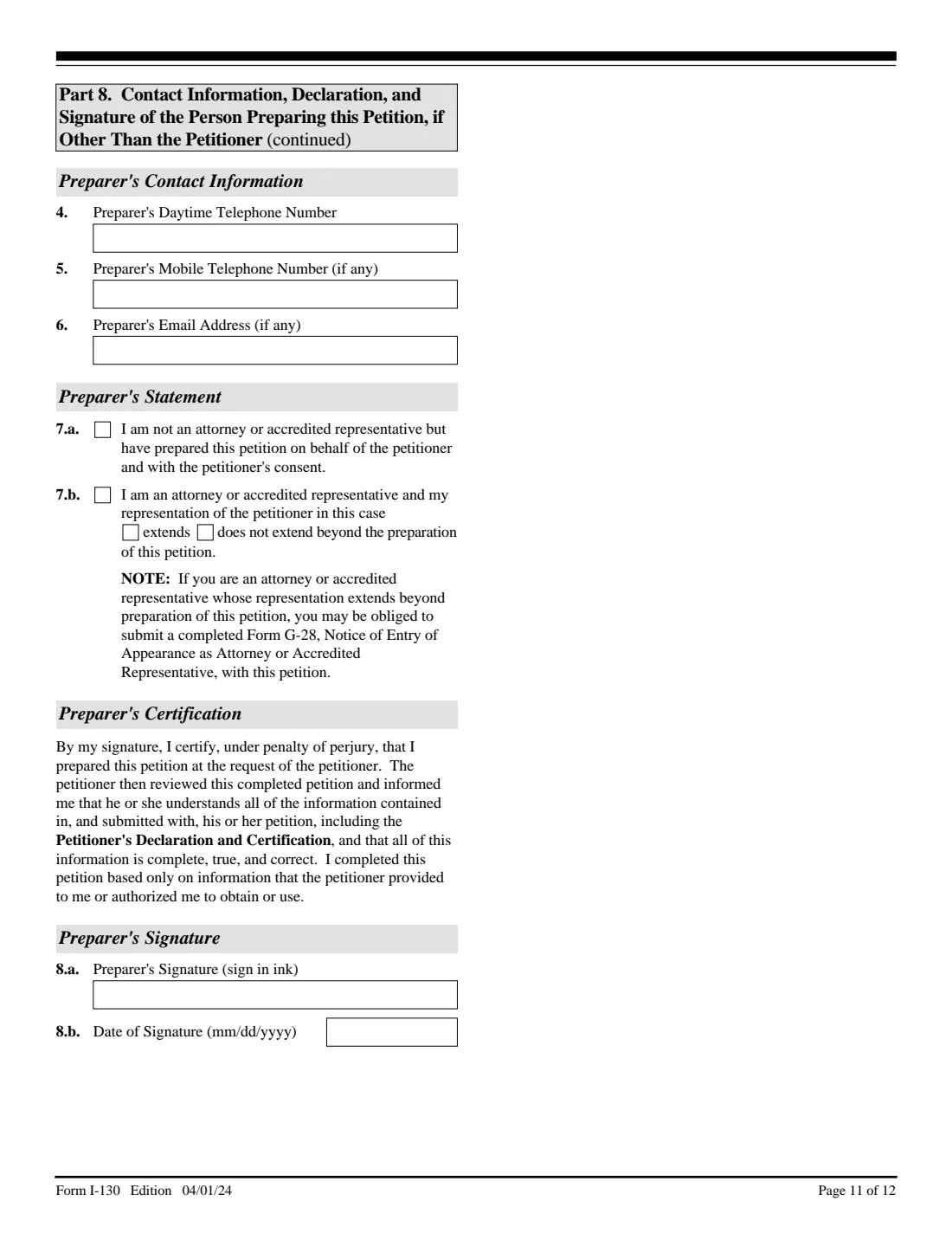
- Part 8. Person preparing this petition, if other than the petitionerPreparer
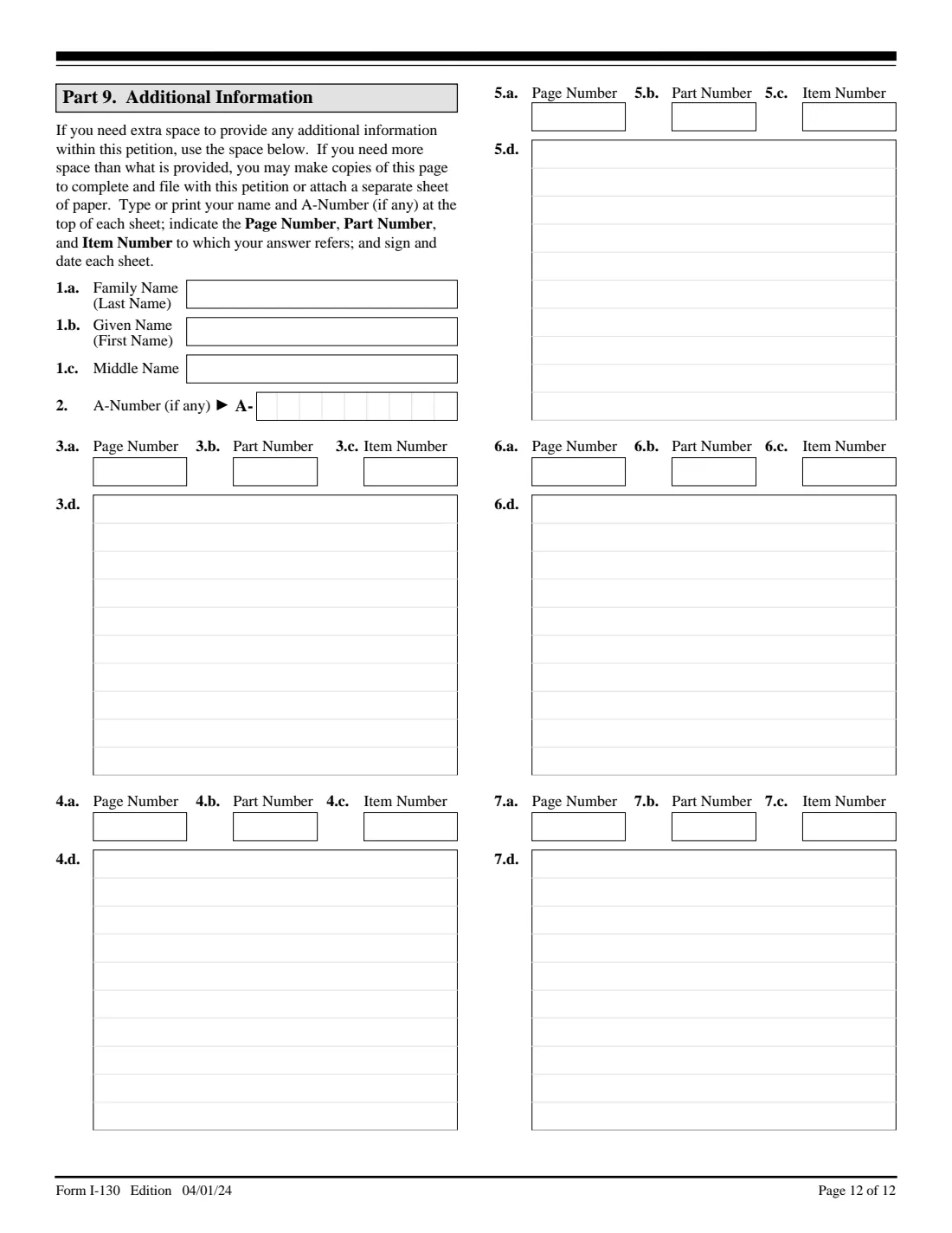
- Part 9. Additional informationPetitioner
How to fill out Form I-130, step by step
1 Part 1. Relationship
Choose spouse, parent, brother/sister or child. For a child or parent, say how the relationship arose (born in or out of wedlock, step-relationship or adoption). For a sibling, say whether you are related by adoption. Everyone answers whether they got status through adoption.
2 Part 2. Information about you
Your A-Number, USCIS Online Account Number and SSN if any, name and other names, birth details, mailing address and five years of addresses, marriages and spouses, your parents, whether you are a citizen (and how) or a permanent resident (class and date of admission), and five years of employment.
3 Part 3. Biographic information
Your ethnicity, race, height, weight, and eye and hair color.
4 Part 4. Information about the beneficiary
Your relative's identity, addresses and contact details, marriages and spouses, spouse and children, U.S. entry details if they are here now, passport, employment and any immigration proceedings. If their language uses another alphabet, their name and address in it. For a spouse, the last address you lived at together. Then answer exactly one of item 61 (applying for a green card at a USCIS office in the U.S.) or item 62 (immigrant visa at a U.S. Embassy or Consulate).
5 Part 5. Other information
Whether you have ever filed a petition for this or anyone else (name, place, date and result), and any other relatives you are petitioning for separately at the same time.
6 Parts 6 to 9. Statement, signatures and extra space
Your contact details and statement about reading the form, then your signature in ink. An interpreter and a preparer complete their parts if used. Part 9 is for anything that didn't fit, with the page, part and item number.
Common mistakes to avoid
- Answering both item 61 and item 62, or neither. USCIS asks for exactly one.
- Forgetting Form I-130A when petitioning for a spouse.
- Leaving out prior marriages, or proof that they ended.
- Listing fewer than five years of addresses or jobs. Use Part 9 for more.
- A permanent resident petitioning for a parent, sibling or married child: those categories are for U.S. citizens only.
- Mixing pages from different editions. USCIS asks that all pages come from the same edition, with the edition date and page numbers visible.
- Not signing, or typing the signature. Sign in ink.
After you fill it out
Print the PDF, check all 12 pages (the edition date and page numbers must be visible), and sign Part 6 in ink. Add the evidence and, for a spouse, Form I-130A, and send the package to the lockbox the USCIS Form I-130 page gives for where you live, or file online instead. FileIt does not submit it for you.
USCIS sends a receipt notice and may ask for more evidence or an interview. Once approved, your relative applies for the green card in the U.S. or through the National Visa Center and a consulate abroad; the sponsor usually also files Form I-864, Affidavit of Support.
Your completed I-130 stays in your FileIt vault under the person's folder, with the evidence you sent. Add the receipt and approval notices as they arrive.
Fill out Form I-130 online with FileIt
- Pick the person. Choose someone from People and FileIt fills in their name, date of birth, address and other details it already knows.
- Answer plain-language questions. One part of the form at a time, with the official help text beside each question — 352 fields in all. Your answers save as you go.
- Check the live preview. Watch your answers land on the real U.S. Citizenship and Immigration Services (USCIS) form, and let FileIt do any worksheet arithmetic.
- Generate the official PDF. FileIt prints your answers into the agency’s own PDF and files it in that person’s folder in your vault.
FileIt fills the form — it never files or submits anything for you. Deliver the finished form to whoever asked for it, the way the form’s instructions say.
Start Form I-130 now — it’s freeForm I-130: frequently asked questions
Can I fill out Form I-130 online with FileIt?
Yes. FileIt guides you through the paper Form I-130, shows only the questions that apply to your relationship, and prints your answers into the official USCIS PDF. You print, sign and mail it yourself. USCIS also offers its own online filing.
Who can I petition for?
A U.S. citizen can petition for a spouse, children, parents and brothers or sisters (for parents and siblings the citizen must be at least 21). A permanent resident can petition for a spouse and unmarried children.
Do I need Form I-130A?
Yes, if you are petitioning for your spouse. The USCIS page says petitioners filing for a spouse must also submit Form I-130A, Supplemental Information for Spouse Beneficiary.
Where do I file Form I-130?
It depends on where you live and whether you file Form I-485 at the same time. U.S. residents file at a USCIS lockbox (Chicago, Dallas, Elgin or Phoenix) or online; petitioners abroad may file at the Elgin lockbox, online, or in limited cases at a U.S. embassy or consulate. The Form I-130 page has the details.
How much is the Form I-130 fee?
USCIS publishes the current fee on its Fee Schedule page. Check it on the day you file, because fees change.
Items 61 and 62: which one do I answer?
Item 61 if your relative is in the United States and will apply for adjustment of status at USCIS; item 62 if they will apply for an immigrant visa at a U.S. Embassy or Consulate abroad. Answer only one; USCIS says not to complete both or leave both blank.
Does an approved I-130 give my relative a green card?
No. It establishes the relationship. Your relative then applies for the green card, in the U.S. with Form I-485 when a visa number is available, or abroad through an immigrant visa.
Can I e-sign Form I-130?
Not for a paper filing. The form says to sign in ink, and USCIS rejects an unsigned petition. FileIt doesn't place e-signature boxes on it.
Official sources
- Blank form (PDF), published by U.S. Citizenship and Immigration Services (USCIS): https://www.uscis.gov/sites/default/files/document/forms/i-130.pdf
- Official instructions and guidance: https://www.uscis.gov/i-130
- Edition shown on this page: 04/01/24 (OMB 1615-0012, expires 02/28/2027) (checked 2026-09-28).
FileIt is not affiliated with or endorsed by U.S. Citizenship and Immigration Services (USCIS) or any government. This page explains the form in general terms and is not legal, tax or immigration advice. Always read the official instructions, and check that you are using the edition the recipient accepts. Page last reviewed 2026-09-28.