What is FS Form 1522?
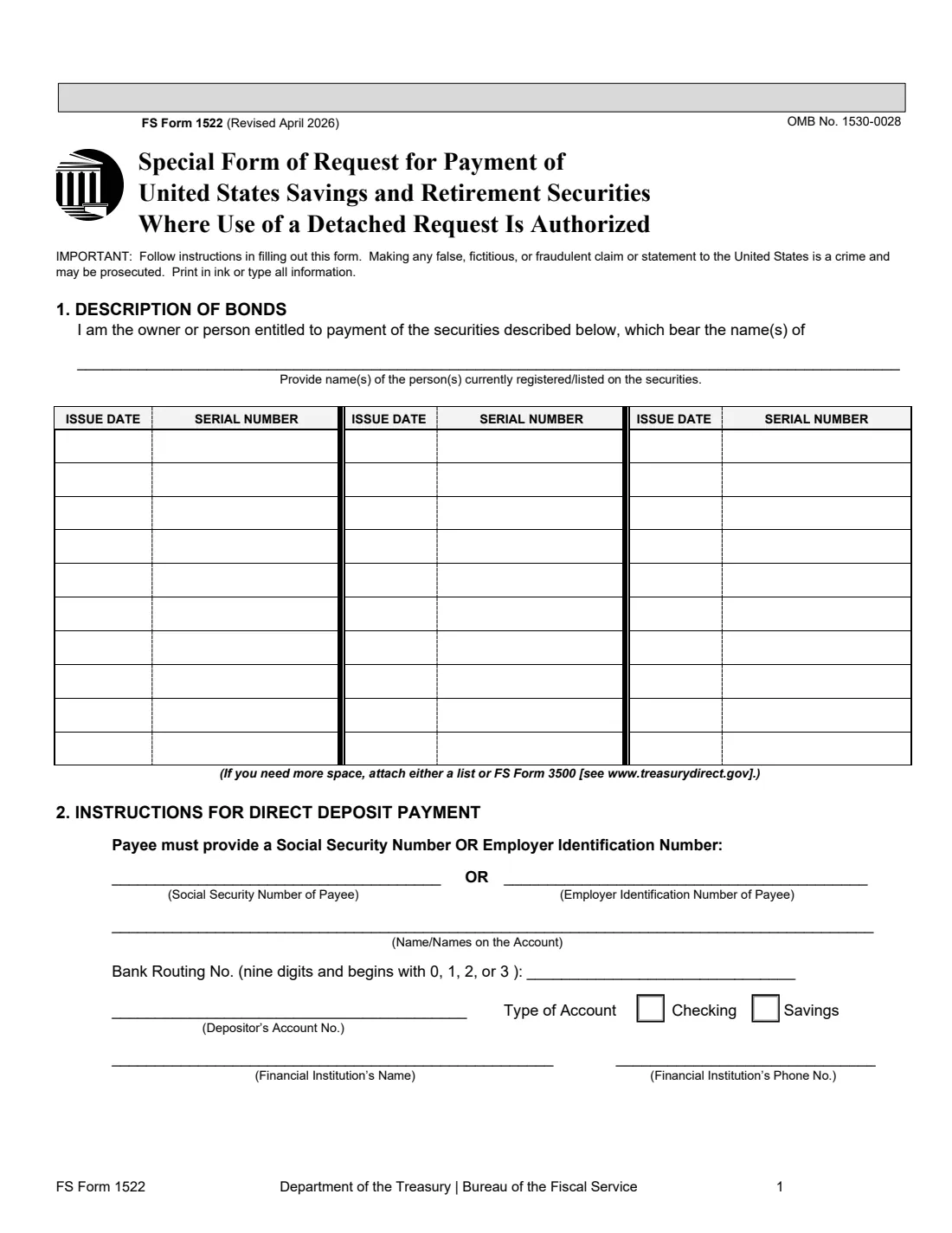
FS Form 1522, Special Form of Request for Payment of United States Savings and Retirement Securities Where Use of a Detached Request Is Authorized, is how you ask the Treasury to pay you for paper U.S. Savings Bonds, Savings Notes, Retirement Plan Bonds and Individual Retirement Bonds. It's the separate ("detached") request you send with the bonds instead of signing the back of each one.
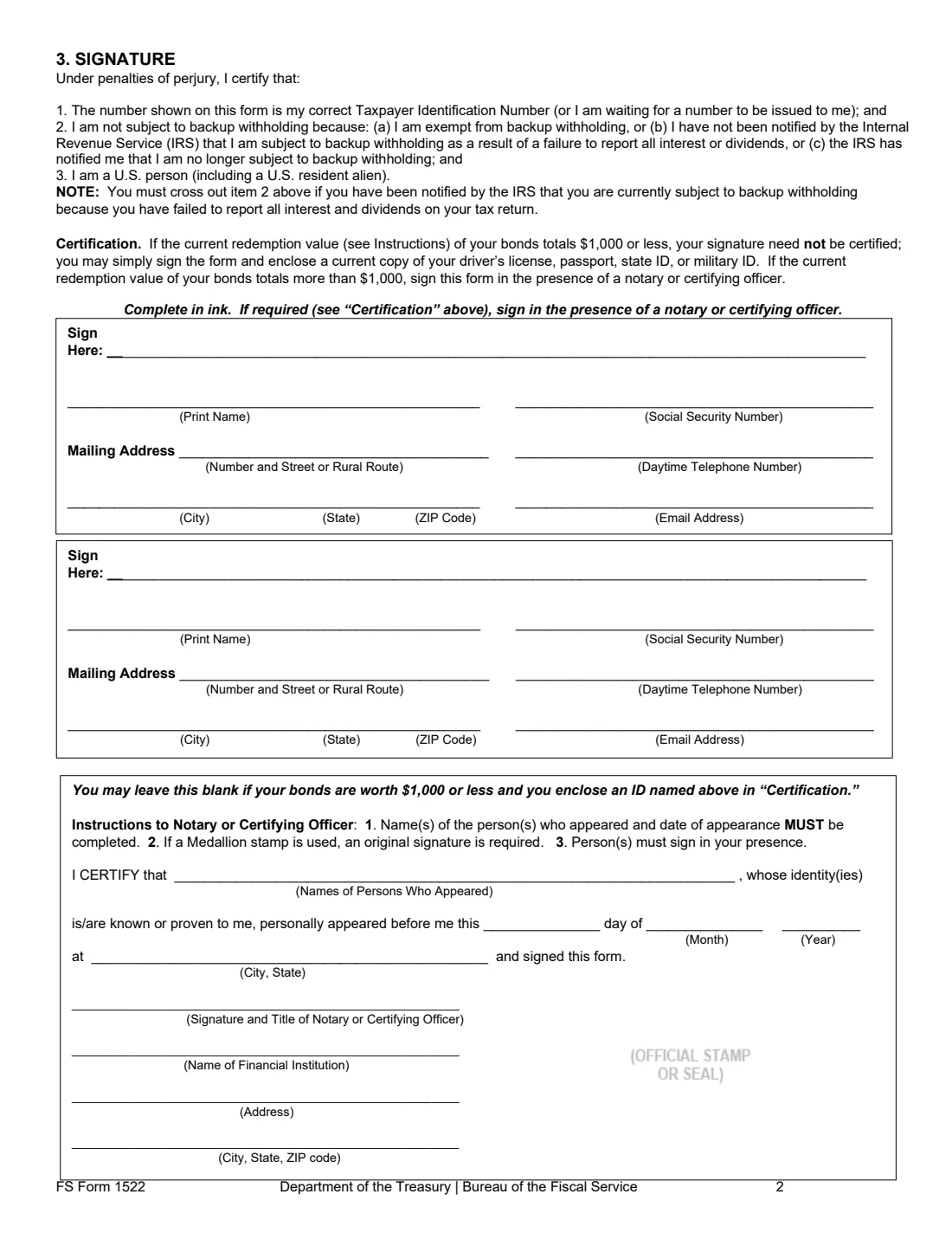
You list the name(s) inscribed on the bonds and each bond's issue date and serial number, give the payee's Social Security or Employer Identification Number and the bank account for direct deposit, and sign. The Bureau of the Fiscal Service's April 2026 revision says that if the bonds' current redemption value totals $1,000 or less you can simply sign and enclose a copy of your ID. Above $1,000 you must sign in front of a notary or certifying officer.
FileIt walks you through each part, checks the routing number and issue dates, and prints your answers into the Treasury's official PDF. You then sign it (with the notary if needed) and mail it with the bonds to Treasury Retail Securities Services.
- Who fills it
- The owner, co-owner, surviving beneficiary, or a legal representative or person entitled to a deceased or incompetent owner's estate.
- Send to
- Treasury Retail Securities Services, P.O. Box 9150, Minneapolis, MN 55480-9150, with the bonds (unless told otherwise).
- Paid by
- Direct deposit into the account you give in Section 2.
- Certification
- $1,000 or less in total: enclose a copy of your ID. More than $1,000: sign before a notary or certifying officer.
- Edition
- Revised April 2026 (OMB No. 1530-0028)
- Agency
- U.S. Department of the Treasury, Bureau of the Fiscal Service
Who needs to fill out FS Form 1522?
- Owners and co-owners of paper Series EE, E or I savings bonds, or savings notes, who want to cash them by mail.
- Holders of paper Retirement Plan Bonds or Individual Retirement Bonds.
- Surviving beneficiaries named on bonds.
- Legal representatives of a deceased or incompetent owner's estate, and people entitled to a deceased owner's estate.
- Minors who, in the notary or certifying officer's opinion, understand the transaction. The instructions say an incompetent person may not sign.
When to use FS Form 1522
- When you want to cash paper bonds by mail rather than at a bank.
- When bonds have stopped earning interest and you want the money.
- When the instructions for your situation call for a detached request instead of signing each bond.
What you need before you start
- The paper bonds, to read each one's issue date and serial number and to mail with the form.
- The name(s) inscribed on the bonds, exactly as shown.
- The payee's Social Security number, or an Employer Identification Number for an estate, trust or other entity.
- The bank account for the deposit: names on the account, routing number, account number, checking or savings, and the bank's name and phone.
- Each signer's printed name, SSN, mailing address, daytime phone and email.
- The bonds' current total redemption value (from the Savings Bond Calculator at TreasuryDirect.gov) to know whether you need a notary.
- A copy of your driver's license, passport, state ID or military ID if the bonds total $1,000 or less.
What’s on FS Form 1522
The 2026 edition has 4 pages. FileIt asks for it in 6 parts, and it is signed by Person requesting payment and Second person requesting payment:
- 1. Description of bondsPerson requesting payment
- More bonds (7 to 15)Person requesting payment
- More bonds (16 to 30)Person requesting payment
- 2. Direct deposit of the paymentPerson requesting payment
- 3. Signature: person requesting paymentPerson requesting payment
- Second person requesting payment (if any)Second person requesting payment
How to fill out FS Form 1522, step by step
1 Section 1: Description of bonds
Give the name(s) of the person(s) currently registered on the bonds, as inscribed. Then list each bond by issue date and serial number. There's room for 30 bonds. If you have more, the form says to attach a list or FS Form 3500.
2 Section 2: Direct deposit
Give the payee's taxpayer identification number: a Social Security number for an individual, or the Employer Identification Number the IRS assigned for an estate, trust or other entity. Then the names on the account, the nine-digit routing number (it begins with 0, 1, 2 or 3), the account number, checking or savings, and the bank's name and phone. The instructions ask you to verify the account details, since mistakes delay the deposit.
3 Section 3: Signature and certification
By signing you certify under penalties of perjury that your taxpayer ID is correct, that you're not subject to backup withholding, and that you're a U.S. person. Cross out item 2 if the IRS has told you you're subject to backup withholding. Each person requesting payment signs in ink, prints their name and gives their address, phone and email.
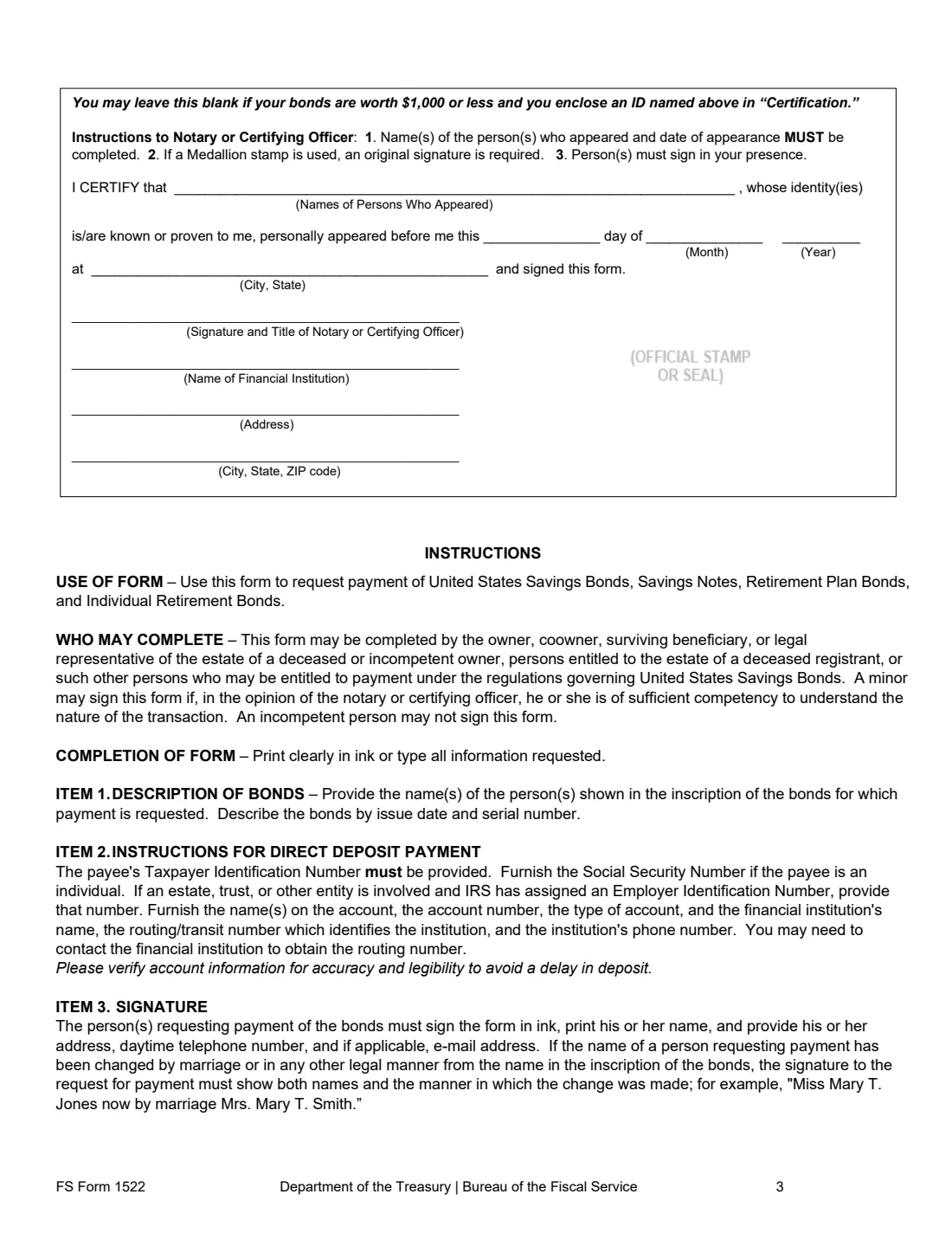
If your name has changed since the bonds were issued, the instructions say to show both names and how the change happened, for example "Mary T. Jones now by marriage Mrs. Mary T. Smith".
4 Notary or certifying officer
For bonds worth more than $1,000 in total, sign in front of a notary or an authorized certifying officer (available at banks and credit unions), who completes and stamps the block at the bottom of page 2. Acceptable stamps include a notary seal, a financial institution's signature guaranteed or corporate seal, or a Medallion program stamp. For $1,000 or less, leave the block blank and enclose a copy of your ID.
Common mistakes to avoid
- Copying a serial number or issue date wrong. Check each against the bond.
- Signing before you're in front of the notary or certifying officer, when the bonds total more than $1,000.
- Forgetting the copy of your ID when the bonds total $1,000 or less.
- Giving a routing or account number that doesn't match the account named.
- Not showing both names when your name has changed since the bonds were issued.
- Mailing the form without the bonds.
After you fill it out
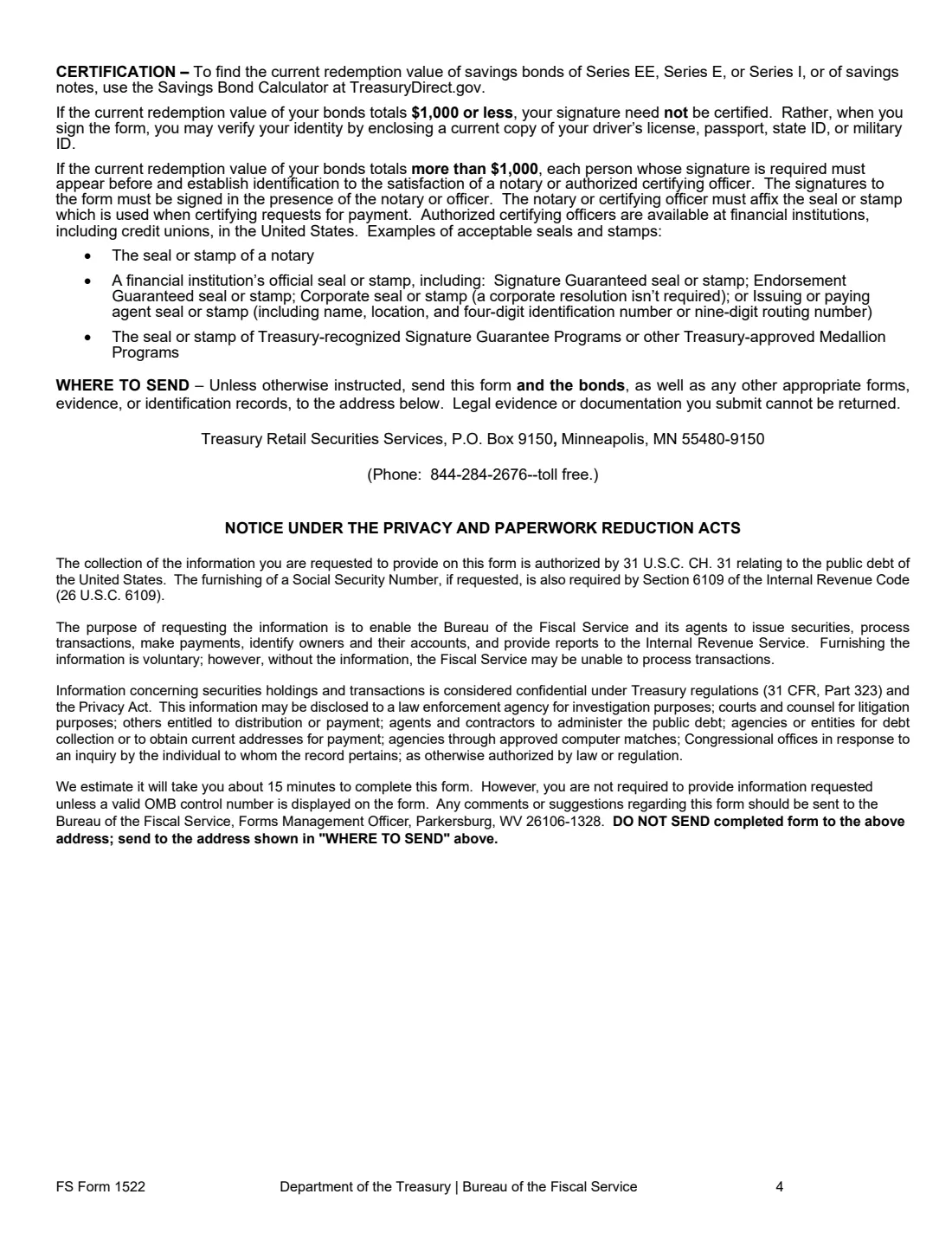
Sign in ink (in front of a notary or certifying officer if the bonds total more than $1,000), then mail the form with the bonds and any other forms, evidence or ID to Treasury Retail Securities Services, P.O. Box 9150, Minneapolis, MN 55480-9150. The form notes that legal evidence you send can't be returned.
Keep a copy. FileIt stores the PDF in your vault with the list of serial numbers you sent.
Questions go to Treasury Retail Securities Services at 844-284-2676 (toll free), the number on the form.
Fill out FS Form 1522 online with FileIt
- Pick the person. Choose someone from People and FileIt fills in their name, date of birth, address and other details it already knows.
- Answer plain-language questions. One part of the form at a time, with the official help text beside each question — 87 fields in all. Your answers save as you go.
- Check the live preview. Watch your answers land on the real U.S. Department of the Treasury, Bureau of the Fiscal Service form, and let FileIt do any worksheet arithmetic.
- Generate the official PDF. FileIt prints your answers into the agency’s own PDF and files it in that person’s folder in your vault. Sign it, or send it for e-signature.
FileIt fills the form — it never files or submits anything for you. Deliver the finished form to whoever asked for it, the way the form’s instructions say.
Start FS Form 1522 now — it’s freeFS Form 1522: frequently asked questions
Do I need a notary to cash savings bonds by mail?
Only if the bonds' current redemption value totals more than $1,000. For $1,000 or less, the form says your signature need not be certified: sign and enclose a current copy of your driver's license, passport, state ID or military ID.
Where do I mail FS Form 1522?
Unless you've been told otherwise, to Treasury Retail Securities Services, P.O. Box 9150, Minneapolis, MN 55480-9150, together with the bonds.
How will I be paid?
By direct deposit to the account you give in Section 2 of the form.
How do I find what my bonds are worth?
The instructions point to the Savings Bond Calculator at TreasuryDirect.gov for the current redemption value of Series EE, E and I bonds and savings notes.
How many bonds can I list?
The table holds 30. For more, attach a list or FS Form 3500, as the form says.
Can I fill out FS Form 1522 online with FileIt?
Yes. FileIt prints your answers into the Treasury's official PDF for you to sign and mail. FileIt never sends anything to the Treasury for you.
Official sources
- Blank form (PDF), published by U.S. Department of the Treasury, Bureau of the Fiscal Service: https://www.treasurydirect.gov/forms/sav1522.pdf
- Official instructions and guidance: https://www.treasurydirect.gov/savings-bonds/cashing-a-bond/
- Edition shown on this page: FS Form 1522 (Revised April 2026), OMB No. 1530-0028 (checked 2026-09-28).
FileIt is not affiliated with or endorsed by U.S. Department of the Treasury, Bureau of the Fiscal Service or any government. This page explains the form in general terms and is not legal, tax or immigration advice. Always read the official instructions, and check that you are using the edition the recipient accepts. Page last reviewed 2026-09-28.