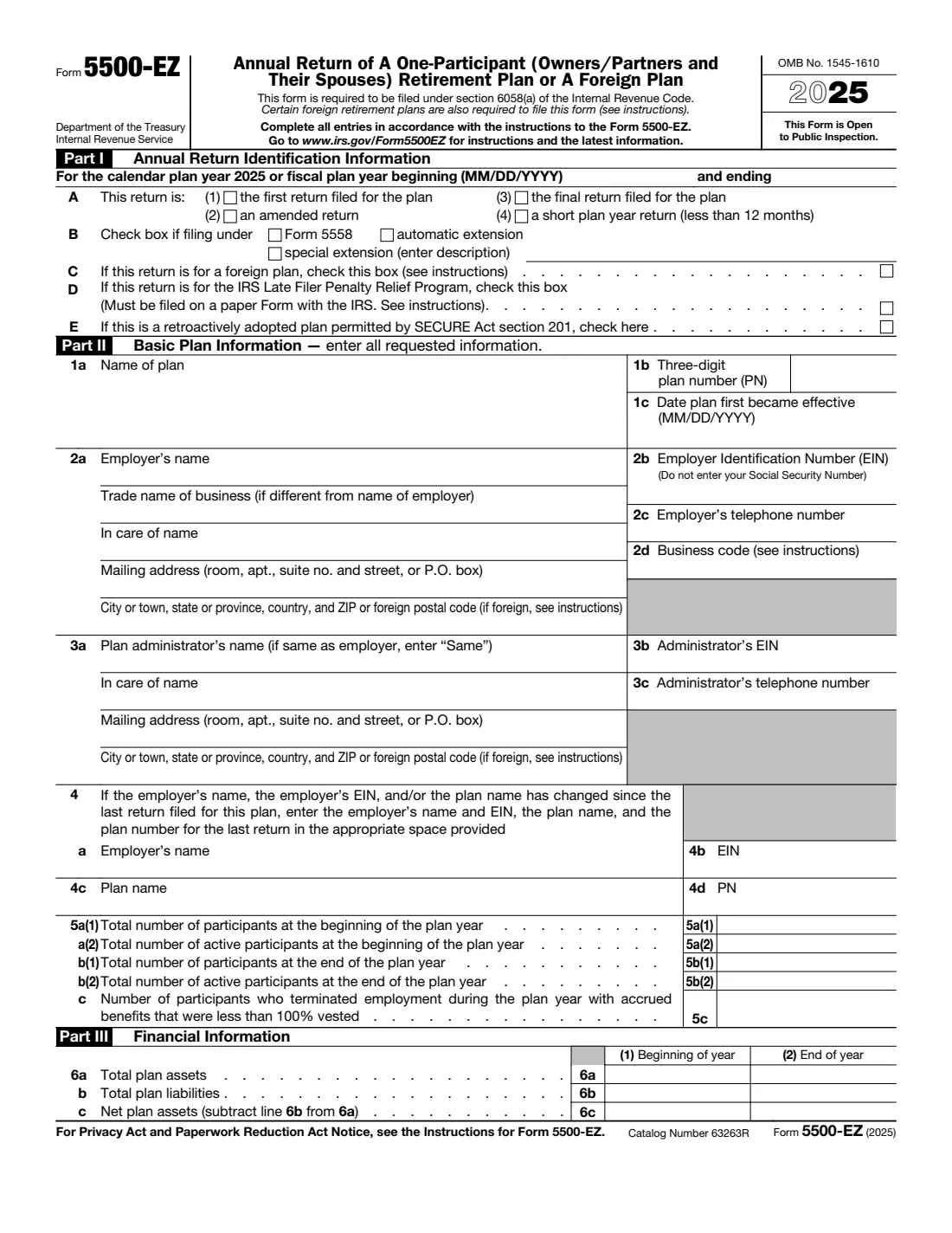
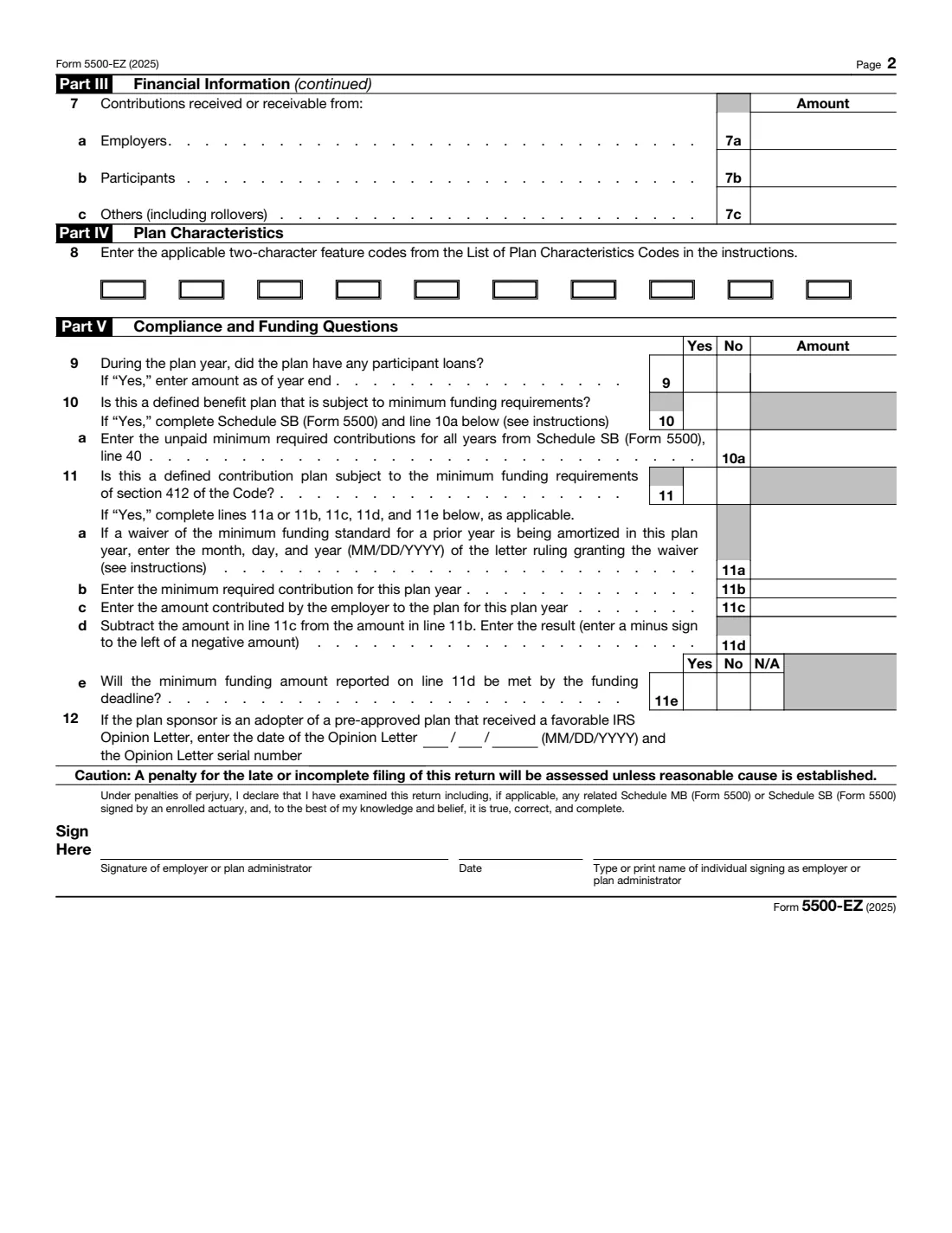
What is Form 5500-EZ?
Form 5500-EZ is the annual return for a one-participant retirement plan: a defined benefit, profit-sharing or money purchase plan (other than an ESOP) that covers only you, or you and your spouse, when you own the whole business, or only partners and their spouses. It is also filed by foreign plans maintained outside the United States primarily for nonresident aliens. Most people meet it through a solo 401(k), also called an individual 401(k).
Not every plan has to file each year. The 2025 instructions say a one-participant plan doesn't file for 2025 if its assets, together with all the employer's other one-participant plans, were $250,000 or less at the end of the plan year. The exception is the plan's final year, when every plan files to show its assets have been distributed. The return is due by the last day of the 7th month after the plan year ends, which is July 31 for a calendar-year plan. The instructions put the late-filing penalty at $250 a day, up to $150,000 per plan year.
FileIt asks for each line in plain language, adds up lines 6c and 11d for you, turns the plan characteristic codes you tick into line 8, and prints everything into the IRS's own PDF. It saves the return in your vault for you to print, sign and mail to the IRS in Ogden, Utah.
- Who files
- The employer (owner) or plan administrator of a one-participant plan or a foreign plan
- Filing threshold
- Plan assets, with the employer's other one-participant plans, over $250,000 at year end, or any plan's final year (2025 instructions)
- Due date
- Last day of the 7th month after the plan year ends (July 31 for a calendar year)
- Extension
- Up to 2½ months with Form 5558, or automatic with the employer's income tax extension in some cases
- Where to file
- On paper to the IRS in Ogden, UT 84201-0020, or electronically through EFAST2
- Edition
- 2025 form, for plan years that began in 2025
Who needs to fill out Form 5500-EZ?
- Self-employed people and business owners with a solo 401(k), profit-sharing or defined benefit plan that covers only themselves, or themselves and their spouse.
- Partnerships whose plan covers only the partners, or partners and their spouses. A 2% S corporation shareholder is treated as a partner.
- Employers maintaining a foreign plan, outside the U.S. primarily for nonresident aliens, that must file under section 6058(a).
- Not for plans with common-law employees beyond the owners and spouses. Those file Form 5500 or 5500-SF with the Department of Labor.
When to use Form 5500-EZ
- Every year in which the plan's assets, combined with the employer's other one-participant plans, exceed $250,000 at the end of the plan year.
- In the plan's final year, when all assets have been distributed or transferred, whatever the balance.
- To correct an earlier return for the same plan year (an amended return).
- To catch up on missed years under the IRS Late Filer Penalty Relief Program (box D). Those returns must go on paper with Form 14704.
What you need before you start
- The plan's formal name, three-digit plan number (usually 001) and effective date, from the plan document.
- The employer's name, EIN (not an SSN), address, phone number and six-digit business code.
- Participant counts at the beginning and end of the year.
- Plan assets and liabilities at the beginning and end of the year, from your year-end account statements, in whole dollars.
- Contributions for the year: employer contributions, your own deferrals, and rollovers.
- Any participant loan balance, and, for a pre-approved plan, the Opinion Letter date and serial number from your plan provider.
What’s on Form 5500-EZ
The 2025 edition has 2 pages. FileIt asks for it in 10 parts, and it is signed by Employer or plan administrator:
- Part I: Plan year and type of returnEmployer or plan administrator
- Part II, line 1: The planEmployer or plan administrator
- Part II, line 2: The employerEmployer or plan administrator
- Part II, line 3: Plan administratorEmployer or plan administrator
- Part II, line 4: Name, EIN or plan name changed since the last returnEmployer or plan administrator
- Part II, line 5: ParticipantsEmployer or plan administrator
- Part III: Financial informationEmployer or plan administrator
- Part IV, line 8: Plan characteristicsEmployer or plan administrator
- Part V: Compliance and funding questionsEmployer or plan administrator
- SignatureEmployer or plan administrator
How to fill out Form 5500-EZ, step by step
1 Part I: Plan year and type of return
Enter the plan year's start and end dates. Check first return, amended, final return or short plan year as they apply. Check an extension box if you're filing under Form 5558, the automatic extension tied to the employer's income tax return, or a special extension the IRS announced. Boxes C, D and E are for foreign plans, the Late Filer Penalty Relief Program, and plans adopted retroactively under SECURE Act section 201.
2 Line 1: The plan
Give the plan's formal name, its three-digit plan number and the date it first became effective. The instructions say to number plans from 001 and keep a number with its plan for good, even after the plan ends.
3 Lines 2 and 3: Employer and plan administrator
Enter the employer's name, trade name, any in-care-of name, mailing address, EIN, phone number and business code. If the employer is also the plan administrator, which is typical for a solo plan, line 3a just says "Same" and the rest of line 3 stays blank.
4 Line 4: Changes since the last return
Only if the employer's name, EIN or the plan name changed since the last return. Enter them as they appeared on that return.
5 Line 5: Participants
Count total and active participants at the beginning and end of the year, and anyone who left employment with less than 100% vested benefits. For a solo 401(k) covering an owner and spouse, this is usually 1 or 2.
6 Lines 6 and 7: Financial information
Enter total assets and liabilities at the beginning and end of the plan year. Beginning figures must match last year's end-of-year figures. Line 6c (net assets) is 6a minus 6b. Line 7 reports contributions received or receivable from the employer (7a), from participants such as your elective deferrals (7b), and others including rollovers (7c). Use whole dollars.
7 Line 8: Plan characteristics
Enter the two-character codes from the instructions' list that describe the plan. Don't leave it blank. A typical solo 401(k) uses 2E (profit-sharing), 2J (401(k) feature) and 3B (covers self-employed individuals), and often 3D (pre-approved plan).
8 Lines 9–12: Compliance and funding
Say whether there were participant loans, and give the year-end balance. Answer whether it's a defined benefit plan subject to minimum funding (line 10) or a defined contribution plan subject to section 412 (line 11, generally money purchase plans), and complete 10a or 11a–11e if so. Line 12 asks for the Opinion Letter date and serial number if you adopted a pre-approved plan.
9 Signature
The employer or plan administrator signs and dates page 2 and prints their name.
Common mistakes to avoid
- Not filing in the final plan year because assets were under $250,000. Every plan files for its final year.
- Forgetting to count all of the employer's one-participant plans together against the $250,000 threshold.
- Beginning-of-year figures that don't match last year's end-of-year figures.
- Entering cents. The instructions say whole dollars only.
- Leaving line 8 blank.
- Entering the owner's Social Security number instead of the employer's EIN on line 2b.
- Filing on paper when the filer must file electronically because it files 10 or more returns of any type in the calendar year.
After you fill it out
Print the return, sign and date page 2, and mail it to: Department of the Treasury, Internal Revenue Service, Ogden, UT 84201-0020. A private delivery service uses the Ogden Submission Processing Center street address given in the instructions. Alternatively you can file Form 5500-EZ electronically through the Department of Labor's EFAST2 system, which is mandatory for filers who must file 10 or more returns of any type during the calendar year.
Keep a copy with the plan's records, along with any Form 5558 or income tax extension you relied on, and Schedule SB for a defined benefit plan. FileIt keeps the filled return in your vault. The form says it is open to public inspection.
Mark the next due date: the last day of the 7th month after the next plan year ends.
Fill out Form 5500-EZ online with FileIt
- Pick the person. Choose someone from People and FileIt fills in their name, date of birth, address and other details it already knows.
- Answer plain-language questions. One part of the form at a time, with the official help text beside each question — 104 fields in all. Your answers save as you go.
- Check the live preview. Watch your answers land on the real Internal Revenue Service (IRS) form, and let FileIt do any worksheet arithmetic.
- Generate the official PDF. FileIt prints your answers into the agency’s own PDF and files it in that person’s folder in your vault. Sign it, or send it for e-signature.
FileIt fills the form — it never files or submits anything for you. Deliver the finished form to whoever asked for it, the way the form’s instructions say.
Start Form 5500-EZ now — it’s freeForm 5500-EZ: frequently asked questions
Do I need to file Form 5500-EZ for my solo 401(k)?
For 2025, only if the plan's assets, combined with your other one-participant plans, were more than $250,000 at the end of the plan year, or if 2025 is the plan's final year. Below that, no return is required for that year.
When is Form 5500-EZ due?
By the last day of the 7th calendar month after the plan year ends. For a calendar-year plan that is July 31. If the date falls on a weekend or legal holiday, you can file the next business day. Form 5558 extends it by up to 2½ months.
What is the penalty for filing late?
The instructions cite a penalty under Code section 6652(e) of $250 a day, up to $150,000 per plan year. The IRS Late Filer Penalty Relief Program offers relief for delinquent returns filed on paper with Form 14704.
Can I file Form 5500-EZ online?
Yes, through the Department of Labor's EFAST2 system, and you must if you file 10 or more returns of any type during the calendar year. Otherwise you can file the paper form, which FileIt fills for you, with the IRS in Ogden, Utah.
Where do I mail Form 5500-EZ?
Department of the Treasury, Internal Revenue Service, Ogden, UT 84201-0020.
Which plan characteristic codes does a solo 401(k) use?
Commonly 2E (profit-sharing plan), 2J (section 401(k) feature) and 3B (plan covering self-employed individuals), plus 3D if it is a pre-approved plan from a provider. Check the full list in the instructions for any other features.
Official sources
- Blank form (PDF), published by Internal Revenue Service (IRS): https://www.irs.gov/pub/irs-pdf/f5500ez.pdf
- Official instructions and guidance: https://www.irs.gov/forms-pubs/about-form-5500-ez
- Edition shown on this page: 2025 (OMB 1545-1610) (checked 2026-09-28).
FileIt is not affiliated with or endorsed by Internal Revenue Service (IRS) or any government. This page explains the form in general terms and is not legal, tax or immigration advice. Always read the official instructions, and check that you are using the edition the recipient accepts. Page last reviewed 2026-09-28.