
What is LPA120 Help with LPA fees?
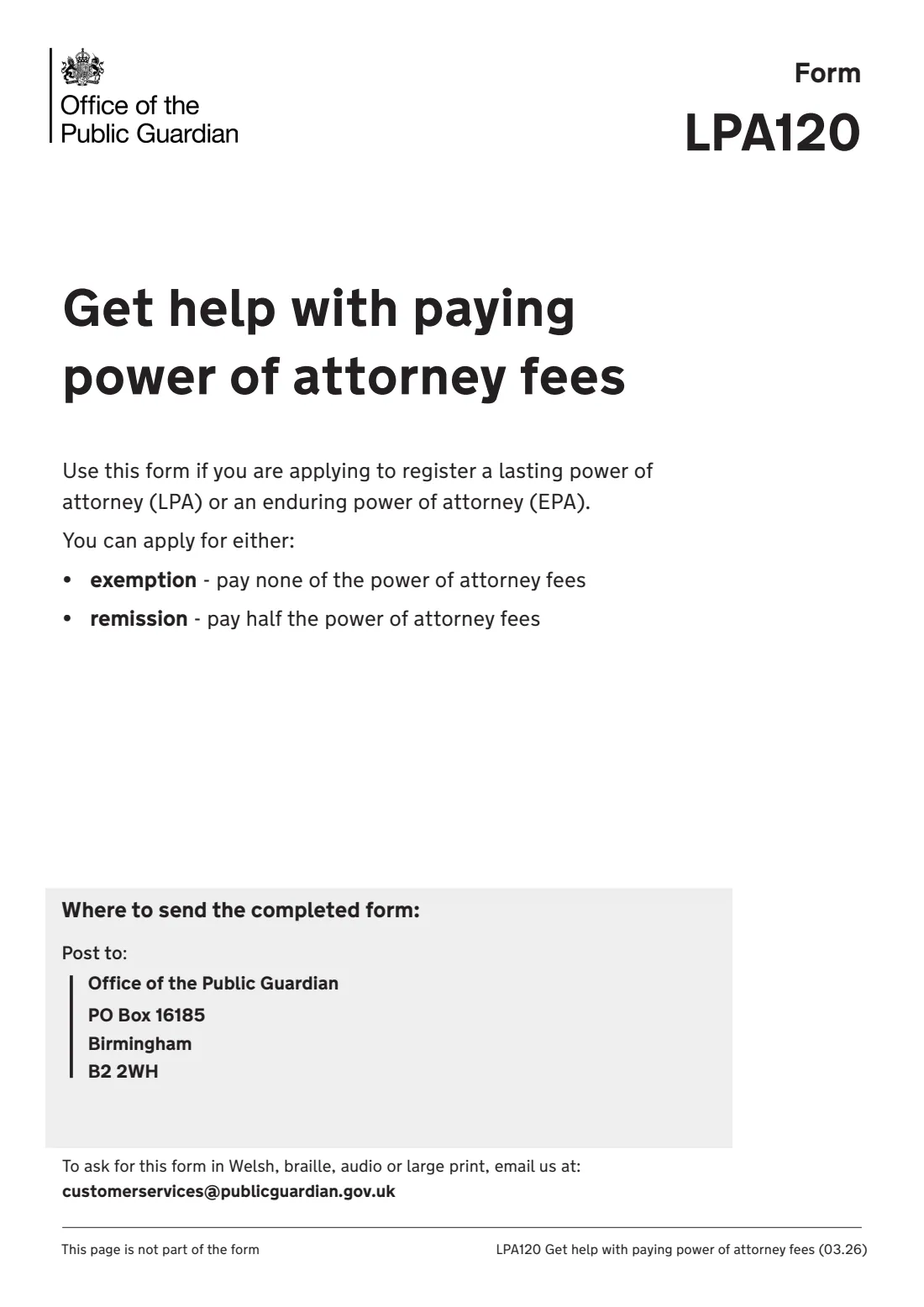
Registering a lasting power of attorney (LPA) or an enduring power of attorney (EPA) in England and Wales costs a fee, paid when the power of attorney is sent to the Office of the Public Guardian (OPG). If the donor gets certain means-tested benefits, or has a low income, form LPA120 asks OPG to waive the fee entirely (an exemption) or halve it (a remission).
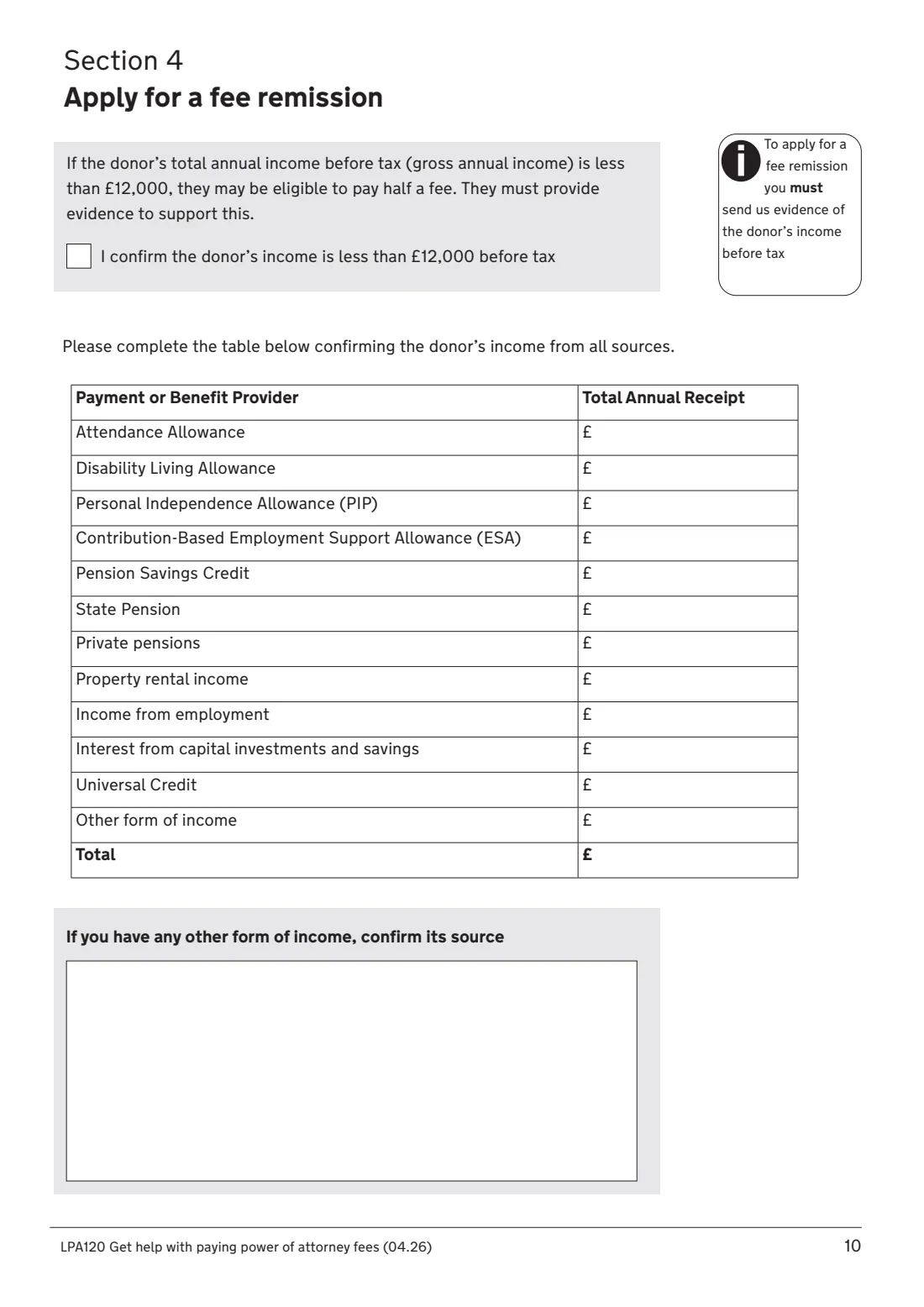
The form asks for your details and, if you're not the donor, your role and the donor's details; which fees you need help with; then either the donor's means-tested benefits and any personal injury damages (for an exemption) or the donor's annual income from every source (for a remission). You sign a declaration and send it with the evidence and the power of attorney itself.
FileIt asks only the section that applies, adds up the donor's income for you, checks it against this edition's £12,000 limit, and prints everything into OPG's own LPA120 PDF (04.26 edition). You print and sign the declaration by hand and send it with the power of attorney. FileIt never sends anything for you.
- Who fills it
- The donor, or an attorney, correspondent or other person applying for them
- Given to
- The Office of the Public Guardian, with the power of attorney
- Exemption
- No fee: for donors on certain means-tested benefits
- Remission
- Half the fee: donor's gross annual income under £12,000 (this edition)
- Signature
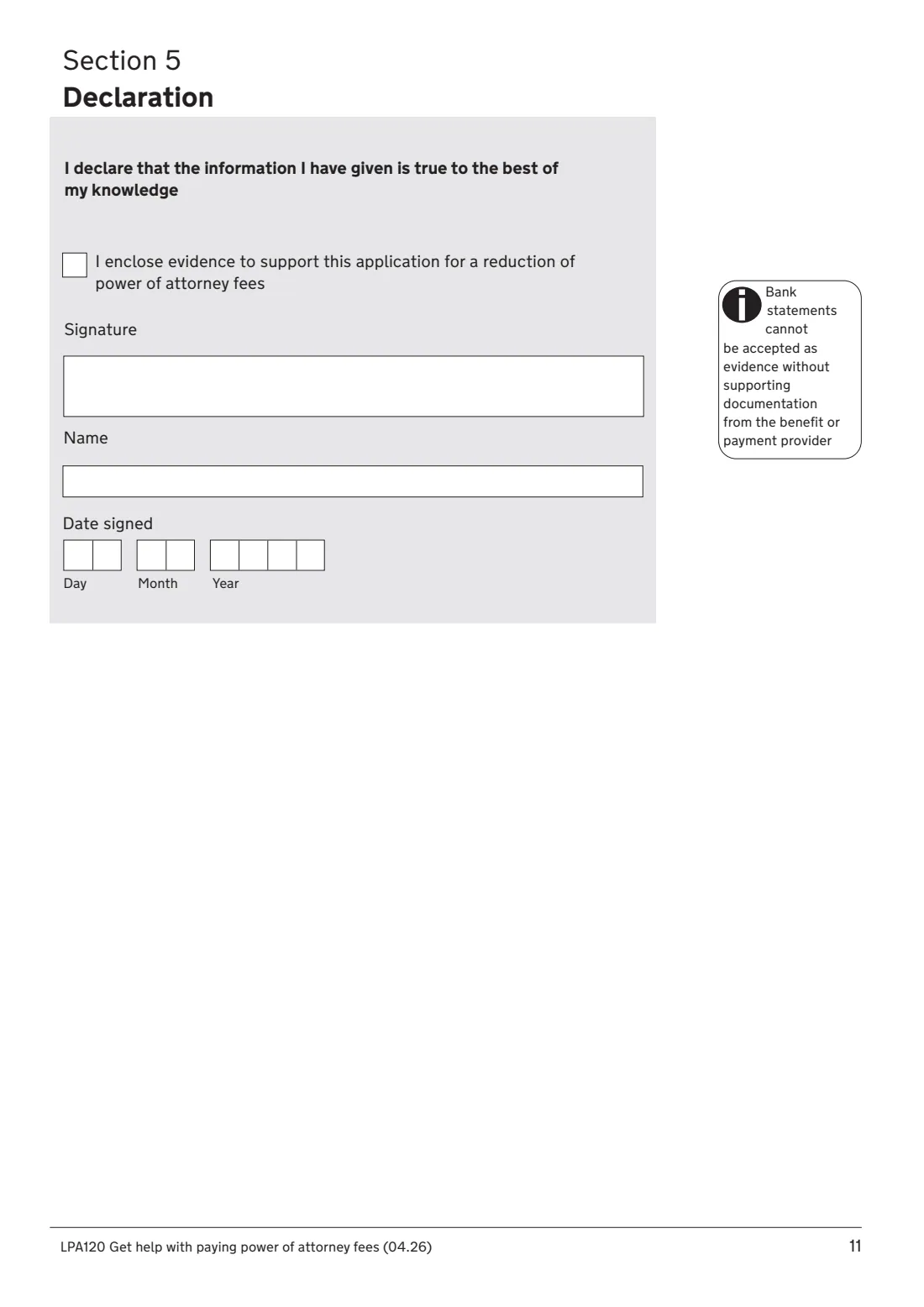
- Declaration signed by hand
- Edition
- LPA120 (04.26)
Who needs to fill out LPA120 Help with LPA fees?
- A donor on Income Support, income-based JSA, income-related ESA, Guarantee Credit, Housing Benefit, qualifying Working Tax Credit, or Council Tax Support who is registering an LPA or EPA.
- A donor whose total income before tax is under this edition's £12,000 limit.
- Attorneys or family members registering an LPA or EPA for a donor on a low income.
- Someone making a repeat application after an LPA was returned.
When to use LPA120 Help with LPA fees
- At the same time as you send the LPA or EPA to OPG to be registered. The form says the application and evidence must be sent together with the power of attorney.
- Once per application. You can tick more than one fee, for example both of the donor's LPAs.
What you need before you start
- Your contact details, and the donor's if you're not the donor.
- The power of attorney documents you're registering, to send in the same envelope.
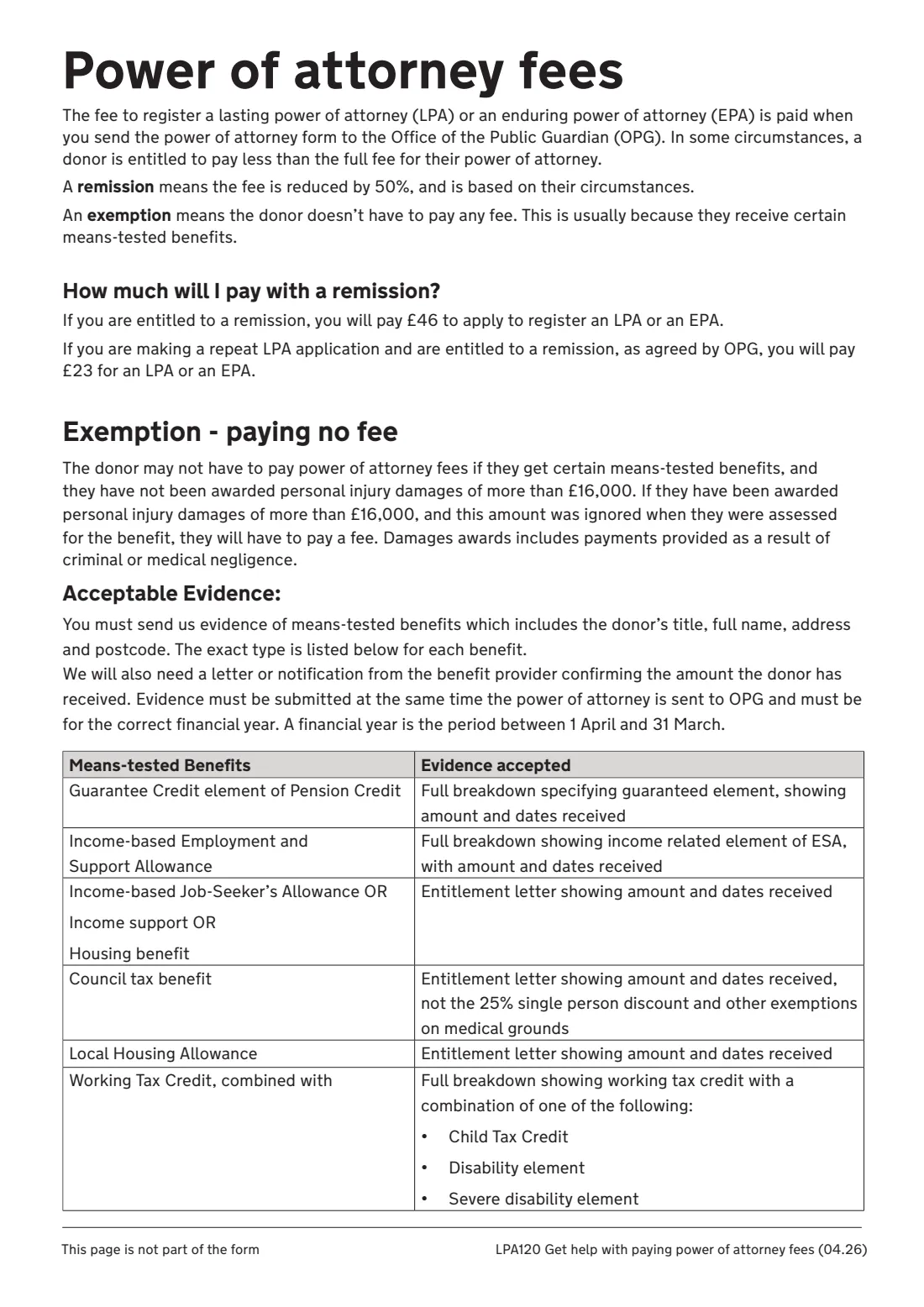
- For an exemption: evidence of the donor's means-tested benefit for the correct financial year (1 April to 31 March), as listed in the form's notes.
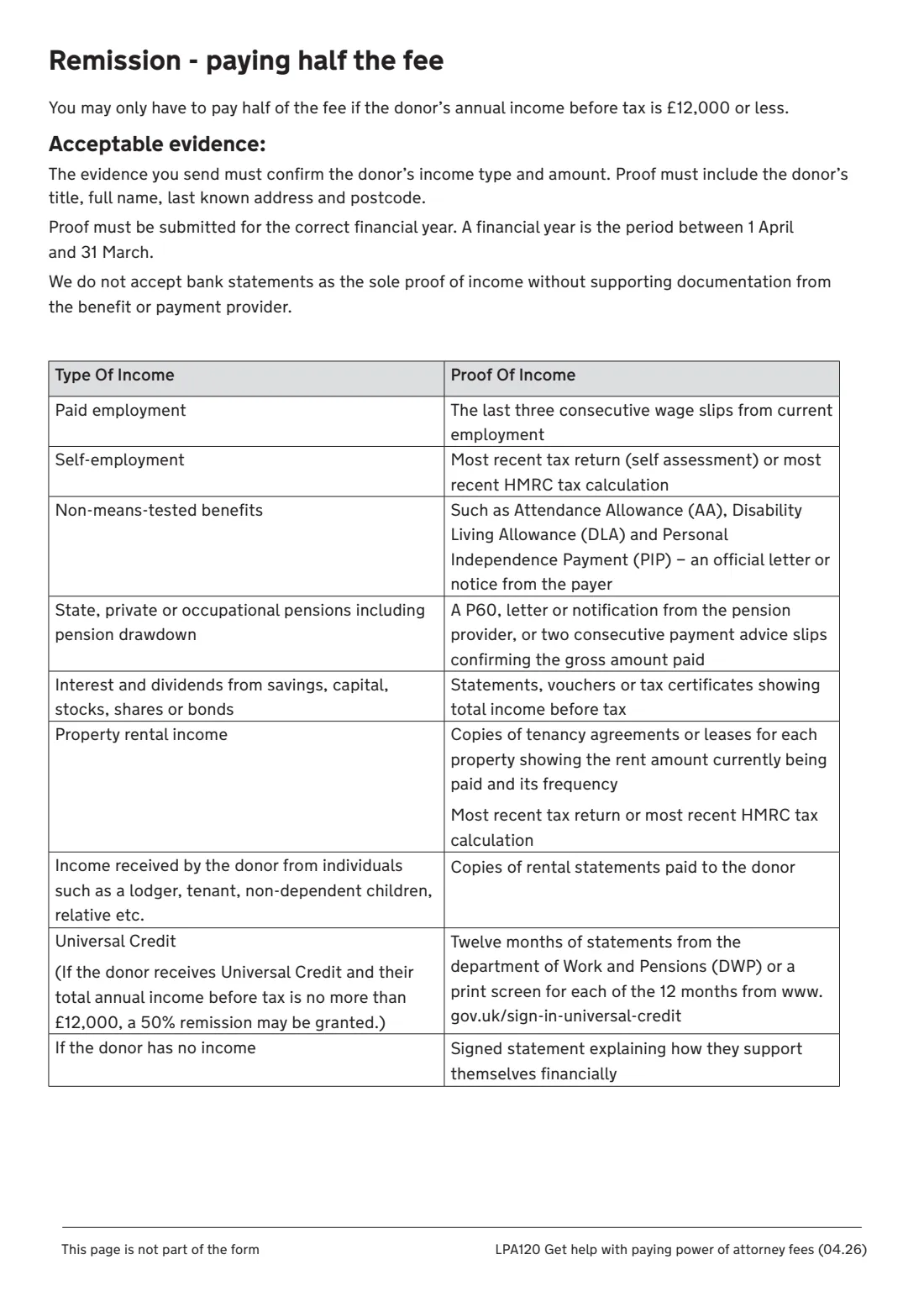
- For a remission: evidence of the donor's income before tax from every source, such as wage slips, a tax return, pension letters or benefit letters.
- Any LPA reference numbers, for a repeat application.
What’s on LPA120 Help with LPA fees
The 2026 edition has 11 pages. FileIt asks for it in 5 parts:
- Section 1. Your detailsApplicant
- Section 2. The applicationApplicant
- Section 3. Apply for a fee exemptionApplicant
- Section 4. Apply for a fee remissionApplicant
- Section 5. DeclarationApplicant
How to fill out LPA120 Help with LPA fees, step by step
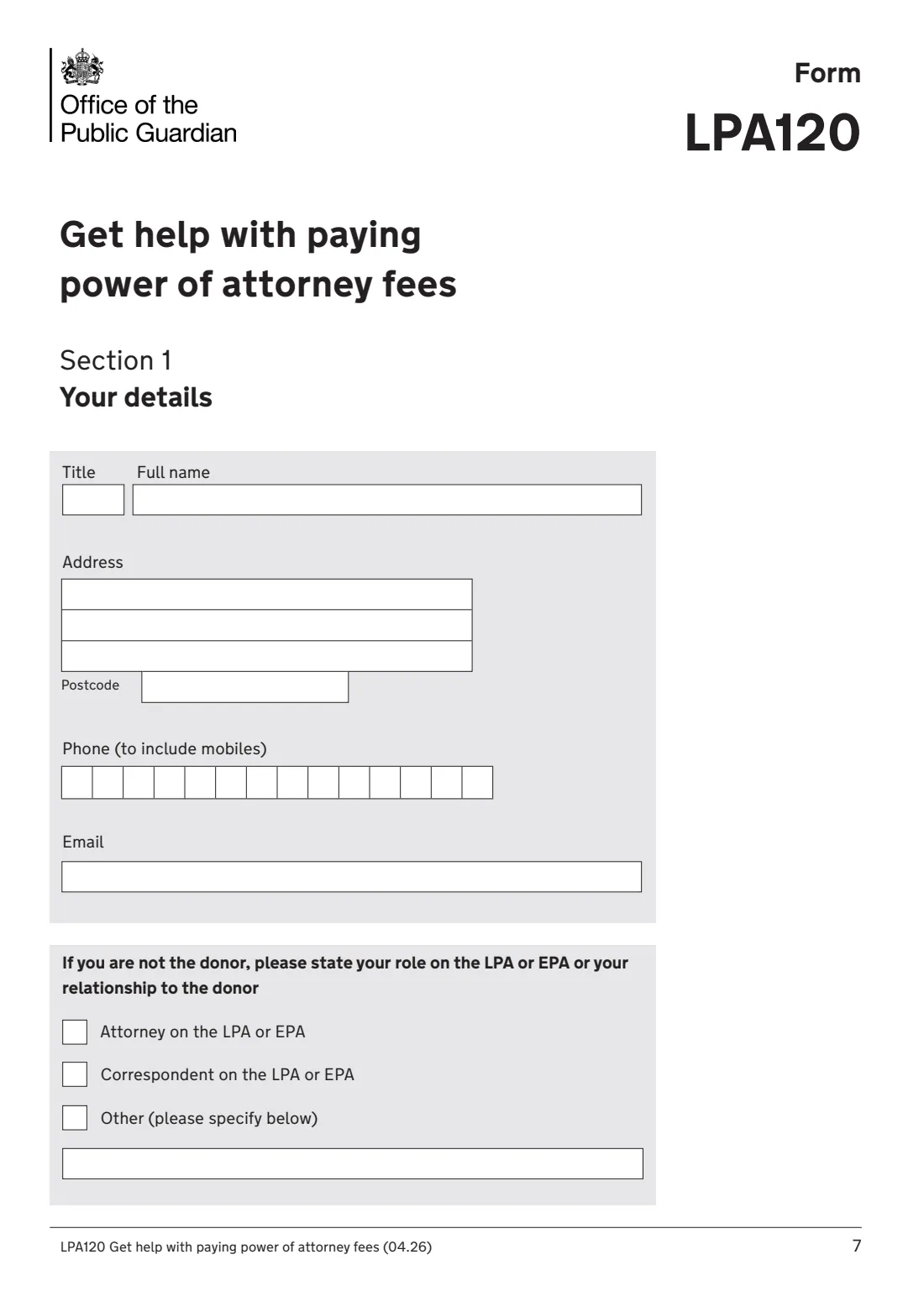
1 Section 1: your details
Your name, address, phone and email. If you're not the donor, say whether you're an attorney, the correspondent, or something else.
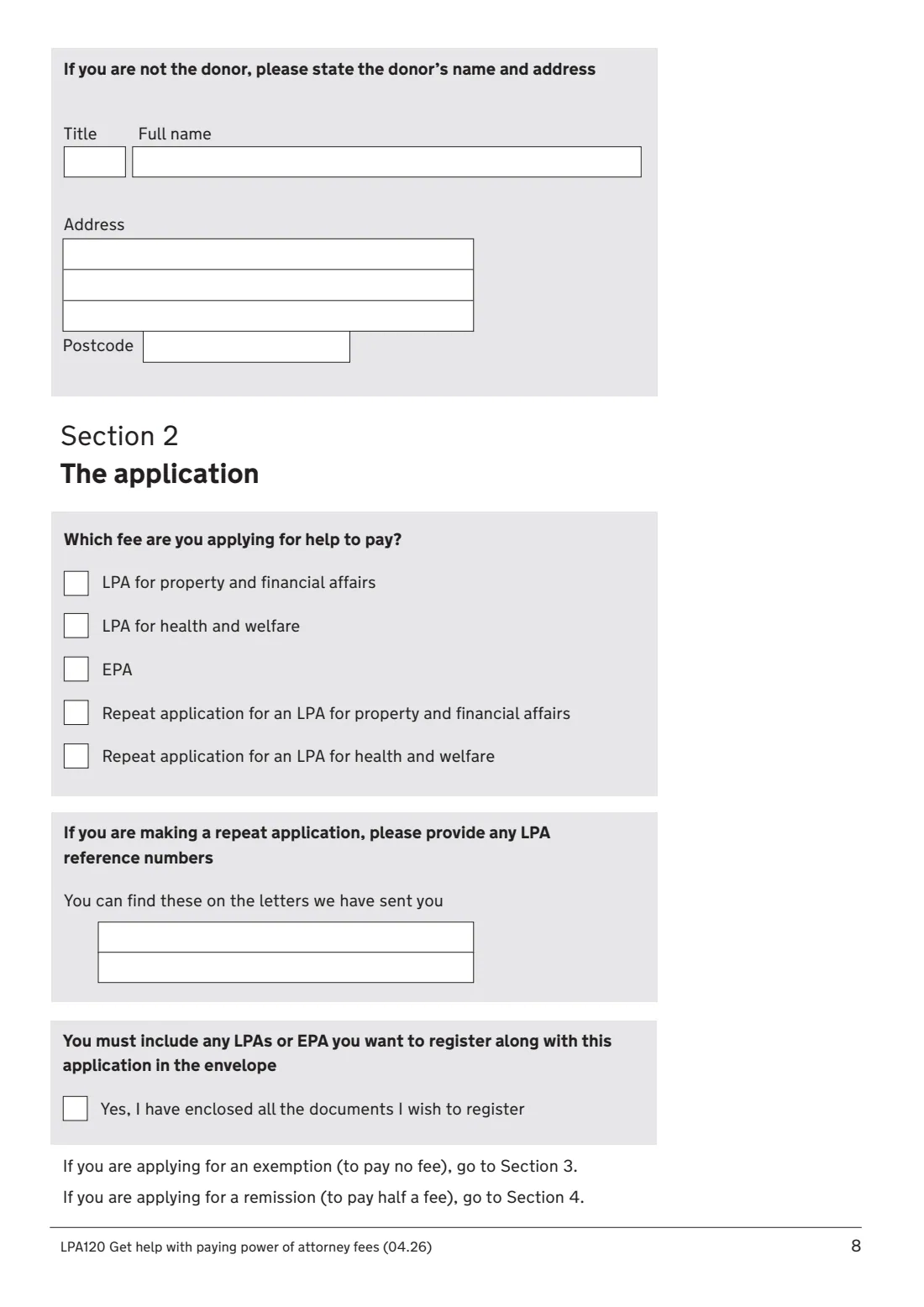
2 Section 2: the application
The donor's name and address if you're not the donor. Tick each fee you need help with (LPA for property and financial affairs, LPA for health and welfare, EPA, or a repeat application), give any LPA reference numbers for a repeat, and confirm you've enclosed the documents to register.
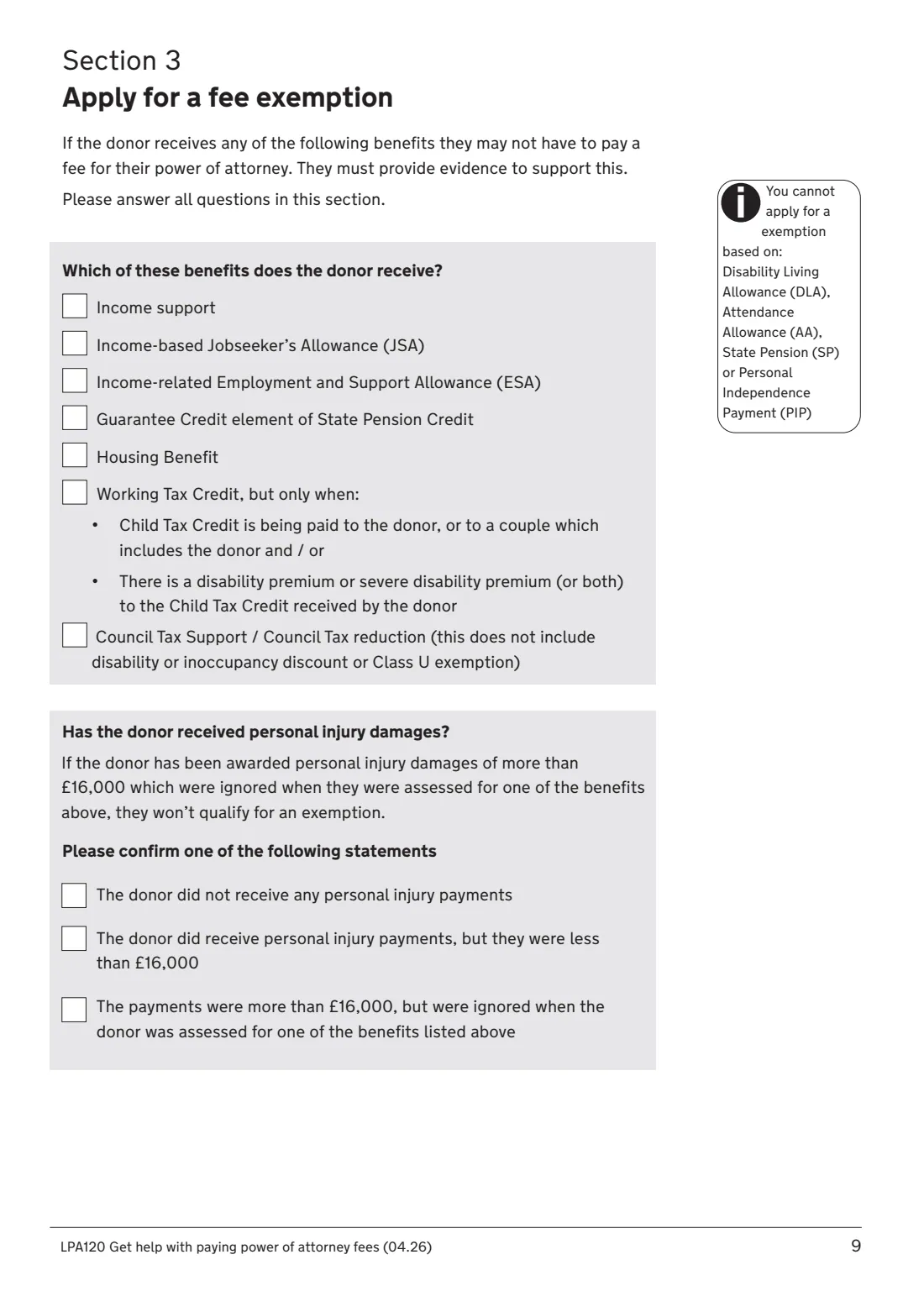
3 Section 3: exemption
Tick the means-tested benefit the donor receives and confirm their position on personal injury damages. The form says a donor awarded more than £16,000 in damages that was ignored when they were assessed for the benefit won't qualify for an exemption. Disability Living Allowance, Attendance Allowance, State Pension and PIP don't count.
4 Section 4: remission
Confirm the donor's income is less than £12,000 before tax and give the yearly amount from each source. FileIt adds up the total. Name the source of any other income.
5 Section 5: declaration
Confirm you've enclosed evidence, then print, sign and date the declaration by hand.
Common mistakes to avoid
- Sending LPA120 separately from the power of attorney. They must go together.
- Using bank statements as the only evidence. The form says they're not accepted without documents from the benefit or payment provider.
- Evidence from the wrong financial year.
- Claiming an exemption based on Disability Living Allowance, Attendance Allowance, State Pension or PIP.
- Leaving out an income source in the remission table.
After you fill it out
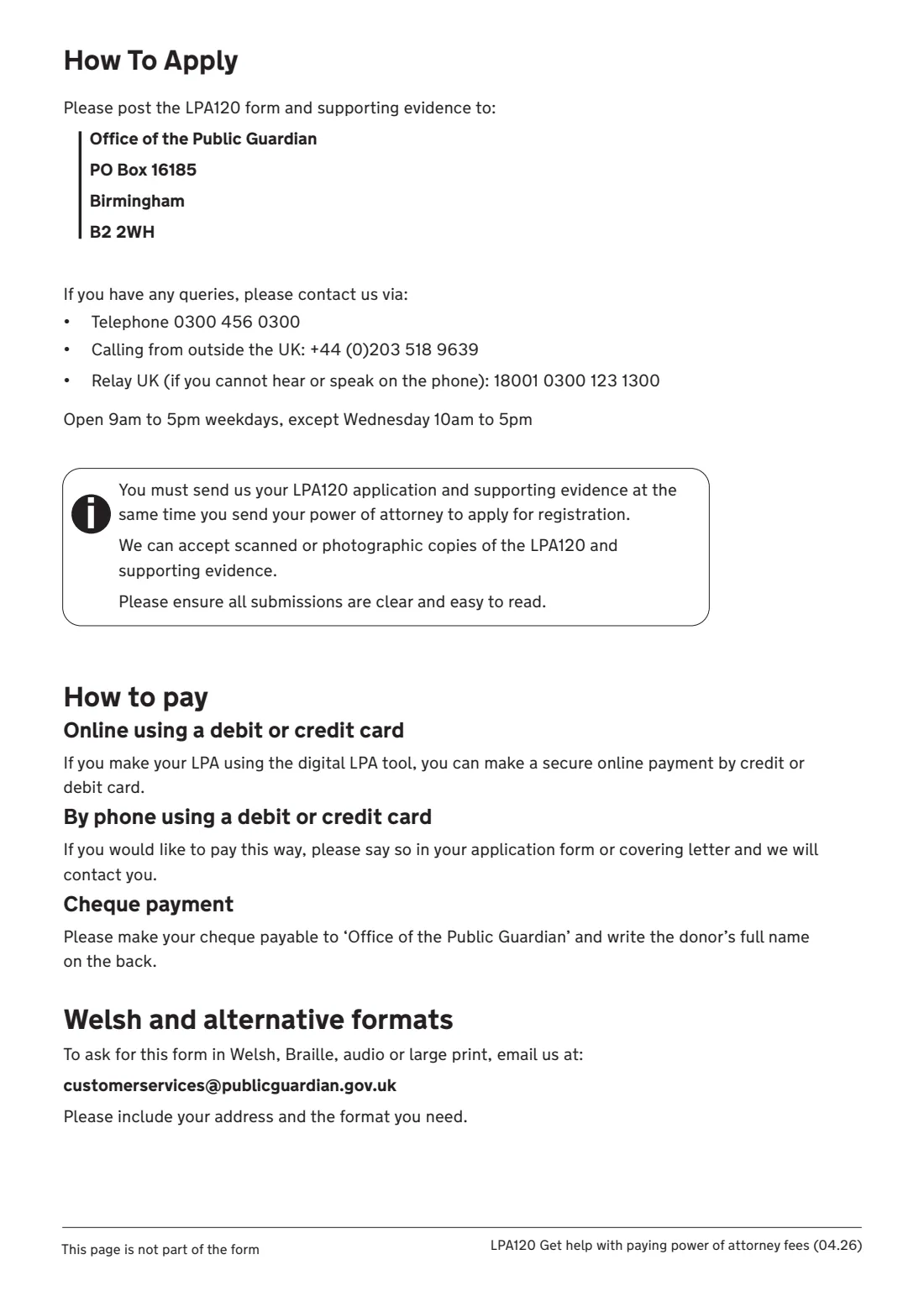
Print, sign and date the declaration, and send the form with the evidence and the power of attorney to the Office of the Public Guardian at the address in the form's notes. FileIt doesn't send it for you.
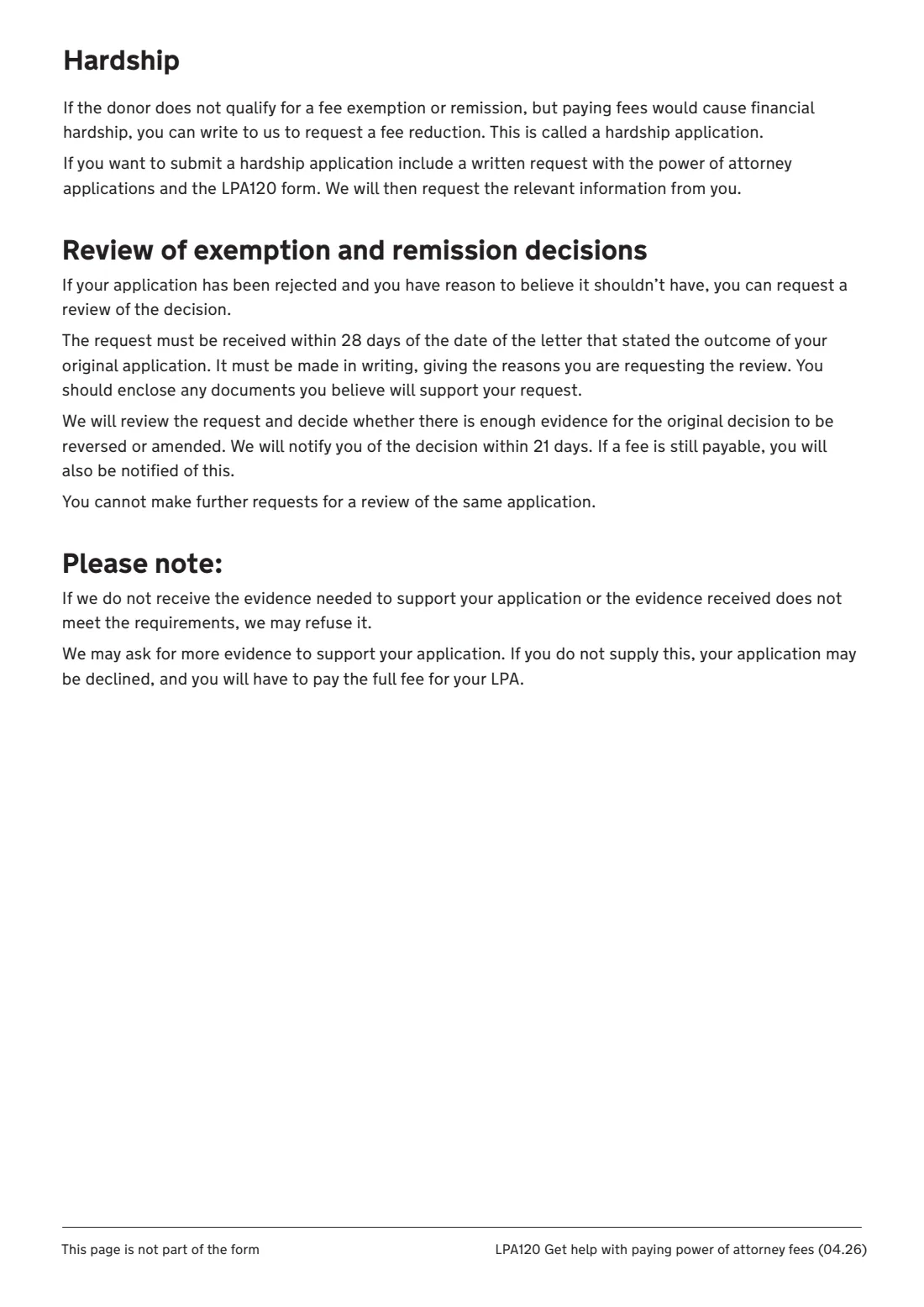
If OPG refuses the application, the form's notes say you can ask for a review in writing within 28 days of the decision letter.
If the donor doesn't qualify but paying would cause financial hardship, the notes explain how to make a hardship application in writing.
Fill out LPA120 Help with LPA fees online with FileIt
- Pick the person. Choose someone from People and FileIt fills in their name, date of birth, address and other details it already knows.
- Answer plain-language questions. One part of the form at a time, with the official help text beside each question — 53 fields in all. Your answers save as you go.
- Check the live preview. Watch your answers land on the real Office of the Public Guardian (OPG) form, and let FileIt do any worksheet arithmetic.
- Generate the official PDF. FileIt prints your answers into the agency’s own PDF and files it in that person’s folder in your vault.
FileIt fills the form — it never files or submits anything for you. Deliver the finished form to whoever asked for it, the way the form’s instructions say.
Start LPA120 Help with LPA fees now — it’s freeLPA120 Help with LPA fees: frequently asked questions
What's the difference between an exemption and a remission?
An exemption means the donor pays no fee, usually because they get certain means-tested benefits. A remission means the fee is reduced by 50%, based on the donor's income.
How much will I pay with a remission?
This edition's notes say £46 to apply to register an LPA or an EPA, or £23 for a repeat LPA application agreed by OPG. Check the current fee on gov.uk, as fees change.
What's the income limit for a remission?
On this edition, the donor's total annual income before tax must be less than £12,000.
Can I send scanned copies?
The form's notes say OPG can accept scanned or photographic copies of the LPA120 and the supporting evidence, as long as they're clear and easy to read.
Do I have to be the donor to apply?
No. An attorney, the correspondent or someone else can apply. Section 1 asks for your role and section 2 for the donor's details.
Official sources
- Blank form (PDF), published by Office of the Public Guardian (OPG): https://assets.publishing.service.gov.uk/media/69e6434584ac36aaf2cc9307/20260420-lpa120-get-help-with-paying-lpa-fees.pdf
- Official instructions and guidance: https://www.gov.uk/government/publications/lasting-power-of-attorney-forms
- Edition shown on this page: LPA120 Get help with paying power of attorney fees (04.26) (checked 2026-10-01).
FileIt is not affiliated with or endorsed by Office of the Public Guardian (OPG) or any government. This page explains the form in general terms and is not legal, tax or immigration advice. Always read the official instructions, and check that you are using the edition the recipient accepts. Page last reviewed 2026-10-01.