What is EX-15 (NIE application)?
EX-15 (Solicitud de Número de Identidad de Extranjero (NIE) y Certificados) is the official application for a Spanish foreigner identity number, the NIE (Número de Identidad de Extranjero), and for certificates confirming whether a foreigner is resident or non-resident in Spain. It is issued under Organic Law 4/2000 and Royal Decree 557/2011, published by Spain's Ministry of Inclusion, Social Security and Migration, and processed with the National Police.
Foreigners need an NIE for many dealings in Spain — the form lists economic, professional and social interests as the reasons, which covers things like buying property or a car, starting work, or opening a business. The form asks for your identity details, your address, optional details of a representative and a notification address, the document you want, your reason, where you are handing it in and your situation in Spain. It must be handed in in person, and its instructions say to write in capital letters and to bring the original and a copy.
FileIt explains each part of EX-15 in English, with the Spanish terms alongside, and prints your answers onto the official PDF in capitals, with the NIE and date of birth split into their boxes. Your name and date of birth can be pre-filled from the People records in your FileIt vault, and the finished PDF is saved there. FileIt does not submit anything and does not book appointments: you print the form, sign it by hand and take it to the office yourself.
- Who fills it
- The foreign national applying (or their legal representative, for a minor)
- Given to
- In person at an immigration office (Oficina de Extranjería), a police station (Comisaría de Policía) or a Spanish consulate abroad
- When
- When you need an NIE for economic, professional or social dealings in Spain, or a resident or non-resident certificate
- Signatures
- Handwritten signature of the applicant, or of their legal representative
- Copies
- The original and a copy of the completed form
- Legal basis
- Organic Law 4/2000 and Royal Decree 557/2011 (article 206)
Who needs to fill out EX-15 (NIE application)?
- Foreigners buying a home, land or a vehicle in Spain, who need an NIE for the purchase and the tax that goes with it.
- Foreigners starting a job or professional activity in Spain.
- Foreign investors, company directors and shareholders with economic interests in Spain.
- People who already have an NIE and need an official certificate that they are resident, or non-resident, in Spain.
- Parents or guardians applying on behalf of a foreign child.
- Lawyers, agencies and other representatives who hand in applications for their clients.
When to use EX-15 (NIE application)
- Before a transaction that needs an NIE — such as signing at a notary, opening certain accounts or registering a vehicle — as the NIE is usually required first.
- On arriving in Spain for work or study, when the procedure you are following calls for an NIE to be assigned separately.
- From abroad, through a Spanish consulate, if you need an NIE without travelling to Spain.
- When a bank, notary or tax office asks you to prove whether you are resident or non-resident in Spain.
What you need before you start
- Your valid passport — its number goes at the top of the form.
- Your full name, sex, date and place of birth, country of birth and nationality, as shown on your passport.
- Your father's and mother's first names.
- Your home address, mobile phone and email address.
- Your existing NIE, if you are applying for a resident or non-resident certificate.
- Evidence of the economic, professional or social reason for your application, as described in the official information sheet.
- The fee payment form (modelo 790, código 012) — check the current fee and how to pay it before you go.
- Details of any representative handing in the application for you, and of any different address for notifications.
- The original and a copy of the completed form.
What’s on EX-15 (NIE application)
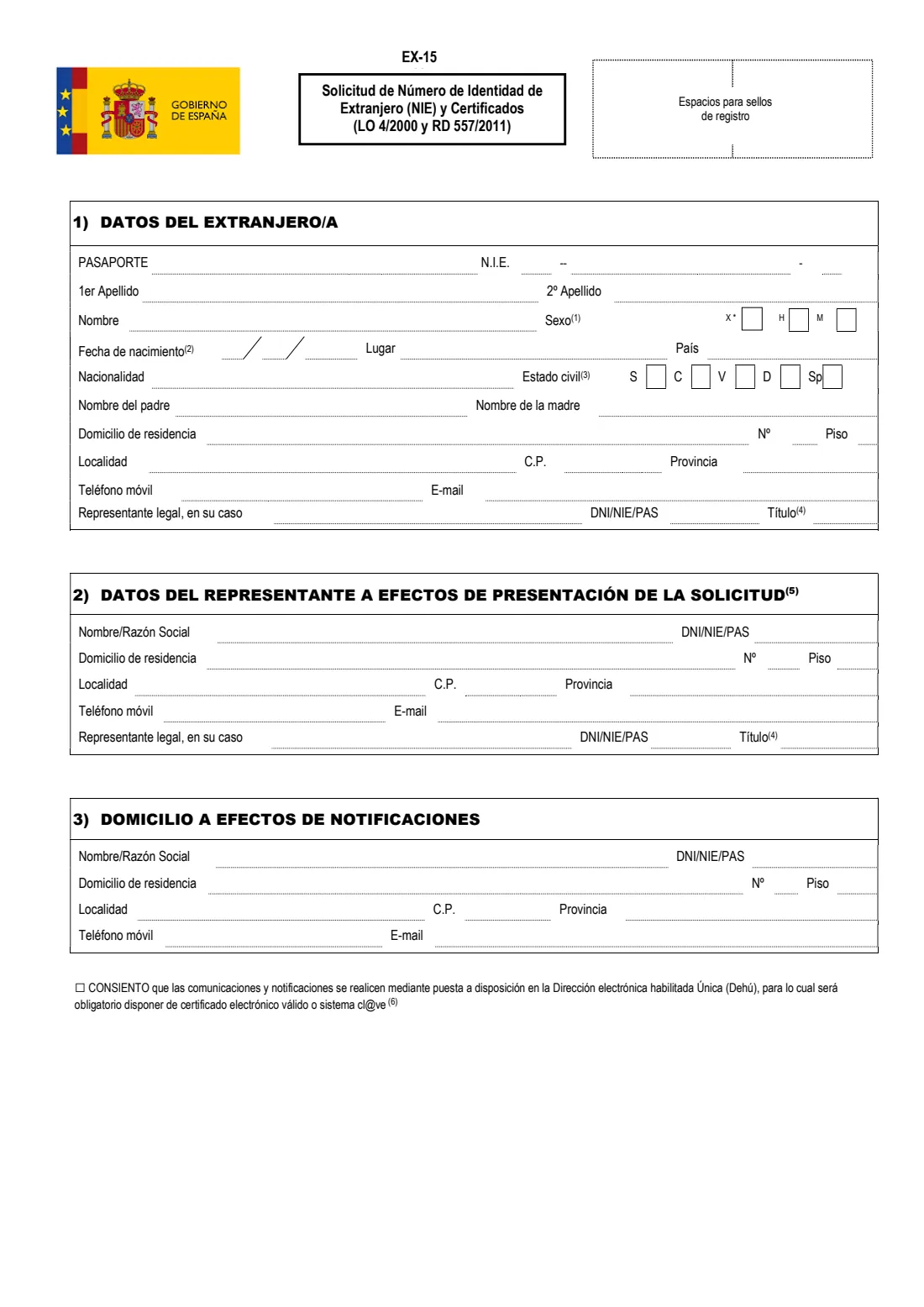
The 2026 edition has 3 pages. FileIt asks for it in 6 parts:
- 1) Your details (Datos del extranjero/a)Applicant (solicitante)
- 2) Representative handing in the application (Datos del representante)Representative
- 3) Address for notifications (Domicilio a efectos de notificaciones)Applicant (solicitante)
- Electronic notifications (Dehú)Applicant (solicitante)
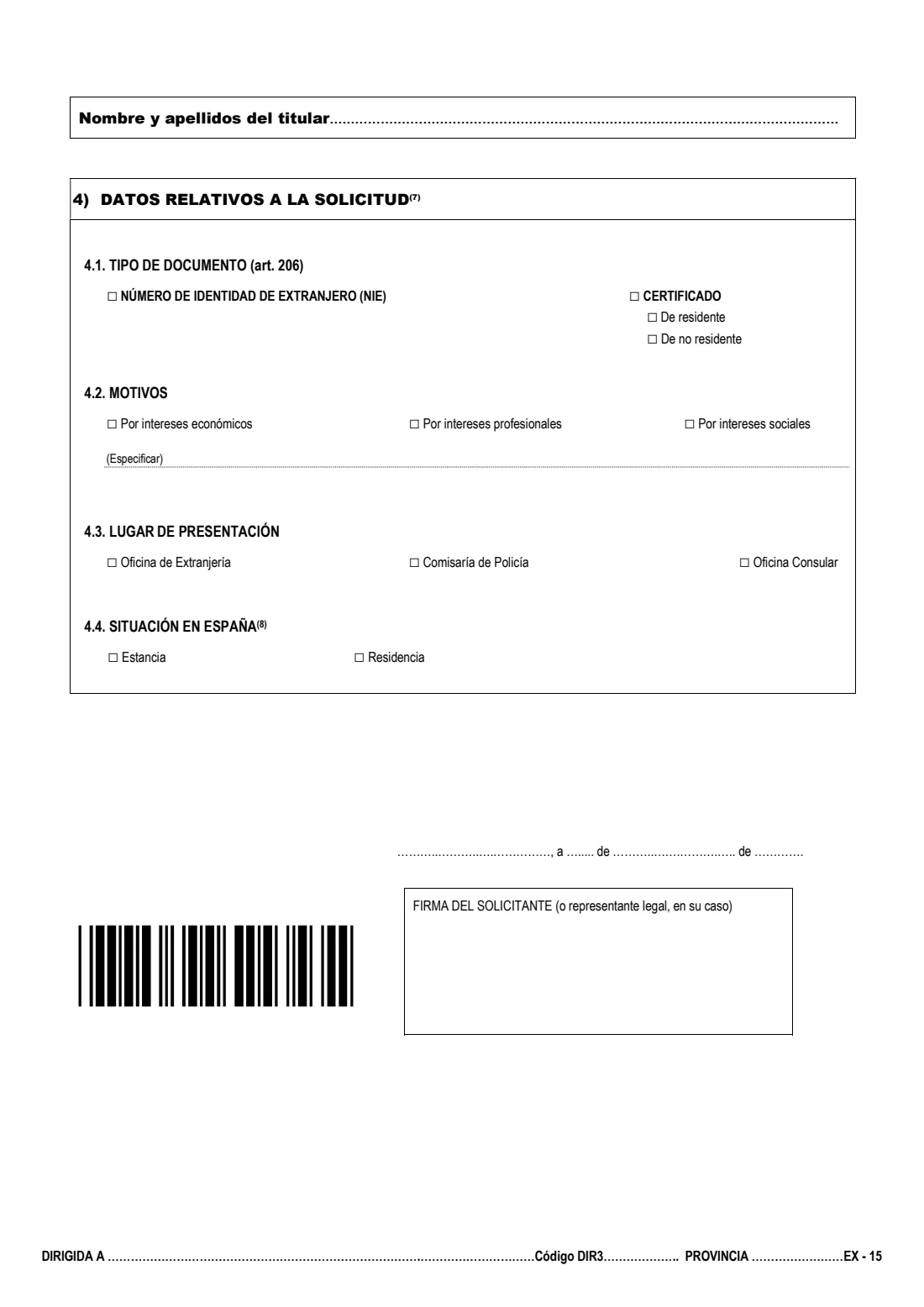
- 4) The application (Datos relativos a la solicitud)Applicant (solicitante)
- Place, date and signatureApplicant (solicitante)
How to fill out EX-15 (NIE application), step by step
1 1) Datos del extranjero/a (your details)
Give your passport number and, if you already have one, your NIE. Then your first and second surnames and your first name, your sex (H for male, M for female, or X for undefined — the form says X may only be used by people whose country of origin recognises it), your date of birth, place and country of birth, nationality and marital status (single, married, widowed, divorced or separated).
Add your father's and mother's names, your home address, locality, postcode and province, and your mobile phone and email. If you are a minor or otherwise act through a legal representative, give their name, document number and the capacity in which they act — for example father, mother or guardian. FileIt prints everything in capitals, as the form asks, and flags an applicant under 18 without a representative.
2 2) Datos del representante (representative handing in the application)
Only fill in this part if someone other than you hands in the application — for example a lawyer, an agency or a relative with authority to act for you. Give their name or company name, DNI, NIE or passport number, address and contact details, and, if the representative is a company, the person who legally represents it.
3 3) Domicilio a efectos de notificaciones (address for notifications)
If notices about your application should go somewhere other than your own address — to your representative, for example — give that name and address here. The instructions explain that notifications go to the person in this part, or otherwise to the applicant.
Below this part is a consent box for electronic notifications through the government's single electronic address (Dirección electrónica habilitada única, Dehú). Tick it only if you want notices made available electronically; you then need a digital certificate or the Cl@ve system to read them. Companies and some other groups are notified electronically whether or not they tick it.
4 4.1 Tipo de documento (document requested)
Tick NÚMERO DE IDENTIDAD DE EXTRANJERO (NIE) to have an NIE assigned. Tick CERTIFICADO if you already have an NIE and need a certificate, then choose De residente (resident) or De no residente (non-resident). FileIt asks for your existing NIE when you choose a certificate and checks its control letter.
5 4.2 Motivos (reason)
Choose economic, professional or social interests, and explain the specific reason in the box below — for example buying a home, a job offer or setting up a business. Keep it short and concrete, and bring evidence that supports it.
6 4.3 Lugar de presentación (where you hand it in)
Tick the place where you will hand in the application: an immigration office (Oficina de Extranjería), a police station (Comisaría de Policía), or a Spanish consulate (Oficina Consular) if you are abroad. At the foot of page 2 you can also write the name of the office the application is addressed to, its DIR3 directory code if you know it, and its province.
7 4.4 Situación en España (situation in Spain)
Tick Estancia if you are in Spain on a stay, such as a visit, or Residencia if you are resident. Applicants handing the form in at a consulate abroad may leave this empty.
8 Place, date and signature
Write the place and date — FileIt prints the day, the month in Spanish and the year — and sign by hand in the box on page 2. The applicant signs, or their legal representative if they have one. There is no electronic signature for this paper form.
Common mistakes to avoid
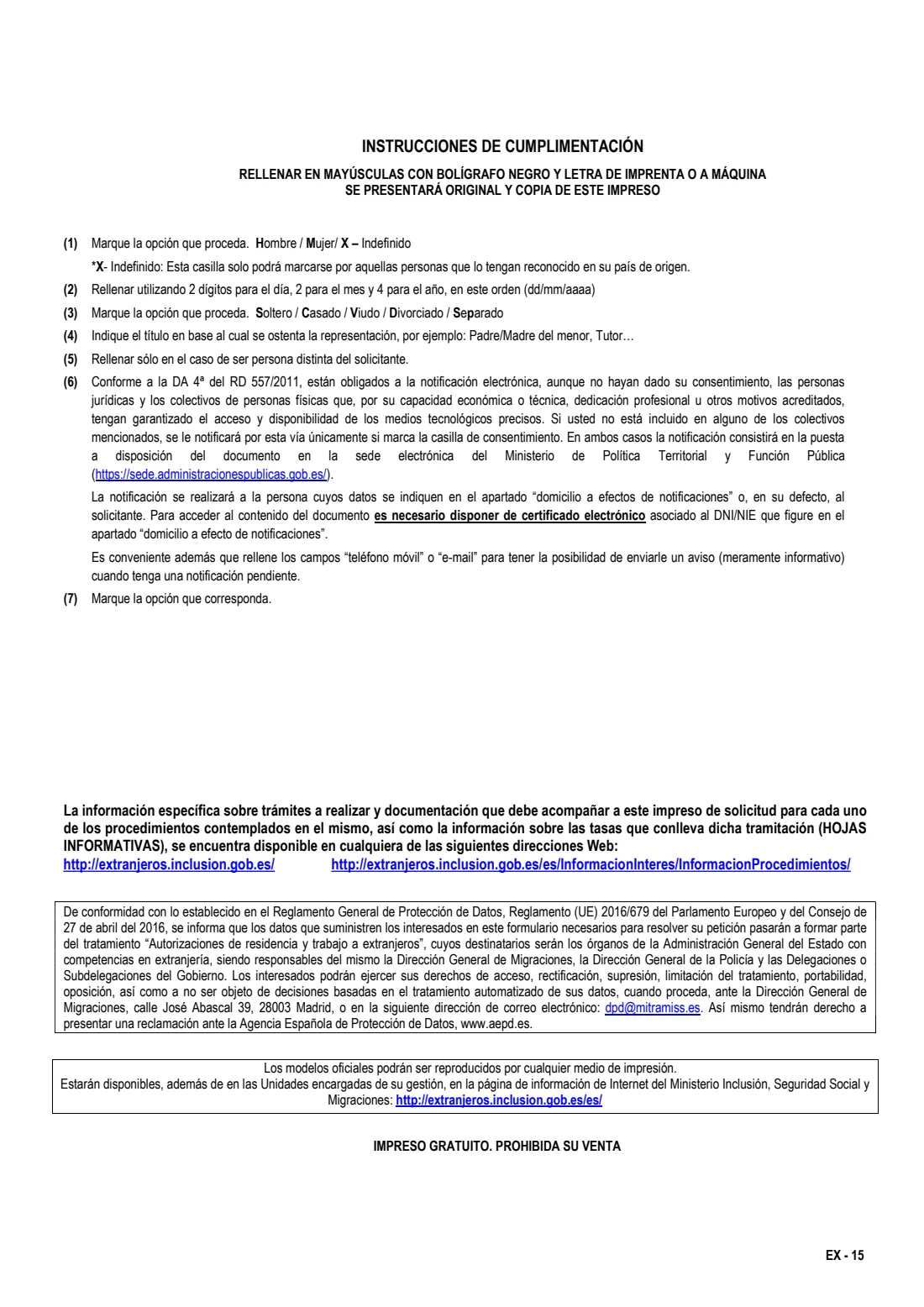
- Writing in lower case — the instructions ask for capital letters, in black ink or typed.
- Bringing only one copy; the form says to present the original and a copy.
- Ticking CERTIFICADO without giving your existing NIE.
- Leaving the reason too vague — explain the specific economic, professional or social reason and bring evidence for it.
- Ticking X for sex when your country of origin does not recognise it for you.
- Forgetting the legal representative's details and signature for a child applicant.
- Ticking the electronic-notification consent without having a digital certificate or Cl@ve to read the notices.
- Turning up without paying the fee or without the documents the official information sheet lists.
After you fill it out
Print the form and sign it by hand — you, or your legal representative. Take the original and a copy, with your passport, supporting documents and proof of the fee, to the office you ticked in part 4.3; offices commonly work by appointment (cita previa). FileIt does not submit the form, book appointments or pay the fee.
The official information sheets (hojas informativas) on the Ministry's immigration website list the documents and fees for each procedure; the form refers you to them, and they are worth checking before you go.
The completed PDF is saved in your FileIt vault under your name. When your NIE or certificate is issued, add it to your vault too, so you have both to hand for notaries, banks and tax offices.
Fill out EX-15 (NIE application) online with FileIt
- Pick the person. Choose someone from People and FileIt fills in their name, date of birth, address and other details it already knows.
- Answer plain-language questions. One part of the form at a time, with the official help text beside each question — 60 fields in all. Your answers save as you go.
- Check the live preview. Watch your answers land on the real Ministerio de Inclusión, Seguridad Social y Migraciones (MISSM) — Secretaría de Estado de Migraciones, with the Dirección General de la Policía form, and let FileIt do any worksheet arithmetic.
- Generate the official PDF. FileIt prints your answers into the agency’s own PDF and files it in that person’s folder in your vault.
FileIt fills the form — it never files or submits anything for you. Deliver the finished form to whoever asked for it, the way the form’s instructions say.
Start EX-15 (NIE application) now — it’s freeEX-15 (NIE application): frequently asked questions
What is the EX-15 form?
EX-15 is the Spanish application for a foreigner identity number (NIE) and for certificates of resident or non-resident status. It is used by foreigners with economic, professional or social interests in Spain.
Where do I hand in form EX-15?
In person at an immigration office (Oficina de Extranjería), a police station (Comisaría de Policía), or a Spanish consulate if you are abroad. You tick the place in part 4.3 of the form.
Can I fill out EX-15 online?
You can fill it in online with FileIt: it explains every question in English, prints your answers in capitals onto the official PDF and saves it in your vault. You then print it, sign it by hand and hand it in in person. FileIt does not submit it for you.
Do I need to write EX-15 in capital letters?
Yes. The instructions say to fill it in in capital letters, in black ink or typed. FileIt prints names and addresses in capitals automatically.
What is the difference between an NIE and a resident certificate?
The NIE is your personal identification number as a foreigner in Spain. A resident or non-resident certificate is an official document confirming your status, for people who already have an NIE.
Can someone apply for me?
The form has a part for a representative who hands in the application on your behalf, and a legal representative signs for a minor. Check the official information sheet for what the office will ask the representative to show.
Is there a fee for the NIE?
Yes. The fee is paid with the police fee form, modelo 790 código 012. Check the current amount and how to pay it before your appointment.
Which reason should I choose?
Choose economic interests for things like buying property or investing, professional interests for work, or social interests for other personal reasons, then describe the specific reason in the box below and bring proof.
Why does the form ask for my parents' names?
EX-15 asks for your father's and mother's names as part of your personal details. Enter their first names as they appear in your documents.
Official sources
- Blank form (PDF), published by Ministerio de Inclusión, Seguridad Social y Migraciones (MISSM) — Secretaría de Estado de Migraciones, with the Dirección General de la Policía: https://www.inclusion.gob.es/documents/410169/2156469/15-Formulario_NIE_y_certificados.pdf
- Official instructions and guidance: http://extranjeros.inclusion.gob.es/es/InformacionInteres/InformacionProcedimientos/
- Edition shown on this page: EX-15 (no edition date printed) (checked 2026-09-26).
FileIt is not affiliated with or endorsed by Ministerio de Inclusión, Seguridad Social y Migraciones (MISSM) — Secretaría de Estado de Migraciones, with the Dirección General de la Policía or any government. This page explains the form in general terms and is not legal, tax or immigration advice. Always read the official instructions, and check that you are using the edition the recipient accepts. Page last reviewed 2026-09-26.