What is EX-17 TIE application?
EX-17 is the Spanish government's application form for the Tarjeta de Identidad de Extranjero, or TIE: the physical identity card that shows a non-EU national's residence or stay authorisation in Spain, their foreigner identity number (NIE) and their photo and fingerprint. It is published by the migration authorities (Ministerio de Inclusión, Seguridad Social y Migraciones) under Organic Law 4/2000 and Royal Decree 557/2011, and it is presented to the competent National Police unit (Policía Nacional).
Having an authorisation to live, work or study in Spain is not the same as holding the card. Once your authorisation has been granted — or you have arrived with a visa that needs a card — you apply for the TIE with this form, in person, and your fingerprints are taken at the appointment. The same form covers a renewed card after your authorisation is renewed or changed, and a duplicate when a card is stolen, lost, destroyed or unusable.
FileIt walks you through each part of the EX-17 in plain English, splits your NIE into the form's three boxes, checks the NIE's control letter, writes the date in the Spanish style ('a 26 de septiembre de 2026') and prints everything in capitals into the ministry's own PDF. Names, dates of birth and addresses can be pre-filled from the People records in your FileIt vault, and the finished form is saved in that person's folder. You print it, sign it by hand and take it to your appointment yourself — FileIt never submits anything.
- Who fills it
- The foreign national (or a parent or guardian for a minor)
- Given to
- The competent Policía Nacional unit, in person only
- Used for
- First TIE, renewal of the card, or duplicate after theft, loss, destruction or damage
- Signatures
- Signed by hand by the applicant or their legal representative
- Copies
- Bring the original and a copy of the completed form
- Language
- Spanish form; fill it in capital letters
Who needs to fill out EX-17 TIE application?
- Non-EU nationals who have been granted a residence, residence-and-work or stay authorisation in Spain and now need the physical card (TIE).
- People who arrived in Spain with a national visa for residence, work or study that must be exchanged for a TIE after arrival.
- TIE holders whose authorisation has been renewed or modified and who need a new card showing it.
- Anyone whose TIE was stolen, lost, destroyed or has become unusable and who needs a duplicate.
- Parents or guardians applying for a child's TIE — the legal representative's details go in section 1 and they sign for the child.
- Not for EU, EEA or Swiss citizens registering as residents, who use a different procedure and certificate.
When to use EX-17 TIE application
- After your authorisation has been granted or has taken effect, or after you enter Spain with a visa that requires a card. The rules generally expect you to apply within a month, so book your fingerprint appointment (cita previa) early; the information sheets set out the exact timing for your procedure.
- When your authorisation is renewed or modified and you need a card that reflects the new situation.
- As soon as possible after a card is stolen, lost, destroyed or damaged — tick the duplicate box.
- Each time you need a new card: the EX-17 is filled in afresh for every application.
What you need before you start
- Your passport (the number goes in section 1), and your NIE — X, Y or Z, seven digits and a check letter.
- Your full name exactly as in your passport, written in Latin letters, including a second surname if you have one.
- Your date and place of birth, country of birth, nationality and marital status.
- Your father's and mother's first names.
- Your address in Spain: street, number, floor, town, postcode and province, plus a mobile number and email if you want notice alerts.
- For a minor: the parent's or guardian's name, DNI/NIE/passport number and in what capacity they act.
- The details of any representative, or of a separate address for notifications, if you use one.
- The documents the official information sheet (hoja informativa) lists for your case, such as a recent photo and proof that the fee (tasa) has been paid.
What’s on EX-17 TIE application
The 2026 edition has 3 pages. FileIt asks for it in 5 parts:
- 1) Foreign national's details (Datos del extranjero/a)Applicant (solicitante)
- 1) Legal representative, if any (Representante legal, en su caso)Applicant (solicitante)
- 2) Representative for the application (Datos del representante a efectos de presentación)Representative (representante)
- 3) Address for notifications (Domicilio a efectos de notificaciones)Applicant (solicitante)
- 4) The application (Datos relativos a la solicitud)Applicant (solicitante)
How to fill out EX-17 TIE application, step by step
1 1) Datos del extranjero/a — the foreign national's details
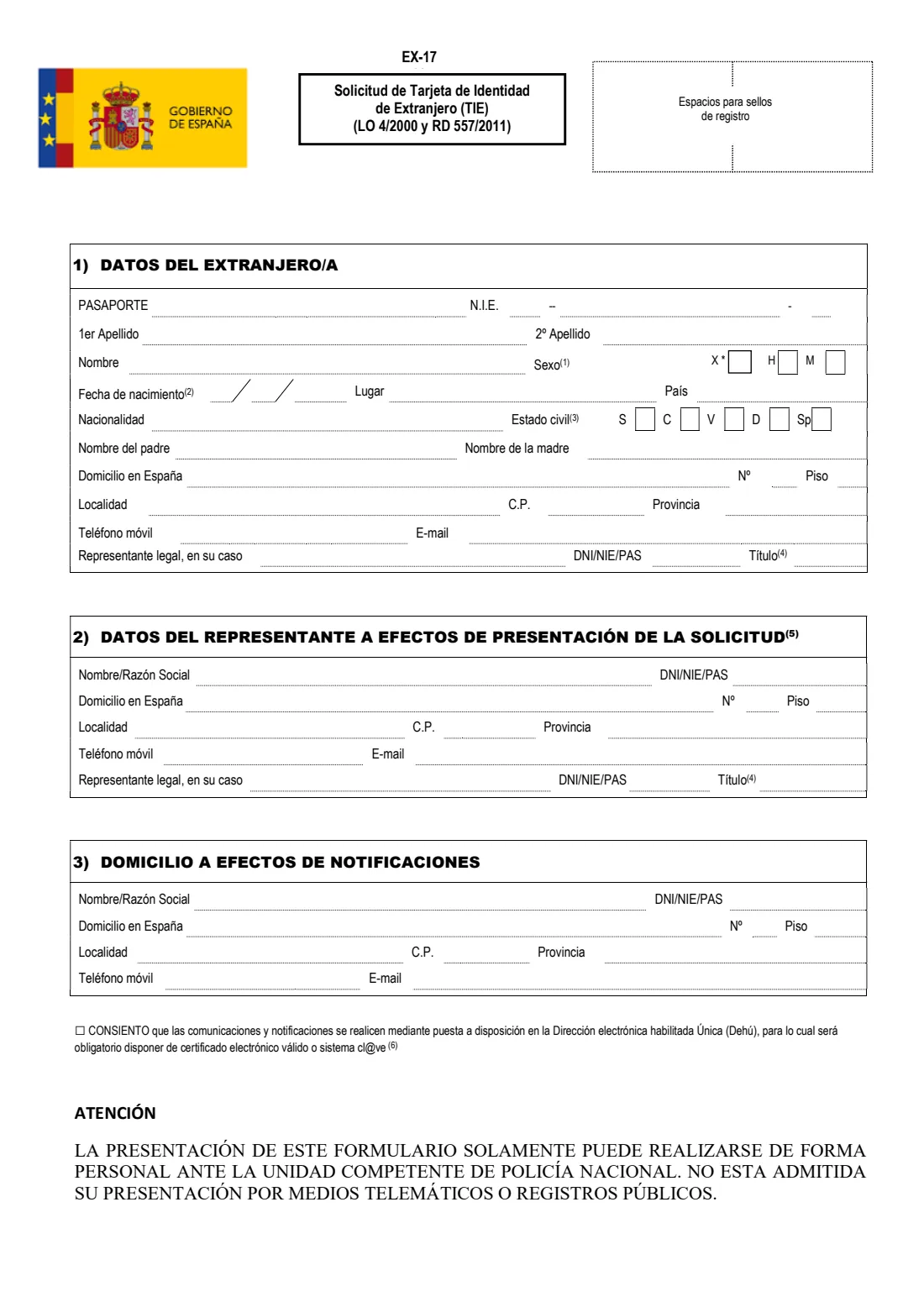
Your passport number and your NIE, split into its three parts: the initial letter, the seven digits and the final check letter. Then your first and second surnames, first names, sex (H for hombre, M for mujer; the X box is only for people whose country of origin recognises a non-binary sex), date of birth (day, month, year), place and country of birth, nationality and marital status (S single, C married, V widowed, D divorced, Sp separated).
The section finishes with your parents' first names and your address in Spain, mobile phone and email. The last line, 'Representante legal, en su caso', is only for a minor or a person under guardianship: the parent or guardian's name, their DNI/NIE/passport number and their capacity, such as PADRE, MADRE or TUTOR.
2 2) Datos del representante a efectos de presentación de la solicitud
Only if someone other than the applicant acts as representative for this application — for example a gestoría or lawyer handling the paperwork. It asks for the representative's name or company name, their DNI/NIE/passport or company number, their address, phone and email, and, for a company, the person acting for it.
Keep in mind the warning printed on the form: the TIE application itself can only be presented personally at the Police unit, because the applicant's fingerprints are taken there.
3 3) Domicilio a efectos de notificaciones
Fill this in only if official notices should go to a different person or address from the applicant's own — for example your representative's office. It repeats the name, ID number, address, phone and email.
Below it is the CONSIENTO box. Ticking it means you agree to receive notices electronically through the government's single electronic address (Dirección Electrónica Habilitada Única, DEHú), which you open with a digital certificate or Cl@ve. Companies and some professional groups must use electronic notices anyway; for other people they are used only if the box is ticked.
4 4) Datos relativos a la solicitud — the type of card
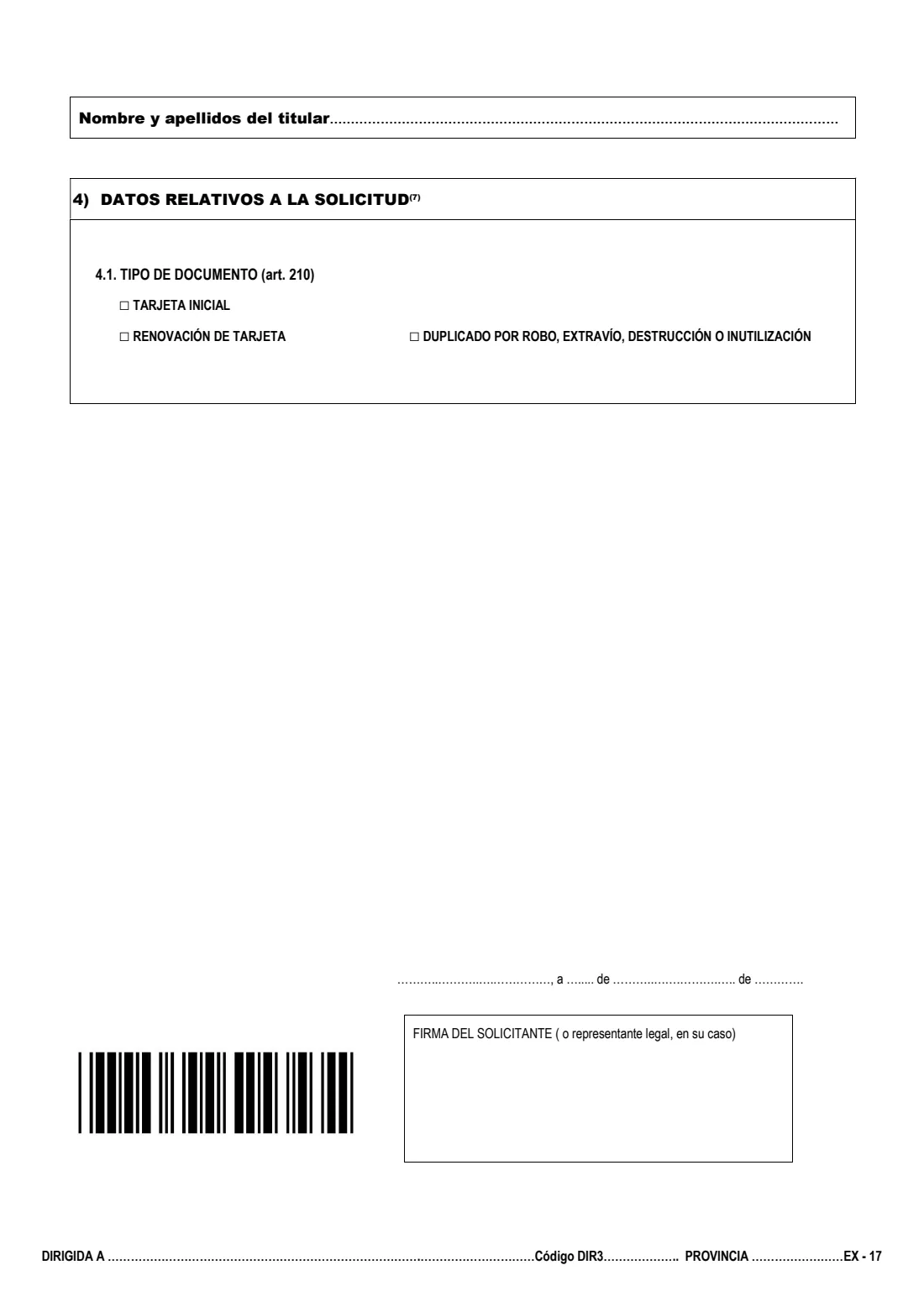
On page 2 the holder's full name is repeated at the top, and you tick one type of document under article 210 of the regulation: TARJETA INICIAL (your first card), RENOVACIÓN DE TARJETA (a renewal) or DUPLICADO for a card that was stolen, lost, destroyed or has become unusable.
5 Place, date and signature
Write the town and the date in the Spanish form '…, a 26 de septiembre de 2026', then sign in the FIRMA DEL SOLICITANTE box — or the legal representative signs for a minor. FileIt fills in the place and date and leaves the signature box empty for your handwritten signature.
The footer line 'DIRIGIDA A … Código DIR3 … PROVINCIA' names the office the application is addressed to. You can give the Police unit from your appointment, or leave it for the office to complete.
6 Instrucciones de cumplimentación — the instructions page
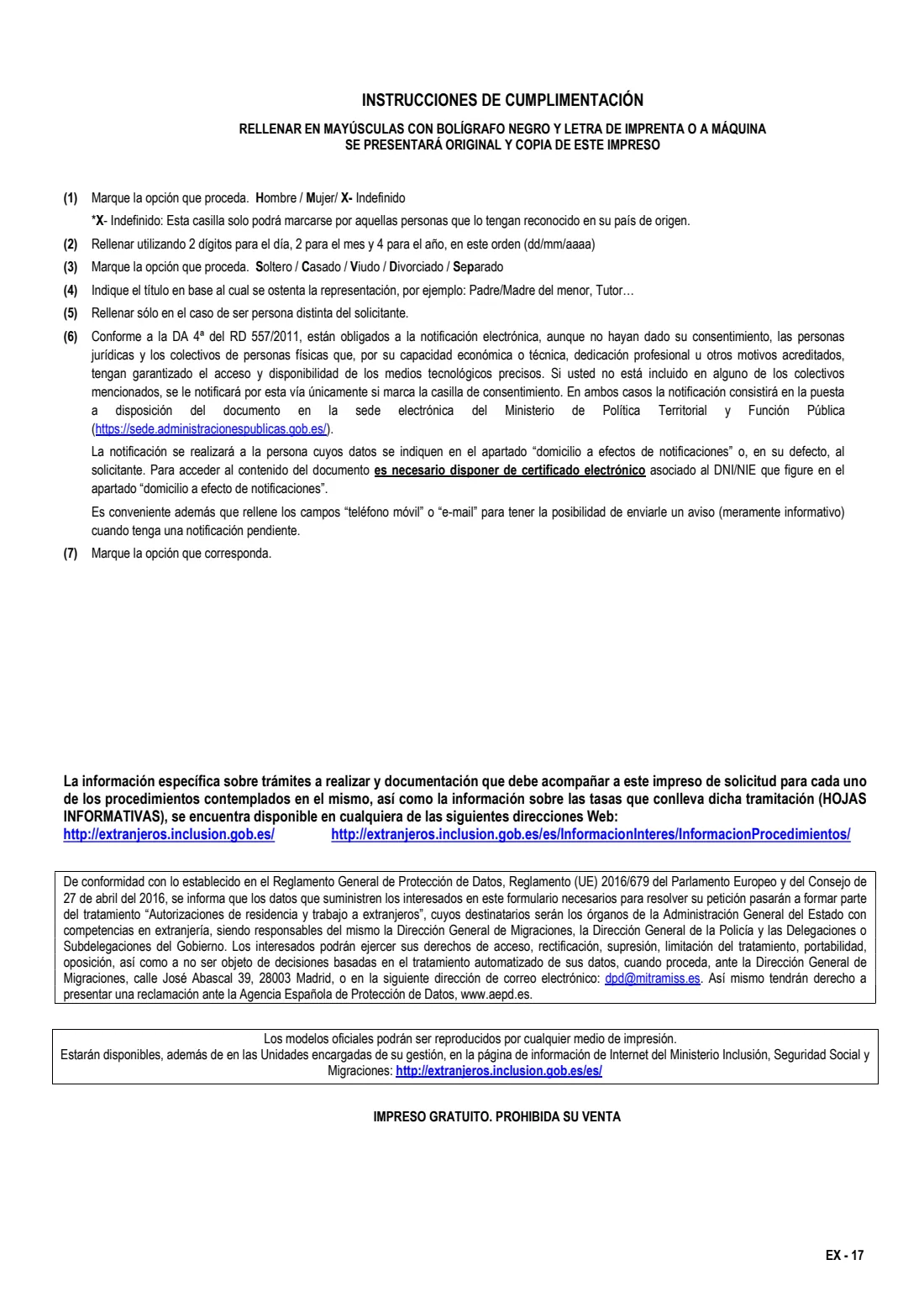
Page 3 explains the numbered notes: fill in capitals, in black ink or typed; dates as dd/mm/yyyy; bring the original and a copy of the form. It also points to the official information sheets for the documents and fees each procedure needs, and carries the data-protection notice. There is nothing to fill in on this page.
Common mistakes to avoid
- Trying to send the EX-17 online or through a public registry — the form states it can only be presented personally to the competent National Police unit.
- Mixing up the NIE boxes: the initial letter, the seven digits and the check letter each have their own box. A wrong check letter is a common typo, so compare it with your documents.
- Writing names differently from the passport, or with letters from another alphabet. Use the Latin spelling in your passport, including both surnames where you have them.
- Ticking the wrong document type — a renewal of your authorisation needs 'Renovación de tarjeta', not 'Tarjeta inicial'.
- Leaving out the legal representative for a child. A parent or guardian fills in their details in section 1 and signs for the minor.
- Filling in sections 2 and 3 when you don't have a representative or a separate notification address. Leave them blank.
- Forgetting the second copy and the supporting documents from the information sheet, such as the photo and proof of the fee.
After you fill it out
Print the completed form, sign it by hand in the signature box (or have the parent or guardian sign for a minor) and make a copy: the instructions ask for the original and a copy. Take them, with your passport and the documents from the official information sheet for your procedure, to your appointment at the Police unit, where your fingerprints are taken. FileIt does not book appointments or send the form anywhere.
Keep the filled PDF in your FileIt vault next to your passport, visa and authorisation, and record the TIE's expiry date when the card arrives so you get reminders well before it runs out. When your authorisation is renewed or the card is lost or stolen, you'll need a new EX-17 — the details you entered can be reused.
Fill out EX-17 TIE application online with FileIt
- Pick the person. Choose someone from People and FileIt fills in their name, date of birth, address and other details it already knows.
- Answer plain-language questions. One part of the form at a time, with the official help text beside each question — 55 fields in all. Your answers save as you go.
- Check the live preview. Watch your answers land on the real Ministerio de Inclusión, Seguridad Social y Migraciones — Secretaría de Estado de Migraciones (form); Policía Nacional (receives it) form, and let FileIt do any worksheet arithmetic.
- Generate the official PDF. FileIt prints your answers into the agency’s own PDF and files it in that person’s folder in your vault.
FileIt fills the form — it never files or submits anything for you. Deliver the finished form to whoever asked for it, the way the form’s instructions say.
Start EX-17 TIE application now — it’s freeEX-17 TIE application: frequently asked questions
What is the difference between the NIE and the TIE?
The NIE (Número de Identidad de Extranjero) is your personal identification number as a foreigner in Spain. The TIE is the physical card that shows your NIE together with your residence or stay authorisation, photo and fingerprint. The EX-17 applies for the card; your NIE is already on your authorisation and goes in section 1.
Can I submit the EX-17 online?
No. The form itself says it can only be presented personally at the competent National Police unit and is not accepted electronically or through public registries, because your fingerprints are taken when you apply. You usually need an appointment (cita previa).
Can I fill in the EX-17 online with FileIt?
Yes. FileIt guides you through every section, checks your NIE and dates, and prints your answers into the official EX-17 PDF, ready to print and sign by hand. It is free on every FileIt account. FileIt does not present the form for you.
Where do I hand in the form?
To the Policía Nacional unit responsible for foreign nationals where you live (an Oficina de Extranjería or police station that handles TIE applications), at your appointment. Bring the original and a copy of the form and the documents your information sheet lists.
Do I use EX-17 to renew my TIE?
Yes. After your authorisation has been renewed or modified, apply for the new card with EX-17 and tick 'Renovación de tarjeta'. Renewing the authorisation itself is a separate procedure with its own form.
My TIE was stolen or lost. Which box do I tick?
Tick 'Duplicado por robo, extravío, destrucción o inutilización'. The information sheet for duplicates explains what else to bring.
How do I fill in the form for my child?
Enter the child's details in section 1 and, on the 'Representante legal, en su caso' line, the parent's or guardian's name, ID number and capacity (for example PADRE or MADRE). The representative signs the form.
Is there a fee for the TIE?
Yes, a fee (tasa) is charged for issuing the card. The amount can change, so check the official information sheet for your procedure. The EX-17 form itself is free — the form says it may not be sold.
Does the form need to be in capital letters?
Yes. The instructions ask for capitals, in black ink or typed. FileIt prints your answers in capitals automatically, apart from email addresses.
Official sources
- Blank form (PDF), published by Ministerio de Inclusión, Seguridad Social y Migraciones — Secretaría de Estado de Migraciones (form); Policía Nacional (receives it): https://www.inclusion.gob.es/documents/410169/2156469/17-Formulario_TIE.pdf
- Official instructions and guidance: https://www.inclusion.gob.es/web/migraciones/formularios
- Edition shown on this page: EX-17 (no edition date printed; the header carries the number 03) (checked 2026-09-26).
FileIt is not affiliated with or endorsed by Ministerio de Inclusión, Seguridad Social y Migraciones — Secretaría de Estado de Migraciones (form); Policía Nacional (receives it) or any government. This page explains the form in general terms and is not legal, tax or immigration advice. Always read the official instructions, and check that you are using the edition the recipient accepts. Page last reviewed 2026-09-26.