What is UDK 441 — Housing benefit application (boligstøtte)?
UDK 441 is Udbetaling Danmark's paper application for housing benefit (boligstøtte), the Danish help towards housing costs. Housing benefit depends on the whole household, not just the applicant, so the form covers everyone who lives in the home. It asks for their CPR numbers, their monthly and yearly income before tax, deductions, capital and share income, and any wealth not registered with the Danish Tax Agency. It also asks about lodgers, rooms used for business, and special circumstances such as a home assigned by the local authority or a wheelchair user in the household. Every adult in the household signs a declaration of joint and several liability (solidarisk hæftelse).
Udbetaling Danmark asks people to apply digitally on borger.dk, which needs MitID. The paper form is for when that isn't possible. It is written in Danish and asks for block capitals (blokbogstaver).
FileIt takes you through UDK 441 in plain English with the Danish terms alongside. Each household member gets their own part, so their CPR number, income column, wealth line and liability line all land in the right places on the official PDF. FileIt pre-fills your name from the People in your vault, prints names in capitals (including letters like ø, å, ł and ș), and checks the form's rules, for example that every household member aged 18 or over signs part L. The finished PDF is saved in your vault. You print it, collect the signatures by hand and post it yourself. FileIt never sends anything to Udbetaling Danmark.
- Who fills it
- The applicant (or a holder of power of attorney or guardian) on behalf of the whole household
- Given to
- Udbetaling Danmark - Boligstøtte — by post to Kongens Vænge 8, 3400 Hillerød
- When
- When you move into a home, or when your household or income changes so that you may qualify
- Signatures
- The applicant signs part K; every household member aged 18 or over signs part L — all by hand
- Edition
- UDK 441, Version 05/26
- Pages
- 8 (4 to fill in, 4 of guidance, terms and privacy information)
Who needs to fill out UDK 441 — Housing benefit application (boligstøtte)?
- Tenants who want help with their rent and can't use the digital application on borger.dk with MitID.
- Pensioners, including people on state, senior, early or disability pension, applying for housing benefit for a rented, owner-occupied or cooperative home.
- Households with several adults, since everyone's income and wealth goes on the same form and every adult signs.
- People who rent out rooms in their home, use rooms for business, or have a home assigned by the local authority.
- Households where someone employs personal helpers under BPA or uses space-demanding aids such as a wheelchair.
- A holder of power of attorney or a guardian applying for someone else, who must send documentation that they may.
When to use UDK 441 — Housing benefit application (boligstøtte)
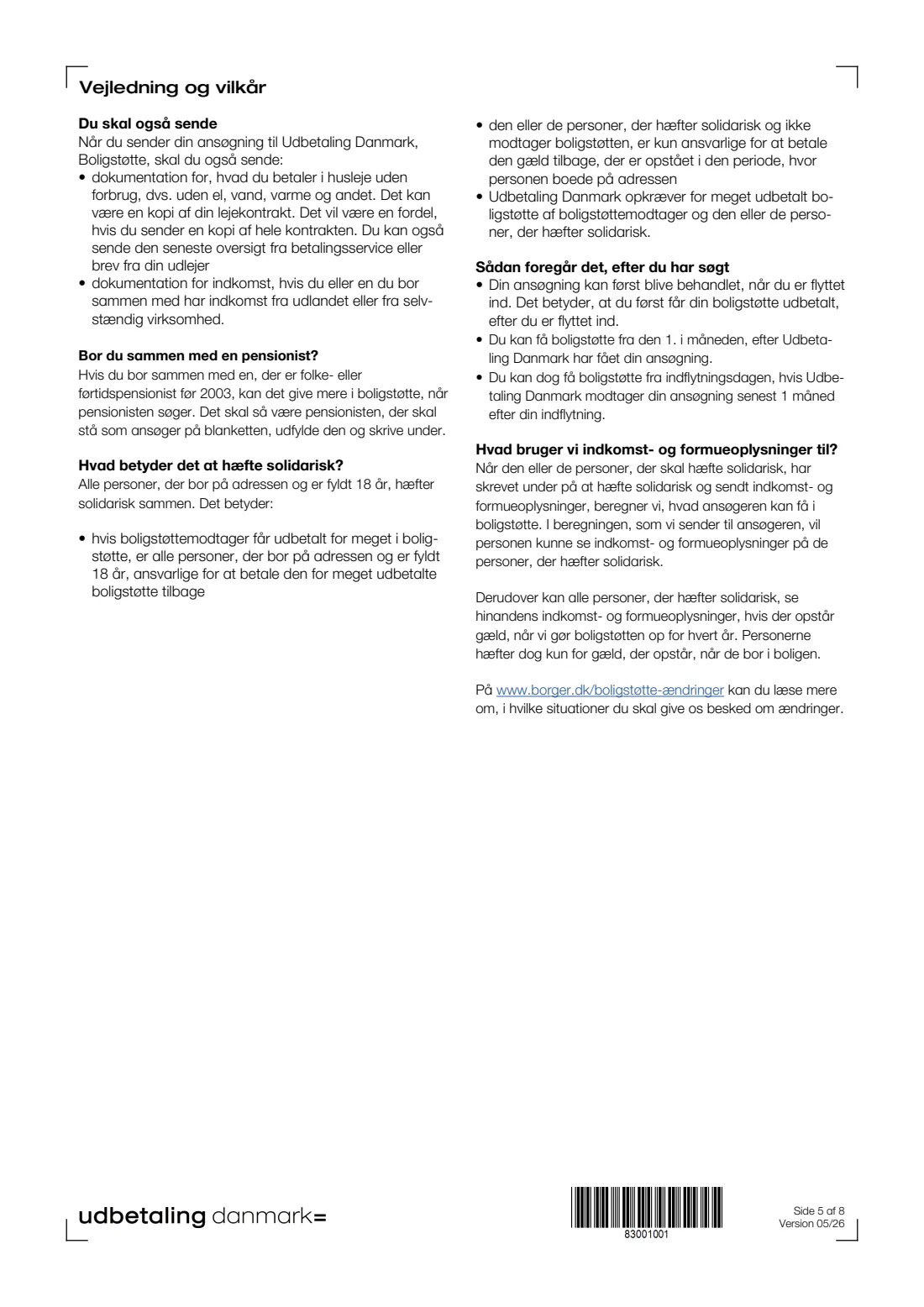
- When you move into a new home. The form's guidance says your application can only be handled once you have moved in.
- Promptly after moving in. Benefit runs from the 1st of the month after Udbetaling Danmark receives the application, or from the day you move in if they receive it no later than 1 month after you move in.
- When your household changes and you may now qualify, for example after a separation, a death, or someone moving into a nursing home.
- If you live with someone who was granted state or disability pension before 2003. The guidance says it can give more housing benefit when that pensioner is the applicant who fills in and signs the form.
- After you receive benefit, report changes as described on borger.dk. The form links to the list of situations that require it.
What you need before you start
- Your CPR number, current address and phone number, and the type of pension you receive, if any.
- The address of the home, the moving-in date, the date the lease starts and the date you want benefit to start from.
- The names and CPR numbers of everyone else who lives there.
- Payslips, SU notices and pension notices for each person, showing monthly amounts after labour market and ATP contributions.
- Yearly figures for each person: employer pensions, self-employment, foreign income, payments to private pensions, interest, rental income and share income.
- Details of any wealth over 100,000 kr. in total for the household that isn't registered with the Danish Tax Agency, such as cash, cars, foreign property or private claims.
- Names, number of rooms and monthly rent for any lodgers.
- Documentation of the rent without utilities, such as a copy of the whole lease, a Betalingsservice overview or a letter from your landlord.
- Proof of foreign or self-employed income, the local authority's letter if the home was assigned, and proof of any compensation for loss of earning capacity.
- A debt statement (gældserklæring) from Udbetaling Danmark if the home is owner-occupied or cooperative.
What’s on UDK 441 — Housing benefit application (boligstøtte)
The 2026 edition has 8 pages. FileIt asks for it in 15 parts:
- A. About the applicant (Oplysninger om ansøger)Applicant
- B. Are you a pensioner? (Er du pensionist?)Applicant
- C. The home you apply for (Jeg søger boligstøtte til)Applicant
- D. Household member 1 (Person 1)Applicant
- D. Household member 2 (Person 2)Applicant
- D. Household member 3 (Person 3)Applicant
- D. Household member 4 (Person 4)Applicant
- D. Household member 5 (Person 5)Applicant
- E. Do you rent out one or more rooms? (Lejer du et eller flere værelser ud?)Applicant
- F. Your monthly and yearly income before tax (Ansøger)Applicant
- G. Wealth not registered with the Danish Tax Agency (Formue)Applicant
- H. Rooms used for business (Værelser til erhverv)Applicant
- I. Other information (Andre oplysninger)Applicant
- J. About residents (Oplysninger om beboere)Applicant
- K. Declaration, consent and signature (Erklæring, samtykke og underskrift)Applicant
How to fill out UDK 441 — Housing benefit application (boligstøtte), step by step
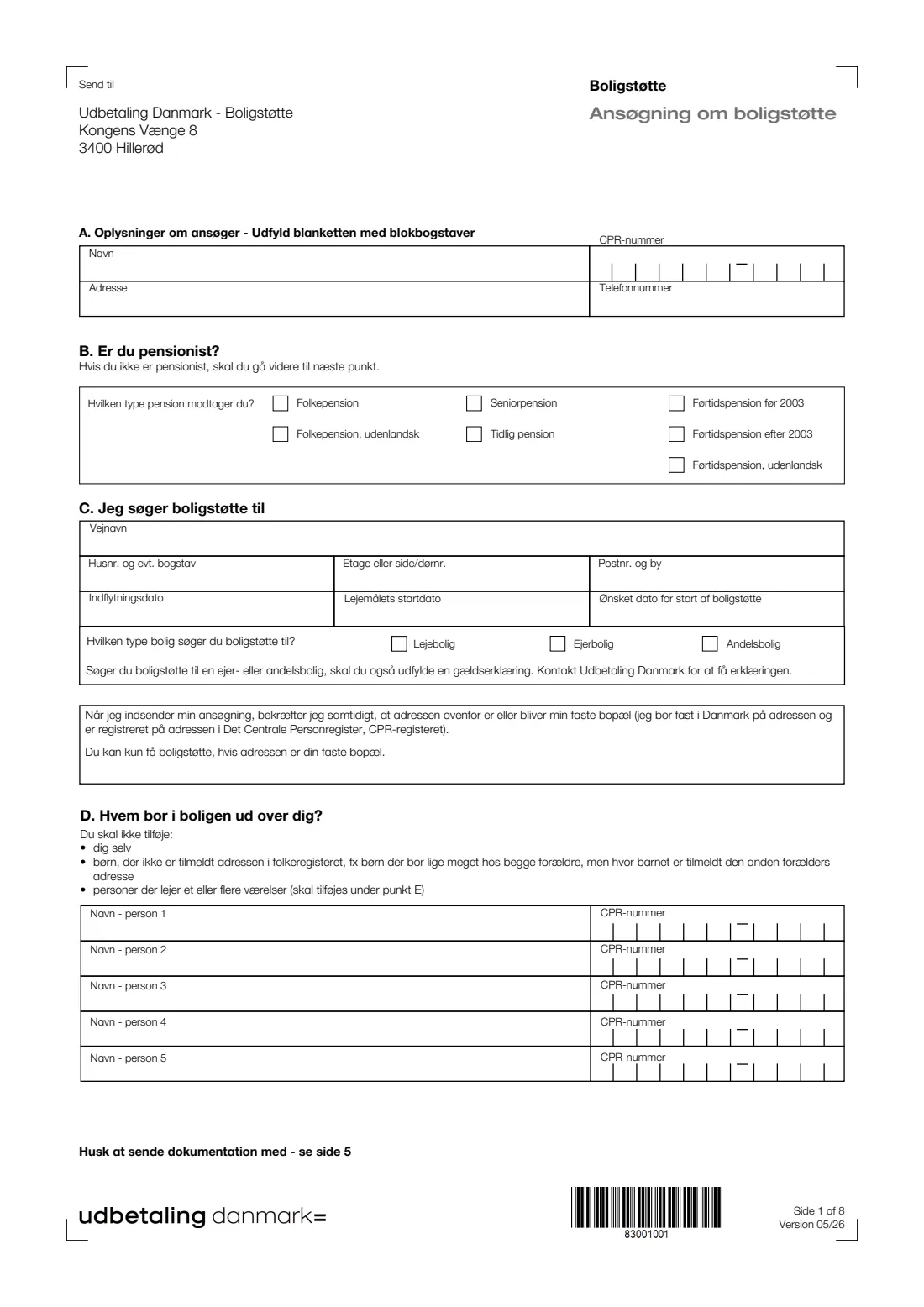
1 A. Oplysninger om ansøger (about the applicant)
Your name, CPR number, address and phone number, in block capitals. The CPR number goes digit by digit into ten boxes. If you live with a pensioner who was granted state or disability pension before 2003, think about who should be the applicant. The guidance says it can give more housing benefit if that pensioner applies.
2 B. Er du pensionist? (are you a pensioner?)
Tick the type of pension you receive: state pension, foreign state pension, senior pension, early pension (tidlig pension), disability pension before or after 2003, or foreign disability pension. If you aren't a pensioner, skip to C.
3 C. Jeg søger boligstøtte til (the home you apply for)
The street, house number, floor or door, postcode and town, then the moving-in date, the start date of the lease and the date you want housing benefit to start. Tick whether it is a rented, owner-occupied or cooperative home. For owner-occupied and cooperative homes you also need a debt statement from Udbetaling Danmark.
By applying, you confirm that the address is or will become your permanent home and that you are registered there in the CPR register. You can only get housing benefit for your permanent home.
4 D. Hvem bor i boligen ud over dig? (who else lives in the home)
The names and CPR numbers of up to five other people living there. Don't include yourself, lodgers (they go in E), or children who aren't registered at the address, such as a child who lives equally with both parents but is registered with the other parent.
5 E. Lejer du et eller flere værelser ud? (lodgers)
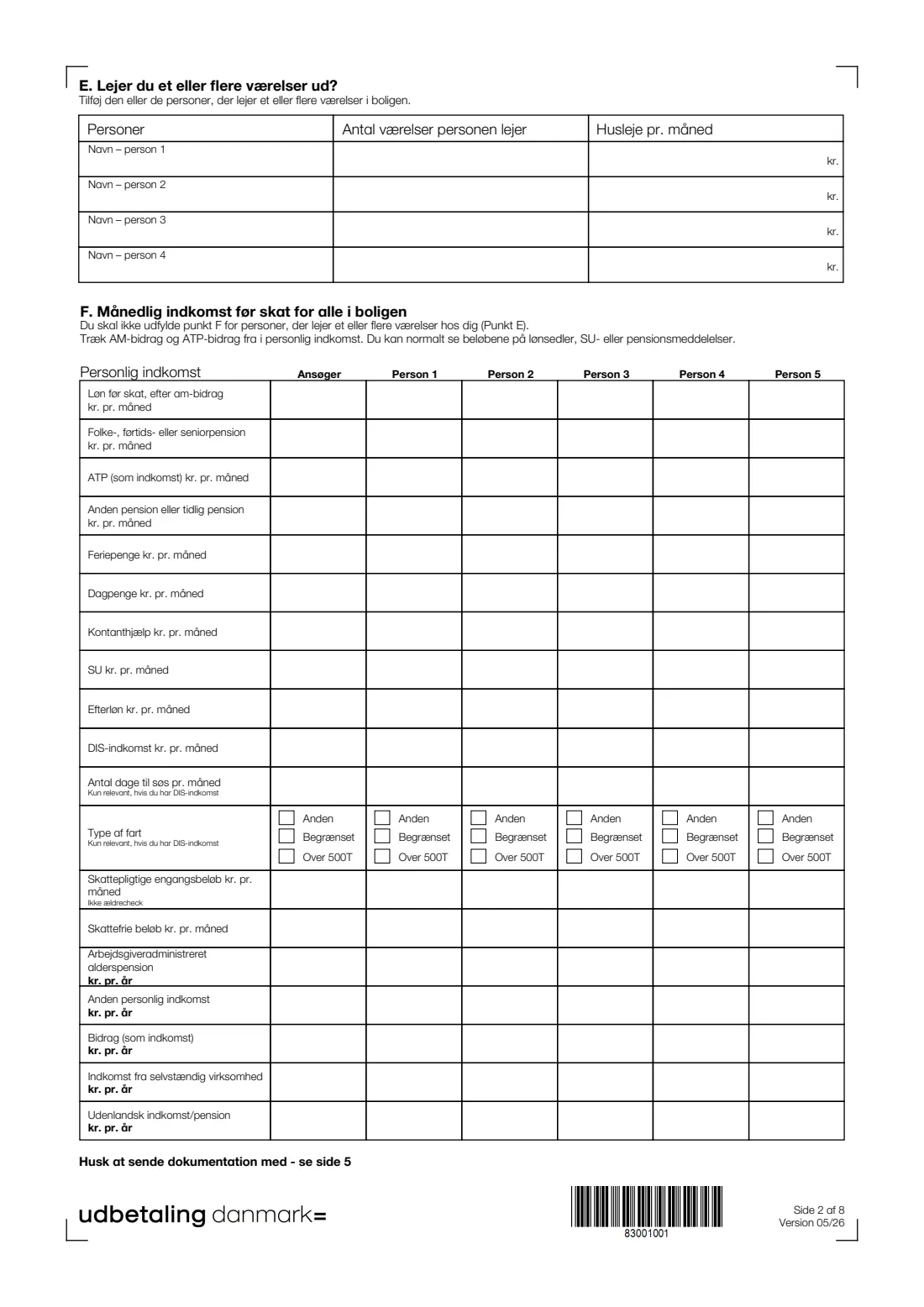
For each person renting one or more rooms from you, give their name, the number of rooms they rent and the rent per month. Lodgers are not included in the income table in F.
6 F. Månedlig indkomst før skat (income for everyone in the home)
A table with one column for the applicant and one for each household member. Monthly rows cover wages after labour market contribution, state, disability or senior pension, ATP, other pensions, holiday pay, unemployment or sickness benefit (dagpenge), cash benefit, SU, early retirement pay, DIS income with days at sea and type of trade, taxable lump sums (not the elderly cheque) and tax-free amounts. Yearly rows cover employer-administered retirement pension, other personal income, maintenance received, self-employment and foreign income or pension.
The form asks you to deduct the labour market (AM) and ATP contributions from personal income. You can usually see the figures on payslips and on SU or pension notices.
7 Fradrag, kapitalindkomst og aktieindkomst (deductions, capital and share income)
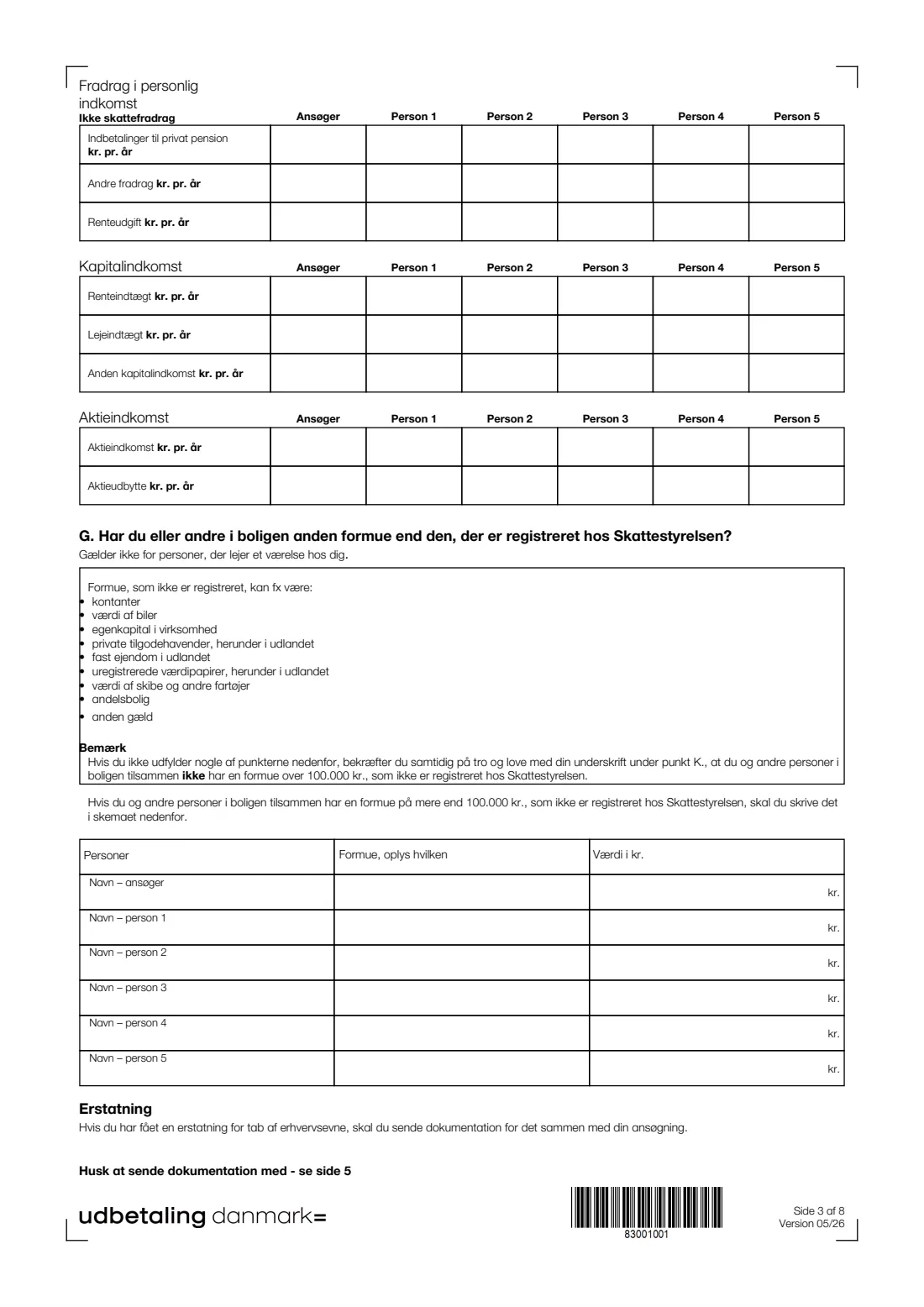
Yearly amounts per person: payments to private pension, other deductions and interest expenses, then interest income, rental income and other capital income, then share income and dividends.
8 G. Formue (wealth not registered with the Danish Tax Agency)
Only if you and the others in the home (not lodgers) together have more than 100,000 kr. that isn't registered with the Danish Tax Agency. Examples on the form include cash, the value of cars, equity in a business, private claims, property or securities abroad, ships and other vessels, a cooperative home and other debt. For each person, state the kind of wealth and its value. If you leave G empty, your signature under K confirms on your honour that the household doesn't have such wealth over 100,000 kr. If you have received compensation for loss of earning capacity, send documentation.
9 H. Værelser til erhverv (rooms used for business)
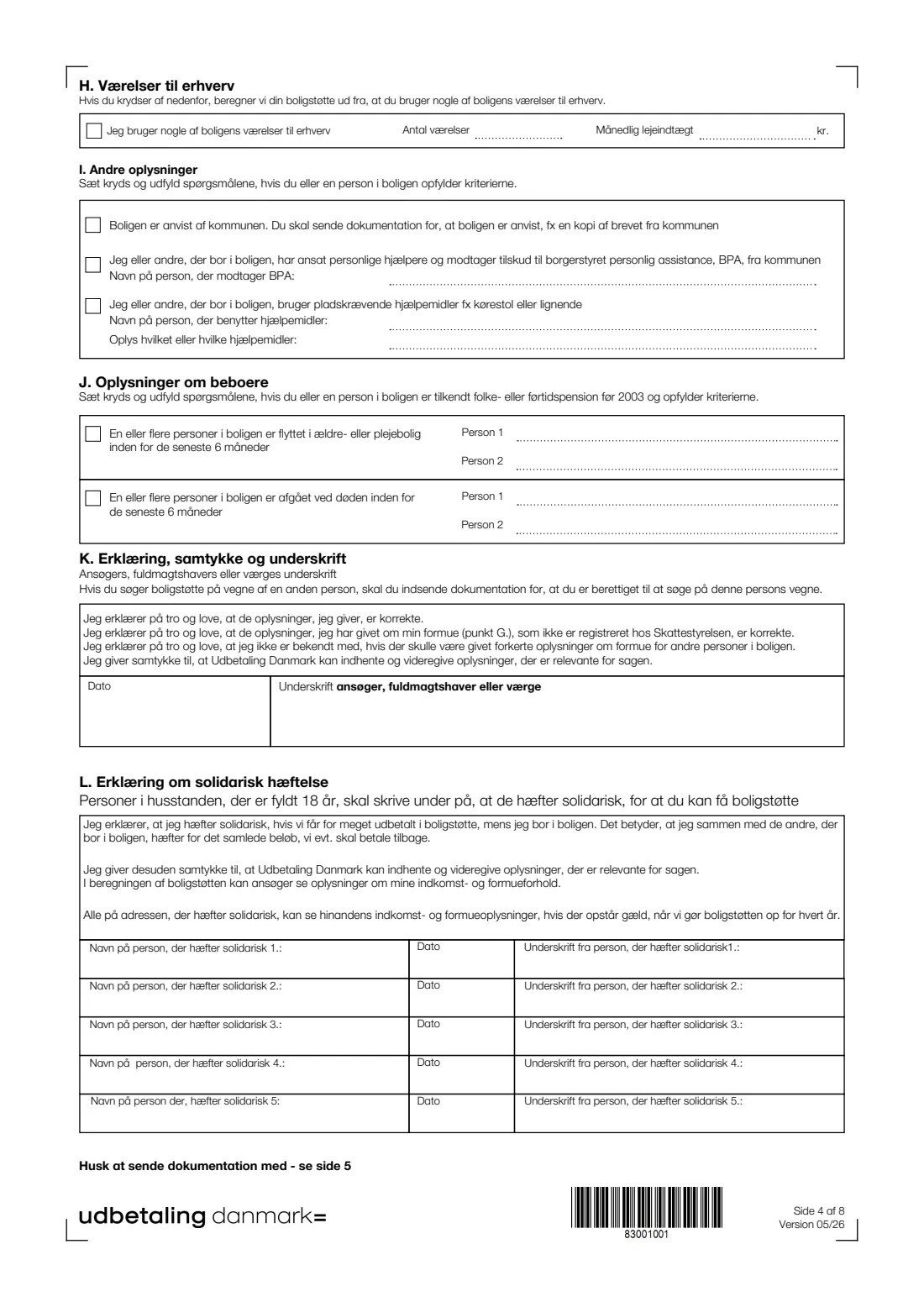
Tick if you use some of the rooms for business, and give the number of rooms and the monthly rental income. Housing benefit is then calculated on that basis.
10 I. Andre oplysninger (other information)
Tick if the local authority assigned the home, and send its letter. Tick if someone in the home employs personal helpers with a local-authority BPA grant, and name them. Tick if someone uses space-demanding aids such as a wheelchair, and name the person and the aids.
11 J. Oplysninger om beboere (about residents)
Only if you or someone in the home was granted state or disability pension before 2003. Tick and name up to two people who moved into senior or nursing housing, or who died, within the last 6 months.
12 K. Erklæring, samtykke og underskrift (declaration and signature)
The applicant, a holder of power of attorney or a guardian declares on their honour that the information, including the wealth information in G, is correct. They also consent to Udbetaling Danmark obtaining and passing on relevant information. Date the form and sign it by hand.
13 L. Erklæring om solidarisk hæftelse (joint and several liability)
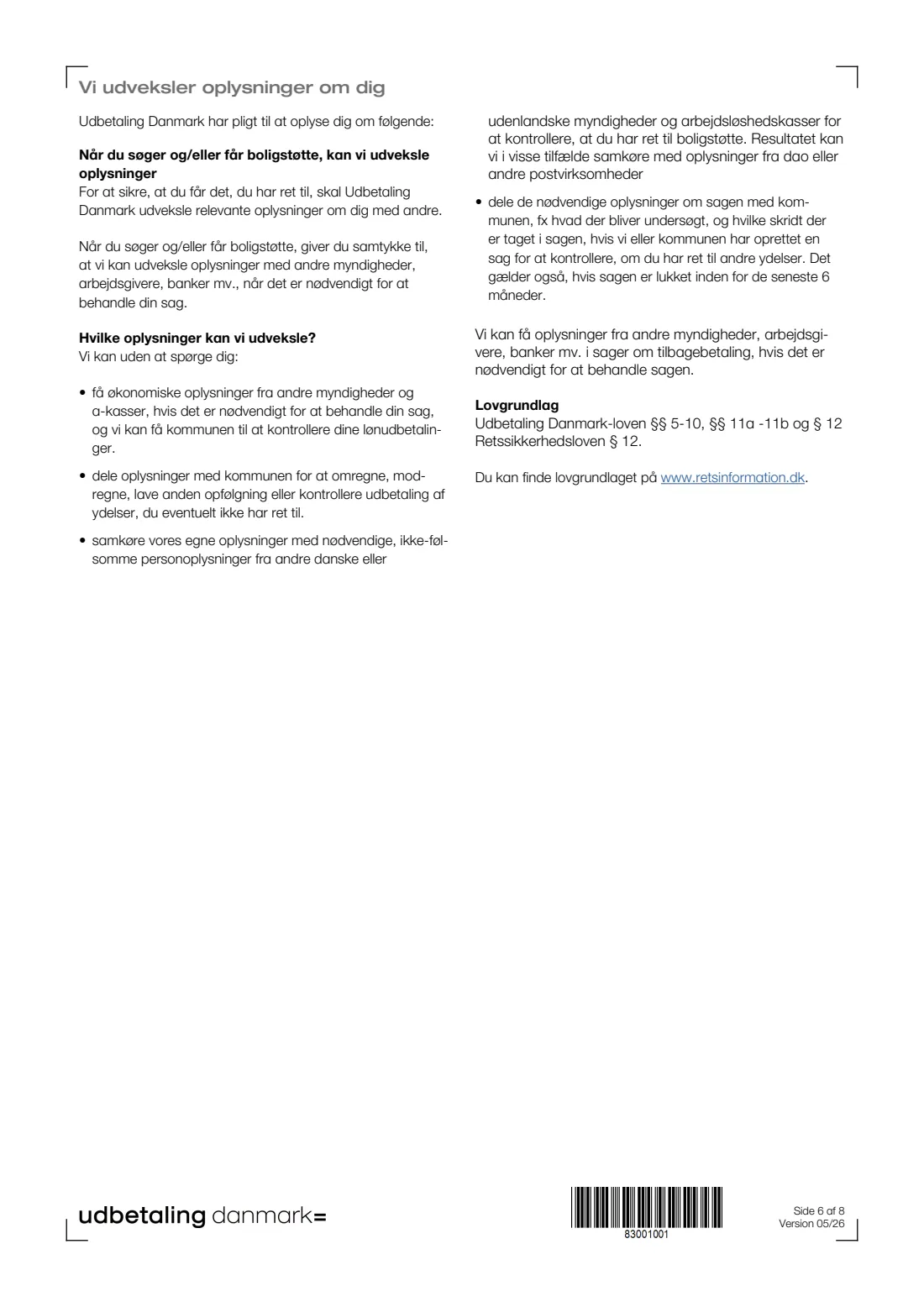
Everyone in the household aged 18 or over writes their name, the date and their signature. They declare that they are jointly liable for any overpaid housing benefit from the period they live in the home, and they consent to information being shared. The applicant can see their income and wealth in the benefit calculation, and everyone who is jointly liable can see each other's figures if a debt arises at the yearly settlement.
Common mistakes to avoid
- Leaving out a household member's income. The table needs a column for everyone living there except lodgers.
- Forgetting the part L signatures. The form says benefit depends on every adult in the household signing.
- Giving pay before the labour market and ATP contributions are deducted. Use the amounts after AM and ATP.
- Mixing up monthly and yearly rows. The top of F is per month, and the lower rows and page 3 are per year.
- Not sending documentation of the rent without utilities, or proof of foreign or self-employed income.
- Waiting too long after moving in. Benefit only reaches back to the moving-in day if Udbetaling Danmark receives the form within 1 month.
- Adding lodgers or children registered at another parent's address as household members in D.
- Applying for an owner-occupied or cooperative home without asking Udbetaling Danmark for the debt statement.
After you fill it out
Print the PDF from your FileIt vault and check every page. Sign and date part K by hand, and have each household member aged 18 or over sign and date their line in part L. Post it with the documents page 5 lists to Udbetaling Danmark - Boligstøtte, Kongens Vænge 8, 3400 Hillerød, the 'Send til' address on the form. If you can use MitID, Udbetaling Danmark prefers the digital application on borger.dk.
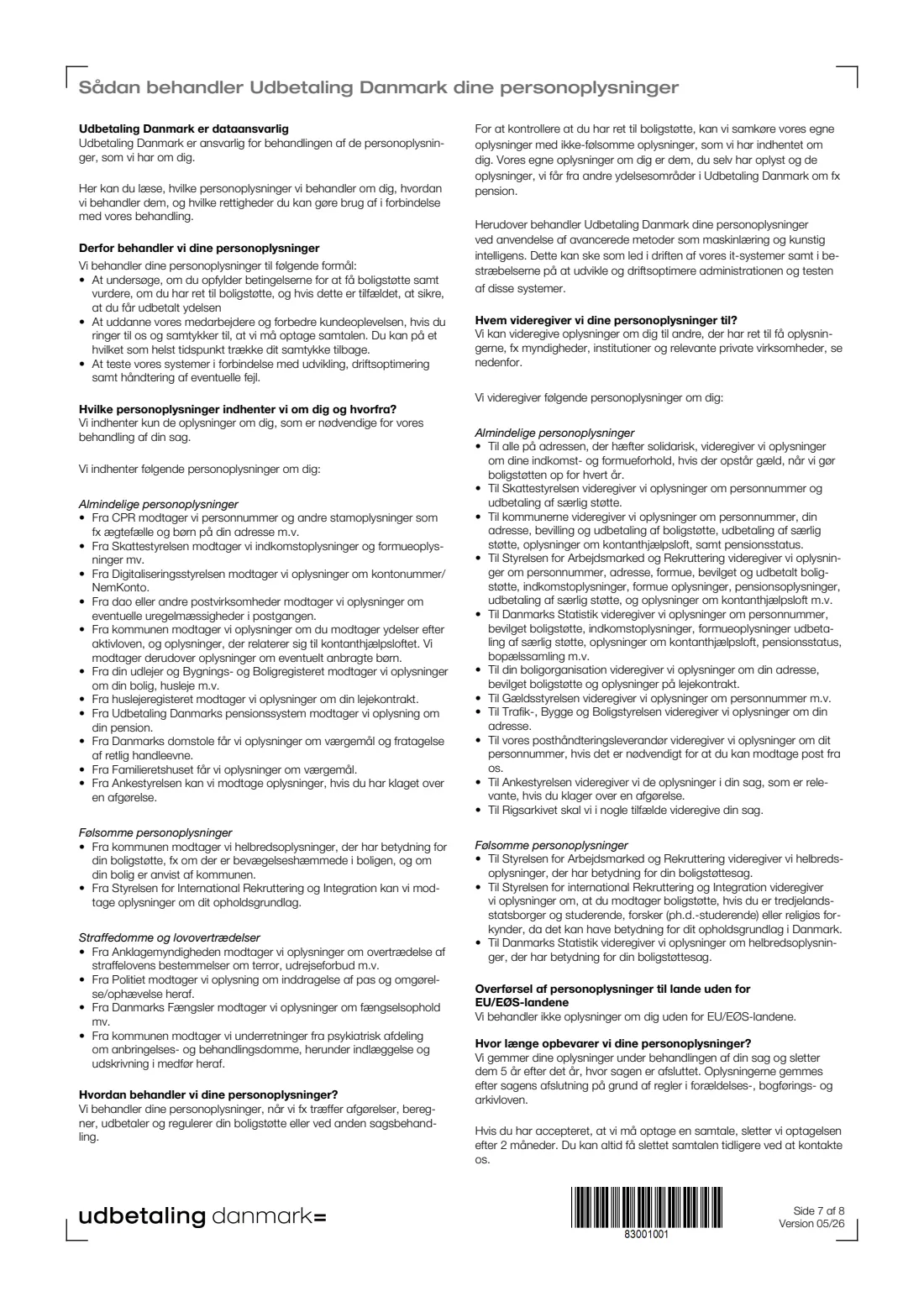
Once the people who are jointly liable have signed and their income and wealth information is in, Udbetaling Danmark calculates what the applicant can get. The calculation it sends shows their income and wealth figures.
Keep the filled form in your FileIt vault next to the lease. When your household, income or rent changes, check borger.dk for when to tell Udbetaling Danmark. Overpaid benefit is collected from the recipient and everyone who is jointly liable.
Fill out UDK 441 — Housing benefit application (boligstøtte) online with FileIt
- Pick the person. Choose someone from People and FileIt fills in their name, date of birth, address and other details it already knows.
- Answer plain-language questions. One part of the form at a time, with the official help text beside each question — 247 fields in all. Your answers save as you go.
- Check the live preview. Watch your answers land on the real Udbetaling Danmark (UDK), Boligstøtte form, and let FileIt do any worksheet arithmetic.
- Generate the official PDF. FileIt prints your answers into the agency’s own PDF and files it in that person’s folder in your vault.
FileIt fills the form — it never files or submits anything for you. Deliver the finished form to whoever asked for it, the way the form’s instructions say.
Start UDK 441 — Housing benefit application (boligstøtte) now — it’s freeUDK 441 — Housing benefit application (boligstøtte): frequently asked questions
What is UDK 441?
It is Udbetaling Danmark's paper application for housing benefit (boligstøtte). It covers the applicant, the home, everyone who lives there with their income and unregistered wealth, lodgers and special circumstances. Every adult in the household signs a liability declaration.
Can I fill in UDK 441 online?
Yes. FileIt lets you fill it in online free, in English with the Danish terms, and prints your answers into the official PDF saved in your vault. You still print it, collect the signatures and post it. Udbetaling Danmark's own digital application is on borger.dk and needs MitID.
Where do I send the boligstøtte form?
The form's 'Send til' address is Udbetaling Danmark - Boligstøtte, Kongens Vænge 8, 3400 Hillerød. Include the documentation it asks for, such as proof of your rent without utilities. FileIt doesn't send it for you.
From when do I get housing benefit?
The form's guidance says you get it from the 1st of the month after Udbetaling Danmark receives your application. You get it from your moving-in day if they receive the application no later than 1 month after you move in. It can only be processed once you have moved in.
Who has to sign part L?
Everyone in the household aged 18 or over, apart from the applicant, who signs part K. By signing, they agree to be jointly liable for overpaid housing benefit from the time they live in the home.
Do I have to report all my savings?
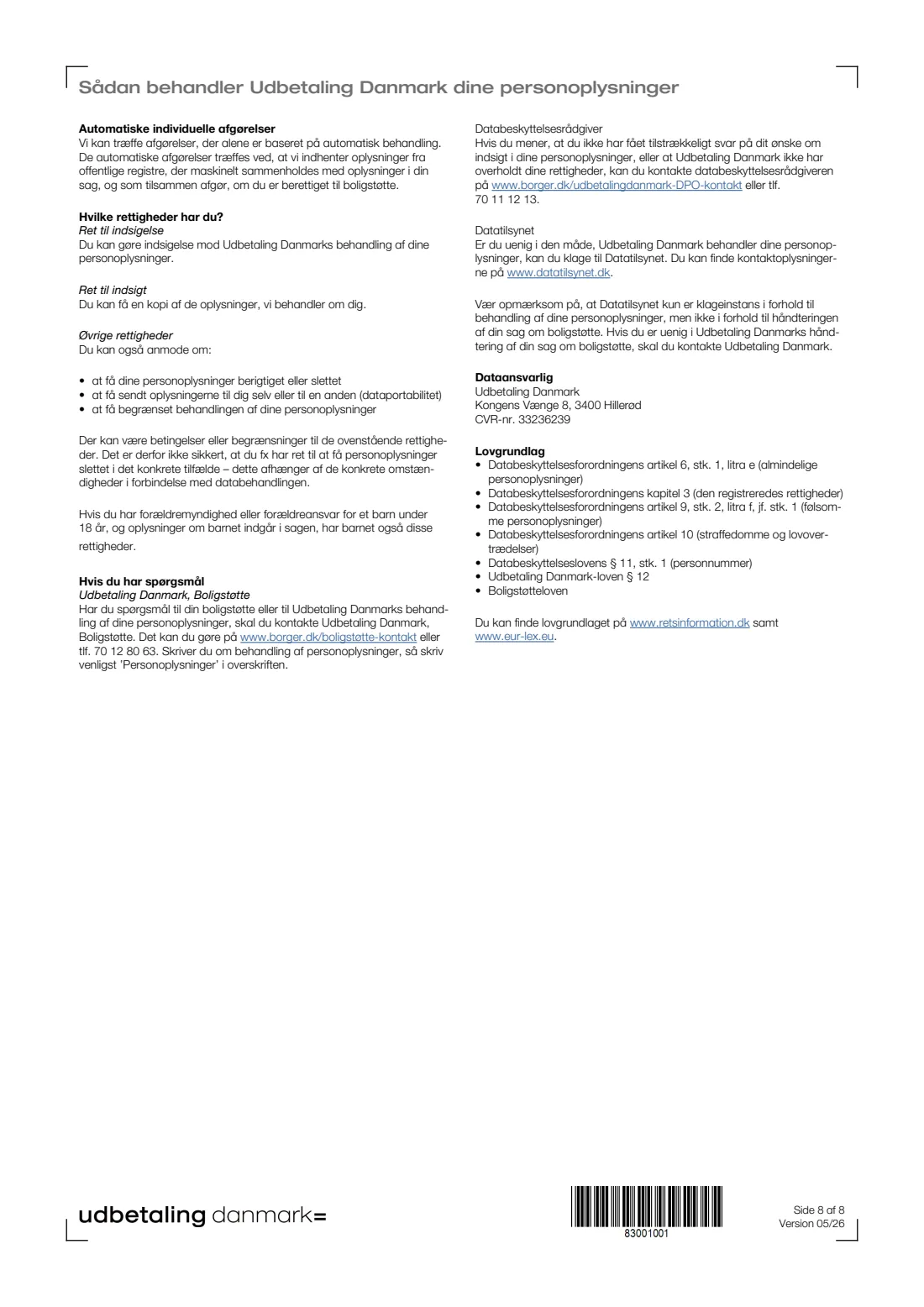
Part G is only for wealth not registered with the Danish Tax Agency, and only if the household together has more than 100,000 kr. of it. If you leave G empty, you confirm on your honour that you don't.
I rent out a room. Does the lodger go on the form?
Yes, in part E, with the number of rooms and the monthly rent. Lodgers aren't listed as household members in D, and their income isn't given in F.
Can I apply for housing benefit for an owner-occupied or cooperative home?
The form covers rented, owner-occupied and cooperative homes. For the last two, you must also fill in a debt statement (gældserklæring), which you get from Udbetaling Danmark.
Official sources
- Blank form (PDF), published by Udbetaling Danmark (UDK), Boligstøtte: https://www.klxml.dk/KLB/Blanket/Gaelder/udk441.pdf
- Official instructions and guidance: https://www.borger.dk/bolig-og-flytning/Boligstoette-oversigt
- Edition shown on this page: UDK 441, Version 05/26 (checked 2026-09-26).
FileIt is not affiliated with or endorsed by Udbetaling Danmark (UDK), Boligstøtte or any government. This page explains the form in general terms and is not legal, tax or immigration advice. Always read the official instructions, and check that you are using the edition the recipient accepts. Page last reviewed 2026-09-26.