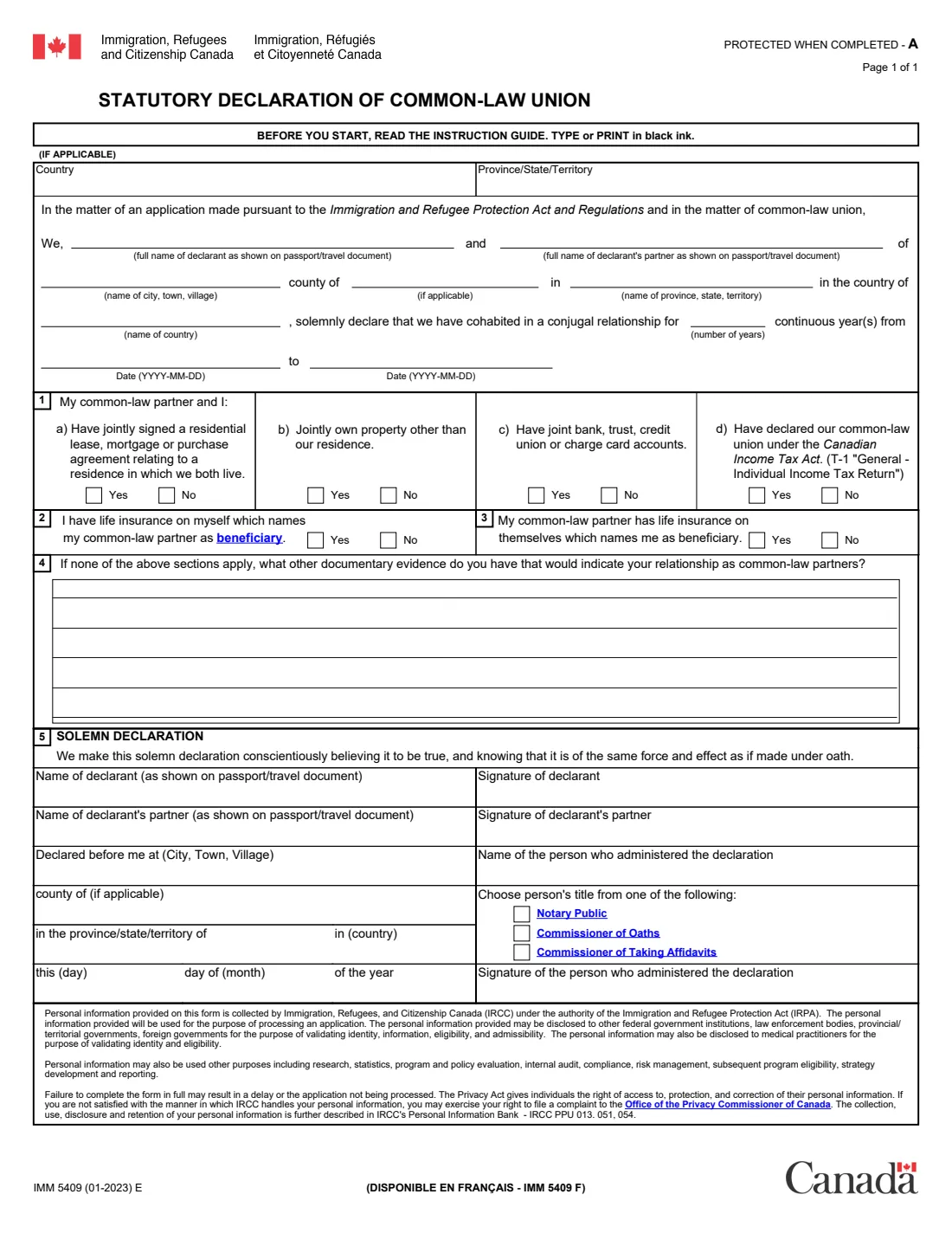
What is IMM 5409?
IMM 5409, Statutory Declaration of Common-law Union, is a one-page form from Immigration, Refugees and Citizenship Canada (IRCC). It is made "in the matter of an application made pursuant to the Immigration and Refugee Protection Act and Regulations": when an IRCC application involves a common-law partner — for example a sponsorship, a permanent residence application or a temporary resident application listing a partner — the instruction guide for that application may ask for this declaration. The current edition is IMM 5409 (01-2023) E; the French version is IMM 5409 F.
In it, both partners solemnly declare how long they have lived together, answer six yes-or-no questions about shared leases, property, accounts, tax filings and life insurance, and, if none of those apply, describe other documentary evidence of the relationship. Both then sign in front of a notary public, commissioner of oaths or commissioner of taking affidavits, who completes the bottom of the form. A statutory declaration has the same force and effect as if made under oath.
FileIt lets you fill in IMM 5409 in plain English and prints your answers onto IRCC's own PDF, with the names repeated where the form needs them and the evidence text laid neatly on the lines. The declarant's name can be pre-filled from your People record in the FileIt vault and the finished PDF is saved there. FileIt never submits anything and can't witness a declaration: you print it unsigned, sign it with your partner before the commissioner or notary, and include it with your application yourself.
- Who fills it
- Both common-law partners together (the declarant and the declarant's partner)
- Given to
- IRCC, as part of the immigration application whose instruction guide asks for it
- When
- When an IRCC application involves a common-law partner
- Signatures
- Both partners sign by hand in front of a notary public or commissioner, who also signs
- Edition
- IMM 5409 (01-2023) E
Who needs to fill out IMM 5409?
- Couples in a common-law relationship where one partner is applying to IRCC and the application's instructions ask for proof of the relationship.
- Sponsors and sponsored partners in a common-law partner sponsorship, where the application's checklist calls for it.
- Principal applicants who list a common-law partner on a permanent or temporary residence application and are asked to show the relationship.
- Partners who have lived together continuously in a conjugal relationship — the usual definition of common-law in Canadian immigration is at least one year.
- Not for married spouses, who normally show the marriage with a marriage certificate instead.
When to use IMM 5409
- When the instruction guide or document checklist for your IRCC application lists IMM 5409.
- After you have lived together continuously for at least a year — the form asks for the number of years and the dates.
- Close to the time you submit, so the 'to' date reflects that you still live together.
- Before you visit the commissioner or notary: fill it in first, but don't sign until you are in front of them.
What you need before you start
- Both partners' full names exactly as shown on their passports or travel documents.
- The city, county (if any), province or state, and country where you live together.
- The date you started living together and the number of continuous years.
- Your answers to the six questions: joint lease, mortgage or purchase agreement; other jointly owned property; joint bank, credit union or charge card accounts; a common-law union declared on your Canadian tax return; and life insurance naming each other as beneficiary.
- If none of those apply, a short description of other documentary evidence, such as bills, correspondence or ID showing the same address.
- Both partners present, with identification, in front of a notary public, commissioner of oaths or commissioner of taking affidavits.
- The supporting documents the application's own checklist asks for.
What’s on IMM 5409
The 2023 edition has 1 page. FileIt asks for it in 3 parts:
- The declarationDeclarants
- Sections 1-4: Evidence of your common-law unionDeclarants
- Section 5: Solemn declaration — declared beforeCommissioner or notary
How to fill out IMM 5409, step by step
1 Jurisdiction and the declaration
The top boxes, marked 'if applicable', name the country and province, state or territory where the declaration is made. Then the opening sentence: "We, (declarant) and (partner), of (city), county of, in (province, state or territory), in the country of (country), solemnly declare that we have cohabited in a conjugal relationship for (number of years) continuous year(s) from (date) to (date)." Use both names exactly as on your passports or travel documents. FileIt checks that the dates cover at least one year and that the number of years doesn't exceed them.
2 Question 1: My common-law partner and I
Four yes-or-no questions: a) have you jointly signed a residential lease, mortgage or purchase agreement for a home you both live in; b) do you jointly own other property; c) do you have joint bank, trust, credit union or charge card accounts; d) have you declared your common-law union under the Canadian Income Tax Act on your T1 return. Answer each honestly, and keep the documents that back up any Yes.
3 Questions 2 and 3: Life insurance
Question 2 asks whether you have life insurance naming your partner as beneficiary; question 3 asks the same the other way round. Again, tick Yes or No.
4 Question 4: Other documentary evidence
If none of the sections above apply, describe what other documents show you live together as common-law partners — for example utility bills or insurance at the same address, identity documents with the same address, or correspondence addressed to both of you. The box has five lines; FileIt wraps your text onto them and warns you if it won't fit.
5 Section 5: Solemn declaration
Both names are printed again under "We make this solemn declaration conscientiously believing it to be true, and knowing that it is of the same force and effect as if made under oath." Each partner signs beside their name — by hand, in front of the official.
The official then completes where the declaration was made (city, county, province or state, country), the date (this day of month of the year), their name, their title — Notary Public, Commissioner of Oaths or Commissioner of Taking Affidavits — and their signature. In FileIt this part is optional: fill it in if you already know the details, or leave it for the official to write by hand.
Common mistakes to avoid
- Signing the declaration before you meet the commissioner or notary — both partners must sign in their presence.
- Writing names that don't match your passports or travel documents.
- Declaring more continuous years than your dates support, or a period of less than one year.
- Answering No to every question and leaving question 4 empty — describe your other evidence.
- Ticking Yes without having the documents to back it up; IRCC may ask for them.
- Using the form when you are married rather than common-law.
After you fill it out
Print the PDF without signing it. Both partners then go to a notary public, commissioner of oaths or commissioner of taking affidavits, bring identification, and sign section 5 in front of them. The official completes the place, date, their name and title, and signs. FileIt adds no electronic signature because the declaration must be witnessed.
Include the signed declaration with your IRCC application exactly as the application's instruction guide and document checklist say, along with the supporting documents they ask for. FileIt doesn't send it to IRCC.
Keep a copy. FileIt saves the filled PDF in your vault; scanning the signed and witnessed version into the same folder gives you a complete record if IRCC asks for it again or you need a new declaration for a later application.
Fill out IMM 5409 online with FileIt
- Pick the person. Choose someone from People and FileIt fills in their name, date of birth, address and other details it already knows.
- Answer plain-language questions. One part of the form at a time, with the official help text beside each question — 31 fields in all. Your answers save as you go.
- Check the live preview. Watch your answers land on the real Immigration, Refugees and Citizenship Canada (IRCC) form, and let FileIt do any worksheet arithmetic.
- Generate the official PDF. FileIt prints your answers into the agency’s own PDF and files it in that person’s folder in your vault.
FileIt fills the form — it never files or submits anything for you. Deliver the finished form to whoever asked for it, the way the form’s instructions say.
Start IMM 5409 now — it’s freeIMM 5409: frequently asked questions
What is IMM 5409 used for?
It is a statutory declaration by two partners that they live together in a common-law relationship. IRCC applications that involve a common-law partner, such as sponsorships or residence applications, may ask for it in their instruction guide or checklist.
Who has to sign IMM 5409?
Both partners sign it, in front of a person authorized to administer oaths — a notary public, commissioner of oaths or commissioner of taking affidavits — who also signs and records where and when the declaration was made.
Can I sign IMM 5409 electronically?
No. It is a solemn declaration witnessed by a commissioner or notary, so both partners sign by hand in their presence. FileIt prepares the filled form for you to print and take to the appointment.
Can I fill out IMM 5409 online?
Yes, with FileIt: answer the questions online and FileIt prints them onto the official IRCC PDF. You then print it, sign it before the official and include it with your application yourself.
Where do I send IMM 5409?
It goes with the IRCC application that asks for it, following that application's instruction guide. It isn't a stand-alone application.
How long do we need to have lived together?
A common-law partner in Canadian immigration is generally someone you have lived with in a conjugal relationship for at least one continuous year. The form asks for the number of years and the start and end dates.
What if none of the questions apply to us?
Answer No and use question 4 to describe other documentary evidence of your relationship, such as bills, letters or ID showing the same address.
Is there a French version?
Yes. The form is also available in French as IMM 5409 F.
Official sources
- Blank form (PDF), published by Immigration, Refugees and Citizenship Canada (IRCC): https://www.canada.ca/content/dam/ircc/documents/pdf/english/kits/forms/imm5409/01-01-2023/imm5409e.pdf
- Official instructions and guidance: https://www.canada.ca/en/immigration-refugees-citizenship/services/application/application-forms-guides/imm5409.html
- Edition shown on this page: IMM 5409 (01-2023) E (checked 2026-09-26).
FileIt is not affiliated with or endorsed by Immigration, Refugees and Citizenship Canada (IRCC) or any government. This page explains the form in general terms and is not legal, tax or immigration advice. Always read the official instructions, and check that you are using the edition the recipient accepts. Page last reviewed 2026-09-26.