What is Travel authorisation for a minor (autorização de viagem internacional)?
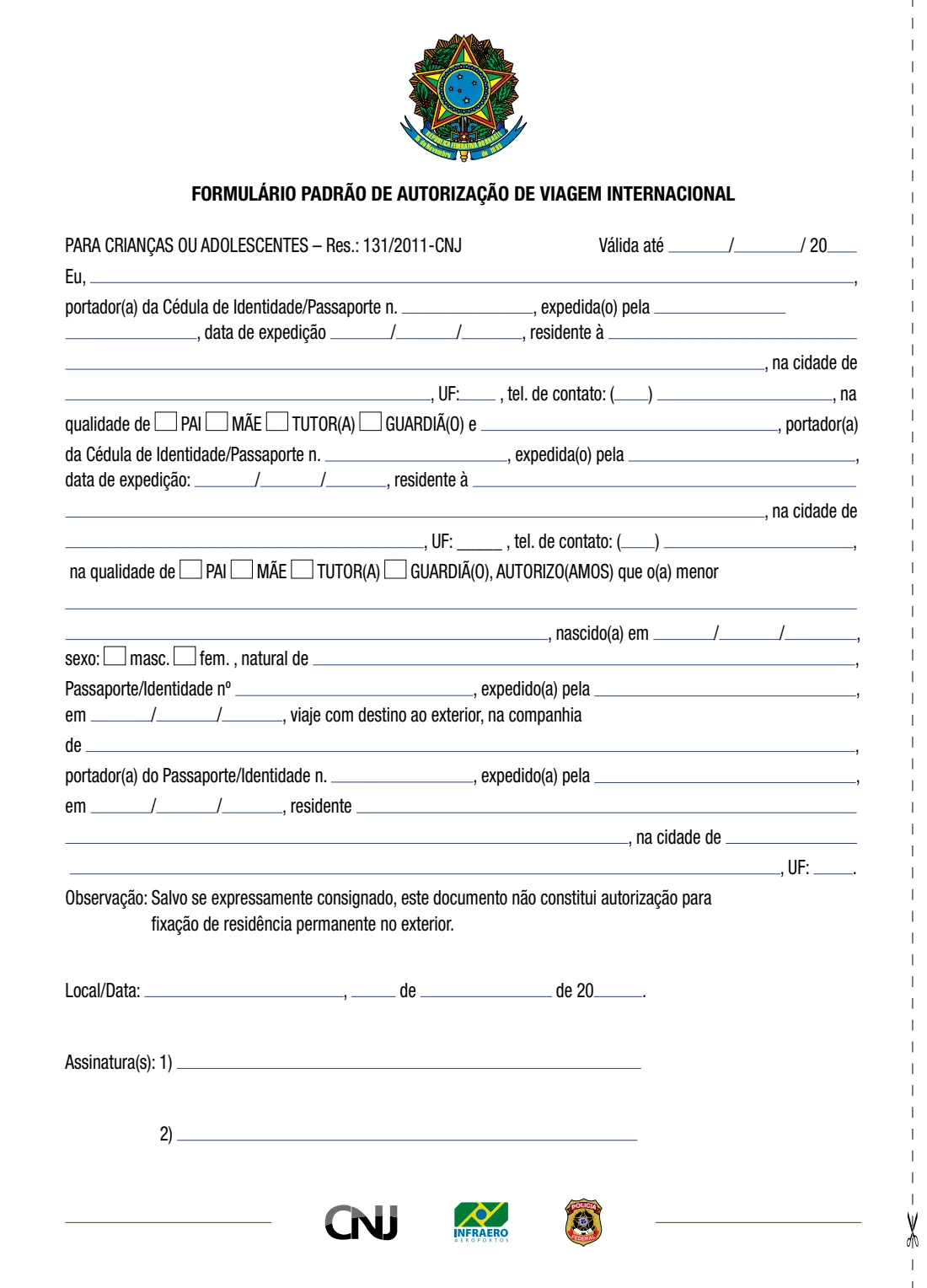
The formulário padrão de autorização de viagem internacional is the standard form published by Brazil's National Council of Justice (Conselho Nacional de Justiça, CNJ) under Resolution 131/2011. Parents or guardians use it to authorise a Brazilian child or adolescent to leave the country when the child is not travelling with both of them — alone, with only one parent, or with another adult such as a grandparent, relative or teacher.
It is a single page: who gives the authorisation and in what capacity, the child's details, the adult the child travels with, how long it is valid, and the place and date. It only works once a notary has recognised the signatures (reconhecimento de firma), and it is checked by the Federal Police and the carrier when the child leaves Brazil.
FileIt asks the questions in plain English, with the Portuguese terms alongside, and prints your answers neatly on the lines of the CNJ's own PDF — dates in the form's day, month and year slots and the month of signing in Portuguese words. The first parent's name can be pre-filled from the People records in your vault, and the finished PDF is saved in the child's or parent's vault folder. You then print it, sign it by hand and take it to a notary. FileIt never sends it anywhere.
- Who fills it
- One or both parents, or the child's guardian
- Given to
- Shown at departure to the Federal Police and the carrier; it is not filed with the CNJ
- When
- Before a trip abroad when the child is not travelling with both parents
- Signatures
- Signed by hand; the signatures must be recognised by a notary — no electronic signature
- Validity
- As written on the form; if no date is given, two years
- Pages
- 1
Who needs to fill out Travel authorisation for a minor (autorização de viagem internacional)?
- Parents of a Brazilian child or adolescent who will travel abroad with only one of them — the parent staying behind authorises the trip.
- Both parents together, when the child travels with a grandparent, aunt, uncle, family friend, teacher or other third party.
- Parents of a child who will travel abroad unaccompanied, for example as an airline's unaccompanied minor.
- A court-appointed guardian (tutor or tutora) or a custodian (guardião or guardiã) acting for the child.
When to use Travel authorisation for a minor (autorização de viagem internacional)
- Before any international trip in which the child will not be travelling with both parents.
- Well before the departure date, so there is time to sign and have the signatures recognised at a notary's office.
- For a series of trips over a period — the form lets you choose how long it is valid; if you leave the date blank, CNJ says it lasts two years.
- Again when the authorisation expires, the companion changes, or the child gets a new passport whose number should appear on it.
What you need before you start
- The identity card (RG) or passport of each person authorising: number, issuing body (for example SSP/SP or DPF) and date of issue.
- Each authoriser's full address, city, state (UF) and a contact phone number with area code (DDD).
- The child's full name, date of birth, sex and place of birth.
- The child's passport or identity document: number, issuing body and date of issue.
- The companion's full name, passport or identity number, issuing body, date of issue and address, if the child travels with someone.
- Identity documents to take to the notary, where the signatures will be recognised.
What’s on Travel authorisation for a minor (autorização de viagem internacional)
The 2026 edition has 1 page. FileIt asks for it in 6 parts:
- Validity (validade)Parent or guardian
- First person authorising (eu)Parent or guardian
- Second person authorising (e)Parent or guardian
- The child or adolescent (o(a) menor)Parent or guardian
- Travelling with (na companhia de)Parent or guardian
- Place and date (local/data)Parent or guardian
How to fill out Travel authorisation for a minor (autorização de viagem internacional), step by step
1 Válida até (valid until)
The last day the authorisation can be used, written in the box at the top right of the form. The form prints only the last two digits of the year after a printed 20.
The CNJ's rules say the document must state its validity; if the date is left out, the authorisation is valid for two years. FileIt checks that the date you choose is after the signing date.
2 Eu (first person authorising)
The first parent or guardian: full name, the number of the identity card or passport they will show the notary, who issued it and when, their address across two lines, city, state and contact phone.
Then tick the capacity in which they sign: father (PAI), mother (MÃE), guardian (TUTOR(A)) or custodian (GUARDIÃ(O)).
3 e (second person authorising)
The same details for the second parent or guardian, when both authorise together — for example because the child will travel with a third person or alone. If only one parent is authorising (usually the one who is not travelling), this part is left blank.
FileIt makes this an optional part and checks that the two people aren't both signing as father or both as mother.
4 AUTORIZO(AMOS) que o(a) menor (the child)
The child's full name, date of birth, sex (masculino or feminino), place of birth (natural de), and the number, issuing body and issue date of the passport or identity document the child will travel with.
Use the details exactly as they appear on the child's travel document. FileIt checks that the child is under 18.
5 na companhia de (the companion)
The adult the child will travel with: full name, passport or identity number, issuing body, date of issue, address, city and state. When one parent authorises the other to travel with the child, the travelling parent goes here.
If the child will travel unaccompanied, this part is left out — ask the notary how they want the companion lines completed.
6 Observação (note)
The form states that, unless expressly stated, the document does not authorise the child to settle permanently abroad. It covers travel, not a move.
7 Local/Data and Assinatura(s)
The city where the form is signed and the date, which FileIt prints with the month in Portuguese words as the form expects. Each person authorising signs by hand on line 1) or 2), and the signatures are then recognised by a notary — either by authenticity (signing in front of the notary) or by likeness to a signature already on file at that notary's office.
Common mistakes to avoid
- Forgetting to have the signatures recognised by a notary — an unrecognised signature won't be accepted at departure.
- Using document numbers or issue dates that don't match the documents that will actually be shown.
- Writing a validity date that ends before the return trip, or before the date of signing.
- Ticking the wrong capacity, or both authorisers ticking the same box as father or mother.
- Filling in only one parent when both must authorise because the child travels with a third party.
- Carrying only one copy when the airline or authorities may want to keep one — check with the carrier.
After you fill it out
Print the completed page and have each person authorising sign it by hand on their line. Then take it to a notary's office (cartório de notas) to have the signatures recognised, bringing identity documents. Because of this notarial step, the form can't be signed electronically in FileIt.
The child or the companion carries the original on the trip, together with the child's passport, and shows it to the Federal Police and the carrier at departure. It is not sent to the CNJ or filed with a court. If parents disagree or one cannot be found, a court authorisation may be needed instead — that is outside this form.
FileIt keeps the filled PDF in your vault. Store a scan of the notarised copy alongside it and the child's passport, with the validity date, so you know when a new authorisation is needed.
Fill out Travel authorisation for a minor (autorização de viagem internacional) online with FileIt
- Pick the person. Choose someone from People and FileIt fills in their name, date of birth, address and other details it already knows.
- Answer plain-language questions. One part of the form at a time, with the official help text beside each question — 41 fields in all. Your answers save as you go.
- Check the live preview. Watch your answers land on the real Conselho Nacional de Justiça (CNJ) form, and let FileIt do any worksheet arithmetic.
- Generate the official PDF. FileIt prints your answers into the agency’s own PDF and files it in that person’s folder in your vault.
FileIt fills the form — it never files or submits anything for you. Deliver the finished form to whoever asked for it, the way the form’s instructions say.
Start Travel authorisation for a minor (autorização de viagem internacional) now — it’s freeTravel authorisation for a minor (autorização de viagem internacional): frequently asked questions
When does a child need a travel authorisation to leave Brazil?
When a Brazilian child or adolescent travels abroad alone, with only one parent, or with someone else. If the child travels with both parents, this authorisation isn't needed.
Can I fill out the autorização de viagem online?
Yes. FileIt lets you answer the questions online and prints them into the CNJ's official PDF, saved in your vault. You still print it, sign by hand and have the signatures recognised by a notary. Notaries also issue an electronic authorisation (AEV) through e-Notariado, which is a separate service.
Does the travel authorisation have to be notarised?
Yes — the signatures of the people authorising must be recognised by a notary. CNJ's Resolution 131 allows recognition by authenticity or by likeness to a signature already registered at the notary's office.
How long is the authorisation valid?
For the period written in 'Válida até'. According to the CNJ, if no validity is stated, the authorisation is valid for two years.
Where do I hand in the form?
Nowhere in advance. The original goes with the child on the trip and is shown to the Federal Police and the airline or other carrier at departure. FileIt does not send it anywhere.
Do both parents need to sign?
If the child travels with one parent, the other parent signs. If the child travels alone or with a third party, both parents normally sign together, which is why the form has room for two people.
Does the child need a photo on the authorisation?
No. CNJ's Resolution 131 dropped the requirement to include the child's photograph.
Official sources
- Blank form (PDF), published by Conselho Nacional de Justiça (CNJ): https://www.cnj.jus.br/wp-content/uploads/2024/04/formulario-padrao-de-autorizacao-de-viagem-internacional-2024-04-05.pdf
- Official instructions and guidance: https://www.cnj.jus.br/cnj-altera-regras-para-autorizacao-de-viagem-de-criancas-ao-exterior/
- Edition shown on this page: Res. 131/2011-CNJ standard form (no edition date printed; file dated 5 April 2024) (checked 2026-09-26).
FileIt is not affiliated with or endorsed by Conselho Nacional de Justiça (CNJ) or any government. This page explains the form in general terms and is not legal, tax or immigration advice. Always read the official instructions, and check that you are using the edition the recipient accepts. Page last reviewed 2026-09-26.