What is the pHQ-9 and GAD-7 screening form template?
The PHQ-9 and GAD-7 are short questionnaires many clinicians use to ask about mood and anxiety. Each item asks how often something has bothered the patient over the last two weeks, rated from "Not at all" to "Nearly every day". They're quick to answer, and asking them the same way each time makes it easier to see change between visits.
This template sets out both questionnaires with their standard wording. Each set of items is a grid, and the column values run from 0 to 3, so the PDF shows the clinician exactly what was chosen. Item 9 of the PHQ-9 is a separate question. Any answer above "Not at all" brings up a notice with crisis resources and a request not to wait for the appointment. A note at the very top says the form isn't monitored in real time.
FileIt doesn't calculate totals or interpret results. The answers are filed as a PDF in your vault, ready for the clinician to score and talk through with the patient.
- Best for
- GP and primary care practices, therapists, counsellors and student health services
- Filled in by
- The patient, before or between appointments
- Time to complete
- About 5 minutes
- Includes
- All 9 PHQ-9 and 7 GAD-7 items rated 0–3, the difficulty question, a crisis notice for item 9
Who uses a pHQ-9 and GAD-7 screening form?
- Sent with the appointment confirmation so answers are ready before a first consultation
- Repeated before each review so the clinician can compare answers over time
- Completed on a tablet in the waiting room instead of a paper copy
- Used by a counselling service at intake and at the end of a course of sessions
- Sent by a student health centre ahead of a wellbeing appointment
Questions on this pHQ-9 and GAD-7 screening form
13 questions over 3 pages · includes conditional questions, multiple pages, ratings.
1 About you
- Your name*
- Date of birth*
- Today's date*
- Clinician or practice
- Why are you completing this today? Before a first appointment · Regular review · My clinician asked me to · Something else
2 PHQ-9
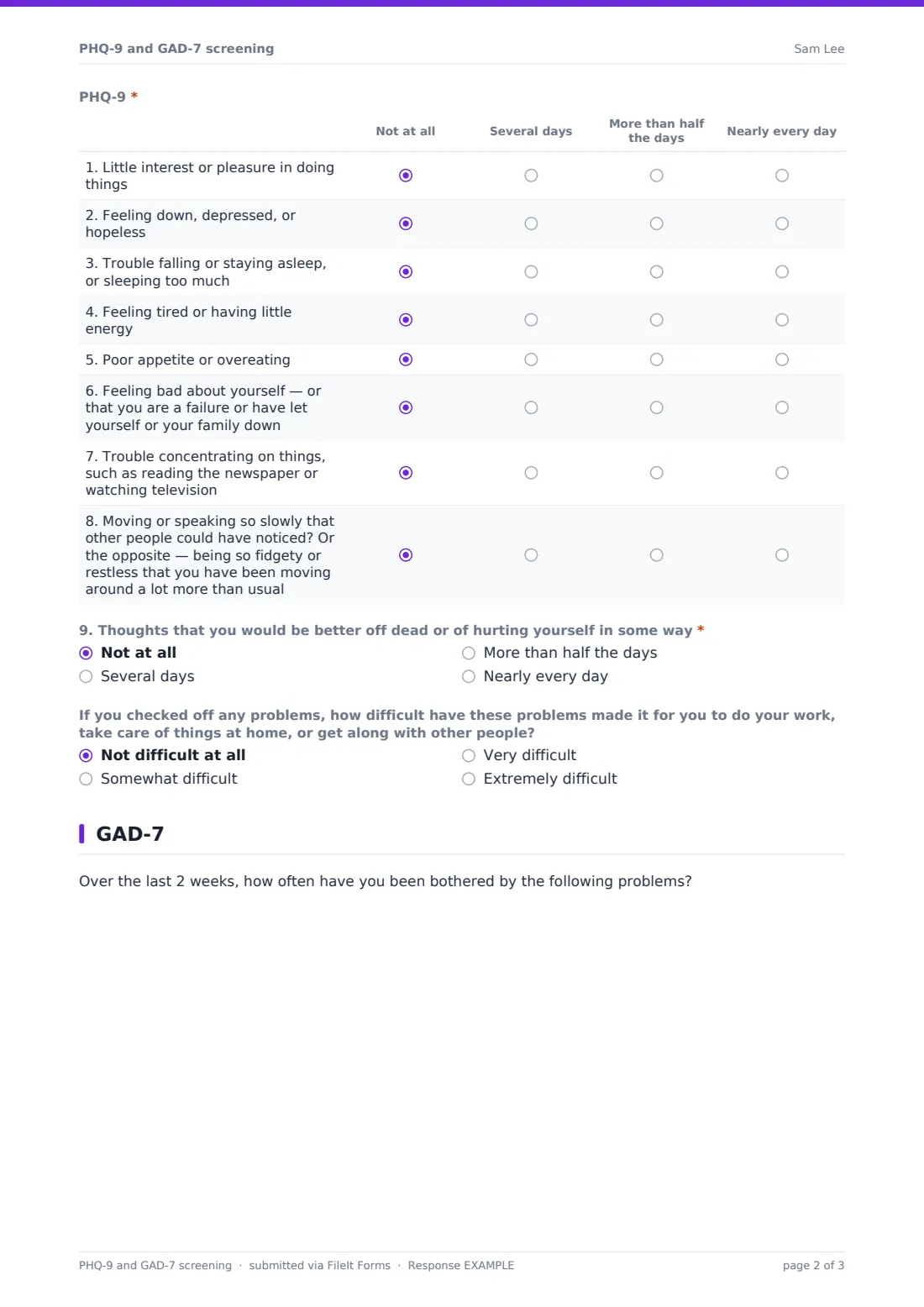
- PHQ-9* Not at all · Several days · More than half the days · Nearly every day
- 9. Thoughts that you would be better off dead or of hurting yourself in some way* Not at all · Several days · More than half the days · Nearly every day
- If you checked off any problems, how difficult have these problems made it for you to do your work, take care of things at home, or get along with other people? Not difficult at all · Somewhat difficult · Very difficult · Extremely difficult
3 GAD-7
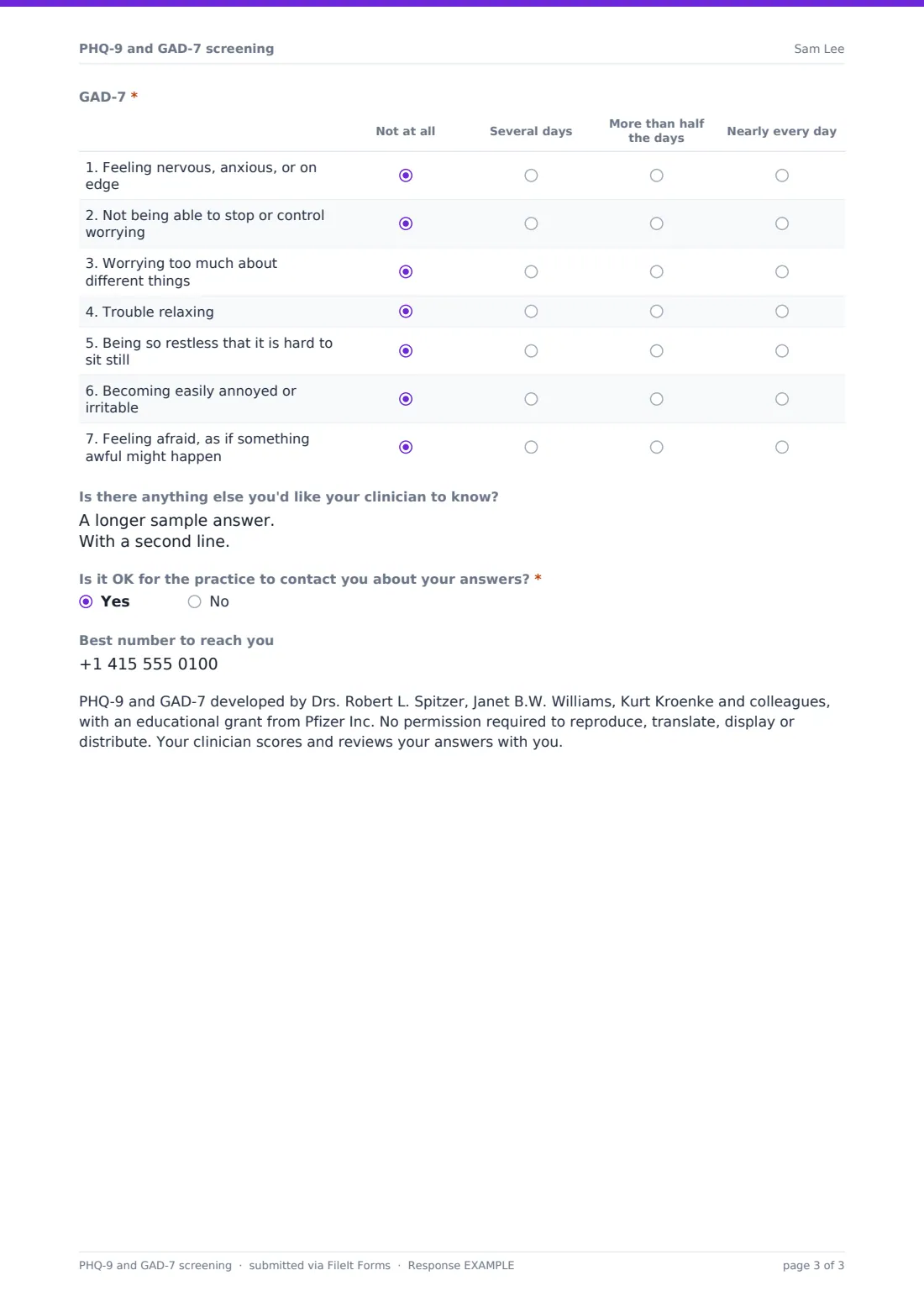
- GAD-7* Not at all · Several days · More than half the days · Nearly every day
- Is there anything else you'd like your clinician to know?
- Is it OK for the practice to contact you about your answers?*
- Best number to reach you asked only when it applies
The pHQ-9 and GAD-7 screening form, page by page
1 About you
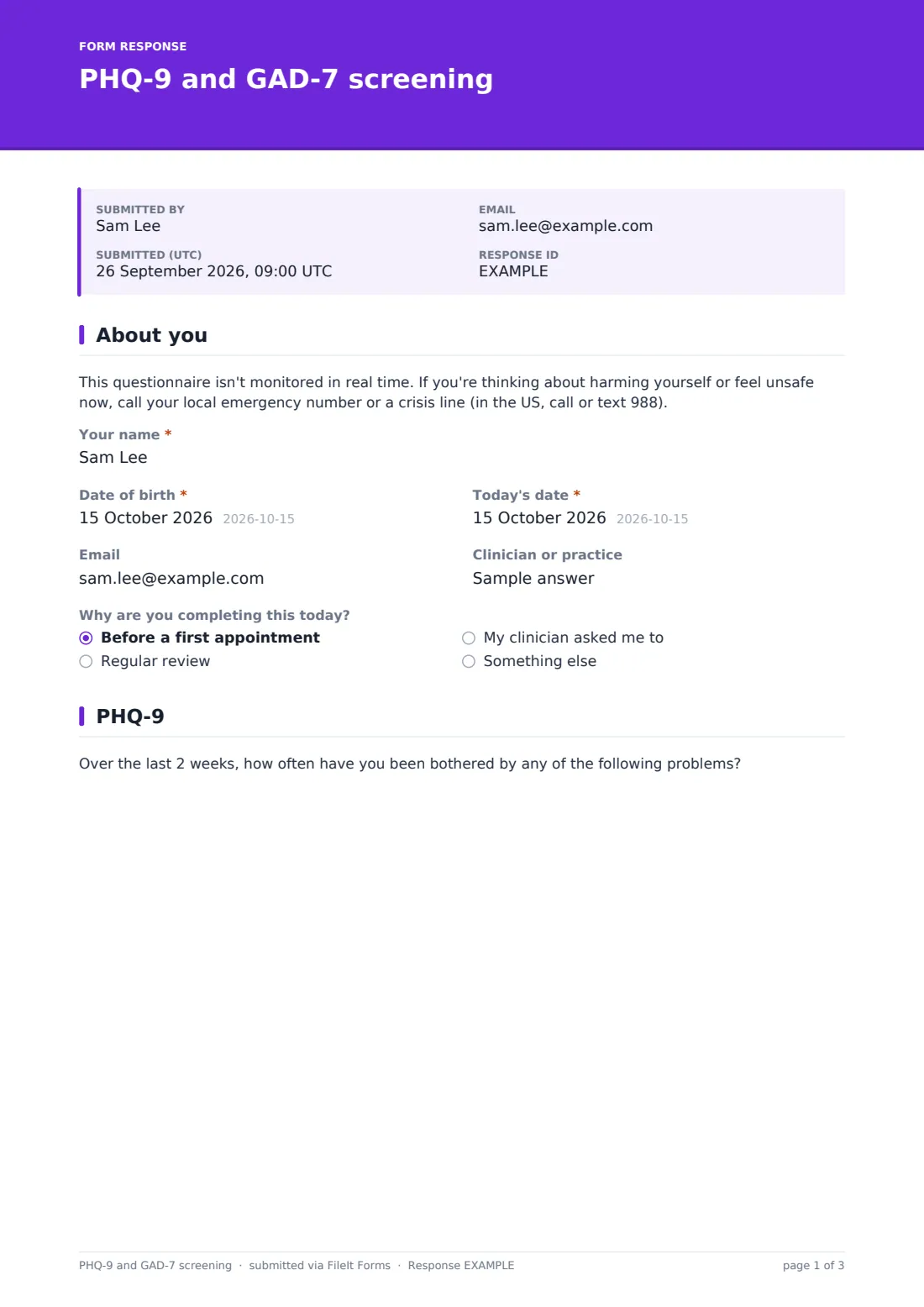
A notice at the top explains the form isn't watched in real time and gives the US 988 line alongside the local emergency number. "Your name", "Date of birth" and "Today's date" are required. Email, "Clinician or practice" and "Why are you completing this today?" are optional.
2 PHQ-9
The standard instruction, "Over the last 2 weeks, how often have you been bothered by any of the following problems?", sits above a grid of items 1 to 8, from "1. Little interest or pleasure in doing things" to the item on moving slowly or being restless. Each is answered "Not at all", "Several days", "More than half the days" or "Nearly every day". Item 9 is its own required question. Any answer from "Several days" upwards shows the crisis-resources notice straight away. The page ends with the standard question about how difficult these problems have made work, home or getting along with others.
3 GAD-7
The seven anxiety items follow in the same grid format, from "1. Feeling nervous, anxious, or on edge" to "7. Feeling afraid, as if something awful might happen". An optional box asks if there's anything else the clinician should know. A required yes/no asks whether the practice may get in touch, and a yes asks for the best number. The page closes with the standard acknowledgement of the questionnaires' authors.
Make the template yours
- Replace the crisis notice with your service's own out-of-hours and crisis numbers
- Add the practice's email to notifications so a clinician sees each response promptly
- Send it as an emailed request so each response is linked to the right patient
- Remove the GAD-7 page if you only use the PHQ-9, or the other way round
- Turn off the emailed copy if patients would rather not receive their answers by email
- File responses in each patient's folder in your vault
Tips for a better pHQ-9 and GAD-7 screening form
- Keep the item wording as it is. Changing it means the answers no longer match the standard questionnaires
- Agree in advance who reviews responses and how quickly, especially when item 9 is above zero
- Tell patients the form isn't watched in real time, and give them the crisis line anyway
- Ask patients to answer about the last two weeks, not just today
- Go through the answers with the patient rather than relying on the numbers alone
Every response becomes a PDF in your vault
Each response becomes a PDF titled with the patient's name and the date, filed in the vault folder you choose. The practice is emailed when a response arrives, and you can add up to ten notification addresses, such as a duty clinician's inbox.
The PDF lists every item with the answer chosen, ready for the clinician to score and discuss. Repeat responses from the same patient stay in the Responses table in date order.
- Start from this template. It opens in the FileIt Forms designer — change any question, add pages, set the rules for when questions appear.
- Share it. Turn on a public link, or send it to people by email, each with their own link. They don’t need a FileIt account.
- Get the answers as PDFs. Each response is saved as a PDF in the vault folder you choose, with uploaded files attached — and listed in a Responses table you can export to CSV.
PHQ-9 and GAD-7 screening form: frequently asked questions
Does FileIt score the PHQ-9 or GAD-7?
No. The form records each answer, and the clinician scores and interprets them. FileIt doesn't give medical advice or diagnoses.
What happens if a patient answers item 9 above zero?
A notice with crisis resources appears on the form immediately. The response is also emailed to the form owner like any other, so agree how your team will follow these up.
Can we use the PHQ-9 and GAD-7 without permission?
The questionnaires' authors state that no permission is required to reproduce, translate, display or distribute them, and the form includes that acknowledgement.
Do patients need a FileIt account?
No. They fill it in from a link or an emailed request on any device.
Is this template free?
Yes. It's one of the starter templates in FileIt Forms, available on every plan.