
What is the newcomer welcome intake form template?
When a family arrives in a new country, they need help with many things at once: a doctor, school places, a bank account, work, English classes and simply meeting people. Settlement programmes and sponsor groups can help best when they understand the whole household from the start, without making the family repeat their story to every volunteer.
This intake asks over three pages about the household — country of origin, arrival date, an optional immigration situation, adults, children and any health needs — then languages, English level and interpreter needs, and finally housing, school, work, skills and the support that would help most right now. Help text tells families they can skip anything they don't want to answer.
Each intake is saved as a PDF in your FileIt vault, so your caseworkers and volunteers share one record of what the family has asked for.
- Best for
- Refugee resettlement agencies, community sponsors, welcome centres and faith-based settlement programmes
- Filled in by
- The family, or a caseworker or volunteer with them
- Time to complete
- About 10 minutes, longer with an interpreter
- Includes
- Household and children, optional immigration status, language and interpreter needs, housing and school questions, skills and a support checklist
Who uses a newcomer welcome intake form?
- A community sponsorship group welcoming a resettled family
- A welcome centre registering new arrivals at a drop-in
- A church or mosque supporting newcomers in its neighbourhood
- A settlement agency's first appointment with a family
- A school or library hosting a newcomer support programme
Questions on this newcomer welcome intake form
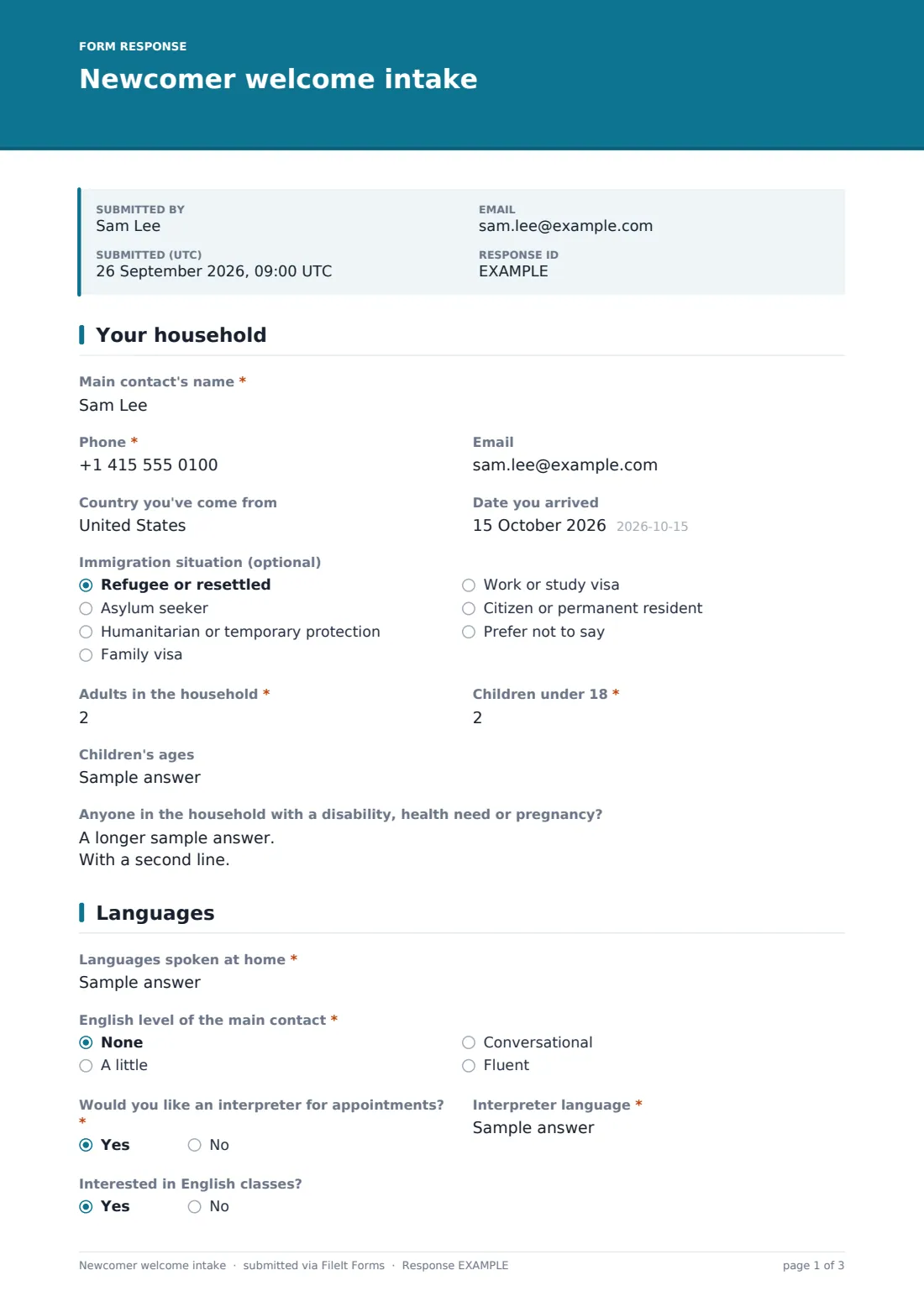
26 questions over 3 pages · includes conditional questions, multiple pages, consent checkbox.
1 Your household
- Main contact's name*
- Phone*
- Country you've come from
- Date you arrived
- Immigration situation (optional) Refugee or resettled · Asylum seeker · Humanitarian or temporary protection · Family visa · Work or study visa · Citizen or permanent resident · Prefer not to say
- Adults in the household*
- Children under 18*
- Children's ages asked only when it applies
- Anyone in the household with a disability, health need or pregnancy?
2 Languages
- Languages spoken at home*
- English level of the main contact* None · A little · Conversational · Fluent
- Would you like an interpreter for appointments?*
- Interpreter language* asked only when it applies
- Interested in English classes?
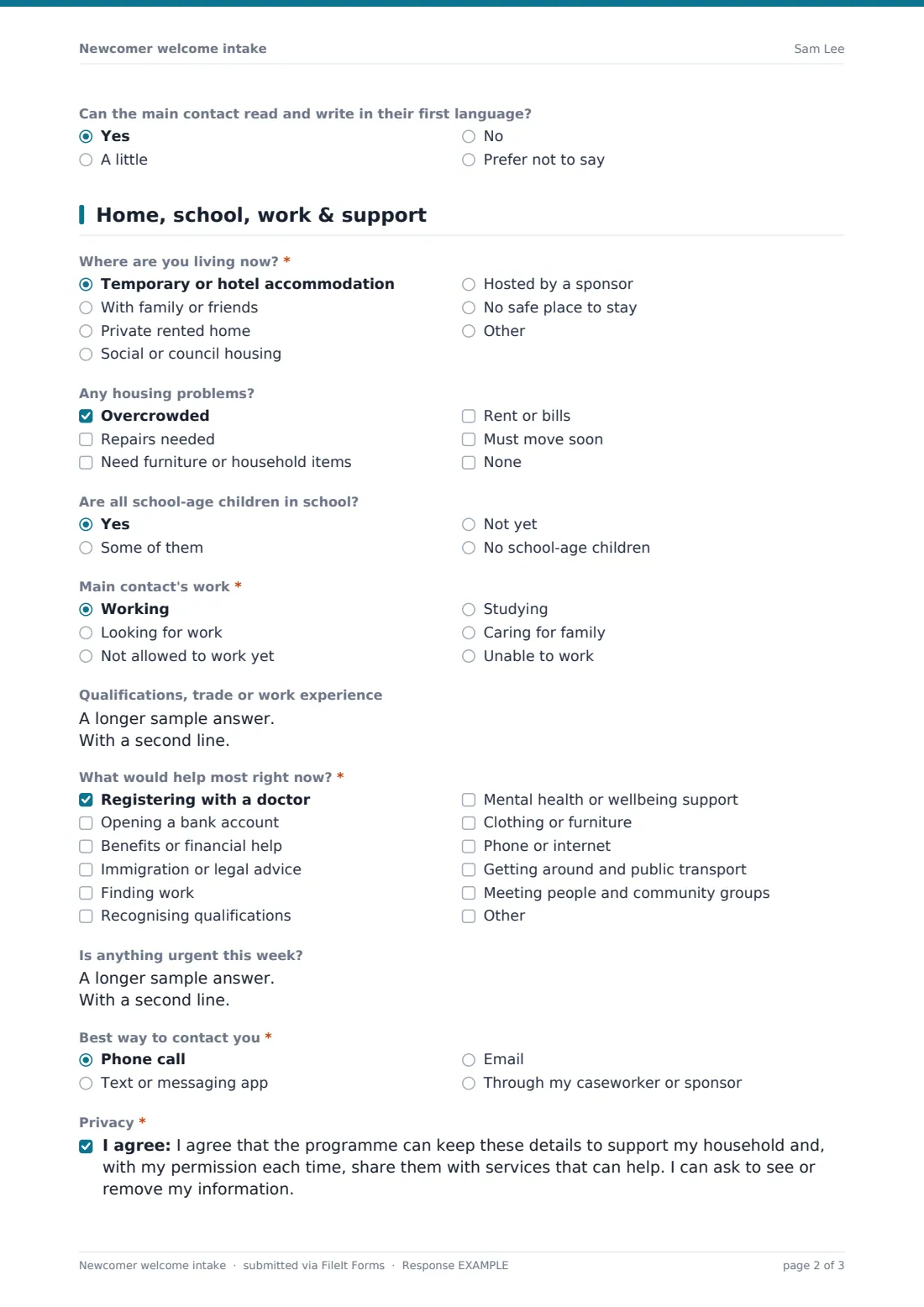
- Can the main contact read and write in their first language? Yes · A little · No · Prefer not to say
3 Home, school, work & support
- Where are you living now?* Temporary or hotel accommodation · With family or friends · Private rented home · Social or council housing · Hosted by a sponsor · No safe place to stay
- Any housing problems? Overcrowded · Repairs needed · Need furniture or household items · Rent or bills · Must move soon · None
- Are all school-age children in school? asked only when it applies Yes · Some of them · Not yet · No school-age children
- Would you like help applying for school places? asked only when it applies
- Main contact's work* Working · Looking for work · Not allowed to work yet · Studying · Caring for family · Unable to work
- Qualifications, trade or work experience
- What would help most right now?* Registering with a doctor · Opening a bank account · Benefits or financial help · Immigration or legal advice · Finding work · Recognising qualifications · Mental health or wellbeing support · Clothing or furniture · Phone or internet · Getting around and public transport · Meeting people and community groups
- Is anything urgent this week?
- Best way to contact you* Phone call · Text or messaging app · Email · Through my caseworker or sponsor
- Privacy*
The newcomer welcome intake form, page by page
1 Your household
The main contact gives their name, phone and email, the country they've come from and the date they arrived. "Immigration situation (optional)" covers refugees, asylum seekers, humanitarian protection, family and work or study visas, residents, or prefer not to say. The number of adults and children follows — any children ask for their ages — and a box asks about disabilities, health needs or pregnancy.
2 Languages
Families list the languages spoken at home and the main contact's English level. "Would you like an interpreter for appointments?" asks which language on a yes. Questions about English classes and reading and writing in their first language help plan support.
3 Home, school, work & support
The family says where they're living now — from temporary accommodation to hosted by a sponsor or no safe place to stay — and ticks any housing problems. When there are children, the form asks whether all school-age children are in school, offering help with school places if not.
The main contact describes their work situation, qualifications and experience. "What would help most right now?" lists priorities from registering with a doctor and opening a bank account to finding work, wellbeing support and meeting people. An urgent-this-week box, the best way to make contact and a privacy statement finish the form.
Make the template yours
- Make copies of the form in the languages your families speak most
- Replace the immigration options with the categories used in your country
- Edit the support checklist to match the services your programme offers
- Add a sponsor or caseworker name field if families are referred
- File each family's intake into its own folder in your vault
- Send a follow-up form after a few months to see what has changed
Tips for a better newcomer welcome intake form
- Fill in the form with the family and an interpreter, rather than sending a link on day one
- Keep the immigration question optional — it isn't needed to offer welcome
- Start with the urgent-this-week answer when you plan the first visit
- Ask about skills early; recognising qualifications can take a long time
- Check consent each time before passing details to another service
Every response becomes a PDF in your vault
When the intake is submitted, FileIt files it as a PDF in your vault and emails your welcome team. The family can receive a copy of their answers.
The Responses table shows every household's support priorities. Filter by need — for example everyone who wants English classes — and export to a CSV to plan sessions.
- Start from this template. It opens in the FileIt Forms designer — change any question, add pages, set the rules for when questions appear.
- Share it. Turn on a public link, or send it to people by email, each with their own link. They don’t need a FileIt account.
- Get the answers as PDFs. Each response is saved as a PDF in the vault folder you choose, with uploaded files attached — and listed in a Responses table you can export to CSV.
Newcomer welcome intake form: frequently asked questions
Is the newcomer welcome intake template free?
Yes. It's included with FileIt Forms on every plan, and every question can be changed.
Do families have to give their immigration status?
No. The question is optional and includes "Prefer not to say".
Can the form be in another language?
You can edit every label in the designer, so you can create a version in Arabic, Ukrainian, Dari or any language your families use.
Does it give immigration advice?
No. It records what support a family wants. Refer immigration questions to a qualified adviser.
Can a volunteer fill it in for the family?
Yes. It works well filled in together at a first visit, on a phone, tablet or computer.
Can we see which families need the same support?
Yes. Filter the Responses table by the support checklist, or export to a CSV.