What is the livestock treatment record form template?
Every farm that treats animals needs to know, at any moment, which animals have had what and when they're clear of their withdrawal period. A missing batch number or a withdrawal date worked out wrongly can mean milk going into the tank too early or an animal sent for slaughter before it's clear. A paper medicine book also has to be in the right place when the inspector, buyer or vet asks for it.
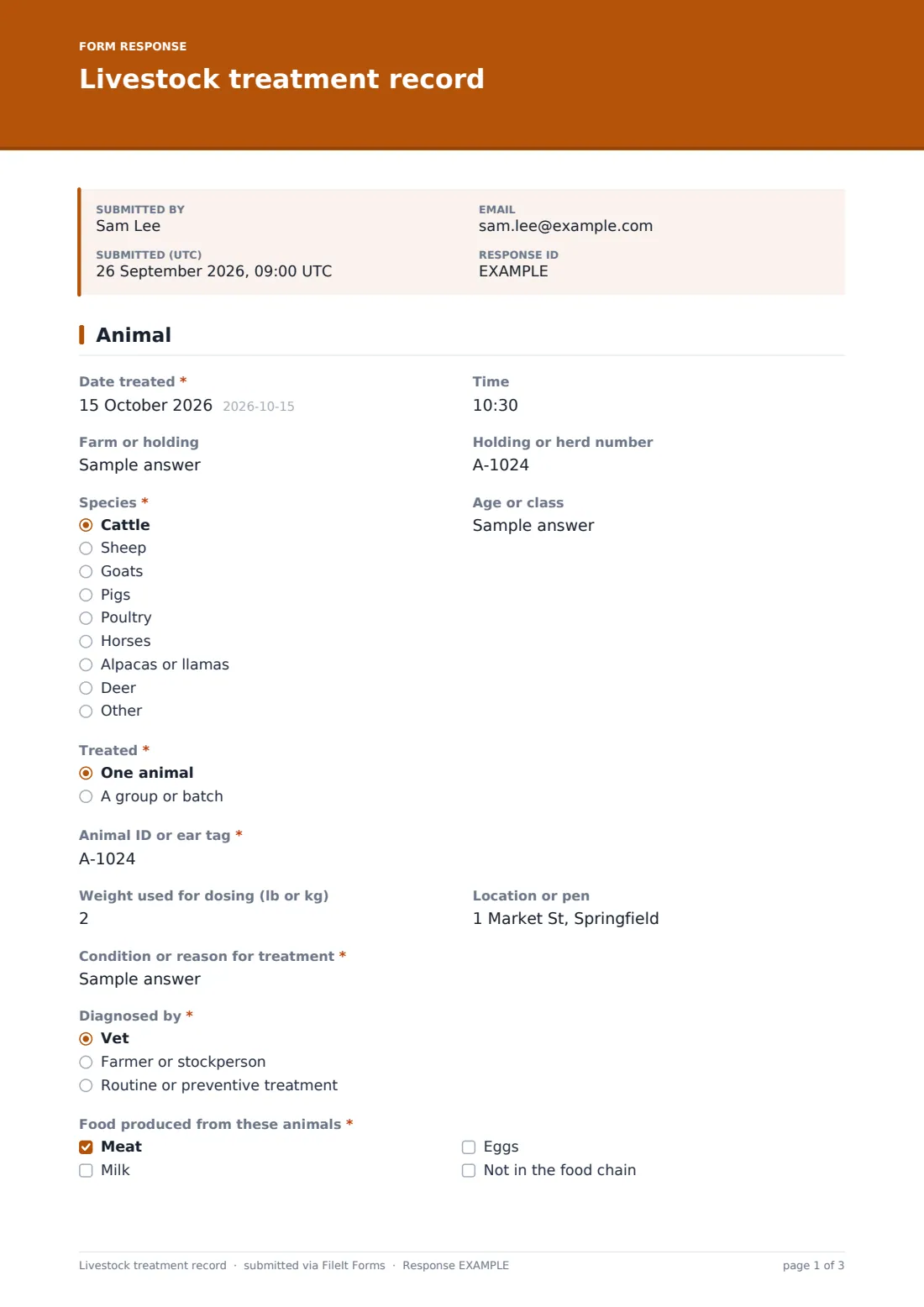
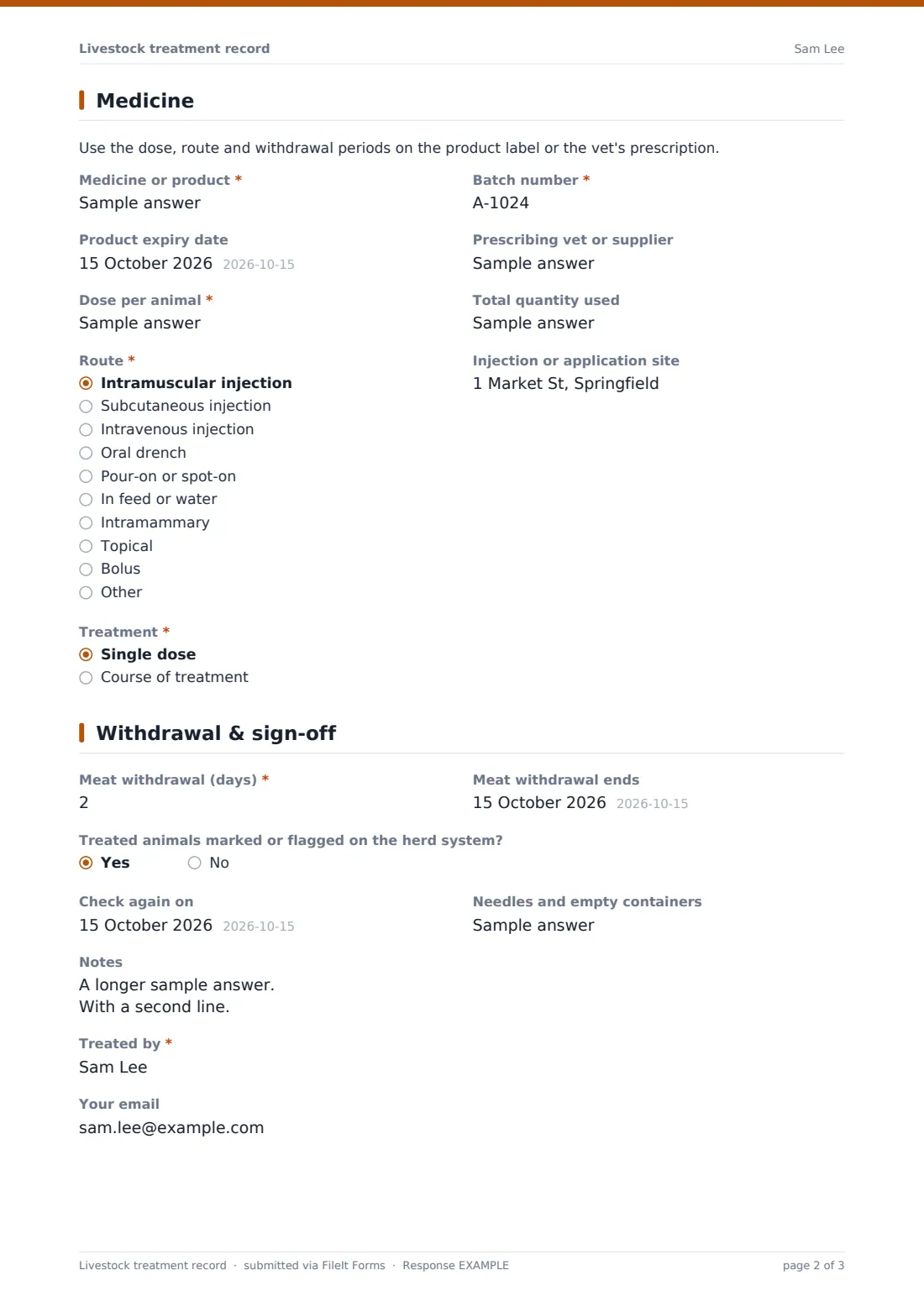
This livestock treatment record gives each treatment its own entry. The first page identifies the animal or group — species, age or class, ear tag or group ID, number treated, weight for dosing — and the condition, and who diagnosed it. The second page records the medicine, batch, expiry, prescribing vet or supplier, dose, total used, route, site and whether it's a single dose or a course.
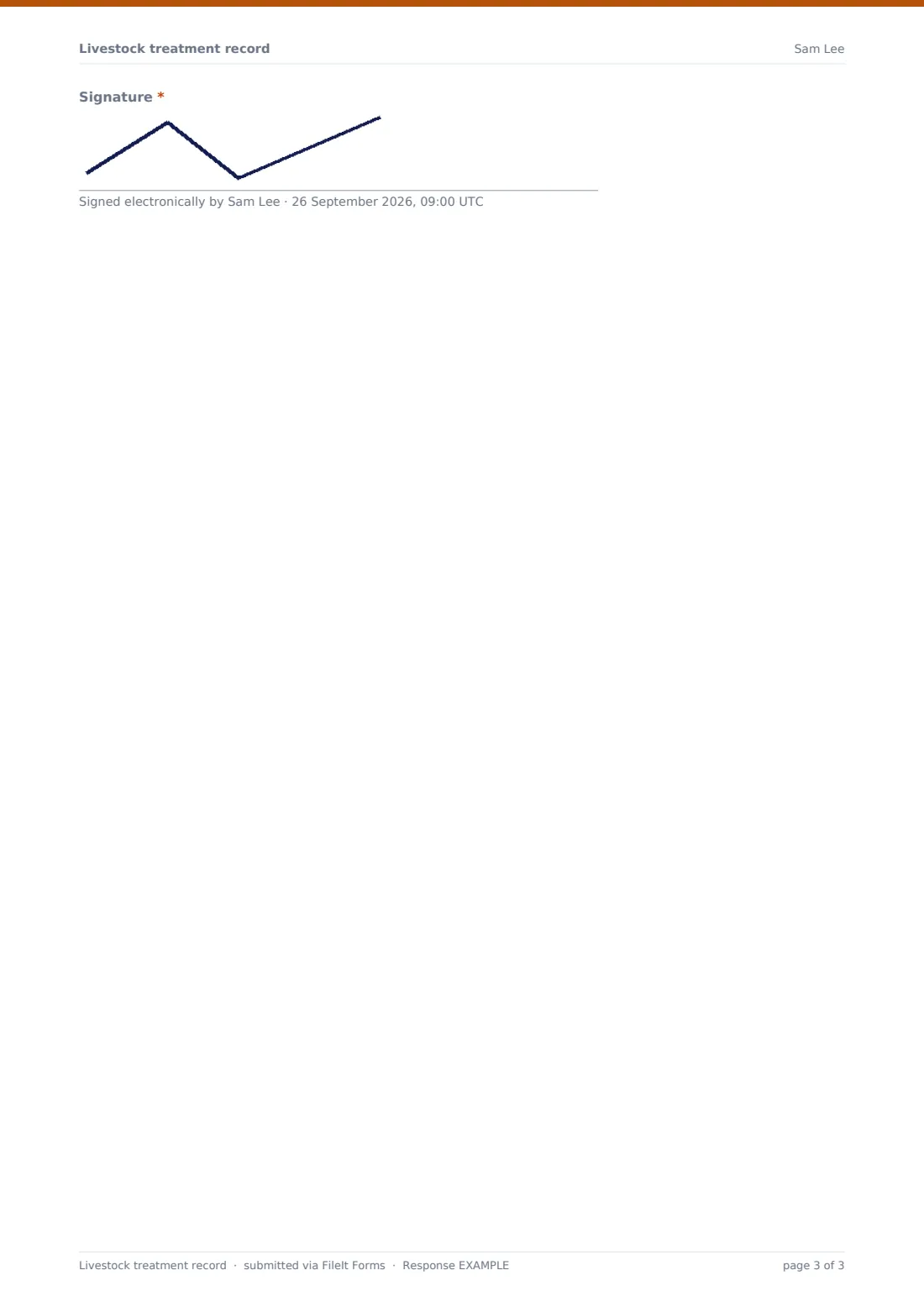
The last page records the meat, milk or egg withdrawal periods that apply with their end dates, whether treated animals were marked, a follow-up date, disposal of sharps and containers, and who treated, with a signature. Each entry is filed as a PDF in your FileIt vault.
- Best for
- Dairy, beef, sheep, pig, poultry and mixed farms, smallholders and equine yards
- Filled in by
- The farmer, stockperson or herd manager who gives the treatment
- Time to complete
- About 2–3 minutes per treatment
- Includes
- Individual or group treatments, batch and expiry, route, courses, meat, milk and egg withdrawal dates, signature
Who uses a livestock treatment record form?
- Recording an antibiotic course for a cow with mastitis
- Logging a worming drench for a group of lambs
- Vaccinating a batch of weaners and recording the batch number
- A smallholder keeping medicine records for a few goats and hens
- Checking which animals are still in withdrawal before sale
- Producing a year of medicine records for an assurance inspection
Questions on this livestock treatment record form
41 questions over 3 pages · includes signature, conditional questions, multiple pages.
1 Animal
- Date treated*
- Time
- Farm or holding
- Holding or herd number
- Species* Cattle · Sheep · Goats · Pigs · Poultry · Horses · Alpacas or llamas · Deer · Other
- Which species?* asked only when it applies
- Age or class
- Treated* One animal · A group or batch
- Animal ID or ear tag* asked only when it applies
- Group, pen or batch ID* asked only when it applies
- Number treated* asked only when it applies
- Individual IDs in the group asked only when it applies
- Weight used for dosing (lb or kg)
- Location or pen
- Condition or reason for treatment*
- Diagnosed by* Vet · Farmer or stockperson · Routine or preventive treatment
- Food produced from these animals* Meat · Milk · Eggs · Not in the food chain
2 Medicine
- Medicine or product*
- Batch number*
- Product expiry date
- Prescribing vet or supplier
- Dose per animal*
- Total quantity used
- Route* Intramuscular injection · Subcutaneous injection · Intravenous injection · Oral drench · Pour-on or spot-on · In feed or water · Intramammary · Topical · Bolus · Other
- Injection or application site
- Treatment* Single dose · Course of treatment
- Course length (days)* asked only when it applies
- Next dose due asked only when it applies
3 Withdrawal & sign-off
- Meat withdrawal (days)* asked only when it applies
- Meat withdrawal ends asked only when it applies
- Milk withdrawal (days)* asked only when it applies
- Milk withdrawal ends asked only when it applies
- Egg withdrawal (days)* asked only when it applies
- Egg withdrawal ends asked only when it applies
- Treated animals marked or flagged on the herd system?
- Check again on
- Needles and empty containers
- Notes
- Treated by*
- Your email
- Signature*
The livestock treatment record form, page by page
1 Animal
Date treated, Time, Farm or holding and Holding or herd number come first, then Species and Age or class. Treated chooses one animal — which asks for the Animal ID or ear tag — or a group, which asks for the group ID, Number treated and optional individual IDs. Weight used for dosing, Location or pen, Condition or reason for treatment and Diagnosed by follow, and Food produced from these animals — meat, milk, eggs or not in the food chain — decides which withdrawal periods are asked for later.
2 Medicine
A note reminds people to use the label or prescription. Medicine or product, Batch number, Product expiry date, Prescribing vet or supplier, Dose per animal and Total quantity used follow. Route lists injections, drenches, pour-ons, in-feed, intramammary, topical and bolus treatments, with an Injection or application site field. A course of treatment asks for its length and the next dose.
3 Withdrawal & sign-off
Meat, milk and egg withdrawal periods, each with the date it ends, appear for the food the animals produce; the number of days is required for each one shown. Treated animals marked or flagged?, Check again on, Needles and empty containers and Notes follow, then Treated by, an optional email for a copy, and a signature.
Make the template yours
- Remove species you don't keep from the dropdown
- Add a dropdown of the medicines in your farm's health plan
- Add a question for the prescription reference
- Add the herd manager to notification emails so every treatment reaches them
- File records into a vault folder per year to match your medicine book
- Add an animal photo upload for lameness or injury records
Tips for a better livestock treatment record form
- Work out withdrawal end dates on the day of the last dose, not the first
- Mark treated animals clearly, especially in the milking herd
- Copy the batch number from the bottle before you throw the box away
- Record group treatments with the IDs if you have them
- Export a year of records to CSV before your vet's annual review
Every response becomes a PDF in your vault
Each treatment is saved as a signed PDF in the vault folder you choose. You're notified straight away, and the person who treated can receive a copy.
The Responses table lets you search by animal ID, medicine or batch and export to CSV for your herd health plan, buyer or inspection.
- Start from this template. It opens in the FileIt Forms designer — change any question, add pages, set the rules for when questions appear.
- Share it. Turn on a public link, or send it to people by email, each with their own link. They don’t need a FileIt account.
- Get the answers as PDFs. Each response is saved as a PDF in the vault folder you choose, with uploaded files attached — and listed in a Responses table you can export to CSV.
Livestock treatment record form: frequently asked questions
Is this livestock treatment record free?
Yes. It's included in the FileIt Forms app on every account, including the free plan.
Does the form calculate withdrawal end dates?
No. Type the withdrawal period and the end date from the label or prescription. FileIt Forms has no date calculations.
Does this meet the medicine record rules where I farm?
FileIt doesn't give legal or veterinary advice. Record requirements vary by country and scheme, so check what yours ask for and add questions if needed.
Can I record a whole group at once?
Yes. Choose a group or batch, give its ID and the number treated, and list individual IDs if you have them.
Can I fill it in on a phone in the shed?
Yes. It works in any phone browser, with a finger-drawn signature.
Do farm staff need a FileIt account?
No. Anyone with the link can submit a record.